
Accelerated Depreciation: Methods, MACRS and Real Estate Examples
Oct 28, 2026

Written by
Alex Martinez, Founder & CEO, Real Estate Skills. Has wholesaled and flipped houses for over 14 years, been part of 1,000+ real estate transactions, and personally acquired 55+ residential investment properties. Has trained 6,000+ investors nationwide.
Reviewed by
Ryan Zomorodi, Co-Founder & COO, Real Estate Skills. Reviewed the depreciation rules, worked examples and IRS sources in this guide before publication.
Publication history: Originally published November 7, 2025. Updated October 2026 to explain the MACRS methods and conventions the IRS actually requires for real estate, correct how depreciation recapture is taxed and the name of the 2025 tax law, update Section 179 to 2026 limits, and add a five-year worked example comparing straight-line, cost segregation and bonus depreciation. Depreciation rules, examples and IRS sources reviewed by Ryan Zomorodi, Co-Founder & COO of Real Estate Skills.
Accelerated depreciation is any method that deducts more of an asset's cost in its early years and less later. For U.S. taxes that means MACRS, which uses 200% declining balance on 5- and 7-year property. Rental buildings can't be accelerated: they must use straight-line over 27.5 or 39 years.
If you looked up accelerated depreciation in an accounting textbook, you'd learn double-declining balance and sum-of-the-years' digits. Neither one goes on your rental's tax return. The IRS has its own system, and the rules for real estate are stricter than most investors expect.
Here's what actually happens on a rental. The building is locked into a slow, straight-line schedule no matter what. The speed comes from separating out everything inside and around the building that wears out faster, the carpet, the appliances, the parking lot, and depreciating those pieces on much shorter schedules. Done right, that can roughly double your deductions over the first five years. Done carelessly, it creates a tax bill at the sale that a lot of investors never saw coming.
This guide walks through the textbook methods, how MACRS really works, why your building gets 27.5 or 39 years, and a five-year example with real numbers. I explain every term the first time it shows up. Before any of the tax math, make sure the rental works on its own: download our free Rental Property Calculator and check the cash flow first.
Educational only, not tax advice. How your rental is classified and depreciated is a judgment call your CPA should make with you, not a template.
What Is Accelerated Depreciation?
Accelerated depreciation puts more of an asset's cost into the early years of its life and less into the later years. The total you deduct never changes. Only the timing does, which matters because a dollar of tax saved this year is worth more than one saved in year ten.
Depreciation itself is simple. When you buy something that wears out over time and use it to make money, like a rental, a roof or a refrigerator in a rental unit, the IRS won't let you write off the full price in the year of purchase. You recover it in slices over a set number of years.
The plain way to slice it is straight-line: the same amount every year. A $10,000 asset over 5 years is $2,000 a year. Accelerated methods tilt those slices toward the front, so year one might be $4,000 and year five might be $1,000. Same $10,000 in total, just sooner.
Why would anyone want that? Because deductions lower your taxable income, and lower taxes now mean more cash now. Cash you keep this year can go into repairs, reserves or your next down payment. The catch, which I'll come back to, is that the IRS eventually wants some of it back when you sell.
Accelerated vs. Straight-Line Depreciation
Straight-line depreciation deducts the same amount every year. Accelerated methods, like double-declining balance and sum-of-the-years' digits, deduct more up front. On a $10,000 asset with a 5-year life, straight-line gives you $2,000 in year one; double-declining balance gives you $4,000.
There are two separate worlds here, and mixing them up is the most common mistake on this topic.
Book depreciation is what a company uses on its financial statements. Accountants can choose straight-line, double-declining balance or sum-of-the-years' digits depending on how the asset actually loses value.
Double-Declining Balance Method
Double-declining balance takes twice the straight-line rate against whatever value is left each year. For a 5-year asset that's 40% of the remaining balance, switching to straight-line once that gives a bigger number. It's a book method; your rental's tax return doesn't use it as-is.
The formula: annual depreciation = 2 × (1 ÷ useful life) × book value at the start of the year.
Sum-Of-The-Years' Digits Method
Sum-of-the-years' digits adds up the years of the asset's life (1 + 2 + 3 + 4 + 5 = 15) and deducts 5/15 in year one, 4/15 in year two, and so on down. It's also a book method, and MACRS doesn't allow it.
The formula: annual depreciation = (years of life remaining ÷ sum of the years' digits) × depreciable cost.
Book Methods vs. MACRS: The Same Asset Four Ways
Tax depreciation is what goes on your return, and for property placed in service after 1986 the IRS requires its own system, the Modified Accelerated Cost Recovery System (MACRS). You don't get to pick sum-of-the-years' digits for your rental. Each class of property comes with its MACRS method already set. That split is also why a business can show one depreciation number on its financial statements and a different one on its tax return for the same asset.
| Year | Straight-line (books) | Double-declining (books) | Sum-of-the-years' digits (books) | MACRS 5-year (taxes) |
|---|---|---|---|---|
| Year 1 | $2,000 | $4,000 | $3,333 | $2,000 |
| Year 2 | $2,000 | $2,400 | $2,667 | $3,200 |
| Year 3 | $2,000 | $1,440 | $2,000 | $1,920 |
| Year 4 | $2,000 | $1,080 | $1,333 | $1,152 |
| Year 5 | $2,000 | $1,080 | $667 | $1,152 |
| Year 6 | $0 | $0 | $0 | $576 |
The same $10,000, 5-year asset under each method. Book columns ignore conventions and salvage value to keep the comparison clean. The MACRS column uses the IRS half-year convention, which is why it runs into a sixth year.
Notice the MACRS year one looks slow. That's the half-year convention: the IRS treats the asset as placed in service in the middle of the year, so you only get half a year's deduction up front. From year two on, it runs well ahead of straight-line.
How MACRS Works For Real Estate
MACRS assigns every type of property a recovery period, a method and a convention. For rental real estate, 5- and 7-year property uses 200% declining balance, 15-year land improvements use 150% declining balance, and the building uses straight-line over 27.5 years (residential) or 39 years (commercial).
Three settings decide every MACRS deduction: how long (the recovery period), how fast (the method), and when the clock starts in year one (the convention). The IRS sets all three in IRS Publication 946, and the Form 4562 instructions spell out which method goes with which class.
| What it is | Recovery period | Method | Convention |
|---|---|---|---|
| Appliances, carpet, furniture in a rental | 5 years | 200% declining balance | Half-year (or mid-quarter) |
| Office furniture and equipment for the business | 7 years | 200% declining balance | Half-year (or mid-quarter) |
| Driveways, fences, parking lots, landscaping | 15 years | 150% declining balance | Half-year (or mid-quarter) |
| Residential rental building and its structural parts | 27.5 years | Straight-line | Mid-month |
| Commercial building and its structural parts | 39 years | Straight-line | Mid-month |
| Land | Never depreciated | None | None |
MACRS settings for common rental property.
That table is the whole game. The only parts of a rental the IRS lets you accelerate are the shorter-lived pieces. The building, and everything the IRS treats as part of it, is straight-line no matter what. That's why investors who say they "accelerated depreciation on their building" really mean they pulled components out of the building and accelerated those.
The Three Conventions
A convention is the IRS's rule for how much of year one you get. Equipment and land improvements use the half-year convention, buildings use mid-month, and a mid-quarter convention kicks in if more than 40% of the year's equipment-type purchases land in the last three months.
- Half-year: the asset is treated as placed in service at the midpoint of the year, so year one gets half a year of depreciation regardless of the actual date.
- Mid-month: buildings are treated as placed in service in the middle of the month they're ready to rent. A rental that's ready in January gets 11.5 months of year-one depreciation (3.485% of the building's cost); one ready in July gets 5.5 months (1.667%).
- Mid-quarter: if more than 40% of the depreciable basis of the year's non-building property goes into service in October, November or December, every one of those assets for the year switches to a quarter-based convention. Investors who close and furnish rentals late in the year trip this without realizing it. Bonus depreciation sidesteps the issue for whatever it covers, but anything you depreciate the regular way gets hit.
Educational only, not tax advice. Recovery periods and methods depend on how the IRS classifies each asset, so confirm classifications with your CPA.
27.5 vs. 39 Years: Which Schedule Applies?
A building is residential rental property, depreciated over 27.5 years, when 80% or more of its rent comes from dwelling units. Everything else, including offices, retail and most short-term rentals, is nonresidential and depreciated over 39 years. Both use straight-line only.
The test is about where the rent comes from, not what the building looks like, and the IRS walks landlords through it in IRS Publication 527. A four-plex with all four units leased to tenants is 27.5-year property. A building with a ground-floor shop that brings in more than 20% of the total rent fails the 80% test and becomes 39-year property, even though most of it is apartments.
Short-term rentals are where investors get surprised. A property rented mostly to transient guests usually doesn't count as dwelling units for this test, so it's commonly depreciated over 39 years instead of 27.5. That's a smaller yearly deduction on the building, which makes the short-life components a cost segregation study pulls out even more important. Have your CPA confirm the classification before your first return on a short-term rental.
Improvements follow the building. Put a new roof, furnace or water heater into a residential rental, and it's depreciated over 27.5 years from the date it's placed in service, not over some shorter "roof life." Appliances and carpet are the exception, because the IRS treats them as separate 5-year property rather than part of the building.
How To Accelerate Depreciation On A Rental Property
Real estate investors accelerate depreciation three ways: a cost segregation study that moves building components onto 5-, 7- and 15-year schedules, bonus depreciation that deducts those components in full in year one, and, for commercial owners, Section 179 expensing on qualifying building improvements.
Cost Segregation
Cost segregation is the step that makes acceleration possible on a building. An engineering-based study separates the purchase price into land, building and shorter-life components, so the components can be depreciated on 5-, 7- and 15-year MACRS schedules instead of 27.5 or 39 years.
Without a study, the cabinets, flooring, site lighting and paving all sit inside the building's straight-line number. With one, they come out and get the faster methods in the MACRS table above. The study has a cost, and on small properties the fee can eat much of the benefit, so get a quote and run the numbers first. Before you hire anyone, read our full guide to the cost segregation study: the process, the fees and the property sizes where it tends to make sense. The IRS also publishes the principal elements of a quality cost segregation study, which is worth reading before you hire anyone.
Bonus Depreciation
Bonus depreciation skips the MACRS schedule entirely and deducts 100% of eligible short-life property, anything with a recovery period of 20 years or less, in year one. Under the One Big Beautiful Bill Act, the 100% rate is permanent for property acquired and placed in service after January 19, 2025.
Bonus depreciation is the most extreme form of acceleration: the whole schedule collapses into year one. It only applies to the short-life pieces, never the land or the building, and property acquired under a contract signed before January 20, 2025 is stuck on the old phase-down rates. The acquisition-date trap, what qualifies, and whether the loss can offset a W-2 paycheck all have their own answers, and I cover them in detail in our guide to bonus depreciation.
Section 179
Section 179 lets a business elect to expense qualifying property in year one, up to $2,560,000 for tax years beginning in 2026. For real estate it mainly helps commercial owners, because roofs, HVAC, fire protection and security systems qualify only on nonresidential buildings.
Section 179 has limits bonus depreciation doesn't. It requires an active trade or business, which many buy-and-hold landlords don't meet. It can't exceed your business taxable income. It phases out dollar-for-dollar once the year's qualifying purchases pass $4,090,000 (2026). And it excludes land improvements like paving and fencing. On a residential rental, it adds little that bonus depreciation doesn't already do.
Accelerated Depreciation Example: One Rental, Three Ways
On a $500,000 rental with a $400,000 building, straight-line alone gives about $72,000 of depreciation over five years. A cost segregation study using regular MACRS raises that to about $126,000. Adding 100% bonus depreciation pushes it to about $154,000, most of it in year one.
Here's one property, run three ways. These are hypothetical numbers built from the IRS MACRS percentages; your study and your CPA will produce the real ones.
The setup:
- You sign a contract on a $500,000 residential rental in 2026, close, and have it listed for rent in January 2026.
- $100,000 is land, which never depreciates, leaving a $400,000 building.
- A cost segregation study finds $60,000 of 5-year property (appliances, carpet, cabinetry) and $40,000 of 15-year land improvements (driveway, fencing, landscaping). That leaves $300,000 as the building.
| Year | A. Straight-line only | B. Cost segregation, regular MACRS | C. Cost segregation + 100% bonus |
|---|---|---|---|
| 2026 | $13,939 | $24,455 | $110,455 |
| 2027 | $14,545 | $33,909 | $10,909 |
| 2028 | $14,545 | $25,849 | $10,909 |
| 2029 | $14,545 | $20,899 | $10,909 |
| 2030 | $14,545 | $20,591 | $10,909 |
| Five-year total | $72,121 | $125,703 | $154,091 |
Depreciation by year (hypothetical numbers).
What the three columns show:
- Column A is the default. The full $400,000 building runs straight-line over 27.5 years: 3.485% in the January start year, then 3.636% a year after that.
- Column B is cost segregation without bonus depreciation. The $60,000 of 5-year property follows 20%, 32%, 19.2%, 11.52%, 11.52%. The $40,000 of 15-year property follows 5%, 9.5%, 8.55%, 7.7%, 6.93%. The remaining $300,000 building stays straight-line. Five-year deductions come out about 74% higher than column A.
- Column C takes the full $100,000 of components in 2026 and leaves only the building for later years. It wins on five-year total and wins big in year one, but it has the smallest deductions from 2027 on.
Column B is the one most guides skip, and it matters more than people think. It's roughly what you get if the property was under contract before January 20, 2025, when the bonus rate was 40% and falling. It's also close to what your state return looks like if your state doesn't follow federal bonus depreciation and makes you depreciate on the regular schedule. In other words, a cost segregation study can still pay off when bonus depreciation doesn't apply, because MACRS on its own is already accelerated.
You'll see rules of thumb online, like "expect 25% of the purchase price in year one." There isn't a reliable one. Column C's first year came to about 22% of the price, but that's driven entirely by how much of the building the study can reclassify, and that changes from property to property.
Results vary. The $100,000 of components here is an illustration; an older house with dated finishes might yield far less, and a newer one with lots of site work far more. Plan around an actual study quote, not this example.
And none of this saves money unless you can use the deduction. If you hold a day job and your rentals are an investment on the side, those losses are usually passive: they offset rental profit and passive income, and whatever's left waits for future years. I tell students the same thing every time: if a rental only makes sense because of the depreciation, it doesn't make sense.
Check The Deal Before You Chase The Deductions
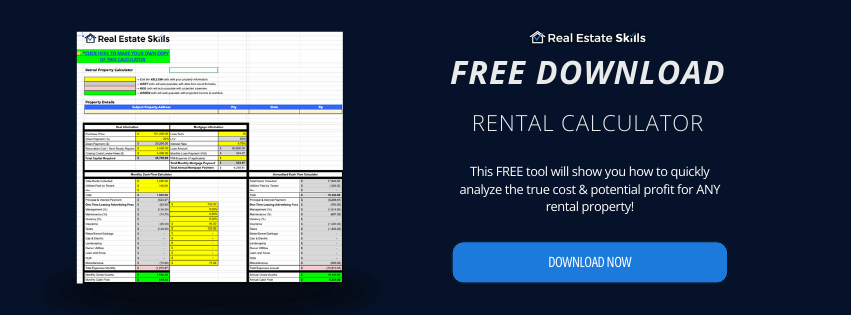
The three columns above only matter if the rental pays its own bills. Plug your rent, vacancy, taxes, insurance and repairs into our free Rental Property Calculator, a spreadsheet that shows the property's cash flow, cap rate and return on investment. If those numbers hold up, then talk to your CPA about accelerating depreciation.
Educational only, not tax advice. Get the land value, component split and rent-ready date from your CPA and a cost segregation professional before relying on any of these numbers.
Depreciation Starts With Owning The Right Property. Learn To Find It.
No depreciation method fixes a rental you overpaid for. The deals that hold up start with a discount at purchase. Our FREE Training shows how our students find below-market properties and decide whether to wholesale, flip or keep them as rentals. Watch it today, then start looking for the property worth depreciating.
Watch The FREE Training →How To Catch Up Missed Depreciation
If you've owned a rental for years without depreciating it, or without separating out its components, you can usually catch up in the current year by filing Form 3115 for an automatic accounting-method change. The missed depreciation comes back as a single deduction instead of amended returns.
Two rules make this worth knowing.
First, skipping depreciation doesn't protect you from it. The IRS reduces your basis by the depreciation you were allowed to take, whether you took it or not. So an owner who never claimed depreciation still gets taxed on it when they sell, without ever having gotten the deduction. If that's you, the catch-up is how you claim what you've already effectively paid for.
Second, the catch-up comes back in one year. When you switch from an incorrect depreciation method to a correct one, the difference is a "section 481(a) adjustment," and a negative adjustment (missed deductions) is taken in full in the year of the change. That's how a "look-back" cost segregation study works on a rental you bought years ago: the components get reclassified, and all the extra depreciation you would have taken lands on this year's return.
The form is IRS Form 3115, the Application for Change in Accounting Method.
Two cautions. The bonus rate follows the year the property was originally placed in service, not the year you file, so a look-back study on a rental placed in service in 2023 uses that year's 80% bonus rate, even if you file the catch-up in 2026. And Form 3115 is technical. This is a job for a CPA who has filed them before, not a weekend project.
Educational only, not tax advice. Whether you qualify for an automatic change and how the adjustment is calculated depend on your filing history, so have a CPA prepare Form 3115.
What Happens When You Sell: Depreciation Recapture
When you sell, depreciation you took on 5- and 7-year components is taxed as ordinary income, up to 37%. Straight-line depreciation on the building is taxed at no more than 25%. The faster you depreciate, the more of your gain lands in the higher ordinary-income bucket.
Every depreciation deduction shrinks your basis, which is what the IRS considers you paid for the property. Shrink the basis and the gain on paper grows when you sell, and the IRS taxes the depreciation part of that gain at special rates. This is called depreciation recapture, and it's the price of accelerating. The IRS covers the rules in IRS Publication 544.
The common shortcut, "recapture is taxed at 25%," is only true for the building's straight-line depreciation. The breakdown:
- 5- and 7-year components (appliances, carpet, cabinetry): every dollar is taxed back as ordinary income, as high as 37%, and it makes no difference whether it came from MACRS or bonus depreciation.
- 15-year land improvements (paving, fencing, landscaping): the part you took above plain straight-line is taxed at ordinary rates; the straight-line part is taxed at up to 25%.
- The building: straight-line depreciation is taxed at up to 25%.
- Real appreciation above your original cost: the regular long-term capital gains rates (0%, 15% or 20%).
The 3.8% net investment income tax can apply on top if your income is high enough.
Back to the example. In column A, all of the depreciation sits in the building, so it's all in the 25%-maximum bucket at sale. In columns B and C, the component depreciation moves into the ordinary-income bucket instead. That's the real trade: bigger deductions now, at whatever your tax rate is today, in exchange for some of the gain being taxed at your ordinary rate later. Deduct at 35% and repay at 35%, and you've had free use of the money for years. Deduct at 22% and repay at 35%, and acceleration cost you.
You can defer recapture with a 1031 exchange into another investment property, and under current law heirs who inherit the property get a stepped-up basis that wipes it out. Recapture can't exceed the gain on each component, so worn-out carpet and appliances worth little at sale often produce less recapture than the worst case. Plan the sale with your CPA before you list.
Educational only, not tax advice. Your actual recapture turns on the purchase and sale price allocations and your tax brackets in the deduction and sale years. Run the sale through your CPA's model before you list.
When Accelerated Depreciation Doesn't Make Sense
Accelerated depreciation backfires when you'll sell soon, when this year's tax rate is low and future rates will be higher, when the losses can't be used for years, or when a cost segregation study costs more than the timing benefit is worth on a small property.
Accelerating is a timing bet, and timing bets can lose. I'd slow down, or stick with straight-line, in these situations:
- You'll likely sell in two or three years. The extra deductions barely get a chance to help before the sale turns much of them into ordinary income.
- Your income is unusually low this year and you expect higher brackets later. A deduction is worth the most in your highest-bracket years.
- The losses would only carry forward. If you're a passive investor with little other passive income, accelerated deductions can sit unused for years.
- The property is small. A study that costs a meaningful slice of the extra deductions it finds can leave you roughly where you started.
- You're flipping it. A house bought to resell is inventory, which isn't depreciable, so there's nothing to accelerate. Flippers should read our guide to taxes on flipping houses instead.
You also have more control than most investors realize. You can elect out of bonus depreciation by class of property, and for 3-, 5-, 7- and 10-year property you can elect the slower 150% declining balance method or straight-line instead of 200% declining balance. Each election covers all property in that class placed in service that year, and it's irrevocable, so decide with your CPA before you file.
Accelerated Depreciation FAQs
Final Thoughts On Accelerated Depreciation
Accelerated depreciation isn't a loophole. It's built into MACRS, and real estate investors get at it by separating a building's short-life parts from the structure. Used on the right property and the right hold period, it's one of the most valuable tax benefits of real estate investing.
The investors who do best with it understand that it changes when they pay tax, not whether they pay it. They know their bracket today, roughly how long they'll hold, and whether they can actually use the losses before they order a study.
Your next step: pull the closing statement on your current rental or the one you're about to buy, and write down the purchase price, the land value, the date it was ready to rent, and whether it's residential or commercial. Take those four numbers to your CPA with a cost segregation quote and ask them to model the next five years with and without the study. If the numbers work, accelerate. If they don't, straight-line is a perfectly good answer.
Educational only, not tax advice.
Deductions Reward Owners. Start With Your First Deal.
You can't depreciate a property you don't own yet. Our FREE Training walks through how our students find discounted deals and turn them into wholesale fees, flips or long-term rentals. Watch it today, and the next rental you buy could be the one you run these numbers on.
Watch The FREE Training →
About The Author
Founder & CEO, Real Estate Skills
Alex Martinez is the Founder and CEO of Real Estate Skills. He has wholesaled and flipped houses for over 14 years, been part of 1,000+ real estate transactions, and personally acquired 55+ residential investment properties. He has trained 6,000+ investors nationwide.
Real Estate Skills is not a law firm or a tax advisory firm, and the information in this article is provided for educational purposes only. It does not constitute legal, tax, or financial advice. Depreciation, passive loss and recapture rules change over time and depend on your income, entity and state. Real estate investing carries risk, and past results do not guarantee future outcomes. Always consult a licensed CPA or tax attorney before changing depreciation methods, ordering a cost segregation study, or making any investment decision.

👉FREE Training
How To Consistently Wholesale, Flip Houses, & Invest In Rental Properties From The MLS
(Without Spending $1 On Marketing)

Alex Martinez, the founder of Real Estate Skills, is known for his strong, practical expertise in real estate, starting from a beginner with no family connections in the industry to acquiring over 55 real estate deals, including wholesale and flips, within his first year.
He has dedicated his career to providing cutting-edge education and resources for real estate professionals. He emphasizes the importance of self-taught knowledge through mentors, books, and hands-on experience.
His journey from earning a modest income to becoming a successful real estate entrepreneur and educator showcases his expertise and dedication to the field.

Ryan Zomorodi, co-founder and COO of Real Estate Skills, leverages his experience from a diverse background in real estate investment, construction management, and entrepreneurship to provide comprehensive education in the real estate sector.
His expertise is rooted in hands-on experience, extensive industry knowledge, and a commitment to empowering others through education.
Ryan's journey reflects a blend of practical experience and entrepreneurial success, contributing to his role in developing a platform that educates and supports aspiring real estate professionals.
Read Ryan's Full Bio >>
