
Real Estate Assignment Contract: The 2026 Investor’s Guide
Mar 19, 2026
Key Takeaways: Real Estate Assignment Contract
The Short Answer: A real estate assignment contract is a legal agreement that transfers your right to purchase a property (known as an equitable interest) to a cash buyer investor for a fee. You never take title to the property, never need a mortgage, and never manage a renovation. You negotiate a deal with a motivated seller, lock it up under contract, and sell that contract to an end buyer for an assignment fee typically ranging from $5,000 to $20,000+, collected directly at the closing table via wire transfer.
- The Opportunity: You can pull a profit from a property without ever actually owning the dirt. This lets you flip deals fast since you aren't stuck waiting on bank approvals or tying up your own cash to take title.
- The "Trap": Slapping "and/or assigns" next to your name doesn't cut it anymore. In today's market, builders and bank-owned REO sellers use ironclad language that blocks assignments unless you use a specific, formal addendum they’ve already vetted.
- The Strategy: Secure a non-refundable earnest money deposit from your end buyer to "lock in" your profit before the deal ever reaches the closing table.
What You’ll Learn: How to master the legal and technical workflow of assigning contracts to scale your wholesaling business with zero-risk exposure.
Think of a real estate assignment contract as your legal shortcut to making money in real estate without having to actually buy a house yourself. You aren't dealing with the stress of getting a mortgage or the nightmare of managing tenants. Instead, you're acting like a professional middleman. You find a great deal, lock it up with a contract, and then sell that contract to an investor who has the cash to finish the job. You aren't selling the physical building; you're selling the "right to buy" it. For anyone starting out in wholesaling, this one piece of paper is the difference between a messy, failed deal and a clean wire transfer hitting your bank account on closing day.
What Is A Real Estate Assignment Contract?
A real estate assignment contract is a legal agreement that transfers a buyer's contractual right to purchase a property — known as equitable interest — to a third-party investor for a fee, allowing the original buyer to profit from a deal without ever taking title to or owning the property. In plain English, a real estate assignment contract is just a legal bridge that lets you hand over your spot in a deal to someone else. You’re the "assignor" (the person giving the deal away), and the person taking it over is the "assignee."
The most important thing to grasp here is that you aren't selling a house, a yard, or a roof. You’re selling a piece of paper—specifically, your "right to buy" that property. In the legal world, we call this "equitable interest." It means that even though you don't own the deed yet, you own the exclusive right to purchase it at the price you negotiated. You’re essentially selling your seat at the closing table to a cash buyer for a fee.
Related Reading: Wholesale Real Estate Contract: Template & FREE PDF Download
Assignment Contract vs. Purchase Agreement: What's the Difference?
A purchase agreement is a binding contract between a seller and a buyer that establishes the terms of a property sale — price, contingencies, and closing date. A real estate assignment contract is a separate, subsequent document that transfers the original buyer's position in that purchase agreement to a third-party investor for a fee. The two documents are not interchangeable. You cannot have an assignment contract without a fully executed purchase agreement already in place — the purchase agreement is the asset being assigned. Without the seller's signature on the original contract, there is no equitable interest to sell.
What is an Assignment Contract & How Does it Work?
Watch as we break down the mechanics of the assignment agreement and how it serves as the foundational document for modern wholesaling.
In this video, we explain why the assignment method is the lowest-cost and fastest way to monetize a real estate deal.
The process begins with a standard purchase and sale agreement between you and the seller. Once that contract is fully executed, you hold equitable title, which gives you the power to assign the deal to a cash buyer for a premium—your assignment fee. This allows you to exit the deal before the official closing date without ever needing to secure a mortgage or provide the full purchase price.
How The Assignment Process Works (Step-by-Step)
The real estate assignment contract process follows four sequential phases: the assignor secures a signed purchase agreement with the seller, markets the equitable interest to cash buyers, executes a formal assignment addendum with a non-refundable deposit, and collects their fee directly from the title company at closing.
The real estate assignment contract workflow is a linear progression that begins with finding a motivated seller and ends with a wire transfer at the title company. The hardest part for most beginners is the transition between the purchase agreement and the assignment addendum; you must ensure the original contract is fully executed with all signatures before you have a legal asset to monetize.
| Phase | Action Step | Technical Requirement |
|---|---|---|
| 1. Acquisition | Sign Purchase Agreement | Ensure contract is "assignable" by default or strike non-assignment clauses. |
| 2. Disposition | Market to Cash Buyers | Share the property details and the "right to buy" price. |
| 3. Execution | Sign Assignment Addendum | Collect a non-refundable deposit from the assignee immediately. |
| 4. Closing | Escrow & Settlement | Title company pays your fee directly from the buyer's funds. |
A lot of beginners trip up right here because they get ahead of themselves and start trying to sell a house before they even have a signed contract with the homeowner. This is a huge mistake. Without a signed purchase agreement in your hands, you don’t actually have any legal "skin in the game" to sell.
If you try to market a deal you don't officially control, you’re basically "daisy-chaining," which is a quick way to get yourself in a mess with both the seller and the buyer. It kills your reputation before you even get started. The right way to do it is simple: get your contract signed first, find your cash buyer, and then use the assignment addendum to put their commitment in writing and lock in your original terms.
How To Calculate Your Assignment Fee (The ARV Formula)
The assignment fee in a real estate wholesale contract is calculated by subtracting your contracted purchase price from your end buyer's price, but the correct method works backward from the ARV: Maximum Allowable Offer = (ARV × 70%) minus estimated repairs, ensuring your buyer's profit margin is intact before you set any fee.
The assignment fee is calculated by subtracting your contracted purchase price from the price your end buyer agrees to pay — but the real skill is working backward from the ARV using the 70% rule to ensure the buyer's profit margin is intact before you set your fee. Get this math wrong, and you won't just lose one deal. You'll lose the buyer permanently.
The Two Formulas Every Wholesaler Must Know
There are two distinct calculations at play in every assignment deal. Most beginners only learn the first one. The second one is where the money actually gets protected.
The surface-level formula is straightforward:
Formula 1 — The Fee Formula: Assignment Fee = End Buyer Price − Your Contract Price
Simple enough. But this formula tells you what your fee is, not what it should be. Pricing your fee in isolation, without first verifying that your end buyer can still make money after paying it, is the fastest way to build a reputation as a wholesaler nobody wants to work with. Which brings us to the formula that actually runs the business.
Formula 2 — The MAO Formula: Maximum Allowable Offer (MAO) = (ARV × 70%) − Estimated Repair Costs
The MAO is the ceiling. It's the most a cash buyer should rationally pay for a property after your fee is baked in. The 70% rule is an industry standard because it leaves room for the buyer's renovation costs, holding costs, and closing costs, and still delivers a workable profit on the back end. Your job as the wholesaler is to lock up the property below MAO, and then price your fee inside the gap between your contract price and that ceiling.
Expert Note: The "Greedy Fee" Trap
The Messy Reality: The wholesalers who come to me asking why their cash buyers won't return their calls are almost always the same ones inflating their ARV and deflating their repair estimates to manufacture a spread that isn't there. Cash buyers see through it immediately — and they don't forget. A $5,000 fee on an honestly underwritten deal that closes in ten days is worth more than a $20,000 fee built on fudged numbers that dies on your desk. Send accurate numbers every time. That's what gets buyers calling you, asking when the next deal is coming.
A Real Worked Example: Sabbir's Fort Worth Deal
Abstract formulas are easy to forget. Numbers you can trace from a real closing table are not. This is how the MAO calculation played out on an actual deal closed by Sabbir, one of our students, in the competitive Dallas-Fort Worth market — his second wholesale deal.
Sabbir identified a distressed single-family home in Fort Worth, Texas. After pulling comps, the after-repair value came in at $260,000. The initial repair estimate was $30,000 to bring the property to retail condition.
Step one: calculate the MAO.
MAO = ($260,000 × 70%) − $30,000
MAO = $182,000 − $30,000
MAO = $152,000
That $152,000 is the ceiling — the most a cash buyer can rationally pay and still have a workable fix-and-flip deal. Sabbir negotiated with the seller and locked the property up at $175,000. He had a contract. He had a deal on paper. Then the physical inspection happened.
His cash buyer walked the property and found severe odors and deferred maintenance that the MLS photos hadn't shown. The repair estimate climbed. The buyer's margin disappeared. The deal was dead at $175,000.
Here is where most beginners panic and walk away. Sabbir went back to the seller instead. Armed with the inspection findings — objective, documented, physical evidence — he renegotiated the purchase price down to $160,000. The seller, facing the prospect of restarting the entire marketing process, agreed.
Step two: price the fee inside the new gap.
Assignment Fee = $170,000 (end buyer price) − $160,000 (contract price) = $10,000
| Metric | Value |
|---|---|
| After-Repair Value (ARV) | $260,000 |
| Repair Estimate | $30,000 |
| Initial Contract Price | $175,000 |
| Renegotiated Purchase Price | $160,000 |
| Assignment Fee | $10,000 |
The seller got a closed deal without going back to market. The buyer got a property priced inside their renovation model. Sabbir collected a $10,000 wire transfer — on his second deal — without ever owning the property, taking out a loan, or picking up a hammer. That is how this strategy works when the math drives every decision from the first offer to the final renegotiation.
How Sabbir Made $22,000 Wholesaling In Texas!
Watch Sabbir break down his Fort Worth deal in his own words — including how he used the inspection findings to renegotiate a $15,000 price reduction and save the assignment from dying at the table.
Sabbir walks through the technical breakdown of his Fort Worth deal and the renegotiation that turned a dead contract into a $10,000 assignment fee.
Expert Note: The Inspection Is Not Just Due Diligence — It's Leverage
The Messy Reality: Sabbir's deal looked dead after the physical inspection revealed severe odors and deferred maintenance that the MLS photos never showed. Most beginners would have either eaten the loss or walked away. Sabbir used the inspection report as documented, objective grounds to renegotiate, and the seller accepted a $15,000 price reduction rather than restart the process from scratch. Physical evidence of condition problems is one of the few legitimate levers you have to renegotiate after a contract is signed. Learn to use it.
What Is A Realistic Assignment Fee In Today's Market?
The hardest part for most beginners is knowing whether the fee they've priced is competitive or if they're leaving money on the table. The answer depends heavily on geography. According to a survey of over 1,000 professional wholesalers conducted by Real Estate Bees, the national average assignment fee sits at $13,000 per deal. Experienced wholesalers typically earn between $15,000 and $20,000. But the regional spread is dramatic. North Carolina and Georgia regularly see average fees around $22,000 per deal, while Arizona — a highly competitive, cash-buyer-saturated market — averages closer to $5,000.
The takeaway is not to anchor on a number. It's to anchor on the math. A market with lower ARVs produces lower absolute fees, but the percentage-based calculation still works. The 70% rule scales with the price point of the market you're working in.
The 3-Scenario Assignment Fee Decision Matrix
Not every deal is built the same. The spread between your contract price and the MAO will vary deal to deal, and your strategy should shift with it. The matrix below maps three common spread scenarios to the right exit strategy and gives you a quick read on when to assign, when to consider a double close, and when to renegotiate with the seller before you go anywhere near a buyer.
| Scenario | Deal Example | Spread / Fee | Recommended Strategy | Why |
|---|---|---|---|---|
| Low Spread | ARV $150k, Repairs $25k, MAO $80k, Contract $73k | $7,000 | Standard Assignment | Fee is modest — full transparency on the HUD won't cause friction. Double close costs would eat too much of your profit. |
| Mid Spread | ARV $250k, Repairs $30k, MAO $145k, Contract $130k | $15,000 | Assignment with Disclosure Management | Fee is visible on the HUD but defensible. Have your disclosure and your deal rationale ready if the seller asks questions at the table. |
| High Spread | ARV $400k, Repairs $40k, MAO $240k, Contract $205k | $35,000+ | Double Close | A $35k fee on the HUD creates seller resentment and buyer pressure. The double close cost ($3k–$5k) is a small price to protect the spread and the relationship. |
Expert Note: Why Your ARV Estimate Is Your Most Expensive Number
The Messy Reality: I'm telling you this from experience — speculation is how you get hurt. When wholesalers base their ARV on where they think the market is going rather than past historical sales, they're building a deal on a foundation that doesn't exist. The most sophisticated cash buyers don't operate on speculation, and neither should you. If the Fed raises rates and prices level off or drop, a speculative ARV doesn't just kill one deal — it can make you lose your shirt. Base every number on the most recent closed comparables, same bed and bath count, same condition, within a half-mile. Reality, not optimism, is what makes you the most trusted wholesaler in your market.
Pros and Cons of Contract Assignments
A real estate assignment contract lets investors generate income with zero capital at risk and no mortgage required, but carries two unavoidable trade-offs: complete profit transparency on the settlement statement and ordinary income tax treatment on fees rather than the more favorable long-term capital gains rate.
Every investment strategy has a risk-to-reward ratio. For the real estate assignment contract, the primary appeal is the ability to generate a payday with zero capital risk, but this comes at the cost of total transparency. The hardest part for most wholesalers is deciding when a deal's profit margin is high enough to justify the work, versus when the potential "con" of tax exposure makes it less attractive.
Related Reading: Wholesaling Houses: The Ultimate Guide For Beginners
The Pros & Cons of Assigning Real Estate Contracts
Before you dive into your first deal, understand the strategic advantages and potential pitfalls of the assignment method compared to traditional flipping.
Watch to learn why "no money, no problem" is a reality for wholesalers and how to protect your deals from being bypassed by agents.
| The Pros (The Payoff) | The Cons (The Friction) |
|---|---|
| Zero Capital Needed: Use equitable interest to flip property without ever needing a mortgage or private money. | Ordinary Income Tax: Assignment fees are typically taxed at your standard income rate, not capital gains. |
| Speed of Execution: Get paid as soon as the title company closes, often in as little as 7–14 days. | Profit Transparency: Both the seller and buyer see exactly how much you are making on the HUD-1. |
| Minimal Management: No need to manage contractors, permits, or renovation budgets. | Agent Circumvention: If not protected by a contract, agents may try to bypass you and go straight to your buyer. |
Expert Note: The "Blackout" Protocol
A lot of wholesalers make the rookie move of handing over their full purchase agreement to a buyer without any protection. Yes, a buyer will eventually need to see that contract for due diligence, but you shouldn't show your hand until you have a signed assignment agreement and a cleared deposit sitting in escrow.
The Tax Reality of Assignment Fees: What Hits Your Check Before You Cash It
Assignment fees from wholesaling real estate contracts are taxed as ordinary income — not capital gains — and self-employed wholesalers owe an additional 15.3% self-employment tax on top of their federal income bracket, meaning a $15,000 fee can carry a combined federal tax obligation exceeding $5,000.
Assignment fees are taxed as ordinary income — not capital gains — and because most wholesalers operate as sole proprietors or single-member LLCs, the IRS also treats this income as self-employment income subject to the full 15.3% self-employment tax on top of your regular income tax bracket. This is the number most beginners never see coming. They close their first deal, collect a $15,000 wire, and spend it. Then April arrives and they're staring at a tax bill they never planned for. Understanding your tax exposure before your first closing is not optional — it's the difference between a profitable wholesaling business and one that slowly bleeds you dry.
Related Reading: What Is An Assignment Fee? The Ultimate Wholesaler's Guide
Why "Ordinary Income" Changes Everything
The single most expensive misconception in wholesaling is that assignment fees are taxed like investment profits. They are not. When you sell a stock you've held for over a year, you pay long-term capital gains rates — currently 0%, 15%, or 20% depending on your bracket. When you collect an assignment fee, the IRS treats that money as ordinary business income, the same category as a W-2 paycheck. Depending on your total income for the year, that means your effective federal rate on a $15,000 fee could be anywhere from 22% to 37% — before state taxes, and before the self-employment tax layer gets added on top.
The practical difference is significant. On a $15,000 assignment fee, a wholesaler in the 24% federal bracket paying full self-employment tax could owe roughly $5,900 in combined federal obligations alone. That's nearly 40 cents of every dollar gone before your state takes its share. Running deals without accounting for this is not a tax strategy. It's a cash flow catastrophe waiting to happen.
The 15.3% Nobody Warns You About
When you work a traditional job, your employer covers half of your Social Security and Medicare contributions. As a self-employed wholesaler, there is no employer. You cover both halves. The full self-employment tax rate is 15.3% — broken down as 12.4% for Social Security and 2.9% for Medicare — applied to your net self-employment earnings. This is calculated and reported on Schedule SE of Form 1040.
The one partial offset the IRS does provide: you can deduct half of your self-employment tax when calculating your adjusted gross income on Form 1040. It doesn't eliminate the bill, but it reduces the income on which your regular income tax is calculated. Every wholesaler operating as a sole proprietor or single-member LLC needs to know this number exists and plan around it from deal one.
Expert Note: The Tax Reality — What Hits Your Check Before You Cash It
Here is the math on a single $15,000 assignment fee for a wholesaler filing as a sole proprietor in the 22% federal bracket. Self-employment tax: $15,000 × 15.3% = $2,295. Federal income tax at 22%: approximately $2,805 (after the SE deduction offset). Combined federal hit: roughly $5,100 — or about 34% of the gross fee. Add your state income tax rate on top of that, and a $15,000 fee can net you closer to $8,500 to $9,500 in take-home cash, depending on where you live. This is not a reason to avoid wholesaling. It is a reason to set aside 35–40% of every assignment fee in a separate account the moment it hits your bank, before you spend a dollar of it.
Quarterly Estimated Taxes: The Obligation Most Beginners Miss
Because no employer is withholding taxes from your assignment fees, the IRS requires self-employed individuals to pay taxes as they earn, not just at year-end. This is done through quarterly estimated tax payments using Form 1040-ES. The four payment deadlines for a typical tax year fall in mid-April, mid-June, mid-September, and mid-January of the following year.
Miss these payments, and the IRS charges an underpayment penalty on top of whatever you owe at filing. The hardest part for newer wholesalers is that the payment cadence doesn't always align with deal flow — you might close two deals in Q1 and nothing in Q2, which makes the June payment feel like a punch in the gut when your pipeline is dry. The fix is simple but requires discipline: treat 35–40% of every assignment fee as a tax reserve the moment it clears, regardless of when your next quarterly payment is due.
The S-Corp Strategy: How Experienced Wholesalers Reduce SE Tax Exposure
Once a wholesaling operation reaches a consistent volume — generally four or more deals per year — the self-employment tax burden becomes significant enough to justify a structural fix. The most widely used strategy is electing S-Corporation tax treatment, either by forming a dedicated S-Corp or by having an existing LLC taxed as an S-Corp via IRS Form 2553.
The mechanism works like this: instead of all your net income flowing through as self-employment earnings, you split your income into two buckets. You pay yourself a "reasonable salary" as a W-2 employee of your own S-Corp — only that salary is subject to the 15.3% self-employment tax. The remaining profit is taken as a distribution, which passes through to your personal return as ordinary income but avoids the SE tax entirely. On $80,000 of annual assignment fee income, this structure can save a wholesaler $5,000 to $10,000 per year, depending on how the salary-to-distribution ratio is structured.
The steel man against this strategy is real, though. S-Corp formation costs range from $500 to $2,000, depending on your state. You'll need a payroll system, a separate business bank account, and a CPA who understands pass-through entity taxation. For investors doing fewer than three to four deals per year, the administrative overhead and ongoing compliance costs may eat the tax savings before you see them. Run the numbers with a CPA before committing to the structure.
The Section 199A QBI Deduction: A Wholesaler's Often-Missed Tax Break
One of the most underutilized tax provisions for active wholesalers is the Section 199A Qualified Business Income (QBI) deduction, made permanent by the 2025 Tax Reform Act. Eligible pass-through businesses — sole proprietorships, partnerships, LLCs, and S-Corps — can deduct up to 20% of their qualified business income from federal taxable income. For a wholesaler generating $60,000 in net assignment fee income, this deduction could reduce the taxable base by $12,000 before any other deductions are applied.
Eligibility has income thresholds and phase-outs, and the rules around whether wholesaling qualifies as a Specified Service Trade or Business (SSTB) require clarification from a tax professional familiar with real estate investor tax law. But for the majority of wholesalers operating below the income threshold, this deduction is on the table and worth pursuing.
| Tax Obligation | Rate / Rule | IRS Form | Veteran Move |
|---|---|---|---|
| Ordinary Income Tax | 10%–37% depending on bracket | Schedule C (Form 1040) | Deduct all legitimate business expenses (marketing, legal, mileage, software) to reduce net income before tax is applied. |
| Self-Employment Tax | 15.3% (12.4% SS + 2.9% Medicare) | Schedule SE (Form 1040) | Deduct half of SE tax on Form 1040 line 15 to reduce your AGI. At 4+ deals/year, explore S-Corp election. |
| Quarterly Estimated Tax | Due April, June, September, January | Form 1040-ES | Set aside 35–40% of every assignment fee the day it hits your account. Never wait until year-end to calculate what you owe. |
| QBI Deduction | Up to 20% of net qualified business income | Form 8995 (Form 1040) | Confirm eligibility with a CPA. If you qualify, this single deduction can reduce your federal taxable income by thousands annually. |
Expert Note: This Is Education, Not Tax Advice
Every wholesaling business has a different structure, income level, state tax environment, and expense profile. The framework above gives you the vocabulary and the mental model to walk into a conversation with a CPA fully prepared — but it does not replace that conversation. A CPA who works specifically with real estate investors will identify deductions, entity structures, and timing strategies that a generic tax preparer will miss entirely. The cost of one annual tax consultation with a real estate-focused CPA typically runs $300 to $800. The cost of filing incorrectly, triggering an IRS underpayment penalty, or missing a deduction you were entitled to is consistently higher. Treat tax planning as a deal cost, not an afterthought.
The Legal Pillars: Is Wholesaling Legal In 2026?
The short answer is yes—real estate wholesaling remains 100% legal in all 50 states as of 2026. However, the legal landscape has shifted toward extreme transparency. Regulators are no longer targeting the act of wholesaling itself, but rather the practice of "unlicensed brokerage." To remain compliant, you must strictly market your equitable interest in the contract, not the physical house, unless you hold a valid real estate license in that jurisdiction.
| Jurisdiction | 2026 Compliance Requirement | Penalty for Non-Compliance |
|---|---|---|
| Illinois | Must have a broker's license if doing more than 1 deal per 12 months. | Hefty fines and "Cease and Desist" orders. |
| Oklahoma | SB 1075 requires a specific 2-day right of rescission for sellers. | Contract becomes void; wholesaler forfeits EMD. |
| California | AB 1850 (proposed legislation — not yet enacted as of March 2026). Would mandate explicit "intent to assign" disclosures if passed. Monitor the California Legislature bill tracker for status updates. | Civil penalties up to $20,000 if enacted. No current enforcement pending bill passage. |
| South Carolina | Strict attorney-state; lawyer must oversee all contract assignments. | Closing delays and potential ethics investigations. |
The trickiest part of this business is staying out of the "unlicensed practice of real estate" trap. A lot of people start out and immediately post a house on Facebook or the MLS as if they own the deed, which is a fast way to get a phone call from the state board.
To stay on the right side of the law in 2026, you really have to be an open book. The simplest way to keep things "clean" is to put a straightforward real estate assignment contract disclosure right in your initial paperwork. You don't need a legal team for this; just add a line that says: "Buyer is a real estate investor and intends to assign this contract for a profit."
Expert Note: The 2026 Transparency Shift
We recently saw a deal in Oklahoma die at the 11th hour because the wholesaler didn't use the state-mandated OREC cancellation notice. The seller found a higher buyer and used the missing disclosure to void the contract without penalty. Never skip state-specific addenda.
The 2025–2026 State Law Expansion: What Changed And Where
As of 2026, at least ten states now require either enhanced disclosures, a mandatory right of rescission, or a full real estate license after a wholesaler completes more than one or two transactions per year — with Pennsylvania, Connecticut, and Texas enacting the most consequential changes in the last 24 months. The four states below represent the new compliance frontier. If you operate in any of them and you're still running deals off a template you downloaded three years ago, you are exposed.
| Jurisdiction | Statute / Law | Effective Date | Key Requirement | Penalty for Non-Compliance |
|---|---|---|---|---|
| Pennsylvania | Act 52 — Wholesale Real Estate Transaction Transparency and Protection Act | January 4, 2025 | Mandatory written disclosures to the seller at time of contract. Seller retains a 30-day right of cancellation. Specific language required — generic templates do not comply. | Contract voidable by seller; wholesaler forfeits EMD and may face civil liability. |
| Connecticut | HB 7287 | July 1, 2026 | Wholesalers must register with the Department of Consumer Protection before executing any assignment transaction. Registration must be renewed annually. | Unregistered transactions subject to cease-and-desist orders and fines up to $25,000 per violation. |
| Texas | Texas Property Code § 5.0155 | January 1, 2024 | Written notice of intent to assign must be provided to both the seller AND the assignee. Adding "and/or assigns" to the buyer name line satisfies this requirement — but failure to deliver separate written notice to the seller after signing, before assigning, can void the deal. | Assignment may be unenforceable; seller retains right to void the original purchase agreement. |
| Tennessee / Maryland / North Dakota | State-level disclosure and licensing statutes (2025) | Various — 2025 | All three states enacted disclosure requirements and licensing thresholds in 2025. Wholesalers completing more than one or two assignments per year now trigger licensing review in each jurisdiction. | Unlicensed practice of real estate charges; fines vary by state from $5,000 to $25,000 per transaction. |
Expert Note: The "Compliance Gap" Is Getting More Expensive
The most dangerous assumption in this business right now is that because wholesaling is technically legal in your state, the specific way you're executing it is also legal. Pennsylvania's Act 52 is a perfect example — wholesaling itself is not prohibited, but executing a deal without the mandated disclosure language and seller cancellation notice is now a contract-voiding event. The cost of a real estate attorney reviewing your state-specific addendum once is typically $150 to $400. The cost of losing a deal, your earnest money, and potentially facing a civil complaint because you skipped that step is orders of magnitude higher. State laws change fast — always verify your state's current statute with a licensed real estate attorney before executing your first deal in any new jurisdiction.
Anatomy Of A Bulletproof Assignment Agreement
A legally enforceable real estate assignment contract requires five components: the assignor and assignee names matching the original purchase agreement exactly, the assignment fee dollar amount, a non-refundable earnest money deposit from the buyer, an indemnification clause releasing the assignor from liability, and a closing date that aligns with the original purchase agreement.
A real estate assignment contract must be more than a simple one-page memo to survive the scrutiny of title companies and sophisticated cash buyers. To ensure you get paid at closing, your agreement needs to clearly memorialize the transfer of rights while shielding you from liability if the end buyer fails to perform. The hardest part is ensuring that the language in this addendum perfectly aligns with the dates and parties listed in your original purchase agreement.
How To Fill Out A Wholesale Assignment Contract
Watch as we go line-by-line through a battle-tested assignment agreement, explaining exactly how to protect your fee and your reputation.
This walkthrough demonstrates how to memorialize the buyer's commitment and ensure your assignment fee is listed on the HUD settlement statement.
How To Fill Out A Real Estate Assignment Contract (Field-by-Field)
Every field in your assignment agreement must be completed accurately before any party signs. A single mismatch between this document and your original purchase agreement — a misspelled name, a wrong closing date — gives a title company grounds to delay or reject the transaction.
- Property address: Use the full legal address exactly as it appears on the original purchase and sale agreement — not the MLS listing or the address as written on the seller's utility bill.
- Assignor name: Must match the buyer name on the original purchase agreement character-for-character, including any LLC designation. "John Smith" and "John Smith LLC" are legally different parties.
- Assignee name: The full legal name of your cash buyer, or the name of their purchasing entity if they are buying inside an LLC.
- Assignment fee: The exact dollar amount the assignee is paying you for the right to purchase — written out in both numerals and words to eliminate ambiguity.
- Non-refundable deposit amount and deadline: Specify the dollar amount and the exact date and time by which the deposit must clear escrow. "Within 24 hours of signing" is not sufficient — use a hard calendar date.
- Indemnification clause: Confirm the assignee agrees to hold you harmless from any claims, costs, or liabilities arising from the property condition or their failure to close.
- Closing date: Must match the closing date in the original purchase agreement exactly. The assignee inherits your timeline — they do not get a new one.
Expert Note: The Deposit Trigger
A real estate assignment contract isn't worth much more than the paper it’s printed on until that deposit hits escrow. If your cash buyer signs the agreement but drags their feet on sending the funds, you don’t have a closed deal yet. You’re still legally responsible for the original contract with the seller, and that buyer can vanish without losing a dime. Never stop your marketing or tell other buyers the deal is gone until you have a confirmed receipt of that deposit from the title company.
What Happens After You Sign The Assignment Contract?
Once both parties have signed the real estate assignment contract, four things happen in sequence. The title company receives the executed agreement and opens escrow for the transaction. The assignee's non-refundable deposit clears into escrow — only at that point should you stop marketing the deal to backup buyers. The original purchase agreement's closing timeline continues running without interruption, meaning your assignee is now bound to the same deadline you negotiated with the seller. At closing, the title company lists your assignment fee as a line item on the settlement statement and wires it directly to you from the buyer's funds.
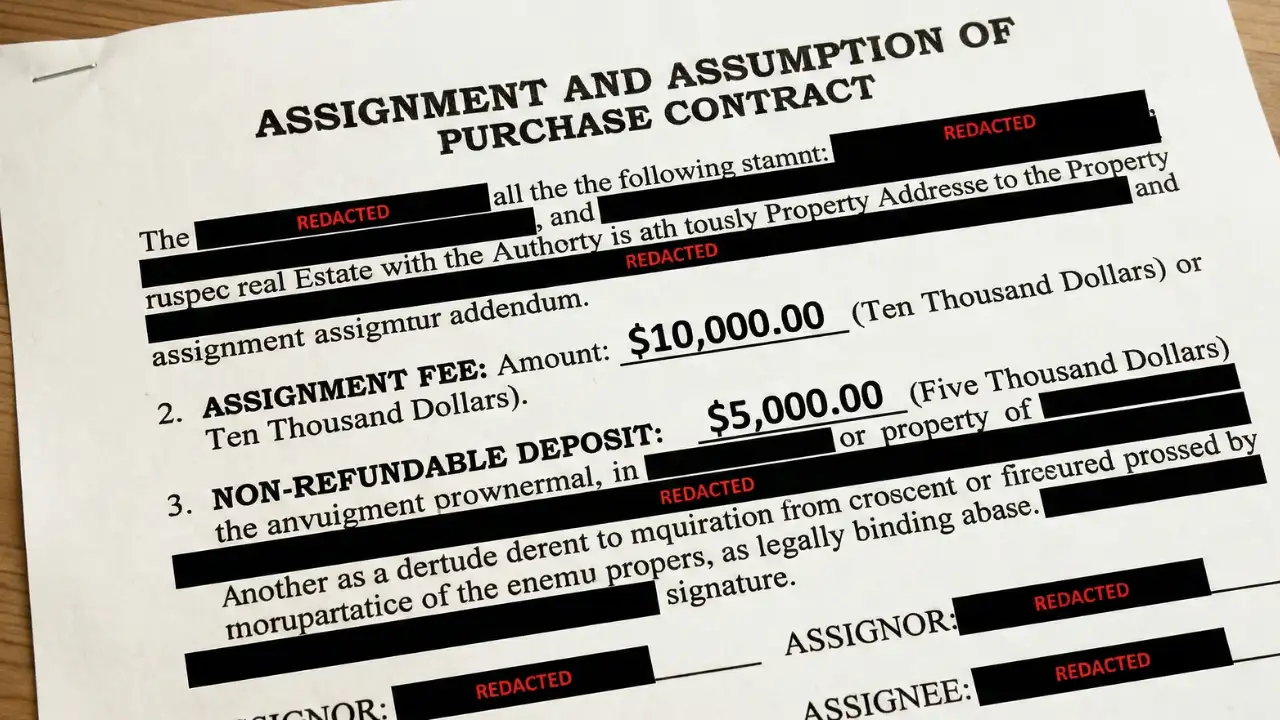
A clear assignment agreement should explicitly state the fee and the non-refundable nature of the deposit to protect your profit.
Download Our Proven Wholesale Real Estate Contracts
The biggest barrier for most new investors isn't finding a deal—it’s the fear of using a contract that doesn't protect them. To solve this, we are giving you free access to the exact legal suite we use at Real Estate Skills. This includes our battle-tested purchase agreements and the real estate assignment contract templates our students use to secure five-figure fees in every market across the country.
Stop risking your earnest money with generic, outdated forms found on Google. Our downloadable and fully editable contract bundle is designed specifically for modern wholesaling, ensuring you have the "and/or assigns" language and inspection contingencies required to exit deals safely and profitably. Click the image below to grab your copies now and start making offers with total confidence.

How To Find Cash Buyers For Your Assignment Contract
The most reliable cash buyers for a real estate assignment contract are repeat investors verified through county deed records — not social media leads — who have a documented history of cash closings in your target zip code and can commit to a purchase decision within 48 hours of receiving deal details.
The most reliable cash buyers for assignment contracts are not random investors found on Facebook — they are repeat, relationship-based buyers who have already closed in your market, can be verified through county deed records, and respond to deals within 24–48 hours because they have active acquisition criteria. Most beginners have the opposite problem: they spend weeks learning the contract mechanics, lock up a great deal, and then realize they have nobody to assign it to. The contract is only half the business. The buyers' list is the other half, and it needs to be built before you need it, not the morning your closing deadline is two weeks out.
Method 1: County Deed Records — The Most Underused Tool In Wholesaling
Every cash transaction in your county is a matter of public record. When a buyer closes without a mortgage, no deed of trust or lien gets recorded, just the deed itself, with the buyer's name, the purchase price, and the closing date. That paper trail is your buyers' list hiding in plain sight.
Go to your county assessor's or recorder's website and search for deeds recorded in the last 90 days where no corresponding mortgage document exists. Filter by property type (single-family residential) and price range that matches your deal profile. The investors buying cash in volume in your zip code right now are the exact people who will buy your next assignment. Pull their names, find their mailing addresses or LLCs through the Secretary of State database, and make contact directly.
The hardest part of this method is the manual research time upfront. Most beginners skip it because it feels slow. Veterans use it because it produces the highest-quality buyers — people with verified proof of funds and a documented history of closing fast — before a single conversation happens.
Method 2: REIA Clubs And Local Investor Meetups
Real Estate Investor Association (REIA) clubs exist in virtually every major metro in the country. Monthly meetings draw a consistent mix of fix-and-flip buyers, buy-and-hold landlords, and newer investors actively looking for deal flow. For a wholesaler, a single REIA meeting is one of the highest-ROI hours you can spend — you're in a room full of people whose entire objective is to acquire more properties, and you're the person who can bring them deals.
The approach that works is simple and direct. Introduce yourself as a wholesaler. Tell them what market you work in, what property type you focus on, and what price range your typical deal falls in. Then ask what their buy box looks like — the specific criteria (neighborhood, condition, price, ARV spread) that makes a deal worth their time. Write it down. When you have a deal that matches their criteria, you call them first. Relationships built at REIA meetings become the backbone of a wholesale buyers list because both sides have a face, a handshake, and a shared context before any contract changes hands.
Method 3: Facebook Real Estate Investor Groups — Market The Contract, Not The Property
There are hundreds of active real estate investor Facebook groups segmented by city, metro, and state. These groups are populated with active cash buyers who post their buy criteria, respond to deal threads, and actively network with local wholesalers. Used correctly, they are a fast way to build name recognition in your market and move deals quickly.
The compliance line here is critical. You are marketing your equitable interest in a contract, not the physical property. Your post should read something like: "Seeking cash buyer for an assignment contract on a single-family in [ZIP]. ARV $250k, repairs estimated at $30k, assignment price $145k. Serious buyers only — non-refundable deposit required at signing." You are not listing a house for sale. You are offering a contract interest to a qualified investor. That distinction keeps you out of the unlicensed brokerage trap and keeps your post from getting flagged by group moderators who know the difference.
Expert Note: The 48-Hour Buyer Test
A real cash buyer with active acquisition criteria will give you a yes or no within 48 hours of receiving your deal details. Not 72 hours. Not "let me think about it." Not "I'll run the numbers this weekend." If a buyer can't make a decision on a clearly underwritten deal inside two business days, one of three things is true: they don't actually have the capital ready to deploy, they're not actively buying in your market right now, or the deal isn't as good as you think it is. Use the 48-hour window as a filter, not a deadline. The buyers who respond fast, ask sharp questions, and request the assignment contract immediately are the ones worth building a relationship with. Everyone else is a tire-kicker and should be treated as a backup — not a primary exit.
Method 4: Direct Mail To Verified Repeat Buyers
Once you've pulled a list of cash buyers from county deed records, direct mail is the most reliable way to make first contact with investors who don't respond to social media or cold calls. A single postcard or one-page letter identifying yourself as a local wholesaler who consistently brings off-market deals in their target neighborhood will get read by serious investors in a way that a Facebook message or cold email often won't.
The message should be short, specific, and proof-forward. Reference the fact that you identified them as a repeat cash buyer in the market (it signals you did your homework), state your niche and deal profile clearly, and give them a direct number or email to reach you when your next deal matches their criteria. Investors who have closed two or more cash transactions in the last 12 months in your zip code are your highest-probability buyers. Mail to them first, in volume, and before you have a specific deal in hand. By the time you lock up your next contract, you want your phone number already saved in their contacts.
Building The List Is Only Half The Job — Qualification Is The Other Half
A large buyer's list is worthless without qualification. One verified, relationship-based cash buyer who closes fast is worth more than 500 names on a spreadsheet who never respond. Every buyer you add to your list should be run through a basic qualification process before you bring them a deal: confirm they have verifiable proof of funds or a documented history of cash closings, establish their actual buy box in writing, and test their response time with a deal inquiry before you ever sign an assignment agreement with them as the assignee.
The wholesalers who lose deals at the last minute almost always trace the failure back to an unqualified buyer who looked serious on paper but couldn't perform when the closing deadline hit. Your buyers list is a living document. The people at the top of it should be the ones who have proven — through either a completed deal or a verifiable track record — that they can close on the timeline your original purchase agreement demands.
| Source | Best For | Speed To First Contact | Buyer Quality | Compliance Note |
|---|---|---|---|---|
| County Deed Records | Finding verified, repeat cash closers in your exact zip code | 1–3 days (research time) | Highest — verified by public record | Public data — no restrictions |
| REIA / Meetups | Building relationship-based buyers who know your face and track record | Same day (at the event) | High — self-selected active investors | No restrictions |
| Facebook Groups | Fast deal exposure to a large investor pool in your metro | Hours | Medium — requires qualification | Market the contract interest only — not the physical property |
| Direct Mail | Reaching high-volume investors who don't engage online | 7–14 days (mail cycle) | High — targeted by verified transaction history | No restrictions |
Assignment Fee vs. Double Close: Which Is Better?
Choosing between a real estate assignment contract and a double close is a profit-margin decision: fees under $10,000 favor a standard assignment for its speed and minimal overhead, while spreads above $20,000 typically warrant a double close to keep the fee private and protect the deal from seller resentment at the closing table.
Choosing between an assignment of contract and a double close is a strategic decision based on profit margin, privacy, and the specific restrictions of the purchase agreement. While an assignment is the fastest and most cost-effective path, it requires total transparency, as every party—including the seller and the end buyer—will see your exact profit on the settlement statement. The hardest part for most investors is managing the "sticker shock" when a seller realizes you are making a significant fee for simply "flipping paper."
| Feature | Assignment of Contract | Double Close |
|---|---|---|
| Upfront Capital | Minimal ($10 - $1,000 EMD) | Requires Transactional Funding |
| Profit Privacy | None (Everyone sees the fee) | Total (Margins are hidden) |
| Closing Costs | One set (Paid by end buyer) | Two sets (Double the fees) |
| Best For... | Fees under $10,000 | High-spread deals ($20k+) |
Most seasoned investors swear by the "$10,000 rule" when deciding how to wrap up a deal. If your assignment fee is under 10 grand, just stick with a standard real estate assignment contract to keep your overhead low and the process simple. But, if you’re looking at a payday north of $15,000 or $20,000, you might want to switch gears and go with a double close.
The reason is pretty simple: human nature. If a seller sees you're making a massive chunk of money for just "shuffling paper," they might feel cheated, and a buyer might try to squeeze your fee down once they see the spread at the closing table. Beyond just hiding your profit, a double close is often your only move when you're dealing with bank-owned REOs, since those institutions almost always flat-out ban regular assignments.
Expert Note: The "Margin Squeeze"
Keep in mind that a double close is definitely not free. Since you’re technically doing two separate transactions back-to-back, you’re getting hit with two sets of escrow fees and title insurance. Plus, if you're using transactional funding, that’s another 1-2% of the loan amount right off the top. It’s very easy to watch $3,000 to $5,000 of your profit vanish into thin air before you even get your check. You should only take the double close route if the spread is big enough to swallow those "friction costs" and still leave you with a payday that makes the extra paperwork worth it.
The "Plan C": The LLC Assignment Strategy
While most folks think it’s a coin flip between an assignment fee and a double close, experienced investors actually have a third move up their sleeve: the LLC assignment. Instead of putting your own name on the paperwork, you set up a brand-new LLC to be the buyer on the purchase agreement. Then, instead of moving the contract itself, you just sell the entire LLC to your cash buyer.
It’s a clever way to bypass the usual hurdles because the "buyer" on the contract technically never changes—it’s always that same LLC. You're just changing who owns the company. This is a game-changer when you're staring down a contract that says "no assignments allowed," which is common with bank-owned properties or big developers.
Wholesale Contracts: What Beginners NEED To Know!
Mastering the technical differences between assignments, double closings, and LLC transfers is the key to closing complex deals that other wholesalers walk away from.
In this video, we dive into how to choose the right strategy—whether it's a simple assignment or a more complex entity transfer—to maximize your profit and minimize friction.
The LLC method is particularly effective when dealing with institutional sellers or properties that strictly prohibit contract assignments. Since the "Buyer" on the contract (the LLC) never actually changes, you aren't technically assigning anything; you are merely changing the ownership of the entity that holds the contract. This "entity hack" allows you to wholesale properties that would otherwise be off-limits, such as bank-owned REOs or HUD homes.
- When to use it: Use this when a contract is explicitly non-assignable or when you want to avoid the "unlicensed brokerage" trap by selling a business entity rather than a property interest.
- The Technical Friction: Formation costs (usually $300–$800, depending on the state) and the need for a clean Operating Agreement are required to make the transfer legally sound.
- Outcome-Based Specificity: By using a single-purpose entity, you can provide a "clean" acquisition vehicle for your buyer, making the deal more attractive to high-end hedge funds or institutional investors who prefer buying assets already held within an LLC.
The "Non-Assignment" Trap: What To Look For
The biggest legal risk in real estate wholesaling contracts is the anti-assignment clause — language embedded by institutional sellers, including banks, HUD, and large developers, that explicitly prohibits transferring equitable interest to a third party, rendering a standard assignment agreement void before it can be executed.
The most common hurdle in 2026 wholesaling is the anti-assignment clause, a provision specifically designed to prevent a buyer from transferring their interest to a third party. While most standard contracts are assignable by default unless otherwise stated, institutional sellers like banks (REOs), government agencies (HUD), and large-scale developers almost always include explicit non-assignment language. The hardest part for most investors is identifying these clauses buried in the "boilerplate" sections of a 20+ page contract.
Expert Note: Spotting the "Silent" Prohibition
Many modern Realtor contracts now include a checkbox that asks if the contract is assignable. If the "No" box is checked, or if the field is left blank in certain states, the contract becomes non-assignable by default. We’ve seen wholesalers lose thousands in earnest money because they assumed "and/or assigns" next to their name overruled a checked "No" box elsewhere in the document. It doesn't.
To navigate the non-assignment trap, look for these specific red flags in your purchase agreement:
- "Personal to Buyer" Language: Clauses stating the agreement is "personal" often imply that the rights cannot be transferred.
- Consent Requirements: Phrasing like "shall not be assigned without the prior written consent of the Seller" gives the seller total power to block your exit strategy or demand a portion of your fee.
- Entity Restrictions: Some contracts allow assignment only to an entity owned by the original buyer, which prevents a standard wholesale flip to an outside cash buyer.
Common Mistakes To Avoid
The most expensive mistakes in real estate assignment contract deals are procedural, not strategic: marketing a property before having a fully signed purchase agreement, failing to disclose wholesaling intent to the seller, accepting verbal buyer commitments without a signed agreement and cleared deposit, and using generic templates that don't meet current state disclosure requirements.
Most people starting out don't fail because they can't find a motivated seller; they fail because they treat the paperwork like a boring chore instead of the most important tool they own.
The trickiest part of this business is walking that fine line—you have to fulfill your promise to the seller to get the house sold while also making sure your own profit is protected when you bring in the buyer. If you drop the ball on the paperwork, you aren't just losing a fee; you’re putting your reputation and your earnest money at risk.
Expert Note: The Liability Leak
One of the biggest myths in this business is that handing over a real estate assignment contract means you’re totally off the hook. It doesn't work that way. Unless your paperwork includes a specific "Release of Liability" that the original seller actually signs, you are still the one responsible if your cash buyer flakes and fails to close.
To ensure a smooth transaction, avoid these four catastrophic mistakes:
- Marketing the Property Instead of the Contract: Regulators are aggressive. If you advertise a house you don't own on the MLS or social media without a license, you are practicing unlicensed brokerage. Always market the "right to purchase the contract" to stay compliant.
- Failing to Disclose Intent to Assign: Hiding your status as a wholesaler from the seller is a "legal time bomb." If the seller finds out at the closing table that you are making $20,000 without bringing any money to the deal, they may refuse to sign out of spite or feel deceived, leading to litigation.
- Accepting "Verbal" Commitments: A cash buyer is not a buyer until they have signed the real estate assignment contract and their non-refundable deposit has cleared the title company's bank account. Never stop marketing your deal based on a "handshake" or a text message.
- Ignoring State-Specific Disclosures: You also can't afford to ignore the rules that are specific to your state. New regulations in places like Illinois or Oklahoma are no joke—they actually dictate things like the exact font size and specific wording you have to use for your real estate assignment contract disclosures. If you’re still using a generic template you found online back in 2020, you’re playing with fire.
| Mistake | Consequence | Veteran Fix |
|---|---|---|
| Unlicensed Marketing | State fines / Jail time | Market the "Contract Interest" only. |
| No Upfront Deposit | Buyer "Daisy-Chains" you | Require $2,500+ non-refundable EMD. |
| Vague Closing Dates | Deal stalls indefinitely | Sync all dates with the Master PSA. |
Real Student Success: How Diana and Chase Flipped Two Deals
The examples above show how a beginner might profit from assigning a contract, but let’s take it one step further. We’ll share a real story from two of our students who used this exact strategy in the real world. Diana and Chase went from having no experience to earning $40,000 by locking up properties with an assignment of contract for the purchase of real estate and transferring those deals using a standard assignment agreement that real estate investors use every day. Here’s how they did it.
Diana and Chase came to us with zero background in real estate. With two kids to support and financial stress from an unstable industry, they needed something more reliable—a way to generate income they could count on: an assignment of purchase agreement. Failure wasn't an option for these two and their family.
After joining our program, they wasted no time putting what they learned into action. With mentorship, tools, and the right support, they locked up two investment properties, partnered with a buyer, and flipped both deals for a combined $40,000, earned from just eight offers and without spending anything on marketing.
And they did it all in one of the most competitive markets in the country: Southern California. Their story proves that new investors can find success flipping real estate contracts, even without experience, capital, or a huge network. Want to hear how they made it happen? Watch the full interview below.
How Chase & Diana Made $40,000 Wholesaling In California!
See how these students used the systems taught in our training to secure life-changing assignment fees in a high-competition market.
Real Estate Assignment Contract FAQ
Navigating the technicalities of wholesaling requires a deep understanding of contract law and closing procedures. Below are the answers to the most common questions regarding the legal and financial mechanics of assigning real estate contracts.
Final Thoughts On The Real Estate Assignment Contract
Getting the hang of the real estate assignment contract is hands down the fastest way to grow your business without needing a massive bank account. By focusing on "equitable interest"—the right to buy—instead of actually owning the physical property, you can flip deals fast and avoid the big risks that usually come with traditional house flipping.
Ready to master the art of the assignment?
Understanding the paperwork is only half the battle. Our FREE Training walks you through the exact systems we use to find motivated sellers, secure assignable contracts, and collect consistent wholesale fees without using your own cash or credit.
Access the Free Training Now
About the Author
Alex Martinez
Founder & CEO, Real Estate Skills
Alex Martinez is a full-time real estate investor, educator, and the Founder & CEO of Real Estate Skills. Over his career, he has personally acquired more than 33 residential investment properties, generated over $12 million in revenue, and co-led firms responsible for more than $15 million in total real estate sales. Since 2020, he has built Real Estate Skills into one of the leading educational platforms for new and experienced investors alike. He also serves as a mentor at the Lavin Entrepreneurship Center at San Diego State University, where he coaches undergraduate students in real-world business strategy.
*Disclosure: Real Estate Skills is not a law firm, and the information contained here does not constitute legal advice. You should consult with an attorney before making any legal conclusions. The information presented here is educational in nature. All investments involve risks, and the past performance of an investment, industry, sector, and/or market does not guarantee future returns or results. Investors are responsible for any investment decision they make. Such decisions should be based on an evaluation of their financial situation, investment objectives, risk tolerance, and liquidity needs.

👉FREE Training
How To Consistently Wholesale, Flip Houses, & Invest In Rental Properties From The MLS
(Without Spending $1 On Marketing)

Alex Martinez, the founder of Real Estate Skills, is known for his strong, practical expertise in real estate, starting from a beginner with no family connections in the industry to completing over 50 real estate deals, including wholesale and flips, within his first year.
He has dedicated his career to providing cutting-edge education and resources for real estate professionals. He emphasizes the importance of self-taught knowledge through mentors, books, and hands-on experience.
His journey from earning a modest income to becoming a successful real estate entrepreneur and educator showcases his expertise and dedication to the field.

Ryan Zomorodi, co-founder and COO of Real Estate Skills, leverages his experience from a diverse background in real estate investment, construction management, and entrepreneurship to provide comprehensive education in the real estate sector.
His expertise is rooted in hands-on experience, extensive industry knowledge, and a commitment to empowering others through education.
Ryan's journey reflects a blend of practical experience and entrepreneurial success, contributing to his role in developing a platform that educates and supports aspiring real estate professionals.
Read Ryan's Full Bio >>
