
Cash Buyers In Real Estate: Types, Verification & How They Work (2026)
Sep 23, 2026

Written by
Alex Martinez — Founder & CEO, Real Estate Skills. Has wholesaled and flipped houses for over a decade, personally acquiring 55+ residential investment properties.
Reviewed by
Ryan Zomorodi — Co-Founder & COO, Real Estate Skills. Reviewed and verified the cash-buyer types, verification steps, seller guidance, and market statistics in this guide before publication.
Publication history: Originally published January 7, 2020. Rewritten June 2026 with a practitioner definition, the buy-box framework, and deeper verification guidance. Updated September 2026 with the types of cash buyers, a section for home sellers weighing a cash offer, sourced 2026 cash-sale statistics, and an expanded FAQ. Strategies and figures verified by Ryan Zomorodi, Co-Founder & COO of Real Estate Skills.
Cash buyers are people or companies that buy real estate with their own funds — no mortgage, no loan approval, no lender — which lets them close in one to two weeks instead of the 30 to 45 days a financed purchase takes. They include fix-and-flippers, landlords, "We Buy Houses" companies, iBuyers, institutional investors, and ordinary homebuyers paying cash. In August 2026, all-cash deals made up 27% of U.S. existing-home sales, according to the National Association of REALTORS®. For a wholesaler, cash buyers are who you sell your deals to; for a homeowner, they're the buyers who trade a lower price for speed and certainty.
In real estate, a cash buyer is someone who purchases a property using their own money, without a mortgage. They might be individual fix-and-flippers, buy-and-hold landlords, companies, funds, or a retiree paying cash for a condo — but if you're a wholesaler, they're the people you build your business around, because they can close fast and don't depend on a lender.
Here's what most people get wrong about cash buyers: they think "cash buyer" describes one kind of person. It doesn't. A flipper doing ten houses a month, a landlord buying one rental a year, and a tech company making instant offers are all cash buyers — and they behave nothing alike. Knowing which type you're dealing with, what separates a great one from a tire-kicker, and how to confirm they can actually close is what this guide is about. We'll cover what a cash buyer really is, the types, how they decide what to buy, how to verify them, how they compare to financed buyers, what homeowners should know before accepting a cash offer, and the latest numbers on how common cash deals are.
What Is A Cash Buyer?
A cash buyer is a person or company that purchases real estate outright with their own capital, instead of financing it through a mortgage. The money comes from savings, business funds, lines of credit, or relationships with private and hard-money lenders, and the purchase is done by wire transfer or cashier's check — no loan approval, no appraisal contingency, no waiting on a bank.
That's the textbook definition, and it doesn't tell you what matters as a wholesaler. So let me tell you who you're actually looking for.
The cash buyers you want are, overwhelmingly, fix-and-flippers — investors who buy distressed houses, renovate them, and resell them for a profit. The reason is simple: volume. A serious fix-and-flipper isn't buying one house. They're buying three, five, sometimes ten houses a month, every month, because that's how their business stays fed. So if you're a wholesaler doing a handful of deals a month, you don't need a giant list of buyers — one or two strong fix-and-flippers can absorb everything you bring them.
Compare that to a buy-and-hold investor, the person buying rentals to keep. They can absolutely be a cash buyer, and sometimes they're the right fit for a particular deal. But a buy-and-hold investor might buy one property every twelve to fourteen months. That's a fine pace for them — it's a terrible match for a wholesaler trying to move multiple deals a month. The math just doesn't work the same way. This is why, deal in and deal out, the fix-and-flipper is the cash buyer a wholesaler builds their business around.
One more thing worth clearing up, because it trips beginners up: a cash buyer is a real person or a real company, not some faceless entity. Sometimes it's a one-person operation — somebody who flips houses and contracts the renovation work out — and you deal with them directly, which means fast decisions. Sometimes it's a company with a CEO, partners, and an acquisitions manager whose whole job is buying deals. Either way, there's a human on the other side, and the one you want to reach is the decision-maker — the person who can tell you yes or no — not an assistant who has to check with someone else.
Types Of Cash Buyers
The main types of cash buyers are fix-and-flippers, buy-and-hold landlords, "We Buy Houses" companies, iBuyers, institutional investors and build-to-rent operators, and individual homebuyers paying cash. For a wholesaler, fix-and-flippers are the core buyer. For a home seller, knowing which type is making the offer tells you roughly what kind of price to expect.
"Cash buyer" describes how someone pays, not who they are or what they want. Here's how the six types compare:
| Type | What They Buy | Pace | Typical Offer | Buys Wholesale Deals? |
|---|---|---|---|---|
| Fix-and-flippers | Distressed houses to renovate and resell | Several a month | Well below retail, based on after-repair value | Yes — the core buyer |
| Buy-and-hold landlords | Rentals that cash-flow, often light rehab | A few a year | Below market, based on rent and returns | Sometimes, for the right deal |
| "We Buy Houses" companies | Any condition, bought directly from owners | High volume | Well below retail, as-is | Often — but some are wholesalers themselves |
| iBuyers | Newer, good-condition homes in eligible markets | High volume, algorithm-driven | Near market, minus service fees and repair credits | Rarely |
| Institutional & build-to-rent | Single-family rentals, portfolios, new-build communities | Bulk | Formula-driven, portfolio pricing | Rarely for small wholesalers |
| Individual homebuyers paying cash | A move-in-ready home to live in | One home | Close to market, with a modest cash discount | No |
Fix-and-Flippers
The workhorse of the cash-buyer world, and the buyer most wholesale deals end up with. A flipper's model depends on buying low enough to cover renovation, holding costs, selling costs, and a profit — so they price every deal backward from what the house will be worth fixed up. The serious ones fund purchases with a mix of their own capital, lines of credit, and hard-money or private lenders, which is how they keep several projects going at once. They know their numbers, they know their neighborhoods, and they can usually tell you yes or no within a day or two.
Buy-and-Hold Landlords
Landlords buy for monthly cash flow and long-term appreciation rather than a quick resale, so they evaluate deals on rent, expenses, and return instead of after-repair value. Many pay cash to close fast, then refinance later to pull their money back out. They're slower and more selective than flippers — a small landlord might buy one property a year — but a landlord who wants a rental in a specific neighborhood can be exactly the right buyer for a house a flipper would pass on.
"We Buy Houses" Companies
These are the operations behind the bandit signs, mailers, and "sell my house fast" ads — local investors, regional companies, and national franchises that buy directly from homeowners in any condition. Many are well-funded flippers and landlords with big marketing budgets. Some, though, are wholesalers: they put a house under contract and then assign it to another investor rather than closing themselves. That's legal in most states when done transparently, but it matters to both wholesalers (you may be talking to a competitor, not an end buyer) and homeowners (you may not be talking to the person who'll actually buy your house). If you're comparing these companies as a seller, our guide to companies that buy houses for cash breaks down the major players.
iBuyers
iBuyers ("instant buyers") are tech-driven companies that use pricing algorithms to make fast cash offers online, usually within a day or two, then inspect the home and close on a flexible timeline. They target newer, well-kept homes in markets where their models work, and they make money on service fees and repair credits rather than deep discounts. They buy from homeowners, not wholesalers, so they're mostly relevant if you're the seller. We've reviewed one of the largest in our Offerpad review.
Institutional Investors And Build-To-Rent Operators
Hedge funds, private-equity-backed rental companies, and build-to-rent developers buy single-family homes at scale, sometimes in bulk portfolios and sometimes as entire new-construction communities built to lease. They pay cash, they move quickly, and they buy by formula. For a wholesaler doing a few deals a month they're rarely a direct buyer, but their presence shapes prices and competition in the markets where they're active.
Individual Homebuyers Paying Cash
This is the group people forget, and it's a big one: retirees, downsizers, relocating professionals, and equity-rich movers who sell one home and buy the next without a loan. They're a large share of all cash sales — which is why cash deals are so common in retiree-heavy markets like South Florida (more on that in the statistics section). They want a move-in-ready home to live in, they'll pay close to market value, and they will never buy a wholesale contract. If you're selling a well-kept house, this is the cash buyer most likely to pay you the most.
What Makes A Great Cash Buyer?
A great cash buyer can give you a yes or no in hours, buys multiple deals a month, knows your market cold, and actually returns your calls. Most people who call themselves cash buyers fail at least one of those — and learning to tell the difference is what separates a wholesaler who closes from one who keeps canceling contracts.
Here's what to look for.
They can make a decision — fast. A real cash buyer can tell you whether they want a deal within a few hours, or at most a couple of days. They don't need a week, they don't need to "run it by" three people, and they don't go silent. This is why you want to be talking to the actual decision-maker, not an assistant or a junior acquisitions person who can't commit. Good deals move fast — when you bring one, you need an answer before it's gone.
They're doing real volume. The best cash buyers are intermediate-to-advanced investors who are already buying, fixing, and reselling multiple houses a month. That experience matters: they know how to analyze a deal in minutes, they have contractors and crews ready, and they understand that good deals don't sit around. The person who watched one flipping show, has never closed a deal, and "definitely has the cash" is the opposite of this — they can't move quickly because they don't actually know what they're doing, and they rarely have the money to back it up.
They're local to your market. This one gets overlooked, and it's a big deal. A cash buyer in Austin does not help you wholesale a house in San Diego — they don't know the neighborhoods, the comps, the good streets versus the bad ones, and they're not going to drive out to a property they can't realistically buy. The best buyers are local, actively doing deals in the exact market you're working. A serious local fix-and-flipper will get out to a property the same day, walk it, and tell you yes or no. That's the speed you're after.
They communicate and they do what they say. Not every cash buyer is a great communicator, but the ones worth keeping pick up the phone, answer texts, and give you real feedback — "this one works," "this one's $30k too high," "not my area." That feedback is how you get better at bringing them deals. The buyer who agrees to meet you at a property and then ghosts you, or strings you along and disappears, isn't a great cash buyer no matter how much cash they have. You want people who are trustworthy and reliable, because you're going to be doing business with them again and again.
There's a mindset shift underneath all of this, and it's the thing most beginners miss: the best cash buyers aren't transactions, they're relationships. Think of them as financing partners, not faceless names on a list. When you genuinely want a buyer to profit on the deals you bring them — when you want them to make good money on the flip so they come back hungry for the next one — you start building the kind of relationship that pays you for years.
📓 From The Field
Some of the cash buyers Alex has worked with have paid him over six figures in a single year — and he knows every one of them on a first-name basis. He's grabbed coffee with them, had dinner, driven around their properties, exchanged gifts at the holidays, been invited to their kids' birthdays. That's not incidental. Nobody pays you six figures a year, deal after deal, if they don't know you and trust you. The wholesalers who treat cash buyers as a relationship to invest in — not a number to blast emails at — are the ones those buyers keep calling back. (Results vary; one investor's experience isn't a promise of income.)
This is also why you don't need a huge list. A small handful of great cash buyers — people who decide fast, buy volume, know your market, and actually want your deals — will outperform a spreadsheet of a thousand strangers every time.
How Many Cash Buyers You Need (And Why They Come First)
A wholesaler needs three to five quality, local cash buyers who are actively flipping multiple deals a month — not hundreds. And you line them up before you put a property under contract, because a contract comes with a deadline, and a deal with no buyer waiting is a deal you'll probably have to cancel.
Beginners get obsessed with building a giant list — and then twelve months go by, they've got hundreds of names and zero deals closed, because they spent all their time collecting buyers instead of doing deals. You also don't want just one, because if your only buyer goes on vacation or already has too many projects, you're back to square one with a deal under contract and no way out. Three to five gives you a Plan A, B, and C, and it's few enough that you can build a real relationship with each one.
The order matters just as much as the number. When you lock up a property, your contract has deadlines, and you usually need to close in ten to fourteen days to stay competitive with other investors' offers. Go under contract with no buyers lined up and you're scrambling to find one, qualify them, and get a commitment before the clock runs out. Miss it, and you cancel — leaving a five-figure fee on the table and burning your reputation with the agent and seller who now know you couldn't perform.
📓 From The Field
When Alex started out, he did it backwards. He got a property under contract first, figured the cash buyers would come running, and had none lined up when the clock started. He had to cancel the deal — one that should have paid a $10,000 to $20,000 fee. After that, he flipped his process: he found the best cash buyers he could, learned what they bought and where, and figured out how many deals each could take. He says he never canceled another deal for lack of a buyer again. (Outcomes vary; this is one investor's experience, not a typical result.)
Why Cash Buyers Work With Wholesalers
Cash buyers pay wholesalers a fee because they're busy running a business and don't have time to find every deal themselves. When you put a property under contract and hand it over, you've done thousands of dollars of marketing and legwork for them — all they do is sign and pay you. It's a fast, clean win for both sides.
If a cash buyer has the money and the experience to buy houses, why would they pay you a fee to bring them one? It's the question every beginner gets stuck on — and the answer is the reason wholesaling works at all: time. (If you're still getting the basics down, start with how wholesaling works.) A serious cash buyer is running a business. They're managing renovations, hiring and firing, keeping projects on schedule, getting houses sold, raising money for the next deal. Finding and locking up properties is just one job competing with a dozen others, and there are only so many hours in a week. They physically cannot chase every deal themselves.
That's the gap you fill. When you put a property under contract and hand it to a cash buyer, all they have to do is sign and pay you — you've done the hunting, the negotiating, and the paperwork for them. And that work has real value. It costs a cash buyer real money to generate a deal on their own: marketing, lead lists, software, sometimes staff, often five to ten thousand dollars in spend just to get a single property under contract — before they've closed on anything. When you bring them a deal that fits, you've delivered that work for free and they only pay you when it's a deal they actually want.
Look at it from their side and it's an easy yes. If a buyer pays you a $10,000 fee on a deal they'll net $30,000 on after the flip, they just turned $10,000 into $30,000 — a three-to-one return, with none of the legwork. A buyer who thinks like an investor isn't annoyed to pay your fee; they're glad to, because you made them money and saved them time. That's the whole relationship in one sentence: you're the deal flow, they're the financing, and both of you win.
Knowing What A Cash Buyer Is Won't Close A Single Deal.
The wholesalers actually getting paid know the whole process — how to find a discounted property, lock it up, and hand it to a cash buyer who pays them a fee — not just the definition. Our FREE Training walks you through exactly how to find deals, analyze them like a pro, and put them in front of cash buyers without spending a dime on marketing or learning it the hard way. Watch it today, then go put it to work.
Watch The FREE Training →How Cash Buyers Decide: The "Buy Box"
Every serious cash buyer has a "buy box" — the specific criteria that define what they'll purchase: where they buy, their price range, property type, renovation appetite, required return, capacity, and how they fund deals. A wholesaler who knows each buyer's buy box brings them deals they say yes to; one who doesn't is guessing.
That target — the specific kind of property a buyer is looking for — is their buy box, and knowing it is what turns a list of names into a business. When you know precisely what each buyer wants, you stop guessing, you go after the right properties on purpose, and you bring buyers deals they actually say yes to.
Think of it like a store. If a customer walks in and asks for a $2 water bottle and you hand them a $40 bottle of wine, they're not buying — you brought them something they didn't ask for. A cash buyer is the same. If they want a three-bed, two-bath in a specific price range and you bring them a luxury teardown, you've wasted everyone's time and you look like an amateur. Ask first, then deliver exactly what they told you. Do that consistently and you become the wholesaler they can't wait to hear from.
A complete buy box covers:
- Where they buy. Specific zip codes, neighborhoods, and cities — and just as important, the areas they won't touch. A buyer might love one part of the county and avoid another because they've had bad luck there.
- Price range. A buyer who tops out at $200,000 doesn't want your $300,000 deal. Know their ceiling and their floor.
- Property type and condition. Houses, condos, multifamily? And how much work will they take on — light cosmetic only, full gut renovations, adding square footage, ground-up builds? A buyer who only does "lipstick" jobs doesn't want a deal that needs $150,000 of work.
- Minimum profit or return. This is the one beginners botch. Don't assume — and when a buyer gives you a number, find out how they calculate it, because everyone runs it differently. The sharpest buyers have their own deal calculator; if you can plug your numbers into their math, you can send a deal already showing it works for them.
- Capacity and speed. How many projects they're running, how many they've completed, whether they could take three deals next month, and how quickly they close.
- Funding. Cash on hand, a line of credit, private money, hard money? A serious volume buyer has multiple funding sources lined up. A buyer who needs a month to close, or who can't say where the money's coming from, is waving a red flag.
Notice what those criteria do on two levels. On the surface, they tell you what to bring each buyer. Underneath, they separate the serious volume buyer from the hobbyist. The buyer who's running twelve projects, has done a hundred and fifty deals, can close in a day, and has three funding sources is a completely different animal from the one with zero projects who "buys anywhere" and isn't sure how they'd pay. "Anywhere and everywhere" is almost always the answer of someone who hasn't done deals. The specifics are where the truth lives.
One positioning tip that pays off here: introduce yourself as a real estate investor, not as "just a wholesaler." It's not about being dishonest — you are an investor. But "I'm just a wholesaler" tells an experienced buyer you're brand new. "I'm a real estate investor who wholesales, flips, and holds property in the area" opens doors — to bigger conversations, to partnering on deals, to splitting flip profits down the road.
And keep the whole thing human. The point isn't to interrogate a buyer — it's to build a relationship with someone you'll do business with for years. Meet them in person if you can. Grab a coffee, walk a property together. The exact words to use on that first call — the opener, all 13 qualifying questions, and how to close — are in our cash buyer script.
Don't Sound Like A Newbie On The Phone. Know Exactly What To Say.
Knowing what a buy box is only helps if you can get a buyer to tell you theirs — without tipping off that it's your first rodeo. One wrong line and a serious investor mentally hangs up. So we put the exact words on paper. Download our free Cash Buyer Script — the same one we've used and refined for over a decade — to open the conversation like a pro, draw out a buyer's complete buy box, and build the kind of relationships that pay you for years.

Verifying Cash Buyers
Verify a cash buyer before you're under contract: get current proof of funds (dated within 30 days, name matching the contract), require earnest money wired into neutral escrow, and confirm a track record. Real buyers are transparent — if verifying feels like pulling teeth, that's your answer.
Not every "cash buyer" is real. Some have the funds and close fast. Others are wholesalers trying to assign your contract, buyers who still need a loan they're calling "cash," or people who simply can't perform. Verifying a buyer before you're under contract protects your time and keeps a deal from collapsing at the worst possible moment. The good news: real cash buyers expect to be vetted and won't flinch. The ones who push back on basic verification are telling you something.
Get proof of funds — and make sure it actually proves something. Ask for a recent bank or brokerage statement, or a lender letter, showing available funds at least equal to the purchase price. The name on it — the person or the LLC — has to match who's signing your contract. Redactions are fine; the account holder and the available balance need to be visible. And it has to be current: proof of funds letters are generally expected to be dated within the last 30 days, so a statement from last year is worthless. If a buyer's funds are spread across accounts, ask for a combined proof.
Know where a beginner actually gets proof of funds — and why a lender is glad to give it. If you're new and don't have your own large balance to show, the easiest source is a hard-money lender. Hard-money lenders typically lend based on the deal and the property, not your credit score, and they'll often issue a proof-of-funds letter quickly — sometimes the same day — because handing one out costs them nothing and builds a relationship with someone who may borrow from them on a future flip. One catch worth knowing: a reputable lender will only issue a proof of funds they'd actually stand behind, so don't rely on the no-questions-asked letters some sites generate for free — sellers and agents have learned to be suspicious of those. When you approach a hard-money lender, present yourself as a wholesaler and a future fix-and-flipper, because that's who they want as a customer.
You can also use your cash buyer's proof of funds. If you've built a real relationship, a serious buyer will have a current proof of funds ready and can let you use it to back your offer — sometimes in exchange for first crack at the deal. Just remember it still needs to be refreshed every 30 days, which means you need a buyer who'll actually send it to you — another reason the relationship matters.
Put real earnest money into neutral escrow. Require the buyer to wire an earnest money deposit to your title or escrow company — never directly to you or the seller — within a business day. After a short inspection window, you can make some or all of it non-refundable, subject to clear title. A serious buyer won't balk at this; a tire-kicker will.
Verify their track record. Ask for two or three recent settlement statements (HUD or ALTA) with the buyer's name on them, or contact info for the title company they close with regularly. A real buyer can point you to agents, contractors, or title officers who'll vouch for them. You're confirming they actually close — not just talk.
Check the entity and the signer. If an LLC is buying, get the operating agreement, the articles or certificate of organization, proof the signer is authorized, and a W-9 — and make sure the entity name matches the proof of funds. Open title right away with a reputable local company, keep every dollar and instruction flowing through escrow, and confirm liens, payoffs, taxes, and HOA balances early so nothing surprises you at closing.
Watch for the red flags. Any one of these is a reason to slow down or walk:
- Reluctance or excuses about providing proof of funds
- A tiny or "I'll send it later" earnest money deposit
- Insisting you "use my title company only"
- Re-trading — trying to renegotiate the price right before closing
- Demanding long contingency periods
- Multiple middlemen in the chain (daisy-chaining), where it's unclear who the real buyer even is
The throughline is simple: real buyers are transparent, and transparency is fast. If verifying someone feels like pulling teeth, that's your answer — protect the deal and move to the next buyer.
This section explains general practices for educational purposes and isn't legal or financial advice. Verification norms and documents vary by state and situation — confirm specifics with your title company and a licensed professional.
After A Buyer Says Yes: Getting The Deal Done
Once a deal is under contract, send your three to five cash buyers the after-repair value, repairs, and purchase price (with your fee built in), plus comps and the closing timeline. Follow up by phone, get a buyer to the property fast, and assign them the contract for your fee.
Once you've got a property under contract that fits a buyer's criteria, getting paid comes down to one clean handoff. You send your three-to-five cash buyers the deal, the right one commits, and you assign them the contract for your fee — or, when a contract can't be assigned, use a double closing instead. Do the earlier steps well — know your buyers, know their buy box — and this part is fast, because you already know who wants it.
What to put in the deal email. Keep it tight and give a qualified buyer everything they need to decide on their own. Three numbers do most of the work: the after-repair value (ARV — what the house is worth fixed up), the estimated repairs, and the purchase price. A real fix-and-flipper can plug those into their own analysis and know in seconds whether it's a deal. Then go a step further: include the comps that justify your ARV, and lay out the timeline — when earnest money is due, when the inspection contingency lifts, and the closing date. If a buyer has to come back and ask you things you could have told them upfront, you didn't do your job.
One detail that matters: build your fee into the purchase price you send — don't itemize it. You want the buyer evaluating whether the deal works at that price, not doing mental math on your spread.
After you send it, follow up with a call or text and try to get your buyer out to the property that same day or the next. Serious buyers move fast — they'll walk it, sometimes bring their contractor, and give you an answer well inside your timeline. When more than one of your buyers wants it, go with the one who's most communicative and can move quickest.
A capital tip that protects beginners: with strong cash buyers who decide in 24 to 72 hours, you often won't have to put up your own earnest money at all — the deal's assigned before yours is even due. And if you're short on cash for a deposit, a buyer who genuinely wants the deal can put up the earnest money themselves.
This is also where having a buyer's exact numbers pays off. If you told a buyer you'd bring deals that hit their minimum return, you need to be able to show it — run the purchase price, the repairs, and the ARV against the profit they require before you ever send it over. That's the difference between "I think this works for you" and "here's the math proving it does."
Don't Send A Deal Until The Numbers Actually Work.
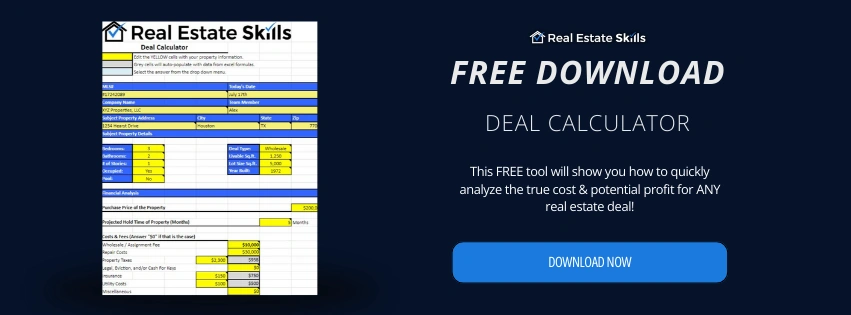
Your cash buyer is going to run the math the second your email lands — so run it first. If your ARV, repairs, or purchase price are off by a few percent, your fee disappears and your buyer stops trusting your deals. Download our free Deal Calculator to nail your maximum offer, factor in repairs and closing costs, and lock in your spread before you send a deal to a single cash buyer — so every deal you bring lands as a yes.
Cash Buyers vs. Financed Buyers
A cash buyer needs no lender, so they close in about one to two weeks and can't be derailed by a loan falling through. A financed buyer relies on a mortgage — credit checks, appraisal, underwriting — and a closing that typically runs 30 to 45 days. The trade-off is price: cash buyers usually pay less.
The core difference comes down to speed and certainty. A cash buyer needs no lender, so they can close in roughly one to two weeks and can't be derailed by a loan falling through. A financed buyer relies on a mortgage, which means credit checks, an appraisal, and underwriting — and a closing that typically runs 30 to 45 days. For a wholesaler on a tight contract timeline, that gap is the whole reason cash buyers exist.
Here's how the two stack up:
| Feature | Cash Buyer | Financed Buyer |
|---|---|---|
| Funding source | Own capital, lines of credit, or private/hard money | Mortgage or other bank financing |
| Approval process | No lender approval — proof of funds is enough | Credit check, appraisal, and underwriting required |
| Closing time | About 1–2 weeks | Roughly 30–45 days |
| Contingencies | Fewer; may shorten or waive inspection | Financing, appraisal, and inspection contingencies common |
| Offer price | Below market — about 9% below financed offers on average in 2025 (Cotality), and lower for investor offers | Often closer to full market value |
| Risk of falling through | Low — no loan to collapse | Higher — financing and appraisal problems are a leading cause of deals dying |
The trade-off cuts both ways, and it's worth being honest about it: a cash buyer usually pays less than a financed buyer would, because what they're really buying is speed and certainty. As a wholesaler, that's exactly the buyer you want — a guaranteed, fast close is worth more to you than a higher price that might collapse in underwriting three weeks from now. But it's why the deals you bring cash buyers have to be genuinely discounted: their whole model depends on buying below market.
For Home Sellers: Should You Accept A Cash Offer?
Accept a cash offer when speed and certainty matter more to you than top dollar — a house that needs major repairs, a deadline like foreclosure or a job move, or an inherited property you don't want to manage. Expect to pay for that certainty: sellers accepted about 9% less on cash deals than financed ones in 2025, and investor offers on houses that need work come in lower still. Verify any cash buyer before you sign.
Most of this guide is written for investors. But if you're a homeowner who just got a cash offer — or called the number on a "We Buy Houses" sign — you're on the other side of the same transaction. We teach investors how to buy this way, so here's how it looks from the buyer's side of the table.
What A Cash Offer Actually Means For You
A cash offer means the buyer isn't borrowing, so there's no loan approval that can fall apart and usually no appraisal the house has to pass. That's why cash deals can close in one to two weeks. It doesn't mean there's no process: the buyer will still run a title search, and many will still want an inspection period. Read the contract for what can let the buyer walk away, and how much earnest money they lose if they do.
How Much Less A Cash Buyer Will Offer — And Why
It depends almost entirely on which type of cash buyer you're dealing with. An individual paying cash for a move-in-ready home will typically offer close to market, with a modest discount for the certainty they bring — across all sales, Cotality found sellers accepted an average 9% discount on cash deals in 2025, and UC San Diego research put the long-run gap between cash and mortgage buyers at roughly 8% to 11%.
An investor is different, and we won't pretend otherwise. A flipper works backward from what the house will be worth after renovation, then subtracts repairs, holding costs, selling costs, and their profit. Many use some version of the maximum allowable offer formula: roughly 70% of after-repair value, minus repairs. On a house worth $300,000 fixed up that needs $40,000 of work, that math lands around $170,000. That's not a lowball trick; it's what the deal has to look like for an investor to take on the renovation risk. Whether it's worth it to you depends on what the repairs, commissions, months of showings, and uncertainty would cost you to sell it the traditional way.
When A Cash Offer Makes Sense — And When It Doesn't
A cash sale is usually the right call when the house needs work a financed buyer's lender won't accept, when you're up against a foreclosure date or a move, when you've inherited a property from out of state, or when a previous deal already fell through on financing. It's usually the wrong call when your home is in good shape, you have time, and your market has buyers — listing it will likely net you more, even after commissions. If you do go the cash route, get more than one offer. Cash buyers compete with each other too.
How To Verify A Cash Buyer As A Seller
Use the same checks investors use on each other. Ask for proof of funds dated within the last 30 days, in the same name as the buyer on the contract. Require earnest money to be wired to a title or escrow company you choose, not theirs. Look up the buyer's LLC on your state's business registry and search their name and phone number for reviews. And ask one direct question: "Will you be closing on this house yourself, or assigning the contract to another buyer?" A contract that names the buyer "and/or assigns" allows them to hand it off. Assignment is legal in most states, and a wholesaler can still get you to a closing — but you deserve to know who's actually buying your home, and a growing number of states require that disclosure.
Red Flags When A "Cash Buyer" Approaches You Unsolicited
- Pressure to sign today, or an offer made sight-unseen that drops sharply after an "inspection"
- No proof of funds, or proof in a different name than the contract
- A token earnest money deposit, or one that goes to them instead of a title company
- Insisting you use their title company, their attorney, or their notary
- Asking you for any upfront fee — legitimate buyers don't charge sellers to buy their house
- Last-minute changes to wiring instructions; always confirm by calling the title company at a number you looked up yourself
If you're an agent presenting a cash offer to a client, the same checklist applies — and it's worth walking your client through the discount they're accepting in exchange for the certainty.
This section is general education for homeowners, not legal or financial advice. Disclosure rules for assignments and wholesale contracts vary by state — have a real estate attorney review any contract before you sign it.
Cash Buyer Statistics (2026)
About 27% of U.S. existing-home sales were all-cash in August 2026, per NAR, down from 28% a year earlier. Redfin's county-records data put the share at 28.8% in March 2026, off a peak near 35% in 2023. Cash is most common in lower-priced and retiree-heavy markets — about half of all purchases in Cleveland and West Palm Beach — and least common on the West Coast. Meanwhile, the discount sellers accept for cash has more than doubled since 2021.
National share. All-cash transactions were 27% of existing-home sales in August 2026, up from 26% in July and down from 28% in August 2025, according to the National Association of REALTORS® (released September 10, 2026). NAR's figure comes from a monthly survey of its members; Redfin measures the same thing differently, by checking deeds for mortgage records across the 40 most populous metros. By Redfin's count, 28.8% of homebuyers paid all cash in March 2026, down from 29.8% a year earlier. The two sources land in the same place: a bit more than one in four homes is bought without a loan.
The trend. Cash share hit a record low of about 20% in April 2020, climbed through the pandemic boom, and peaked near 35% in 2023 when mortgage rates approached 8% and buyers who could afford it avoided borrowing altogether. It has been sliding since, as rates eased toward the low 6% range and most markets tipped in buyers' favor, so fewer buyers need an all-cash offer to win. For context, the pre-pandemic range was roughly 25% to 30%.
By market. Where cash is common tells you a lot about who's paying it:
| Metro | Share Bought With Cash (March 2026) | Change vs. March 2025 |
|---|---|---|
| Cleveland, OH | 51.1% | +4.9 pts |
| West Palm Beach, FL | 51.1% | −0.1 pts |
| Detroit, MI | 45.8% | +9.6 pts |
| Riverside, CA | 38.1% | +9.3 pts |
| Fort Lauderdale, FL | 38.0% | −0.7 pts |
| National (40 metros) | 28.8% | −0.9 pts |
| San Diego, CA | 20.7% | −3.0 pts |
| Los Angeles, CA | 20.5% | −3.9 pts |
| Sacramento, CA | 19.9% | −4.2 pts |
| Oakland, CA | 18.4% | −1.0 pts |
| Seattle, WA | 17.6% | −0.7 pts |
Source: Redfin analysis of county records across 40 of the most populous U.S. metros, published May 2026.
Two very different buyers drive those top markets. In Cleveland and Detroit, homes are cheap enough that investors and ordinary buyers can pay outright — which is exactly why those markets are full of flippers and landlords. In West Palm Beach and Fort Lauderdale, it's affluent retirees and second-home buyers. At the other end, cash is rarest on the West Coast because buying a home outright there can take seven figures. For a wholesaler, a high cash share in a lower-priced market is a good sign: there are active investors to sell to.
The cash discount is growing. Cotality found that sellers accepted an average 9% discount on cash purchases versus financed ones in 2025, up steadily from 4% in 2021, 6.2% in 2022, 6.8% in 2023, and 7% in 2024. Part of the reason: as rates rose, the share of pending sales that fell apart roughly doubled, from about 2–3% to 5–6%, so sellers now pay more for certainty. Cotality's analysis also found investors make up a much larger share of cash purchases than of financed ones — about 36% versus 25%. Longer-run academic research from UC San Diego's Rady School of Management found mortgage buyers paid 8% to 11% more than cash buyers, depending on the dataset.
Investor activity is down. NAR reported that individual investors and second-home buyers made up 15% of transactions in August 2026, well below 21% a year earlier. For wholesalers, that means fewer active buyers in many markets — which makes the few serious, verified ones on your list more valuable, not less.
Figures current as of September 2026. Cash-sale shares move month to month; NAR publishes new existing-home sales data each month, with September 2026 figures scheduled for October 13, 2026.
Where Cash Buyers Come From
Where do wholesalers actually find them? The main free methods are Craigslist, searching what a motivated seller would Google ("sell my house fast" plus your city), calling the numbers on "We Buy Houses" bandit signs, pulling recent cash sales from public records, and meeting investors at local REIA meetings — and you want three to five quality local buyers, not hundreds. The full walkthrough, with the exact search phrases, a skip-tracing demo, and a methods comparison, is in our guide on how to find buyers for wholesale real estate. The two videos below cover the fastest free methods.
How To Find Cash Buyers For Wholesaling! [FREE]
Alex Martinez walks through one of the fastest, free ways to find cash buyers online for your wholesale deals — using the Craigslist Trick.

How To Build A Cash Buyers List For Wholesaling (FREE)!
Alex Martinez breaks down proven strategies to build a cash buyers list fast — including the methods most beginners overlook.

Tips For Working With Cash Buyers
Once you've got a few solid cash buyers, the relationships keep the deals flowing. Price deals so there's room for their profit, be honest about condition, keep each buyer's buy box organized, stay flexible on which buyer fits, and treat it as the long game that turns one deal into repeat business.
Once you've got a few solid cash buyers, the relationships are what keep the deals — and the fees — flowing. A few things that make the difference:
- Price deals realistically. Cash buyers expect a discount for the speed and certainty they bring, so analyze your comps and bring numbers that leave room for their profit. A deal that only works for you isn't a deal they'll take.
- Be straight about condition. Lead with the upside — a fast, clean close — but be honest about repairs, title issues, or anything you know. Buyers who catch you hiding a problem don't come back; buyers who trust your numbers do.
- Keep your buyers organized. Maintain a running record of each buyer's criteria, price range, and the areas they want — their buy box. When a deal comes in, you should be able to match it to the right buyer in minutes, not start from scratch.
- Stay flexible and know when to walk. Not every deal fits your best buyer, and not every offer is worth taking. If one buyer's too busy, go to the next. If the numbers don't work for anyone, don't force it.
- Treat it like the long game. The buyers who pay you for years are the ones you've built a real relationship with. Show up, respond quickly, and bring them what they actually asked for — that's what turns a one-time deal into repeat business.
Cash Buyers FAQs
Final Thoughts On Cash Buyers
Cash buyers are the engine of a wholesaling business — and a big part of the housing market, closing about one in four U.S. home sales. They close fast, they don't depend on a bank, and the good ones will buy from you deal after deal.
But "cash buyer" covers a lot of ground. A flipper doing ten houses a month, a landlord buying one rental a year, an iBuyer's algorithm, and a retiree paying cash for a condo all fit the label and behave nothing alike. For a wholesaler, the ones that matter are three to five local fix-and-flippers who decide fast, buy real volume, and whose buy box you know cold — lined up before you go hunting deals, verified before you're under contract, and treated like the financing partners they are. For a homeowner, the lesson is the same checklist from the other side: know which type of buyer you're dealing with, understand the discount you're trading for speed, and verify before you sign.
Know the type. Know what they want. Verify every one. Do that, and cash buyers stop being a mystery and start being the most reliable part of the deal.
You Know How Cash Buyers Work. Now Learn To Feed Them Deals.
A great buyers list is worthless without deals to bring them. The wholesalers who actually get paid follow a proven process from day one — finding discounted properties, locking them up, and handing them to the cash buyers they've built relationships with. Our FREE Training walks you through the entire system, the same one thousands of our students use. Watch it today, then go put your buyers list to work.
Watch The FREE Training →
About The Author
Founder & CEO, Real Estate Skills
Alex Martinez is the Founder and CEO of Real Estate Skills. With more than a decade of investing experience and 55+ residential properties acquired, he has personally wholesaled and flipped houses across the country — building the kind of cash-buyer relationships that pay six figures in a year. Through Real Estate Skills, Alex and his team have helped thousands of students understand, qualify, and verify cash buyers, lock up deals, and close profitable transactions.
Real Estate Skills is not a law firm, and the information in this article is provided for educational purposes only — it does not constitute legal, tax, or financial advice. Real estate investing carries risk, and past results do not guarantee future outcomes; any figures mentioned are illustrative and individual results vary. Market statistics are drawn from the sources cited and change over time. Always consult a licensed real estate attorney and your own tax and financial advisors before entering into any contract or transaction.

👉FREE Training
How To Consistently Wholesale, Flip Houses, & Invest In Rental Properties From The MLS
(Without Spending $1 On Marketing)

Alex Martinez, the founder of Real Estate Skills, is known for his strong, practical expertise in real estate, starting from a beginner with no family connections in the industry to acquiring over 55 real estate deals, including wholesale and flips, within his first year.
He has dedicated his career to providing cutting-edge education and resources for real estate professionals. He emphasizes the importance of self-taught knowledge through mentors, books, and hands-on experience.
His journey from earning a modest income to becoming a successful real estate entrepreneur and educator showcases his expertise and dedication to the field.

Ryan Zomorodi, co-founder and COO of Real Estate Skills, leverages his experience from a diverse background in real estate investment, construction management, and entrepreneurship to provide comprehensive education in the real estate sector.
His expertise is rooted in hands-on experience, extensive industry knowledge, and a commitment to empowering others through education.
Ryan's journey reflects a blend of practical experience and entrepreneurial success, contributing to his role in developing a platform that educates and supports aspiring real estate professionals.
Read Ryan's Full Bio >>
