
DealMachine Review 2026: Pricing, Credits, Pros & Cons
Oct 15, 2026

Written by
Alex Martinez, Founder & CEO, Real Estate Skills. Has wholesaled and flipped houses for over 14 years, been part of 1,000+ real estate transactions, and personally acquired 55+ residential investment properties. Has trained 6,000+ investors nationwide.
Reviewed by
Ryan Zomorodi, Co-Founder & COO, Real Estate Skills. Reviewed the pricing, terms and ratings in this review against DealMachine's published documentation.
Publication history: Originally published November 2, 2021, and last updated January 12, 2026. Updated October 2026 with DealMachine's new per-seat pricing and data credits, its July 2026 relaunch, current BBB and Trustpilot ratings, a scored verdict, and updated alternatives. Pricing and terms verified by Ryan Zomorodi, Co-Founder & COO of Real Estate Skills.
Our DealMachine review comes down to this: it's still a strong driving-for-dollars app, but in 2026 it became a metered data platform. Plans start at $99 per seat per month, and revealing or exporting owner contacts spends monthly data credits that don't roll over. We rate it 3.3 out of 5.
We earn commissions from some of the tools in this review, including DealMachine, PropStream and BatchLeads, at no extra cost to you. Those relationships didn't change our verdict or our scores.
If you're reading DealMachine reviews right now, you've probably seen three different prices and wondered which one is real. At one point or another, all of them were. DealMachine rebuilt its pricing in 2026, and most of the reviews ranking today still describe the old app.
When I started investing, driving for dollars meant a notepad on the passenger seat. Driving for dollars is simple: you drive neighborhoods looking for run-down or vacant houses, then track down the owners before those properties ever hit the market. I'd write down every overgrown yard and boarded window, then spend my nights on the county website hunting for owner names and mailing addresses. DealMachine was built to kill that busywork, and that part of the product is still its best feature.
Here's how I put this review together. I went through DealMachine's current pricing, help center and feature pages, its July 2026 relaunch announcement, and its public ratings on the BBB, Trustpilot and the App Store. Then I judged it the way I judge any lead tool after years of running acquisitions: does it help you decide which owners deserve your time and your marketing budget? I didn't run a paid account test, and where that limits what I can tell you, I say so. Before you pay for any lead tool, run a few deals through our free deal calculator so you know what an owner's property is actually worth to you.
What Is DealMachine?
DealMachine is a real estate data platform that helps investors find properties, identify the owners and contact them. It was founded in 2017 in Indianapolis by David Lecko and Dave Oster, who still run it as co-CEOs, and it covers more than 150 million U.S. properties.
DealMachine started the way a lot of good investing tools do: as one investor's fix for his own headache. David Lecko was driving Indianapolis neighborhoods looking for rundown houses and burning hours trying to figure out who owned them. He built an app that matched a photo of a property to its ownership records, and his co-founder Dave Oster built the engineering behind it. According to DealMachine, the two each put in $5,000 to get it off the ground.
Today it's much bigger than a driving app. DealMachine says more than 150,000 people use it, and its database covers over 150 million properties and 240 million people. Investors are still the core audience, but it now also sells to real estate agents, roofing and solar companies, lenders, insurers and software developers who want property data inside their own products.
For you as an investor, the simple version is this: DealMachine helps you answer three questions. Which properties might the owner want to sell? Who owns them? How do I reach that person? Everything else in the platform is built around those three.
Who Owns DealMachine?
DealMachine is a private company led by its co-founders, David Lecko and Dave Oster, who are co-CEOs. Its operating company is DealMachine Operations, Inc. CB Insights lists one outside seed investment, from Vision Ventures in 2023. Ownership percentages aren't publicly disclosed.
In other words, it's still founder-run (funding details are on DealMachine's CB Insights profile). That matters for a review like this, because the big 2026 changes (per-seat pricing, data credits, the AI relaunch) came from the same founders who built the original app, not from a new owner rewriting the product.
What Changed At DealMachine In 2026?
In July 2026, DealMachine relaunched as an AI-driven property data platform. It switched to per-seat plans with monthly data credits, replaced its 7-day trial with a free browsing account, added plain-English search and AI tools, and its new plans no longer list a built-in dialer.
If you used DealMachine a year or two ago, you're looking at a different product. On July 28, 2026, DealMachine announced it was moving from a real estate investing app to what it calls a property intelligence platform: a data layer that feeds your other tools, your team, and AI assistants. In early October it followed up with a fully redesigned mobile app.
Here's the old DealMachine next to the new one:
| Classic DealMachine | DealMachine After The 2026 Relaunch | |
|---|---|---|
| How you pay | A flat monthly price per plan, with a lead limit | A price per seat, with a monthly pool of data credits |
| Owner phone numbers and emails | Marketed as unlimited | 1 credit per contact revealed, 1 credit per record exported |
| Free trial | 7 days | No time limit; a free account lets you browse and search, but contacts stay locked until you pay |
| Built-in dialer | AI-powered dialer, billed per minute or $99 a month per user for unlimited calling | Not listed in the new plans or feature pages, though DealMachine's July 2026 terms still describe a manual dialer where you start each call yourself |
| AI tools | Alma, an AI assistant for deal questions and call scripts | Plain-English search, AI agents, connections to Claude and ChatGPT, and a Copilot assistant whose AI credits are listed as coming soon |
| Mobile app | Driving for dollars app | Redesigned app (October 2026) with route and mileage tracking |
Plain-English search means you type something like "vacant single-family homes with 50% equity in Indianapolis" and DealMachine builds the list, instead of you setting each filter by hand.
The API and AI connections are for people running other software. An API is a way for another program to pull DealMachine's data automatically. DealMachine also offers connectors that let AI assistants like Claude and ChatGPT search its data directly. Every plan includes API access.
The dialer is the change I'd check first if you cold call. The new plans and feature pages don't list a dialer, and DealMachine suggests exporting contacts to your own calling tool. But its terms of service, updated July 2026, still describe a dialer where you start each call yourself. Older plans had a full AI-powered dialer, and some users report calling features were pulled. If calling inside the app matters to you, ask DealMachine exactly what your plan includes before you subscribe.
If you're already a subscriber, your classic plan keeps working, and you don't have to switch. (More on classic pricing in the pricing section.)
Here's what this shift actually means if you wholesale. The old DealMachine was built for a solo investor in a car. The new one is built for teams that move a lot of data between tools. That's great if you run a call team with its own dialer and CRM. It's less great if you're a beginner who wanted one app that does everything for one flat price.
The new model also rewards discipline. Free searching lets you study your market without spending a dollar, which I love. But every contact you reveal now costs something, so pulling 5,000 leads you'll never call is a mistake you pay for every month.
It's early. The relaunch is a few months old and the new app is weeks old, which is exactly why we left "The New AI Platform" unrated in the scorecard instead of guessing.
How Does DealMachine Work?
DealMachine works in four stages: find properties by driving with the mobile app or building a list on your computer, reveal owner contact info using data credits, reach owners by postcard or through your own dialer, and track every lead in shared lists with your team.
Here's the workflow start to finish, with a note on where each step costs money. Steps without a cost note are free inside the app.
- Pick your market. On a free account, search the ZIP codes or neighborhoods you want to invest in and see what's there.
- Find properties. Either drive the neighborhood with the mobile app (tap a house to tag it, snap a photo, see the owner instantly) or build a list at your desk with filters or a plain-English search.
- Narrow the list. Focus on properties showing more than one sign of trouble, like a vacant house with high equity and back taxes. Cut anything you won't actually market to.
- Reveal the owners. Unlock phone numbers and emails for the properties you kept. Cost: 1 data credit per contact.
- Reach out. Send postcards from the app, or export your list to your own dialer or CRM. Cost: postcards are paid per piece; exports cost 1 credit per record, and records you've already revealed this month don't cost twice.
- Follow up. Keep leads organized in lists, add notes, and share them with teammates so nobody calls the same owner twice.
Should You Drive For Dollars Or Pull A List?
Driving for dollars costs time and finds distressed houses that lists often miss. Pulling a list costs more marketing money but works from your desk in minutes. Many investors combine both: pull a list, then drive it to confirm which houses are actually distressed.
This is the real decision inside DealMachine, and it comes down to whether you have more time or more money.
Driving finds the houses that haven't shown up in the data yet: the lawn nobody's mowed in two months, the tarp on the roof, the stack of newspapers on the porch. Fewer investors are chasing those owners, so each one is worth more. It costs you gas and evenings, not marketing dollars.
Pulling a list is fast. You can have a thousand absentee owners (owners who don't live in the property) in a few minutes. But everyone else with a data subscription can pull that same list, so you'll need to mail and call a lot more owners to land the same deal. When I interviewed DealMachine's Matt Kamp in 2022, he said their data showed pulled lists took roughly three to four times more marketing spend to land a deal than driving. That's DealMachine's own number from four years ago, so treat it as a direction, not a guarantee. It matches what I've seen, though.
The smartest approach uses both. Pull a list of properties with several warning signs, then drive it, or send a teammate to drive it, and only market to the houses that actually look distressed. You spend fewer credits and less mail on owners who were never going to sell.
Every Contact You Reveal Costs A Credit. Make The Call Count.
On DealMachine's new plans, you pay for every owner contact you unlock, so a call that falls flat is money wasted. Download our free Wholesaling Cold Calling Script for the lines to open the conversation, handle common objections and build rapport with homeowners and agents, whether you dial from your own phone or a separate dialer.

DealMachine Features: What You Get In 2026
DealMachine includes nationwide data on 150 million properties and 240 million people, plain-English AI search, skip tracing and contact enrichment, a driving-for-dollars app, postcards with automated drip campaigns, a comps tool, and API, Zapier, Claude and ChatGPT connections. Premium filters require the Pro plan.
- Finding properties: You can search DealMachine's nationwide database by filters (equity, vacancy, absentee owners, pre-foreclosure, and hundreds more) or just type what you want in plain English and let the AI build the list. DealMachine's App Store listing claims more than 700 filters and 287 exportable fields, depending on your plan. Pro adds premium filters.
- Finding owners: This is skip tracing: phone numbers, emails and mailing addresses for the people tied to a property. You can look up one owner or a whole list at once. Enrichment goes a step further, turning a bare address into a full owner and property profile. DealMachine advertises a match rate above 95% and says it checks numbers against multiple sources. Those are DealMachine's own figures, so test them on a small list in your market before you trust them at scale.
- Driving for dollars: The mobile app tracks your route and mileage, lets you tag a property with one tap, snap a photo, and pull the owner on the spot. Teammates can drive for you, and their finds land in the same account. The app was rebuilt in October 2026 with faster maps and easier property notes.
- Reaching owners: The built-in mail app sends 4x6, 6x9 and 6x11 postcards from your saved lists, with templates, automated drip campaigns (a series of mailers that go out on a schedule) and response tracking. For calling, see the dialer note above: the new plans don't advertise a full built-in dialer.
- Analyzing deals: DealMachine includes a comps tool and free calculators for estimating rehab costs and BRRRR deals (buy, rehab, rent, refinance, repeat). My advice with any automated comp: treat it as a starting point, pull your own real estate comps from recent sales, and only then lock in your after-repair value (ARV), what the house should be worth once it's fixed.
- Connecting your other tools: Every plan includes API access, Zapier, and connectors for AI assistants like Claude and ChatGPT. DealMachine also offers AI agents that can watch your deals and run tasks for you. If you don't run other software, you can ignore all of this. If you do, it's the strongest part of the new platform.
| Feature | What It Does | Plan |
|---|---|---|
| Property search and AI search | Find properties by filter or plain-English request | All plans |
| Premium filters | More specific targeting | Pro and Scale |
| Skip tracing and enrichment | Owner phones, emails and full profiles | All plans (uses data credits) |
| Driving for dollars app | Route tracking, photos, instant owner lookup | All plans |
| Postcards and drip campaigns | Mail owners from saved lists | All plans (pay per piece) |
| Comps and calculators | Value and rehab estimates | All plans |
| API, Zapier, Claude and ChatGPT connections | Send DealMachine data to your other tools | All plans |
| Onboarding and account manager | Setup help for big teams | Scale |
What Is DealMachine? (Tutorial Sneak Peek)
I recorded this walkthrough with Matt Kamp, then a VP at DealMachine, in February 2022. It shows the list builder and list stacking (finding properties that show up on several distress lists at once, which usually means a more motivated owner). The layout, features and pricing have changed since, so use this page for current numbers and the video for the idea behind the workflow.

Run The Numbers Before You Pay For Another Lead
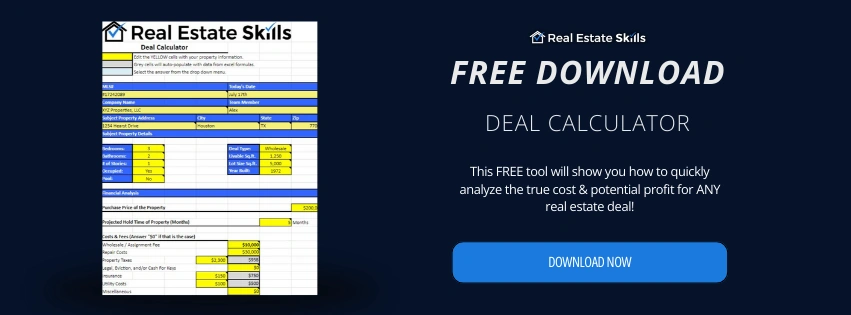
DealMachine's comps and estimates give you a starting point, but your offer is what makes or breaks a deal. Download our free Deal Calculator spreadsheet to work out your Maximum Allowable Offer (MAO, the most you can pay and still profit), factor in rehab and closing costs, and see your profit spread before you send a single postcard.
DealMachine Pricing: How Much Does It Cost In 2026?
DealMachine costs $99 per seat per month on Basic or $149 per seat on Pro, with 10,000 or 20,000 monthly data credits. Scale runs $599 a month per package of 10 seats and 100,000 credits. Postcards cost extra, $0.70 to $0.89 each, and annual billing saves 17%.
DealMachine prices by the person now, not by the account. Each seat (one user login) gets its own monthly pool of data credits, and everything that pulls contact information out of the platform spends them. Here's what each plan costs as of October 2026. Prices change, so confirm on DealMachine's pricing page before you buy.
| Basic | Pro | Scale | |
|---|---|---|---|
| Price (billed monthly) | $99 per seat | $149 per seat | $599 per package |
| Data credits per month | 10,000 per seat | 20,000 per seat | 100,000 per package |
| Seats | Buy as many as you need | Buy as many as you need | 10 per package |
| What the extra money buys | Base plan | Premium filters, priority support | Onboarding and team training, single sign-on, dedicated account manager |
| Best for | A solo investor testing one market | A solo operator or small team marketing every month | Agencies and large teams buying data in bulk |
Every plan includes the same core: nationwide property and owner data, saved searches and filters, the driving for dollars app, the postcard app, team management, and API, CLI and Zapier connections for plugging DealMachine into other tools. The difference between plans is mostly how much data you can pull and how fast support answers.
One thing that catches people off guard: a two-person team on Basic is $198 a month, and three people on Pro is $447. Price the seats before you price the plan.
How Do DealMachine's Data Credits Work?
A data credit is DealMachine's billing unit for contact and property data. Browsing and searching inside the app are free. Revealing one owner's contact info costs one credit, and exporting costs one credit per record. Credits reset every month, and unused ones don't roll over.
In the old days, DealMachine sold "unlimited skip tracing." Skip tracing for real estate just means looking up a property owner's phone numbers and email addresses so you can contact them. That's gone. Today, contact data comes out of your credit balance, and here's how it actually gets spent:
- Revealing a contact: 1 credit per person. One person costs one credit no matter how many phone numbers and emails come back. A property with four contacts (owners, a spouse, relatives) costs four credits to reveal in full.
- Exporting: 1 credit per record, and a property and a contact each count as a record. Exporting 10 properties with one contact each spends 20 credits.
- Repeats are free: once you've revealed or exported a record, pulling it again in the same billing month doesn't cost a second credit.
- Separate balances: postcards are paid from a separate mail balance, not your data credits. DealMachine also lists AI credits for its Copilot assistant as coming soon.
DealMachine's help center explains how its data credits work in more detail.
The part that bites is the reset. Credits you don't use this month are gone. If you pull hard one month and coast the next, you pay for capacity you never touch. Most beginners I talk to buy more data than they can follow up on, and on this model that mistake now has a monthly price tag.
What Does A Real Month On DealMachine Cost?
A solo investor on Basic who exports 1,000 leads with one contact each and mails 500 standard postcards spends about $474 that month: $99 for the seat and $375 for postcards. The 1,000 leads use 2,000 of the plan's 10,000 credits.
💡 Example: One Month On Basic vs. Pro (As Of October 2026)
- You pull a list of 1,000 high-equity absentee owners (owners who don't live in the property) and export each with one contact: 1,000 property credits plus 1,000 contact credits = 2,000 credits. Basic includes 10,000, so you've used a fifth of your month.
- You mail 500 standard 4x6 postcards. On Basic that's 500 × $0.75 = $375. On Pro it's 500 × $0.70 = $350.
- Your month on Basic: $99 + $375 = $474. On Pro: $149 + $350 = $499.
- Bump the mail to 1,000 postcards and both plans land at exactly $849 ($99 + $750 vs. $149 + $700). At that volume, Pro's cheaper postcards pay for the upgrade, and you get double the credits and the premium filters for free.
My take: if you're mailing fewer than about 1,000 postcards a month, start on Basic. If you're mailing more, Pro costs you nothing extra. These are illustrative numbers, and your real cost depends on how many contacts you reveal per property and how much you mail.
Is DealMachine Free? Is There A Free Trial?
DealMachine no longer offers a time-limited free trial. You can create a free account without a credit card and browse properties, owners and search results for as long as you want. To reveal contact info, export, or mail, you need a paid plan.
This is a real change from the 7-day trial most reviews still mention (and that DealMachine's older help pages and App Store listing still describe). On DealMachine's free account, contact details show up blurred or locked, and paid features open an upgrade screen.
I actually like this setup for beginners. Search your own market for free, see whether the properties you'd target are in there, and only pay when you're ready to reach owners. Just don't enter a card until you know which plan and how many seats you need.
Postcard Pricing
DealMachine postcards cost $0.75, $0.81 or $0.89 each on Basic and $0.70, $0.80 or $0.87 on Pro, for 4x6, 6x9 and 6x11 cards. Mail is pay as you go and billed separately from your subscription and data credits.
| Postcard Size | Basic | Pro |
|---|---|---|
| 4x6 | $0.75 | $0.70 |
| 6x9 | $0.81 | $0.80 |
| 6x11 | $0.89 | $0.87 |
Scale customers and high-volume mailers can ask DealMachine for a custom per-piece rate.
What If I'm On An Older DealMachine Plan?
If you subscribed before the 2026 change, your classic Starter, Pro or Pro Plus plan keeps working, and you don't have to switch. Classic plans charged a flat monthly price with a fixed lead limit. New plans charge per seat with monthly data credits.
This is why you'll see so many different DealMachine prices online. Third-party reviews from mid-2026 list classic Starter at $119 a month ($99 billed annually), Pro at $179 ($149 annually), and Pro Plus at $279 ($232 annually). Those are classic-plan prices. If you're signing up today, the Basic, Pro and Scale prices above are what you'll be offered.
DealMachine Pros And Cons
DealMachine's biggest pros are its driving-for-dollars app, a free browsing account, a large owner database and built-in postcards. Its biggest cons are metered data credits that expire monthly, no full built-in dialer or CRM, pricier postcards than rivals, and an F rating at the BBB.
| Pros | Cons |
|---|---|
| The driving-for-dollars app is included in every plan, with route tracking, photos and instant owner lookups | Revealing and exporting contacts spends data credits, and unused credits disappear each month |
| A free account with no card and no time limit lets you test your market first | The new plans don't list a full built-in dialer, and there's no full CRM |
| A large database: over 150 million properties and 240 million people, by DealMachine's count | Postcards cost $0.70 to $0.89, above PropStream's and BatchLeads' advertised rates |
| Postcards and automated drip campaigns go out straight from your saved lists | BBB rating of F, and DealMachine's terms say fees are non-refundable |
| API, Zapier, Claude and ChatGPT connections come with every plan | Per-seat pricing adds up quickly for teams |
| Re-revealing or re-exporting the same record in the same month is free | The platform relaunched in July 2026 and the app was rebuilt in October, so expect changes |
If you read only one row, read the first. DealMachine's best feature and its biggest drawback both live there: a great tool for finding properties, paired with a meter on the information you need to act on them.
Is DealMachine Legit? Complaints, Ratings, And Reviews
Yes, DealMachine is a real, established company, founded in 2017 in Indianapolis, with over 150,000 users by its own count and a 4.8-star App Store rating. But the BBB rates it F for nine unanswered complaints, and recent reviews target the 2026 credit system.
| Where | Rating (As Of October 2026) | What To Know |
|---|---|---|
| Apple App Store | 4.8 out of 5, about 5,000 ratings | Reflects the mobile driving-for-dollars app. There's no way to tell how many ratings came after the 2026 relaunch. |
| Trustpilot | 3.6 out of 5, 68 reviews | The profile is unclaimed, and DealMachine doesn't invite reviews there. All four reviews from the past 12 months are 1-star. |
| Better Business Bureau | F, not accredited | The BBB cites nine complaints, none of which DealMachine responded to. |
Legit and right for you are two different questions. DealMachine is a real company with real data, run by its two co-founders, and plenty of investors have closed deals with it. That's not in dispute. What the ratings tell you is how things go when something goes wrong, and right now that's the weak spot.
Here's what keeps coming up in complaints, in my own words:
- Billing and cancellations: Some users report charges they didn't expect (see a Reddit thread on DealMachine billing complaints). One said a refund was refused after an add-on they cancelled right away. A BBB reviewer said the cancel option in the app didn't work for them.
- The 2026 credit system: The newest reviews are from longtime users. Their complaint is that actions which used to be included now cost credits, and they don't want a chat-style AI interface.
- Data quality: A few users say the data in their markets is stale or wrong (including a beginner's thread on DealMachine data concerns). This varies by market, and I can't confirm it either way without testing.
- Removed features: One four-year user says DealMachine pushed its calling tools hard, then pulled them.
- Homeowners on the other end: Some BBB reviews come from homeowners who got calls or texts from businesses using DealMachine data, and they cite Do Not Call concerns.
On the positive side, the praise is consistent too: the driving-for-dollars app is easy to use, having owner contact info in one place saves real time, and many reviewers single out support staff by name. Most of those positive Trustpilot reviews date to early 2025, before the relaunch.
Over on Reddit, a recent r/WholesaleRealestate thread titled "The downfall of DealMachine" drew dozens of comments, and older threads mostly praised the free skip tracing the new plans no longer offer. That shift in tone matches everything else I found.
How To Protect Yourself Before You Subscribe
Explore on the free account first, then pay monthly instead of annually until you're sure. DealMachine's terms say fees are non-refundable, plans renew automatically, and mail credits expire after a year. Set a reminder before renewal, and track your data credit balance.
- Search your market free first. A free account needs no card. Confirm the properties you'd target are in there before you pay.
- Start monthly. Annual billing saves 17%, but DealMachine's terms say paid fees are non-refundable. Don't prepay a year until you've proven the tool works for you.
- Price the seats. Every user is a separate seat. Only add teammates who'll actually use it.
- Set a renewal reminder. Subscriptions renew automatically. Put a reminder on your calendar a week before your billing date.
- Watch your credit balance. Click your name in the corner of the screen to see what's left and when it resets. Credits don't roll over.
- Don't overload your mail wallet. Money you add for postcards expires one year after it's added, and expired funds aren't refunded.
- Know the calling rules. DealMachine's terms make you, not DealMachine, responsible for following telemarketing and Do Not Call laws when you contact owners (see the FTC's telemarketing and Do Not Call rules). Scrub your lists before you call or text.
This is educational, not legal advice. Telemarketing and texting rules vary by state, so confirm your outreach plan with a licensed attorney.
How Do You Cancel DealMachine?
Log in on a computer, click your name, open Billing Settings, scroll to the bottom and click Cancel Subscription, then confirm. Your access continues until the end of the billing period, and you won't be charged again. If you subscribed through Apple, cancel in your Apple ID settings.
Here are DealMachine's cancellation steps for the new platform:
- Log in to your DealMachine account.
- Click your name in the corner of the screen and open Billing Settings.
- Scroll to the bottom and click Cancel Subscription.
- Read the reminder about your mail wallet (the balance stays on your account but can't be used without a subscription), then continue.
- Pick a reason and confirm.
After you cancel, DealMachine says your leads stay in the account, your marketing pauses, and your access runs through the end of the current billing period. If the cancel button doesn't show up, contact support and ask for a live person. DealMachine says an overdue balance or unfinished account setup can hide it.
One more thing worth knowing: DealMachine's terms of service also mention a 30-day notice period for ending the agreement. If you're cutting it close to a renewal date, cancel early and save a screenshot of the confirmation.
Who Should Use DealMachine (And Who Should Skip It)?
DealMachine fits investors who drive for dollars and teams that already run their own dialer and CRM and want bulk owner data. Skip it if you're brand new with no marketing budget, need a built-in dialer and CRM, or want flat, predictable monthly pricing.
| If You Are... | Verdict | Why |
|---|---|---|
| An investor who drives for dollars | Good fit | The driving app is included in every plan and is still the best part of the product |
| A team with its own dialer and CRM | Good fit | Per-seat data credits, exports and API connections are built for feeding other tools |
| A wholesaler building a cash buyer list | Good fit, with a budget | You can pull owners of multiple properties, but every contact you reveal costs a credit |
| Brand new with little or no marketing money | Skip for now | You'll pay for data before you've learned what to do with it |
| A cold caller who wants calling and a CRM in one app | Look elsewhere | The new plans don't list a full built-in dialer, and DealMachine isn't a full CRM |
| Someone who wants a flat, predictable bill | Look elsewhere | Data is metered monthly, credits expire, and mail is billed separately |
Here's who DealMachine is built for:
- You drive for dollars: If you like working a market in person, DealMachine still does this better than most. The app tracks your route, lets you snap a photo of a rough-looking house, and pulls the owner's information on the spot. That photo can even go on the postcard you send them. If this is how you plan to find deals, it's the strongest reason to pay for DealMachine.
- Your team already has its own systems: If you run a call team with a separate dialer and a CRM (customer relationship management software, the system that tracks every lead and follow-up), the new DealMachine is built for you. You pull and enrich owner data, push it into your tools through exports, Zapier or the API, and pay per seat. That's the direction the whole July 2026 relaunch points.
- You need cash buyers: A cash buyer is an investor who buys with cash, and they're who you sell your wholesale deals to. When I interviewed Matt Kamp, then a VP at DealMachine, back in 2022, he suggested pulling a list of people who own several properties in your market. Those owners are already investors, which makes that list one of the quickest ways to start building a cash buyers list somewhere new. It still works on the new plans. Just remember each contact you reveal spends a credit.
And here's who should skip it:
- You're brand new and have no marketing budget: This is the group I'd steer away from right now. Between the seat, the credits and the postcards, you're spending money every month before you've analyzed your first deal. The free account is great for learning your market, but you don't need paid owner data to do your first deal. I'll show you the free alternative I'd use instead in the next section.
- You want to cold call from one app: If calling is your main channel, you want the dialer, the call notes and the follow-up reminders in the same place. The new DealMachine plans don't advertise that, and DealMachine has never been a full CRM. You'll end up paying for DealMachine plus a dialer plus a CRM.
- You need a predictable bill: Some months you'll use every credit. Other months you won't, and the unused credits vanish. If you'd rather know exactly what you'll pay each month, a flat-priced tool will sit better with you.
- You need stability right now: The platform relaunched in July and the mobile app was rebuilt in October. If you're running a business that can't absorb a feature changing mid-campaign, it's reasonable to wait a few months and see how the new version settles.
DealMachine vs. PropStream And Other Alternatives
Choose PropStream if you want MLS data and comps at a flat $99 a month. Choose BatchLeads if you want owner phones and emails included on every plan, from $119 a month, plus an add-on dialer. Choose DealMachine if driving for dollars is your main lead source.
| As Of October 2026 | DealMachine | PropStream | BatchLeads |
|---|---|---|---|
| Starting price | $99 per seat (Basic) | $99 (Essentials) | $119 (Growth) |
| Free trial | No time limit; free browsing account, contacts locked | 7 days with 50 free leads | 7 days |
| Owner phones and emails | 1 data credit per contact (10,000 credits per seat on Basic) | 12¢ per contact on Essentials; included on Pro or with the Connect add-on (from $30 a month) | Included on every plan (10,000 leads a month on Growth) |
| Users included | 1 per seat | 1 (extra users $30 a month each) | 3 |
| Calling | No full built-in dialer listed in new plans | Click-to-dial on Pro or with Connect | Dialer AI add-on, $89 a month |
| 4x6 postcard | $0.75 on Basic | From $0.57 | $0.58 on Growth |
| MLS data | Not listed on its pricing page | Included | Included |
Prices and features change often. Check each company's pricing page before you choose. If you want a wider field than these three, see our ranking of the best real estate wholesaling software.
Which Is Better, PropStream Or DealMachine?
PropStream is better for desk research: it includes MLS data, comps and calculators on a flat monthly price, with skip tracing at 12¢ per contact or free on higher tiers. DealMachine is better if you find deals by driving neighborhoods and want that app built in.
I'd put it this way: PropStream is the research tool, DealMachine is the field tool. If you spend your time at a desk pulling lists, comping properties and mailing, PropStream gives you more for the same $99. If you're in the car most evenings tagging houses, DealMachine's driving app is the reason to pick it. For the full breakdown, read our PropStream review.
Is BatchLeads A Better DealMachine Alternative?
BatchLeads is the better DealMachine alternative if you call owners. Growth costs $119 a month with three users and owner contact info included on 10,000 leads a month, and you can add a built-in AI dialer for $89. DealMachine is cheaper for one person who mainly mails.
BatchLeads now operates under the PropStream umbrella (its site is branded "powered by PropStream"), and it's built for wholesalers who live on the phone. Owner contact info comes with every saved lead instead of being metered per reveal, three users are included, and its postcards run cheaper than DealMachine's. The trade-off is the price of entry: $119 a month before the dialer add-on, against $99 for a single DealMachine seat. Our BatchLeads review goes deeper.
The Free Alternative I'd Start With: The MLS
The MLS (Multiple Listing Service) is the database agents use to list homes for sale. It has on-market listings, expired and withdrawn listings, and sold data for comps. For a beginner with no marketing budget, it's the place to find a first deal before paying for lead software.
Here's my honest bias, and I'll say it once: if you're starting from zero, I'd find your first deal on the MLS before you pay for any lead tool. The properties are already for sale, the sellers are already motivated enough to list, and the sold data gives you the most reliable comps you'll find. No credits, no postcards, no monthly seat.
Then, once you have a deal or two behind you and a marketing budget, layer in a tool like DealMachine, PropStream or BatchLeads to go after the off-market owners everyone else is mailing.
Find Your First Deal Before You Pay For Lead Software
Lead tools like DealMachine charge you every month for owner data, and that only pays off once you know how to turn a list into a signed contract. Our FREE Training shows you how to consistently wholesale, flip houses and invest in rental properties straight from the MLS, without spending a dollar on marketing. Watch it today, then decide which tools your business actually needs.
Watch The FREE Training →Is DealMachine Worth It In 2026?
Yes, if you drive for dollars or run a team with its own dialer and CRM. No, for most brand-new investors. A year on Basic costs $1,188 before mail, and real outreach usually costs several times that, so judge it against your marketing budget, not the subscription.
My verdict is a 3.3 out of 5. The driving app is still excellent, the data is broad, and the free account makes it easy to try. Against that: metered credits, an F at the BBB, and a platform that's mid-overhaul. It's worth it for the right investor and an expensive distraction for the wrong one.
DealMachine's own launch announcement says one closed deal pays for the platform for a year. On the subscription alone, that's true. But the subscription is the cheap part. The real cost of finding off-market deals is the marketing you run on top of it, which for most investors means real estate direct mail.
💡 Example: What A Year Of DealMachine Really Costs (As Of October 2026)
- Basic plan, one seat: $99 × 12 = $1,188 a year.
- Add 500 standard postcards a month at $0.75 each: $375 × 12 = $4,500 a year.
- Total for the year: $5,688, before your time, phone costs or any other tools.
- One wholesale deal with a $10,000 assignment fee (the fee you're paid for handing your purchase contract to a cash buyer) covers that year and leaves about $4,312.
- Zero deals in that year means you're down $5,688. The software didn't fail; the follow-up did.
These numbers are illustrative, and your results will vary with your market, your list and how consistently you follow up. Nothing here is a promise of income.
Here's the question I'd actually ask: can you afford to market consistently for six months without a deal? If yes, DealMachine is a reasonable tool to run that marketing through. If no, the subscription isn't your problem yet, and paid data won't fix it.
If you're still deciding, do this before you spend a dollar:
- Open a free account and search the ZIP codes you actually want to invest in.
- Count the properties that fit your criteria, like high equity, absentee owners or vacant homes. If there are only a few hundred, you may not need a paid data plan at all.
- Pick your channel: driving for dollars, mail, or calling through your own dialer. DealMachine earns its keep on the first two.
- If you subscribe, start on Basic, billed monthly, and set a fixed mail budget for 90 days.
- Track cost per conversation. Write down every owner who calls you back. At 90 days, if those conversations aren't turning into offers, cancel and put that money toward a different lead source.
DealMachine Review FAQs
Final Thoughts On This DealMachine Review
DealMachine is still a good tool for investors who drive for dollars or run teams with their own systems, but it's no longer the flat-priced, all-in-one app many reviews describe. Treat it as a data source you pay for by usage, and budget accordingly.
I've watched DealMachine go from the app that ended the notepad-on-the-passenger-seat era to a data platform built for teams and AI tools. Both versions solve a real problem. The difference is who they're built for, and in 2026 that's less often the brand-new investor with $300 and a free weekend.
Here's the part no software changes: a lead tool only finds owners. You still have to talk to motivated sellers, read the situation, make an offer that works, and follow up when they say "not yet." I've seen investors with the best data in town close nothing, and I've seen investors with a free MLS login and a phone close deal after deal.
So pick the tool that fits how you actually find deals, keep your costs tight for the first 90 days, and spend most of your energy getting good at the conversation. That skill transfers to every tool you'll ever use.
The Data Is The Easy Part. Learn The Process That Closes Deals.
Every lead tool hands you owner names and phone numbers. What separates investors who get paid is knowing which deals are worth chasing and how to make offers sellers actually accept. Our FREE Training walks you through the same MLS-based system thousands of our students use, with no paid lead lists required. Watch it today and start working your market the smart way.
Watch The FREE Training →
About The Author
Founder & CEO, Real Estate Skills
Alex Martinez is the Founder and CEO of Real Estate Skills. He has wholesaled and flipped houses for over 14 years, been part of 1,000+ real estate transactions, and personally acquired 55+ residential investment properties. He has trained 6,000+ investors nationwide.
Real Estate Skills is not a law firm, and the information in this article is provided for educational purposes only. It does not constitute legal, tax, or financial advice. Software pricing, features and terms change often, and telemarketing, texting and direct mail rules vary by state and change over time. Real estate investing carries risk, and past results do not guarantee future outcomes. Always confirm current terms with the software provider, and consult a licensed attorney before running outreach campaigns or entering any contract or transaction.

👉FREE Training
How To Consistently Wholesale, Flip Houses, & Invest In Rental Properties From The MLS
(Without Spending $1 On Marketing)

Alex Martinez, the founder of Real Estate Skills, is known for his strong, practical expertise in real estate, starting from a beginner with no family connections in the industry to acquiring over 55 real estate deals, including wholesale and flips, within his first year.
He has dedicated his career to providing cutting-edge education and resources for real estate professionals. He emphasizes the importance of self-taught knowledge through mentors, books, and hands-on experience.
His journey from earning a modest income to becoming a successful real estate entrepreneur and educator showcases his expertise and dedication to the field.

Ryan Zomorodi, co-founder and COO of Real Estate Skills, leverages his experience from a diverse background in real estate investment, construction management, and entrepreneurship to provide comprehensive education in the real estate sector.
His expertise is rooted in hands-on experience, extensive industry knowledge, and a commitment to empowering others through education.
Ryan's journey reflects a blend of practical experience and entrepreneurial success, contributing to his role in developing a platform that educates and supports aspiring real estate professionals.
Read Ryan's Full Bio >>
