
Double Close Real Estate: How Double Closing Works & What It Costs
Sep 08, 2026

Written by
Alex Martinez, Founder & CEO, Real Estate Skills. Has wholesaled and flipped houses for over 14 years, been part of 1,000+ real estate transactions, and personally acquired 33+ residential investment properties. Has trained 6,000+ investors nationwide.
Reviewed by
Ryan Zomorodi, Co-Founder & COO, Real Estate Skills. Reviewed the double-close process, funding structures, and state legality points in this guide before publication.
Publication history: Originally published September 22, 2020. Updated September 2026 with a full assignment vs. double closing comparison, a decision framework, an itemized cost breakdown, corrected funding terminology, and verified 2026 state rules. Contract and legality points verified by Ryan Zomorodi, Co-Founder & COO of Real Estate Skills.
A double closing is two separate sales of the same property, hours apart: you buy from the seller, then immediately resell to your end buyer. Neither side sees your profit. It costs more than assigning. Expect two sets of closing costs, typically $3,000 to $8,000 extra.
Most people land on this page in the middle of a deal. You have a property under contract, you have a buyer, and something about the assignment isn't working. Maybe the contract says you can't assign it. Maybe the spread got big enough that putting it on an assignment addendum feels like handing your buyer a reason to renegotiate. Maybe their lender won't touch an assigned contract.
That's the situation a double close is built for. You stop selling a contract and start selling a house. Briefly, sometimes for less than an hour, but genuinely. Your name goes on the deed. Two contracts, two settlement statements, and the spread between them is yours without either side seeing it.
Here's the honest version before you read any further: we assign about 99% of our deals. Assignment is cheaper, faster, and the right call almost every time. Double closing is what you reach for when assigning isn't available or isn't safe, and knowing which situation you're in is most of the skill. This guide covers what a double closing is, what it costs with real numbers, how the same-day process runs, when to use it instead of assigning, and where state law has tightened in 2026.
What Is A Double Closing? (The Mechanics)
A double closing is two completely separate real estate transactions on the same property, closed back-to-back, usually within hours of each other. You buy the property from the original seller, then immediately resell it to your end buyer. You hold title in between, sometimes for only minutes.
To understand the mechanics, you have to see the deal as two distinct events involving three parties: the Seller (A), you (Investor B), and the End Buyer (C). This is the "A-B-C" transaction chain.
- Transaction 1 (The A→B Purchase): You enter a contract to buy the property from the original seller. You go to the closing table, sign the buying documents, and the deed transfers to you or your entity. For that window, you are the legal owner of record.
- Transaction 2 (The B→C Sale): Moments later, sometimes at the same table, you sell that same property to your end buyer. You sign the selling documents, and the deed transfers from you to them.
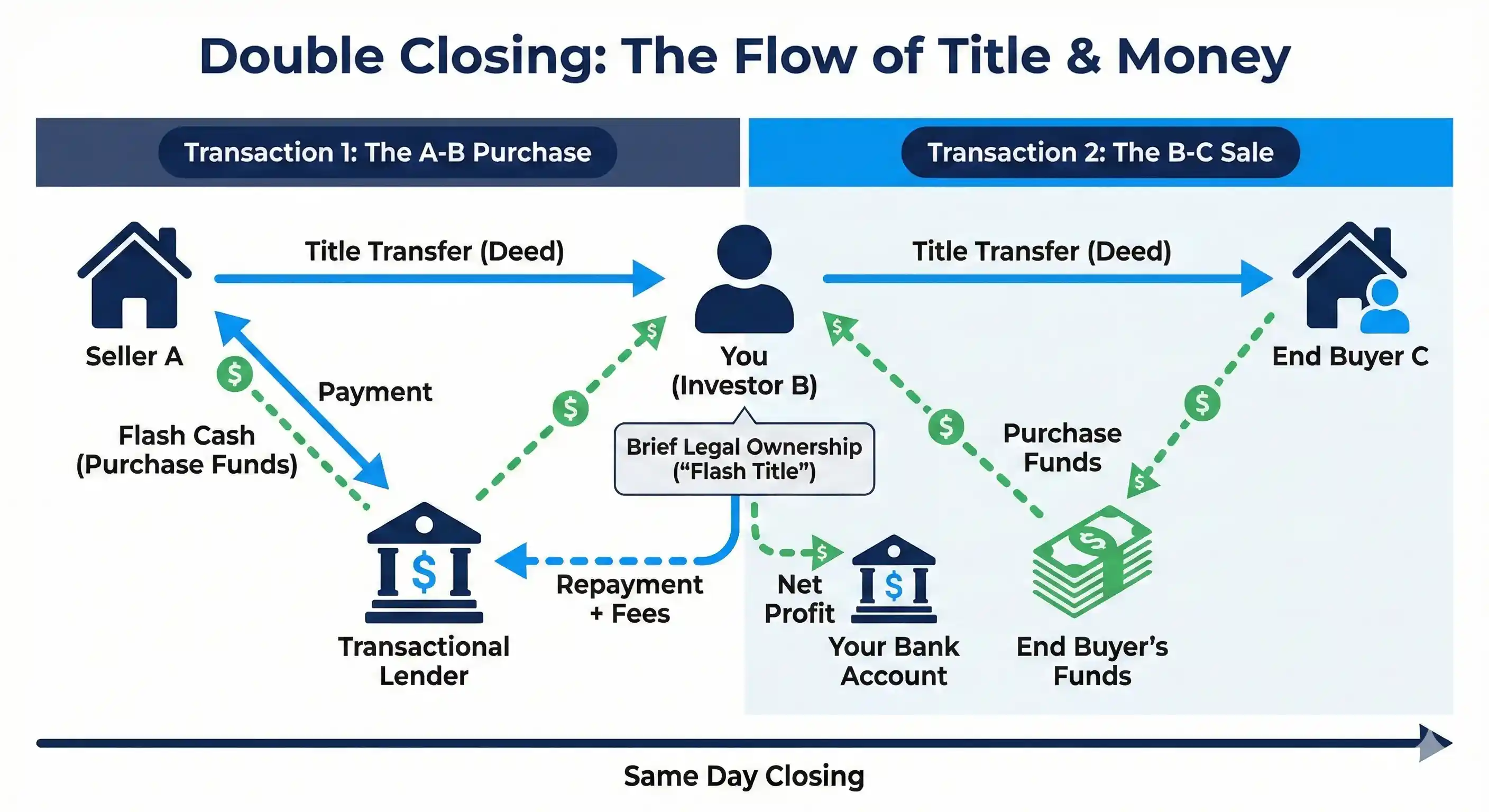
What makes the strategy work is that brief window of ownership. You might hold title for twenty minutes, but because you genuinely owned the property, you are the principal in the second transaction. You don't disclose your purchase price to the end buyer, and you don't disclose your sale price to the original seller.
Compare that to how assignment of contract works. There, you aren't selling the property at all. You're selling your rights under the contract, the end buyer steps into your position, and they close directly with the original seller. Simple and cheap, but your fee is visible to everyone on the HUD-1 settlement statement.
A double close splits those events into two separate timelines, and that separation is what protects your spread.
Double Escrow, Back-To-Back Closing & Other Names For The Same Deal
Double escrow, concurrent closing, simultaneous closing, back-to-back closing, and dual close all describe the same transaction as a double closing: two separate sales of one property, closed hours apart, with you as the buyer in the first and the seller in the second.
You will hear this deal called five different things depending on who you are talking to, and it throws beginners constantly. A title officer in Arizona says double escrow. An attorney in Illinois says simultaneous closing. Your cash buyer says back-to-back. They all mean the same two transactions.
One of those names carries baggage, and you should know why before you use it in front of a closing agent.
Double escrow has a reputation problem. Chicago Title's own fraud training materials list "flips or double escrows" as a category of mortgage fraud, and the Justice Department has prosecuted cases built around them. So when you say the phrase to an escrow officer, some of them flinch.
Here is what actually made those deals criminal, because it was not the two-closing structure. In the prosecuted cases, the second sale ran at an inflated price on a fraudulently obtained mortgage, and the fact that the property was being sold twice on the same day was deliberately hidden from the lender. Fraud requires concealment and a victim. That is what those had.
A legitimate double close has neither. Your title company knows about both sides before either one funds. Two real contracts, two real settlement statements, nothing hidden from anyone who is entitled to see it. The structure is identical. The intent is the opposite.
The practical version of that rule: if anyone ever suggests keeping the first sale off a lender's radar, you are being invited into the illegal one. Walk.
Back-to-back closing is the more useful term, because it describes the timing honestly. The two closings are sequential, not simultaneous. The deed from your purchase has to record before you can convey to your buyer, and county recorders have same-day cutoffs. Miss the cutoff and your second closing slides to the next business day, which is why "double closing" and "same-day closing" are not always the same sentence.
Two terms that sound similar and are not this deal at all. Double ending is one agent representing both sides of a single sale, which is dual agency. A split closing or bifurcated closing is one sale where the buyer and seller each use their own closing agent. Neither involves you buying and reselling.
When you call a title company, Ryan's advice is to vet them before you have a deal on the table, because not every title company will handle this. Ask whether they do back-to-back or same-day double closings. If the answer is a pause, keep dialing.
Read Also: Title Companies That Work With Wholesalers
Assignment vs. Double Closing: Which Should You Use?
Assign when your buyer is fine seeing your fee and the contract allows it. It's cheaper, faster, and one closing. Double close when the contract blocks assignment, the spread is large enough to invite renegotiation, or your buyer requires you on title.
Both get you paid. They're different transactions, and the difference costs real money.
An assignment transfers your position in the contract. You never own anything, your buyer closes directly with the seller, and your fee shows up as a line item on the settlement statement. One closing, almost no cost to you.
A double close means you buy the house and sell the house. Two contracts, two closings, two settlement statements, and two sets of closing costs. Your buyer sees the price they're paying and nothing else.
Here's how they compare on the things that actually decide it:
| Assignment | Double Close | |
|---|---|---|
| Who sees your profit | Buyer and seller both see your fee on the settlement statement | Nobody. Each side sees only their own price |
| Cost to execute | Little to nothing, often a few hundred dollars | Two sets of closing costs, roughly $3,000 to $8,000 more |
| Funding required | None for the purchase. You may still need an earnest money deposit, which some wholesalers cover with earnest money deposit funding | The full purchase price for the first closing |
| Timeline | One closing, typically 14 days from contract | Two closings, usually same day, occasionally next |
| Contract requirements | Must be assignable; "and/or assigns" language helps | No assignment clause needed. You're performing, not assigning |
| Title company willingness | Some closing offices have stopped handling assignments | Wholesale-friendly title company required; not all will |
| Best used when | Buyer knows and accepts your fee, modest spread | Large spread, non-assignable contract, or buyer requires it |
| Risk level | Lower. Fewer moving parts, no capital exposure | Higher. You're on title, coordinating two closings |
Double Closing Explained: When To Use It Instead Of An Assignment
Ryan Zomorodi walks through both exits and explains exactly when he reaches for a double close. Opens at the double closing section.

Four Reasons To Double Close Instead
The spread is big enough to spook your buyer. A $10,000 fee on an assignment addendum rarely gets challenged. A $50,000 fee often does. Your buyer's return doesn't change either way, but seeing the number invites a renegotiation you don't need. Double closing removes the conversation.
The contract can't be assigned. Genuinely non-assignable contracts are rarer than beginners think. Most realtor contracts permit assignment, usually with seller consent. But REO, HUD, and some institutional sellers restrict it outright, and a double close sidesteps the restriction because you're not assigning anything. Worth knowing: Ryan has assigned REOs, you just have to move earlier in the transaction. Later on, it gets harder.
Your buyer requires it. Institutional buyers and hedge funds sometimes want a wholesaler on title between them and a mom-and-pop seller, creating separation from the optics of buying directly from a distressed homeowner. When a buyer at that level asks for a double close, that's the deal.
You don't know the buyer yet. This one gets missed. Even on a modest fee, if you have no relationship with the cash buyer, an assignment hands a stranger your number and a reason to push. Alex and Ryan both make the same point: they assign because their buyers want them to win. Without that relationship, the fee is exposed.
And one reason to build a track record. When you double close, you're the buyer on one settlement statement and the seller on the other, as principal. That paper trail matters later. When you're raising private or hard money loans for flips and rentals, a stack of closings you were principal on is a different conversation than a stack of assignment fees.
Which Should You Use On This Deal?
Assign unless something specific stops you. Double close when the contract prohibits assignment, the spread is large enough to invite a renegotiation, your buyer requires you on title, or state marketing rules make assignment awkward. Assign when the spread is modest or funding isn't available.
Run your deal through these. First one that applies is your answer.
- The contract prohibits assignment, so double close. Not "the seller might not like it." Actually prohibits it. REO, HUD, some institutional sellers. You're buying and reselling, so there's nothing to assign and the restriction doesn't reach you.
- Your buyer or their lender requires you on title, so double close. Hedge funds and institutional buyers sometimes want separation from the seller. Some lenders won't fund an assigned contract. When the buyer sets the structure, that's the structure.
- The spread is large enough to cause a problem, so double close. There's no universal number. The question is whether your buyer, seeing that figure on an addendum, would come back at you. Ten thousand rarely does. Fifty thousand often does. You know your buyer.
- You're wholesaling in a state with marketing restrictions, so double close is usually the safer structure. Illinois, Oklahoma, Ohio, South Carolina. Taking title makes you the actual seller and removes the equitable-interest argument entirely. Talk to a local attorney before you decide.
- You don't have a relationship with the buyer, so lean double close. Even on a normal fee. An assignment hands a stranger your number and a reason to negotiate.
- None of the above and the spread is modest, so assign. This is most deals. Cheaper, faster, one closing, no capital. Assignment is the default for a reason.
- You have no access to transactional funding and no pass-through option, so assign. A double close you can't fund isn't a double close. Sort the funding before you commit to the structure, not after.
One number to sanity-check against. If your gross spread is under about $10,000, double closing is usually the wrong call, because two sets of closing costs will take a large share of it. That's a rule of thumb, not a rule. A $7,000 spread on a non-assignable REO still gets double closed, because the alternative is no deal at all.
Decide before you need to. Whichever way you're leaning, sort it out during your inspection period, while your earnest money is still refundable and you can still walk. That means confirming your title company handles double closes, confirming funding, and knowing whether the contract is assignable, all before your contingency expires. A structure question you're still solving three days out from closing is a structure question you're going to lose.
What Does A Double Closing Actually Cost?
A double closing costs roughly $3,000 to $8,000 more than an assignment, because you pay closing costs twice: once buying, once selling. On a $280,000 purchase with a $20,000 spread, that's about $4,000, leaving roughly $16,000. Add transactional funding and it's a point or two more.
Everybody says "two sets of closing costs." Almost nobody shows you what that means on a real deal, so here it is.
The deal: you have a property under contract at $280,000. Your cash buyer will pay $300,000. On an assignment, that's a $20,000 fee.
| Same Deal, Both Ways | Assignment | Double Close |
|---|---|---|
| Your purchase price | n/a | $280,000 |
| Buyer pays | $300,000 | $300,000 |
| Gross spread | $20,000 | $20,000 |
| A→B closing costs (you as buyer) | n/a | ~$2,000 |
| B→C closing costs (you as seller) | n/a | ~$2,000 |
| Transactional funding, if used (≈1.5%) | n/a | ~$4,200 |
| Your closing costs | ~$0 to $500 | n/a |
| Net to you | ~$19,500 to $20,000 | ~$16,000, or ~$11,800 with funding |
Where the money actually goes. On the buy side you're paying recording fees, escrow or attorney fees, a lender's or owner's title policy, and transfer taxes in states that charge them. On the sell side you may be covering the owner's title policy for your end buyer, plus another round of escrow and recording. Two closings, two of nearly everything.
The two variables that move this most:
- Transfer taxes. Some states charge nothing. Others charge a percentage of the sale price, and you'll pay it twice. This is the single biggest reason a double close that pencils in one state doesn't in another, and it's the first thing to ask your title company about.
- Whether you need funding. If you're using your own cash or a pass-through closing, the funding line is zero. If you're borrowing, it's a point or two of your purchase price, which on a $280,000 deal is real money against a $20,000 spread.
Run the math before you pick the structure, not after. Alex's version of this is blunt: on that same deal, instead of $20,000 you might make $16,000 double closing. That's a fifth of your profit for privacy. Sometimes that's an easy trade. On a $60,000 spread, $4,000 to keep the number off the table is nothing. On a $12,000 spread it's most of the reason to do the deal at all.
What doesn't come out of your money: on an assignment, your fee isn't reduced by closing costs or agent commissions. Commissions are tied to the original sale price, and the end buyer pays closing costs as the actual purchaser. Closing costs only become your problem when you double close, which is exactly the point.
Figures are a worked example, not a specific closed transaction. Closing costs vary significantly by state, county, and title company. Get a written estimate from your closing agent before you commit to a structure.
Do You Need Money For A Double Closing?
You need funds for the first closing, but they don't have to be yours. Three options: transactional funding, a 24-to-72-hour loan sized to your purchase price; your own cash; or in some markets your end buyer's funds through a pass-through closing.
Here's the part that trips people up. In an assignment, you never buy anything, so you never need the purchase price. In a double close, you are actually buying the house. Somebody has to wire $200,000 to the title company for that first closing, and it can't be nobody.
Three ways to solve it.
Transactional funding. A short-term loan that exists only for the length of the closing, usually 24 to 72 hours. The lender wires into escrow on your behalf, you take title, you resell, and the loan is repaid out of your buyer's funds the same day. It costs a couple of points, which comes out of your spread. We compare the lenders who offer it here: transactional funding lenders.
Your own cash. Cleanest option if you have it. Most people starting out don't, and that's fine. This isn't a strategy that requires you to be capitalized.
Pass-through closing. This is where your end buyer's funds arrive in escrow first and are used to fund your purchase from the seller. Ryan's position is that it's a legitimate way to double close with none of your own money. You just need a wholesale-friendly title company, and you vet them before you have a deal on the table, because not every one will do it.
That last caveat is doing real work, and it's gotten heavier over the past few years. Alex puts it plainly: some escrow companies and some investors aren't keen on a double close funded with one person's money. Title underwriters in several states now decline it outright over chain-of-title exposure, and closing attorneys in some markets have stopped offering it entirely.
So the honest answer on pass-through funding in 2026 is that it's neither fraud nor freely available. It's a title-company-by-title-company, state-by-state question, and it has been narrowing. Ask before you structure the deal, not the week you're closing. If your title company says no, transactional funding is the fallback and the deal still works.
One thing that isn't optional either way: you need a genuine ability to close. Making an offer you couldn't perform on if the resale fell through is where bad-faith and misrepresentation exposure starts. Whether that ability comes from a lender, a partner, or your own account matters less than the fact that it's real.
How To Double Close In 7 Steps (The Logistics)
To double close, you find a deal with enough spread to absorb two sets of closing costs, get it under contract, line up a cash buyer and your funding, open two files with one title company, and close both transactions in sequence on the same day.
Executing a double close requires precision. Unlike a standard purchase where you have 30 days to figure things out, both closings happen within hours of each other. One mistake on the A→B side immediately derails the B→C side.
Follow this workflow to make sure both sides fund successfully:
- Step 1: Find The Right Deal
- Step 2: Run The Numbers
- Step 3: Get It Under Contract
- Step 4: Find The End Buyer
- Step 5: Line Up Your Funding
- Step 6: Open Escrow
- Step 7: Execute The Double Close
Step 1: Find The Right Deal (Deep Discount Required)
The math is the hardest part of this strategy. Because you're paying closing costs on the purchase and again on the sale, your spread needs to be significant.
You can't double close a property you picked up at 90% of market value. There isn't enough room. You need off-market properties, distressed homes, pre-foreclosures, or tired landlords, where you can acquire the asset well below the after repair value (ARV) minus repairs.
The margin squeeze: in a standard assignment, a $5,000 fee is a win. In a double close, a $5,000 spread is a loss. After two sets of closing costs and a funding fee, you'd be paying for the privilege of doing the deal.
Step 2: Run The Numbers
Before you make an offer, calculate the costs for both transactions. Beginners forget that on the A→B side they're the buyer, which means they're responsible for buyer's closing costs, and then they're the seller on the B→C side.
Work out both sets of closing costs, transfer taxes if your state charges them, and any funding cost. Then compare that net against what the same deal would pay you on an assignment. The full breakdown is in the cost section above.
Step 3: Get It Under Contract (The A→B Side)
Once the numbers work, sign a the purchase agreement that starts the deal with the seller. This creates your equitable interest in the property.
Contrary to what most people assume, you don't need "and/or assigns" language for a double close. You're not assigning the contract, you're performing on it. You're buying the house.
📍 The Inspection Period Is Your Lifeline
Always include an inspection contingency of 7 to 14 days in your A→B contract. It does two jobs at once:
- It protects your deposit. If you can't find a buyer or the numbers don't hold, you can cancel inside the window and recover your earnest money.
- It's your decision window. This is when you confirm your title company handles double closes, confirm your funding, and settle whether you're assigning or double closing.
Once that contingency expires, your deposit is at risk and your options narrow fast.
Step 4: Find The End Buyer (Cash or Hard Money)
Your buyer needs to close with cash or hard money. FHA won't work on a same-day resale, because the seller must have owned the property at least 90 days under 24 CFR 203.37a, and you'll have owned it for hours. That rule is still in force as of September 2026.
Conventional and VA don't carry that federal rule, though individual lenders often apply their own overlays that produce the same result. Cash and hard money are the reliable routes.
If you don't have buyers lined up yet, start here: how to find cash buyers.
Step 5: Line Up Your Funding
Line up your funding before closing day. Most wholesalers use a transactional lender for the first leg; some use their own cash or a pass-through closing. The mechanics are covered above, and we compare the lenders who offer it here: transactional funding lenders.
Step 6: Open Escrow
Both closings run through one title company, in two separate files: A→B and B→C. Not every closing office handles these, so confirm before you have a deal on the table rather than the week you're closing.
Here's how to find one: title companies that work with wholesalers.
Step 7: Execute The Double Close
On closing day, the sequence matters more than the clock:
- Your end buyer wires first. Their funds arriving in escrow proves the exit is real before anyone else commits money.
- Your funding goes in second. Your transactional lender wires once they can see the buyer's funds are there, or you bring your own cash.
- A→B funds and records. The seller gets paid. You're the owner of record.
- B→C funds off your buyer's money. Your lender is repaid with their fee, and the difference wires to you.
That whole sequence usually runs inside one business day. When wires land late or a county recording cutoff is missed, the second closing moves to the next morning.
For the paperwork itself, both contracts side by side, see our double closing contract template.
Is Double Closing Legal? (2026 State Rules)
Double closing is legal in all 50 states. No state bans it. A handful (Illinois, Oklahoma, Ohio, South Carolina) restrict how you market a property you don't own yet, and Oklahoma's SB 1075 is the only statute that defines double closing by name.
This section is educational and explains how these rules generally work. It isn't legal advice. Wholesaling and closing requirements vary by state and change often, so confirm with a licensed real estate attorney in your market before you structure a deal.
Double closing isn't legal because of a loophole. It's legal because of two ordinary areas of law: contract law and property law.
When you sign a valid purchase agreement, you acquire an equitable interest, a recognized ownership right in that contract. It's what lets you assign the deal, transfer your position, or buy the property and immediately resell it. That last one is the double close.
The licensing question turns on two phrases that appear in most state statutes: acting for another, and for a fee. A broker negotiates someone else's transaction and gets paid a commission. You're negotiating your own purchase as the buyer. Your spread isn't a commission. It's the profit on a property you actually owned.
Which is why, in the strictest states, a double close is often the safer structure. Ryan's point on this is worth repeating: when you take title, you become the true legal seller. There's no assignment, no equitable-interest argument to have, no ambiguity about whose deal it is. You bought a house and you sold a house. That removes most of the friction the restriction states are aimed at.
| State | What The Rule Does | Effective |
|---|---|---|
| Oklahoma | SB 1075 defines "double closing" by statute and folds it into regulated wholesaling. Mandatory written disclosures before any contract, a two-business-day seller cancellation right, and earnest money held in an Oklahoma escrow account. See the enrolled bill text. | Nov 1, 2025 |
| Illinois | Two or more contract assignments in any 12-month period makes you a broker, requiring a license. 225 ILCS 454. | Amended 2019 |
| Ohio | A standalone, bold, 12-point disclosure to the seller before any binding contract on 1–4 unit residential property. Skip it and the seller can cancel before close of escrow. ORC §5301.95. | March 2, 2026 |
| South Carolina | Marketing residential property before you're the owner on title requires a license, even holding an equitable interest. Assigning itself isn't prohibited; advertising is. H4754, SC Code §40-57-30(44). | 2024 |
| North Carolina | No new law. House Bill 797 did not pass. See below. | n/a |
The North Carolina correction. You'll find plenty of pages stating that House Bill 797 took effect October 1, 2025 and requires a license to wholesale. It didn't. The bill passed the House 103–0 on April 30, 2025, went to the Senate, and was referred to the Rules Committee on May 1, 2025. That's the last recorded action, and you can check the bill's legislative record yourself. The October date was conditional on enactment that never came. Wholesaling and double closing remain legal in North Carolina without a license, but the bill could move again, so confirm before you rely on it.
One nuance worth taking to an attorney if you operate in Ohio: the statute defines a wholesaler by intent to assign or novate the contract. Whether a genuine double close falls inside that definition is a real question, and not one I'd answer for you.
Know Your State's Rules Before You Structure The Deal
Whether you assign or double close should partly depend on where you're operating. Illinois counts your transactions. Oklahoma defines double closing by statute. South Carolina restricts what you can advertise before you're on title. Getting this wrong costs you a deal at best. Download our free state-by-state guide to check your market's current licensing, assignment, and disclosure rules before you decide how to close.
Verified against primary sources as of September 2026. Wholesaling and closing rules change fast. Confirm your state's current requirements with a licensed real estate attorney before you structure a deal.
Read Also: Whether Wholesaling Is Legal In Your State
How Long Does A Double Closing Take?
Both closings usually happen the same day, hours apart. The A→B closing funds in the morning, B→C in the afternoon. Start to finish from contract to close is typically 14 days, matching a normal cash transaction. The two closings are the last day of it.
The two-closings-in-one-day part is the short version. The real timeline is your contract period.
You go under contract, you have your inspection window to find a buyer and sort out funding and title, and you close. Fourteen days is a normal cash close and it's what most wholesale contracts run.
Closing day itself is a sequence, not a moment. Your buyer's funds arrive first, which proves the exit is real. Your funding for the first leg goes in next. A→B funds and records. Then B→C funds off your buyer's money, your lender is repaid, and the difference wires to you.
The whole thing can span 24 to 48 hours when wires land late or a recorder's office cutoff gets missed. Which brings up the next question.
Do Both Closings Happen On The Same Day?
Usually, but not always. The deed from your purchase generally has to record before you can convey to your buyer, and county recorders have same-day cutoffs. Miss one and your second closing moves to the next business day. The deal still closes.
This catches people, because "same-day double close" is how everyone describes it and then it doesn't happen that way.
The sequencing is real. You can't sell what you don't yet own on record, so the first deed records, then the second. When a wire lands at 3pm and the recorder closed at noon, you're closing tomorrow.
Nothing breaks. Your funding runs a day longer, your buyer waits a day. Ask your title company what their recording cutoff is and build the day around it rather than against it.
Can You Double Close With No Money?
Yes, but not for free. Three routes: transactional funding, where a lender covers the first closing for 24 to 72 hours; a pass-through closing using your buyer's funds, where the title company allows it; or your own cash. Funding costs come out of your spread.
"No money down" is doing some work in that phrase. You don't need capital sitting in your account. Somebody's money still has to fund that first closing.
Transactional funding is the standard answer and it costs a point or two. Pass-through is genuinely free but availability has narrowed and depends on your title company. Your own cash is cleanest if you have it.
The version that doesn't exist is the one where nobody funds the A→B leg. Full mechanics are in the funding section above.
Why Would A Title Company Refuse A Double Closing?
Most refusals come down to three things: the closing office doesn't do simultaneous closings as a matter of practice, their title underwriter won't insure a pass-through funded transaction, or state rules in that market restrict the structure. It's rarely that your specific deal is a problem.
A no from a title company usually isn't about you.
- They don't do them. Plenty of closing offices handle ordinary purchases and nothing else. Two files on one property in one day is outside their normal workflow, and they're not going to learn it on your deal.
- Their underwriter says no. This is the one people misread as "double closing is illegal." It isn't. The underwriter is declining to insure a specific funding structure, usually pass-through, because of chain-of-title exposure. The same office will often handle the identical deal funded by a transactional lender.
- Market practice. In some states attorneys close deals rather than title companies, and local convention varies more than people expect.
The fix is the same in every case: find out before you have a deal under contract. A refusal on day two of your inspection window is a scheduling problem. A refusal on day twelve is a lost deal.
What Is A Double Close In Wholesaling?
In wholesaling, a double close is the exit strategy where you buy the property and immediately resell it, instead of assigning your contract. It's the alternative to an assignment, used when the contract blocks assigning, the spread is large, or your buyer requires you on title.
Wholesalers have three ways out of a deal: assign the contract, double close, or sell the entity holding the contract. Assignment is the default and covers the overwhelming majority of deals.
The double close is the exit you reach for when assigning isn't available or isn't the right call. Everything above (the comparison, the decision framework, the costs) is about picking between the first two.
The third, selling the LLC that holds the contract, is a more situational tool that's worth knowing exists.
Double Closing FAQs
Final Thoughts On Double Closing
A double closing isn't the advanced move. It's the alternative move.
Assignment is the default, and it should be. One closing, almost no cost, no capital. About 99% of our deals go that way. The double close exists for the deals where assigning isn't on the table: the contract that prohibits it, the spread big enough to start an argument, the institutional buyer who wants you on title, the state where marketing a property you don't own is the thing that gets you in trouble.
What separates people who use it well from people who get burned by it is almost never the mechanics. It's timing. You have an inspection window, and that window is when you find out whether your title company handles these, whether your funding is real, and whether the contract is actually assignable. Answer those three while your earnest money is still refundable and the structure decision is easy. Answer them three days before closing and you're negotiating from a position you didn't choose.
The costs are knowable. The process is ordinary, two closings that a competent title company runs all the time. The legality is settled in all 50 states, though a handful now regulate how you market.
So: run your next deal through the decision path above. Most of the time it'll tell you to assign. When it doesn't, you'll know exactly why, what it costs, and what to line up first.
You Know Which Exit To Use. Now Learn How To Find Deals Worth Closing.
A double close only pays when the spread is big enough to absorb two sets of closing costs, and that comes from the deal, not the structure. Buy at retail and no exit strategy saves you. The wholesalers who actually get paid follow a proven process from day one: finding discounted properties, locking them up, and choosing the right exit with confidence. Our FREE Training walks you through the entire system, the same one thousands of our students use. Watch it today, then go find the deal.
Watch The FREE Training →
About The Author
Founder & CEO, Real Estate Skills
Alex Martinez is the Founder and CEO of Real Estate Skills. He has wholesaled and flipped houses for over 14 years, been part of 1,000+ real estate transactions, and personally acquired 33+ residential investment properties. He has trained 6,000+ investors nationwide.
Real Estate Skills is not a law firm, and the information in this article is provided for educational purposes only. It does not constitute legal, tax, or financial advice. Wholesaling and double closing laws and requirements vary by state and change over time. Real estate investing carries risk, and past results do not guarantee future outcomes. Always consult a licensed real estate attorney and your own tax and financial advisors before entering into any contract or transaction.

👉FREE Training
How To Consistently Wholesale, Flip Houses, & Invest In Rental Properties From The MLS
(Without Spending $1 On Marketing)

Alex Martinez, the founder of Real Estate Skills, is known for his strong, practical expertise in real estate, starting from a beginner with no family connections in the industry to completing over 50 real estate deals, including wholesale and flips, within his first year.
He has dedicated his career to providing cutting-edge education and resources for real estate professionals. He emphasizes the importance of self-taught knowledge through mentors, books, and hands-on experience.
His journey from earning a modest income to becoming a successful real estate entrepreneur and educator showcases his expertise and dedication to the field.

Ryan Zomorodi, co-founder and COO of Real Estate Skills, leverages his experience from a diverse background in real estate investment, construction management, and entrepreneurship to provide comprehensive education in the real estate sector.
His expertise is rooted in hands-on experience, extensive industry knowledge, and a commitment to empowering others through education.
Ryan's journey reflects a blend of practical experience and entrepreneurial success, contributing to his role in developing a platform that educates and supports aspiring real estate professionals.
Read Ryan's Full Bio >>
