
Fix and Flip Formula: What Percentage of ARV Should You Offer?
Oct 08, 2026

Written by
Alex Martinez, Founder & CEO, Real Estate Skills. Has wholesaled and flipped houses for over 14 years, been part of 1,000+ real estate transactions, and personally acquired 55+ residential investment properties. Has trained 6,000+ investors nationwide.
Reviewed by
Ryan Zomorodi, Co-Founder & COO, Real Estate Skills. Licensed agent in California who has done deals in over a dozen states.
Publication history: Originally published January 28, 2026. Updated October 2026 with market-specific percentages backed by worked numbers at four price points, a corrected holding-cost method, real deal examples from our team, and an accurate update on the vacated FinCEN reporting rule. Figures and examples reviewed by Ryan Zomorodi, Co-Founder & COO of Real Estate Skills.
The fix and flip formula is after-repair value (ARV) × 70%, minus repair costs. The answer is the most you should pay. A house worth $300,000 once fixed that needs $50,000 of work: pay $160,000 or less. Use 60–65% in slow markets and 75–80% only in fast ones.
A fix-and-flip formula is a mathematical risk-management framework used to determine the highest possible purchase price for a distressed house that still covers your costs and leaves you a profit. Put simply, it tells you the most you can pay before a deal stops making sense.
If you're new, the scary part isn't the math. It's not knowing whether the number it gives you is right for your market. Every house flipping formula you'll find online starts at 70% and stops there. If you want the background, start with the 70% rule in house flipping. The short version: 70% assumes an average house, in an average neighborhood, that sells in an average amount of time. Plenty of deals aren't average. A house that sits on the market eats interest every month. A pricier house can lose $25,000 in a single price cut.
So this guide picks up where the 70% rule ends. You'll learn which percentage fits your market and how holding costs push it down, then which deals no percentage can save. One rule runs through all of it: we never count on prices going up. You make your money when you buy, and this formula is how you make sure you do.
What Percentage Of ARV Should You Use In The Fix And Flip Formula?
Use 70% only as a starting point. On a typical deal the right number runs from about 60–65% on cheaper, slower houses to 75–80% on pricier homes that sell fast, because fixed costs and your minimum profit take a bigger bite out of a low ARV.
These figures are examples for learning how the formula works, not financial advice. Run your own numbers and talk to your lender before you make an offer.
The 30% the rule leaves on the table isn't a cushion that grows neatly with the price of the house. It has to pay for your loan, your holding costs, closing on both ends, agent commissions and your profit. Several of those barely change between a cheap house and an expensive one. Your profit target is tied to the size of the rehab, not the sale price. Six months of holding is six months either way. So the cheaper the house, the bigger the share of the after-repair value those costs eat, and the lower your percentage has to go.
Here's what happens when you run the itemized math (every cost listed line by line instead of buried in the 30%) and turn the answer back into a percentage. I call that the effective percentage: your maximum offer plus your rehab, divided by the ARV.
| Deal | 70% rule says offer | Itemized maximum offer | Effective percentage | What happens if you use 70% |
|---|---|---|---|---|
| $150,000 ARV, $40,000 rehab | $65,000 | about $55,400 | about 64% | Your profit lands about $10,000 under your target |
| $300,000 ARV, $50,000 rehab | $160,000 | about $168,000 | about 73% | Close to your target |
| $545,000 ARV, $40,000 rehab | $341,500 | about $402,000 | about 81% | You underbid by about $60,500 and likely lose the deal |
| $1,000,000 ARV, $100,000 rehab | $600,000 | about $687,000 | about 79% | You underbid by about $87,000 |
Every row uses the same assumptions: hard money at 10% interest plus one point covering 90% of the purchase and rehab, private money at 10% covering the rest, a six-month hold, buying costs and holding costs at 2% of the purchase price, selling closing costs at 1% of the ARV, agent commissions at 4% of the ARV (commissions are negotiable), and a profit target equal to the rehab budget. These are the numbers I use in my own deal analysis. Your lender, your market and your commission terms will change the result, so treat this as an example, not a promise.
The $545,000 row is a real analysis I walk through on our channel. Itemized, it comes to $401,990, which I round down to a $400,000 offer. (watch this part)
📓 From The Field
Alex's first flip, a house in Poway (San Diego County) bought in 2015, shows the table playing out on a real deal. It was listed at $500,000. Alex set a conservative ARV of $520,000, the price he was confident it would sell for, and estimated repairs at $40,000. The 70% rule capped his offer at $324,000. He got it under contract at $390,000, about 83% of ARV once you add the repairs back, with an estimated $34,000 profit on a five-month hold. Repairs came in around $42,000, the house sold for $535,000, and he netted a little over $61,000 after paying back his private lenders. Anyone sticking to 70% would have been $66,000 short of the offer that won the deal. Two caveats: Alex was a licensed agent and listed the house himself, so he skipped a listing commission most flippers would pay, and 2015 prices and rates were not today's. Results vary. (watch this part)
The pattern is the whole lesson. The 70% rule is roughly right in the middle of the market and wrong at both ends. On a cheap house, it lets you pay more than your profit target allows. On an expensive one, it prices you out of deals that would have paid you well.
Run Your Own Numbers Before You Pick A Percentage
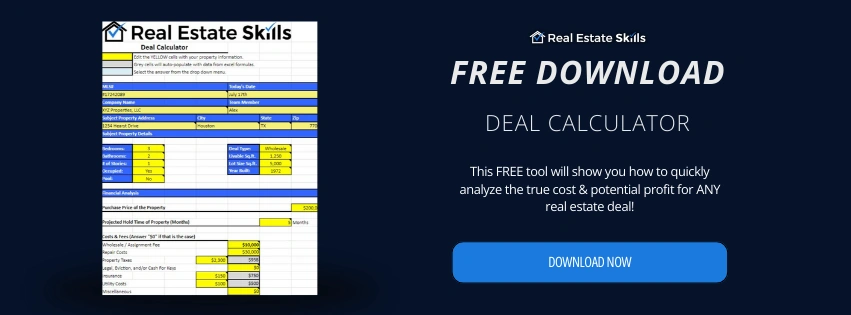
The table above uses our assumptions. Your deal won't match them exactly, and that's the point. Download our free Deal Calculator, the same spreadsheet we use to underwrite our own flips, and plug in your ARV, rehab and costs to find your maximum allowable offer. Then compare it to what the 70% rule would have told you, and you'll see your market's real number.
How Do You Know Which Percentage To Start With?
Start from the kind of neighborhood and how fast renovated homes sell there. Lower-priced, slower areas start at 60–65% of ARV, average neighborhoods at 70%, and higher-priced areas where flips sell quickly at 75–80%, but only after you've itemized every cost.
Investors often sort neighborhoods into Class A, B or C. It's informal shorthand, not an official rating, but it's a useful way to set your starting point:
| Neighborhood type | Starting percentage | Why |
|---|---|---|
| Class C: older, lower-priced areas where flips take longer to sell | 60–65% | A low ARV means fixed costs and your profit take a bigger share. Surprises during the rehab are more common, and a slower sale means more months of holding costs. |
| Class B: average neighborhoods priced near the local norm | 70% | This is the deal the 70% rule was built for. |
| Class A: higher-priced, in-demand areas where renovated homes sell fast | 75–80% | A fast sale cuts holding costs, and the 20–25% left over is a lot of dollars on a big ARV. But buyers expect nicer finishes, and a single price cut is bigger, so check your profit in dollars before you go above 70%. |
The neighborhood isn't the only thing that slows a sale. Ryan has flipped four-bedroom, one-bath houses and says they take noticeably longer to sell because far fewer buyers want that layout. Treat an awkward house like a slower market, even on a good street. If you're still deciding where to buy, start with the best places to flip houses.
Should You Change The Percentage When The Market Shifts?
Yes. In a rising market, keep your ARV at today's comps and never count on prices climbing. In a softening market, cut your ARV 5–10% depending on how long you'll hold, which can drop your effective percentage by several points.
Ryan, my co-founder, is firm on this: we never build appreciation into a flip. A rising market gives you more confidence in your numbers, and maybe room to tighten your margin a little, but any price gain is a bonus. A softening market shows its warning signs before prices actually drop: days on market creep up, inventory builds, open houses go quiet, offers dry up and listings sit past 30 days. That's when Ryan discounts the ARV (a $500,000 ARV becomes $480,000) and favors shorter projects (watch this part).
Here's what that does to the formula. On the $300,000 deal above, cutting the ARV by 5% and stretching the hold from six months to nine drops the effective percentage from about 73% to about 66%. Same house, same rehab, a seven-point swing. That's why you check the market's direction on every deal, not once a year.
Once you've picked your percentage, plug it into the MAO formula to calculate your maximum allowable offer.
How Do Holding Costs Change Your House Flipping Formula?
Holding costs are already inside the 70% rule, so don't subtract them twice. Use the quick formula to screen deals, then list every cost to set your real offer. When your hold runs long or your loan costs more, drop the percentage until your profit target still holds.
This section explains how carrying costs generally work. It isn't financial advice. Confirm your own loan terms and costs before you make an offer.
Holding costs (also called carrying costs) are everything you pay just to own the house while it's being fixed and sold: loan interest, property taxes, insurance, utilities and HOA dues, if any. Stan Gendlin, our fix-and-flip lead, adds the ones beginners forget: dumpsters and portable toilets, both of which can bill by the day.
One correction first. You'll see a version of the formula online that says (ARV × 70%) − repairs − holding costs. An earlier version of this guide said it too. It's wrong. The 30% that the 70% rule leaves on the table is what pays for holding, financing, closing and your profit. Subtract holding costs again and you've charged yourself twice, which pushes your offer too low and loses you deals.
The two honest ways to run it:
- The quick screen: ARV × your percentage − repairs. Your carrying costs are baked into the percentage. Use it to decide in a few seconds whether a house deserves a closer look.
- The itemized version: ARV − repairs − financing − buying costs − holding costs − selling costs − your profit. This is the one you make the actual offer from.
The quick guide we use in our own deals sits between the two: agent commission plus taxes, utilities and insurance for the time you hold the house come to roughly 10% of the ARV, before your loan costs (watch this part).
How To Fix and Flip Houses For Profit (FREE CALCULATOR)!
Alex Martinez and Stan Gendlin walk through how we underwrite a flip, from a conservative ARV to the 10% cost rule and the profit target we hold every deal to.

💡 What A Month Of Holding Actually Costs
- Take the hard-money loan from the $545,000 deal in the table: $396,000 at 10% interest plus one point.
- The point is due up front: $3,960.
- Interest runs about $39,600 a year, roughly $108 a day or $3,300 a month.
- On the planned six-month hold, that's $19,800 in interest.
- If the project runs two months long, that's another $6,600 in interest alone, before taxes, insurance and utilities.
Those rates aren't unusual. Federal mortgage data shows that in 2025 the median rate on loans from non-bank lenders (where most hard money comes from) was about 10.25%, with the middle half between 9.5% and 11%, according to an analysis of federal HMDA loan data. Points aren't in that data, and your terms depend on your lender and track record. Our guide to hard money lenders covers how they price loans and what they look for.
Plan the hold conservatively. On a $40,000 cosmetic rehab, Alex budgets six months: about two months of work (a rough guide is $10,000 of work per week, plus padding for delays), about two months on the market and about two months to close. That matches the national picture: ATTOM's Q1 2026 home flipping report puts the typical flip at 165 days from purchase to resale. Seasons matter too. Stan has bought houses in summer, told himself they'd be done before winter, and ended up listing over the holidays in a cold-weather market, the slowest time of year to sell (watch this part).
How the hold moves your percentage. On the $300,000 deal from the table, a six-month hold works at about 73% of ARV. Stretch it to nine months and the number drops to about 71%. Twelve months, about 69%. Each extra quarter costs about two points of offer on a mid-priced house. That's why a slow-selling area or a big rehab pushes you below 70%.
Profit leaks even when nothing goes wrong. A buyer asks for $5,000–6,000 toward closing costs. The sale takes two extra months and burns several thousand dollars in interest. Agent fees are a moving part as well. Since August 17, 2024, offers to pay the buyer's agent can't be posted on the MLS, and commissions are fully negotiable, according to NAR's settlement FAQ. Many sellers still offer buyer concessions or pay the buyer's agent off-MLS, so decide what you'll offer before you run your numbers.
The check we hold every deal to. When you're starting out, aim to net at least $1 of profit for every $1 you spend on the rehab: spend $40,000, make at least $40,000 (watch this part). That's net, after your lenders are paid. Bigger rehabs carry more risk, so they need bigger profits, and this rule scales automatically.
Pad the rehab number, too. Henish Pulickal, founder of San Diego construction company Cal HomeCo, budgets a contingency of at least 10% on top of the rehab estimate. Some problems only show up once the walls are open. Our house flipping spreadsheet has the rehab benchmarks and contingency settings we use.
Budget the carry as cash, not just a line item. In his third year, Stan took on too many renovations at once and ended up using money set aside for one deal to finish another. Know how much cash each project needs to carry it through the sale, and never count on one house selling in time to fund the next.
Does The FinCEN Reporting Rule Add Days To Your Closing?
No. FinCEN's residential real estate rule was vacated nationwide on March 19, 2026, and no reports are required while that order stands. Even when it was in force, the closing or settlement agent filed after closing, so the rule itself didn't add days to an investor's closing.
This is a summary of an active legal situation, not legal advice. Confirm current requirements with your title company or a real estate attorney before you close.
What the rule was. Starting March 1, 2026, the rule required reports on certain all-cash (non-financed) transfers of residential property to LLCs and trusts, which is exactly how many flippers buy. The duty to file fell on the closing or settlement agent and others in a set order of real estate professionals, not on the buyer. Reports were due after closing: by the last day of the following month, or 30 days after closing, whichever was later, according to FinCEN's residential real estate FAQ.
What happened. In Flowers Title Companies, LLC v. Bessent, the U.S. District Court for the Eastern District of Texas vacated the rule on March 19, 2026, ruling that FinCEN exceeded its authority. FinCEN filed a notice of appeal to the Fifth Circuit on May 11, 2026. A federal court in Florida upheld the rule in a separate case, and that decision is on appeal to the Eleventh Circuit, so the courts haven't settled this yet.
What it means for your deal. As of October 2026, nobody has to file. FinCEN says that if the rule comes back, transfers that closed while the order was in force won't need retroactive reports. Your title company may still collect ownership information for LLC buyers in case the rule returns. Check FinCEN's FAQ page before you close, because this can change quickly. An earlier version of this guide said the rule adds 5–7 days to closing. That was never right, and it's been removed.
You Know Your Number. Now Find Deals That Fit It.
A percentage is only useful when you have houses to run it on. The investors who flip profitably follow a proven process from day one: finding discounted properties on the MLS, running the numbers before they offer, and walking away when the math says no. Our FREE Training walks you through the entire system, the same one thousands of our students use. Watch it today, then go put your formula to work.
Watch The FREE Training →When Will No Percentage Save The Deal?
When the inputs are wrong. The formula only works if the ARV comes from real comps and the rehab number is honest. Push either one to make a deal fit, and no percentage protects you. Walk away when the honest numbers don't work, even if you're $5,000 apart.
Every flip that went wrong in our own deals comes back to the same thing: someone bent an input so the deal would fit. Here are the ways it happens, and what each one cost.
Shaving the rehab to close a gap. Stan was once $5,000 apart from a seller on a house that needed a lot of work. Instead of negotiating the price down, he told himself he could do the renovation for less. He couldn't. The market slowed at the same time, so he spent more and sold for less than he planned (watch this part). His rule now: the renovation number is the renovation number.
Henish has watched the same thing from the contractor side. An agent on his team budgeted $65,000 to renovate a 1,300-square-foot house. Henish told him to budget $130,000. The job finished at $130,000, and the agent still made about $75,000 because he'd planned for it. With the $65,000 budget, he'd have been hunting for the other half mid-project. Results vary. If you're new to scoping a renovation, start with our guide to estimating rehab costs.
Pricing above the comps. On a San Diego deal, Stan's numbers came up about $20,000 short. His last few flips had sold above his estimates, so he assumed this one would too. The market slowed, the rehab ran over, and he barely made any money (watch this part). Alex and Ryan teach the same rule in different words: never break the comps. The highest recent sale of a comparable renovated house in the neighborhood is your ceiling, not your starting point. Pull real estate comps the way an appraiser would, then check your number with our ARV calculator.
📓 From The Field
Stan once underwrote a flip at about $20,000 of profit and quietly hoped it would reach $40,000. Then the HVAC system, which everyone had missed, needed replacing, and the house sold $15,000 below his estimate. Six months of work broke even. Looking back, he says the right move was to wholesale it for $5,000–10,000 and move on. Hope isn't a line in the formula.
One repair bigger than your margin. Foundation problems and failing retaining walls are where rules of thumb stop working. Henish has seen a single retaining wall or foundation repair run $20,000 or more, which can wipe out a flip expected to net $30,000–40,000. When a house shows structural problems, get a structural engineer or concrete contractor out before you commit. This is also where the dollar-for-dollar profit target earns its keep: it leaves room for one nasty surprise.
Renovating above the neighborhood. On Stan's first flip after moving to South Carolina, he brought the finish level he was used to from San Diego. It became the nicest house on the street and sold for no more than the highest comp. Every neighborhood has a price ceiling, and finishes beyond it don't raise the ARV. They just raise the rehab.
Who this formula isn't for:
- Rental buyers: if you plan to keep the house as a rental, a flipper's percentage isn't your number, because you're not paying selling costs or chasing a one-time profit.
- Houses with no comparable sales: if no renovated houses have sold nearby, there's no ARV you can trust, and the formula has nothing to work with. Most flippers pass on those.
If you catch yourself adjusting a number so the deal works, that's the deal telling you no.
Fix And Flip Formula FAQs
Final Thoughts On The Fix And Flip Formula
The fix and flip formula isn't one number. It's a starting point you adjust to the deal in front of you. Seventy percent works on an average house in an average neighborhood. Cheaper, slower houses need less. Pricier houses that sell fast can support more, once you've counted every cost.
What protects you isn't the percentage. It's honest inputs: an ARV that doesn't go past what the comps support, a rehab number with a cushion, and a hold time padded for delays. Bend any of those and the math stops protecting you, whatever percentage you use.
Here's your next step. Pull three recent listings in your area that look like flips. Run each one at 70%. Then run it again at the percentage that fits that neighborhood, and add up the full cost of holding it for six months. Note which deals change from "no" to "yes," and which ones should have been a "no" all along. That one exercise will teach you your market's real number faster than any rule of thumb.
Stop Guessing At 70%. Start Running Real Deals.
Knowing which percentage fits your market is step one. Finding houses where that number actually works is where the money is. Our FREE Training shows you how we find discounted deals on the MLS without spending a dollar on marketing, then analyze them so your offer protects your profit before you sign anything. Watch it today, then take your first deal from analysis to offer.
Watch The FREE Training →
About The Author
Founder & CEO, Real Estate Skills
Alex Martinez is the Founder and CEO of Real Estate Skills. He has wholesaled and flipped houses for over 14 years, been part of 1,000+ real estate transactions, and personally acquired 55+ residential investment properties. Through Real Estate Skills, he and his team have trained 6,000+ investors nationwide to find deals, run their numbers and close.
Real Estate Skills is not a law firm or a financial advisor, and the information in this article is provided for educational purposes only. It does not constitute legal, tax, or financial advice. Lending terms, regulations, and market conditions vary by state and change over time. Real estate investing carries risk, and past results, including the deals described here, do not guarantee future returns. Always consult a licensed real estate attorney and your own tax and financial advisors before entering into any contract or transaction.

👉FREE Training
How To Consistently Wholesale, Flip Houses, & Invest In Rental Properties From The MLS
(Without Spending $1 On Marketing)

Alex Martinez, the founder of Real Estate Skills, is known for his strong, practical expertise in real estate, starting from a beginner with no family connections in the industry to acquiring over 55 real estate deals, including wholesale and flips, within his first year.
He has dedicated his career to providing cutting-edge education and resources for real estate professionals. He emphasizes the importance of self-taught knowledge through mentors, books, and hands-on experience.
His journey from earning a modest income to becoming a successful real estate entrepreneur and educator showcases his expertise and dedication to the field.

Ryan Zomorodi, co-founder and COO of Real Estate Skills, leverages his experience from a diverse background in real estate investment, construction management, and entrepreneurship to provide comprehensive education in the real estate sector.
His expertise is rooted in hands-on experience, extensive industry knowledge, and a commitment to empowering others through education.
Ryan's journey reflects a blend of practical experience and entrepreneurial success, contributing to his role in developing a platform that educates and supports aspiring real estate professionals.
Read Ryan's Full Bio >>
