
Flipping Real Estate Contracts: How To Flip Contracts In 7 Steps (2026)
Aug 24, 2026

Written by
Alex Martinez — Founder & CEO, Real Estate Skills. Has wholesaled and flipped houses for over 14 years, been part of 1,000+ real estate transactions, and personally acquired 33+ residential investment properties. Has trained 6,000+ investors nationwide.
Reviewed by
Ryan Zomorodi — Co-Founder & COO, Real Estate Skills. Reviewed the contract-flipping process, exit strategies, and legal points in this guide before publication.
Publication history: Originally published December 10, 2019. Updated August 2026 with a corrected 7-step process, four contract exit strategies, current assignment-fee data, real deal breakdowns with full numbers, an updated legal section, and a new FAQ. Reviewed and verified by Ryan Zomorodi, Co-Founder & COO of Real Estate Skills.
Flipping real estate contracts means putting a property under a purchase agreement, then selling that agreement to a cash buyer for a fee without ever buying the house. Your fee is the spread between your price and theirs — commonly $5,000 to $20,000 per deal. It's the same strategy as wholesaling.
Most people find this strategy the same way: someone on the internet says you can make $10,000 without buying a house, and it sounds like a scam. Fair reaction. The mechanics are real and fairly boring — you sign a purchase agreement with a seller, you sell your position in that agreement to an investor, and you get paid at closing. Alex Martinez did his first one in 2012 at twenty years old, contracted a house in El Cajon at $328,000, and collected a $22,000 fee without ever owning it. What isn't boring is how many ways a beginner loses money doing it wrong.
Here's what almost nobody says up front: the contract isn't the hard part, and finding a property isn't either. Deals die in the gap between signing with a seller and finding a buyer. Your earnest money is typically due within 72 hours of the seller signing, and your inspection window runs about a week after that. That's the whole runway — and if you're starting your buyer search after you've signed, you're already behind. It's why the order of operations in this guide starts with your cash buyers instead of the property.
This walks the whole thing in seven steps: finding a deal, locking it up so the contract is genuinely assignable, getting a buyer committed before your window closes, and picking the right exit — because assigning isn't the only one, and in a growing number of states it isn't always available. Real numbers throughout, including two deals that didn't go clean. You can download the free contracts here and follow along.
What Does It Mean To Flip Real Estate Contracts?
Flipping a real estate contract means you sign a purchase agreement with a seller, then transfer your buyer position to a cash investor before closing. You never take title. The investor closes with the seller directly, and you're paid a fee — typically $5,000 to $20,000 — for putting the deal together.
You are not selling a house. You're selling your right to buy one.
That distinction sounds academic until you understand where the right comes from. The moment a seller signs your purchase agreement, you hold what's called equitable interest — a real, recognized legal interest in that property, even though the seller still holds title. Under the doctrine of equitable conversion, that interest is the thing you're selling. It's why this works, and it's why the paperwork matters more than anything else in the transaction.
It also means something most beginners miss: until you transfer it, you are the buyer. Not a matchmaker, not a finder. The law treats you as the person who agreed to buy that house, with real obligations attached. Go in expecting to perform, because a contract you couldn't actually close on is a weak one. If you're brand new to how real estate investing works, this is the single concept worth understanding before anything else.
💡 A $15,000 Fee, Start To Finish
- You find a distressed house and agree to buy it for $150,000.
- The seller signs. You now hold equitable interest and the property is off the market.
- You bring it to a cash buyer who agrees to take your position for $165,000.
- You sign an assignment contract transferring your rights to them.
- They close directly with the seller, who receives their $150,000.
- Escrow pays you the $15,000 difference at closing.
You never owned the house. You never fixed anything. You never took out a loan.
Two things worth noticing. Your buyer isn't paying $15,000 for nothing — they're getting a property they wanted at a price that works, and they were going to pay a finder something regardless. And the seller got what they agreed to. Done right, this is a three-way win, not a skim.
It's The Same Thing As Wholesaling
Flipping real estate contracts and wholesaling real estate are the same strategy. Different words, identical mechanics. If you've read about wholesaling and you're wondering how contract flipping differs — it doesn't. Some people say "flipping contracts" because "wholesaling" sounds like something you do with pallets of inventory.
Worth knowing so you don't spend weeks thinking there are two strategies to learn. If you want the process from the wholesaling side, we've covered the full wholesaling process step by step as well.
Flipping Contracts vs. Two Things It Gets Confused With
| Flipping Contracts | Flipping Houses | Selling A Real Estate Contract (Note) | |
|---|---|---|---|
| What you sell | Your right to buy a property | The renovated property itself | Future payments owed to you |
| Do you own it? | No, never | Yes, for months | You owned it — you sold it with seller financing |
| Money needed | Earnest money, sometimes none | Purchase price plus renovation | None — you're the one getting paid |
| Timeline | Days to weeks | Three to nine months typically | Years of payments, sold at a discount |
| Your profit | Assignment fee | Sale price minus all costs | Lump sum instead of monthly payments |
| Covered in this guide? | Yes | No — different strategy | No — different business entirely |
Flipping houses is what HGTV shows. You buy it, you pay the contractors, you carry the holding costs, and you hope the market holds while you're in it. Real money, real risk, real capital required. Contract flipping is the opposite trade: you take a smaller payday in exchange for being out of the deal before any of that starts.
Selling a real estate contract usually means something else entirely. If you sold a property with seller financing and you're collecting monthly payments, that promissory note is an asset you can sell to a note buyer for a lump sum. Completely different transaction, different buyers, different math. If that's what brought you here, this guide isn't it — you're looking for note selling or seller-financed note buyers.
Everyone still with us is in the right place.
Read Also: Wholesale Real Estate Contract Templates
How To Flip Real Estate Contracts In 7 Steps
To flip a real estate contract: build your cash buyer list, find a distressed property, lock it up with an assignable purchase agreement, verify it can be assigned, get a buyer committed inside your inspection window, sign the assignment contract, and collect your fee at closing. Seven steps, usually under 30 days.
- Build your cash buyers list — before anything else
- Find the right property
- Lock it up with a purchase agreement
- Confirm the contract is actually assignable
- Get your buyer committed inside the inspection window
- Assign the contract
- Collect your fee at closing
Most guides put finding the buyer at step four or five. That order is why beginners lose deposits. More on that immediately.
Step 1: Build Your Cash Buyers List First
Find your cash buyers before you find a property. Cash buyers are investors who buy distressed houses with their own money. Ask three to five of them exactly what they want — price range, area, condition — then go find that. It reverses the entire process.
Here's the version almost every guide gets backwards.
They tell you to find a great deal, lock it up, then market it and find a buyer. Sounds logical. It's also how you end up with a signed contract, a seven-day window, and a list of strangers who've never heard of you.
Alex Martinez puts it flatly: cash buyers are the people you contact first. The reason is arithmetic. Your earnest money is typically due within 72 hours of the seller signing, and the goal is to have your buyer locked before that deposit is even due. You cannot do that from a standing start.
Reverse it and the job changes completely. Instead of finding a deal and hoping someone wants it, you find out what specific buyers want and go looking for exactly that.
What A Cash Buyer Actually Is
An investor — usually a fix-and-flipper or a landlord — who buys distressed properties with their own funds, no mortgage. They don't need the house to be pretty. They need the numbers to work.
You want three to five of them. Not fifty. Three to five who buy consistently and will tell you their criteria straight.
Where To Find Them
- Local real estate investor association meetings. Alex built his first buyer relationships this way, attending every month until he knew the top flippers in his county.
- Call agents on recently-renovated listings. That listing is a flip someone just finished. Ask the agent whether their seller wants more fix-and-flip opportunities. Free, fast, and you're talking to a proven buyer.
- Property management companies. They manage properties for investors who are actively buying. Ask for an introduction.
- Hard money lenders. They lend to active investors who are always short on deals. An introduction from a lender carries weight.
The Question That Does The Work
Once you have someone on the phone, get specific. Price range, target areas, condition they'll take, minimum spread they need.
Neelema, a Real Estate Skills student and a practicing anesthesiologist, described treating her cash buyer the way she treats a surgeon in the operating room — find out exactly what they need, then deliver precisely that. One of her buyers told her he wanted waterfront property in the Arlington section of Jacksonville. So that's what she looked for. Nothing else.
When one finally appeared, she already knew who was buying it.
📓 From The Field
Neelema's first deal, closed July 2023, came from following this order exactly. She spent weeks finding nothing that matched her buyer's criteria. When a waterfront Arlington property finally listed at $315,000, she contracted it at $245,000 and assigned it for a $10,000 fee — wired to her account the day it closed. She'd had earlier properties under contract and couldn't find buyers for any of them. This was the first one where she knew the buyer before she knew the house. Results vary; her outcome isn't a projection of yours.
Know What To Say Before You Dial
Building your buyer list first only works if the calls go well. Ask the wrong questions and you get vague answers you can't act on — "sure, send me deals" tells you nothing. Ask the right ones and a buyer will hand you their exact criteria: price range, areas, condition, minimum spread. Then you go find that. Download our Cash Buyer Script for the questions that surface a buyer's real buy box on the first call.
Read Also: How To Find Cash Buyers In Your Market
Step 2: Find The Right Property
Look for distressed properties with motivated sellers — houses needing real work, priced for cash buyers. The MLS is the fastest source: filter for new listings, price reductions, and listings sitting over 60 days. You're looking for a house nobody else wants at a price that works.
Two things have to be true. The property needs real work, and the seller needs to sell.
Distressed property means it needs repairs — outdated kitchens, damaged flooring, sometimes far worse. These often can't qualify for conventional financing, which means the seller needs a cash buyer. That's your opening.
Motivated seller means circumstance is pushing them: foreclosure, divorce, an inherited house they don't want, a job relocation. Motivated sellers are weighing speed and certainty against price, and that's the trade you can win.
Where The Deals Actually Are
Most beginners chase off-market — cold calling, direct mail, driving for dollars. Alex's position is that this is backwards, and his reasoning is straightforward: the overwhelming majority of transactions happen on the MLS, so that's where the sellers are. They've already raised their hand. They've hired an agent. They're expecting calls.
Three filters that work:
- New listings in the last 24 hours. Speed matters. Being among the first callers is sometimes the whole advantage.
- Listings sitting 60+ days. Time on market correlates with motivation. A seller who's been waiting is a seller who'll talk.
- Price reductions. A cut is a public signal that expectations are adjusting.
No MLS access? Redfin, Zillow, and Realtor.com carry syndicated listings. You lose the agent's confidential remarks, but the listings are there. One Real Estate Skills student closed his first deal at $7,000 working entirely from Redfin.
What You're Reading For
Listing language tells you plenty. Fixer. Cash only due to condition. Investor special. As-is. Those phrases are the agent telling you the property needs work and won't finance.
What you don't want is retail — a renovated, move-in-ready house. It doesn't matter how motivated that seller is. There's no room in the numbers for an investor, and you'll be bidding against families who'll pay more than any investor ever would.
Step 3: Lock It Up With A Purchase Agreement
Submit a written offer with your price, earnest money deposit, a short inspection contingency, and "and/or assigns" language that keeps the contract assignable. Every owner on title must sign. Once they do, you hold equitable interest and the property is off the market while you find your buyer.
This is where you stop browsing and take a position.
This explains how these clauses generally work and isn't legal advice. Contract forms and disclosure requirements vary by state and have changed recently in several. Have a licensed real estate attorney review your contract before you use it.
What Goes In The Offer
- Purchase price — low enough that your buyer profits after repairs, and your fee fits between.
- Earnest money deposit — typically 1–3% of purchase price, sometimes up to 5% in competitive markets. Held by title or escrow, never handed to the seller.
- Inspection contingency — your escape hatch and your buyer-finding window.
- "And/or assigns" — the language that keeps the contract transferable. Without it you may have nothing to sell.
- Closing date — 14 days is competitive and gives you room.
If you want the clause-by-clause breakdown, we've covered what goes in a purchase and sale agreement and real estate investment contracts separately.
Ask The Agent What Would Win
Here's a move most people never make. When you're up against other offers, ask the listing agent directly: what would make this offer work?
Neelema was told there were seventeen offers on a property at $200,000 — including one from a large investment company that had bid that morning. Instead of guessing, she asked the agent what she could do to stand out. The agent told her: shorten the inspection contingency and come up on price. She offered $205,000 and got the contract.
She beat seventeen offers by asking a question.
About That Earnest Money
Bigger deposits make stronger offers, but it's your money at risk. Two things soften that.
Timing is often worth more than amount. On his first deal, Alex's seller wanted the deposit due immediately on acceptance — but it was a short sale, meaning bank approval could take a month. Rather than park his money for weeks, he countered: he'd raise the deposit to 10% of the purchase price ($32,800), but it would be due three days after short-sale approval, not seller acceptance. Bigger number, better timing. The seller took it.
Sometimes your buyer funds it. If you have a committed buyer already, some will put up the earnest money themselves. It's a real technique — it just requires a buyer in place before you sign, which is Step 1 again. Treat it as the exception, not the plan.
The 70% Rule Will Cost You Deals
Most beginner guides teach it: take 70% of the after-repair value, subtract repairs, subtract your fee, and that's your maximum offer.
Alex ran his first deal both ways. Real ARV was $475,000, repairs $50,000, target fee $22,000.
| The 70% Rule | What He Actually Offered | |
|---|---|---|
| Calculation | 70% of $475,000 = $332,500, minus $50,000 repairs, minus $22,000 fee | Analyzed against his buyer's actual return requirement |
| Maximum offer | $260,500 | $328,000 |
| Outcome | Offer far too low — seller listed at $385,000 | Accepted; $22,000 fee collected |
A $67,500 gap on the same deal. The 70% rule would have kept him from ever getting it under contract.
The rule isn't useless — it's a fast sanity check. But it's a blunt instrument that assumes every buyer wants the same return in every market. If you're offering by it exclusively, you're underbidding good deals and losing them to people who did the actual math.
Run The Numbers The Way Alex Ran That Deal
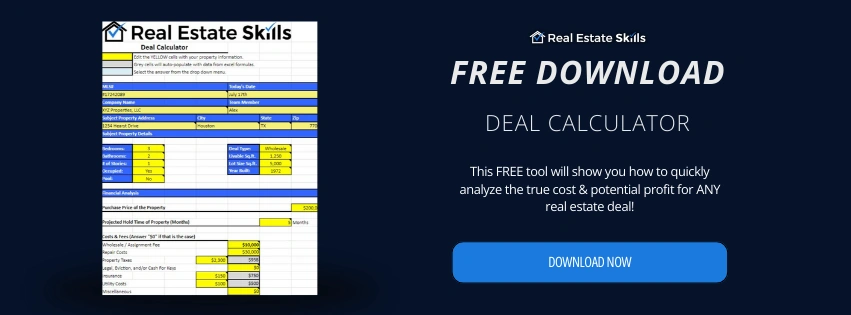
The 70% rule would have capped that offer at $260,500. The actual winning offer was $328,000 — same deal, same fee, $67,500 apart. The difference is working backward from what your cash buyer actually needs to earn instead of applying a blanket formula. Download the deal calculator used on every Real Estate Skills wholesale and flip deal, plug in your ARV, repairs, and target fee, and it returns the exact number to offer.
📓 From The Field
Alex got his first ARV wrong by $50,000. He estimated the El Cajon house would resell at $525,000; the real number was closer to $475,000. His comps were scattered — the two beautifully renovated ones were in a nicer neighborhood with views and pools his property didn't have. The deal still worked, because he'd checked it at the lower number first and knew he'd clear $20,000 either way. When his cash buyer pushed back on the ARV, he re-ran it and landed at a $22,000 fee. His own words: "I was $50,000 off. Nobody's perfect." The skill isn't being right. It's leaving enough room to be wrong.
Lock Up Your Deal With Contracts That Actually Assign
The whole strategy rests on two documents: a purchase agreement that keeps your position assignable, and an assignment contract that transfers it. Miss the "and/or assigns" language, or use a form that wasn't built for this, and you can end up holding a contract you can't sell — which means you're the one buying the house. Download our attorney-drafted Wholesale Real Estate Contracts, the same Purchase & Sale Agreement and Assignment Contract used in our own deals and by thousands of our students.

Step 4: Confirm The Contract Is Actually Assignable
Before you market a deal, confirm you can legally transfer it. Most purchase agreements are assignable by default, but some contracts require the seller's written consent, and a few states now restrict how you assign or advertise. Check the contract language and your state's current rules first.
This step is the one that saves deals, and it's the one almost nobody writes down.
Here's the good news: real estate contracts are assignable by default. It's a basic principle of contract law — contractual rights transfer unless the agreement says otherwise. The "and/or assigns" language from Step 3 makes it explicit, but you generally start from a position of yes.
Three things can complicate that.
The contract restricts it. Some standard forms — certain state Realtor associations' agreements among them — require the seller's written consent before you assign, often with language saying consent won't be unreasonably withheld. That's a step, not a wall.
Your state added rules. This is the part that's changed. Several states passed wholesaling legislation between 2024 and 2026 — some requiring you to disclose that you hold equitable interest rather than title, some restricting how you can market a property you don't own, a few requiring registration or a license. None ban the practice. But the rules are real, they're new, and they vary. Check yours before your first deal, not during it.
The title company won't process it. Not every closing agent handles assignments. Ask before you're a week from closing.
If You Can't Assign It, You Still Have Options
Don't panic and don't walk. There are three other ways out of the deal, covered in detail further down: amend the contract, double close, or never go on the contract in the first place. That last one is how Ryan Zomorodi has closed 36 deals across 12 states, and it sidesteps assignment restrictions entirely.
📍 Check Before You Market The Deal
Three confirmations, in this order:
- The contract language — does it permit assignment outright, or require the seller's written consent?
- Your state's current rules — disclosure requirements, marketing limits, and registration rules changed in several states between 2024 and 2026.
- Your closing agent — confirm your title company or attorney will process an assignment before you need them to.
For where your state stands right now, see our guide on your state's current wholesaling rules.
Wholesaling rules changed in multiple states between 2024 and 2026 and continue to change. This is educational, not legal advice — confirm your state's current requirements with a licensed real estate attorney before you sign anything.
Step 5: Get Your Buyer Committed Inside Your Window
Your inspection contingency — usually seven to fourteen days — is your window to get a buyer committed. Send the deal to your cash buyers immediately with the numbers, photos, comps, and deadlines. The goal is a committed buyer before your earnest money is even due, typically 72 hours in.
If you did Step 1, this is where it pays off. If you skipped it, this is where it hurts.
The Clock You're Actually Racing
Two deadlines run simultaneously, and beginners only watch one.
| Deadline | Typical Timing | What It Means |
|---|---|---|
| Earnest money due | ~3 days after the seller signs | Your deposit goes to escrow. Your money is now in the deal. |
| Inspection contingency | 7–14 days from signing | Your last day to cancel and recover the deposit. |
| Closing | 14–30 days | Your buyer closes with the seller. |
The 72-hour deposit deadline is the one nobody talks about. Your inspection window is your legal protection, but your money hits escrow long before it expires. Alex's standard is to have the deal assigned before that deposit is even due — which only works if the buyers were lined up first.
Send Them Everything At Once
When the contract is executed, send your buyers a single email containing the property address, the numbers (after-repair value, repair estimate, your price), photos, comps, showing instructions, and the contract deadlines.
Alex calls it the "platinum platter" — the point being that a cash buyer should be able to decide in seconds. Most wholesalers send an address and a price and then field ten questions. Send everything, and the answer comes back the same day.
On The Inspection Window — An Honest Tension
Alex's standard offer carries a seven-day inspection contingency. Short windows make offers more attractive because they reduce the seller's uncertainty, and Neelema won a contract against seventeen competing offers partly by shortening hers.
But that window is also your protection. Fourteen days gives you twice the runway to find a buyer, and if you're new, runway matters more than winning marginal offers.
The honest answer: shorten it when you already have a buyer waiting, keep it long when you don't. Which is, again, Step 1.
Step 6: Assign The Contract
The assignment contract transfers your buyer position to your cash buyer for a fee. You're the assignor, they're the assignee. Match the property, seller, and date to your original agreement, state your fee in words and numbers, and both parties sign. Usually one page.
The assignment itself is anticlimactic, and that's worth saying because beginners dread it.
It's typically a single page. It names you as assignor and your buyer as assignee, references the original purchase agreement by date and property, states your fee, and gets two signatures. Your buyer steps into your position and becomes responsible for closing.
The Fear That Isn't Real
New wholesalers assume the assignment is the moment everything falls apart — the seller finds out, the agent objects, the deal collapses.
Neelema was braced for exactly that. Having signed with her cash buyer, she called the listing agent to request an assignment addendum, fully expecting a problem.
The agent said: okay, sure.
Ryan Zomorodi's read is that this is routine. Assignments happen constantly in real estate. Handled professionally, they're an administrative step, not a confrontation.
Consider A Non-Refundable Deposit
Ask your buyer for a portion of your fee up front, at signing, credited toward the total. Size it larger than your own earnest money, and even if your buyer never closes, you're not underwater. On a $15,000 fee with $2,000 of your own money in escrow, a $5,000 non-refundable deposit means a dead deal still leaves you ahead.
📓 From The Field
Neelema priced her first assignment at $260,000. Her buyer misread it as $280,000 and asked to confirm. She corrected him — down — then let him negotiate her to $255,000, because she was afraid of losing the deal. Her own words: "I was so worried I was going to lose the deal if I pulled too much on the assignment fee." The deal closed and she was paid $10,000. She also left roughly $25,000 on the table between the misread number and the negotiation. That fear is normal on a first deal, and it's expensive. Results vary.
Read Also: The Assignment Contract Explained
Step 7: Collect Your Fee At Closing
Send both contracts to the title company or closing attorney. Your fee appears as a line item on the settlement statement and is paid at closing by wire or check — usually the same day or the next. You have no closing costs on an assignment.
Send the executed purchase agreement and the signed assignment contract to whoever is closing the deal. In most states that's a title or escrow company; in some it's an attorney. Find out which applies in your market before your first deal, not during it.
Two Ways To Get Paid
Through escrow. Your fee sits on the settlement statement and the closing agent wires it to you. Clean, documented, and it builds a paper trail — a stack of settlement statements is how you prove to lenders and partners that you actually close deals.
Outside escrow. Some wholesalers keep the fee off the assignment and invoice the buyer directly, so the seller and agents never see the spread. Ryan does it this way on the deals he structures — an invoice, paid directly, no line item anywhere.
Both are legitimate. Escrow builds proof; direct keeps things private.
What Doesn't Come Out Of Your Fee
Closing costs and agent commissions. Your fee is a flat amount on top of the purchase price. The end buyer pays closing costs because they're the one buying. Commissions attach to the sale price, not your fee.
Closing costs only become your problem if you double close — which is why that route needs a bigger spread to make sense.
Then Do It Again
Neelema kept in touch with her cash buyer and kept hunting his target area. Alex's first buyer relationships came from monthly investor meetings and lasted years. The fee is the outcome; the relationship is the business.
How To Start Wholesale Real Estate In 2026 (15hrs/wk)!
Alex walks the full process end to end, including the assignment order of operations and how the fee reaches your account at closing.

Four Ways Out Of A Wholesale Deal
There are four ways to profit from a contract without keeping the property: assign it, double close, use a novation, or never go on the contract at all. Assignment covers most deals. The other three exist for when a contract can't be assigned, your spread is too large to show, or your buyer needs financing.
Most guides stop at assignment. That works until the day it doesn't — the contract prohibits transfer, the title company refuses, your state added rules, or your buyer needs a mortgage and their lender won't touch an assigned contract.
Then you need another door. There are three.
| Assign | Double Close | Novation | Never Sign | |
|---|---|---|---|---|
| Do you take title? | No | Yes, briefly | No | No |
| Your name on the contract? | Yes, then transferred | Yes | Replaced by the new buyer | Never |
| Closing costs for you | None | Two sets | None | None |
| Is your fee visible? | Yes, on the assignment | No | No | No |
| Money needed | Earnest money | Funding for the first close | Earnest money | None |
| Best for | Most deals | Large spreads, no-assign contracts | Buyer needs financing | Strict states, no entity, no capital |
1. Assign The Contract
The default, and what the seven steps above describe. You transfer your buyer position for a fee, your buyer closes with the seller, and escrow pays you. No closing costs, one closing, one page of paperwork.
Use it unless something specific stops you.
2. Double Close
You actually buy the property and immediately resell it, usually the same day, using two separate purchase agreements — one between the seller and you, another between you and your end buyer.
When it makes sense:
- The contract can't be assigned. You're buying and reselling, not transferring, so an assignment restriction doesn't apply.
- Your spread is large enough to spook the buyer. A $50,000 assignment fee on a single page invites pushback. A double close keeps your profit private — your buyer only sees the price they're paying.
- Your state restricts assignment. Some do now.
What it costs: you're both a buyer and a seller, so you pay two sets of closing costs — transfer taxes, title fees, escrow, recording. That's why double closing generally needs a substantial spread to be worth it. On a smaller fee, assign.
How you fund the first closing is the part beginners miss. Two routes: your end buyer's funds are used to close your purchase, or you use transactional funding — a short-term loan built specifically for back-to-back closings.
Stan Gendlin's caution is worth repeating: buyers sometimes let you use their money, but more often they won't. Plan on needing transactional funding rather than assuming a buyer will cover you.
Confirm your title company handles double closings before you structure a deal around one. Not all do.
Read Also: How To Double Close On A Wholesale Deal
3. Novation
A novation replaces the original contract entirely. Rather than transferring your position, the agreement is cancelled and a new one is signed directly between the seller and the new buyer. You're fully released.
The difference that matters: in an assignment, the original contract survives and you may remain liable if your buyer fails to close. In a novation, you're out — the contract you signed no longer exists.
Where it earns its place: financing. Lenders generally won't fund a purchase where the buyer acquired their position by assignment. Underwriters see the assignment and the deal stalls. With a novation, the lender sees a clean contract between seller and buyer, because that's what it is. If your best buyer is using conventional or FHA financing rather than cash, this can be the only route that closes.
It also keeps your compensation off the closing documents — you're typically paid separately.
The honest caveats: a novation requires all parties to agree, including the seller. It's more paperwork than an assignment, some title companies handle them rarely, and at least one state's recent disclosure rules explicitly cover novation alongside assignment. This is a route to run past an attorney, not to improvise.
Read Also: How A Novation Works And When To Use One
4. Never Go On The Contract At All
Instead of contracting a property yourself, you partner with an active investor, submit offers in their entity using their proof of funds, and get paid a fee when the deal closes. There's no assignment, no double close, and your name never appears on the contract.
This is the one almost nobody teaches, and it solves several problems at once.
How it works. You find an active investor buying real consistent volume — a flipper, a landlord, a developer. You sign an agreement defining your role (find deals matching their criteria) and your compensation. Then you submit offers in their entity, using their proof of funds. They're the buyer from day one. They sign, they fund, they close. You invoice them for your fee.
Nothing gets assigned, because nothing needs to be. Nothing gets marketed, because you're not selling a contract to anyone.
Why it matters right now. Every state rule tightening around wholesaling targets one of two things: assigning a contract, or marketing a property you don't own. This structure does neither. If you're in a state that's added restrictions, this is worth understanding.
How you get paid. Ryan structures compensation three ways, often in combination:
- Flat fee — typically $5,000 to $20,000 per deal regardless of size
- Percentage of purchase price — commonly 1% to 5%, sometimes on a sliding scale where smaller deals carry a higher percentage
- Profit share — a cut of the net profit when the property resells, often 5% to 10%
His preference is cash at closing plus upside later: "I like to get paid today and save some for later."
What it requires. One good buyer relationship. Not fifty — one investor doing genuine volume who'll put their entity and proof of funds behind your offers in writing. Get the agreement signed before you submit a single offer.
📓 From The Field
Ryan Zomorodi found a house at 2522 H Street in Bellingham, Washington — listed at $345,000, in a state he'd never set foot in. He offered the day it listed using his buyer's entity and proof of funds. He lost. Someone else tied it up higher. He didn't chase it. Then that escrow fell apart, and so did the next one. After two failed escrows the listing agent called him back and took his $295,000 offer — $50,000 under list. His compensation was structured as a 1% acquisition fee at closing ($2,950) plus 6% of net profit. The flip resold at $535,000 and produced just under $79,000 in profit, so his profit share came to $4,740. Total: $7,690 on a property he never visited and never signed a contract on. His own note on the number: it isn't life-changing on its own, but one or two a month is a six-figure business. He's closed 36 deals across 12 states this way. Results vary.
Which One Should You Use?
Assign. Start there, and reach for the others when something specific pushes you off it.
Assigning is simplest, cheapest, and covers the large majority of deals. Double close when the contract won't transfer or your spread is too large to show. Novate when your buyer needs financing or you want a clean exit from liability. And if you're in a restrictive state, have no entity, or have no capital at all — the fourth route is worth a serious look, because it removes you from the transaction entirely.
These structures carry different legal, tax, and disclosure implications, and the rules vary by state and have changed recently. This is educational, not legal advice — work with a licensed real estate attorney in your market before structuring a deal any of these ways.
How Much Money Can You Make Flipping Real Estate Contracts?
Most assignment fees run $5,000 to $20,000 per deal, with industry surveys putting the national average near $13,000. Your income is that fee times how many deals you close. Fees vary widely by market — roughly $5,000 in lower-priced areas to $22,000 in the strongest ones.
There's no salary here. You're paid per deal, so the honest answer is two numbers multiplied together: what you make per deal, and how many you close.
What One Deal Pays
The most-cited figure comes from a survey of more than a thousand professional wholesalers, which landed on a national average of about $13,000 per assignment. It ranges by market — roughly $5,000 in lower-priced areas up to around $22,000 in states like North Carolina and Georgia. If you want the mechanics of how that number gets set, we've broken down how assignment fees are calculated separately.
Read that number carefully, though. It surveys people who already close deals regularly and know how to price an assignment. Sources that fold in newer operators tend to land closer to $10,000. Your first deal will probably be under the average, and that's normal.
Three Real Deals, Three Very Different Fees
| Deal | Contract Price | Fee | Notes |
|---|---|---|---|
| Alex's first deal, 2012 | $328,000 | $22,000 | Short sale, El Cajon CA, 45 days |
| A student's first deal, 2023 | $245,000 | $10,000 | Virtual, Jacksonville FL, closed from New York |
| Alex, a later deal | $429,700 | $5,300 | Listed at $510,000; smaller spread |
That third row matters more than the first two. $5,300 is a real fee on a real deal, and any article implying every assignment pays five figures is selling you something. Some deals are thin. You take them, because a thin deal that closes beats a fat one that doesn't.
What The Deal Actually Looked Like
💡 Alex's First Deal — El Cajon, California, 2012
- Five-bedroom house listed at $385,000, outdated and needing a full cosmetic renovation.
- Called the listing agent the day after it hit the MLS; the seller was in a distressed situation.
- Offered $328,000 — $57,000 under list.
- Seller signed nine days after the property listed. It was a short sale, so bank approval followed.
- Used the waiting period to line up a cash buyer from investor-association contacts.
- His buyer's projected profit: about $44,700 on a $475,000 resale.
- Closed July 13, 2012. Fee: $22,000. He was 20 years old.
Note step 6. His buyer made roughly twice what he did — and took on the renovation, the holding costs, and the market risk to get it. That's the trade. You take the smaller, faster, safer number.
How I Got My First Wholesale Real Estate Deal! | $22,000!
Alex walks his first deal from the MLS listing through to the $22,000 check, including the numbers he got wrong.

The Multiplication, And The Honest Denominator
One deal a month at $10,000 is $120,000 a year gross. Two or three a month puts you in the $200,000-plus range. The math is simple.
What's not simple is the input. Alex's working ratio is roughly 15 written offers to get one deal. Neelema was sending four to five offers a day, started in May, and got her first contract accepted on June 28 — and she'd had several earlier properties under contract that she couldn't find buyers for.
That's the part most articles leave out. It isn't one offer, one deal. It's fifteen offers, one deal, and some of the contracts you win won't close at all.
What Eats Into It
Your fee is gross revenue, not profit. Out of it comes self-employment tax — assignment income is ordinary income, taxed as such — plus whatever you spend on MLS access, software, and driving. And when a deal dies outside your contingencies, your earnest money goes with it.
Read Also: What Wholesalers Actually Make Per Year
You've Seen The Numbers. Now Learn To Produce Them.
A $22,000 fee looks simple written down. What it actually took was a buyer list built before the deal existed, an offer submitted the day the property hit the market, and a process that had already been run enough times to work under a deadline. That's the part nobody posts about. Our FREE Training walks the entire system — finding discounted properties, locking them up, lining up cash buyers, and collecting your fee — the same process Alex used on that first deal and thousands of our students have used since.
Watch The FREE Training →Is Flipping Real Estate Contracts Legal?
Yes. Flipping real estate contracts is legal, and no state bans it. What's changed is regulation: several states added disclosure requirements, marketing restrictions, or registration rules between 2024 and 2026. You're selling your equitable interest, not the property — but you must follow your state's current rules.
Let's settle this, because it's the question that stops people before they start.
Flipping contracts is legal. Assigning a purchase agreement is legal. Contractual rights are assignable by default unless the contract says otherwise — that's ordinary contract law, not a real estate loophole. And what you're selling is your equitable interest: the recognized legal interest you hold the moment a seller signs your agreement.
What isn't true is that this is a settled, static question.
What Actually Changed
Between roughly 2019 and 2026, and accelerating sharply through 2024 and 2025, state legislatures started regulating wholesaling. The pattern is consistent across states:
- Disclosure requirements — telling the seller in writing that you hold equitable interest, not title, and that you intend to assign
- Marketing restrictions — limits on advertising a property you don't own, on the theory that marketing property is brokerage activity
- Registration or licensing — a handful of states now require one or the other, sometimes triggered after a certain number of deals per year
- Seller cancellation rights — in some states, failing to disclose gives the seller the right to cancel
None of these is a ban. They're rules, and they're followable. But they're new enough that plenty of content still on the internet — including, until this update, parts of this article — describes a regulatory environment that no longer exists.
Where The Trouble Actually Comes From
The people who get in trouble aren't the ones assigning contracts. They're the ones who skip the disclosure, market a house as if they own it, and leave a seller feeling misled.
That's the behavior the new laws target. Disclose what you are, use a contract built for this, and follow your state's rules, and you're operating the way the regulations intend.
Do You Need A License?
In most states, no. You're a principal in your own transaction — the buyer — not an agent representing someone else's deal for a commission. Writing your own offer and selling your own contractual interest doesn't require a license in most of the country.
The line to watch is between investing and brokering. A license is for representing other people's transactions. Wholesaling is buying and selling your own position.
That said, a handful of states have narrowed this — some by requiring a license to publicly market a deal, at least one by limiting how many deals an unlicensed person can do in a twelve-month period. Check yours.
Getting licensed isn't a bad idea, and it's not a defensive move. The real benefits are practical: MLS access, state-specific contract forms, credibility with agents, and commission income. Alex holds a license for exactly those reasons. It's an advantage, not a requirement, and it's not a substitute for following your state's disclosure rules.
What To Actually Do
📍 Before Your First Deal
Four things, in order:
- Look up your state's current wholesaling rules. They may have changed in the last two years.
- Use a contract built for wholesaling, with clear assignment and marketing language — not a generic form.
- Have a local real estate attorney review your contract and your process before your first deal. This is the single highest-value hour you'll spend.
- Disclose. If your state requires written disclosure of your equitable interest, do it in writing, every time.
For the full breakdown by state, see our guide on whether wholesaling is legal in your state.
If Your State Is Restrictive
You still have options. A double close removes the assignment entirely. A novation replaces the contract rather than transferring it. And the fourth route — never going on the contract, covered above — involves no assignment and no marketing of a property you don't own, which is why Ryan Zomorodi uses it across twelve states.
Restrictive doesn't mean closed. It means structure the deal differently.
Real Estate Skills is not a law firm and this is educational, not legal advice. Wholesaling laws vary by state and have changed materially since 2024. Always confirm your state's current requirements with a licensed real estate attorney before doing a deal.
Read Also: Is Wholesaling Real Estate Legal In Texas?
Should You Flip Contracts Or Flip Houses?
Flip contracts when you want a smaller, faster payday with limited capital and limited risk. Flip houses when you have the capital, the contractor relationships, and the tolerance to be in a deal for months. Most investors start with contracts because it's how you learn the numbers on someone else's money.
Same deal, two very different trades.
| Flipping The Contract | Flipping The House | |
|---|---|---|
| Capital needed | Earnest money, sometimes none | Purchase price plus renovation |
| Time in the deal | Days to weeks | Three to nine months typically |
| What you manage | Two contracts and a closing | Contractors, permits, budget, timeline, resale |
| Your exposure | Your earnest money | Purchase, renovation, holding costs, market shift |
| Typical payday | $5,000–$20,000 | Often 2–4× that on the same property |
| Paid when | At closing, usually within 30 days | When it resells, months later |
The El Cajon deal shows both sides on one property. Alex made $22,000 in about six weeks and was out. His cash buyer's projected profit was roughly $44,700 — double — but they carried the renovation, the holding costs, and the risk that the market moved while they were mid-rehab.
Neither number is better. They're different trades. You're choosing between a smaller sure thing and a larger maybe.
The Decision Rule Nobody Publishes
Here's a genuinely useful one, and it came out of Alex getting his first deal wrong.
His comps on that property were scattered — the renovated ones nearby had views and pools his house didn't. He couldn't pin the after-repair value with confidence. His conclusion wasn't to guess harder. It was: because of the uncertainty in the ARV, I knew I was going to wholesale this one for sure.
Uncertainty in your numbers is an argument for assigning. When you flip the house, you're betting your capital on that resale number being right. When you assign, you're handing that bet to someone with more information, more contractor relationships, and more tolerance for being wrong — and you're taking a smaller, certain payment to do it.
That's not a beginner's crutch. It's how experienced investors decide deal by deal.
Why Almost Everyone Starts With Contracts
You learn the same skills either way — finding deals, running comps, estimating repairs, negotiating, working with agents and title companies. The difference is what it costs you to learn them.
Get an ARV wrong on an assignment and your fee shrinks. Get it wrong on a flip and you're carrying a house that won't sell at the number you needed.
Ryan Zomorodi's framing is that wholesaling is getting paid to learn. You're building buyer relationships, seeing deals through to closing, and developing judgment — funded by fees instead of by your savings. When you're ready to take one down yourself, you already know what a good deal looks like because you've handed a hundred of them to people who buy them for a living.
Who Should Skip Contracts And Just Flip
If you have the capital, an established contractor you trust, and you can be out of pocket for six months without stress — flipping produces more per deal and you already have the infrastructure. Contract flipping's advantages are mostly advantages to people who lack those things.
And if you're doing both: assign the ones where your numbers are uncertain or the spread is thin, and keep the ones where you're confident and the margin justifies the months.
Who Flipping Contracts Is Wrong For
Contract flipping is wrong for you if you want passive income, hate cold outreach, or need money this month. It's a transactional business — you earn only when you close. Most deals don't close, the income is fully taxable as ordinary income, and your earnest money is genuinely at risk.
Everything above is what this looks like when it works. Here's what it looks like the rest of the time.
You Earn Nothing When You're Not Working
This is transactional income. Close a deal, get paid. Stop closing deals, income stops. There's no accumulation — no rent arriving whether you worked that month or not, no appreciating asset, no equity building in the background.
Every deal starts from zero. That's fine if you want cash now and you're building toward something else. It's a poor fit if what you actually want is passive income, because this is close to the opposite.
The Ratio Is Not One-To-One
Alex's working number is roughly 15 written offers to get one deal. Neelema was sending four to five offers a day and it took from May to late June to get her first contract accepted — and she'd had several properties under contract before that where she couldn't find a buyer at all.
Read that last part again. Getting a contract signed isn't the finish line. Contracts fall apart. Buyers pass. Windows expire. Some of the deals you win won't close, and you'll have done all the work anyway.
If you need this to produce money in the next thirty days, the math is against you.
Your Earnest Money Is Real Money At Risk
Your deposit — typically 1% to 3% of the purchase price — goes to escrow within about 72 hours of the seller signing. Inside your inspection contingency it's refundable. Outside it, it isn't. Miss the deadline to notify the seller, or blow past your window while hunting a buyer, and that money is gone.
There are ways to reduce the exposure: a committed buyer who funds the deposit, a non-refundable deposit from your buyer sized above your own, or structuring so you never go on the contract at all. But the default version of this strategy puts your money on a clock. Anyone telling you there's no risk and no money involved is skipping this part. If capital is the constraint, we've covered how to wholesale with no money in more depth.
It's A Communication Business
You will talk to strangers constantly. Listing agents, cash buyers, sellers, title companies. On the phone, not by text.
Stan Gendlin's candid version: if you're not naturally outgoing, building a buyer list will take you longer. That doesn't make it impossible — Neelema is a physician, not a salesperson, and her approach was methodical rather than charismatic. But if the idea of calling twelve agents this week makes you want to close the tab, be honest with yourself about that now rather than after you've paid for a contract template.
The Tax Treatment Is Unfavorable
Assignment fees are ordinary income. No capital gains treatment, no depreciation, no long-term holding advantage. You'll owe self-employment tax on top of income tax, and nothing is withheld — so a $15,000 fee is not $15,000 in your pocket.
Set aside a meaningful portion of every fee when it lands. Plenty of first-year wholesalers spend the whole thing and meet the tax bill unprepared.
You're Leaving The Bigger Money On The Table
By design. Your buyer usually makes more than you on the same property — sometimes double, as on the El Cajon deal. That's the trade you chose: smaller, faster, safer.
It stops being a fair trade if you're doing all the work of a flipper and taking a wholesaler's fee. If you find yourself managing the rehab, fronting money, and coordinating the resale, you're not flipping contracts anymore — you're flipping houses for a fraction of the profit.
And You're Only As Good As Your Buyers
Your buyer list is the business. Lose your two best buyers and your deal flow doesn't slow down — it stops, because you've got contracts signed and nobody to assign them to.
That's the single largest structural risk in this model, and it's another argument for Step 1. Three to five active buyers, maintained continuously, not assembled the week you need one.
So Who Is It Right For?
Someone with limited capital who wants into real estate and is willing to make a lot of calls to get there. Someone who'd rather have $10,000 in three weeks than $40,000 in eight months. Someone building toward flipping or rentals who wants to learn the numbers on someone else's money first.
If that's you, the rest of this guide is the process.
If you want passive income, hate the phone, or need guaranteed money next month — this isn't it, and there's no version of it that becomes it.
Flipping Real Estate Contracts FAQs
Final Thoughts On Flipping Real Estate Contracts
Flipping a real estate contract comes down to one thing: you found a deal somebody else wanted and you got paid for finding it. Everything in this guide — the buyer list, the offers, the contingency windows, the four exits — exists to make that transaction happen cleanly and to make sure you're protected while it does.
The people who succeed at this aren't the ones with the most capital or the best market. They're the ones who built a buyer list before they needed it, who know their deadlines cold, and who understand what their contract actually says. When a deal gets tight — the window's closing, a buyer wavers, an agent goes quiet — they know exactly where they stand and what the next move is.
And plenty of deals don't work. Alex missed an after-repair value by $50,000 on his first one. Neelema left roughly $25,000 on the table because she was afraid of losing hers. Ryan lost a Bellingham property to a higher offer before two escrows collapsed and it came back to him. Those aren't cautionary tales — they're what a normal first year looks like. Every one of those deals still paid.
Start with the buyer list. Three to five active investors who'll tell you exactly what they want. Then go find it. That's the whole business, and it's the step almost everyone does last.
Most People Read About This And Never Do A Deal.
The gap isn't information — you just read 4,000 words of it. It's that the first deal is where every small thing you skipped shows up at once: the buyer you hadn't called yet, the deadline you didn't mark, the contract clause you didn't check. Our FREE Training walks the whole process in order so your first one runs on a system instead of on guesswork. Watch it, then go build your buyers list.
Watch The FREE Training →
About The Author
Founder & CEO, Real Estate Skills
Alex Martinez is the Founder and CEO of Real Estate Skills. He has wholesaled and flipped houses for over 14 years, been part of 1,000+ real estate transactions, and personally acquired 33+ residential investment properties. He closed his first wholesale deal at 20 years old for a $22,000 assignment fee, and has since trained 6,000+ investors nationwide on how to find deals, use the right contracts, and get paid at the closing table.
Real Estate Skills is not a law firm, and the information in this article is provided for educational purposes only — it does not constitute legal, tax, or financial advice. Wholesaling and contract assignment laws vary by state and have changed materially since 2024. All deal figures, fees, and student results described here are specific to those transactions and are not projections; individual results vary, and many wholesale deals do not close. Real estate investing carries risk, including the loss of earnest money. Always consult a licensed real estate attorney and your own tax and financial advisors before entering into any contract or transaction.

👉FREE Training
How To Consistently Wholesale, Flip Houses, & Invest In Rental Properties From The MLS
(Without Spending $1 On Marketing)

Alex Martinez, the founder of Real Estate Skills, is known for his strong, practical expertise in real estate, starting from a beginner with no family connections in the industry to acquiring over 55 real estate deals, including wholesale and flips, within his first year.
He has dedicated his career to providing cutting-edge education and resources for real estate professionals. He emphasizes the importance of self-taught knowledge through mentors, books, and hands-on experience.
His journey from earning a modest income to becoming a successful real estate entrepreneur and educator showcases his expertise and dedication to the field.

Ryan Zomorodi, co-founder and COO of Real Estate Skills, leverages his experience from a diverse background in real estate investment, construction management, and entrepreneurship to provide comprehensive education in the real estate sector.
His expertise is rooted in hands-on experience, extensive industry knowledge, and a commitment to empowering others through education.
Ryan's journey reflects a blend of practical experience and entrepreneurial success, contributing to his role in developing a platform that educates and supports aspiring real estate professionals.
Read Ryan's Full Bio >>
