
How To Flip Houses In California: Step-By-Step Guide (2026)
Oct 05, 2026

Written by
Alex Martinez, Founder & CEO, Real Estate Skills. Has wholesaled and flipped houses for over 14 years, been part of 1,000+ real estate transactions, and personally acquired 55+ residential investment properties. Has trained 6,000+ investors nationwide.
Reviewed by
Ryan Zomorodi, Co-Founder & COO, Real Estate Skills. Reviewed the legal and licensing points in this guide before publication.
Publication history: Originally published March 17, 2022. Updated October 2026 with a corrected explanation of California's flipper disclosure law (AB 968), the current $1,000 contractor licensing limit, a new section on the costs and taxes unique to California, three real California flips from our team and students, and 2026 market data. Legal and licensing points reviewed by Ryan Zomorodi, Co-Founder & COO of Real Estate Skills.
To flip a house in California, buy a distressed home below its after-repair value, renovate with CSLB-licensed contractors, and resell through escrow. Accept an offer within 18 months of buying and AB 968 makes you disclose contractor work and permits. The median U.S. flip grossed $60,526 in Q2 2026 (ATTOM).
If you've run the numbers on a California house, you probably felt your stomach drop. A fixer in a decent neighborhood here can cost more than a whole block of houses in some states. So the real question isn't how to flip. It's whether you can do it here without the prices, the permits and the paperwork burying you.
You can. I've been investing in real estate since 2012, and in June 2015 I bought the first flip where I took on most of the work myself: a dated three-bedroom in Poway, in San Diego County. My friend Stan Gendlin, who has flipped more than 1,000 houses, and I have done dozens of flips together right here in San Diego. Our students are flipping everywhere from the Coachella Valley to Orange County.
Here's what all of that taught me. The 15 steps of a flip are the same in any state. What changes in California is the rulebook: who's legally allowed to do the work, what you have to disclose when you sell fast, how escrow pays you, and how much the state holds back before you see a dollar. That rulebook is what this guide is built around, with real numbers from three California deals along the way.
Run your own numbers as you read with our free Deal Calculator.
How To Flip Houses In 2026 (In 90 Days Or Less)
Stan Gendlin and I walk through every stage of a flip, starting with my Poway deal.

Watch the full process before you read the steps. In this masterclass I break down my Poway flip, then Stan and I walk through every stage of a deal from finding the house to getting paid. It's built for investors anywhere, so here are the moments that matter most if you're flipping in California:
- 56:44: What cosmetic rehabs cost per square foot in San Diego, and why that number climbs at higher price points
- 1:16:04: How we negotiate the listing commission down on a California resale
- 1:29:53: Why your first flip should be in your own backyard (and why I started in San Diego)
- 2:23:06: Writing your offer on the California Association of REALTORS® contract and keeping your deposit refundable
- 3:10:48: Setting up the LLC you'll buy and sell through
What Is Flipping Houses?
Flipping a house means buying a property that needs work for less than its after-repair value, renovating it, and reselling it at a profit, usually within months. The median U.S. flip earned $60,526 in gross profit in Q2 2026 (ATTOM), before rehab, loan, holding and selling costs come out.
Gross profit is the difference between what a flipper paid and what they sold for, and it's the number you'll see in headlines. Your real profit is what's left after the renovation, the loan, months of holding costs and the cost of selling. On a California flip, every one of those costs is bigger than in most states, because they're tied to the price of the house.
The work itself is the same everywhere: find a house the average buyer won't touch, fix what's keeping it from selling at full value, and sell it to someone who wants a finished home. What's different in California is the rulebook around that work, and that's what this guide is about. If you're brand new and want the basics first, start with our guide on how to flip a house, or learn it step by step in a house flipping course, then come back here for the California version.
Why Flip Houses In California?
Flip in California for the size of the dollar spreads and deep buyer demand, not cheap entry. Typical home values run from about $393,000 in Fresno to over $1.4 million in San Francisco (Zillow, 2026), so a solid margin here pays far more than on a cheaper house.
A 20% spread on a $400,000 house is $80,000. The same 20% on a $900,000 house is $180,000. That's the case for California in one line. The case against it is the same math: the down payment, the monthly interest, the commissions and the taxes all scale with the price, so a mistake costs more too.
Leverage is what makes the numbers work for a beginner. A hard money lender covering about 90% of the purchase price means you control a $600,000 house with about $60,000 of your own or a private lender's money for the down payment, plus closing and holding costs. If you buy right and sell at your ARV, your return is measured on that smaller amount. If you buy wrong, the loss is measured on the same small base, which is why Step 7 matters more than anything else in this guide.
There's also real inventory, even in an expensive state. California recorded 7,985 foreclosure starts in the first quarter of 2026, the third most in the country (ATTOM), and dated homes owned for decades come to market through estates and trust sales every week.
My honest take: California isn't the easiest place to do your first flip. It's one of the most rewarding places to build a flipping business, if you start in a price band you can afford and follow the rules in this guide.
Learn The Fundamentals Before You Buy In California
At California prices, one bad purchase can wipe out a year of profit. Before you scout neighborhoods or call a lender, get the fundamentals down: how to recognize a real deal, which properties are worth renovating, and how new investors get started the right way. Our free Ultimate Guide To Start Real Estate Investing walks you through it.

California Real Estate Market Trends: What To Watch
Four trends are shaping California flips in 2026: thinner margins (the median U.S. flip returned 21.5% gross in Q2 2026, per ATTOM), 30-year mortgage rates above 7%, an insurance market that's reopening but still tight in fire zones, and state rules that make adding an ADU a real value play.
1. Margins are getting thinner. Nationally, the median flip earned $60,526 in gross profit and a 21.5% gross return in the second quarter of 2026, down from $66,000 and 25.4% in the first quarter (ATTOM). Flips made up 6.2% of all home sales and took a median 161 days. When margins tighten, the flippers who keep making money are the ones who buy right and move fast.
2. Rates are squeezing your buyers. The average 30-year fixed mortgage rate hit 7.28% on October 1, 2026, the highest since November 2023 (Freddie Mac). Your buyer is shopping by monthly payment, so price the finished house for what a payment buys in your area, and expect more of your offers to come with seller credit requests.
3. Insurance is reopening, slowly. California's FAIR Plan, the insurer of last resort, had 696,562 policies in force as of June 2026, but its growth slowed to its lowest pace since 2022. Farmers lifted its caps on new homeowners policies in May 2026, and Allstate and State Farm General have both filed to resume writing new policies in California. In high fire hazard areas, coverage is still limited and expensive, so get a quote for your future buyer before you buy, not after you renovate.
4. ADUs add value you can build. State law limits how much cities can restrict accessory dwelling units (ADUs) (a second, smaller home on the same lot, often a converted garage). On a lot with room, permitting an ADU can turn a standard flip into a property that helps the next owner pay their mortgage. It's a bigger, longer project with its own permits, so price it like one.
We check these numbers on Zillow's California home values page, the CAL FIRE fire hazard severity zone map, ATTOM's California data and the state HCD ADU handbook before every offer.
How To Flip Houses In California In 15 Steps
To flip a house in California: pick a market, line up money, find contractors and an investor-friendly agent, find and analyze a deal, write your offer on the C.A.R. contract, inspect during your contingency, close through escrow, renovate with permits, then list, negotiate and get paid when the sale records.
These are the same 15 steps we follow on every flip, in the order a real deal happens. What makes this the California version is what's inside each one: the contract we write on, the licensing rules for who touches the house, the escrow process, and the costs the state adds at the end.
- Pick Your Market
- Find Your Money
- Find Three Contractors
- Find An Investor-Friendly Agent
- Find A House To Flip
- Make Discovery Calls To Listing Agents
- Analyze The Property
- Call Agents & Submit Written Offers
- Perform Due Diligence When The Offer Is Accepted
- Close On The Deal
- Renovate The House
- Prep & List The House On The MLS
- Field Offers & Negotiate
- Accept The Best Offer
- Sell The House & Get Paid
1. Pick Your Market
Start where you live. When I started flipping in San Diego, the biggest advantage I had was being able to get to a property in 30 minutes. You'll meet contractors there, walk it with your agent, and check the work every week. If you live in California and pick a flip in Texas, every one of those visits is a flight.
Being local also lets you feel what the listing photos don't show: the house that backs onto train tracks, the street under a flight path, the block that changes two streets over. Those things decide your resale price, and you can only learn them by driving the neighborhood.
Then let your capital pick your price band, because California's spread is enormous. Typical home values run from about $393,000 in Fresno and Bakersfield and about $483,000 in Sacramento (Zillow, June 2026), to about $930,000 in Los Angeles and $985,000 in San Diego, to more than $1.4 million in San Francisco (Zillow, July and August 2026). A $400,000 flip and a $1.2 million flip are different businesses. The bigger one needs more cash for the down payment and runs a much bigger monthly bill while you renovate.
Pick one area you can reach within an hour, learn its renovated comps cold, and stay there for your first few deals. Before you settle on a neighborhood, check the CAL FIRE fire hazard map, because a house your buyer can't easily insure is a house you'll have trouble selling. (We compare the major California markets in detail further down.)
2. Find Your Money
Line up your money before you look at a single house. California listings with real potential move fast, and listing agents take offers more seriously when a proof of funds letter (a letter from your lender or bank showing you can close) is attached.
Most flips here use two layers of money:
Hard money (the main loan). Hard money lenders lend on the property and its after-repair value more than on your income. In California right now, terms we see run roughly 8.5% to 11% interest with 1 to 2 points (a point is 1% of the loan, paid at closing), lending up to about 90% of the purchase price and up to 100% of the rehab, closing in as little as five to ten days. Rates change constantly, so get current term sheets from two or three lenders. National lenders like Kiavi and Lima One lend in California, and local lenders often know the neighborhoods better. Confirm any lender you use holds a California Financing Law license (look it up on the Department of Financial Protection and Innovation site) or works through a licensed real estate broker.
Private money (the gap). Hard money usually leaves you short the down payment and some closing and holding costs. That gap gets filled by private money lenders: individuals who lend you their own money. On my Poway flip, I borrowed from three of them on top of the hard money loan, and I met one at a local real estate investor association meeting. Search Meetup for one in your county.
Here's the California detail most guides skip: usury law. A private individual who lends to you directly, without a licensed real estate broker arranging the loan, is generally capped at 10% annual interest under the California Constitution. Charge more and the lender can lose the interest and face penalties, which can blow up the relationship and the deal. Keep direct private loans at or under 10%, or have a licensed broker arrange anything higher. This is educational information, not legal advice; have an attorney draft private loan documents.
A bank loan is too slow for most flips. Even for owner-occupants, the average 30-year fixed rate was 7.28% on October 1, 2026 (Freddie Mac), investor loans price higher, and closing takes a month or more. If you're short on the down payment, read our guide on how to flip houses with no money.
3. Find Three Contractors
Get three bids on every job. The first number is a guess. The second gives you a comparison. The third shows you what the market actually charges and exposes the contractor padding the price because you look new.
The best contractors I've found came from other flippers. My contractor on the Poway flip was a referral from a flipper friend I'd done deals with, and your hard money lender is another good source, because they've seen which crews finish the jobs they fund. Whoever you find, run their license through the CSLB lookup before they set foot in the house (see the contractor license rules below).
Two California payment rules protect you:
- The down payment cap. On a home improvement contract, a contractor can't ask for more than $1,000 or 10% of the contract price up front, whichever is less (Business and Professions Code §7159.5). It applies to investor-owned houses too. A contractor asking for 50% to "buy materials" is breaking the law or isn't licensed. The main exception is a contractor who carries a specific payment and performance bond.
- Pay for work done, not work promised. Tie every payment after that to finished milestones. Ryan's rule is to always be ahead on work and behind on pay.
Should you act as your own general contractor? Ryan's estimate is that once you've built a reliable list of trades, running the job yourself and hiring each trade directly can save you 15% to 30% compared with hiring a general contractor. The catch he always adds: it takes real project management skill, because now you're the one scheduling the trades, catching mistakes and keeping the job on time. California also caps how often you can do this. Under the owner-builder rules, you can hire licensed trades directly on no more than four single-family homes offered for sale in a calendar year unless a licensed general contractor runs the job. For your first flip, hire the GC. Here's how to choose the right general contractor.
4. Find An Investor-Friendly Agent
You want an agent who's comfortable writing offers well under list price, can pull renovated comps, and answers the phone on a Saturday. Most agents spend their days selling move-in-ready homes to families, so you're looking for the minority who work with investors. It matters because 91% of sellers used an agent in NAR's 2025 survey, which means most of the deals you'll ever see run through one.
The fastest way to find them: search Zillow or Redfin for homes in your area that sold in the last six months with words like "fixer," "TLC" or "contractor special," and look up who represented the buyer. That agent just closed a deal for an investor. Then ask them:
- How many investor purchases have you written in the last 12 months?
- Will you write offers 20% or 30% under list without arguing with me about it?
- Can you pull comps for fully renovated homes, not just everything that sold nearby?
- Will you list my flips when they're done, and at what rate?
The California paperwork. Since January 1, 2025, California law requires a written agreement between you and your buyer's agent before you sign an offer (Civil Code §1670.50). It has to spell out the agent's compensation and services, and for individual buyers it can't run longer than three months (the three-month limit doesn't apply when you buy through an LLC or other entity). On the C.A.R. forms, it's the Buyer Representation and Broker Compensation agreement. Compensation is negotiable, and you can ask the seller to cover it in your offer.
If you want your own access to listings, read how to get MLS access in California.
5. Find A House To Flip
The MLS (multiple listing service), the database agents use to list homes for sale, is where we find most of our flips, and it costs nothing to search. You don't need to spend thousands on direct mail or hours driving for dollars to find your first deal. My Poway flip was listed on the MLS at $500,000. Christina found her La Quinta flip on the MLS too. The sellers there have already decided to sell; your job is to find the ones whose house needs work and whose situation needs a clean, fast offer.
Two kinds of listings deserve your attention:
- Fresh listings with distress words. Set an alert for terms like "fixer," "as-is," "cash only," "TLC" or "trust sale" and call the agent the day the listing goes live. Being first matters.
- Stale listings. Filter for homes that have sat 60 days or more. A seller paying a mortgage on an empty house for two months is ready to hear a lower number.
California has its own pipeline of distressed houses too. Inherited homes are one: since Proposition 19 took effect in 2021, an heir keeps the parent's low property tax bill only by moving in, which may prompt more families to sell inherited, dated houses. Foreclosures are another: California had 7,985 foreclosure starts in the first quarter of 2026, the third most of any state (ATTOM). If you go after pre-foreclosures, read the Home Equity Sales Contracts Act section below first.
Keep making offers. Christina sent about 40 offers on the MLS, and by then agents had started texting her houses before they were even listed. Wholesalers are one more source; if you buy from them, it helps to know how wholesaling works in California from their side (see the case studies below).
6. Make Discovery Calls To Listing Agents
Call the listing agent before you write anything. Your goal is to learn what the listing doesn't say and to get the agent rooting for you. Listing agents only get paid when the house sells, so a serious buyer calling is good news to them.
The questions I'd ask on a California listing:
- Is it still available, or is there an accepted offer that hasn't hit the MLS yet?
- Who's selling and why? A trust sale, an estate or a landlord tired of a vacant rental each tells you something different about urgency.
- Do you know of any work done without permits, like a garage conversion or an added bathroom? Unpermitted additions are common in older California houses and can wreck your appraisal.
- Would the seller take an as-is cash offer with short contingencies and a quick close?
- Would you be open to representing me on this one?
That last question matters. California allows an agent to represent both buyer and seller on the same deal, as long as both sides get the required disclosures and agree in writing (Civil Code §2079.14 to §2079.17). An agent who earns both sides of the commission has every reason to get your offer accepted.
Don't make the offer on the first call. Tell the agent you'll run the numbers with your contractor and get back to them within a day, then do exactly that.
7. Analyze The Property
You make your money when you buy. If you overpay in California, no finish selection will save the deal, so three numbers have to work before you offer: the after-repair value, the repair cost and the purchase price.
After-repair value (ARV). Pull real estate comps: sold, renovated homes from the last six months within half a mile, in the same city and zip code, within about 20% of your house's square footage, and ideally in the same neighborhood. Find at least three. California adds its own traps: in hilly areas, a view home and a non-view home on the same street can be hundreds of thousands of dollars apart, and a freeway or flight path between two "nearby" comps can change everything. Run your numbers at the price you're sure the house sells for, not the price you hope for. Our free ARV calculator does the math.
Repair costs. On cosmetic San Diego rehabs, we see roughly $30 to $40 per square foot, and that number climbs as the price point and finish level go up. Use that for a quick first pass, then get the real number from a contractor walkthrough, and add 10% to 15% for surprises. Older California houses hide the same few: termite damage, galvanized pipes, outdated wiring and foundations that were never bolted to the frame. For a line-by-line method, see the cost section below.
Purchase price. Work backward from the ARV, subtracting every cost, not just repairs. Here's a California example on a house that should sell for $750,000 after a $90,000 renovation:
💡 California Example: The Maximum Offer On A $750,000 Flip
- Repairs: $90,000
- Buying costs (escrow, title, lender fees): about $10,000
- Loan points (2% on about $540,000): about $10,800
- Five months of holding (loan interest, insurance, utilities, property tax): about $29,900
- Selling costs at 6.5% (commissions, transfer tax, escrow, title, small credits): about $48,750
- Your profit target: $60,000
That leaves a maximum allowable offer of about $500,000. The 70% rule in house flipping (70% of ARV minus repairs) would have told you $435,000. At California prices, the shortcut usually comes in too low, so you lose deals you could have won. That's why we run the full math on every house. Your numbers will vary with your lender, your timeline and your market. Stan and I also use a quick gut check: commissions, holding taxes, utilities and insurance usually eat about 10% off the top of the sale price.
Run The Full California Math Before You Offer
The example above has five lines of costs before your profit, and every one of them changes with your lender, your timeline and your city. Our free Deal Calculator lets you plug in your purchase price, repairs, closing costs and holding costs to see your profit spread and your maximum allowable offer before you write a contract.
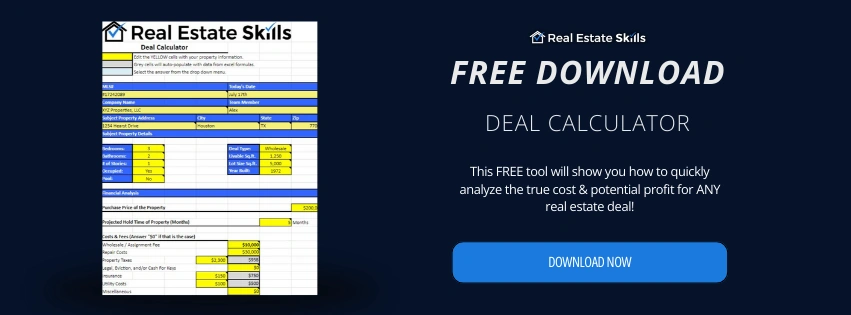
If you'd rather build your own, here's how to set up a house flipping spreadsheet.
8. Call Agents & Submit Written Offers
Call the listing agent before you send anything: "I'm sending a clean written offer at this price. It's cash, with a short inspection period and a 14-day close." Then have the agent write it up on the California Association of REALTORS® Residential Purchase Agreement, the contract California agents actually use. Don't bring your own form to a listing agent. (For an off-market deal with no agent involved, start from a real estate purchase agreement template and have a California attorney review it.)
These are the terms we email the agent to put in the contract:
- Buyer name. Your LLC's name, or your own if you don't have one yet. A new LLC files Articles of Organization with the California Secretary of State, so have that and your LLC's Statement of Information ready to show you can sign.
- Price. Your maximum offer from Step 7, not a dollar more.
- Deposit. We usually put down $5,000 to $10,000. The contract gives you three business days after acceptance to get it to escrow, and in our area it's refundable while your contingencies are still open. Read your contract to confirm that before you sign.
- Inspection contingency. The C.A.R. contract defaults to 17 days for inspections, loan and appraisal. We shorten the inspection period to seven days, which tells the seller we're decisive.
- A 14-day close or sooner. Speed is worth real money to a distressed seller.
- Free and clear title. The seller delivers the house without liens or other debts attached.
- Your agent's name. If the listing agent is representing you, put their name in the buyer's agent section.
- Proof of funds. Attach it every time.
One California point new investors get wrong: the 3% cap on how much deposit a seller can keep when a buyer backs out only protects buyers who plan to live in the home. As an investor, once you remove your contingencies, the whole deposit can be at risk if you walk away.
Then send more offers. You can analyze a hundred houses, but until you sign contracts, you're shopping, not investing.
9. Perform Due Diligence When The Offer Is Accepted
Your contingency period is the only time you can find a problem and still walk away with your deposit. With a seven-day inspection window, everything below happens in the first few days.
- Open escrow and send your deposit. Get the signed contract to escrow on day one. You have three business days to deliver the deposit. Call your escrow officer at a number you already know to confirm wiring instructions before you send a dollar.
- Walk it with your contractor. Build the scope of work (the line-by-line list of every repair and material) during this walk. That scope becomes your budget, your contractor's bid and, if you're using hard money, the document your lender funds against.
- Hire a home inspector, and scope the sewer. It costs a few hundred dollars and covers what your contractor might rush past: the electrical panel, the roof, the plumbing and the sewer line to the street.
- Order a termite report. California's licensed pest inspectors file a Wood Destroying Pests and Organisms report with two kinds of findings. Section 1 items are active infestation or damage you can see now. Section 2 items are conditions likely to lead to it, like moisture or wood touching soil. The report has to be delivered within 10 business days after the inspection starts, so order it the day you're accepted. State law doesn't require one to sell, but the C.A.R. contract has a section on who pays for one, and many buyers and lenders ask for it. Skipping inspections is how one of our Northern California students found termites and no crawl-space access only after he'd closed (his full deal is in our guide to the hard money loan).
- Pull the permit history. Ask the city or county building department what's been permitted on the property. If there's an added bathroom or garage conversion with no permit, price in either legalizing it or living with it.
- Get an insurance quote. In high fire hazard areas, find out what coverage will cost you during the rehab and what it will cost your future buyer, before you lose the right to cancel.
If the numbers changed, renegotiate while you can still walk: "The inspection found $15,000 in foundation work we didn't plan for. We need a $15,000 credit or a price reduction, or we'll have to cancel."
Build Your Scope Of Work Before Your Contingency Ends
Your inspection window is the only time a missed repair is still the seller's problem. Our free Scope of Work Template lists every item from the roof to the foundation, so your three contractors bid the same job and you know your real renovation number before you remove contingencies. Keep the finished version: it's the start of your AB 968 file.

10. Close On The Deal
California is an escrow state. You won't sit at a table with the seller and their lawyer. A neutral escrow holder, either an independent escrow company licensed by the state or a title company's escrow department, collects the money and documents from both sides and releases everything when every condition is met.
If you're borrowing, you'll sign a promissory note (your promise to repay) and a deed of trust (the document that secures the loan with the house and lets the lender foreclose without going to court if you don't pay). The seller signs a grant deed transferring the house to you or your LLC.
You'll usually sign with a notary a day or two before closing. California escrows typically fund after recording, so the deal is done when the county recorder records the grant deed, which also puts the world on notice that the house is yours. That's when you get the keys.
Have two things ready the day you close:
- Insurance in force on day one. A vacant house under renovation needs a vacant dwelling or builder's risk policy. A standard homeowners policy often limits coverage once a house has been empty for a couple of months.
- A plan for the supplemental tax bill. California reassesses the house at your purchase price, and the county sends a separate supplemental property tax bill for the difference, often months after closing. Buy a house for $500,000 from a long-time owner assessed at $150,000 and that's roughly $3,850 a year in extra tax on the $350,000 difference at a 1.1% rate, prorated for the rest of the fiscal year. New flippers miss this one all the time.
11. Renovate The House
Renovate to the comps, not to your taste. If the renovated homes that sold nearby have quartz counters and luxury vinyl plank floors, marble and hardwood won't raise your price. They'll only lower your profit.
Permits are where California renovations get slow and expensive, so plan for them on day one. Your licensed contractor pulls them, and the work isn't finished until it passes final inspection. A few California rules come up on almost every flip:
- Energy code. Title 24 energy standards apply when you replace things like HVAC systems, windows or water heaters, so make sure your contractor's price includes compliant equipment.
- Water fixtures. A permitted renovation triggers replacing old toilets, showerheads and faucets with water-conserving models before your final sign-off.
- Fire zones. Building in a fire hazard severity zone can bring stricter materials rules for roofs, vents, siding and windows.
- Your AB 968 file. Every contract, permit and sign-off you collect now becomes your disclosure package when you sell.
Get the paperwork signed before any work starts: the contractor agreement, the final scope of work, a payment schedule tied to finished milestones, the contractor's certificate of insurance, and a W-9. Then collect a lien release with every payment. California requires specific statutory forms (conditional and unconditional releases, for progress and final payments), and subcontractors and suppliers on your job may send you a preliminary notice, which preserves their right to file a mechanics lien if they go unpaid. A lien on title can hold up your sale, so don't release a payment without the matching release.
How long does it take? My Poway cosmetic job took about four weeks. Raymond's bigger scope in Orange County was seven and a half weeks in and still going. If you're managing the crew yourself, Raymond's project management fee (in the case studies below) shows one way to get paid during the work.
12. Prep & List The House On The MLS
Walk the finished house with your contractor and a roll of painter's tape and mark every scuff, gap and drip. California buyers paying top dollar notice sloppy finish work, and they assume what they can't see was rushed too. Add the safety items to that list: working smoke alarms, carbon monoxide alarms where required, and a strapped water heater, all things you'll certify in writing at sale.
Then make the house look like the price:
- Stage it. In NAR's 2025 Profile of Home Staging, 29% of agents said staging increased the dollar value buyers offered by 1% to 10%, and 49% of sellers' agents said it cut time on the market. The median cost of professional staging was $1,500. Expect to pay more in coastal California.
- Pay for professional photos. Redfin's research found professionally photographed listings sold for more and drew more views. Your first showing happens on a phone screen.
Negotiate the commission. California listing commissions averaged about 2.57%, with about 2.51% going to buyers' agents, in an August 2026 survey (Clever). Since August 2024, the buyer's agent's pay is negotiated separately and isn't automatically offered. On our flips, we push the listing side down toward 1.5%, because we're bringing the agent repeat business, and agents rarely turn that down. Knowing how the agent is paid helps too: one who keeps most of the commission at a high-split or flat-fee brokerage has more room to negotiate than one who splits it 60/40 with their broker. Sign a listing agreement of about 90 days, not six months. If a well-priced renovated house hasn't sold in 90 days, something needs to change.
Price it to pull buyers in. On the Poway flip, I listed in a price range so we could bid the price up when offers came in, and it sold for $535,000, above my $520,000 estimate. Where your MLS doesn't allow range pricing, list slightly under your ARV. More buyers see it, more show up to the same open house, and competition does the work.
13. Field Offers & Negotiate
The highest number isn't always the best offer. Compare offers on the net sheet (what actually lands in your account after costs and credits) and on how likely each one is to close:
- Cash has no loan or appraisal to fail.
- Conventional loans with 20% or more down are solid, especially with a full underwriting approval attached, not just a pre-qualification letter.
- FHA and VA loans bring stricter appraisals that can flag small repairs you'll have to make before closing. With FHA, remember the 90-day rule in the legal section below, and that seller credits are capped at 6% of the price and can only cover the buyer's actual costs, never cash back to them. If you agree to a credit, write it so any unused amount stays with you.
If several buyers want the house, California gives you a useful tool: the C.A.R. Seller Multiple Counter Offer. You can counter several buyers at once and ask for their best price and terms. Even if a buyer signs your counter, nothing is binding until you sign the final acceptance, so you stay in control of which deal you take.
Negotiate the terms, not just the price:
- Shorten the buyer's contingency periods from the 17-day default.
- Ask for a bigger deposit. (If the buyer will live in the home, California caps what you can keep at 3% of the price if they back out.)
- Offer credits instead of repairs. You don't want your contractor back in the house during escrow.
- On over-asking offers, ask the buyer to cover any gap between the price and the appraisal in cash.
14. Accept The Best Offer
Once you accept, the roles flip. Now the buyer is the one looking for problems, and your job is to keep the deal moving.
- Deposit: the buyer has three business days to get it to escrow. A late deposit is your first warning sign.
- Inspection and appraisal: expect the buyer's inspector to find something, even in a clean renovation. A loose outlet or a missing GFCI isn't a reflection on your work. Answer the buyer's Request for Repair with a small credit instead of repairs whenever you can.
- Disclosures: deliver the full package (the Transfer Disclosure Statement, Natural Hazard Disclosure, your AB 968 disclosure, fire zone documents if they apply and the seller questionnaire) as early as you can. Late disclosures give buyers new reasons to renegotiate.
California contingencies don't remove themselves. On the C.A.R. contract, the buyer removes contingencies in writing. If a deadline passes without that, you don't get to cancel the next morning. You first serve a Notice to Buyer to Perform, which by default gives them two more days, and only then can you cancel. Have your agent track every deadline and serve the notice the day it's late.
A few days before closing, the buyer does a final walkthrough to confirm the house is in the condition they agreed to and any agreed repairs are done. Have it broom clean, with the staging furniture and every bit of construction debris gone.
15. Sell The House & Get Paid
When the buyer's loan funds and the county records the deed, escrow pays everyone in order. Your lenders get paid off first, and each one records a reconveyance releasing their lien. Next come the costs: commissions, title insurance, escrow fees, and transfer taxes. Whatever's left is wired to you.
Before that happens, two California-only items come out of your proceeds:
- Transfer tax. Counties charge $1.10 per $1,000 of the price, which is $825 on a $750,000 sale. Several cities, including Los Angeles, San Francisco, Oakland and San Jose, charge their own tax on top. (The cost section below has the rates.)
- State withholding. Unless you qualify for an exemption, escrow withholds 3⅓% of the sale price for the Franchise Tax Board (California's tax agency) on Form 593. On a $750,000 sale that's about $25,000 held back, even if your profit is only $60,000. As an individual or single-member LLC, you can instead elect withholding of 12.3% of your estimated gain, which on a $60,000 gain is $7,380. A multi-member LLC registered in California is usually exempt. It's a prepayment toward your state tax, not an extra tax, and you get credit for it when you file. Tell your escrow officer which option you're using before closing, and have your CPA confirm it.
Read the estimated settlement statement line by line before you sign. Escrow officers handle a lot of files, and a missed credit or a wrong tax proration is easy to miss. Fix it before the deal records.
Watch for wire fraud. California escrows are a constant target for scammers who send fake "updated wiring instructions" by email right before closing. Never trust wiring instructions that arrive by email. Call your escrow officer at a number you already have and confirm the details by voice before any money moves in either direction.
Then plan for your tax bill. Flip profits are taxed as ordinary income, and California gives no lower rate for capital gains, with a top state rate of 13.3%. The cost section below has the California tax details.
How Much Do House Flippers Make In California?
Nationally, the median flip grossed $60,526 in Q2 2026 (ATTOM), and no current California-only average is published. California spreads are bigger in dollars, but so are the costs: on a $750,000 resale, a $250,000 gross spread can shrink to about $60,000 of real profit. Results vary widely.
Be careful with the profit numbers you see online. Most of them are gross profit: the resale price minus the purchase price, nothing else. ATTOM's national figure for the second quarter of 2026 was $60,526, a 21.5% gross return, down from $66,000 the quarter before. You'll also find California averages quoted without a date or a source. I'd ignore any number you can't trace.
What you actually keep is net profit, and the gap between the two is bigger here than almost anywhere. Here's the same California deal from Step 7, start to finish:
| The Step 7 deal | Amount |
|---|---|
| Resale price (ARV) | $750,000 |
| Purchase price | $500,000 |
| Gross spread | $250,000 |
| Renovation | minus $90,000 |
| Buying costs (escrow, title, lender fees) | minus about $10,000 |
| Loan points | minus about $10,800 |
| Five months of holding (interest, insurance, utilities, property tax) | minus about $29,900 |
| Selling costs (commissions, transfer tax, escrow, title, credits) | minus about $48,750 |
| Net profit before income tax | about $60,500 |
A $250,000 headline turns into roughly $60,000, about a quarter of the gross. Then income tax comes out of that, because California taxes flip profits as ordinary income with no lower rate for capital gains. That's why I tell new investors to set a dollar profit floor for every deal before they write an offer. We've always aimed for at least $30,000 of profit on a deal, and at today's California price points you'll want more cushion than that.
Real deals land all over the range. My Poway flip netted a little over $61,000. Christina projected about $90,000 to split with her contractor partner on her La Quinta flip. Others make less, and some lose money when the rehab runs long or the market softens mid-project. Your profit depends on your purchase price, your costs, your timeline and your market, and there's no guarantee of any result.
How much you make in a year comes down to how many deals you close, not the average. For national earnings data, see our guide to house flipper salary.
Real California Flips: 3 Deals, 3 Markets
Three real California flips show how different the state's markets are. I bought in Poway for $390,000 in 2015. Our student Christina contracted a La Quinta house at $360,000, and Raymond contracted one in Orange County at $630,000 this year. Each deal turned on a different California lesson.
Averages tell you what's possible. Deals tell you what actually happens. These three cover coastal San Diego County, the desert and Orange County, at three very different price points. These are individual results, not typical ones, and every flip carries a real risk of losing money.
Alex's Poway Flip: The Cosmetic Fixer (San Diego County, 2015)
This is the first flip where I took on most of the work myself. It was a 1,358-square-foot, three-bedroom house in Poway that was dated, not broken: a full cosmetic job.
I found it on the MLS at $500,000. The listing agent already had another buyer, so I asked to be the backup. That buyer got cold feet, our backup offer of $360,000 opened the conversation, and we landed under contract at $390,000. Comparable renovated homes had sold around $520,000 to $540,000, so I ran the numbers at $520,000, the price I knew it would sell for any day of the week.
The contractor walked it and quoted $40,000. We came in at about $42,000 in roughly four weeks: hardwood floors, scraped popcorn ceilings, a reworked guest bath and master bath, pool repairs, a widened driveway and a cleaned-up yard. It sold for $535,000. After paying back my private lenders, I netted a little over $61,000, and because I was licensed and listed it myself, about $15,000 of commission stayed in my pocket.
Would the same deal work in California today? That house sits in a city where the typical home is now worth about $1.2 million (Zillow, February 2026). The rehab wouldn't change much: at the $30 to $40 per square foot we see on San Diego cosmetic jobs, 1,358 square feet still lands between roughly $41,000 and $54,000. What changes is everything tied to the price. My hard money lender put up $312,000 at 10%, which ran about $2,600 a month. Borrow $900,000 at the same rate and you're paying $7,500 a month. A 2.57% listing commission on a $1.2 million sale is about $31,000. In today's coastal California, the renovation is a smaller share of the deal and the cost of money and time is a much bigger one, which is why speed matters more here than almost anywhere else.
Here's the full walkthrough of this deal:
My First House Flip: Flipping A House From Start To Finish
I walk through the Poway flip step by step, from the MLS backup offer to the $535,000 sale.

Christina's La Quinta Flip: The Contractor Partnership (Coachella Valley)
Christina is one of our students in La Quinta, near Palm Springs. In a January 2023 interview, she walked us through the first offer she ever got accepted, and she decided to flip it rather than wholesale it.
The house was on the MLS at $380,000. She offered $350,000, the seller came back at $360,000, and she took it, because renovated comps nearby were selling for $550,000 to $575,000. The structure is what makes this one worth studying:
- Her contractor became her partner. He put up the lender's $60,000 down payment and is covering the rehab. She found the deal, brought the lender and runs the design. They split the profit 50/50.
- She chose points over rate. Her hard money lender offered two options: 2 points (2% of the loan up front) at 10% interest, or no points at 14%. They paid the points because a slow market could stretch the hold. Here's the math that makes that call easy: on any loan size, 2 points costs the same as six months of paying 4% more in interest. Hold longer than six months and the points win. Sell faster and the no-point loan wins.
- Her lender made her prepay a full year of homeowners insurance, about $2,300, which was close to everything she had out of pocket at the time. That was the lender's requirement, not California law, but plan for it.
- The roof surprised them after closing, to the tune of about $7,000. A budget of roughly $100,000 had enough padding to absorb it.
- She's designing for the local buyer. Palm Springs-style breeze block outside, and light fixtures she brought back from Morocco. In desert-modern markets, buyers pay for the look, not just new finishes.
At the time of the interview, she projected about $480,000 all-in and a conservative resale of $570,000 or more, which would leave around $90,000 to split. Those were her projections mid-project, not a final result, and the market decides the actual number.
One more thing from her story: after about 40 offers on the MLS, agents started texting her about houses before they were listed. That's what consistent offers do. Christina walks through the deal starting at 18:04 of her interview.
Raymond's Orange County Flip: Picking The Neighborhood (2026)
Raymond's deal is near Santa Ana, in Orange County. His first filter wasn't the house. It was the school district: he looked for one families actively want to be in, on the reasoning that it would hold up the resale price. That's sound selection logic anywhere in California, where buyers routinely pay more to be in the right district.
He also wanted what he called a relatively simple flip, and he used everything that needed fixing to justify a lower price. The scope still ended up long: drywall, foundation work, landscaping, fencing, a new roof and gutters, dry rot repair, a new kitchen and bath, interior and exterior paint, and recessed can lights. When we talked, he was seven and a half weeks in and tracking right on his budget of about $120,000.
His entry price is the number worth noticing. Raymond's contract price was $630,000, in the same county as Irvine, where the typical home value is about $1.5 million (Zillow, January 2026). Orange County isn't one market, and the gap between its coastal and inland cities is where a sub-$700,000 flip is still possible.
The part I'd study most is how he gets paid during the job, not just at the end. Raymond manages the crew himself and builds a project management fee into every payment to his workers. If he pays a worker $30 an hour, the project pays him an extra $6 an hour, a 20% markup, for managing them. My co-founder Ryan's take was that it's fair: coordinating a crew is real work, and this gives Raymond cash flow while the house is still torn apart. It's one operator's arrangement, not a standard. If you try it, put it in writing and get your capital partner's agreement up front, because that markup comes out of their returns too.
Raymond put this one under contract, assigned it for a fee and stayed in for a share of the flip profits. The full structure and numbers are in our guide on how to wholesale real estate in California.
You've Seen Three California Flips. Now Learn To Find Your Own.
My Poway flip, Christina's La Quinta project and Raymond's Orange County deal all started the same way: a house bought at the right price, with numbers that worked before anyone signed a contract, and money from partners and lenders instead of our own savings. Our FREE Training walks you through the system behind deals like these. Watch it today, then go find your first California flip.
Watch The FREE Training →Is House Flipping Illegal In California?
No. Flipping houses is legal in California. What's illegal is the fraud some flippers use to fake a profit: inflated appraisals, straw buyers, hiding known defects, or buying from a homeowner in foreclosure without following the Home Equity Sales Contracts Act. Follow the disclosure and licensing rules and you're fine.
Here's the line. If you buy a house for $500,000, put $100,000 into a new roof, kitchen and baths, and sell it for $700,000, the renovation earned that price. That's a flip. If you buy the same house, do nothing, and get an appraiser to call it worth $900,000 so a buyer's lender funds the gap, that's mortgage fraud, and it's a felony.
The schemes that get flippers in real trouble look like this:
- Straw buyers and loan fraud. Putting a fake buyer on a loan application, or lying about income or occupancy to get financing you wouldn't otherwise qualify for.
- Pressuring an appraiser. Pushing, bribing or "suggesting a number" to an appraiser. The value has to come from real comparable sales.
- Hiding what you know. California makes you fill out a Transfer Disclosure Statement (the state's standard seller disclosure form) even if you never lived in the house, and you can't waive it. Painting over water damage you know about isn't staging. It's fraud.
- Buying a pre-foreclosure the wrong way. This is the one most new California investors have never heard of, so it gets its own section below.
None of this is a reason to avoid flipping. It's a reason to run a clean file, which is exactly what the next section is about.
If your plan is to put houses under contract and sell the contract instead of renovating, that's wholesaling, and it's governed by a different set of rules under California's real estate licensing law: Is Wholesaling Real Estate Legal In California?
The Pre-Foreclosure Trap: California's Home Equity Sales Contracts Act
Buying a house from an owner who lives in it after a notice of default has been recorded (the formal first step of a California foreclosure) puts you under Civil Code §1695. The homeowner can cancel your contract until midnight of the fifth business day after signing, or until 8:00 a.m. on the day of the trustee sale if that comes first. You can't record a deed or take title during that window. The contract itself must be in writing with specific language and a cancellation notice the statute spells out.
The penalties are why this matters. A seller can sue for actual damages plus attorney's fees, and for some violations at least three times their actual damages. Criminal penalties run up to $25,000 and a year in jail per violation (§1695.8). The law doesn't apply to houses you buy at the trustee sale itself, to deeds in lieu, or to sellers who aren't living in the home.
My rule: if a notice of default is on title and the owner still lives there, I don't write a word until a California real estate attorney has drafted the contract. This is educational information, not legal advice.
The FHA "90-Day Rule" Is A Loan Rule, Not A Flipping Ban
New investors often think quick resales are illegal because of HUD's anti-flipping rule (24 CFR 203.37a). It only controls who can buy with an FHA loan. If 90 days or fewer pass between the date you closed on the house and the date your buyer signs their purchase contract, that buyer can't use FHA financing. Between 91 and 180 days, if your resale price is 100% or more above what you paid, the lender has to order a second appraisal.
Cash and conventional buyers aren't affected. But FHA is how a lot of first-time California buyers get into homes at the price points flippers sell at, so time your listing with that 90-day mark in mind.
California House Flipping Law: What AB 968 Actually Requires
AB 968 (Civil Code §1102.6h) applies when you accept an offer on a house within 18 months of taking title. You must give the buyer a list of additions, structural changes, alterations and repairs by contractors you hired, those contractors' names and contact information, and your permits.
California's flipper disclosure law took effect for offers accepted on or after July 1, 2024. The idea behind it is simple: a buyer paying for a fresh renovation should be able to see who did the work and whether it was permitted.
When the 18 months starts and stops. The clock starts on the date title transferred to you. It stops on the date you accept an offer, not the day escrow closes. Say you close on your purchase March 1, 2026, finish the rehab in June, and accept an offer in July. You're well inside the window, so you owe the disclosure. Most flips fall inside it.
What you hand the buyer:
- A list of every room addition, structural change and other alteration or repair done since you bought the house by a contractor you hired.
- The name of each of those contractors, and whatever contact information they gave you. Names are required wherever the contract price is above the California State License Board (CSLB) threshold, which is $1,000 as of January 1, 2025.
- Copies of the permits you obtained. If your contractor pulled the permits instead, you can point the buyer to that contractor and give them the contractor's contact information.
What it doesn't cover. AB 968 is about work by contractors you hired. Work you did yourself isn't on this list (it still belongs on your Transfer Disclosure Statement if it's relevant). The law also doesn't apply to the same sales that are exempt from California's standard seller disclosures, like foreclosure sales, probate and other court-ordered sales, and transfers between co-owners or family members.
The $500 number you'll see online is outdated. When AB 968 passed, the contractor-name requirement was tied to the CSLB threshold, which was $500 at the time. AB 2622 raised that threshold to $1,000 effective January 1, 2025. You'll also see claims that you must disclose "every repair." The statute covers work by contractors you hired, not every fix you ever made.
The statute doesn't set a delivery deadline. I'd hand it over with the rest of your disclosures right after you open escrow. A buyer who gets it late, after their inspection turns something up, starts wondering what else you didn't mention.
Here's how I actually think about this law: it rewards flippers who were already doing it right. When a buyer's agent sees a permit for the electrical panel and a licensed contractor's name next to it, that's a selling point. When there's no permit for a kitchen that obviously got gutted, the disclosure becomes a list of questions. So we build the file as we go:
- The signed contract with every contractor, with their CSLB license number and a screenshot of the license lookup showing it active
- Every permit, plus the final inspection sign-off
- Invoices, and lien releases (signed proof the contractor and their suppliers were paid) for each payment
- The scope of work, plus before and after photos
That folder becomes your AB 968 disclosure in about ten minutes. This is educational information, not legal advice; have a California real estate attorney or your transaction coordinator confirm your disclosure package on each sale.
The Other Disclosures A California Flip Triggers
AB 968 sits on top of the disclosure package every California seller owes, investor or not. Plan for all of it before you list:
- Transfer Disclosure Statement (Civil Code §1102.6). Required on one-to-four-unit sales whether or not you ever lived there, and it can't be waived. As a flipper, you disclose what you know, and that includes what your contractors found when they opened the walls.
- Natural Hazard Disclosure (Civil Code §1103.2). Flags whether the property sits in a flood, fire, earthquake fault or seismic hazard zone. Your escrow or a disclosure company usually orders the report.
- Fire hazard zone documents. If the house is in a high or very high fire hazard severity zone, you owe the buyer documentation that the property meets defensible space requirements (Civil Code §1102.19), or a written agreement that the buyer will get it within a year of closing. Homes built before 2010 in those zones also get a home-hardening disclosure (§1102.6f). CAL FIRE released new local fire hazard maps in 2025 that now include moderate, high and very high zones, so check the current map, not the one from the day you bought.
- Safety items you certify at sale. Working smoke alarms (Health & Safety Code §13113.8), carbon monoxide alarms if the house has gas appliances, a fireplace or an attached garage (§17926), and a water heater that's braced and strapped (§19211).
- Water-conserving plumbing fixtures. Older homes need compliant low-flow toilets, showerheads and faucets, and a permitted renovation triggers the replacement before your final sign-off (Civil Code §1101.4). You also disclose it in writing.
- The Seller Property Questionnaire. If you're selling on the California Association of REALTORS® contract, it comes with a detailed seller questionnaire on top of the state forms.
Put the safety items on your final punch list. An inexpensive water heater strap or a missing CO alarm should never be the thing that holds up your escrow.
Do You Need A Real Estate License To Flip Houses In California?
No. You don't need a real estate license to buy, renovate and sell your own property in California. The state only requires one when you act for someone else for pay (Business and Professions Code §10131). You do need licensed contractors for any job of $1,000 or more.
A real estate license is for representing other people's deals. When you buy a house in your own name or your LLC's, fix it and sell it, you're the principal, not an agent. Some of the best flippers I know have never taken the exam.
That said, I had my license on the Poway flip, and it paid for itself on that one deal. I listed the house myself and kept roughly $15,000 I would have paid a listing agent. That's the real argument for getting licensed. It isn't a requirement; it's a way to keep more of each sale.
Here's how the trade-off looks in California today:
| The upside | The downside | |
|---|---|---|
| Money | You can list your own flips. California listing commissions averaged about 2.57% in an August 2026 survey of agents (Clever), so on a $930,000 resale (close to the typical Los Angeles home value) that's roughly $24,000 you keep. Results vary by deal and market. | You'll still pay the buyer's agent if your buyer has one, and the broker who holds your license may take a split. |
| Access | You get your own MLS access, so you can pull comps and set up deal alerts without waiting on anyone. | A good investor-friendly agent gives you most of that for free. |
| Obligations and cost | You can also earn commissions representing other buyers and sellers between flips. | You're held to a higher standard: disclose your license in writing whenever you buy from or sell to the public, or you risk a fraud or discipline claim. California also requires three college-level courses (135 hours) before the exam, 45 hours of continuing education every four years, and a broker to hold your license. |
My take: if you plan to do several flips a year, the license usually earns its keep. If you're doing your first one, spend that time finding the deal. In the masterclass, Stan and I go back and forth on this exact question at 3:03:23.
What About A Contractor's License?
You don't need a contractor's license to flip a house in California, as long as licensed contractors do the work. What you can't do is pick up the tools yourself on anything but the smallest jobs. These rules from the Contractors State License Board (CSLB) decide it:
1. The $1,000 minor work limit. Since January 1, 2025 (AB 2622), an unlicensed person can only do jobs where labor and materials together come to less than $1,000, the work needs no building permit, and it isn't one piece of a bigger project split up to stay under the line (Business and Professions Code §7048). Patching drywall in one room qualifies. Re-roofing doesn't.
2. The owner-builder exemption doesn't fit flips. California lets owners work on their own property without a license, but only if the improvements aren't intended or offered for sale (§7044). A flip is intended for sale by definition, and if you sell within a year of finishing, the law presumes you built it for sale. You can still act as the coordinator and hire licensed trades directly (a licensed electrician, a licensed plumber and so on), but the exemption caps that at four single-family homes offered for sale per calendar year unless you use a licensed general contractor.
3. Unlicensed work is a crime here. Contracting without a required license is a misdemeanor in California. A first conviction can bring a fine of up to $5,000 and up to six months in jail (§7028), and the penalties climb for repeat offenses.
Before you hire anyone, look them up on the CSLB's license check. Confirm the license is active, that it's the right classification for the job (a "B" for general building, a "C-10" for electrical, a "C-36" for plumbing), and that they carry workers' compensation if they have employees. If you eventually want to do the work yourself, the path is getting your own general contractor's license, which takes at least four years of journey-level experience.
If you want to save money by managing the trades yourself instead of hiring a general contractor, read Step 3 before you try it. This is educational information, not legal advice; confirm your specific situation with the CSLB or a California construction attorney.
How Much Does It Cost To Flip A House In California?
Flipping a California house costs the purchase price plus four layers: renovation, buying, holding and selling costs. On a 1,500-square-foot cosmetic flip, plan roughly $45,000 to $60,000 for the rehab at $30 to $40 per square foot, plus selling costs of about 6% to 8% and months of interest.
Here's how the money stacks up on a California flip, in the order you'll spend it.
1. The Purchase Price
This is the biggest number and the one you control most. Typical home values range from under $400,000 in Fresno and Bakersfield to well over $1 million on the coast (see the market comparison below). Whatever the market, set your price from the full math in Step 7, not from the 70% rule alone.
2. The Renovation
California labor and materials cost more than national averages, and permits add time and money. Here's what a 1,500-square-foot house looks like at different levels of work:
| Rehab level | What it usually includes | Cost on 1,500 sq ft |
|---|---|---|
| Cosmetic | Paint, flooring, fixtures, landscaping, light kitchen and bath updates | About $45,000 to $60,000 at the $30 to $40 per square foot we see on San Diego cosmetic jobs |
| Moderate | New kitchen and baths, windows, some electrical and plumbing | About $75,000 to $112,500 at national rates of $50 to $75 per square foot, and often more in coastal California |
| Full gut | Roof, HVAC, panel, plumbing, framing or structural work | $135,000 to $200,000 or more at national rates of $90 to $135+ per square foot, and high-cost California metros can run close to double |
These are starting points, not quotes. Every number above moves with your city, your finish level and what's behind the walls. Older California houses hide termite damage, galvanized plumbing and unbolted foundations, so add 10% to 15% for surprises. For a full method, read our guide to estimating rehab costs, and use our free Scope of Work Template to get bids from three contractors on the same list.
3. The Holding Costs
These are what you pay every month you own the house, and California permit timelines can stretch them.
- Loan interest. At 10%, a $540,000 hard money loan costs about $4,500 a month.
- Property tax. California's base rate is 1% of the purchase price plus local voter-approved charges, so most bills land around 1.1% to 1.25% a year. You'll also get a supplemental bill after you buy (see Step 10).
- Insurance. A vacant dwelling or builder's risk policy usually costs more than a standard homeowners policy.
- Utilities. Water, power and gas stay on the whole time your crew is working.
4. The Selling Costs
Plan on about 6% to 8% of the sale price:
- Commissions. Total commissions in California averaged about 5.08% in an August 2026 survey (Clever), and both sides are negotiable.
- Escrow, title and transfer tax. Roughly 1% to 2%, depending on your county and city (details below).
- Staging. The median cost of professional staging nationally was $1,500 in NAR's 2025 survey, and it can run higher in coastal California.
- Credits. Whatever you give the buyer after their inspection.
California Costs & Taxes You Won't See In Other States
These are the line items that surprise investors coming from other states.
City transfer taxes. Every county charges $1.10 per $1,000 of the sale price. Some cities add a lot more. Here's what that means on a $750,000 sale:
| Where the house is | Transfer tax rate | Tax on a $750,000 sale |
|---|---|---|
| Any California county | $1.10 per $1,000 | $825 |
| City of Los Angeles (added to the county tax) | 0.45%, plus Measure ULA of 4% over $5.4 million and 5.5% at $10.9 million or more | $3,375 |
| San Francisco (in place of the county tax) | $3.40 per $500 between $250,000 and $1 million (rates climb above that) | $5,100 |
| Oakland (added to the county tax) | 1.5% between $300,000 and $2 million | $11,250 |
| San Jose (added to the county tax) | $3.30 per $1,000, plus Measure E above $2 million | $2,475 |
| City of San Diego | No city tax beyond the county's | $0 |
Rates are current for transactions after June 30, 2026 and change by city, so confirm with your escrow officer. Who pays is negotiable, but in most of the state the seller customarily pays the county tax.
Who pays title and escrow depends on where you are. In much of Southern California, the seller customarily pays for the buyer's owner's title insurance policy. In much of Northern California, the buyer usually pays for it, though counties like Santa Clara follow the southern custom. Learn your county's custom, because it changes your costs on both the purchase and the sale.
State withholding at closing. Escrow holds back 3⅓% of your sale price for the Franchise Tax Board unless you're exempt or elect withholding on your estimated gain instead. It's a prepayment toward your state tax, not an extra cost, but it ties up your cash until you file. (Step 15 walks through an example.)
Your LLC's annual costs. Most flippers buy in an LLC. In California, that means:
- $70 to file Articles of Organization with the Secretary of State, plus a $20 Statement of Information within 90 days and every two years after.
- An $800 annual franchise tax, starting the first year. A 2026 state budget law cuts the first-year amount to $400 for new LLCs' 2027 through 2029 tax years.
- A separate LLC fee once your LLC's total California income reaches $250,000: $900 up to $499,999, $2,500 up to $999,999, $6,000 up to $4,999,999, and $11,790 at $5 million or more. For a flipper, the sale price of each house counts toward that total, so a single $750,000 sale puts you in the $2,500 tier. Have your CPA confirm how your LLC's income is counted.
State income tax. California taxes flip profits as ordinary income, with no lower rate for capital gains, and the top rate is 13.3%. Our guide to taxes on flipping houses covers the federal side, including self-employment tax.
This is educational information, not tax or legal advice. Talk to a California CPA before your first deal.
What's The Best Place To Flip Houses In California?
The best place to flip in California is the market you can afford and reach within an hour. Typical home values run from about $393,000 in Fresno and $483,000 in Sacramento to roughly $930,000 in Los Angeles, $985,000 in San Diego and $1.5 million in Irvine (Zillow, 2025 to 2026).
There's no single best market, only the best one for your budget and your ability to show up. Here's how seven California markets compare on price, from most to least affordable:
| Market | Typical home value (Zillow) | Best fit for |
|---|---|---|
| Fresno | About $393,000 (June 2026) | A first flip with less money at risk |
| Sacramento | About $483,000 (June 2026) | Mid-priced flips that suit first-time buyers |
| Riverside County (Inland Empire) | About $604,000 (August 2026) | Bigger lots, room for ADUs, desert and suburban markets |
| Ventura | About $874,000 (November 2025) | Coastal-adjacent flips under $900,000 |
| Los Angeles | About $930,000 (August 2026) | Experienced flippers who know specific neighborhoods |
| San Diego | About $985,000 (August 2026) | Cosmetic flips in established neighborhoods |
| Irvine | About $1.52 million (January 2026) | Well-capitalized investors who want stable values |
Values change monthly; check the current number on Zillow before you rely on it.
Fresno. The lowest entry point on this list, which means less of your own money on the line and smaller monthly interest while you work. The dollar profit per deal is smaller too, and appraisals cap what buyers' lenders will fund, so don't renovate past what the renovated comps support.
Sacramento. Under $500,000 typical value puts many finished flips within reach of first-time buyers using FHA loans. That's a big buyer pool, but time your listing around FHA's 90-day rule.
Riverside County. The Inland Empire and the desert cities east of it are where lots get bigger and prices drop well below the coast. Christina's La Quinta flip is in Riverside County. Bigger lots make ADUs and garage conversions realistic, and in the desert, HVAC and design matter more than in coastal markets.
Ventura. If you want to flip near the ocean without coastal Los Angeles prices, Ventura sits under $900,000. Inventory is thin, and parts of the county sit in fire hazard zones, so check the CAL FIRE map and insurance before you offer.
Los Angeles. Huge and uneven. The city adds a 0.45% transfer tax on top of the county's, and permits can be slow, so your margin has to absorb both. Pick a handful of neighborhoods and learn them street by street.
San Diego. This is where I started, and where Stan and I have done dozens of flips together. Cosmetic jobs here run roughly $30 to $40 per square foot in our experience, and dated homes in established neighborhoods are the bread and butter. Prices are high, so speed matters: every month you hold costs more here.
Irvine. The highest entry point on this list, and values have held steady (down just 0.4% over the year to January 2026). Many neighborhoods have HOAs and Mello-Roos special taxes that your buyer will factor in, and you'll need serious capital or partners to play here.
Orange County isn't all Irvine prices, either. Raymond's flip, covered in the case studies above, started at $630,000 in the same county.
Is It Hard To Flip Houses In California?
Yes, harder than most states, mostly because of money and rules, not the work. Prices are higher, almost everything needs licensed contractors and permits, and AB 968, transfer taxes and state withholding add steps. Margins are thinner too: the median U.S. flip returned 21.5% gross in Q2 2026 (ATTOM).
Here's what actually makes it hard here, in the order new investors usually feel it:
- The capital. A down payment on a $600,000 house is a different conversation than one on a $200,000 house, and lenders want to see you can cover it.
- The rules. You can't swing the hammer yourself on anything but small jobs, permits take time, and selling within 18 months means an AB 968 disclosure.
- The clock. Every month costs more here. A slow permit or a slow contractor is a real number on your settlement statement.
- The competition. Good on-market listings get multiple offers. You win with speed and a clean offer, not just price.
And here's what makes it doable. Buyers in California will pay for a well-renovated home in a good neighborhood, deals still show up on the MLS every week, and the rules are knowable. Everything in this guide is what we've learned doing this here since 2012.
Is it still profitable in 2026? For flippers who buy right, yes. Margins are thinner than a few years ago, so the deals that work are the ones where the full math in Step 7 still leaves your profit target after every cost. If a deal only works if prices rise while you renovate, it's not a deal.
Can You Flip Houses In California Part-Time?
Yes. Our student Raymond flips in Orange County alongside a full-time job. It works if you start with a smaller deal, line up financing and a crew first, and stay relentless about the project. In California you'll need licensed contractors, since you can't do the work yourself on weekends.
"Flipping houses is not my full-time job" is how Raymond put it. His advice for new investors doing it on the side is simple: start small, get all your pieces in place before you buy, and stay relentless about checking on the work. He was seven and a half weeks into a full renovation when we talked, with a full-time job running alongside it.
The California twist is labor. In a lot of states, part-time flippers do the work themselves on nights and weekends. Here, the owner-builder exemption doesn't cover a house you're planning to sell, and anything above the $1,000 minor-work limit needs a licensed contractor. So your part-time job isn't swinging a hammer. It's managing the people who do: approving the scope, checking progress, paying against finished milestones and making decisions fast.
That last part is the real test. Raymond said it directly: you have to be a quick decision maker, because there are always problems on a flip and usually more than one way to solve each one. If you take three days to answer your contractor, your holding costs keep running for those three days.
Who this probably isn't for. I'd rather tell you now than after you've bought a house:
- If you need the money to be guaranteed. Flips can lose money. If losing your deposit or your profit would put your household at risk, build your cash cushion first.
- If you can't take calls during your day job. Contractors, inspectors and agents need answers during business hours.
- If you don't care how the house turns out. Raymond loves the design side, and his crew is often amazed by the finished house. My co-founder Ryan's view is that if you get no satisfaction from turning an eyesore into something beautiful, flipping may not be the most rewarding thing for you. You can still make money, but pushing a big renovation to the finish in under two months takes some passion, not just financial motivation.
If that list describes you, wholesaling, which is putting a house under contract and selling the contract to a flipper, gets you into California real estate with far less money and time at risk. The case studies above link to our full California wholesaling guide.
How To Flip Houses In California: FAQs
Final Thoughts On House Flipping In California
California will never be the cheapest place to flip a house. It is one of the best places to learn to do it right, because the rules here force you to run a real business: licensed contractors, permitted work, clean disclosures and numbers that hold up after every cost.
If you're ready to start, here's what to do this week. Pick one market you can drive to and look up its typical home value. Get term sheets from two or three hard money lenders so you know what you can actually buy. Find one investor-friendly agent using the search in Step 4. Then run three real listings through the math in Step 7 before you write a single offer. That's how my first California flip started, and it's how our students' flips start today.
California Rewards Flippers Who Follow A System.
Licensed contractors, AB 968 disclosures, escrow deadlines and state withholding punish guesswork here, and they reward investors who run every deal the same disciplined way. Our FREE Training walks you through the exact process we use to find discounted houses, run the numbers and get to the closing table, the same system we've taught to more than 6,000 investors. Watch it today, then go write your first offer.
Watch The FREE Training →
About The Author
Founder & CEO, Real Estate Skills
Alex Martinez is the Founder and CEO of Real Estate Skills. He has wholesaled and flipped houses for over 14 years, been part of 1,000+ real estate transactions, and personally acquired 55+ residential investment properties. He has trained 6,000+ investors nationwide, and he bought the first flip where he took on most of the work himself in Poway, California, in 2015.
Real Estate Skills is not a law firm, a tax advisor or a lender, and the information in this article is for educational purposes only. It does not constitute legal, tax or financial advice. California real estate, contractor, tax and disclosure laws change, and every deal is different. Real estate investing carries risk, including the loss of your investment, and past results, including the deals described in this article, do not guarantee future outcomes. Consult a licensed California real estate attorney, CPA and other qualified professionals before entering any transaction.

👉FREE Training
How To Consistently Wholesale, Flip Houses, & Invest In Rental Properties From The MLS
(Without Spending $1 On Marketing)

Alex Martinez, the founder of Real Estate Skills, is known for his strong, practical expertise in real estate, starting from a beginner with no family connections in the industry to acquiring over 55 real estate deals, including wholesale and flips, within his first year.
He has dedicated his career to providing cutting-edge education and resources for real estate professionals. He emphasizes the importance of self-taught knowledge through mentors, books, and hands-on experience.
His journey from earning a modest income to becoming a successful real estate entrepreneur and educator showcases his expertise and dedication to the field.

Ryan Zomorodi, co-founder and COO of Real Estate Skills, leverages his experience from a diverse background in real estate investment, construction management, and entrepreneurship to provide comprehensive education in the real estate sector.
His expertise is rooted in hands-on experience, extensive industry knowledge, and a commitment to empowering others through education.
Ryan's journey reflects a blend of practical experience and entrepreneurial success, contributing to his role in developing a platform that educates and supports aspiring real estate professionals.
Read Ryan's Full Bio >>
