
Hard Money Loans: Rates, Terms & Real Costs (2026)
Aug 07, 2026

Written by
Alex Martinez — Founder & CEO, Real Estate Skills. Has wholesaled and flipped houses for over a decade, personally acquiring 33+ residential investment properties.
Reviewed by
Ryan Zomorodi — Co-Founder & COO, Real Estate Skills. Has personally borrowed from hard money and private lenders to fund deals across more than a dozen states. Verified the rate figures, leverage math, and lending rules in this guide before publication.
Publication history: Originally published May 29, 2019. Updated August 2026 with a full rewrite covering loan structure, current rates and leverage figures, a real deal cost breakdown, the federal business-purpose rules governing these loans, and an expanded risk section. Verified by Ryan Zomorodi, Co-Founder & COO of Real Estate Skills.
A hard money loan is short-term financing secured by the property itself, not your credit. Private lenders fund 70% to 90% of your purchase price plus rehab, close in about a week, and charge roughly 9% to 13% interest plus 1.5 to 3 points over a 6- to 18-month term.
The name scares people off. It shouldn't.
"Hard money" sounds like something you'd get from a guy in a parking lot, and most beginners assume it's the financing of last resort — what you settle for when the bank says no. That's backwards. The word "hard" refers to the hard asset securing the loan. The house is the collateral, which is exactly why the lender can skip your W-2s and fund in a week instead of six.
I used a hard money lender on my first fix and flip. It was expensive, and I didn't have another option — but I'd rather borrow from a company that lends professionally and prices risk for a living than put a friend's savings at stake before I'd proven I could finish a deal. That loan is why the deal happened at all.
Here's what actually matters, and almost nobody says it plainly: the interest rate is not the expensive part. Points are due in cash at closing whether the deal works or not, and the clock runs every single day you own the property. A rehab that goes a month long and a listing that sits 57 days will cost you more than the difference between 9% and 13% ever will. I've watched it happen on real deals — including one of our students' first flips, which still cleared $40,000 despite losing $20,000 to problems nobody inspected for.
This walks through what these loans are, how they're structured, what they cost on a real deal with real numbers, and who has no business using one. If you want to run your own deal alongside it, download the free Deal Calculator and plug your numbers in as you go.
What Is A Hard Money Loan?
A hard money loan is short-term financing from a private lender, secured by the investment property rather than your credit. The lender underwrites the deal — what the property is worth now, what repairs cost, and what it's worth fixed up — and funds in days rather than the 30 to 60 days a bank takes.
Strip away the name and it's simple: someone lends you money to buy and fix a house, and the house is what backs the loan.
That last part is the whole thing. A bank lends against you — your income, your tax returns, your debt-to-income ratio, two years of employment history. A hard money lender lends against the deal. They want to know four numbers: what the property is worth today, what you're paying for it, what the repairs will cost, and what it'll be worth once it's fixed. That fourth number is the after repair value, or ARV, and it's the most important figure in the entire transaction. Get it wrong and nothing else you do can save the deal. If you're not sure how to calculate one, here's how to estimate a property's after repair value.
This is why hard money exists at all. The properties investors want — the ones with peeling paint, a dead furnace, and thirty years of deferred maintenance — usually can't get a conventional mortgage in the first place. A bank won't lend on a house that isn't habitable. So a category of lender grew up around exactly that gap.
What A Hard Money Lender Actually Is
A hard money lender is a company or individual in the business of lending money to real estate investors, secured by the property. Not a bank. Not a credit union. A private business whose product is short-term capital for deals like yours.
Understanding their motive removes most of the mystery. They aren't doing you a favor and they aren't evaluating your character — they make money by lending money, and they want more of it. They charge interest monthly and an origination fee up front, and they only get paid if deals get funded. So a beginner walking in with a genuinely good deal is a customer, not a supplicant.
The flip side is the part beginners underestimate: they will decline a bad deal, and your credit has nothing to do with it. Bring thin numbers and the answer is no, no matter how good your FICO is. Bring a strong deal with real margin and they'll lend on it even if you've never done this before — because their worst case is taking back a property worth more than they lent against it.
That's genuinely liberating if you're starting out. You are not being judged. Your deal is.
Choosing which lender to work with, what they'll require from you, and what to ask before you sign is a separate job with its own rules. When you're ready for it, here's how hard money lenders evaluate your deal.
Why It's Called "Hard" Money
The term throws people, so let's kill the confusion now. "Hard" refers to the hard asset — the physical property securing the loan. It doesn't mean hard to get, and it doesn't mean hard terms. In practice these loans are considerably easier to get than a conventional mortgage, because there's far less about you to verify.
Worth knowing: the industry is actively trying to retire the phrase. In March 2022 the National Private Lenders Association passed a resolution titled "Encouraging the End of the Term Hard Money," urging members toward "private lending," "bridge lending," or "transitional lending" instead. The American Association of Private Lenders did the same — an organization that was founded in 2009 as the National Hard Money Association before renaming itself. So if a lender's website never uses the words you searched for, that's why. Same product, under a name the industry considers loaded.
The Five Numbers That Define The Loan
Every hard money loan comes down to these. They'll all get explained properly in the sections ahead, but here's the vocabulary so nothing catches you off guard:
- Interest rate — what you pay annually for the money, billed monthly. Roughly 9% to 13% as of 2026.
- Points — the origination fee, expressed as a percentage of the loan. One point is 1%. Due in cash at closing.
- Term — how long you have. Typically 6 to 18 months.
- Loan-to-cost (LTC) — the share of your total project cost the lender funds. Usually 70% to 90%.
- After repair value (ARV) — what the finished property is worth. It caps how much they'll lend.
Two of those trip up nearly every beginner: points aren't financed into the loan, and LTC is measured against purchase price plus rehab, not just the purchase price. Both get their own treatment below.
How A Hard Money Loan Works
A hard money loan is interest-only for its full term, then the entire principal comes due in one balloon payment. You pay monthly interest during the project, and the loan is repaid in full when you sell or refinance — usually within 6 to 18 months.
The structure is the part that surprises people, and it's genuinely good news.
On your home mortgage, every monthly payment splits in two: some goes to interest, some pays down what you actually owe. That's called amortization. Thirty years of it and the loan is gone.
Hard money doesn't work that way. You pay interest only — the cost of borrowing, nothing else — every month for the length of the project. The principal doesn't budge. Then at the end, the entire balance comes due at once. That final lump is called a balloon payment, and you don't write a check for it. You pay it off by selling the house or refinancing into a long-term loan.
Here's the counterintuitive result: even at a much higher rate, the monthly payment can be smaller than a conventional mortgage on the same amount, because you're not paying down principal. Lenders build it this way on purpose. They know an investor mid-rehab has money going out and nothing coming in, so they keep the monthly bleed as low as possible.
Run it on $100,000 at 12% for a year and it's $12,000 in interest — $1,000 a month. That's the whole monthly obligation. The $100,000 itself is due at the end.
The Lifecycle Of The Loan
Five stages, start to finish:
- Underwriting. The lender evaluates the deal — purchase price, rehab budget, ARV. They'll order an appraisal or a broker price opinion to confirm the value themselves.
- Funding. Money goes to the title company and you close. Roughly 3 to 10 days once valuation and title work are done, versus 30 to 60 for a bank.
- The rehab, in draws. Here's the part that catches beginners: the renovation money is usually not handed over at closing. It sits in a rehab holdback and gets released in stages as work is completed and inspected. You front the cost of each phase, then get reimbursed.
- Monthly interest. Due every month regardless of how the project's going.
- The exit. You sell or refinance, the loan is repaid in full, and you keep what's left.
That third stage deserves emphasis, because it changes how much cash you need. If your lender reimburses in draws, you need working capital to pay contractors before the money arrives. Ask exactly how their draw schedule works before you close, not after.
The Scope Of Work Gets Locked In
This one costs people real money and almost nobody warns them.
Your loan is priced around the scope of work — the itemized, line-by-line list of what you're doing to the house and what each item costs. Your lender wants it before closing because it's how they size the loan and set your terms.
The catch: once it's locked into the loan documents, changing it is difficult. One of our students had a contractor's scope of work baked into his loan terms before he could swap contractors — and he'd already decided that contractor wasn't going to work out. He was stuck with a document from someone he no longer wanted on the job.
So get your scope of work from a contractor you've actually vetted, not the first one who answers the phone. And if a contractor can't produce an itemized list with prices, that's not a paperwork inconvenience — it's information about whether they can run your job at all.
What Happens If It Goes Wrong
Worth being direct, because the fear here is usually worse than the reality.
Hard money loans are typically secured by the property and nothing else. If the deal collapses and you can't pay, the lender's remedy is to take the house back. They generally aren't coming after your personal residence, your savings, or your other assets — the loan is tied to that one property. Lenders in this space frequently describe their loans as non-recourse for exactly this reason.
But don't treat that as automatic, because it isn't. Many lenders offer better rates in exchange for a personal guarantee, which is you agreeing to be personally on the hook. It's often a checkbox on the application, and taking the better rate means giving up the protection. Second-position lenders — including private money filling your down payment gap — may have entirely different terms.
Read your loan documents and find out specifically whether you're personally guaranteeing this loan. Don't assume either answer.
This section explains how these loans are generally structured. It isn't legal or financial advice — terms vary by lender and by state, so confirm the specifics with your lender and, on your first deal, an attorney.
Hard Money Loan Rates, Points & Terms
Hard money rates run roughly 9% to 13% as of 2026, plus 1.5 to 3 points paid in cash at closing, on terms of 6 to 18 months. Lenders fund 70% to 90% of total project cost, capped at 65% to 80% of the property's after repair value.
Four numbers determine what a hard money loan costs you and how much cash you bring. Here's where the market sits in 2026:
| Term | Typical Range | What Moves It |
|---|---|---|
| Interest rate | 9% – 13% | Experience, leverage, property type, credit |
| Points (origination) | 1.5 – 3 points | Lender, loan size, leverage tier |
| Loan term | 6 – 18 months | Project scope; extensions usually cost extra |
| Loan-to-cost (LTC) | 70% – 90% | Your track record and the deal's margin |
| ARV cap | 65% – 80% | Lender policy; the ceiling on total loan size |
| Time to fund | 3 – 10 days | Appraisal and title turnaround |
Rates aren't uniform across project types. A residential fix-and-flip for someone with a few completed deals typically lands in the 9% to 12% range. Ground-up construction and second-position loans price higher — into the mid-teens — because the risk is genuinely greater. Rates move with the broader interest-rate environment, so treat these as a 2026 snapshot and get live quotes before you underwrite.
Points Are Cash, Not Financing
A point is one percent of the loan amount. Borrow $100,000 at 2 points and that's $2,000.
The part that catches people: points are not rolled into the loan. They're due at closing, in cash, on top of your down payment. Budget them separately or you'll arrive at the closing table short.
Points are also where lenders differentiate. Some charge less origination and more interest, some the reverse. On a short hold, points hurt more than the rate — you pay them once regardless of whether you hold the property four months or twelve, while interest at least stops accruing when you exit. That asymmetry matters and almost nobody explains it.
LTV, ARV, And LTC Are Three Different Things
This is the concept beginners get wrong most often, and getting it wrong is what produces the "wait, I need how much at closing?" moment three days before funding.
- LTV (loan-to-value) — the loan as a percentage of what the property is worth right now, in its current condition.
- ARV-LTV — the loan as a percentage of what it'll be worth fixed up. This is the ceiling on how much they'll lend, typically 65% to 80%.
- LTC (loan-to-cost) — the loan as a percentage of your total project cost: purchase price plus rehab budget. Usually 70% to 90%.
They're not interchangeable, and LTC is the one that determines your cash. A lender quoting "90%" means 90% of purchase plus rehab, not 90% of the purchase price.
Work it through. Purchase price $400,000, repairs $40,000. Total project cost is $440,000. At 90% LTC the lender funds $396,000 — which means you bring $44,000, plus points, plus closing costs.
Two ratios apply at once, and the lower one wins. The lender will fund up to 90% of cost and no more than, say, 75% of ARV. If your ARV is thin, that cap binds first and your loan shrinks no matter how good your LTC looks.
More Leverage Costs More Than You'd Think
Here's a real quote on a real deal — a two-bedroom in San Diego, purchase price $550,000, rehab budget $65,000, ARV $750,000.
Borrowing $500,000 toward the purchase puts the loan at 90.91% LTC and 75.33% of ARV. Same deal, same property, two different ratios — which is exactly why the vocabulary matters.
That deal qualified for a higher-leverage tier at 95% LTC and 80% ARV. The cost of stepping up: an extra 0.25% in origination, and a rate of 10.45% for twelve months — about $4,354 a month.
Now drop the purchase loan to $450,000. Bring more of your own cash, and the quoted rate falls to 8.25% for the same twelve-month term.
That's a 220-basis-point swing on a $50,000 difference in loan size. Leverage isn't free, and it isn't priced linearly. The less you borrow, the cheaper the money gets — twice over, since you're paying a lower rate on a smaller balance.
There's a real tradeoff underneath. Maximum leverage means less cash out of pocket, which means you can run more deals at once. Lower leverage means cheaper money and more cushion when something goes wrong. Neither is automatically right. But you should be making that choice deliberately, with the numbers in front of you, instead of reflexively taking the biggest loan you qualify for.
Rates, points, and leverage tiers vary by lender and change with the market. These figures reflect 2026 conditions and real quotes — confirm current terms directly before relying on them for a deal.
What A Hard Money Loan Actually Costs
Interest is the smallest part of what a hard money loan costs you. Points are due in cash at closing whether the deal works or not, and every extra week of rehab or days on market adds holding costs. Time, not the rate, is what kills margins.
Every article about hard money quotes you a rate. Almost none show you what a loan costs on an actual deal — so here's one, start to finish.
A Real First Flip
One of our students, Robert, bought his first flip in Northern California using hard money for the purchase and rehab, with private money covering his down payment. Here's how it went.
💡 Robert's First Fix & Flip: The Numbers
- Contracted at $230,000, renegotiated down to $220,000 after walking the property with a contractor.
- Rehab budget: $65,000 – $70,000. Estimated ARV: $385,000.
- Cash required at closing: $80,000.
- A private lender funded $60,000 at 10%; Robert and his partner covered the remaining $20,000.
- Closing took 46 days instead of the scheduled 14.
- Renovation ran October to January — roughly a month longer than planned.
- Listed at $399,000, cut four or five times down to $369,000.
- Sold at $375,000 after 57 days on market, with a $12,000 seller credit.
- Private lender repaid $66,000. Net profit: about $40,000.
Individual results vary. This is one student's deal and not a projection of typical outcomes.
He made money on his first flip. Most people don't. But look at where the money leaked, because that's the actual lesson.
The inspection he skipped cost $20,000. He was juggling lender paperwork and contractor bids and never ordered one. After closing, his contractor found no crawl space access and termites. Twenty thousand dollars, gone before a single improvement was made. His profit went from roughly $60,000 to roughly $40,000 on that one omission.
Every delay was billable. Closing took 46 days instead of 14. The rehab ran a month long. The listing sat 57 days. Add it up and that's months of interest on borrowed money — money that accrues whether or not anything is happening at the property. As Robert put it, every day of contractor delay is another day you're paying interest.
Overpricing cost him twice. He listed at $399,000 with thin comps, then chipped away through four or five reductions. Fifty-seven days of holding costs, and he still ended up giving a $12,000 seller credit to close it. He's blunt that he'd list at $375,000 from the start if he could do it again — and probably sell faster.
He cleared $40,000 anyway. That's the part worth sitting with: the deal absorbed a $20,000 surprise, a month of overrun, and 57 days on market, and still worked — because the underlying numbers had room. That margin is what a good deal buys you. It's not luck; it's what happens when you don't buy a property that only works if everything goes right.
He Made $40,000 Flipping His First House [Deal Breakdown]
Alex sits down with Robert to walk through the whole deal — how he found it, how he funded it with hard money and private money, what went wrong in the renovation, and what he'd do differently.

The Rate Is Not The Expensive Part
Notice what didn't drive Robert's outcome. Not the interest rate. Time did.
This is the mental shift that separates people who make money with hard money from people who get eaten by it. A rate is an annual price on borrowed capital. Your actual cost is that rate multiplied by how long you hold the loan — and the holding period is the variable you control worst and underestimate most.
Two projects, same $300,000 loan at 11%. One exits in six months and pays about $16,500 in interest. One drags to eleven months and pays about $30,250. Same rate. Same lender. Nearly $14,000 apart, and the difference is entirely schedule.
Which is why chasing a rate a point lower while tolerating a contractor who takes three extra months is optimizing the wrong number.
Annual Rates And Flat Fees Are Not The Same Thing
One trap when you're comparing offers, and it shows up constantly in gap funding.
Most hard money is quoted annually. Borrow $80,000 at 10% for a full year and that's $8,000. Exit in six months and you pay roughly half — about $4,000 — because you only had the money half the year. Shorter holds genuinely cost less.
Private money is often quoted as a flat fee instead. Robert borrowed $60,000 and repaid $66,000 — a flat 10%, not an annualized one. That $6,000 is the same whether he holds it five months or twelve. On a short project, a flat 10% is meaningfully more expensive than an annualized 10%, even though both are "10%."
Before you accept any offer, ask one question: is this annualized, or is it a flat fee? Then do the arithmetic for your actual expected timeline, not for a year.
Run Your Numbers Before You Borrow Anyone Else's
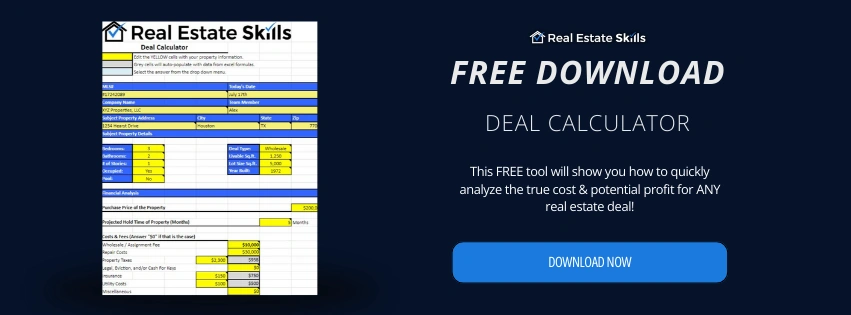
When you're paying points up front and interest every month, a few percent of error in your ARV isn't a smaller profit — it's a deal that can't cover its own financing. Robert's flip survived a $20,000 surprise because the numbers had room to begin with. Download the free Deal Calculator to work out your maximum allowable offer, factor in rehab and closing costs, and see whether your margin survives the cost of the money before you make an offer.
Once You Know The Numbers, You Need A Lender
Understanding what a hard money loan costs is one job. Finding a lender who'll fund your specific deal — what they'll require from you, what the total cost looks like beyond the rate, and what to ask before you sign — is a different one, with its own rules.
That's covered in full here: what lenders require from a first-time investor and how to vet one before you sign.
Knowing What The Money Costs Is Step One. Finding The Deal Is Step Two.
Cheap financing can't rescue a bad deal, and no calculator finds you one. The investors who actually get funded are the ones bringing lenders properties with real margin — bought right, analyzed right, with room to absorb the surprises every rehab produces. Our FREE Training walks you through the entire system, the same one thousands of our students use to find deals, fund them, and get paid. Watch it today, then go put these numbers to work.
Watch The FREE Training →Hard Money vs. Private, Conventional & DSCR Financing
Hard money trades cost for speed — it funds in days on the strength of the deal, where a conventional loan takes 30 to 60 days and underwrites you. Private money is negotiated directly with an individual and is often cheaper. DSCR loans are long-term financing for rentals, not renovations.
Hard money isn't the only way to fund a deal, and it isn't always the right one. Here's how the realistic options compare.
| Hard Money | Private Money | Conventional | DSCR | |
|---|---|---|---|---|
| Who lends | Lending company | Individual you know | Bank or credit union | Portfolio lender |
| Underwrites | The deal | The relationship | You — income, credit, DTI | The property's rent |
| Rate | 9% – 13% | 6% – 12%, negotiated | Market mortgage rates | Above conventional |
| Points | 1.5 – 3 | Often none | 0.5 – 1 | Varies |
| Time to fund | 3 – 10 days | As fast as they'll write the check | 30 – 60 days | 3 – 6 weeks |
| Term | 6 – 18 months | Negotiable | 15 – 30 years | 30 years |
| Distressed property? | Yes | Yes | Usually not | No — needs to be rentable |
| Best for | Flips and rehabs on a deadline | Gap funding, repeat deals | Move-in-ready holds | Refinancing a finished rental |
Conventional Financing
A bank underwrites you: income, tax returns, credit, debt-to-income. Cheaper money and far longer terms — but it takes 30 to 60 days, and banks generally won't lend on a property that isn't habitable. A house with a dead furnace and no working kitchen doesn't qualify, which rules out most properties worth flipping.
Conventional financing is where you want to end up on a property you're keeping. It's rarely how you buy the distressed deal in the first place.
Private Money
Private money comes from a person rather than a company — a colleague, a family friend, someone in your network with capital sitting idle. They aren't marketing themselves and they aren't in the lending business.
The economics are different in your favor. Terms are negotiated directly, so rates range widely, roughly 6% to 12% depending on what you agree to. Often there are no origination points at all, which on a short project can matter more than the rate.
The tradeoff is availability. Hard money is a product you can go buy this week. Private money is a relationship you build before you need it — which is why most investors start with hard money and add private money as they go. Cultivating private lenders is its own discipline, covered in depth in how to find and work with private money lenders.
DSCR Loans
DSCR stands for debt service coverage ratio — the lender's measure of whether a property's rent covers its own mortgage payment. Qualify on the property's income rather than your personal income.
Worth knowing because of where it fits: DSCR loans are long-term financing on stabilized rentals, not renovation money. If you're using the BRRRR strategy — buy, rehab, rent, refinance, repeat — hard money funds the first two steps and a DSCR loan is frequently how you exit into the fourth. They're sequential, not competing.
Using Private Money To Cover The Hard Money Gap
This is the structure most beginners don't know exists, and it's how a lot of first deals actually get funded.
Your hard money lender funds 70% to 90% of project cost. The rest is your problem. On a mid-sized deal, that gap can be $30,000 to $80,000 — and if you had that sitting around you might not be reading this.
So investors fill the gap with private money. The hard money lender takes first position on the property. The private lender takes second position, meaning if everything collapses, the first-position lender gets paid before they see a dollar. That extra risk is why second-position money is priced higher.
That's exactly how Robert funded his flip. His lender required $80,000 at closing. A private lender he knew put in $60,000 — reduced from the $80,000 he asked for, specifically because it was his first deal and they were pricing the risk honestly. He and his partner covered the last $20,000 themselves.
📓 From The Field
Robert asked his private lender for the full $80,000 down payment and got $60,000. Their reasoning was straightforward: he'd never done a flip before. He raised the remaining $20,000 with his business partner in about a month and closed the deal — then repaid the private lender $66,000 when the house sold. His read on it afterward was less about the money than the paying-back: fulfilling the terms is what makes the second loan easier to get. Individual results vary.
Two things to be clear-eyed about before copying this.
Stacking leverage removes your cushion. Robert's own $20,000 was the only real equity in the deal — and the termites and crawl space cost exactly $20,000. If he'd borrowed that piece too, a routine surprise would have put the project underwater instead of merely less profitable.
And your lender has to allow it. Many hard money lenders restrict or prohibit subordinate financing on the down payment, and some require documented proof the cash is yours. Ask before you structure the deal, not after.
Types Of Hard Money Loans
Hard money isn't one product. Fix-and-flip loans fund purchase plus rehab, bridge loans cover a gap between transactions, construction loans fund ground-up builds, and rental loans hold a property short-term before refinancing. Terms and rates differ by type.
Lenders in this space offer several products, and the one you ask for changes your rate, your term, and how the money is released.
Fix-And-Flip Loans
The most common by far. Funds the purchase and the renovation, structured for a fast in-and-out — buy, rehab, sell, repay. Terms typically run 6 to 12 months, and the rehab portion usually comes in draws as work is completed. If you're new to the strategy itself, start with how to flip a house step by step.
This is what most people mean when they say hard money.
Bridge Loans
Short-term financing that covers a gap. You've found a property but your capital is tied up in another deal, or your permanent financing hasn't closed yet. A bridge loan carries you across.
Same asset-backed structure, but the exit is different: you're not selling a renovated house, you're waiting for a specific event — a sale to close, a refinance to fund, a tenant to stabilize the property.
Construction Loans
Ground-up builds, or projects so extensive they amount to one — tearing down to the foundation, adding a second story, building accessory dwelling units. Funded in stages against completed work.
Expect higher rates and longer terms. Construction carries more risk for the lender: no existing structure to fall back on, longer timelines, and more that can go wrong.
Rental And Fix-To-Rent Loans
Buy and renovate a property you intend to keep rather than sell. Hard money funds the acquisition and rehab, then you refinance into long-term financing once it's rented and stabilized.
This is the BRRRR path — the hard money loan is a bridge to the refinance, not the permanent financing. Know your exit lender before you start, because if the refinance doesn't materialize, your balloon payment still comes due.
Land Loans
Undeveloped land is difficult to finance conventionally — no structure, no rental income, no comparable sales in many markets. Hard money lenders will sometimes lend on it because they're underwriting the asset's value rather than its cash flow. Expect lower LTVs and higher rates than a property with a house on it.
The practical point: ask your lender which product fits your project before you're quoted, not after. A fix-and-flip loan and a construction loan on the same property carry different rates, different terms, and different draw schedules. Describing your project accurately up front gets you priced correctly the first time.
Pros & Cons Of Hard Money Loans
Hard money buys speed and access to properties banks won't touch, funded on the strength of the deal rather than your credit. You pay for it in rate, points, and a short clock — and the short clock is what makes it dangerous if your project runs long.
Most articles give you five pros and five cons in a tidy table. The real tradeoff isn't that symmetrical.
What Hard Money Genuinely Gives You
Speed. Three to ten days versus 30 to 60. On a distressed property with competing offers, that's frequently the entire reason your offer gets accepted. Sellers of problem properties want certainty and a short escrow more than they want the highest number.
Access to properties conventional financing can't touch. A vacant house with a caved-in roof doesn't qualify for a mortgage. It qualifies for hard money, because the lender is underwriting what it'll be worth fixed, not what it is now. This is the real unlock, and it's what makes the whole fix-and-flip model possible.
Your credit isn't the gate. Beginners fixate on this and they're half right. Credit still affects your rate — better scores get better pricing. But a strong deal with thin credit gets funded far more readily than a weak deal with an 800 score. The deal is what's being judged.
Your other assets usually aren't at stake. The loan is typically secured by the property alone. As covered earlier, that's not automatic and a personal guarantee changes it — but it's a meaningfully different risk profile than borrowing against your own home.
You keep your capital working. Using a lender's money instead of your own means the cash you do have can fund a second deal, or sit as a reserve for when a rehab surprises you. That optionality is worth more than most beginners realize.
What It Actually Costs You
The money is expensive, and points are the sharp edge. Nine to thirteen percent is real money, but the points are what people underestimate — 1.5 to 3 percent of the loan, in cash, at closing, non-refundable, before you've made a dollar.
The clock is the real risk. This is the one that hurts people, and it deserves more weight than the rate. Six to eighteen months sounds generous until a contractor goes quiet for three weeks, a permit takes longer than anyone said, and your listing sits through a slow month. Interest accrues the whole time. Robert's flip absorbed a 46-day close, a month of rehab overrun, and 57 days on market — every one of those days billable.
Extensions cost money, and you'll want one more often than you'd think. If your project isn't done when the term ends, you're negotiating an extension, usually for a fee, sometimes at a worse rate. Ask what an extension costs before you sign, because you're asking from a much weaker position after.
You still need meaningful cash. Ten to thirty percent of project cost, plus points, plus closing costs, plus working capital to front rehab draws. "No money down" is not what this is.
Your margin has to be big enough to survive being wrong. This is the honest version of every point above. The cost of the money isn't the problem — the problem is a deal so tight that the cost of the money is what breaks it. Robert lost $20,000 to termites and a crawl space and still cleared $40,000, because there was room. A deal that only works if nothing goes wrong isn't a deal. It's a bet.
The summary judgment: hard money is a tool for projects with a real margin and a real deadline. When the numbers have room and you exit on schedule, the cost is a rounding error against the profit. When the numbers are thin or the timeline slips, it's the most expensive money you'll ever borrow — and that's the case worth taking seriously, which is next.
The Real Risks — And Who Should Not Use One
The main risk is losing the property. Hard money is secured by the house, so if you can't repay or refinance before the term ends, the lender can foreclose. The danger isn't the rate — it's a thin deal, a slipping timeline, or no realistic exit.
Time to answer the question people are actually asking when they type "are hard money loans dangerous."
They're not dangerous in the way people fear — this isn't predatory lending, and the lender isn't hoping you fail. Foreclosing is expensive and slow; they'd rather you succeed and come back. But they are genuinely risky in a specific way, and it's worth naming precisely.
What You Actually Stand To Lose
The property. The house secures the loan. Miss the balloon payment with no extension and no exit, and the lender can take it — along with your down payment, your points, and whatever you sank into the rehab.
What you generally don't lose is everything else. As covered earlier, these loans are typically secured by the property rather than your personal assets. A failed flip is usually a contained disaster rather than a life-altering one. That containment is real and it's the single most reassuring fact about this financing — provided you haven't signed a personal guarantee. Check.
Where it gets worse: if you stacked private money in second position to cover your down payment, that lender is still owed. They're behind the first-position lender on the property, but the obligation doesn't evaporate. If that money came from someone you know, the fallout isn't only financial.
The Three Ways Deals Actually Fail
Not the rate. These:
The margin was too thin from the start. The most common failure by a distance. You paid too much, or your ARV was optimistic, or your rehab estimate was a guess. Then something ordinary happens — termites, a foundation issue, a permit delay — and the deal has no room to absorb it. A house that only pencils if everything goes right is not an investment.
The timeline slipped past the term. Rehabs run long. Nearly all of them. If your six-month loan meets a nine-month project, you're negotiating an extension from a weak position or scrambling to refinance mid-renovation, which most lenders won't do on an unfinished property.
The exit never materialized. You planned to sell and the market cooled. You planned to refinance and the appraisal came in low, or your DSCR didn't work, or your credit changed. The exit is the part beginners plan least and need most. Know specifically how this loan gets repaid — which lender, which product, what they'll require — before you take it.
Who Should Not Use A Hard Money Loan
Naming this plainly, because a lot of content in this space won't.
- Anyone buying a home to live in. Not a preference — largely a legal boundary, explained below.
- Anyone whose deal only works at best-case numbers. If your projected profit is smaller than a plausible surprise, you don't have a margin, you have a hope. Robert's flip survived a $20,000 hit because there was room. Run your numbers at the pessimistic end and see whether the deal still clears the cost of the money.
- Anyone without cash reserves beyond the down payment. You need the down payment, the points, closing costs, and a reserve. If a draw reimbursement takes three weeks and you can't pay your contractor in the meantime, the project stops while interest keeps running.
- Anyone who needs this specific deal to work. Financial pressure produces bad decisions — accepting a scope you can't verify, skipping an inspection, taking maximum leverage to preserve cash. Robert skipped his inspection because he was overwhelmed, not because he didn't know better. It cost $20,000.
- Anyone planning a long hold. This is short-term money. If the plan is to buy and keep a rental, hard money is at most a bridge to permanent financing — and you should know what that permanent financing is before you start.
Why You Can't Use One On Your Own Home
This surprises people, and the usual explanation — "consumer lending laws" — is too vague to be useful. Here's the actual mechanism.
Federal consumer-credit rules under the Truth in Lending Act and its implementing rule, Regulation Z, apply to credit extended for personal, family, or household purposes. Under 12 CFR § 1026.3(a), credit extended primarily for a business or commercial purpose is exempt from those rules — and separately, so is credit extended to an entity rather than an individual. Two independent exemptions. Under the official interpretation, a loan to acquire, improve, or maintain non-owner-occupied rental property is treated as business purpose.
Which is why the occupancy question is on every application. The moment you intend to live in the property, the loan becomes consumer credit — pulling in ability-to-repay obligations, disclosure requirements, and originator licensing that most private lenders aren't set up to handle. Not worth it to them, so they decline.
This also explains the LLC question. Many lenders require you to close in an entity, and one reason is that loans to non-natural persons sit in that second exemption. But an LLC is a lender requirement, not a legal mandate — you'll see it claimed otherwise, and that claim is wrong. If a lender requires an entity, form one because they asked, not because a statute compels it.
This explains general regulatory structure for educational purposes and is not legal advice. Lending rules vary by state and change over time — consult a licensed attorney about your specific situation before you rely on any of it.
Hard Money Loan FAQs
Final Thoughts On Hard Money Loans
Hard money isn't complicated once you see what it actually is: someone lends you money against a house, charges you for the time you hold it, and wants it back when the project ends.
Everything else is arithmetic. The rate and points set the price. LTC sets what you bring. The term sets the clock. And the clock is the part that decides how this goes — not the rate everyone fixates on. A deal that exits on schedule at 12% beats one that drags eleven months at 9%, every time.
The investors who do well with this money aren't the ones who negotiated the best terms. They're the ones who bought right in the first place. Robert cleared $40,000 on his first flip after losing $20,000 to termites, running a month long, and sitting 57 days on market — because the deal had room. Every one of those setbacks would have wiped out a thinner deal. Nobody gets a first flip where nothing goes wrong. What you get to control is whether your margin can absorb it.
So before you talk to a lender, do this: take a property you're actually looking at, run the real numbers — purchase price, honest rehab estimate, conservative ARV — then subtract the cost of the money. Points at closing. Monthly interest for a timeline a third longer than you think you need. Closing costs on both ends.
If the deal still works, you have something. If it only works at your optimistic numbers, you've learned something more valuable than a rate quote — and it cost you nothing.
That's the whole discipline. Everything above is just detail on how the money works.
You Understand The Money. Now Go Find A Deal Worth Borrowing For.
No lender, rate, or loan structure rescues a deal that was bought wrong. The investors who build real businesses are the ones who consistently find properties with enough margin to survive the surprises — then fund them, finish them, and do it again. Our FREE Training walks you through the entire system, the same one thousands of our students use to find discounted properties, lock them up, and get paid. Watch it today, then go put these numbers to work on a real deal.
Watch The FREE Training →
About The Author
Founder & CEO, Real Estate Skills
Alex Martinez is the Founder and CEO of Real Estate Skills. With more than a decade of investing experience and 33+ residential properties acquired, he has personally wholesaled and flipped houses across the country — funding his first fix and flip with a hard money lender. Through Real Estate Skills, Alex and his team have helped thousands of students learn how to find deals, fund them, and close profitable real estate transactions.
Real Estate Skills is not a law firm or a lender, and the information in this article is provided for educational purposes only — it does not constitute legal, tax, or financial advice. Hard money loan terms, rates, and lending regulations vary by lender and by state and change over time. Real estate investing carries risk, including the loss of the property securing your loan, and past results do not guarantee future outcomes. Always consult a licensed real estate attorney and your own tax and financial advisors before entering into any loan or transaction.

👉FREE Training
How To Consistently Wholesale, Flip Houses, & Invest In Rental Properties From The MLS
(Without Spending $1 On Marketing)

Alex Martinez, the founder of Real Estate Skills, is known for his strong, practical expertise in real estate, starting from a beginner with no family connections in the industry to completing over 50 real estate deals, including wholesale and flips, within his first year.
He has dedicated his career to providing cutting-edge education and resources for real estate professionals. He emphasizes the importance of self-taught knowledge through mentors, books, and hands-on experience.
His journey from earning a modest income to becoming a successful real estate entrepreneur and educator showcases his expertise and dedication to the field.

Ryan Zomorodi, co-founder and COO of Real Estate Skills, leverages his experience from a diverse background in real estate investment, construction management, and entrepreneurship to provide comprehensive education in the real estate sector.
His expertise is rooted in hands-on experience, extensive industry knowledge, and a commitment to empowering others through education.
Ryan's journey reflects a blend of practical experience and entrepreneurial success, contributing to his role in developing a platform that educates and supports aspiring real estate professionals.
Read Ryan's Full Bio >>
