
How To Find Houses To Flip On Zillow (The 2026 Investor Blueprint)
Oct 14, 2026

Written by
Alex Martinez, Founder & CEO, Real Estate Skills. Has wholesaled and flipped houses for over 14 years, been part of 1,000+ real estate transactions, and personally acquired 55+ residential investment properties. Has trained 6,000+ investors nationwide.
Reviewed by
Ryan Zomorodi, Co-Founder & COO, Real Estate Skills. Reviewed the Zillow search steps, deal math, and legal points in this guide.
Publication history: Originally published February 20, 2026. Updated October 2026 with a corrected Zillow search method, a new section on pricing your offer, current rules for working with listing agents, a real student deal found on Zillow, and a new on-camera Zillow walkthrough. Reviewed by Ryan Zomorodi, Co-Founder & COO of Real Estate Skills.
To find houses to flip on Zillow, open Filters, type a distress word like "as-is," "TLC" or "motivated" into the Keywords box, then open each result to check its time on Zillow and price history. In my co-founder Ryan's spring 2026 Chicago search, "motivated" cut 4,656 listings to 76.
If you've scrolled Zillow looking for a flip, you've probably decided the good ones are gone before you ever see them. That isn't how it works. The houses that make money are the ones regular buyers scroll right past: the dated ones, the ones a bank won't finance, the ones that have been listed for months while the price keeps dropping.
My first deal was an on-market listing. I called the agent, made an offer, and got it under contract. Our students still find deals that way. Brayden, one of our students in Tampa Bay, found a house in St. Petersburg on Zillow this year and negotiated it to $50,000 under the asking price. Not every listing turns into a deal, but the deals are there if you know how to search.
Below are the filters and keywords to use, how to spot a seller who's ready to negotiate, how to run your numbers before you offer, and what to say when you call the listing agent. Before you make an offer on anything you find, run the numbers in our free deal calculator.
Can You Really Find Houses To Flip On Zillow?
Yes. Zillow shows most of the same homes investors buy every day, and the best flips are the listings regular buyers skip: houses that need too much work, won't qualify for a normal mortgage, or have been listed for months. Those sellers often take less for a fast, cash, as-is sale.
The idea that every good deal disappears before it's listed assumes investors and families want the same houses. They don't. A family buying a home usually wants something they can move into, and their lender usually wants a house in livable condition. A home with a failing roof, a gutted kitchen or a structural problem is a dead end for most of them. To me, it's the starting point.
So those houses sit. The seller keeps paying the mortgage, taxes and insurance. The agent lowers the price, then lowers it again. By the time a listing has been up for a few months with a couple of price cuts, the seller has learned that a regular buyer isn't coming. That's when a clean cash offer starts to sound good.
| What You See On Zillow | How A Regular Buyer Reacts | Why It Matters To A Flipper |
|---|---|---|
| Months on the market, multiple price cuts | Assumes something's wrong and moves on | The seller is paying to hold the house and is more open to offers |
| Major repairs needed | Can't get a loan, or doesn't want the project | Room to buy below value and add value through renovation |
| Unpermitted addition | Worries about the appraisal, the loan and the inspection | Possible discount, but price in the cost of permitting or removing it, and don't count that space in your ARV until it's legal |
| "Cash only" or "as-is" in the description | Skips it | Fewer buyers competing with you |
As Ryan likes to put it, you don't have to buy, but some sellers have to sell. That gap is where flips come from.
When this doesn't work: in very tight markets with few homes for sale, regular buyers and other investors will compete hard even for houses that need work, and prices get bid up past what a flip can support. If every distressed listing in your area sells in a week above the asking price, widen your search area or add other ways of finding deals. Our guide on how to find houses to flip covers the off-market options.
How To Find Houses To Flip On Zillow (Step By Step)
Set your area, home type and price ceiling, then search Zillow's Keywords filter for distress words. Check Listing Type for owner and foreclosure listings, open each result to read days on market and price history, verify the details, and save the search so new listings reach you first.
Treat Zillow as a search tool, not a photo album. Every step below does one of two things: it removes listings you'd never flip, or it surfaces a seller who's ready to talk. Zillow moves its menus around from time to time, so if a filter isn't exactly where I describe it, look under Filters or More.
Step 1: Set Your Area, Home Type, And Price Ceiling
Search one market you know well, limit home types to houses and small multifamily, and set a maximum price below what renovated homes there sell for. That clears out land, condos and overpriced listings before you read a single description.
The price that matters is what the house would sell for after it's fixed up. That's called the after repair value (ARV). You'll calculate it properly later in this guide. For now, a rough ceiling keeps you out of homes where the math can never work.
Zillow's filters also include year built and HOA. A maximum year built pushes older homes to the top, and older homes are more likely to need the roof, plumbing or electrical work that creates room to add value. Consider excluding homes with an HOA (homeowners association), because association rules and approvals can slow a renovation down.
Don't over-filter at the start. My co-founder Ryan Zomorodi runs his keyword search first, then narrows down to his exact buy box: property type, square footage, lot size and part of town. A buy box is just the short list of properties you're actually willing to buy. (watch this part)
Step 2: Search Zillow By Keyword
Open Filters, scroll to Keywords, and type one word an agent would use for a house that needs work or a seller who needs out, such as "as-is," "TLC," "cash only" or "motivated." Zillow then shows only the listings whose description contains that word.
Ryan ran this live in Chicago in spring 2026. The city had 4,656 homes for sale. He typed "motivated" into Keywords, hit apply, and 76 listings were left, each one an agent advertising a seller who wants to make a deal. In the markets he works, "motivated" typically flags 1% to 2% of active listings. Yours will vary. (watch this part)
| Keyword Group | Words To Try | What It Usually Signals |
|---|---|---|
| Condition | as-is, TLC, fixer upper, needs work, handyman special, contractor special | The house needs repairs the seller won't make |
| Financing | cash only, cash, investor special | It may not qualify for a normal mortgage, so most retail buyers can't compete |
| Motivation | motivated, bring all offers, priced to sell, must sell | The seller cares more about closing than about top dollar |
| Situation | estate sale, foundation, fire damage | A specific problem: an inherited home, structural damage, a disaster repair |
Search one word at a time. Each word pulls a different set of listings, and a word that returns nothing in your market doesn't mean there are no deals there. Try the next one.
Then read before you trust a match. When Ryan searched "cash" on a listing site, one result was a house described as a "strong cash flowing investment property." The keyword matched, but there was no distress. A keyword gets you to the right listings; it doesn't prove anything about them.
How To Find FREE Motivated Seller Leads on Zillow
Watch Ryan run the "motivated" keyword search on Zillow live, then walk through the listings it finds, including one with $79,000 in price cuts after 232 days on the market.

Step 3: Check Listing Type For Owner And Foreclosure Listings
Zillow's Listing Type filter lets you include for-sale-by-owner homes and foreclosure categories in your search. Bank-owned homes are actually for sale. Pre-foreclosures usually aren't: they're homes where the owner has fallen behind and the lender has started the foreclosure process.
For sale by owner, or FSBO, means there's no listing agent, so you talk to the seller directly. Bank-owned homes, also called REO (real estate owned), are properties a lender took back and put up for sale, usually through an agent. Zillow's own guidance warns that a pre-foreclosure is not necessarily for sale, because the owner can still catch up on payments and keep the house. I explain each category, and how to work it, in the pre-foreclosure section below.
Step 4: How To Find Houses That Have Been On The Market For A Long Time
Zillow's Days on Zillow filter only narrows to newer listings, so it can't surface stale ones. Instead, run your keyword search, open each result, and check how long it has been on Zillow and its price history. Months on the market plus repeated price cuts point to a seller under pressure.
A house that sits costs its owner money every month: mortgage, taxes, insurance, utilities. The longer it sits, the more open the seller gets to an offer that would have insulted them on day one.
Here's what that looks like on a real listing. One of the "motivated" results in Ryan's Chicago search had been on Zillow for 232 days. The price history showed it listed at $624,000, cut to $600,000, then cut again to $545,000. That's $79,000 off, and the description said the owner wanted offers. That seller isn't holding out for top dollar anymore. (watch this part)
One catch: the counter can understate how long a house has really been for sale. According to Zillow's help center, a listing the same agent pulls and relists doesn't restart its count unless it was off the market for 31 or more days in a row. Wait out that window and the listing looks brand new. The price history still shows the earlier listing and its price, so read it every time.
If a listing expires without selling, the seller may be even more ready to deal. See our guide on how to find expired listings.
Step 5: Read The Listing Like An Investor
Read the full description, the photos and the property details before you call anyone. You're looking for the reason the house hasn't sold and whether the repairs leave room for profit. A motivated seller gives you room to negotiate, but motivation alone doesn't make a house a flip.
Signs worth noticing:
- Few or no interior photos: Often the condition, or an occupant, is something the agent would rather you see in person.
- "As-is": The seller won't make repairs, and you're expected to account for them in your price.
- "Seller occupied" or a tenant in place: Showings may be limited, and you'll need to plan around move-out timing.
- Dated kitchens, baths and systems in the photos: That's where renovation dollars go, and where the value gets added.
Ryan showed exactly why motivation and condition are separate questions. One "motivated" listing in Chicago was a four-bedroom, two-bath bungalow of about 1,500 square feet, sold as-is with the seller living there. It was clearly lived in and partly updated, with a newer kitchen, so it wasn't a flip candidate. The seller's motivation still gave a buyer bargaining power. Motivation tells you the price can move. The repairs and your numbers tell you whether it's a flip. (watch this part)
Step 6: Check The Listing's Facts Against Public Records
Before you run any numbers, confirm the square footage, bedroom and bathroom count and year built against your county assessor's record. Zillow shows what the listing reports, and listings get these wrong. One wrong square footage figure throws off every price-per-square-foot comparison you make.
Look the property up on the county assessor's or property appraiser's website by address or by its APN, the assessor's parcel number, a unique ID every property has. If the listing and the county disagree, ask the listing agent why before you write an offer.
One of our students, Brayden, learned this on his first deal. The St. Petersburg house he found on Zillow was listed at 2,400 square feet, but that figure included an indoor pool room, and the real living space was well under it. He had to renegotiate in the middle of the deal, and his planned $20,000 fee was cut in half. (Results vary, and this isn't typical.) Check the numbers before you sign, not after.
Step 7: Save The Search And Turn On Alerts
Save your filtered search and turn on notifications so new listings that match reach you the day they post. Save individual listings you like, too. When one drops its price or comes back on the market after a failed contract, you want to know first.
This step matters more than it looks. Offers that get turned down come back. A seller turns you down today, the buyer they picked can't close, and three weeks later the agent calls you. I've seen it happen over and over. A saved listing is how you notice the moment it goes from pending back to for sale.
You Know How To Find The Listings. Now Learn To Turn Them Into Deals.
Finding a motivated seller on Zillow is the easy part. The investors who actually close follow a proven process from there: running the numbers, calling the listing agent, and getting a signed offer in front of the seller. Our FREE Training walks you through that full on-market offer system, the same one thousands of our students use. Watch it today, then go make your first offer.
Watch The FREE Training →What Pre-Foreclosure, Auction And Bank-Owned Mean On Zillow
A pre-foreclosure tag on Zillow isn't a listing. It means a lender has filed a notice of default (NOD), a public notice that the owner has missed enough payments for foreclosure to begin. The owner still holds title, and the house isn't actually for sale unless the owner chooses to sell.
Zillow shows foreclosure information at three stages, and each one works completely differently for a buyer. Pre-foreclosure data comes from public records, and Zillow asks you to create a free account to see it.
| What Zillow Shows | What It Actually Means | What You Do |
|---|---|---|
| Pre-foreclosure | A notice of default has been filed (or, in states where foreclosure goes through the courts, a lis pendens: a notice that a foreclosure lawsuit has been filed). The owner still owns the house and may catch up on payments. | Contact the owner directly. The house usually isn't listed. |
| Foreclosure auction | The house is scheduled to be sold at a public auction, often called a trustee's or sheriff's sale. | Bid at the auction, under that county's rules. You usually can't see inside. |
| Bank-owned (REO) | Nobody bought it at auction, so the lender took it back and is now selling it. | Make an offer through the listing agent, like any other listed home. |
What Does NOD Mean On An Active Listing?
It means the house is listed for sale while the owner is also behind on the mortgage and the lender has filed a notice of default. The owner is racing the foreclosure clock, which usually makes them a motivated seller. If they owe more than the house is worth, the lender may have to approve the sale.
That last case is called a short sale, because the lender agrees to accept less than it's owed. Short sales take longer and involve the lender's own review, so ask the listing agent early whether the seller owes more than the asking price. Either way, a listed pre-foreclosure is an ordinary on-market deal: you call the listing agent and make an offer, as described below.
How Investors Use Pre-Foreclosure Data
Treat Zillow's pre-foreclosure tag as a lead, not a listing. Confirm the filing in the county records, then contact the owner, usually by mail or after skip tracing, before the auction date. Expect many owners to catch up on payments or not want to sell.
Skip tracing means using a data service to find an owner's phone number or email. (Here's our breakdown of skip tracing services.) Zillow's foreclosure information can be out of date, so check the filing with the county recorder or court before you spend time on the house.
Be careful how you approach these owners. Never promise to stop a foreclosure, and never make your letter look like an official notice. Some states, including California and New York, have laws regulating investors who buy homes from owners in foreclosure. For letters that work and what to leave out, see our guide to real estate mailers. For the full foreclosure process, see how to find distressed properties.
This is educational, not legal advice. Foreclosure rules and timelines vary by state, so talk to a local real estate attorney before you contact owners in foreclosure or bid at an auction.
How To Find ARV On Zillow (And Why Not To Trust The Zestimate)
A Zestimate is an automated estimate, not an appraisal. To find ARV on Zillow, switch your search to sold homes, then look for renovated homes within about half a mile that sold in the last 90 days and match your house's bedrooms, bathrooms and square footage.
ARV, the after repair value, is the number every other figure in your deal depends on. Get it wrong and your profit was never real.
How To Pull Sold Comps On Zillow
Change the listing status from For Sale to Sold, zoom the map to the blocks around your property, and filter to the same home type, bed and bath count, and a similar size. Then open each recent sale and keep only the ones that were renovated, because ARV is the price of a fixed-up house.
A "comp" (short for comparable) is a recently sold home similar to yours. Here's how to pick good ones:
- Sold, not listed: Asking prices are what sellers hope for. Sale prices are what buyers actually paid, and appraisers work from sales.
- Close in distance and time: About half a mile and the last 90 days is a good starting point. In rural areas with few sales, widen both, and consider paying for an appraisal before you commit.
- The same condition you'll create: Look at the photos. If your plan is a full renovation, compare to renovated homes, not to the dated house next door.
- Normal sales only: Leave out a home sold to a family member at a discount, or one sold in obviously rough shape. They drag your number down for reasons that don't apply to your house.
- Square footage you've checked: If you compare price per square foot, make sure the square footage is right. Brayden's deal earlier in this guide shows what happens when it isn't.
This is a quick version. For adjustments and how to weigh one comp against another, see our guide on how to pull real estate comps.
Why Some Sold Prices Are Missing On Zillow
In non-disclosure states, including Texas, Utah and Wyoming, sale prices aren't part of the public record, so Zillow's sold data there can be incomplete or missing. Sold prices still flow through the MLS, so if you invest in one of these states, ask an agent to pull MLS comps for you.
The full list of non-disclosure states varies a little depending on the source, so if your sold searches keep coming back without prices, check your state's rules. The fix is the same everywhere: get comps from someone with MLS access, and don't rely on Zillow's estimates to fill the gap.
Why You Can't Use The Zestimate As Your ARV
The Zestimate doesn't know your house's condition or what you plan to renovate, and it can't tell a gutted kitchen from a new one. Zillow learned this the hard way: it shut down its own home-flipping business, Zillow Offers, in 2021 after struggling to predict home prices.
Zillow Offers bought homes, renovated them and resold them, which is house flipping at enormous scale. In November 2021, Zillow announced it was winding the business down. In Zillow's own announcement, CEO Rich Barton said forecasting home prices had proven far less predictable than Zillow had expected, and the company took a write-down of roughly $304 million on homes it had bought for more than it now expected to sell them for.
If Zillow couldn't flip profitably using its own pricing models, you shouldn't set your ARV with them either. Use the Zestimate as a rough first look at a neighborhood, then pull your own sold comps.
| Value Source | How Reliable For A Flip | The Problem |
|---|---|---|
| Zestimate | Low | Can't see condition, finishes or your renovation plan |
| Active listings | Medium-low | Shows what sellers are asking, not what buyers paid |
| Recent sold comps (similar, renovated, nearby) | High | Takes judgment to choose and adjust, and may be missing in non-disclosure states |
For a closer look at how Zillow's estimate stacks up against Redfin's, see our breakdown of whether Zillow or Redfin is more accurate.
How Much Should You Offer On A Zillow Flip?
Work backward from the after repair value. Subtract repairs, holding costs, buying and selling costs, and the profit you need. What's left is the most you can pay. Never start from the asking price or the Zestimate, because neither one knows your repair budget or your profit target.
Here's what each piece means:
- After repair value (ARV): What the house will sell for once it's renovated, based on recent sales of comparable homes nearby.
- Repairs: The full renovation budget, ideally from contractor quotes, not guesses.
- Holding costs: What you pay every month while you own it: property taxes, insurance, utilities, and loan interest if you borrow.
- Buying and selling costs: Closing costs when you buy, plus agent commissions and closing costs when you sell.
The numbers below are an illustration, not financial advice. Costs vary by market, lender and property, so run your own numbers for every deal.
A Real Example: Working Backward From $315,000
On a house listed at $200,000 with an estimated $315,000 ARV and about $90,000 in repairs, Ryan's numbers show roughly $6,000 of profit at the asking price, about $36,000 at $170,000, and about $56,000 at $150,000. His minimum on a flip is $30,000, so his offers start around $170,000.
My co-founder Ryan walked through this house on camera: four bedrooms, two baths, about 2,200 square feet, built in 1940, listed at $200,000 and needing a full renovation. Here's how he built the numbers.
💡 Ryan's Numbers On A $200,000 Listing
- ARV: For the example, he used $315,000, the price he estimated it could sell for after renovation based on comparable sales.
- Repairs: $40 per square foot for a full refresh, about $90,000. He called that estimate on the high side for the size of the house.
- Timeline: His rule of thumb is one week of work per $10,000 of repairs, so about nine weeks. He rounds up to three months because renovations almost always run long, then adds a month to sell and a month to close: about five months total.
- Holding costs: about $400 a month for taxes, insurance and utilities, or about $2,000 over five months. This example assumes no loan. If you borrow, add the interest and lender fees.
- Buying costs: about 1% of the purchase price in closing costs.
- Selling costs: 1.5% for the listing agent, 2.5% budgeted for the buyer's agent, and 1% for closing, which comes to about $15,750 on a $315,000 sale.
| Purchase Price | Approximate Profit |
|---|---|
| $200,000 (asking) | About $6,000 |
| $170,000 | About $36,000 |
| $150,000 | About $56,000 |
At the asking price, the deal isn't worth doing. $30,000 below it, it clears Ryan's minimum. That's how you arrive at an offer: not by knocking a percentage off the list price, but by knowing the number where your profit appears.
There's one rule that matters more than any formula. Don't push your ARV up or your repair budget down to make a deal work on paper. If the numbers don't work, negotiate a lower price or walk away. A flip that only works on an optimistic spreadsheet loses money in real life.
What About The 70% Rule?
The 70% rule says to pay no more than 70% of the ARV minus repairs. On Ryan's example, that's $315,000 × 0.70 = $220,500, minus $90,000 in repairs, for a maximum offer of $130,500. It's a fast screening tool, but it ignores your actual costs.
Ryan's line-by-line math put this deal's starting offer around $170,000. The 70% rule would have stopped at $130,500. That's a $39,500 gap on the same house.
Ryan thinks the 70% rule is outdated and makes you less competitive, because sellers and agents take your offers less seriously when they're well below what the deal can actually support. That's a fair point in competitive markets. The other side deserves its due, though: the extra margin the 70% rule builds in protects you when your repair estimate is wrong, and as a beginner, your repair estimate will be wrong at least once. A reasonable approach is to use the 70% rule as a quick screen when you're scrolling listings, then run the full numbers before you make an offer.
Plan Your Resale Around The FHA 90-Day Rule
If you resell within 90 days of buying, your buyer can't use an FHA-insured loan, a common loan for first-time buyers. Between 91 and 180 days, if your resale price is 100% or more above what you paid, the lender must order a second appraisal. Build your timeline so you clear these windows.
Ryan's five-month timeline clears the 90-day window. His resale price ($315,000) is about 85% above a $170,000 purchase, under the 100% mark, so a second appraisal wouldn't be triggered. FHA's property flipping rule has exceptions, and lenders can add their own requirements, so confirm the current rules with a lender before you set your resale timeline.
Run These Numbers On Any Zillow Listing
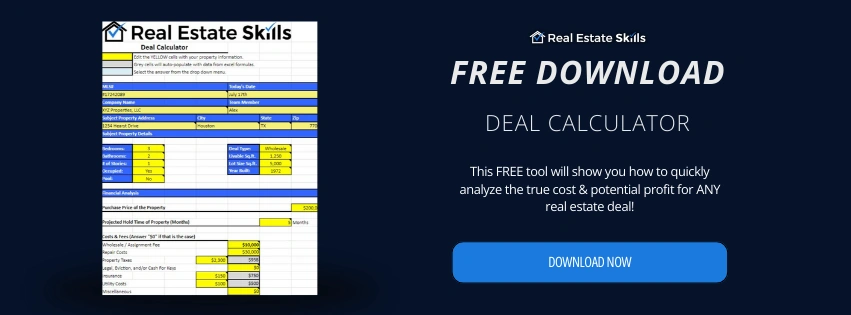
Plug in a listing's ARV, repair budget, holding costs and selling costs, and our free deal calculator shows your profit at any purchase price and the most you can offer. Ryan walks through these same inputs in the $200,000 example above, and the calculator works whether you plan to flip the house or wholesale it.
How To Call The Listing Agent And Make An Offer
Scroll past Zillow's Contact Agent button to the "Listed by" section, call that agent, and ask about the seller's situation before you talk price. Then email your offer terms with proof of funds, have the agent send a written contract, and sign it. That's when your offer is real.
The listing agent is the person who talks to the seller. They know why the house is for sale, what the seller needs, and whether anyone else has made an offer. Zillow can show you the house; only the agent can get you the deal.
This section explains how the offer process generally works. It's educational, not legal advice. Contract forms and disclosure rules vary by state, so have a licensed real estate attorney review anything before you sign.
Find The Real Listing Agent On Zillow
Don't use the Contact Agent button. Zillow says it connects you with a Premier Agent partner, a buyer's agent who advertises on Zillow, not the agent who listed the house. Look for the "Listed by" details on the listing instead. They show the listing agent's name, brokerage and usually a phone number.
In Ryan's Chicago walkthrough, the listing agent's name and phone number were right there on the listing. No skip tracing, no guessing at an owner's contact information, no mailing lists. You know exactly who to call, and you can call today. (watch this part)
What To Ask On The First Call
Ask about the property's condition, what the seller needs from this sale, whether there are other offers, the seller's preferred closing date, and which terms matter besides price. Then listen. The answers tell you what offer has a real chance of being accepted.
I call this a discovery call, and the most important part is listening. Stay with the agent's answers even when the conversation goes somewhere your script didn't plan for, because that's usually where the useful information is. If the seller needs time to move out, offer a flexible closing date. If the agent has been burned by an investor who disappeared, tell them how you'll stay in touch from contract to closing, then do it. Small promises kept build trust: if you say the offer will be in their inbox by 3 p.m., send it by 3 p.m.
Some agents won't accept an offer from someone who hasn't seen the property. Brayden, one of our students, runs into this, so when an agent asks, he walks through the house first and then submits.
Know What To Ask Before You Call
Our free discovery call script has the questions we use on MLS deals to qualify a distressed listing, uncover the seller's motivation and build rapport with the listing agent. It was written for wholesale deals, and the same questions work when you're buying to flip. Ryan mentions it in the Zillow walkthrough above.

How To Turn Your Offer Into A Signed Contract
Email the agent your offer terms with proof of funds, ask them to send you the written purchase contract, then review it, sign it, and send it back. Naming a price on the phone isn't an offer. The signed contract in the seller's hands is.
Proof of funds is a document showing you can pay for the house: a bank statement, or a letter from the lender funding your purchase. Including it with your terms tells the agent you're a real buyer, not someone fishing for a price.
Use the purchase contract and disclosures approved for your state, and make sure the terms reflect what the seller told you matters. If you're not working with your own agent, nobody on the deal is looking out for your interests, so read every page and have an attorney review your first contracts.
What To Do When The Seller Says No
Treat a "no" as information and follow up. A counter tells you where the seller's price is right now. A higher competing offer that depends on a loan is your chance to sell speed and certainty. And many rejected offers come back weeks later when the first buyer can't close.
Don't close the door at the first sign of resistance. Ask the agent what it would take. Keep a simple record of every offer: the property, the agent, your price, the seller's response and your next follow-up date. After several offers, you'll see the patterns, like whether your repair estimates are too high or which agents keep listing the kind of houses you want.
Even when a deal doesn't work out, a real offer gets your name in front of the agent. Ryan's goal is to get on each agent's short list of cash buyers, so the agent calls him first about pocket listings, meaning homes the agent has been hired to sell but hasn't advertised yet. That's how a single Zillow listing turns into a source of future deals.
📓 From The Field
Brayden, one of our students in the Tampa Bay area, found his first deal on Zillow this year: a three-bedroom, two-bath house in St. Petersburg with an indoor pool, listed at $375,000. He worked the deal through the listing agent and got it under contract at $325,000, $50,000 under the asking price. It closed about two and a half weeks later. His exit was assigning the contract to a buyer rather than renovating it himself, but he found it and negotiated it exactly the way a flipper would. The part he expected to be hardest, talking to agents, turned out to be easier than he thought. They want to close deals too. Watch Brayden walk through the deal.
Should The Listing Agent Represent You Too?
You can ask, but it's not automatic. When one agent represents both buyer and seller, it's called dual agency. Some states ban or restrict it, and where it's allowed, both sides must agree in writing. Whether it changes the agent's pay depends on the listing agreement, not on the MLS.
The old advice was that a listing agent would push your lowball offer harder if they could keep the whole commission, sometimes called a "double dip." That changed with the August 2024 NAR settlement rules. Offers of buyer-agent compensation can no longer be posted on the MLS, and agents working with buyers must have a written agreement with them before touring a home. So don't assume a fixed commission split, and don't build your offer around one. If you want to explore having the listing agent represent you, ask how it works in your state and under that listing. For the details, see our guide to dual agency and double commission.
Flipping Houses On Zillow: FAQs
Final Thoughts: What To Do On Zillow This Week
Once a week, run your saved searches for new distressed listings, call the listing agents on the best ones, run the numbers on the houses that pass the call, send written offers, and follow up on every offer already out. Consistent offers beat clever searches.
Finding the house was never the hard part. The investors who close deals are the ones who make offers every week and follow up when the first answer is no. In Ryan's experience, about one in every 5 to 15 offers gets accepted. Results vary by market and by how well you price, but the math only works if the offers go out. And making an offer costs you nothing but your time.
The other discipline is walking away. If your numbers say $170,000 and the seller won't go below $200,000, let it go and make the next offer. Your profit on a flip is set the day you buy, not the day you sell. Know your maximum before you call, and stick to it. Our guide to the maximum allowable offer (MAO) formula walks through it.
The Deals Are On Zillow. Learn How To Lock Them Up.
Saved searches and price alerts only get you a list of houses. Getting one under contract takes the right numbers, the right conversation with the listing agent, and a written offer that works for the seller. Our FREE Training shows you how we find the right properties, talk with listing agents, and structure offers, step by step. Watch it today, then run your next Zillow search with a plan.
Watch The FREE Training →
About The Author
Founder & CEO, Real Estate Skills
Alex Martinez is the Founder and CEO of Real Estate Skills. He has wholesaled and flipped houses for over 14 years, been part of more than 1,000 real estate transactions, and personally acquired 55+ residential investment properties. He has trained more than 6,000 investors nationwide.
Real Estate Skills is not a law firm, and the information in this article is provided for educational purposes only. It does not constitute legal, tax, or financial advice. Real estate laws, disclosure rules, and lending requirements vary by state and change over time. Real estate investing carries risk, and the deals described here are examples, not a promise of future results. Always consult a licensed real estate attorney, lender, and tax advisor before entering into any contract or transaction.

👉FREE Training
How To Consistently Wholesale, Flip Houses, & Invest In Rental Properties From The MLS
(Without Spending $1 On Marketing)

Alex Martinez, the founder of Real Estate Skills, is known for his strong, practical expertise in real estate, starting from a beginner with no family connections in the industry to acquiring over 55 real estate deals, including wholesale and flips, within his first year.
He has dedicated his career to providing cutting-edge education and resources for real estate professionals. He emphasizes the importance of self-taught knowledge through mentors, books, and hands-on experience.
His journey from earning a modest income to becoming a successful real estate entrepreneur and educator showcases his expertise and dedication to the field.

Ryan Zomorodi, co-founder and COO of Real Estate Skills, leverages his experience from a diverse background in real estate investment, construction management, and entrepreneurship to provide comprehensive education in the real estate sector.
His expertise is rooted in hands-on experience, extensive industry knowledge, and a commitment to empowering others through education.
Ryan's journey reflects a blend of practical experience and entrepreneurial success, contributing to his role in developing a platform that educates and supports aspiring real estate professionals.
Read Ryan's Full Bio >>
