
How To Flip Houses In Alabama: The Ultimate Step-By-Step Guide (2026)
Jan 27, 2026
Key Takeaways: How To Flip Houses In Alabama
- The Opportunity: Alabama offers one of the lowest entry points in the nation, coupled with property taxes that are effectively a rounding error for your holding costs.
- The "Trap": The Alabama Home Builders Licensure Board (HBLB) is strict. If your renovation exceeds a certain amount, you cannot just "hire a guy." You must follow specific state laws to complete the project.
- The Strategy: Alabama may have relatively affordable home prices, but the process can get confusing. You can't just dive in headfirst; you must follow a proven system that navigates every hurdle and ensures you make money.
What You’ll Learn: A complete, step-by-step blueprint on how to flip a house in Alabama from beginning to end—covering every critical stage from finding the deal to cashing the check.
You don't need a college degree or a massive savings account to build wealth in real estate. That is the appeal. But if you want to know how to flip houses in Alabama without losing your shirt, you have to treat this like a business, not a hobby. While the barrier to entry here is low, the competition is real. This guide strips away the TV drama and hands you a practical, step-by-step operating system for finding, funding, and fixing properties across the state.
- What Is Flipping Houses?
- Why Flip Houses In Alabama?
- Alabama Real Estate Market Trends: What To Watch
- How To Flip Houses In Alabama In 15 Steps
- How Much Do House Flippers Make In Alabama?
- Is House Flipping Illegal In Alabama?
- Do I Need A Real Estate License To Flip Houses In Alabama?
- How Much Does It Cost To Flip A House In Alabama?
- How To Flip A House In Alabama With No Money
- What's The Best Place To Flip Houses In Alabama?
- Is It Hard To Flip Houses In Alabama?
- Pros And Cons Of Flipping Houses In Alabama
- FAQ: Alabama House Flipping
- Final Thoughts On Flipping Homes In Alabama
Stop guessing what works in the Alabama market. Whether you are targeting rehabs in Birmingham or Huntsville flips, our FREE Training walks you through how to find consistent deals and build passive income locally—without wasting money on expensive marketing.
This FREE Training reveals the exact system our students use to flip profitably in the Heart of Dixie. Watch it today—so you can stop wondering and start closing.
Master The Process Before You Scout The Market. While the specific laws in Alabama are unique (as we will cover below), the fundamental 15-Step Flipping Blueprint remains the same. Watch this video to understand the operational side of the business—from estimating rehab costs to managing contractors—so you can apply these principles specifically to the Alabama market.
What Is Flipping Houses?
At its core, flipping houses is just arbitrage. You are buying a distressed asset, usually one that banks won't finance, injecting cash to fix the defects, and selling it to a retail buyer who can get a standard 30-year mortgage. It is not about "design" or "transformation." It is about buying a dollar for 50 cents.
The Alabama Flipping Formula
To ensure you actually make a profit, most Alabama investors use the 70% Rule as a baseline:
(After Repair Value x 0.70) - Estimated Repairs = Maximum Allowable Offer (MAO)
*If you pay more than this MAO formula, you are likely eating into your profit margin before you even swing a hammer.
The realm of house flipping is not limited to standard single-family homes. Savvy investors often expand their portfolios by targeting:
- Multifamily Units: Duplexes and Triplexes (common in Birmingham).
- Short-Term Rentals: Vacation conversions (popular in Gulf Shores/Mobile).
- Value-Add Flips: Deep cosmetic rehabs in established neighborhoods.
Beyond the balance sheet, flipping is one of the best investment vehicles for anyone looking to transform their financial future. It creates a significant cash event now, avoiding the slow grind of collecting monthly rent checks.
You aren't waiting years for equity to grow; you are forcing it to happen in months. By taking the worst house on the block and making it the best, you get paid for solving problems that other investors are too afraid to touch. That is the real power of mastering how to flip houses in Alabama.
Related Reading: How To Wholesale Real Estate In Alabama (The Step-By-Step Guide)
Why Flip Houses In Alabama?
Most investors overcomplicate this. You don't flip in Alabama because of a temporary "market spike" or a flashy news headline. You flip here because the state offers a structural advantage that coastal markets cannot compete with: Artificial Inefficiency.
Because banks generally refuse to lend on properties with structural defects or older electrical systems (common in Birmingham's 1950s inventory), retail buyers are locked out of the market. This leaves an abundance of distressed inventory that only cash-heavy investors can touch. If you know how to buy foreclosed homes in Alabama, you aren't competing with homebuyers; you are buying the mess they can't afford to fix.
The 3 "Unfair" Advantages of Alabama
- Lowest Holding Costs in the Nation: Alabama consistently ranks in the top 3 for lowest property taxes in the U.S. (often near 0.40%). Holding a flip for 6 months here costs peanuts compared to New Jersey or Texas.
- Landlord-Friendly Laws: There is no rent control. If a tenant doesn't pay, the eviction notice period is just 7 days. This security makes the backend exit strategy (holding as a rental) viable if you can't sell.
- The "Price Floor": You can still pick up C-class single-family homes for under $100k. In many other states, that price point no longer exists.
While the S&P 500 might average a historically steady return, it offers zero leverage. Real estate allows you to control a $200,000 asset with $40,000 of capital. When you combine this leverage with Alabama's low entry point, you create a "safe harbor" for your money that is insulated from the volatility of high-priced markets. Now is the ideal time to learn how to flip houses in Alabama—not because the market is "hot," but because the math is reliable.
Alabama Real Estate Market Trends: What To Watch
Don't get 'paralysis by analysis.' I see too many new investors freeze up because they are trying to track fifty different data points. In Alabama, the game is simpler. We don't have the wild volatility of coastal markets; we have steady, boring consistency. Instead of trying to time the market perfectly, focus on these three structural realities that keep our floor high and our risk low:
- Chronic Inventory Shortage: Alabama rarely exceeds a 6-month supply of inventory (a balanced market). This "tightness" in supply—especially in Birmingham and Huntsville—means that renovated, move-in-ready homes often sell at a premium because there is simply nowhere else for buyers to go.
- The "Affordability Gap": While national median prices skyrocket, Alabama consistently remains 30-40% below the national average. This affordability ensures a steady stream of first-time homebuyers who can qualify for FHA loans to buy your flips.
- High Foreclosure Velocity: Because Alabama is a Non-Judicial Foreclosure State, banks can foreclose on distressed properties much faster than in states like New York or Florida. This keeps the pipeline of distressed leads flowing for investors who know where to look.
Your Live Data Toolkit
Don't rely on outdated blog posts. Use these live data sources to verify your ARV (After Repair Value) before you make an offer:
- For Live Price Checks: Zillow’s Alabama Market Overview (Good for quick "napkin math" estimates).
- For Inventory Data: Realtor.com Alabama Data (Check "Days on Market" here).
- For Foreclosure Trends: SoFi’s Foreclosure Guide & ATTOM Data Solutions.
- For Economic Health: Bureau Of Labor Statistics (Alabama) (If jobs are growing in a county, house prices will follow).
How To Flip Houses In Alabama (15 Steps)
Execution is everything. You can find a cheap house in Birmingham, but if you fumble the contractor vetting (Step 3) or miscalculate the ARV (Step 7), the market will punish you. We have broken down the entire process of how to flip houses in Alabama into 15 operational stages. This is not a menu of options; it is a chronological assembly line. Don't skip steps.
- Pick Your Market
- Find Your Money
- Find Three Contractors
- Find An Investor-Friendly Agent
- Find A House To Flip
- Make Discovery Calls To Listing Agents
- Analyze The Property
- Call Agents & Submit Written Offers
- Perform Due Diligence When The Offer Is Accepted
- Close On The Deal
- Renovate The House
- Prep & List The House On The MLS
- Field Offers & Negotiate
- Accept The Best Offer
- Sell The House & Get Paid
1. Pick Your Market (Birmingham vs. Huntsville)
You cannot just "flip in Alabama." You have to pick a specific ecosystem, because the strategies for the state's two biggest markets are diametrically opposite.
The "Iron City" (Birmingham): This is a cash-flow market. You are looking for 1950s brick ranch-style homes in working-class suburbs like Gardendale, Center Point, or Hueytown. The entry price is low, but the appreciation is slow. You flip here for quick, predictable base hits.
The "Rocket City" (Huntsville): This is an appreciation market driven by federal spending (NASA, FBI HQ, Redstone Arsenal). In zones like Madison or South Huntsville, you are paying a premium to enter, but the buyer demand is fierce. You flip here if you have deeper pockets and want to capture equity growth.
The Remote Trap: If you are investing from out of state, do not try to be a pioneer. Stick to the primary MSAs (Metropolitan Statistical Areas). We see too many remote investors get lured into rural Alabama (like Jasper or Talladega) because the houses are $40,000. Do not do it. There is zero buyer depth there. If you can't drive to the property, you need to be in a market with robust property management and contractor depth.
2026 Alabama Market Matrix
| Zone | Strategy | Entry Price | My Verdict |
|---|---|---|---|
| Birmingham Metro | Cash Flow | $80k - $150k | Aggressive Buy |
| Huntsville / Madison | Appreciation | $250k+ | Moderate Buy |
| Rural AL (Jasper/Talladega) | Speculation | < $50k | Caution / Wait |
*Aggressive Buy: High volume of buyers, easy to exit. Caution: Low liquidity, you might get stuck holding the property.
2. Find Your Money
Most beginners get this backward: they find a house first, then scramble to find money. In the competitive Alabama market, that is a losing strategy. Sellers will not look at your offer without a Proof of Funds (POF) letter attached. Cash is oxygen; you need to secure your supply line before you go into battle.
You generally have two options. You can use Hard Money (Institutional Capital) or Private Money (Relationship Capital). In 2026, successful flippers often use a "Capital Stack" that combines both.
The Cost of Capital: Hard Money vs. Bank Loan
| Feature | Hard Money (The Norm) | Traditional Bank |
|---|---|---|
| Speed to Close | 7-14 Days | 45-60 Days (Too slow for flips) |
| Loan-to-Cost (LTC) | 85% - 90% (Includes Rehab) | 75% - 80% (Purchase Only) |
| Interest Rate | 10% - 12% | 6% - 8% |
| "The Gotcha" | 2-3 Points Upfront (Expensive) | Strict Income Verification |
Option A: Hard Money Lenders (Fast but Expensive)
These are asset-based lenders. They care less about your credit score and more about the profitability of the deal. If the numbers work, they lend.
- Top National Picks: Kiavi and Lima One are excellent for deals in Birmingham, Huntsville, and Mobile.
- The Rural Warning: Be careful. Many national lenders have a "minimum population requirement." If you are trying to flip a house in a rural town (population < 10,000) or if the loan amount is under $75,000, national lenders may reject you. In those cases, you must use local community banks.
Related Reading: Lima One Capital Review
Related Reading: Kiavi Review
Option B: Private Money (The "Gap" Solution)
Hard money lenders rarely cover 100% of the cost. They might cover 90% of the purchase and 100% of the rehab, leaving you to pay the 10% down payment plus closing costs. This is called "The Gap."
To fill this gap without using your own savings, savvy investors use Private Money (loans from friends, family, or other investors) or Business Credit lines (0% interest cards).
Watch: Fix & Flip Lenders
If you don't have the 10-20% down payment required by hard money lenders, watch this video. I explain how to use business credit strategies to fund your deals with literally $0 out of pocket.
3. Find Three Contractors (The "Rule of 3")
You want to know how people go broke learning how to flip houses in Alabama? It isn’t the market crashing. It’s a contractor walking off the job with a $15,000 deposit. It happens constantly. If you don't vet these guys like your business depends on it, you are going to get burned. That is why we have a hard rule: Three bids. Minimum. No exceptions. You can't know if a price is fair if you have nothing to compare it to.
How To Find The Best Contractors For Your Flip
Most investors don't know what to ask. In this video, I break down the exact questions to ask a General Contractor to find out if they are a pro or a scammer. Watch this before you make a call.
The "Alabama $10k Rule" (Critical Legal Info)
Unlike some states where anyone with a truck can be a contractor, Alabama is strict. According to the Alabama Licensing Board for General Contractors, any prime contract over $10,000 requires a state license. If you hire an unlicensed handyman for a large rehab, you are opening yourself up to massive liability and potential work stoppages by the city.
How To Vet Your Crew (Red vs. Green Flags)
When you are learning how to flip houses in Alabama and interviewing contractors at Home Depot (the "Pro Desk" at 6:00 AM is a great place to look) or at a local REIA meeting, look for these signals:
| 🚩 RED FLAG (Run Away) | ✅ GREEN FLAG (Hire Them) |
|---|---|
| "I need 50% upfront to buy materials." (They are robbing Peter to pay Paul). |
"I work on a Draw Schedule." (They get paid only when milestones are passed). |
| "I don't do contracts; a handshake is fine." (You will have zero legal recourse). |
Provides a detailed Scope of Work (SOW). (Line-item pricing for every nail and board). |
| "I can start tomorrow." (Good contractors are busy. Immediate availability is suspicious). |
"I can start in 3 weeks." (They have a pipeline of happy clients). |
4. Find An Investor-Friendly Agent
There is a massive difference between a "Retail Agent" and an "Investor-Friendly Agent." A retail agent spends their day picking out throw pillows and holding open houses for emotional homebuyers. An investor-friendly agent is a "deal junkie" who understands ARV, repair estimates, and the 70% Rule. You need the latter.
Why You Need One (The "Pocket Listing" Advantage):
According to the National Association of Realtors, 89% of sellers use an agent. If you don't have an agent, you are locked out of the MLS (Multiple Listing Service), where the vast majority of deals live. But the real value of an investor-friendly agent is "Pocket Listings"—off-market deals they send to you before they list them on the MLS.
Watch: The "Agent Outreach" Script
Don't be thrown off by the title. In this video, I break down the exact conversation script we use to vet agents. Whether you are wholesaling or flipping, the questions you ask to find "Investor-Friendly" agents are exactly the same. Watch this to learn how to sound like a pro on your first call.
The "Vetting Script": 3 Questions To Ask
When interviewing an agent, ask these three questions. If they fail, hang up.
| The Question | The "Wrong" Answer | The "Right" Answer |
|---|---|---|
| "Do you invest in real estate yourself?" | "No, I just sell." | "Yes, I have 3 rentals / I flip on the side." |
| "How many offers will you write for me this week?" | "I only write offers we think will be accepted." | "As many as it takes. I know it's a numbers game." |
| "Do you understand the 70% Rule?" | "What's that?" | "Yes, and I can pull comps to support your ARV." |
The Cost: It's Free (For You)
Here is the best part: In Alabama, the Seller pays the commission (typically 5-6% split between agents). That means hiring a shark of a buyer's agent to hunt for deals costs you exactly $0 out of pocket. You are getting a professional negotiator on your team for free.
📖 Related Reading: How To Get MLS Access In Alabama (Without A License)
5. Find A House To Flip (The "On-Market" First Approach)
Ignore the "gurus" who tell you to drive around for hours looking for tall grass ("Driving for Dollars"). It is 2026. The most efficient way to find deals is to tap into the stream where 90% of sellers go: The Multiple Listing Service (MLS).
The MLS is not just for retail buyers. If you know how to filter the noise, it is a goldmine for distressed inventory. The secret is knowing that "pretty" houses don't make money; "ugly" houses do. You are looking for the property that scares everyone else away.
The "Distressed Keyword" Cheat Sheet
Copy and paste this list to your agent. Tell them: "Set up an automated email alert for any listing in [City] under $150k that contains these words in the public remarks:"
| The "Soft" Signals (Cosmetic) | The "Hard" Signals (Deep Discount) |
|---|---|
| "TLC Needed" | "Cash Only" |
| "Handyman Special" | "Foundation Issues" |
| "Investor Special" | "Mold / Fire Damage" |
| "Sold As-Is" | "Estate Sale / Probate" |
Watch: How To Filter The MLS For "Hidden" Deals
In this video, I log into Redfin/Zillow and show you exactly how to filter for the "Day Zero" and "Old Listing" opportunities. I also show you how to find deals with "bad photos" that other investors are ignoring.
The Two "Winning Timelines"
Once you have your feed set up, there are only two times you should make an offer. Everything in between is a waste of time.
- The "Day Zero" Strike: Speed is your weapon. If a property hits the MLS at 9:00 AM priced 30% below market value, you need to view it by 12:00 PM and offer by 2:00 PM. You are trying to beat the weekend crowd.
- The "Day 90" Vulture: Filter your search for listings that have been active for 60 to 90+ days. These sellers are tired, desperate, and paying two mortgages. This is where you can negotiate massive price cuts (e.g., offering $120k on a $160k listing).
The "Off-Market" Shortcut (Wholesalers)
If you have more money than time, you can skip the hunting entirely and buy from Wholesalers. These are specialists who find off-market deals, put them under contract, and assign the contract to you for a fee (usually $5k–$10k).
Where to find them: Join local Facebook groups (search "Alabama Real Estate Investors") or attend the local REIA meeting. A good wholesaler will have 2-3 vetted deals ready to sell you every month.
However, whether you find your deal through a wholesaler or an auction, there is one massive, Alabama-specific risk you must check before you close. If you buy a foreclosed home, you don't fully own it yet.
⚠️ Critical Warning: The "Right of Redemption" Trap
If you buy a foreclosure in Alabama, you must navigate the Statutory Right of Redemption. Under Alabama law, a foreclosed homeowner typically has 180 days (from the date of foreclosure) to buy the home back from you at the price you paid plus interest. In some cases involving tax deeds, this period can extend up to 3 years.
The Risk for Flippers: If you pick up a foreclosure for $100,000 and start a $50,000 remodel the next day, you are walking on thin ice. If the previous owner redeems the property, they get the house back, and getting reimbursed for your new kitchen and floors is legally very difficult.
The Solution: Enlist the services of a real estate attorney. You may need to obtain a "Quitclaim Deed" from the previous owner surrendering their redemption rights, or wait out the statutory period before starting heavy construction.
6. Make Discovery Calls To Listing Agents (The "4 Pillars")
Most beginners make the mistake of submitting an offer blindly. This is amateur. Before you spend 30 minutes analyzing a deal, you spend 5 minutes on a discovery call with the listing agent. Your goal is not to negotiate yet; it is to disqualify the bad leads and uncover the "hidden story" behind the good ones.
The Strategy: When you call, mention that you are an "unrepresented buyer" (or that your partner is an agent but you are calling directly). This subtly signals to the listing agent that they might get to keep the full commission (Double-End the deal). Suddenly, they become much more talkative.
The "4 Pillars" Discovery Script
Do not hang up until you have answers to these four questions. This is your "Go / No-Go" filter.
| The Pillar | The "Money" Question |
|---|---|
| 1. Motivation | "Why is the seller selling? Is there a specific reason they need to move now?" (Look for: Divorce, Probate, Relocation, Vacant Home). |
| 2. Timeline | "If we come to an agreement, how soon are they looking to close?" (If they say "no rush," it's not a deal). |
| 3. Condition | "What are the big ticket items? specifically the Roof, HVAC, and Foundation?" (Photos lie. The agent knows the truth). |
| 4. Price | "I know you have it listed at $150k, but what is the number where the seller signs today?" (You will be shocked how often they give you the bottom line). |
The "Pocket Listing" Pivot:
Before you hang up, always ask: "Do you have any other fixer-uppers coming up soon that aren't on the MLS yet?"
Top listing agents always have a pipeline. This is how you find deals before anyone else sees them.
7. Analyze The Property
The next step in flipping houses in Alabama is analyzing the property. This involves using the information gathered from the listing agent and supplementing it with further details, focusing on "the big three": the after-repair value (ARV), the repair costs, and the purchase price. These crucial metrics help determine if a property is a viable investment.
After-Repair Value (ARV)
The ARV represents the estimated value of a property after all necessary repairs and renovations have been completed. Calculating the ARV involves using comparable sales, or "comps," which are recently sold properties similar to the one you are considering flipping. Real estate comps provide a benchmark for the property's potential market value, helping investors estimate what the home could sell for post-renovation. To find accurate comps, look for properties that meet these criteria:
- The same bed and bath count as the subject property
- Within 20% of the subject property’s square footage
- Located in the same neighborhood
- Located within one-half mile of the subject property
- Sold within six months
- Recently renovated
Once comps have been identified, average out the prices of the eligible comps. This involves calculating the average sale price of the comparable properties that closely match your investment property. By doing this, you can derive a realistic estimate of the ARV, which will guide your investment decisions and help determine the potential profitability of the flip.
Repair Costs
When you are learning how to flip houses in Alabama, you must learn how to estimate repair costs. To estimate repair costs on a fix-and-flip property in Alabama, conduct a thorough property inspection and consult with experienced contractors. Start by making a detailed list of all necessary repairs and renovations. Then, obtain multiple quotes from contractors to get a realistic estimate of labor and material costs. Additionally, factor in a contingency budget for unexpected expenses, typically around 10-15% of the total repair costs. By leveraging professional expertise and comprehensive planning, you can accurately estimate repair costs, ensuring a profitable flip.
Purchase Price
Once you have the ARV and the rehab costs, the next step is to determine your maximum allowable offer (MAO). This is the highest price you can pay for the property while ensuring a profitable investment. To accurately determine your purchase price, account for all of these factors:
- The ARV: The value you expect the home to be after repairs are made.
- Hard Money Loan Costs: Include the interest rate (usually between 10% and 15%), origination fees, points, and the duration you expect to hold the loan balance.
- Private Money Loan Costs: Include the interest and duration of the project.
- Front-End Closing & Holding Costs: Typically around 2% of the purchase price for closing costs, plus holding costs such as insurance, utilities, and taxes.
- Backend Closing Costs: Usually 1% of the ARV.
- Realtor Fees: Generally around 6% of the purchase price, but negotiate with an investor-friendly agent for a smaller fee if possible.
- Projected Profit: Factor in your desired profit margin, aiming for a return similar to the national average of 27.5% on rehab projects.
Subtract all of these costs from the ARV to determine your MAO. This represents the highest price you can pay for the property while still ensuring a profitable investment.
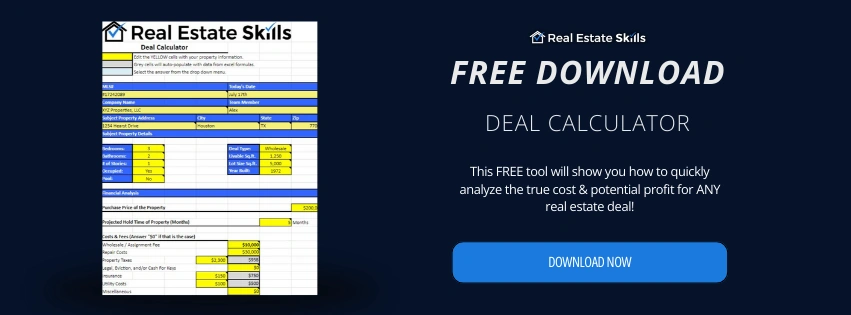
Stop Guessing: Run The Numbers Like A Pro
Finding a cheap house in Alabama is easy; knowing if it's actually profitable is the hard part. Don't risk your capital on "napkin math." We have built a professional-grade Deal Calculator that lets you plug in your purchase price, repair estimates, and holding costs to see your true Net Profit instantly. Download the tool we use to analyze properties daily and verify your margins before you ever make an offer.
8. Call Agents & Submit Written Offers
Here is the rookie mistake: downloading a 40-page contract, spending hours filling it out, emailing it to the agent, and... silence. You just wasted your time. In this business, Speed > Paperwork.
Before you draft the formal Alabama Residential Purchase Agreement, pick up the phone. Call the listing agent and make a "Verbal Soft Offer," say this:
"Based on the repairs needed, our numbers are coming in around $130,000 cash, closing in 14 days. If I write that up officially today, is that something the seller would sign?"
If they say "No way," ask where they need to be. If they say "Maybe" or "Get it to me," then you trigger the paperwork.
The "Clean Offer" Cheat Sheet
When you instruct your agent to write the offer (or when you fill it out yourself), these 8 terms must be clear. A confused mind says "no," so keep it simple.
| Deal Term | The Strategy |
|---|---|
| 1. Purchaser Name | Use your LLC name (e.g., "Apex Flipping LLC") for asset protection. If you don't have one yet, use your name followed by "and/or assigns." |
| 2. The Price | Stick to your MAO (Maximum Allowable Offer). Do not get emotional and overbid. |
| 3. Earnest Money (EMD) | 1% - 2% of the price. (e.g., $1,500 on a $150k house). This is enough to show you are serious, but low enough to minimize risk. |
| 4. Inspection Period | 7 to 10 Days. This is your "Get Out of Jail Free" card. If you find a hidden disaster during this week, you can cancel and get your EMD back. |
| 5. Closing Date | 14 Days (or sooner). Speed is your competitive advantage over retail buyers who need 45 days for a mortgage. |
| 6. Title Condition | "Seller to deliver clear and marketable title." This protects you from inheriting old liens or tax bills. |
Don't Forget: Always attach your Proof of Funds (POF) letter. An offer without a POF is just a piece of paper; with a POF, it's cash.
9. Perform Due Diligence (The "Retrade" Strategy)
Once the ink is dry, the clock starts. You usually have a 7 to 10-day Inspection Period. This is not just a formality; it is your final line of defense against buying a money pit. Your goal here is not just to inspect the property, but to verify your math.
The "3-Step Vetting" Protocol:
- The Professional Inspection ($400): Never skip this. Hire a licensed Alabama home inspector. They will find the "invisible" problems—termite damage in the crawlspace, knob-and-tube wiring, or a cracked heat exchanger.
- The Contractor Walkthrough (Free): Walk the property with your General Contractor. Using the inspector's report, have them build a line-item Scope of Work. If their quote comes back $10k higher than your budget, you have a problem.
- The "Retrade": This is where pros make money. If the inspection reveals $5,000 in unexpected electrical work, you don't just eat that cost. You go back to the seller and ask for a $5,000 price reduction or a closing credit. This is called "Retrading," and it saves investors millions every year.
The "Big Ticket" Inspection Checklist
Ignore the cosmetic stuff (paint, carpet). Focus on the "Deal Killers" that cost $5,000+ to fix.
| Item | What To Look For |
|---|---|
| Foundation | Horizontal cracks in the basement or sticking doors. (Cost: $5k - $20k) |
| Roof | Missing shingles or "curling" edges. (Cost: $6k - $12k) |
| HVAC | Is the unit older than 15 years? It will likely fail. (Cost: $5k - $8k) |
| Electrical | Ungrounded outlets or old fuse boxes. (Cost: $3k - $7k) |
Watch: How To Create A "Scope of Work" (And Estimate Costs)
If you underestimate the repairs, you lose money. In this video, I walk you through exactly how to build a Scope of Work budget that includes a "contingency fund" for the surprises you will inevitably find.
10. Close On The Deal (The HUD-1 Audit)
Closing day isn't a party. It’s an audit. Before you sign a single page, you need to stare down the HUD-1 Settlement Statement. That paper is the scorecard. It tells you exactly where every penny is going—to the seller, the title company, the lender. If you don't read it, you'll pay junk fees you didn't owe.
The Signature Trap: This trips people up constantly. When you sign the mortgage note, do not just use your name. If you are buying in an LLC, you have to sign as '[Your Name], Manager.' If you forget the 'Manager' part, you might as well shred your LLC paperwork because you just lost your asset protection. Check the signature block before the agent prints the stack. If it's wrong, make them fix it.
The "Junk Fee" Detector
Title companies and lenders often slip extra fees into the closing statement. Scan your HUD-1 for these lines. If you see them, challenge them.
| The Fee | The Verdict |
|---|---|
| Owner's Title Insurance | ✅ Mandatory. (Protects you from prior liens/claims). |
| "Admin Fee" / "Processing Fee" | 🚩 Junk Fee. (Ask to have this removed or reduced). |
| Courier / Wire Fees | ⚠️ Negotiable. (Why pay $50 for a courier in 2026?). |
| Recording Fees | ✅ Mandatory. (Paid to the county to record the deed). |
The "Clean Title" Check: Ensure your Title Search came back with "Marketable Title." If there is an old mechanics lien from a contractor who worked on the house in 2015, the title company must clear it before you close. Do not accept a promise that "we'll fix it later." No clear title, no closing.
11. Renovate The House
Step 11 in learning how to flip houses in Alabama is where the fun starts. The renovation phase is where the profit is actually made—or lost. The goal is not to build your "dream home"; the goal is to match the ARV. If the comps in the neighborhood have laminate countertops, do not install Quartz. If you over-renovate, you are donating your profit to the buyer.
The "Golden Rule" of Payments: Never, under any circumstances, pay a contractor 100% upfront.
Structure the payments on a "Draw Schedule" (e.g., 25% to start, 25% after rough-in, 25% after drywall, 25% upon completion). If a contractor demands 50% down just to show up, find a new contractor.
The "Legal Shield" Checklist
Do not let a hammer swing until these 6 documents are signed. This is your insurance policy against lawsuits and liens.
| The Document | Why You Need It |
|---|---|
| 1. Independent Contractor Agreement | The "Master Contract." It defines timelines, penalties for delays, and exactly who is responsible for permits. |
| 2. Final Scope of Work (SOW) | Attach this to the contract. It prevents the dreaded "Oh, that wasn't included in the quote" argument later. |
| 3. Payment Schedule | Ties cash to milestones. Example: "Payment #2 released ONLY after plumbing inspection passes." |
| 4. Insurance Indemnification | Protects you if a worker falls off a ladder. Without this, their injury could become your lawsuit. |
| 5. W-9 Form | Required by the IRS. You need this to issue them a 1099 form at the end of the year. Get it before you pay them. |
| 6. Final Lien Waiver | Crucial. The contractor signs this upon final payment, legally admitting they have been paid in full. It stops them from placing a mechanic's lien on the house later. |
12. Prep, Price & List (The "Grand Opening")
You don't just "put a sign in the yard." You are launching a product. The first 72 hours on the MLS determine your final profit. If you launch with bad photos or the wrong price, the listing goes stale, and you will be forced to cut the price by $10k or $20k later.
Watch: How To Sell Your Flip Fast (For Top Dollar)
This is the final hurdle. In this video, I walk you through the exact "Selling Protocol" we use to move inventory quickly. I cover staging, how to negotiate commissions with your agent, and why we use a 90-day listing agreement instead of 6 months.
The "3-Check" Launch Protocol
Do not let your agent activate the listing until these three boxes are checked:
- The "99%" Punchlist: Contractors are famous for finishing 99% of the job and vanishing. Do not make the final payment until every light switch plate is on, every faucet is caulked, and the construction dust is gone. Buyers hate "unfinished" projects.
- The "Virtual" Staging Hack: Physical staging costs $3,000+. If you are on a tight budget, use Virtual Staging ($40 per photo) for the primary rooms (Living Room, Master Bed, Kitchen). It stops the "empty room echo" in photos and gets the click.
- The "Drone" Rule: A 2013 RedFin study proved that professional photos sell homes for thousands more. In 2026, you need more: Drone Shots. If your flip has a new roof or a big yard, a drone shot is mandatory to show the value.
The Pricing Strategy: "Event Pricing"
Most amateurs list their house 5% above the ARV to "leave room for negotiation." This is a mistake. It scares away buyers and lets the house sit.
Instead, use "Event Pricing." List the property at 5% BELOW the market value.
Example: If the ARV is $200,000, list it at $189,900.
Why this works:
- It triggers price alerts for buyers capped at $190k.
- It creates a "fear of loss" among buyers, leading to a bidding war.
- You usually end up selling above your $200k target because emotion takes over.
The Marketing "Blast" Checklist
| Channel | The Strategy |
|---|---|
| MLS Listing | Upload on Thursday morning. This hits buyers' inboxes just in time for weekend planning. |
| Zillow/Redfin | Ensure your agent "Claims" the listing and adds a custom description highlighting the new upgrades (Roof, HVAC). |
| The "Open House" | Schedule it for the first Sunday after listing. Create a deadline for offers (e.g., "Offers reviewed Tuesday at 5 PM"). |
13. Field Offers & Negotiate
If you followed the "Event Pricing" strategy in Step 12, you shouldn't just have one offer; you should have three or four. Now you have a high-quality problem: deciding which one to take.
Most beginners just look at the highest price. This is dangerous. In the game of flipping houses in Alabama, a $210,000 offer that closes in 45 days is often worse than a $205,000 offer that closes in 10 days. You have to calculate your "holding costs" (insurance, utilities, hard money interest) for that extra month.
The Offer Matrix: Cash vs. Finance
Use this cheat sheet to compare the two main types of buyers you will meet.
| Offer Type | Pros | Cons (The Risk) |
|---|---|---|
| The "FHA/Va" Buyer | Highest Price. Retail buyers fall in love with the house and will bid up. |
Appraisal Risk. If the bank appraiser says the house is worth $5k less, the deal might die. (45-day close). |
| The "All Cash" Buyer | Speed & Certainty. No appraisal, no lender underwriting. Can close in 10 days. |
Lower Price. They usually bid 5-10% lower because they know their cash is valuable. |
The "Highest and Best" Tactic
If you have multiple offers, do not counter them one by one. Have your agent send a "Multiple Counter Offer" form to everyone.
The Script: "We have received multiple offers. Please submit your Highest and Best offer, with your best terms, by Tuesday at 5:00 PM."
This forces buyers to drop their contingencies and bid their maximum number because they know they only get one shot. This single move can add $5,000 to your bottom line in 24 hours.
14. Accept The Best Offer (And Hold The Line)
Once you learn how to flip house sin Alabama, you need to know what to look for when accepting offers. Once you sign the purchase agreement, the power dynamic shifts. The buyer now has the leverage because they have the "Inspection Contingency." Successfully flipping houses in Alabama requires you to defend your profit margin during this final 30-day window.
The "Second Negotiation": Almost every buyer will hire an inspector. The inspector will find 20 small things wrong (a loose doorknob, a cracked tile). The buyer will then send a "Request for Repairs." Do not panic. This is standard procedure.
Pro Strategy: Credits > Repairs
If the buyer asks for $2,000 worth of electrical repairs, do not agree to fix it.
- Why? If you fix it, they will inspect the work again. If they don't like the quality, they can delay closing.
- The Move: Offer a $1,500 "Closing Cost Credit" instead.
- The Win: You save $500, you don't have to send your contractor back, and the buyer feels like they won because they get cash at closing.
The Appraisal Hurdle
If your buyer is using a loan (FHA or Conventional), the bank will order an appraisal. If the appraisal comes in lower than the agreed price, you have three options:
- Drop the Price: Match the appraisal value (most common).
- Challenge It: Send your agent to the appraiser with your own list of "Comps" to justify the value.
- Meet in the Middle: Ask the buyer to cover the "gap" in cash.
After the due diligence period expires, the buyer's deposit becomes "hard" (non-refundable). At this point, the deal is effectively done. The final step is the walkthrough, where the buyer confirms the house is empty and broom-swept. If you managed the process well, this is just a formality on your way to the bank.
15. Sell The House & Get Paid (The "Waterfall")
The closing table is the finish line. In Alabama, closings are typically handled by a Closing Attorney or a Title Company. Unlike some states where you have to wait days for the deed to record ("Dry Funding"), Alabama is generally a "Wet Funding" state.
The Payout Order (The "Waterfall"): Do not assume you are just going to receive a check with the full purchase price. The closing attorney will distribute the money accordingly. Here is how the math works on a typical deal flipping houses in Alabama:
The Profit Breakdown (Example)
| Final Sale Price | $220,000 |
| (-) Loan Payoff (Principal + Interest) | $145,000 |
| (-) Agent Commissions (6%) | $13,200 |
| (-) Closing Costs / Credits | $4,000 |
| (=) NET WIRE TO YOU | $57,800 |
What To Do With The Profit? (Velocity of Money)
Novice investors spend the profit on a new truck. Pros understand the velocity of money. They take that $57,800 and immediately use it as the down payment for two more flips. The goal is not just to get paid once; it's to keep the capital moving.
Congratulations. You have successfully navigated the process. You found the deal, funded it, renovated it, and sold it. You are now officially a real estate investor.
How Much Do House Flippers Make In Alabama?
There is a massive difference between "TV Profit" and "Real Profit." If you watch HGTV, you might think you simply subtract the repairs from the sale price and keep the rest. In the real world of flipping houses in Alabama, you must account for "Holding Costs" and "Closing Costs."
Generally speaking, successful investors in Alabama aim for a Gross Profit of 15% to 20% per deal. However, this varies significantly depending on which market you are investing in.
Alabama Profit Potential (By Market)
Based on historical market performance, here is what investors typically target in the state's top three hubs:
| City | Avg. Gross Profit | Why It Works |
|---|---|---|
| Huntsville | ~$64,000 | The "Tech" Premium. Driven by engineering and aerospace jobs, buyers here have higher incomes and pay more for renovated homes. |
| Birmingham | ~$58,000 | Volume & Velocity. As the largest city, there is constant inventory. It is a "bread and butter" market for consistent deals. |
| Mobile | ~$52,000 | Affordability. Lower entry prices allow new investors to get started with less capital, though margins are tighter. |
*Note: "Gross Profit" is calculated as [Resale Price] - [Purchase Price] - [Repairs]. It does not include agent fees or loan interest.
The "70% Rule" Reality
To secure these profit margins, you cannot overpay. This is why most Alabama flippers stick to the 70% Rule: Never pay more than 70% of the After Repair Value (ARV) minus repairs. If you buy right, the profit is locked in before you even swing a hammer.
Is House Flipping Illegal In Alabama?
No. House flipping is a legitimate, legal, and highly profitable business model in Alabama. It is simply the act of buying a property, improving it, and reselling it.
However, there is a "dark side." The reason this question gets asked is that the FBI actively targets "Illegal Property Flipping" schemes. You need to know the difference between a smart investment and a federal crime.
The Legal Line: Business vs. Fraud
| ✅ Legal Flipping | 🚫 Illegal Flipping (Fraud) |
|---|---|
| Buying Low: Negotiating a discount because the house needs repairs. | False Appraisals: Conspiring with an appraiser to value the home higher than it is worth. |
| Adding Value: Renovating the kitchen and roof to justify a higher resale price. | Cosmetic Cover-Ups: Painting over mold or hiding structural damage without disclosing it. |
| Profit: Selling for market value. | Kickbacks: Paying the buyer under the table to help them qualify for a loan. |
The "90-Day" Rule (The Real Hurdle)
While flipping is legal, the Federal Housing Administration (FHA) has a strict rule that can kill your deal if you aren't careful. It is called the FHA 90-Day Flip Rule.
- The Rule: If you buy a house and try to resell it to an FHA buyer (which is most first-time homebuyers in Alabama), you cannot sign a contract until you have owned the home for at least 90 days.
- The Risk: If you finish your renovation in 45 days and accept an FHA offer, the bank will automatically reject the loan.
- The Fix: If you plan to flip fast (under 90 days), you must market the home to Cash or Conventional Loan buyers only.
As long as you avoid fraud and understand the lender waiting periods, flipping houses in Alabama is entirely compliant with state and federal laws.
The "Caveat Emptor" Rule (Buyer Beware)
There is one major legal distinction every investor must know: Alabama is a "Caveat Emptor" state. This translates to "Let the Buyer Beware."
Unlike many other states, where sellers are legally required to hand you a thick stack of disclosures listing every known defect, Alabama sellers generally have no duty to disclose defects to a buyer. Unless there is a direct health/safety risk or a fiduciary relationship, the seller can legally stay silent about that leaky roof or the old wiring.
The takeaway for flippers: You cannot rely on the seller to tell you the truth. In Alabama, the burden of discovery falls 100% on you. If you skip a professional inspection and find mold three weeks later, you likely have zero legal recourse. You bought it, you broke it, you own it.
Do I Need A Real Estate License To Flip Houses In Alabama?
The short answer is no. You do not need a real estate license to buy, fix, and sell houses in Alabama. You are acting as the Principal in the transaction, which is perfectly legal.
However, the real question is: "Should you get one?"
Many new investors rush to get licensed, thinking it will save them money on commissions. While true, it comes with a "double-edged sword" called Disclosure.
Licensed agents must disclose their status to sellers immediately when flipping in Alabama.
The License Debate: Pros vs. Cons
| ✅ The Pros (Why Get It) | ❌ The Cons (Why Skip It) |
|---|---|
| Commission Savings: You keep the Buyer's Agent commission (typically 2.5% - 3%) on every house you buy. | Mandatory Disclosure: You must tell every seller you are an agent. This raises their defenses. |
| MLS Access: You control your own data and don't have to wait for an agent to answer the phone. | Fees & Education: It costs $2,000+ and 60 hours of classes to get started, plus annual board dues. |
| Control: You write your own offers at 11:00 PM on a Saturday if you want to. | Higher Liability: As a licensed pro, you are held to a higher legal standard than a regular investor. |
Watch: The "License" Verdict (Is It Worth It?)
Still on the fence? In this video, I break down the math. I explain why I eventually got my license, but also why I tell most beginners to focus on finding deals first before worrying about passing an exam.
How Much Does It Cost To Flip A House In Alabama?
When learning how to flip houses in Alabama, a lot of people are concerned about how much it will cost. If you watch HGTV, you might think the math is simple: Buy Price + Repair Cost = Total Cost. This is how amateurs go broke.
In the real world of flipping houses in Alabama, you have to account for the "Soft Costs" that bleed your profit margin every month the house sits unsold. To be a successful investor, you need to budget for four distinct categories.
1. Acquisition Costs (The "Buy")
Alabama is one of the most affordable markets in the country, but "affordable" doesn't mean free. Unless you are paying 100% cash, you will likely use a Hard Money Loan. This means you need to have "Skin in the Game."
- Down Payment: Typically 10% to 20% of the purchase price.
- Origination Fees: Lenders charge 2 to 4 points (2-4% of the loan amount) just to open the loan.
- Closing Costs: Title insurance, recording fees, and attorney fees will run another $1,500 to $2,500.
2. Repair Costs (The "Rehab")
The biggest variable in your budget is the renovation. A "cosmetic refresh" costs significantly less than a "full gut." Use this matrix to estimate your budget based on the property's condition:
The Alabama Rehab Cost Matrix
| Scope of Work | Cost Per Sq. Ft. | What's Included? |
|---|---|---|
| Light Rehab (Lipstick on a pig) |
$15 - $25 / sq. ft. | Paint, carpet/flooring, landscaping, light fixtures. |
| Medium Rehab (The Standard Flip) |
$30 - $50 / sq. ft. | New kitchen & baths, minor electrical/plumbing, new roof or HVAC. |
| Heavy Rehab (Full Gut) |
$60 - $80+ / sq. ft. | Structural work, full rewire/replumb, moving walls, new windows. |
Don't Let Hidden Repairs Destroy Your Budget
The difference between a profit and a loss often comes down to a single missed repair item. Don't guess on your renovation budget. Download our free Scope of Work Template to itemize every single repair—from the roof to the foundation—so you can hand a clear plan to your contractors and get accurate, hard numbers before you ever buy the property.
3. Holding Costs (The "Burn Rate")
Every day you own the house, you lose money. These are called "Carrying Costs," and they continue until the day the buyer's wire hits your account.
- Loan Interest: Hard money interest (usually 10-12% annually) is paid monthly. On a $150k loan, that is $1,250/month out the door.
- Utilities: You must keep the lights and water on for contractors and showings ($200/month).
- Insurance: You need a "Vacant Dwelling Policy," which is more expensive than standard homeowner's insurance.
4. Selling Costs (The "Exit Tax")
Finally, you have to pay to sell the house. In Alabama, you should budget 8% to 10% of the final sale price for selling costs.
- Agent Commissions: 6% (3% to your agent, 3% to the buyer's agent).
- Closing Costs: 2% (Title transfer tax, closing attorney fees, recording fees).
- Concessions: 1-2% (Credits you give the buyer for repairs).
How To Flip A House In Alabama With No Money?
The biggest myth in real estate is that you need to be rich to start. In 2026, money is a commodity. If you find a great deal (70% of ARV), the money will find you.
The secret to flipping with "No Money Down" is not finding one magical lender; it is stacking capital sources. Here is the blueprint professionals use to flip houses without using their own savings:
The "Capital Stack" Strategy
How to get 100% financing by combining two different sources:
- Layer 1: The Hard Money Loan (70-80%)
The institutional lender covers the bulk of the purchase price and 100% of the renovation costs. They get the first lien on the property. - Layer 2: "Gap Funding" (20-30%)
This is where Private Money comes in. You find a private individual (doctor, lawyer, family member) to lend you the down payment and closing costs in exchange for a fixed return (e.g., 10% interest) or a share of the profits.
Result: You own the house, the rehab is funded, and you have $0 invested.
The "No Cash" Alternative: Wholesaling
If you don't want to take on debt, your best entry point is Wholesaling. This isn't technically "flipping" (taking title), but it generates quick cash.
In a wholesale deal, you get the contract with the seller and then sell the piece of paper (the contract) to a rich investor for a $10,000 fee. You never buy the house, you never fix a toilet, and you need $0 to start.
Watch: How To Flip Real Estate With $0 (Step-By-Step)
In this video, I break down exactly how to structure "No Money Down" deals using the Wholesaling method. This is the fastest way to build your capital reserves so you can eventually graduate to fixing and flipping.
What's The Best Place To Flip Houses In Alabama?
There is no single "best" market; there is only the best market for your strategy. Alabama is unique because its three major hubs offer completely different investment profiles.
If you want rapid appreciation, you go to Huntsville. If you want consistent, lower-priced volume, you go to Birmingham. If you want cash flow and lower entry costs, you look at Mobile.
The Alabama Market Matrix (2026 Investor Guide)
| The City | The "Investor Personality" | Why It Wins |
|---|---|---|
| Huntsville | The Appreciation Chaser | Tech & Defense Boom. Home to Redstone Arsenal and massive tech influx. Prices are higher (Median ~$330k), but appreciation is the fastest in the state. |
| Birmingham | The Volume Flipper | Inventory & Stability. The largest metro area means more distressed inventory. Suburbs like Gardendale and Alabaster are "bread and butter" flip territory. |
| Mobile | The Entry-Level Investor | Low Barrier to Entry. You can still find fixer-uppers under $100k here. Strong rental demand from the port and industrial sectors supports your exit strategy. |
| Tuscaloosa | The "Niche" Specialist | Student Housing. Flipping here often means converting single-family homes into student rentals (The "Kiddie Condo" strategy). |
The "Hidden Gem" Neighborhoods
While everyone fights for deals in downtown Birmingham, savvy investors are moving to the outskirts. Watch these specific zip codes:
- In Huntsville: Look at Meridianville and Harvest. These are "spillover" towns where buyers go when they are priced out of Huntsville proper.
- In Birmingham: Crestwood South and East Pinson Valley are seeing rapid revitalization, offering high returns for renovators willing to do heavy rehabs.
- In Mobile: Midtown offers historic homes that sell for a premium when modernized, while West Mobile offers steady, lower-risk flips for first-timers.
Is It Hard To Flip Houses In Alabama? (The Reality Check)
Let's be honest: If flipping houses were easy, everyone in Alabama would be doing it. It is simple to understand, but hard to execute. The investors who fail are the ones who treat it like a hobby. The ones who succeed treat it like a manufacturing business.
Alabama has a unique set of challenges that you won't see on HGTV. If you are flipping in Birmingham, Huntsville, or Mobile, here are the three "Deal Killers" you need to watch out for:
The "Alabama 3" (Top Challenges)
| The Challenge | Why It Happens & How To Fix It |
|---|---|
| 1. The "Red Clay" Foundation | The Issue: Alabama's clay soil expands when wet and shrinks when dry. This causes massive foundation shifting in older homes. The Fix: Always budget $500 for a structural engineer report on any house built before 1980. Look for "stair-step" cracks in brick. |
| 2. The "Cast Iron" Trap | The Issue: Many Birmingham/Mobile homes built in the 50s and 60s still have original cast iron plumbing. It will fail. The Fix: Scope the sewer line with a camera during your inspection. Budget $3k-$5k to replace it with PVC. |
| 3. The Termite Tax | The Issue: In the South, it's not if you get termites, it's when. Hidden damage behind drywall can destroy your budget. The Fix: Never buy a house without a "Termite Bond" (warranty). If the seller doesn't have one, deduct the cost of treatment from your offer. |
The Verdict: Flipping in Alabama isn't "hard" if you have the right systems. The state offers low entry prices and a stable workforce. The difficulty comes from trying to cut corners on due diligence. If you account for the "Alabama 3" in your budget, you will outperform 90% of your competition.
Pros And Cons Of Flipping Houses In Alabama
Investors usually have to choose between affordable houses or growing cities. Usually, you can't have both. Alabama is the exception. It offers the low price point of the Midwest with the population surge of the Sunbelt. That is why investors are flocking here. But before you write an offer, you need to look at the downsides. The cheap taxes are great, but the environmental risks are real and need to be in your budget.
The Alabama Scorecard
| ✅ The Pros (Why You Win) | ❌ The Cons (The Risks) |
|---|---|
| 1. Nation-Leading Tax Rates: Alabama has the 2nd lowest property taxes in the U.S. (approx 0.41%). This drastically lowers your holding costs while the house sits vacant. |
1. Old Inventory Issues: Much of Alabama's housing stock was built between 1940-1970. You will frequently encounter cast-iron plumbing, asbestos, and ungrounded wiring. |
| 2. Landlord-Friendly Laws: If you can't sell, you can rent. Alabama is a landlord-friendly state with no rent control and a relatively swift eviction process for non-paying tenants. |
2. Extreme Weather Costs: From hurricanes in Mobile to tornadoes in Huntsville, insurance premiums can be high. You must carry "Builder's Risk" insurance during the flip. |
| 3. The "Affordability Gap": The median home price is well below the national average. You can buy a cosmetic fixer in Birmingham for $120k, which is impossible in other growth markets. |
3. Rural Days on Market (DOM): Outside of the "Big 4" cities (Huntsville, Birmingham, Mobile, Montgomery), properties can sit for 90+ days. Stick to the metro areas. |
Frequently Asked Questions About Flipping Houses In Alabama
To help you navigate the local market, we have compiled answers to the most common questions investors ask when starting the journey of flipping houses in Alabama.
Final Thoughts On Flipping Homes In Alabama
Real estate is simple, but people make it complicated. You now know exactly how to flip houses in Alabama, from finding the deal to cashing the check. The state offers incredible value, but the market won't wait for you. Stop analyzing the charts and go look at some properties. The only thing standing between you and that first profit check is the courage to make an offer. Go get to work.
Stop guessing what works in the Alabama market. Whether you are targeting rehabs in Birmingham or Huntsville flips, our FREE Training walks you through how to find consistent deals and build passive income locally—without wasting money on expensive marketing.
This FREE Training reveals the exact system our students use to flip profitably in the Heart of Dixie. Watch it today—so you can stop wondering and start closing.
*Disclosure: Real Estate Skills is not a law firm, and the information contained here does not constitute legal advice. You should consult with an attorney before making any legal conclusions. The information presented here is educational in nature. All investments involve risks, and the past performance of an investment, industry, sector, and/or market does not guarantee future returns or results. Investors are responsible for any investment decision they make. Such decisions should be based on an evaluation of their financial situation, investment objectives, risk tolerance, and liquidity needs.

👉FREE Training
How To Consistently Wholesale, Flip Houses, & Invest In Rental Properties From The MLS
(Without Spending $1 On Marketing)

Alex Martinez, the founder of Real Estate Skills, is known for his strong, practical expertise in real estate, starting from a beginner with no family connections in the industry to completing over 50 real estate deals, including wholesale and flips, within his first year.
He has dedicated his career to providing cutting-edge education and resources for real estate professionals. He emphasizes the importance of self-taught knowledge through mentors, books, and hands-on experience.
His journey from earning a modest income to becoming a successful real estate entrepreneur and educator showcases his expertise and dedication to the field.

Ryan Zomorodi, co-founder and COO of Real Estate Skills, leverages his experience from a diverse background in real estate investment, construction management, and entrepreneurship to provide comprehensive education in the real estate sector.
His expertise is rooted in hands-on experience, extensive industry knowledge, and a commitment to empowering others through education.
Ryan's journey reflects a blend of practical experience and entrepreneurial success, contributing to his role in developing a platform that educates and supports aspiring real estate professionals.
Read Ryan's Full Bio >>
