
How to Get a House Under Contract for Wholesaling (7 Steps)
Oct 13, 2026

Written by
Alex Martinez, Founder & CEO, Real Estate Skills. Has wholesaled and flipped houses for over 14 years, been part of 1,000+ real estate transactions, and personally acquired 55+ residential investment properties. Has trained 6,000+ investors nationwide.
Reviewed by
Ryan Zomorodi, Co-Founder & COO, Real Estate Skills. Licensed real estate agent in California with eXp Realty. Reviewed the contract terms, deposit guidance, and state rules in this guide before publication.
Publication history: Originally published November 20, 2025. Updated October 2026 with a rebuilt 7-step process, a new section on getting listed (MLS) properties under contract, current deposit and deadline numbers, verified 2026 state wholesaling rules, and rewritten seller scripts. Contract terms and state rules reviewed by Ryan Zomorodi, Co-Founder & COO of Real Estate Skills and a licensed real estate agent in California.
To get a house under contract for wholesaling, agree on a price with the seller, then both sign a purchase agreement with an inspection contingency and "and/or assigns" language. You're under contract once every owner signs. Your deposit, often about $1,000 or 1–3% of the price, is due to the title company within about 72 hours.
If you're about to put your first house under contract, the seller probably isn't what scares you. The paper is. What if you sign and can't find a buyer, and suddenly you're on the hook for a house you could never afford?
That's not how a well-written purchase agreement works. It protects you as much as it protects the seller. Your inspection window is your exit. Your deposit is usually the most you can lose. And nothing is binding until every owner on title has signed. I've gotten houses under contract at kitchen tables and through listing agents, and the protections are the same every time. Most beginners just never had anyone walk them through it.
So that's what this is: the 7 steps I follow, the deposit and deadline numbers my team actually writes into contracts, what to say when you put the agreement in front of a seller, and the state rules to check before anyone signs. My co-founder Ryan Zomorodi, a licensed real estate agent in California, reviewed every legal point. You can download the attorney-reviewed contract we use (a general form with wholesaler language built in, so check it against your state's rules) and follow along.
What Does "Under Contract" Actually Mean?
A house is under contract when the seller and buyer have both signed a purchase agreement. The seller can't sell to anyone else, and you hold an equitable interest: the legal right to buy at the agreed price by the closing date. You don't own the house, but you control it.
When you get a house under contract, you're not buying it yet. That's the mental block that stops most beginners, so let's clear it up first.
The day the seller signs your purchase and sale agreement, you gain what's called an equitable interest. That's the legal right to buy the property at the price and terms you agreed to, by the date in the contract (the legal principle behind this is called equitable conversion). The seller still owns the house and still holds the deed until closing. But you control it. That control is what you're selling when you wholesale.
The comparison everyone uses is a restaurant reservation: the table is yours for Friday night and nobody else can sit there. It's close, but it misses something important. A reservation costs you nothing if you don't show up. A purchase agreement doesn't work that way. Until you assign the contract to a cash buyer, you are the buyer, with a real obligation to close. That's exactly why the protections in the next section matter so much.
Here's the other half, and it's the part that makes this whole business work. Once you're under contract, nobody can go around you. My co-founder Ryan gets asked this all the time: "What if the listing agent just sells the house straight to my investor?" They can't. While your contract is in place, you're the only person with the right to buy that property. Anyone who wants it has to go through you.
| Buying the House (Traditional) | Under Contract (Wholesaling) | |
|---|---|---|
| What you hold | Legal title (the deed) | Equitable interest (the contract right to buy) |
| Money at signing | A down payment or the full price, at closing | An earnest money deposit: about $1,000 or 1–3% off-market, 1–5% on a listed property |
| How long it lasts | Permanent, until you sell | Until the closing date, often 14 days |
| What you can lose | Whatever you paid, plus everything you put into the house | Usually just your deposit, if you back out after your inspection window closes |
| Your role | The final owner | The buyer, who usually plans to assign the contract to a cash buyer |
💡 Worked Example: Backing Out Inside vs. Outside Your Window
- Say you sign a $200,000 purchase agreement with a $2,000 deposit (1%) and a 7-day inspection window.
- On day 5 you realize the numbers don't work, so you cancel in writing and your $2,000 comes back to you.
- If you'd waited until day 10 and then walked, the seller could keep the $2,000.
Most investor contracts include a liquidated damages clause (the part that says the deposit is the seller's remedy if you default), but check yours, because that clause is what caps your risk. Outcomes depend on your exact contract and your state.
Free Download: The Wholesale Contracts We Use
You can download the same attorney-reviewed Purchase and Sale Agreement and Assignment Contract we use in our own deals, free. It's a general form with wholesaler language built in, so check it against your state's disclosure and licensing rules before you use it.
Get the Contracts We Use to Put Houses Under Contract
You don't need to write a purchase agreement from scratch, and you shouldn't use something random from a forum. Download the attorney-reviewed Purchase and Sale Agreement and Assignment Contract we use in our own deals. It's a general form with wholesaler language already built in, including "and/or assigns," an inspection contingency, and a liquidated damages clause. Before you use it, check it against your state's disclosure and licensing rules.

The 4 Must-Have Clauses in Your Contract
Before you sign, your contract needs four protections: an inspection contingency of about 7 days that lets you cancel and recover your deposit, "and/or assigns" language so you can transfer the deal, a deposit held by a title company that caps your risk, and a realistic closing date.
This explains how these clauses generally work. It isn't legal advice. Contract forms and rules vary by state, so have a local real estate attorney review your contract before you rely on it.
A contingency is a condition in the contract that has to be met before you're locked in. If it isn't met, you can walk away and get your earnest money back. These four clauses are what let you go under contract on a house without betting money you don't have.
1. The Inspection Contingency (Your Way Out)
This is the one I tell every beginner not to skip, ever. It gives you a set number of days to inspect the property and cancel for any reason, with your deposit refunded. As a wholesaler, it's also the window where you get your cash buyer in to see the house and commit.
- How long: I recommend 7 days when you're starting out. If the seller will give you 14, take it. A shorter window makes your offer stronger, and a longer one gives you more room. I wouldn't go below about 5.
- Who can inspect: Make sure the clause lets you or anyone you designate inspect the property. That's what lets your cash buyer, a contractor, or a partner walk the house when you can't be there yourself.
- The deadline is real: If you want out, you cancel in writing before the window closes. Miss the date, and your deposit is at risk.
On listed properties, the agent writes the offer on your state's standard association form. Every one of those forms I've used has an inspection contingency built in; you just fill in the number of days. Confirm it's there on yours.
2. Assignability (Your Right to Sell the Deal)
Right after your name as the buyer, write "and/or assigns." That one line makes it clear you can transfer the contract to another buyer, which is how you get paid. Purchase agreements are generally assignable unless the contract itself says otherwise.
On listed deals, though, you need to read the form, because each state's standard contract handles this differently:
- California: the standard purchase agreement lets you assign only with the seller's separate written consent, which the seller can't unreasonably withhold.
- Florida: the standard "AS IS" contract has three boxes. You may assign and be released from liability, assign but stay liable, or not assign at all. If no box is checked, treat it as not assignable.
- Texas: the standard form doesn't prohibit assignment, but Texas attorneys recommend stating it expressly in the special provisions. Texas also requires you to tell the seller in writing that you intend to assign.
My rule: don't sign a contract you can't assign unless you could actually close on the house yourself, or you have a fallback in writing. And when a seller asks what "and/or assigns" means, tell them the truth. More on how to say it in the scripts section.
3. Your Deposit, Held by Title and Capped as Your Risk
Your earnest money deposit (the good-faith money that shows the seller you're serious) never goes to the seller directly. It goes to a neutral third party: a title company, an escrow company, or a closing attorney, depending on your state.
Then look for the liquidated damages clause. It typically says that if you default, meaning you back out after your contingencies expire, the seller keeps your deposit and that's the end of it. That's what makes your deposit, not the price of the house, the most you can usually lose. Ryan has asked a lot of attorneys about the scarier remedy, specific performance (where a court forces a buyer to close), and they consistently tell him sellers rarely pursue it. They keep the deposit and move on. Rare isn't never, though, so read your contract's default section.
How much should the deposit be? On off-market deals, Ryan and I use about $1,000 on lower-priced houses, or 1–3% of the price. On listed properties, I expect 1–5%; in San Diego we usually put $5,000 or $10,000. Some states now set a floor. Louisiana, for example, requires at least 1% held in escrow on wholesale deals. Your numbers may differ by market. For the full breakdown, see our guide to the earnest money deposit.
4. A Realistic Closing Date
The closing date sets the deadline for everything, including your cash buyer, who steps into your shoes and has to close by that same date. We put 14 days on cash offers. That's fast enough to beat financed buyers and long enough to line up the right cash buyer.
If the seller needs more time to move, give it to them. Fitting the date to their life is one of the easiest ways to win the deal.
If you ever need more time than the contract gives you, any term can be changed with a written amendment, but only if the seller agrees. It's a request, not a right, so pick a date you can actually hit.
Step-by-Step: How to Get a House Under Contract
Getting a house under contract for wholesaling takes seven steps, from lining up buyers to starting the clock once the agreement is signed:
- Line up your cash buyers before you make offers
- Run your numbers to find your maximum offer
- Check your state's rules before anything is signed
- Learn what the seller needs, then make your offer
- Present the agreement, at the kitchen table or through a listing agent
- Get every signature and confirm it's fully executed
- Start the clock: deposit, inspection deadline, assignment, closing
These are the steps I follow on every deal, in this order. Most beginners start at step 4 and wonder why their first contract falls apart at step 7.
Step 1: Line Up Your Cash Buyers Before You Make Offers
Find your cash buyers first, and ask them exactly what they buy: which zip codes, what condition, what price range. Then you only put houses under contract that someone already wants, instead of signing first and hoping a buyer appears inside a 7-day window.
This is the step most people skip, and it's the one that decides whether your first contract gets assigned or canceled. I learned it from a habit in one of my favorite books: begin with the end in mind. Your end is a cash buyer who closes.
My favorite cash buyers are fix-and-flippers. The active ones buy several houses a month, so one good flipper can take every deal you bring them. A landlord who buys a rental every year or two is still a buyer, just a much slower one. Find them at local real estate investor association meetings, or search "we buy houses" plus your city and you'll find the investors already marketing for deals.
Here's why it matters for the contract itself: your inspection window is short. Ryan and I have watched plenty of new wholesalers sign a contract, then spend the last day of their contingency scrambling to find anyone who'll take it. That's when deals fall apart. When your buyers are lined up first, signing the contract is the easy part. Our guide on how to find cash buyers walks through building your list.
Step 2: Run Your Numbers to Find Your Maximum Offer
Your maximum allowable offer is the most you can pay and still leave room for your cash buyer's profit and your fee. The common formula: after-repair value × 70%, minus repairs, minus your fee. Know this number before you talk price, so you never sign a contract no buyer will take.
After-repair value (ARV) is what the house will be worth once it's fully fixed up, based on recent sales of similar renovated homes nearby. One mistake I see even in AI-generated answers: the 70% applies to the after-repair value, not to what the house is worth today in its current condition.
💡 Worked Example: Finding Your Maximum Offer
- After-repair value: $300,000
- × 70% = $210,000
- Minus repairs of $40,000 = $170,000 (roughly what a flipper can pay)
- Minus your fee of $10,000 = $160,000, your maximum offer to the seller
Treat 70% as a starting point, not a law. The real number is whatever your cash buyers will actually pay, which is why step 1 comes first. Think about how your buyer will make money on the house, whether that's a flip, a rental, or a teardown, and price your offer from there. Numbers here are illustrative; your market and your buyers will move them. For the full formula and variations, see our guide to the maximum allowable offer.
Run Your Maximum Offer Before You Talk Price
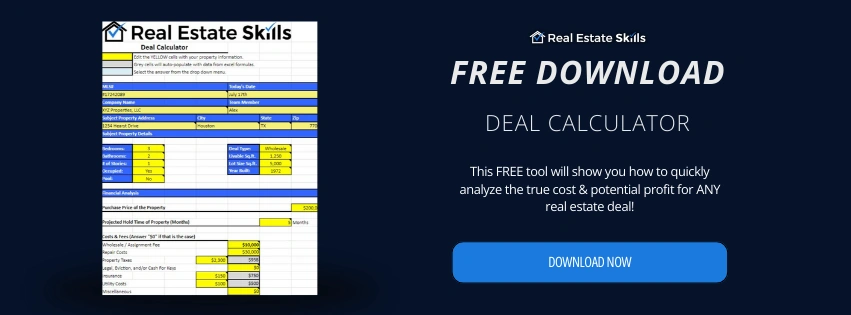
Plug in the after-repair value, your repair estimate, and your fee, and our free Deal Calculator spreadsheet works out your maximum allowable offer, factors in closing costs, and shows the spread left for your cash buyer. Know your ceiling before the seller asks for your number, so you never sign a contract no buyer will take.
Step 3: Check Your State's Rules Before Anything Is Signed
Before you sign, check what your state requires. Some states now require a real estate license to wholesale, a signed wholesaler disclosure before the contract is binding, written notice that you plan to assign, or a minimum deposit held in escrow. Miss one, and the seller may be able to cancel.
This step matters more every year. It changes how you sign, not just what you do afterward. A few examples of what's in force as of 2026:
- Ohio: you have to give the seller a separate wholesaler disclosure, signed by both of you, before the contract becomes binding.
- Pennsylvania: you need a real estate license to do a wholesale transaction at all.
- Philadelphia: the city requires its own wholesaler license, plus a signed disclosure given to the homeowner at least three days before you present an offer.
- Louisiana: the deposit must be at least 1% of the price, held in escrow.
The full list, with what each rule means at the signing table, is in the state rules section below. Laws change fast, so confirm your state's current requirements with a local real estate attorney before your first deal. This isn't legal advice.
Step 4: Learn What the Seller Needs, Then Make Your Offer
Before you name a price, find out why the seller is selling and what would make it easy for them. Then make your offer, name your number, and stop talking. Terms like covering moving costs or a short stay after closing can win a deal that price alone won't.
If you lead with paperwork, you look like you're there to take something. Start with questions instead. Why are they selling? Where are they going next, and when? What worries them most about the sale? People sign with someone they trust, and they trust someone who listened.
Ryan's point on this is one I agree with completely: most new investors compete only on price. You can go deeper. If the seller hasn't found their next place yet, letting them stay a couple of weeks after closing can matter more to them than a few thousand dollars on price. Covering their moving costs can do the same. Any arrangement like that goes in writing (a post-closing occupancy agreement, reviewed by an attorney), because it affects insurance and possession.
When you're ready, say your number clearly, then stop talking and let the seller respond. Silence feels uncomfortable, but filling it is how beginners negotiate against themselves.
Then give the offer a deadline. Ryan sets 24 to 48 hours for the seller to accept. It keeps your offer from sitting open while they shop it around, and it's honest urgency because it's written into the agreement, not invented. If it expires, you can always resubmit.
Step 5: Present the Agreement (Kitchen Table or Listing Agent)
How you present the agreement depends on who you're buying from. Direct from a seller, you bring your own investor purchase agreement and walk them through it in plain English. On a listed property, you email the agent your offer terms and proof of funds, and the agent writes the contract on your state's standard form.
Before anything else: don't mix up the two contracts. If you hand a listing agent your off-market investor contract, they'll know immediately that you're new. Agents write offers on their state association's standard form. Your own contract is for deals where you're working directly with the owner.
▶ Watch this part: Alex on which contract to use, on and off market (3:40)
Path A: Direct to the Seller (the Kitchen Table)
Bring two printed copies, or send it through DocuSign if the seller is out of state or prefers their phone. Some sellers, especially older ones, trust a pen and paper more, so let them choose.
Then walk through it, but don't read it aloud line by line. Summarize what matters: the price, the closing date, how many days you have to inspect, where the deposit goes, and what "and/or assigns" means. The script for this is in the next section.
This only works if you know the contract cold. Ryan's advice to beginners is to read it several times, highlight it, and practice filling it out before your first appointment. For a seller, signing this may be one of the biggest decisions of their life. If you can't explain it confidently, why would they sign with you instead of someone who can?
If your state requires a wholesaler disclosure, it comes before or with the agreement, not after. (See step 3.)
Path B: Through a Listing Agent (MLS)
We do a lot of our deals off the MLS, and the process is different. You don't fill out a contract. You give the agent everything they need to write one for you.
- Make the offer on the phone first. Call the agent back, tell them the number you can do, then stop and let them respond. Sometimes they'll write it up on the spot. Sometimes they'll say it's too low, and that's where beginners hang up and lose the deal. Ask where it needs to be. When I walked a beginner named Tim through this, the agent came back $5,000 above his $425,000 offer. His numbers still left him at least a $5,000 fee, so the deal still worked. And if an agent tells you flat out the offer won't work, ask them to submit it anyway: an offer is better than no offer, and yours can become the backup.
- Then email the offer packet. Send it all at once, so the agent never has to come back and ask:
- Purchaser name: you or your LLC.
- Close date: 14 days or sooner. That's normal for cash.
- Earnest money: the amount, usually due within about 72 hours of acceptance. My rule of thumb on listed deals is 1–5% of the price.
- Inspection contingency: 7 days. Never submit an offer without one.
- Proof of funds: a document showing you have access to the purchase price. Many hard money lenders (lenders who fund fix-and-flip deals) will give investors a proof-of-funds letter, and some post one on their website. It has to be real and issued for you. Never edit or borrow someone's statement without their written authorization.
- Your LLC documents, if you're buying in one: your articles of organization or operating agreement, showing you're authorized to sign.
- Before you sign, read the assignment terms on their form. California, Florida, and Texas each handle assignment differently (see the must-have clauses above), and so do other states.
- Close the loop. Ask the agent when they'll send the contract. If they say by 4:00, and it's 4:05 with nothing in your inbox, call them. It isn't done until it's signed.
How To Get MLS Wholesale Deals Under Contract!
Alex walks a beginner through his first offer on a listed property: the agent call, the offer terms, funding the deposit, proof of funds, and following up until the contract is signed.

Watch specific parts:
- Handling agent objections (0:42)
- What goes in your offer terms (1:48)
- Funding the deposit (3:02)
- Why the inspection contingency matters (5:01)
- Proof of funds (6:10)
- Following up until it's signed (8:48)
Step 6: Get Every Signature and Confirm It's Fully Executed
You're only under contract once every owner on title has signed and you have the fully executed agreement back. Confirm who owns the property before you write the offer, sign correctly if you're buying in an LLC, initial every page, and check that the terms match what you agreed to.
Signing your side doesn't put the house under contract. The seller's signature does, and every seller has to sign. This is where deals quietly die. A house can have more than one owner: a married couple, business partners, several heirs who just inherited it. If one owner on title doesn't sign, the contract can be void. Call a title company before you write the offer and confirm exactly who owns it.
Before you leave the table, or before you hit "finish" in DocuSign, check three things:
- Every owner has signed, and you've signed with your correct title if you're signing for an LLC.
- Every page is initialed where the form asks for it.
- The terms match what you agreed to: price, deposit, inspection days, closing date, and the buyer line with "and/or assigns."
On listed deals, the agent sends back the fully executed agreement once the seller signs. That copy, with every signature on it, is your proof you're under contract. The date of the last signature is usually the contract's effective date, and your deadlines run from there.
For a clause-by-clause walkthrough of everything in the agreement, see our wholesale real estate contract guide.
Step 7: Start the Clock (Deposit, Inspection, Assignment, Closing)
Once the contract is fully signed, three deadlines start. Send it to your title company and get your deposit in, usually within about 72 hours. Get your cash buyer through the house before your inspection window closes, about day 7. Then assign the contract so your buyer closes by the closing date, usually day 14.
Send the signed agreement to your title company or closing attorney the same day, so they can open escrow (the neutral holding of money and documents until closing) and start the title search.
Then get your deposit in on time. A seller can treat a late deposit as a default, so don't tie up a house and sit on it.
My goal is to assign the deal before the deposit is even due, which is why step 1 comes first. When that doesn't happen and you don't have the cash, borrow it. That's what I did when I had no money. Say you borrow $5,000 for a deposit and agree to pay the lender 10%, so $500. On a $10,000 fee, you net $9,500. Your deposit is normally returned or credited to you at closing; how that works depends on your title company and contract. Just remember: borrowed money is only safe while you're inside your inspection window. Miss the deadline, and it's at risk like any other deposit.
Inside that window, get your cash buyer to walk the property. If the numbers don't work, you cancel in writing before the deadline. Once your buyer commits, you assign the contract and they step into your place to close. Our guide to assignment of contract covers that document.
💡 Worked Timeline: One Deal, Start to Finish (Illustrative)
- Day 0: The seller signs your $280,000 purchase agreement. It's fully executed, and you're under contract.
- Day 1: You send it to title. Escrow opens and the title search starts.
- By day 3: Your $2,800 deposit (1%) is at title. Your cash buyer walks the house and signs an assignment at $300,000.
- Day 7: Your inspection window closes. You're already assigned, so there's nothing left to cancel.
- Day 14: Closing. The seller receives $280,000, your cash buyer owns the house, and your $20,000 assignment fee is paid at closing.
Numbers are illustrative. Outcomes vary by deal, market, and contract.
You Know How To Lock Up a Deal. Now Learn To Do It Consistently.
Getting one house under contract is a skill. Doing it again and again is a system: finding motivated sellers, making offers that get accepted, and assigning your contracts to cash buyers who close. Our FREE Training walks you through the entire process, the same one thousands of our students use. Watch it today, then go make your next offer.
Watch The FREE Training →The "Kitchen Table" Script: What to Say to the Seller
Summarize the agreement in plain English instead of reading it aloud: the price, the closing date, your inspection days, where the deposit goes, and what "and/or assigns" means. Then ask for the signature and give the offer a real deadline. Confidence and honesty close more deals than pressure does.
The moment you put the agreement in front of a seller is when most beginners freeze. Here's the mindset that fixes it: your job isn't to talk anyone into selling. It's to make a clear offer that solves their problem, and explain it so well that signing feels simple.
Don't read the contract out loud. Nobody can follow legal language read at them. Summarize it, and let them ask about anything they want.
The Script
Move to the paperwork, summarize the agreement in plain English, then ask for the signature. Use the real words (agreement, contract, sign), and if your state requires a wholesaler disclosure, have it signed before the agreement and explain why it comes first.
🗣️ Moving to the paperwork
"Everything we talked about works for me. Let me show you the agreement, so you can see it's exactly what we discussed."
🗣️ The plain-English summary (the part that matters)
"This is a standard purchase agreement. It says I'm buying the house for [price], and we close on or before [date]. I have [7] days to inspect the property, and if something's wrong, I can cancel during that time. My deposit of [amount] goes to [title company], not to me and not to you, and it's applied to the price at closing. And this line, 'and/or assigns,' means I can transfer the agreement to another investor I work with. If I do, your price, your closing date, and everything else stay exactly the same."
🗣️ The ask
"Do you have any questions about any of it? … Then if it looks right to you, I'll sign here, and you sign right next to me."
Use the real words: agreement, contract, sign. Sellers aren't fooled by softer substitutes, and the moment they feel you're dressing something up, trust drops.
If your state requires a wholesaler disclosure, hand it over and have it signed before the agreement, and say why: "The state requires me to give you this first. It explains that I'm an investor, not an agent representing you, and that I may assign this agreement." Done this way, it sounds professional, not suspicious.
What If They Hesitate?
If a seller hesitates, don't argue and don't invent competition. Agree that it's a big decision, point to the real deadline written into your offer, and ask which specific term is bothering them, so you can solve it instead of pushing.
If the seller says, "I don't know, this feels fast," don't argue, and don't invent competition. Agree with them, then point to the deadline that's actually in your offer:
🗣️ What to say
"That's completely fair. It's a big decision. Take tonight and think it over. This offer is good until [time] tomorrow, because that's how long I can hold these numbers. If anything in it doesn't work for you, tell me what, and let's see if I can fix it."
That deadline is real. It's written into the agreement (step 4), so it's honest urgency instead of a bluff. Often the hesitation is about one specific term: the closing date, moving, or what happens to their stuff. Ask what it is. Then you're solving a problem instead of pushing.
Handling Seller Objections
The objections that stall a signing are usually about the attorney, the deposit, and what "and/or assigns" means. Answer each one honestly and calmly: offer an attorney-review period, explain exactly who holds the deposit and when it's at risk, and tell the seller plainly that you may assign the agreement.
An objection usually means the seller is interested but needs reassurance. Stay calm and answer like you hear these questions every week, because you will.
| What the Seller Says | What to Say |
|---|---|
| "I want my attorney to look at this first." | "You absolutely should. Let's write in that your attorney has two business days to review and approve it. If they don't approve it, the agreement is canceled and nobody owes anything." |
| "Why is your deposit only [amount]?" | "It's held by [title company], not by me, and it's applied to your price at closing. I'm paying cash and buying as-is, so you're not waiting on a lender or doing repairs. If I back out after my inspection period, you keep the deposit." |
| "What does 'and/or assigns' mean?" | "It means I can transfer this agreement to another investor I work with, or to a company I set up for the purchase. If I do, nothing about your deal changes: same price, same closing date, and you still get paid at closing." |
| "Are you going to sell my contract to someone else?" | "I might. I'm an investor, and sometimes I bring in another buyer to close. Either way, you get the price we agreed to, on the date we agreed to, and the title company handles the closing." |
Offer Attorney Review Instead of Fighting It
If a seller wants their attorney involved, offer it instead of resisting. Write a short attorney-review clause into the additional terms, such as two business days to approve, so you leave with a signed agreement and the seller feels protected.
If a seller wants their attorney involved, don't try to talk them out of it. Offer it. In the additional terms section of the agreement, write something like:
📝 Sample attorney-review clause
"This agreement is subject to review and approval by Seller's attorney within two business days of signing. If Seller's attorney disapproves in writing within that time, this agreement is canceled and any deposit is returned."
You walk away with a signed agreement, the seller feels protected, and if the attorney suggests a change, you can usually work it out. In some states this is already built in: Illinois's standard residential contract, for example, includes a five-business-day attorney review period. Have your own attorney confirm the wording before you use it.
State Rules to Check Before You Sign (2026)
No state bans wholesaling outright, but several now regulate how you sign. Pennsylvania requires a real estate license. Ohio requires a separate signed disclosure before the contract is binding. Louisiana requires at least a 1% deposit in escrow. Check your state's current rules before any seller signs.
This section summarizes laws as of October 2026, for education only. It isn't legal advice. Wholesaling laws change quickly, so confirm current requirements with a licensed real estate attorney in your state before you sign or market anything.
When I started, very few states had laws written specifically about wholesaling. Now several do, and they change how you sign. Most of the new laws go after two things, as Ryan explains in his video on wholesaling legally in any state:
- publicly marketing a property you don't own
- assigning a contract for a fee without telling people what you're doing
▶ Watch this part: Ryan on what the new laws actually target (2:09)
None of these laws ban wholesaling everywhere. But calling it "legal in all 50 states," full stop, isn't accurate anymore either. In Pennsylvania, for example, you need a license to do it at all. Here's what's in force in the states that most directly change how you get a house under contract.
📍 Check Your State's Rules First
These rules apply to residential property, and they change often. Treat this as a starting point, not a checklist.
- Pennsylvania: Since January 2025 (Act 52 of 2024), you need a real estate license to do a wholesale transaction. The contract has to include specific notices. The seller can cancel within 30 days of signing or before the property is conveyed, whichever comes first, with all payments refunded within 10 business days. Philadelphia also requires its own city wholesaler license (Residential Property Wholesaler License), plus a signed disclosure given to the homeowner at least three days before you present an offer.
- Ohio: Since March 2, 2026 (Ohio Revised Code 5301.95), you have to give the seller a separate, standalone wholesaler disclosure in the wording the law prescribes. You and the owner both sign and date it before the contract can become binding. Skip it, and the owner can cancel any time before closing, and your earnest money goes to them.
- Louisiana: Since August 1, 2026 (Act 807), you must give the seller required written disclosures before signing, include a cancellation notice in the contract, and put down a deposit of at least 1% of the purchase price, held in escrow. A $100 deposit is no longer legal there on a wholesale deal.
- Oklahoma: Since November 1, 2025 (SB 1075), your contract must include the state's required disclosures and the homeowner's cancellation notice. If they're missing, you can't enforce the contract. Double closing now counts as wholesaling, so it no longer gets you around the rules. You're also prohibited from placing liens on the property, which is why recording paperwork to "lock up" a deal can backfire there.
- Texas: Since January 1, 2024 (Texas's assignment notice rule), you must tell the seller in writing that you intend to assign the contract. You must also tell your buyer in writing that you hold only a contract right, not legal title.
- South Carolina: Under the 2024 law, marketing the property itself for sale before you own it counts as licensed activity. Marketing your contract position, without marketing the house, is treated differently (the Real Estate Commission's wholesaling guidance). The line is narrow, so talk to a South Carolina real estate attorney before your first deal there.
- Illinois: One wholesale deal in a 12-month period is allowed without a license. Two or more in any 12 months, and you need a broker's license (Illinois Real Estate License Act).
Other states have added rules in 2025 and 2026 too. For every state, see our guide on whether wholesaling is legal in your state.
What this means at the signing table:
- Find out whether you need a license in your state before you make offers, not after you have a contract.
- Give any required disclosure first. In states like Ohio, it has to be signed before the agreement binds, so it can't be an afterthought.
- Meet any minimum deposit. Louisiana's 1% floor overrides whatever you'd normally offer.
- Don't record documents against the property to protect your position unless your attorney confirms it's allowed in your state.
- Put your intent in writing. Transparency is your best protection everywhere. In states with required wording, though, a one-line note in the contract isn't enough; you need the state's exact form.
What If You Can't Find a Buyer Before Your Inspection Deadline?
If no cash buyer commits before your inspection window closes, you have three honest options. Renegotiate the price based on real findings, ask the seller for a written extension, or cancel in writing before the deadline and get your deposit back. The one thing you can't do is let the deadline pass and hope.
This is the scenario every beginner worries about, so let's be specific. You're on day 5 of a 7-day inspection window and nobody has committed. Here's what you can do.
- Renegotiate, but only on real findings. If your inspection or your buyers' walkthroughs turned up something real, go back to the seller with it in writing: a roof, a foundation problem, or repairs nobody saw at the first visit. Say the contract is at $160,000, and a contractor's bid shows the roof needs $15,000 nobody accounted for. Asking for $145,000, with the bid attached, is a fair conversation. The seller can say no, and then you decide whether to cancel.
What I won't do is lock up a house at a price I know is too high, planning to cut it at the last minute. Agents and sellers remember that, and it's one of the reasons wholesalers get a bad name. If you need to renegotiate, do it early, and bring evidence.
- Ask for an extension. Any term in a contract can be changed if everyone agrees, including the inspection deadline and the closing date. Some of our best deals needed an extension to get done. Put it in a short written amendment that both of you sign. Remember, it's a request, not a right; the seller doesn't have to say yes.
- Cancel inside your contingency. If the deal doesn't work, cancel in writing before your inspection deadline, using the notice method your contract requires. Your deposit comes back, the seller can move on, and you haven't lost anything but time. That's exactly what the inspection contingency is for. Canceling a deal that doesn't work isn't failure; it's using the contract the way it was written.
What you can't do is let the deadline pass and keep looking. Once the inspection window closes, your deposit is usually at risk if you back out.
📓 From The Field
I've watched a lot of new wholesalers get their first house under contract and stop doing everything else. They think about that one deal day and night, and stop making offers. Then the deal doesn't fit their buyers, they have to cancel, and they're back at zero. Ryan and I see the same pattern on the other end: beginners waiting until the last day of their contingency to find a buyer. The fix for both is the same. Line up your buyers before you sign, and keep making offers while you're under contract, so one deal never decides your month.
What happens to your deposit depends on your contract's wording and your state. Read the cancellation and default sections before you sign.
How to Get a House Under Contract for Wholesaling: FAQs
Final Thoughts: The Contract Is Your Inventory
Getting a house under contract for wholesaling comes down to doing the steps in order: line up buyers, run your numbers, check your state's rules, and sign an agreement with the right protections. The contract is your inventory. Without a signed one, you have a conversation, not a deal.
You're not in the business of buying houses. You're in the business of getting good ones under contract. That signed agreement is your inventory, and until every owner has signed it, all you have is a nice conversation.
What I want you to take from this guide is that the contract isn't the scary part. Your inspection window is your exit. Your deposit is usually the most you can lose. And nothing binds you until it's fully signed. The wholesalers who struggle usually skipped a step: they signed before they had buyers, guessed at the price, or never checked their state's rules. The ones who do well do the boring parts first.
So here's what to do this week:
- Call your first few cash buyers, and write down exactly what each one buys: zip codes, condition, price range.
- Run your maximum offer on five real houses in those areas, before you talk to a single seller.
- Look up your state's current wholesaling rules, and find out whether you need a license or a specific disclosure.
- Download the contract and fill it out twice for practice, so you can explain every term in plain English when it counts.
Then go make offers, and keep making them. Not every deal will close, and that's fine. That's what the contingency is for.
Your First Contract Is the Hardest. Don't Guess Your Way Through It.
You have the steps, the numbers, and the scripts. What most beginners are missing is a proven process that ties it all together, from finding the right sellers to getting paid at closing. Our FREE Training walks you through the entire system thousands of our students use. Watch it today, then go get your first house under contract.
Watch The FREE Training →
About The Author
Founder & CEO, Real Estate Skills
Alex Martinez is the Founder and CEO of Real Estate Skills. He has wholesaled and flipped houses for over 14 years, been part of 1,000+ real estate transactions, and personally acquired 55+ residential investment properties. He has trained 6,000+ investors nationwide, and his walkthroughs on making offers and getting deals under contract are among the most-watched videos on the Real Estate Skills YouTube channel.
Real Estate Skills is not a law firm, and the information in this article is provided for educational purposes only. It does not constitute legal, tax, or financial advice. Wholesaling laws, required disclosures, and contract requirements vary by state and city and change over time. Real estate investing carries risk, and examples and results described here are not typical or guaranteed. Always consult a licensed real estate attorney and your own tax and financial advisors before signing or assigning any contract.

👉FREE Training
How To Consistently Wholesale, Flip Houses, & Invest In Rental Properties From The MLS
(Without Spending $1 On Marketing)

Alex Martinez, the founder of Real Estate Skills, is known for his strong, practical expertise in real estate, starting from a beginner with no family connections in the industry to acquiring over 55 real estate deals, including wholesale and flips, within his first year.
He has dedicated his career to providing cutting-edge education and resources for real estate professionals. He emphasizes the importance of self-taught knowledge through mentors, books, and hands-on experience.
His journey from earning a modest income to becoming a successful real estate entrepreneur and educator showcases his expertise and dedication to the field.

Ryan Zomorodi, co-founder and COO of Real Estate Skills, leverages his experience from a diverse background in real estate investment, construction management, and entrepreneurship to provide comprehensive education in the real estate sector.
His expertise is rooted in hands-on experience, extensive industry knowledge, and a commitment to empowering others through education.
Ryan's journey reflects a blend of practical experience and entrepreneurial success, contributing to his role in developing a platform that educates and supports aspiring real estate professionals.
Read Ryan's Full Bio >>
