
How To Invest In Real Estate With No Money: 15 Proven Strategies (2026)
Jun 19, 2026

Written by
Alex Martinez — Founder & CEO, Real Estate Skills. Started with no money, wholesaled his first deal for $22,000, and has since wholesaled and flipped houses across the country.
Reviewed by
Ryan Zomorodi — Co-Founder & COO, Real Estate Skills, and a licensed real estate agent (eXp Realty, CA). Reviewed and verified the financing strategies, figures, and legal points in this guide.
Publication history: Originally published July 7, 2023. Updated June 2026 — expanded from 14 to 15 strategies (adding REITs and subject-to, and folding SBA loans into a single small-business-loan section), rebuilt with an answer-first structure, refreshed every third-party figure to current sources, added a self-assessment and an honest "who this is wrong for" section, and corrected the bad-credit guidance. Financing strategies, figures, and legal points reviewed by Ryan Zomorodi, Co-Founder & COO of Real Estate Skills.
Yes, you can learn how to invest in real estate with no money of your own — because "no money" means none of yours, not zero money in the deal. Every purchase needs capital; the skill is using someone else's (a lender's, a partner's, or the seller's) and structuring the deal so it's worth their while. Wholesaling and REITs are the most accessible starting points — one active, one passive — and there are 15 proven strategies in total. The right one depends on what you bring instead of cash: time, a good deal, a network, decent credit, or just a few dollars.
Every time I talk to someone who wants to get into real estate, the same belief is blocking them: that you need a pile of cash, a trust fund, or perfect credit just to start. It's the single most common reason people who could do this never do. And it's wrong.
I'd know — I started with none of those things. My first wholesale deal took about eight hours of work and paid $22,000, and I never put a dollar into it. In my first year I did over 50 deals and more than $12 million in revenue. I'm not a trust-fund baby; my parents never lent me money for a deal. What I learned is that today's investors, whether they have money or not, are using other people's capital to build their portfolios — and paying for it out of the profit.
So the real question was never "do I have enough money?" It's "who wants to fund my first deal and make some money with me?" This guide breaks down all 15 strategies for controlling and profiting from real estate without spending a dollar of your own — and, just as importantly, how to pick the one that fits your actual situation. New to all of this? Start with our free Ultimate Guide to Start Real Estate Investing and follow along.
How To Get Started In Real Estate Investing With No Money!
Watch Alex Martinez, CEO of Real Estate Skills, walk a beginner through exactly how to get started in real estate with no money or prior experience.

Is It Really Possible To Invest In Real Estate With No Money?
Yes — but it's worth being precise about what "no money" means. It means none of your money, not zero money in the deal. Every purchase needs capital. The skill is sourcing it from someone else — a lender, a partner, or the seller — and structuring the deal so they come out ahead too.
Here's the honest version. "No money down" doesn't mean a deal happens by magic with no capital in it. It means none of the capital is yours. Someone is still funding the purchase — a hard money lender, a private individual, a partner, or the seller themselves — and your job is to bring the deal and the work that makes their money worth lending.
Every one of the 15 strategies below is really a version of the same move: you trade something other than cash. You're swapping in time and hustle, a genuinely good deal, a relationship, decent credit, or your willingness to live in the property — and that's what stands in for the money you don't have. Understand that, and the whole thing stops feeling like a trick and starts feeling like what it is: leverage.
And leverage isn't a beginner's loophole — it's how the business runs at every level. Experienced investors use other people's money even when they have their own, because tying up your own cash in one deal is what stops you from doing the next three. The cost of that money (interest, a profit split, a fee) is just the price of admission, and on a good deal it's a price well worth paying. There are three main things you can trade in place of cash:
- Interest — you borrow the money (hard money, private money, a HELOC, a microloan) and pay it back with interest. The lender wins on the yield; you win on the deal.
- A share of the profit — a partner funds the deal, you find and run it, and you split the result. No interest, but you give up a piece of the upside in exchange for using their capital.
- The seller's own equity — with seller financing, subject-to, lease options, or an assumable loan, the seller (or their existing mortgage) effectively becomes the bank, and you step in with little or nothing down.
Once you see those three levers, the strategies stop looking like 15 unrelated tricks and start looking like 15 ways to pull one of them. The rest of this guide is how each works, who each fits, and where each can bite you — starting with the one I tell almost every beginner to start with.
You Don't Need Money to Start. You Need to Know What You're Doing.
The hardest part of investing with no money isn't the money — it's knowing what to do first. Before you worry about which lender to call or which structure to use, you need the one skill every strategy on this list depends on: finding a deal with enough room in it to make the numbers work. Our free Ultimate Guide to Start Real Estate Investing walks you through the fundamentals, step by step, so you start in the right place instead of guessing.
1. Wholesaling Real Estate
Wholesaling is the closest thing to a true no-money entry point. You put a distressed property under contract at a discount, then assign that contract to a cash buyer for a fee — never buying the property or putting in your own cash. It needs no capital and no license in most states, just time and consistent effort. It's where I started, and where I send most beginners.
| Strategy Snapshot: Wholesaling Real Estate | |
|---|---|
| Best For | Beginners with time, hustle, and no capital |
| Capital Required | $0 (a small earnest money deposit, often refundable) |
| What You Trade Instead | Time, effort, and persistence through a lot of nos |
| Risk Level | Low — you never own the property; an inspection contingency is your backout |
| Time To First Deal | Often 30 to 90 days |
| Profit Potential | $5,000 to $50,000 per deal, with many around $10,000 |
When people ask me how to invest in real estate with no money, my answer is almost always the same: start with wholesaling real estate. It's how I got started, and it's the cleanest example of trading effort for cash you don't have.
Here's the mechanics. You find a distressed property, get it under contract at a discount, and assign those contract rights to a cash buyer for a fee. You never buy the property and you never put money in. Put a house under contract at $180,000, assign it to a buyer at $200,000, and you walk away with a $20,000 assignment fee. No money in, fee out. My very first deal worked exactly like that: about eight hours of work, found on the MLS, under contract at $328,000, assigned at $350,000, for a $22,000 fee — without a dollar of my own in the deal.
The part that makes or breaks beginners is the sequence. Most people find a deal first, then scramble for a buyer, and when they can't find one in time, they cancel and make nothing. Flip the order. Find three to five local cash buyers first, learn exactly what they buy — their areas, their price points, their numbers — and then go find those deals. When you do it in that order, you already know who's buying before you ever sign a contract.
For finding deals, I lean on the MLS, and there's a reason. According to the National Association of Realtors' 2025 Profile of Home Buyers and Sellers, 91% of sellers used a real estate agent to sell their home — only about 5% sold for sale by owner. In other words, the overwhelming majority of deals flow through agents and the MLS, so that's where I fish. I filter for distressed properties that need to sell, and when I call the listing agent I offer them both sides of the commission — on a $200,000 property that takes the agent from roughly $5,000 to $10,000. I've used that for over a decade and it consistently gets my offers picked over the competition.
To analyze a deal, the standard formula is the 70% rule: after-repair value times 70%, minus repairs, minus your fee, gives your maximum offer. In hot markets you'll sometimes see investors stretch to 75% or even 80% to win deals, but that's the aggressive edge, not the safe default — the tighter your margin, the less room for error, and the more likely your cash buyer passes. Verify the ARV against real comps before you commit. And expect volume: it's normal to send roughly 15 offers to get one accepted. Don't get discouraged at 14 nos — that's the math working, not failing.
One caution worth stating plainly, because it's where new wholesalers get into legal trouble: if you ever scale into cold outreach to find sellers, you're stepping into telemarketing law. The Telephone Consumer Protection Act (TCPA) carries penalties of $500 per call — and up to $1,500 per call for willful violations, with no cap. Scrub against the Do Not Call registry and know the rules before you dial. Starting on the MLS, the way I do, sidesteps that entirely.
How To Start Wholesale Real Estate In 2026 (15hrs/wk)!
Alex Martinez breaks down how to start wholesaling in 2026 on just 15 hours a week — no money, no license, and no prior experience required.

Real Student Win: How Landon Made $20,000 Wholesaling With $0 Marketing
Landon had never done a real estate deal in his life. He'd tried dropshipping, Amazon FBA, insurance, solar, and roofing sales, all with the goal of eventually investing in real estate. When he found wholesaling, it clicked: no license, no months of studying, just go do it.
His first deal was a two-bed, two-bath house in Wilson, North Carolina — wholesaled virtually from his home in South Carolina, a market he'd never set foot in. He started on-market, working with the listing agent, Chandler. The seller had been mid-renovation when her husband passed away and her own health gave out; she couldn't finish the work and just needed out. Landon negotiated her down from an original ask of $150,000 to a contract price of $100,000. Repair quotes from three contractors came in around $40,000.
When his initial cash buyers passed, he didn't cancel — he posted the deal in Facebook investor groups and found a buyer at $118,000. During the inspection period, that buyer's inspector estimated $60,000 to $65,000 in repairs and pushed for a $15,000 price cut. Landon held the line and gave up just $2,000. Then he took the same inspection report back to the seller and negotiated $4,000 off his own contract price — dropping his buy price to $96,000 while selling at $116,000.
Final Wholesale Fee: $20,000 | Net After A Referral Fee: ~$19,000 | Marketing Spend: $0
He did the whole thing part-time while working a full-time job, virtually, into a market he'd never visited, starting with nothing but a phone call to a listing agent. After a roughly $1,000 referral fee, he netted about $19,000. Watch his full story:
Wholesaling In North Carolina: How Landon Made $20K!
The full story of how Real Estate Skills student Landon wholesaled his first deal virtually in North Carolina — $20,000, zero marketing spend, while working full-time.

Read Also: Wholesale Real Estate: The (ULTIMATE) Guide
You don't need money to start. You need the system. The hardest part of investing with no money isn't the money — it's knowing exactly what to do first. Our FREE Training walks you through the entire process: finding discounted properties, locking them up with none of your own cash, and turning them into paydays — the same system thousands of our students use.
Watch it today and take your first real step.
2. Hard Money Lenders
Hard money lenders fund the bulk of a fix-and-flip — often 80 to 90% of purchase and rehab — based on the deal, not your credit. They're fast, easy to access with no track record, and pricier than a bank. Pair them with private money to cover the gap and you can fund a flip with little or none of your own cash.
| Strategy Snapshot: Hard Money Lenders | |
|---|---|
| Best For | Fix-and-flip investors with a strong deal but limited capital |
| Capital Required | Low — lenders cover 80 to 90% of purchase and rehab |
| What You Trade Instead | Interest and points — and a genuinely good deal |
| Risk Level | Medium — many loans today are non-recourse, but borrowed money must be repaid |
| Time To First Deal | 2 to 4 weeks after lender approval |
| Profit Potential | $30,000 to $100,000+ per fix-and-flip deal |
One of the most stubborn beginner myths is that you need a big pile of cash in the bank before you can do a deal. Hard money lenders exist precisely to remove that excuse. They're companies in the business of lending to investors, and they'll typically fund 80 to 90% of both the purchase price and the renovation budget on a flip. When someone tells me they don't have the capital to start, my first answer is that most of the capital is already available to them — they just have to find the deal worth funding.
Two terms tell you how much a hard money lender will actually give you. LTC (loan-to-cost) is the percentage of your total project cost — purchase plus rehab — they'll fund. LTV (loan-to-value) is the percentage of the after-repair value they'll lend against. Lenders cap you at whichever comes in lower, which is their way of making sure the loan is safe against the finished value. The higher the leverage you want, the more it costs — that's the basic tradeoff.
On terms: hard money runs more expensive than a bank because it's fast and deal-based. Rates move with the market, but they generally sit somewhere from the high single digits into the mid-teens, usually plus a point or two of origination (on a $100,000 loan, two points is $2,000 upfront). Most are interest-only during the project, which keeps your monthly carrying cost down while you renovate. And your credit matters far less than the deal — many lenders have a FICO floor somewhere in the 600s, but if the numbers work, the deal carries the loan.
One shift has made this far less risky than when I started: non-recourse loans. My first hard money deal had me personally guaranteeing over $300,000 — if it had gone sideways, I'd have been on the hook for every dollar. Today, many hard money loans are non-recourse, meaning if a deal goes wrong you may lose the 10 to 20% you put in, but the lender can't come after your home, your car, or your personal assets. Worth confirming on any loan, because it changes your downside completely.
One practical note that pays off later: most hard money lenders require you to borrow in an LLC rather than your personal name. That's standard and usually a good thing for liability — but as you'll see in Stephanie's flip below, the same LLC structure can occasionally collide with local permitting, so it's worth knowing going in.
That last 10 to 20% hard money doesn't cover is exactly where private money comes in — and stacking the two is how a flip gets done with none of your own cash. The key to unlocking both is the same: your network. Tell everyone what you're doing. You cannot raise capital nobody knows you need.
3. Private Money Lenders
Private money comes from individuals — not companies — with capital sitting idle who want a better return. Terms are fully negotiable: it can be cheaper than hard money in first position, or more expensive as gap funding behind a hard money loan. It's relationship-based, so you find it by telling people what you're doing, not by searching for it.
| Strategy Snapshot: Private Money Lenders | |
|---|---|
| Best For | Investors with a strong deal and a network to draw on |
| Capital Required | $0 — the lender provides the capital in exchange for a return |
| What You Trade Instead | Interest — and a relationship you've earned |
| Risk Level | Low to Medium — terms are negotiable and relationship-based |
| Time To First Deal | Varies — depends on relationship development |
| Profit Potential | $30,000 to $100,000+ per deal when combined with hard money |
Most people picture private money lenders as some exclusive club you need a connection to join. They're not. Private money lenders are ordinary high-net-worth individuals — friends, family, colleagues, agents you've worked with, people you meet at investor meetups — with capital in a savings account earning very little, looking for something better. You're not asking a favor. You're offering an investment that beats what their bank is paying them.
The key difference from hard money is who's marketing to whom. Hard money lenders advertise — they want your business. Private lenders don't market at all; you find them by talking about what you're doing. Tell the agents you work with, tell people at REIA meetings, tell friends from college. The capital is out there sitting idle; your job is to let people know the opportunity exists.
Now the cost nuance, because it's commonly gotten backwards. In first position — as the primary loan on a deal, backed by a real relationship — private money can be cheaper than hard money, sometimes meaningfully so, and often with zero origination points. But when private money is used as gap funding — the second-position piece that covers the 10 to 20% hard money won't — it can cost more, because that position carries more risk for the lender. So private money isn't automatically the cheap option; it depends entirely on where it sits in the deal. Stephanie's flip below is a clean example: her private money sat in second position behind hard money, and it cost her more, not less.
📓 From The Field
Two things I've learned raising private money. First: ask for advice, and you'll often get money; ask for money, and you'll often get advice. Approach people as someone sharing an opportunity and asking what they think, and the capital tends to follow. Second: some of my best private lenders started as something else entirely — including sellers I'd worked with, who saw how I operated and decided they'd rather lend on my next deal than sit on their cash. Outcomes vary, but the pattern holds: money follows trust you've already earned.
One source most investors overlook: real estate agents. They understand the numbers, they see deals daily, and they know what a good one looks like. Bring an agent a solid flip and they may both lend on it and list it for you on the back end — and because that listing commission adds to their total return, they'll sometimes lend at a lower rate than a pure lender would. That dual benefit can put their all-in return in the 15 to 20% range while still costing you less than hard money.
The real power, again, is stacking. Hard money covers 80 to 90%; private money covers the gap; together they can fund a deal with zero of your own capital. I'm not a trust-fund baby — my parents have never lent a dollar on any of my deals. Every private money relationship I've built came from showing up consistently, presenting deals clearly, and making my lenders money. That's the whole playbook.
Real Student Win: How Stephanie Flipped A House With None Of Her Own Cash
Stephanie is a food-service business owner of about 20 years with no construction background, who came to Real Estate Skills to build income before eventually exiting her business. By the time her featured flip came around — a property in an affluent Minneapolis suburb — she had no down payment left; every dollar she had was tied up in another flip running at the same time.
She found it on the MLS, ran the numbers, knew it was undervalued, and submitted an offer with an escalation clause that maxed out at $421,000. She didn't expect to win it. She did — and then had to fund it with nothing in the bank. Her hard money lender covered most of the purchase and rehab; for the gap, that lender connected her with a private money lender they'd worked with before. The private money sat in second position and cost more than the hard money — but it closed the deal. She bought at $421,000, put about $135,000 into the renovation, finished the basement to add nearly 1,000 square feet, and sold for $705,000.
Purchase: $421,000 | Rehab: ~$135,000 | Sale: $705,000 | Own Capital: $0
The gross spread was nearly $150,000. After paying back both lenders and covering holding costs, she netted about $35,000 — a number she's candid was compressed by the project running long while she paid interest on both loans. Her honest takeaway: without private money the deal simply doesn't happen, and the time a flip takes is everything when you're paying interest the whole way. Watch her full story:
Flipping Houses With Private Money: How Stephanie Made $150K!
The full story of how Real Estate Skills student Stephanie combined hard money and private money to flip houses — generating six figures in gross profit without putting up any of her own capital.

4. Fix & Flip With Other People's Money
Flipping with no money means funding the purchase and rehab with hard money and private money instead of your own cash, then selling for a profit. It pays far more per deal than wholesaling — but it carries real risk, so de-risk it: wholesale first, cherry-pick only clear winners, keep early rehabs small, and never overextend.
| Strategy Snapshot: Fix & Flip With OPM | |
|---|---|
| Best For | Investors who can find a strong deal and manage a renovation |
| Capital Required | Low — hard money and private money fund purchase and rehab |
| What You Trade Instead | Interest, points, holding costs — and active management |
| Risk Level | Medium to High — leverage and time both cut into profit |
| Time To First Deal | A few months per flip, start to sale |
| Profit Potential | Larger per-deal paydays than wholesaling — but variable |
Flipping is where the per-deal numbers get bigger — and where the risk does too. The no-money version works exactly like the hard-money and private-money sections above: you fund the purchase and rehab with other people's capital, do the work, and sell. The leverage that makes it possible with none of your own cash is the same leverage that punishes a bad deal, so the entire game is de-risking it.
Here's how I'd keep a first flip from hurting you. Wholesale first — it teaches you to spot a real deal and quietly builds the contractor and buyer relationships a flip depends on. Cherry-pick — once you can find deals, flip only the clear winners and wholesale the rest. Stay small and cosmetic early — paint, floors, fixtures, kitchens, not foundations and additions, until you've got reps in. And don't overextend — keep wholesaling for steady cash flow so you're never depending on a flip finishing to pay your bills.
One of my early flips shows what's possible with none of your own money in. It was on Del Marino Avenue: bought for $390,000, about $42,000 in renovation, sold for $535,000 — roughly $61,000 in net profit in around 89 days, funded entirely with hard money and private money, none of it mine.
Now the honest counterweight, because flip numbers get oversold. According to ATTOM's most recent year-end data, the typical gross profit on a U.S. home flip was about $65,981, a roughly 25.5% return on the purchase price — and ATTOM noted that margin was the lowest since 2008. Two things to sit with there. That figure is gross — before rehab, financing, and holding costs — so your actual take-home is meaningfully less. And "typical" includes a lot of mediocre deals; the good ones beat it and the bad ones lose money. Stephanie's flip from the last section is the perfect illustration: a near-$150,000 gross spread that netted about $35,000 once both loans, interest, and a long timeline were paid. Flip the right deal, managed tightly, and the math is excellent. Flip a marginal one on borrowed money and it can erase itself.
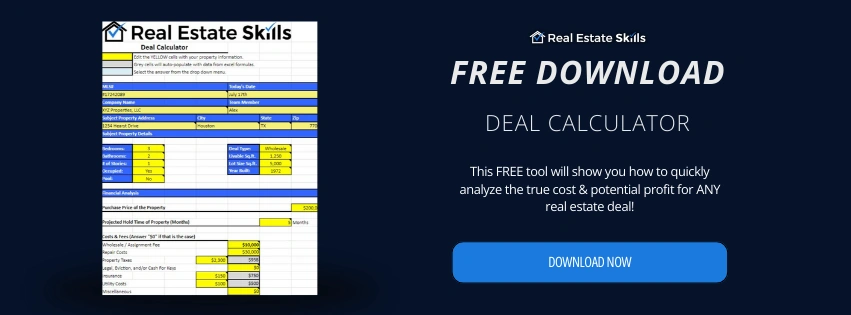
Stop Guessing. Calculate Your Exact Offer In Seconds.
Flipping and wholesaling are numbers games — if your math is off by a few percent, the profit disappears. Don't risk a deal on back-of-the-napkin math. Download our free Deal Calculator to instantly determine your Maximum Allowable Offer (MAO), factor in repairs and closing costs, and lock in your spread with confidence before you ever make an offer.
5. Seller Financing
With seller financing, the seller acts as the bank: no traditional mortgage, no underwriting, no credit qualification. It works best on free-and-clear properties, where the seller can negotiate price, rate, down payment, and term directly with you — sometimes down to zero down. The hardest part isn't the structure; it's the conversation.
| Strategy Snapshot: Seller Financing | |
|---|---|
| Best For | Investors targeting free-and-clear or inherited properties |
| Capital Required | $0 to Low — down payment is negotiable, sometimes zero |
| What You Trade Instead | Interest paid to the seller instead of a bank |
| Risk Level | Low to Medium — no bank, but fewer built-in protections |
| Time To First Deal | 1 to 2 weeks — closes faster than a traditional loan |
| Profit Potential | Varies — depends on price, terms, and exit |
Seller financing is one of the most misunderstood strategies in real estate and one of the most powerful for investors who learn to use it. Instead of going to a bank, you make a deal directly with the seller, who acts as the lender. No traditional mortgage, no lengthy underwriting, no credit qualification. You agree on terms, and the arrangement gets recorded at closing through a title company or closing attorney.
It works best on properties that are owned free and clear — no existing mortgage or liens. With no bank already in the picture, the seller has full flexibility to negotiate price, interest rate, down payment, and repayment timeline directly with you. I've seen deals with no payments until the property resells, interest-only structures, and down payments as low as zero. The terms are as creative as you and the seller are willing to make them.
The hardest part isn't the paperwork — it's the conversation. Most sellers have never heard of seller financing and won't raise it themselves, so you have to introduce it and show why it benefits them. And there are real benefits: they avoid an agent commission, they can spread out their tax liability instead of taking one lump sum (which matters enormously on an inherited property), and they often net more overall because the interest you pay adds to their total return. On a $300,000 property held a year, a seller charging 5% earns an extra $15,000 they'd never have seen from a straight cash sale.
Before you structure any seller-financed deal, verify there are no existing liens — they take priority over your agreement and must be cleared first. Always run a title search, always record the agreement properly through a title company or attorney, and always do your own due diligence. Unlike a bank loan, where the lender requires inspections to protect itself, seller financing has no such protection built in. That falls entirely on you.
📓 From The Field
Most investors pitch seller financing as a negotiation about price. The sellers who say yes are the ones who feel like they're getting more, not less. The most effective pitch reframes the interest entirely: instead of asking for a discount, you tell the seller the interest they'd normally pay a bank is going to them instead. On a $300,000 deal that can mean $15,000 or more in extra income they'd never have received from a straight cash sale. Lead with that, and let the price conversation follow.
6. Lease Options
A lease option lets you control a property and lock in a purchase price today, with the right — not the obligation — to buy it later, usually within one to three years. You pay a small option fee upfront (typically 1 to 5%), control an appreciating asset without owning it, and buy time to qualify for financing. The catch: that fee is non-refundable.
| Strategy Snapshot: Lease Options | |
|---|---|
| Best For | Investors with limited credit or capital who need time to qualify |
| Capital Required | Low — typically a 1 to 5% option fee upfront |
| What You Trade Instead | A non-refundable option fee, in exchange for time and control |
| Risk Level | Low to Medium — you control without owning, but can lose the fee |
| Time To First Deal | 30 to 60 days to secure the agreement |
| Profit Potential | Varies — depends on appreciation and the locked-in price |
Plenty of investors have heard of lease options but never done one, and the mechanics are simpler than the name suggests. You lease the property, you lock in a purchase price today, and you hold the right to buy it later. You're not taking on a mortgage yet and you're not buying yet — you're controlling the property. In real estate, control is most of the game.
Here's how it comes together. You find a motivated seller — someone who needs to move, wants income from the property, or can't sell quickly in the current market — and negotiate a lease that gives you the right, but not the obligation, to buy at a set price within a set window, usually one to three years. For that option you pay an upfront fee, typically 1 to 5% of the purchase price, often credited toward the price if you buy. If you don't buy, the seller keeps the fee. That non-refundable fee is the real risk here: walk away, and it's gone.
The hardest part is finding sellers open to the structure. Most MLS sellers want a clean, quick sale. The ones who say yes are usually tired landlords, sellers in slow markets, or owners of a property that's been sitting. When you find one, it's a genuine win-win: they get monthly income and a future sale, you get control of an appreciating asset with little cash out of pocket. Lock in today's price, let the market work during your option period, and if it appreciates you can exercise, refinance, sell, or hold — while using the time to repair credit or save a down payment.
Don't skip the legal work. A lease option is a real contract, and the terms matter: purchase price, option length, how much rent credits toward the purchase, and what happens to your option fee if you back out. Have a real estate attorney draft or review it, and run a title search before signing to confirm the seller actually owns it free of complicating liens.
📓 From The Field
Beginners obsess over negotiating the purchase price on a lease option and forget the variable that actually decides whether they can use it: the length of the option period. A one-year option sounds like plenty until you factor in credit repair, financing qualification, or a market that shifts. Push for the longest period the seller will agree to — two to three years is ideal. A short option puts all the time pressure on you and none on the seller. Get the time right before you worry about anything else in the deal.
7. Subject-To (Taking Over The Seller's Mortgage)
Subject-to means buying a property "subject to" the existing mortgage staying in place — you take over the payments, but the loan stays in the seller's name. It can mean little or nothing down and a below-market inherited rate. It's also an advanced, higher-risk strategy: the lender's due-on-sale clause can be called at any time, and the seller stays legally exposed.
This section explains how subject-to generally works for educational purposes — it isn't legal or financial advice. Subject-to deals carry real legal and financial risk for both parties and the rules around them vary by state, so work with a real estate attorney before structuring one.
| Strategy Snapshot: Subject-To | |
|---|---|
| Best For | Experienced investors working with a genuinely motivated seller |
| Capital Required | Low — often little or nothing down, beyond catching up arrears |
| What You Trade Instead | Taking on payment responsibility — and significant risk |
| Risk Level | High — due-on-sale clause; loan stays in the seller's name |
| Time To First Deal | Varies — depends on finding the right seller situation |
| Profit Potential | Strong — an inherited low rate can mean immediate cash flow |
Subject-to is one of the most powerful no-money structures and one of the easiest to get wrong, so I'm putting the risk right up front. You buy a property subject to its existing financing: the seller's mortgage stays exactly where it is, in their name, and you simply take over making the payments. You typically get the deed, so you control and own the property — but the loan doesn't move. That's what lets a deal happen with little or nothing down, and it's also the source of every risk that comes with it.
When it shines: a seller who needs out — behind on payments, relocating, facing a hardship — and has a low fixed rate from years ago. You take over a 3% or 4% loan in a market where new loans cost much more, which can mean real cash flow from day one on a property you bought for almost nothing down. For the right seller, you're solving a genuine problem; for you, you're inheriting a rate no new buyer can get.
Now the risks, plainly, because this is not a beginner's first move:
- The due-on-sale clause. Almost every mortgage gives the lender the right to demand the full balance when the property transfers. With subject-to, the title transfers while the loan stays put — which can trigger that clause. Lenders don't always call it, but they can, at any time, and enforcement has drawn more attention since rates rose. If it's called, you need to refinance or pay it off fast.
- The loan stays in the seller's name. Their credit is on the line for a mortgage you're paying. Miss payments and you damage someone who trusted you — and they remain legally liable. That's a serious responsibility, and it's why the relationship and the paperwork have to be airtight.
- It's documentation-heavy. Authorization to communicate with the lender, insurance changes, a clear written agreement — this is attorney territory, every time.
Treat subject-to as an advanced tool you grow into, not a starting point. Done right, with a real attorney and a seller who fully understands the arrangement, it's a legitimate way to acquire cash-flowing property with almost nothing down. Done casually, it can hurt the person who trusted you. Respect the difference.
Wholesale Legally In Any State: Your 2026 Compliance Roadmap
Creative strategies only work when you stay compliant — and the rules differ in every state. Our free How To Wholesale Real Estate & Legalities Guide breaks down how to operate legally wherever you are, with the disclosure rules, assignment requirements, and state-by-state specifics you need to keep every deal clean. Download it and build on a foundation that holds up.
8. Home Equity Line Of Credit (HELOC)
A HELOC lets an existing homeowner borrow against built-up equity — often up to 80 to 85% of the home's value minus what's owed — to fund an investment with nothing out of pocket. It's one of the cheapest sources of capital available. The catch is real: your own home is the collateral, so a deal gone wrong puts the roof over your head at risk.
| Strategy Snapshot: HELOC | |
|---|---|
| Best For | Existing homeowners with built-up equity |
| Capital Required | $0 out of pocket — your home equity does the work |
| What You Trade Instead | Interest — and your home as collateral |
| Risk Level | Medium — your primary residence secures the line |
| Time To First Deal | Roughly 45 to 60 days for HELOC approval |
| Profit Potential | Depends on the deal you fund — HELOC is the vehicle, not the strategy |
If you already own a home and have been paying it down for a few years, you may be sitting on a funding source you haven't thought about. A Home Equity Line of Credit (HELOC) lets you borrow against the equity in your primary residence to invest. Most lenders let you access up to 80 to 85% of your home's appraised value minus what you still owe, typically wanting you to keep 15 to 20% equity and a credit score around 680 or better. On a $400,000 home with a $200,000 balance, that can mean a sizable line to deploy.
Unlike a mortgage or a hard money loan, a HELOC doesn't hand you a lump sum. It works more like a credit card: during the draw period (often five to ten years) you pull funds as needed, pay them back, and pull again, paying interest only on what you actually use. That flexibility makes it a great bridge tool before you've built hard money or private money relationships — a down payment on an investment property, rehab costs on a flip, or a gap while another deal closes.
HELOC rates are usually variable and tied to the prime rate, so they move over time, but they generally come in well below hard money — one of the lowest-cost sources of capital available to a homeowner. On a $100,000 draw, the gap between a HELOC rate and a hard money rate can be several thousand dollars straight off your profit.
Here's the part beginners gloss over: your house is the collateral. Not a stranger's, not the deal you found on the MLS — the home you live in. If the investment goes sideways and you can't repay, you're putting your residence at risk. So use a HELOC only on conservative deals with a clear exit, never to speculate. The numbers have to work on paper before you pull a single dollar.
📓 From The Field
Most investors wait until they have a deal under contract to apply for a HELOC — exactly backwards. Approval runs 45 to 60 days, so if you wait until you need the money, you miss the deal. Apply before you need it, get the line established and sitting ready, and draw on it when the right opportunity shows up. An open HELOC also gives you proof-of-funds access that agents take seriously, the same edge a hard money pre-approval letter provides.
9. Government Loans (FHA, VA & USDA)
FHA, VA, and USDA loans let owner-occupants buy with little or nothing down — FHA from 3.5%, VA and USDA at zero down for those who qualify. Pair one with house hacking (live in one unit, rent the others) and you turn the owner-occupancy requirement from a limitation into one of the strongest no-money entry points there is.
| Strategy Snapshot: Government Loans | |
|---|---|
| Best For | Owner-occupants with 580+ FICO buying with little to no money down |
| Capital Required | 0% to 3.5% down depending on loan type |
| What You Trade Instead | Living in the property — for at least the required period |
| Risk Level | Low — government-backed with strong consumer protections |
| Time To First Deal | 30 to 60 days depending on loan type |
| Profit Potential | Strong long-term wealth-building through a low-down-payment entry |
When a new investor tells me they can't afford a down payment, my first question is whether they've looked at FHA, VA, or USDA loans. Most haven't, and most didn't know these programs could be a path into investing at all. For investors willing to be owner-occupants — at least to start — they offer terms conventional lenders simply can't match. Here's each one:
- FHA Loans (Federal Housing Administration): The most widely used. As little as 3.5% down with a 580+ score, or 10% down with a 500–579 score. They carry mandatory mortgage insurance and are for a primary residence only. The real power for investors is pairing FHA with house hacking — buy a two-to-four-unit property, live in one unit, let the others cover the mortgage.
- VA Loans (Dept. of Veterans Affairs): For eligible servicemembers, veterans, National Guard and Reserve members, and surviving spouses. Zero down, no private mortgage insurance, with a funding fee of roughly 1.25% to 3.3% (waived for many disabled veterans). For a qualifying veteran, using a VA loan on a two-to-four-unit property — live in one, rent the rest — is one of the cleanest and most underused moves in real estate. Primary residence only.
- USDA Loans (Dept. of Agriculture): The most overlooked. 100% financing — zero down — for properties in eligible rural and suburban areas, which covers far more of the map than most people assume (income limits apply, generally up to about 115% of the area median). They run a bit slower to close and are primary-residence only. Always check the USDA eligibility map before assuming a property doesn't qualify.
The shared limitation is owner-occupancy: none of these buys a pure investment property you'll never live in. But for an investor willing to house hack, that's a feature, not a bug. Buy a small multifamily with 3.5% down (or zero, if you qualify for VA or USDA), live in one unit, rent the others, cover your mortgage, and build equity from day one. It's how a lot of successful investors got started.
📓 From The Field
A lot of investors hear "owner-occupancy required" and move on. That's a mistake. That requirement is exactly what unlocks the lowest down payments and best rates in the entire lending market. Buy a duplex or fourplex, live in one unit for the required period, let the other units cover your mortgage, and when you're ready to move, convert the whole property to a rental. You just acquired a cash-flowing rental with 3.5% down — that's the move most people walk right past.
10. House Hacking
House hacking means living in a property while tenants cover your mortgage — buy a two-to-four-unit with a low-down-payment loan, live in one unit, rent the rest. It eliminates or slashes your housing cost, the biggest line item in most budgets, and turns the money you save into capital for your next deal. You can even do it before you own anything.
| Strategy Snapshot: House Hacking | |
|---|---|
| Best For | First-time buyers willing to live in their investment |
| Capital Required | As little as 3.5% down with an FHA loan on a 2-to-4-unit |
| What You Trade Instead | Sharing a roof — for at least the loan's required period |
| Risk Level | Low — rental income offsets your mortgage |
| Time To First Deal | 30 to 45 days with FHA financing in place |
| Profit Potential | $500 to $2,000+ per month saved or cash-flowed, by market and unit count |
Before I ever bought my first rental, I was house hacking without calling it that. I was living in San Diego, where rent eats most people alive. So I leased a four-bedroom, three-bath place for $3,400 a month and subleased three of the rooms at $1,200 each. After utilities, I was paying roughly $100 to $200 a month to live in San Diego for almost four years — essentially living for free. Over that stretch I saved $30,000 to $50,000 in rent I wasn't paying. Think about what you'd have to earn pre-tax to bank that, and it's the equivalent of an extra income. That's the power of the idea, and you can do it before you own a thing.
The classic version of house hacking applies that same principle to a property you own. Buy a two-to-four-unit, live in one unit, rent the others, and the rental income covers your mortgage — often entirely. You build equity, hold a cash-flowing asset, and pay little to nothing to live each month. It's one of the most direct no-money-down paths because the FHA program lets you buy a two-to-four-unit with as little as 3.5% down, as long as you occupy one unit.
Here's what the numbers can look like. Buy a fourplex for $400,000 with 3.5% FHA down — about $14,000 out of pocket. Live in one unit, rent the other three at $1,200 each: $3,600 a month coming in. A mortgage on roughly $386,000 at current rates might run $2,500 to $2,800 a month with insurance. The rent covers the payment and puts money back in your pocket while you live there and the asset appreciates. (Your real numbers will vary by market — run them.)
The hardest part of house hacking is vacancy. Beginners budget for full occupancy and get caught when a tenant leaves for a month or two. Budget one to two months of vacancy per unit per year. If the deal still works with that cushion, it's a good house hack. If it only works at 100% occupancy, the numbers are too tight — find a better deal or a lower price.
📓 From The Field
You don't have to buy a multifamily to house hack. Rent out spare bedrooms in a single-family home. House hack a property with an ADU or a basement unit. Or do what I did — lease a place and sublease rooms before you own anything at all. The core principle holds at every level: use other people's rent to eliminate or slash your own housing cost, and redirect what you save into your next investment. Start wherever you are.
11. Equity Partnerships
An equity partnership pairs your sweat equity with someone else's capital: you find, analyze, and run the deal; your partner funds it; you split the profit on terms set upfront. It's $0 down for the deal-finder. The mindset that makes it work is approaching a partner with an opportunity, not a request for a favor.
| Strategy Snapshot: Equity Partnerships | |
|---|---|
| Best For | Skilled deal-finders with limited capital |
| Capital Required | $0 — your partner brings the money, you bring the deal |
| What You Trade Instead | A share of the profit, and the work of running the deal |
| Risk Level | Low to Medium — risk and reward are shared |
| Time To First Deal | 60 to 90 days — relationship-building takes time upfront |
| Profit Potential | $10,000 to $50,000+ per deal depending on split and exit |
Here's the mindset shift that changes everything with equity partnerships: you're not begging someone for money. You're presenting a qualified partner with an opportunity they couldn't find on their own. Walk into the conversation from a position of value rather than desperation, and the whole dynamic changes.
The structure is simple. You put in the sweat equity — find the deal, run the numbers, manage execution and operations. Your partner brings the funding. You split profits on terms set upfront. Common splits run 50/50 on net profit after the partner's capital is returned; some skew 70/30 toward the partner because they carry the financial risk; others tilt your way if you bring a real track record. The terms are negotiable, and you have more leverage than you think when you show up prepared.
The people most likely to say yes aren't strangers. They're people already in your orbit with capital earning little: cash-heavy, deal-light investors; business owners who understand ROI but lack time; high earners like doctors, dentists, and attorneys with no real estate experience. They're not hard to find — they're hard to approach if you don't know what you're doing.
What separates those who close partnerships from those who don't is preparation. Before you approach anyone, know the deal cold: the numbers, the timeline, the exit, and what happens if something goes wrong. Above all, know what's in it for them, because that's the only question they're actually asking. Show someone a clear, conservative path to a solid return in six to twelve months and you'll have a very different conversation than if you show up with enthusiasm and a handshake. Then formalize everything in writing with an operating agreement drafted by an attorney — general partnership versus limited partnership matters — no matter how well you know the person.
📓 From The Field
Most beginners approach partnership conversations too early — before they've done a deal, before they can talk numbers with confidence, before they have any proof they can execute. That's backwards. The fastest way to find a capital partner is to wholesale first and get a few deals done. Then, when a potential partner asks what you've done, you have a real answer. Capital respects competence. Show up with deals under your belt and the conversation is a completely different one than showing up with just a dream.
12. Small-Business Loans (Microloans & SBA)
Small-business loans are gap-fillers, not primary funding — and here's the honest catch most guides skip: SBA microloans can't be used to buy real estate, and the bigger SBA 7(a) and 504 loans are for owner-occupied business property only. Used correctly, a microloan can cover a repair or closing-cost gap on a deal that's already mostly funded.
| Strategy Snapshot: Small-Business Loans | |
|---|---|
| Best For | Investors needing a small gap filled, or business owners buying owner-occupied property |
| Capital Required | Low — these provide capital rather than require it |
| What You Trade Instead | Interest — on a smaller, targeted loan |
| Risk Level | Low — smaller amounts mean less exposure |
| Time To First Deal | 30 to 90 days depending on lender and program |
| Profit Potential | Depends on the deal funded — this is the gap-filler, not the strategy |
Let me be straight about these, because they're widely misrepresented in no-money guides. A microloan isn't going to fund your real estate deal — and per the SBA's own rules, microloan proceeds cannot be used to purchase real estate. What a microloan can do is plug a small, specific gap in a deal that's already mostly funded another way: cosmetic repair costs on a flip you're doing yourself, a closing-cost shortfall, working capital for your investing business. Think precision tool, not primary funding.
The SBA microloan program is the most common, with these parameters:
- Loan amounts: Up to $50,000, with the average around $13,000 to $16,000.
- Interest rates: Generally 8% to 13% annually — well below hard money.
- Repayment terms: Up to six or seven years, easing the short-term pressure of a hard money loan.
- Who provides them: Nonprofit intermediaries and community lenders, many built to support first-time and underserved business owners.
- What they weigh: Your business plan, character, and ability to repay — more than credit score or collateral — which makes them accessible when conventional financing isn't.
What about the bigger SBA loans? The SBA 7(a) (up to $5 million) and SBA 504 are real options — but only for owner-occupied business property. Your business has to occupy the majority of the building (generally at least 51%). So if you're a business owner buying the commercial or mixed-use building you operate out of, an SBA 504 with as little as 10% down can be a genuine path to ownership. What none of them are is a way to buy a pure investment property you'll never occupy — that's simply not what SBA financing is for. Knowing that up front saves you from chasing a loan that was never going to fund your rental.
📓 From The Field
The biggest mistake with these loans is treating them like a primary funding strategy — or worse, assuming an SBA loan will buy your rental. It won't. Where a microloan earns its place is stacked on top of a deal that's already funded: layered into a flip to cover the rehab gap, or used for the working capital your investing business needs. Know exactly what the tool is for before you reach for it.
13. The BRRRR Method
BRRRR — Buy, Rehab, Rent, Refinance, Repeat — lets you recycle the same capital across multiple rentals. You buy distressed with hard or private money, rehab to force value, rent it, then refinance to pull your money back out and do it again. It's a phase-two strategy: powerful for scaling, but the refinance step is where it can disappoint.
| Strategy Snapshot: The BRRRR Method | |
|---|---|
| Best For | Investors scaling a rental portfolio by recycling capital |
| Capital Required | Low — funded by hard or private money, returned via refinance |
| What You Trade Instead | Interest, a rehab, and capital tied up through seasoning |
| Risk Level | Medium — many moving parts; the refinance can come up short |
| Time To First Deal | 6 to 12 months per full cycle, including seasoning |
| Profit Potential | Ongoing cash flow per property, compounding across doors |
When it comes to building a rental portfolio without injecting new capital at every step, BRRRR is the method that changes the math. It stands for Buy, Rehab, Rent, Refinance, Repeat: buy a distressed property, rehab it to force appreciation, place a tenant, then refinance on the new appraised value to pull your original capital back out and roll it into the next deal. Done right, you're recycling the same dollars instead of spending fresh money on every property — leaving a cash-flowing rental behind at each stop.
My business partner Ryan ran a clean example on a rental he calls Tate Drive. He bought it for $155,000, put $31,000 down, and rents it for $1,300 a month, netting around $366 a month in cash flow. But the monthly cash flow is only one of four ways that deal pays him: there's the cash flow itself, the loan paydown as the tenant covers the mortgage, the appreciation over time, and the tax advantages of owning rental property. Stack those four and the real return is well beyond what the cash flow alone suggests — which is the whole point of buy-and-hold.
Here's the cycle in practice. Buy below market — typically targeting a purchase no higher than about 70% of after-repair value minus rehab. Renovate to force value and make it rentable. Place a tenant. Then refinance: most lenders let you cash out up to roughly 75 to 80% of the appraised value on an investment property. If your numbers were right going in, that refinance returns most or all of your original capital, leaving you a cash-flowing rental and your money freed up for the next one. Then repeat.
The hard part isn't the rehab or the deal — it's the refinance. Most lenders require a seasoning period of 6 to 12 months before they'll refinance on the new appraised value instead of your purchase price, so your capital is tied up longer than beginners expect. And the most common mistake is over-rehabbing — spending more than the new appraisal will support. BRRRR works on the buy, not the rehab. Overpay or over-improve and the cash-out won't return enough to keep the cycle going. Run conservative numbers, build in a 10 to 15% rehab contingency, and verify your ARV with a local agent or appraiser before you close.
📓 From The Field
The cash-out refinance fails more often than courses admit, for two reasons: the appraisal comes in under your projected ARV, or the lender's seasoning requirement pushes past your hard money loan's maturity date. The fix is to negotiate a loan extension with your hard money lender before you close, not after the appraisal disappoints. Build the extension option into the original loan agreement — it costs almost nothing upfront and can save the entire deal on the back end.
14. Assumable Mortgages
An assumable mortgage lets you take over a seller's existing loan — including their below-market rate. Only FHA, VA, and USDA loans are assumable; conventional loans aren't. The honest catch: you still have to cover the gap between the loan balance and the purchase price, in cash or with a second loan — so "assume the loan" rarely means "buy it free."
| Strategy Snapshot: Assumable Mortgages | |
|---|---|
| Best For | Buyers targeting FHA, VA, or USDA properties with low locked-in rates |
| Capital Required | Gap financing — the difference between loan balance and price |
| What You Trade Instead | Covering the equity gap — in cash or a second loan |
| Risk Level | Low to Medium — lender approval required; VA entitlement considerations |
| Time To First Deal | 45 to 90 days for formal assumption approval |
| Profit Potential | Strong — a below-market rate lifts cash flow from day one |
An assumable mortgage lets you take over the seller's existing loan — their rate, balance, and terms. The appeal is obvious in a high-rate market: assume a loan locked at 3% or 4% when new loans cost well above 6%, and you get a built-in cash-flow advantage on the exact same property, worth hundreds a month. Which loans qualify:
- FHA loans: Assumable with lender approval; the buyer qualifies through a formal process that runs about 45 to 90 days. There's an assumption fee (often up to around $1,800). One of the most accessible types for non-veterans.
- VA loans: Assumable with lender approval, and a non-veteran can assume one (assumption fee around 0.5%). The catch: the seller's VA entitlement stays tied up until the loan is paid off or the buyer substitutes their own entitlement — sellers must understand that before agreeing.
- USDA loans: Assumable with lender approval on eligible rural properties. Less common, but worth checking on rural deals.
- Conventional loans: Not assumable. A due-on-sale clause requires full payoff when the property changes hands. If the seller has a conventional loan, this strategy is off the table.
Now the honest part most pitches skip: assuming the loan rarely buys the property outright, because of the equity gap. If a seller owes $180,000 on a home worth $280,000, you assume the $180,000 loan — but you still owe the $100,000 difference. That gap has to be covered: in cash, with a second mortgage or HELOC, with private money, or via seller financing on the difference. Stack an assumable first mortgage with seller financing on the gap and you can build a genuine zero-down structure — but only if the seller agrees to finance that gap. Otherwise, "assuming the loan" still requires real money for the equity. Go in knowing which situation you're actually in.
📓 From The Field
The biggest barrier to assumable mortgages isn't the process — it's awareness. Most sellers with an FHA or VA loan have no idea it can be assumed, and most listing agents have never done one. When you find a property with an assumable below-market loan, you often have to educate both the seller and the agent on how it works and why it helps everyone: the seller gets a cleaner sale, you get a rate no new loan can match. Come prepared with a simple one-page explanation and you'll stand out from every other offer on the table.
15. REITs & Real Estate Crowdfunding
REITs and crowdfunding are the truly passive end of real estate — you invest in property without owning, managing, or financing anything. A publicly-traded REIT starts at the price of a single share; crowdfunding minimums can be as low as $10. You trade control and bigger returns for simplicity, and you take on a real liquidity risk worth understanding before you commit.
| Strategy Snapshot: REITs & Crowdfunding | |
|---|---|
| Best For | Passive investors who want exposure without owning or managing property |
| Capital Required | As little as $10, up to $5,000+ for accredited deals |
| What You Trade Instead | Control and upside — for simplicity and true passivity |
| Risk Level | Low to Medium — market and platform risk; crowdfunding can be illiquid |
| Time To First Deal | Immediate — you can invest the day you open an account |
| Profit Potential | Dividends and appreciation — returns vary and aren't guaranteed |
Every other strategy in this guide is hands-on. This one is the opposite, and it's the most accessible starting point of all if you have a few dollars but no time. A REIT (real estate investment trust) is a company that owns income-producing real estate, and you buy shares of it the same way you'd buy any stock — through a brokerage account, at the current share price. Crowdfunding works similarly but pools investors directly into specific properties or portfolios, often with low minimums. Either way, you own a slice of real estate without ever touching a property, a tenant, or a loan.
There's one feature of REITs worth knowing because it's why they pay income: by law, a REIT must distribute at least 90% of its taxable income to shareholders each year. That's what makes them favored for dividends — though those dividends are generally taxed as ordinary income, not at the lower qualified-dividend rate, and like any investment the returns aren't guaranteed. Publicly-traded REITs are also liquid: you can buy and sell shares on an exchange any trading day.
Crowdfunding platforms split investors into two groups, and the distinction matters:
- Non-accredited investors: Anyone can invest on platforms like Fundrise, often starting around $10 to $100. These offerings are SEC-registered, carry more oversight, and tend toward more conservative return profiles. If you're starting out and want passive exposure with almost no capital, this is the entry point.
- Accredited investors: If your net worth exceeds $1 million (excluding your primary residence) or you earn over $200,000 a year, you qualify for a wider range of private deals with potentially higher returns and higher risk. Minimums here typically start around $5,000 to $25,000.
Now the risk that gets glossed over: liquidity. Publicly-traded REITs you can sell any day, but crowdfunding investments can lock up your capital for years, and the right to redeem early isn't guaranteed — platforms can suspend it. This isn't hypothetical: Fundrise suspended redemptions on certain of its equity REIT offerings in late 2025, and RealtyMogul halted share repurchases in early 2026. Investors who assumed they could pull their money out on demand found they couldn't. So treat crowdfunding capital as money you can leave parked for years, read the redemption terms before you invest, and don't put in funds you might need back quickly.
My honest take: if your goal is to build real skills and do active deals, treat REITs and crowdfunding as a place to park money while you learn, not a substitute for the work. But if you genuinely want passive exposure and have no interest in finding deals or managing property, it's a legitimate option — and the most realistic one for someone with a few dollars and no time.
Compare All 15 No-Money Strategies
Every strategy here works — the right one for you depends on your time, capital, credit, network, and how fast you need to move. Use this matrix to scan them side by side, then read the self-assessment below it to match one to your actual situation.
| Strategy | Best For | Capital Required | Risk Level | Time To First Deal |
|---|---|---|---|---|
| Wholesaling | Beginners with time and hustle, no capital | $0 | Low | 30–90 days |
| Hard Money Lenders | Fix-and-flip investors with a deal but no cash | Low (fees + points) | Medium | 2–4 weeks after approval |
| Private Money Lenders | Investors with a strong network and deal | $0 (relationship-based) | Low–Medium | Varies by relationship |
| Fix & Flip With OPM | Investors who can find a deal and manage a rehab | Low (borrowed) | Medium–High | A few months per flip |
| Seller Financing | Investors targeting free-and-clear or inherited homes | $0–Low (negotiable) | Low–Medium | 1–2 weeks |
| Lease Options | Investors with limited credit who need time to qualify | 1–5% option fee | Low–Medium | 30–60 days |
| Subject-To | Experienced investors with a motivated seller | Low | High | Varies |
| HELOC | Existing homeowners with built-up equity | $0 out of pocket | Medium | 45–60 days (approval) |
| Government Loans | Owner-occupants with 580+ FICO and stable income | 0–3.5% down | Low | 30–60 days |
| House Hacking | First-time buyers willing to live in their investment | 3.5% FHA down | Low | 30–45 days |
| Equity Partnerships | Deal-finders who lack capital but bring strong deals | $0 (sweat equity) | Low–Medium | 60–90 days |
| Small-Business Loans | Gap-filling, or owner-occupied business property | Low (up to $50K micro) | Low | 30–90 days |
| BRRRR Method | Investors scaling a rental portfolio with recycled capital | Low (borrowed) | Medium | 6–12 months per cycle |
| Assumable Mortgages | Buyers targeting FHA/VA/USDA loans with low rates | Gap financing only | Low–Medium | 45–90 days |
| REITs & Crowdfunding | Passive investors wanting exposure without owning | $10–$5,000+ minimum | Low–Medium | Immediate |
Is This Realistic For You?
Yes — but which strategy is realistic for you depends on what you bring instead of money. Every approach trades cash for something else: time and hustle (wholesaling), a good deal plus a lender's trust (hard and private money), a network (partnerships), credit and a willingness to live in the property (house hacking), or a few dollars and patience (REITs). Match the strategy to your honest situation, not to whichever sounds best.
Here's the part that actually decides your outcome, and it isn't which strategy is "best." It's which one fits you. "No money" never means "nothing required" — you're substituting something else for cash. So before you pick, get honest about what you're bringing to the table.
If what you have is time and a willingness to grind, wholesaling is the natural start. No money, no license in most states, but it demands consistent effort and the discipline to push through a lot of nos. Carve out 10 to 15 hours a week and don't discourage easily, and it's the most realistic on-ramp there is — it's where I'd point most beginners.
If what you have is the ability to find a genuinely good deal, hard money and private money open up. Lenders care about the deal more than your résumé, so a strong deal is your real currency — it's how flipping and BRRRR become possible with little of your own cash. But it only works if the deal is actually good, because borrowed money has to be repaid either way.
If what you have is relationships, or the ability to build them, partnerships and private money are your path. Someone funds, you find and run the deal, you split the result. Your job is to bring real value and put the terms in writing.
If what you have is decent credit and you're willing to live in the property, house hacking with a low-down-payment government loan is one of the most realistic ways in — the cheapest financing available, with tenants helping cover your mortgage, in exchange for a year of sharing a roof.
And if what you have is a few dollars and no time to manage anything, REITs and crowdfunding let you start today, passively, for as little as the price of a share — trading control and bigger returns for simplicity.
Notice the pattern: there's a realistic path for almost everyone, but not every path for everyone. Someone with no time but some savings should look at REITs or partnerships, not wholesaling. Someone with time but no money and no network should start wholesaling, not chase creative-finance deals that require trust they haven't built yet. The fastest way to stall is to pick the strategy that sounds most impressive instead of the one that matches your actual time, capital, credit, and network today. Start where you are — you can always evolve into the others as you build the missing pieces, which is exactly what the next-to-last section maps out.
The Honest Version: Who No-Money Investing Is Wrong For
No-money investing isn't for everyone. Using none of your own cash usually means more leverage, more risk, and more dependence on a deal being genuinely good — because borrowed money must be repaid whether the deal works or not. It rewards people who can find real deals, manage risk soberly, and stick with it. It punishes those chasing fast, passive, guaranteed money.
Every section so far has shown what's possible. This one shows the other side honestly, because anyone who tells you investing with no money is easy or risk-free is selling you something. Here's who these strategies are genuinely wrong for, and how real deals actually go sideways.
Leverage cuts both ways. This is the core truth under every no-money strategy. Using other people's money multiplies your returns when a deal works — and multiplies your losses when it doesn't. A flip that would've cost you a chunk of savings if you'd paid cash can, when financed, cost you that plus the borrowed money you still owe, plus the interest that accrued the whole time. The less of your own money in a deal, the more the deal has to perform. There's no version of this where you get the upside of leverage without the downside risk. If a strategy promises both, walk away.
Time quietly eats profit. The gap between a deal's gross spread and your actual take-home is mostly interest and holding costs, and they accrue every single day. Remember Stephanie from the flipping section: a roughly $150,000 gross spread on paper — $421,000 purchase, about $135,000 in rehab, sold for $705,000 — that netted about $35,000. The difference vanished into a project that ran far longer than planned while she paid interest on both a hard money loan and a private money loan, plus taxes and holding costs. Her honest verdict: the time it takes is everything, especially when you're paying interest on borrowed money.
The friction is real, and it's specific. Stephanie's flips are a catalog of what actually goes wrong, none of which shows up in the glossy version. Her permit costs came in around $3,500 when she expected closer to $1,500 — because the city charged a percentage of the renovation budget, not a flat fee. On another property, the city refused to issue a permit at all because she'd bought the home in an LLC rather than her personal name — the same LLC structure hard money lenders often require, which tells you these strategies can quietly work against each other. She ran one general contractor across two flips at once and both blew their timelines — one stretched from a planned 16 weeks to 32 — because the contractor couldn't staff both. And a renovation bid quoted verbally at $170,000 came in at $205,000 once the work was actually scoped. This is the business up close: solvable problems, but constant ones. If that sounds exhausting rather than interesting, the active strategies aren't for you.
Each strategy carries its own specific risk. Worth saying plainly in one place. With a lease option, your option fee and rent credits are non-refundable — don't buy, and that money is gone. With a HELOC, you've pledged your own home as collateral; miss payments and you can lose the house you live in. With subject-to, the lender's due-on-sale clause can be called at any time, forcing immediate payoff and leaving the seller — whose name is still on the loan — exposed. With BRRRR, if the refinance doesn't appraise high enough, your cash stays trapped in the deal. With crowdfunding, your money can be locked up for years, and some platforms have suspended redemptions entirely. None of these are reasons not to invest — they're reasons to go in with your eyes open and never on a marginal deal.
Who this is genuinely wrong for. If you need guaranteed income, this isn't it — none of these outcomes are promised, and anyone implying otherwise is misleading you. If you can't tolerate risk or the possibility of a deal losing money, the leverage that makes no-money investing possible is the same leverage that can hurt you. If you're looking for truly passive money but have no capital, your honest option is to build active income first (wholesaling) and convert it to passive later — not to skip straight to passive with nothing. If you won't put in consistent time, the active strategies will stall and the passive ones will move slowly. And if you're drawn to the most advanced plays — subject-to, sandwich lease options — as a first move, reconsider; those carry the most legal and financial downside and are where beginners get hurt.
The people who succeed at this aren't the ones who found a trick. They're the ones who learned to find genuinely good deals, respected the risk, managed the boring details, and kept going when it got hard. If that's you, the strategies in this guide are real and they work. If you were hoping for fast, passive, guaranteed money with no effort and no risk, no financing structure will give you that — in real estate or anywhere else.
Because these strategies involve borrowing, contracts, taxes, and significant financial risk, treat this guide as education, not personalized financial or legal advice. Before acting on any of them, consider speaking with a qualified financial advisor, attorney, or tax professional about your specific situation.
What I'd Do From Scratch Today
If I were starting over today with no money, I'd follow the same path I actually took: wholesale first to earn active income with no capital, use those profits and skills to cherry-pick a few flips for bigger paydays, then reinvest everything into rental properties for passive income. Active income first, passive wealth second — in that order.
People want to skip to owning rentals. I get it — that's where the passive income and the real wealth are. But you can't start there with no money, and trying to is how people stall. Here's the actual sequence I'd run, and did.
Start by wholesaling
It needs no capital, no license in most states, and it teaches the one skill everything else depends on: finding and locking up a good deal. My first wholesale deal took about eight hours of work and paid $22,000 — found on the MLS, under contract at $328,000, assigned to a cash buyer at $350,000, never a dollar of my own in it. The goal at this stage isn't one lucky deal; it's consistency. Wholesale a couple of houses a month and you're building both income and the deal-finding muscle.
Then cherry-pick flips
Once you can reliably find deals and you've watched, at no risk, which contractors and buyers actually perform, start flipping the best ones yourself and wholesaling the rest. Flips pay more per deal — my Del Marino flip made about $61,000 in roughly 89 days, funded entirely with hard and private money, none of it mine. Keep early budgets small and mostly cosmetic, and keep wholesaling for steady cash flow so you're never dependent on a flip finishing to pay your bills.
Then reinvest into rentals
This is where it becomes wealth. Take the profits from wholesaling and flipping and buy cash-flowing rentals. My partner Max bought a rental for $78,000, put $15,600 down at a 7.5% rate, and it cash-flows about $500 a month — and he owns 17 doors built up over about two and a half years. One rental isn't life-changing. A portfolio of them is.
The reverse-engineering exercise
Here's how to turn that into a concrete goal instead of a vague hope. Start with your monthly expenses — say $6,000. Divide by the cash flow you target per rental (~$300/unit) and you get the number of units you need: 20. Multiply by a typical down payment (~$30,000) and you get the capital required: $600,000. Divide that by your target profit per flip (~$30,000) and you get the number of flips it takes to fund it: 20. Now "be financially free" has become a countable plan — 20 flips' worth of profit, reinvested into 20 rentals, covers your life. (Those per-unit and per-deal figures are targets, not promises; your real numbers will vary by market. The point is the method, not the exact count.)
That's the whole map. Wholesale to learn and earn, flip to accelerate, buy rentals to build lasting income — each stage funding and teaching the next.
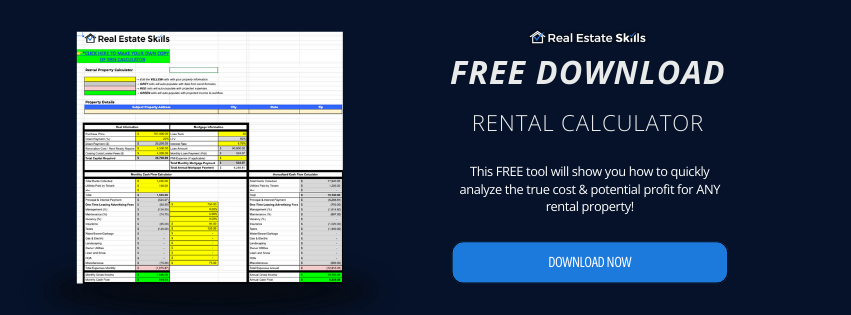
Will Your Rental Actually Cash Flow? Run The Numbers First.
The reverse-engineering exercise only works if each rental actually cash-flows the way you projected. Before you buy, pressure-test the deal: plug in your rent, expenses, and financing to see your real cash flow, cap rate, and ROI — not a hopeful guess. Download our free Rental Property Calculator, the same tool we use to analyze our own portfolio, and buy on numbers instead of optimism.
FAQ: Investing In Real Estate With No Money
Getting started with no cash raises a lot of questions. Here are direct answers to the ones that come up most, so you can weigh your options and move forward without the common mistakes.
Final Thoughts On Investing With No Money
The belief that you need money to invest in real estate is the single biggest thing that stops people who could otherwise do this. It's also wrong. The investors closing deals right now — including the ones who started with nothing — aren't using their own money. They're using a lender's, a partner's, or the seller's, and paying for it out of the profit.
What it actually takes isn't capital. It's the willingness to learn to find a genuinely good deal, the discipline to manage risk soberly, and the persistence to keep going through the nos. Start where you are, with whatever you've got — time, a little credit, a few dollars, or just the willingness to grind — and pick the one strategy that fits your real situation today. Get one deal done. Then let it compound: active income first, passive wealth second.
The path is well-worn and the strategies are real. The only thing left is to start.
You've seen the strategies. Now see the system that runs them. Knowing the strategies is one thing; executing them consistently is another. The investors who actually get paid don't reinvent the wheel — they follow a repeatable process for finding deals, funding them, and reinvesting the profits. Our FREE Training breaks down that exact system step by step, the same one thousands of our students use.
Watch it today, then go put it to work.
About The Author
Founder & CEO, Real Estate Skills
Alex Martinez is a full-time real estate investor and the Founder & CEO of Real Estate Skills. He got his start with no money, wholesaling his first deal for a $22,000 fee, and in his first year acquired 50+ deals generating over $12 million in revenue. He has since wholesaled and flipped houses across the country and built a rental portfolio alongside his partners. Through Real Estate Skills, Alex and his team have helped thousands of students learn to find deals, fund them with other people's money, and close their first profitable transaction — and he mentors entrepreneurship students at the Lavin Entrepreneurship Center at San Diego State University.
Real Estate Skills is not a law firm, and the information in this article is provided for educational purposes only — it does not constitute legal, tax, or financial advice. Real estate financing strategies, loan programs, and wholesaling laws vary by state and change over time. All investing carries risk, including the possible loss of capital, and past results do not guarantee future outcomes; individual results vary. Always consult a licensed real estate attorney and your own tax and financial advisors before entering into any contract, loan, or investment.

👉FREE Training
How To Consistently Wholesale, Flip Houses, & Invest In Rental Properties From The MLS
(Without Spending $1 On Marketing)

Alex Martinez, the founder of Real Estate Skills, is known for his strong, practical expertise in real estate, starting from a beginner with no family connections in the industry to completing over 50 real estate deals, including wholesale and flips, within his first year.
He has dedicated his career to providing cutting-edge education and resources for real estate professionals. He emphasizes the importance of self-taught knowledge through mentors, books, and hands-on experience.
His journey from earning a modest income to becoming a successful real estate entrepreneur and educator showcases his expertise and dedication to the field.

Ryan Zomorodi, co-founder and COO of Real Estate Skills, leverages his experience from a diverse background in real estate investment, construction management, and entrepreneurship to provide comprehensive education in the real estate sector.
His expertise is rooted in hands-on experience, extensive industry knowledge, and a commitment to empowering others through education.
Ryan's journey reflects a blend of practical experience and entrepreneurial success, contributing to his role in developing a platform that educates and supports aspiring real estate professionals.
Read Ryan's Full Bio >>
