
How To Make 1 Million Dollars: The Math, The Timeline & The Real Estate Path
Sep 04, 2026

Written by
Alex Martinez — Founder & CEO, Real Estate Skills. Has wholesaled and flipped houses for over 14 years, been part of 1,000+ real estate transactions, and personally acquired 33+ residential investment properties. Has trained 6,000+ investors nationwide.
Reviewed by
Ryan Zomorodi — Co-Founder & COO, Real Estate Skills. Reviewed and verified the savings math, timeline calculations, and rental property figures in this guide before publication.
Publication history: Originally published March 10, 2025. Updated September 2026 with the full savings-and-timeline math behind reaching $1 million, a real first rental property breakdown with verified figures, corrected appreciation and loan-paydown calculations, a new section on when real estate is the wrong choice, and a rebuilt FAQ. Reviewed and verified by Ryan Zomorodi, Co-Founder & COO of Real Estate Skills.
Making 1 million dollars comes down to three things: how much you invest, what return you earn, and how long you stay in. At an 8% return, $671 a month gets there in 30 years. Real estate shortens that timeline because it's the one asset a bank will lend you 80% to buy.
Most articles on this either sell you a course or tell you to quit buying coffee. Neither answers what you actually asked, which is whether $1 million is realistic for someone in your position and how long it would take.
It's knowable. $1 million is arithmetic with three inputs, and once you see the numbers the whole thing stops feeling mystical. You'll also see why most people don't get there, and it isn't the reason you'd expect — it has almost nothing to do with picking better investments.
Then we'll get to the part I know best. Real estate is the fastest legitimate way most people compress that timeline, and I'll show you exactly why using real numbers from real deals, including the ones that were uncomfortable. Not because real estate is magic. Because it's the only ordinary asset where someone else funds 80% of the purchase and a tenant pays down the loan.
If you want to see the deal side of this in practice, our FREE Training walks through how our students find and close their first deals.
How To Make Your FIRST $1 MILLION Dollars (Even If You're Broke)!
Ryan Zomorodi walks through his first rental property purchase — a $155,000 house bought from over a thousand miles away with $35,000 down — and what that position is worth today.

How Much Money Do You Need To Save To Make 1 Million Dollars?
At an 8% annual return, saving $671 a month reaches $1 million in 30 years. Shorten it to 20 years and you need $1,698 a month; to 10 years, $5,466. The monthly number climbs fast as the timeline shrinks, which is why time matters more than income for most people.
Here's the whole thing in one table. Find your timeline, read across, and that's the cost.
| Years | at 7% | at 8% | at 10% |
|---|---|---|---|
| 10 years | $5,778 | $5,466 | $4,882 |
| 15 years | $3,155 | $2,890 | $2,413 |
| 20 years | $1,920 | $1,698 | $1,317 |
| 25 years | $1,234 | $1,051 | $754 |
| 30 years | $820 | $671 | $442 |
| 35 years | $555 | $436 | $263 |
| 40 years | $381 | $286 | $158 |
Monthly amount needed to reach $1 million, investing every month and reinvesting everything you earn.
Look at the 8% column and notice how violent that curve is. Thirty years costs $671 a month. Twenty years costs two and a half times that. Ten years costs eight times. Every decade you wait roughly doubles the monthly bill.
Why 8%? The S&P 500 has returned just under 10% a year since 1928 including dividends, and 10.4% over the 30 years through December 2025. I plan at 8% because planning at the historical maximum is how people end up short. If markets beat 8%, you arrive early. That's the direction you want to be wrong in.
💡 A Real Starting Point: $500 vs. $1,000 A Month
- You put $500 a month into an index fund — a fund that buys the whole market instead of individual stocks.
- At an 8% return, you reach $1 million in about 33 years.
- Push it to $1,000 a month and that drops to roughly 25 and a half years.
- You bought back seven and a half years by finding another $500 a month — not by picking better investments.
That trade is available to almost everyone and almost nobody makes it.
Now the part most articles skip. $1 million in 30 years is not $1 million today. At 3% inflation, a million dollars three decades out buys roughly what $412,000 buys now. Still real money. Not the retire-tomorrow number it sounds like, and if your plan quietly assumes it is, the plan has a hole in it.
So that's the baseline, and for most people it's a 25-to-35-year answer. The obvious question is whether anything makes it faster. Two things do, and only two — which is what the next section is about.
Returns aren't guaranteed. These figures are illustrations built on historical averages, not predictions. Markets have gone a decade returning close to nothing, and every timeline above assumes you keep investing straight through those stretches, which is the part people actually fail at.
How Long Does It Take To Make 1 Million Dollars?
How long depends almost entirely on where you start. $100,000 invested at an 8% return reaches $1 million in about 30 years on its own. Add $500 a month and it's under 23 years. Starting from zero at $500 a month, roughly 33 years.
Start with the hardest version of the question: you put money in once and never add another dollar. Here's how long that takes.
| Starting amount | at 7% | at 8% | at 10% |
|---|---|---|---|
| $5,000 | 78 years | 69 years | 56 years |
| $25,000 | 55 years | 48 years | 39 years |
| $50,000 | 44 years | 39 years | 31 years |
| $100,000 | 34 years | 30 years | 24 years |
| $200,000 | 24 years | 21 years | 17 years |
| $400,000 | 14 years | 12 years | 10 years |
Years to reach $1 million from a one-time investment, no additional contributions.
That table is bleak on purpose. It's the honest answer to "how do I turn $5,000 into $1 million" — on its own, $5,000 doesn't get there in a working lifetime. Not because the math is broken, but because $5,000 compounding alone is doing all the work and it doesn't have enough to work with.
Nobody actually invests this way, though. Real people put in a lump sum and keep adding. That changes everything:
| Starting point | Time to $1 million at 8% |
|---|---|
| $5,000 + $500/month | 32.7 years |
| $25,000 + $500/month | 29.8 years |
| $50,000 + $500/month | 27.0 years |
| $100,000 + $500/month | 22.8 years |
| $100,000 + $1,000/month | 19.2 years |
| $100,000 + $2,000/month | 14.8 years |
| $400,000 + $1,000/month | 9.3 years |
Compare the two tables and one thing jumps out. $25,000 alone takes 48 years. The same $25,000 with $500 a month behind it takes under 30. The monthly contribution is doing more work than the starting balance. If you're sitting on a small amount wondering how to turn it into a million, the honest answer is that the amount matters far less than what you add to it every month.
Watch what happens at the end, too. $100,000 growing at 8% is worth about $147,000 after five years, $216,000 after ten, and $466,000 after twenty. Then it crosses a million around year 30. It took twenty years to make the first $366,000 and the last decade to make the final $534,000. Compounding is boring for a long time and then it isn't, which is exactly why most people quit in the boring part.
Can You Make $1 Million In 1 To 3 Years?
Not from investment returns. I want to be blunt about this because it's the most-searched version of the question and it gets the most dishonest answers.
To turn $100,000 into $1 million in two years, you'd need roughly a 216% annual return. Nothing produces that reliably. The things that occasionally do — concentrated bets, options, crypto, high leverage on a single position — produce total losses at a similar rate, and the people selling you the winning story never show you the distribution.
Fast $1 million outcomes are real, but they come from three places, none of which is compounding:
- Income. You earn it. A very high salary, a commissioned or equity-heavy role, a professional practice. Slow to build, but it's the most reliable of the three.
- Ownership. You build something and sell it, or you own equity in something that gets sold.
- Leverage. You borrow to control assets worth far more than you put in, and the assets appreciate and produce income while someone else pays down the debt.
The third is where real estate lives, and it's the one available to ordinary people without a founder's equity stake or a surgeon's income. It's not a shortcut to one year. It is genuinely faster than the tables above, for a specific and boring reason: no bank will lend you $400,000 to buy index funds. They'll do it for a house, and the tenant covers the payment.
That's the next section, with real numbers from a real deal.
Timelines vary with returns, taxes, fees, and how consistently you invest. These are illustrations using historical averages, not forecasts or promises.
How To Turn $25,000, $50,000, or $100,000 Into $1 Million
Leverage is what shortens the timeline. $100,000 in cash buys one $100,000 asset. The same $100,000 split into five 20% down payments controls $500,000 of property — and every dollar of appreciation, rent, and loan paydown happens across all five instead of one.
Section 2 showed $100,000 taking about 30 years to reach $1 million on its own. Here's what changes that.
Leverage means using borrowed money to control an asset worth more than what you put in. You've probably used it already without calling it that — a mortgage on your own home is leverage. You put down 20% and the bank funds the other 80%, but you own 100% of whatever that house does next.
That's the piece people miss. Appreciation isn't calculated on your down payment. It's calculated on the whole property.
Put $100,000 into an index fund and an 8% year makes you $8,000. Put that same $100,000 down on a $500,000 property and a 4% appreciation year makes you $20,000 — on a far more conservative growth rate — because you're earning on the full $500,000, not on your share of it.
Now split it further. Five separate $100,000 properties at 20% down each. Same $100,000 out of pocket, but now you've got five sets of rent coming in, five tenants paying down five loans, and five properties appreciating. That's what "$100,000 into $1 million" actually looks like as a mechanism, and it's why the real estate answer to that question is different from the index-fund answer every other article gives you.
Starting with less? The same principle applies at a smaller scale — see our guide on how to invest $10K in real estate.
📓 From The Field — Ryan's First Deal
Ryan Zomorodi bought his first rental in 2015: a single-family house on Tate Drive near Memphis, priced at $155,000. He was living in San Diego, more than a thousand miles away. He put 20% down, and with closing costs his total cash into the deal was about $35,000 — close to everything he had at the time.
That $35,000 controlled a $155,000 asset. The property has since more than doubled in value, and the loan has been paying down the whole time, which puts his equity position above $200,000 on a $35,000 investment. It has also returned roughly 10% cash-on-cash every year he's owned it — meaning about $3,500 a year in cash, which over a decade has returned his original down payment in full while he still holds the property.
One property, one market, over a decade that was unusually strong for US housing. Individual results vary widely and past performance doesn't predict future returns.
Here's the comparison that matters. Ryan's $35,000 became roughly $210,000 in equity plus about $35,000 of accumulated cash flow. The same $35,000 in an index fund over the same ten years would be worth somewhere around $69,000 at 7%, or $91,000 at 10%.
That gap is leverage. Not better judgment, not market timing. The bank funded 80% of the asset and a tenant covered the payment.
The Honest Version
Three things have to sit next to those numbers.
That decade was exceptional. FHFA data puts long-run US home appreciation around 4.3% a year. A property doubling in ten years is roughly 7% annually — well above the historical average, in a stretch that included the post-2020 price surge. The most recent FHFA quarterly report shows four-quarter appreciation of 2.2%. Anyone modeling the next ten years on the last ten is making a mistake.
Leverage multiplies losses identically. If that $155,000 house had dropped 20%, Ryan's $31,000 of equity would have been close to wiped out while the $124,000 loan stayed exactly where it was. The reason cash-flowing properties survive downturns is that the rent keeps arriving and you're never forced to sell at the bottom. Buy a property that doesn't cash flow and leverage becomes the thing that ends you.
Equity isn't cash. That $200,000+ is real, and it isn't spendable without selling or refinancing. The $3,500 a year is the part that actually shows up in a bank account.
And one more, less dramatic: the index fund didn't require finding a tenant, replacing a water heater, or fielding a call about a broken furnace. The leveraged return is higher. It is not passive, and anyone telling you otherwise hasn't owned rentals.
Educational information, not investment advice. Real estate carries risk including vacancy, unexpected repairs, and market decline. Consult a licensed professional before investing.
How Do People Actually Make $1 Million? What The Data Says
Most millionaires got there slowly and unglamorously. In Ramsey Solutions' study of over 10,000 millionaires, 79% inherited nothing, 8 in 10 built wealth through a company 401(k), and three-quarters credited consistent long-term investing. The average took around 28 years, reaching $1 million near age 49.
Before I make the case for real estate, here's what the largest study on this actually found — because it isn't what most people in my industry will tell you.
Ramsey Solutions surveyed more than 10,000 millionaires. The overwhelming majority — 79% — received no inheritance from parents or family, and only 3% inherited $1 million or more. Eight out of ten built their wealth through a company 401(k), and three out of four said regular, consistent investing over a long period was the reason they got there. No millionaire in the study cited single-stock picking as a major factor.
They weren't executives either. Only 15% held senior leadership roles, 62% went to public state schools against 8% at elite private ones, and 8 in 10 came from middle-income or lower-income families. The five careers producing the most millionaires were engineering, accounting, management, law, and teaching, and a third never earned six figures in any single working year.
So the honest headline is this: the most common way to reach $1 million in America is to earn an ordinary income, spend less than it, and invest the difference for about three decades. That's the baseline every other route gets measured against.
| Route | Capital to start | Typical timeline | Main risk | Your control |
|---|---|---|---|---|
| Invest a paycheck | $0 | 25–35 years | Time; quitting in a flat decade | Low |
| High-income skill or career | Cost of training | 15–25 years | Years to build; income stops if you do | Medium |
| Build and sell a business | Varies | 5–15 years, if it works | Most don't reach a sale | High |
| Real estate | 20%+ of a property | 10–20 years | Leverage cuts both ways; illiquid | High |
Every one of these works. They differ in what they cost you at the start and how much of the outcome you control. For a closer look at the first and last rows, see our breakdown of how real estate and stocks compare as investments.
Here's the part worth sitting with. Federal Reserve survey data compiled by the Aspen Institute puts the median net worth of homeowners near $400,000 against roughly $10,400 for renters, and median home equity around $200,000 — about half of a typical homeowner's total net worth.
Half. For most American millionaires, real estate was already doing a large share of the work — they just weren't calling it investing, because it was the house they lived in. The whole idea behind buying rentals is doing deliberately, several times over, what most people do once by accident.
That's the case for this route. The rest of this guide is how it actually works, starting with the number people ask about most.
Study findings describe past participants, not predictions. Individual outcomes vary.
How To Start With Little Or No Money
You can't buy property with literally nothing, but it doesn't have to be your money. The four realistic routes: earn the down payment actively through wholesaling or flipping, partner with someone who brings capital, borrow from a private lender, or use a low-down-payment loan on a property you live in.
Let me kill the "no money down" thing first, because it's the most oversold idea in this business.
Somebody has to fund the purchase. The question isn't whether money is involved — it's whose money, and how you get access to it. Once you frame it that way, the routes are straightforward.
Earn it actively. This is the most common path from zero. You use a strategy that pays cash without requiring you to own anything — wholesaling, where you put a property under contract and assign that contract to a buyer for a fee, or fix-and-flip, where you buy distressed, renovate, and resell. Then the profits become down payments. Alex built his rental portfolio this way, and it's how a lot of our students fund their first purchase. One of them, Sabbir, closed his first wholesale deal in the Dallas–Fort Worth market for a $5,000 fee with roughly $100 out of pocket — after two earlier contracts fell through. That's the honest version of starting with nothing.
Partner with capital. A joint venture: someone brings the money, you bring the deal and the work, and you split the equity. You own less of more. For a first-timer with a genuinely good deal and no cash, this is often the fastest route, and it's how a lot of deals get done that otherwise wouldn't.
Borrow privately. Private money lenders are individuals lending on the strength of the deal rather than your W-2. Hard money lenders are short-term, asset-based, and more expensive — typically used to buy and renovate a property, then refinance into a long-term loan once it's rented and worth more. That buy-renovate-refinance sequence is the BRRRR method, and it's how a lot of investors recycle the same capital into property after property. There are also DSCR loans, which qualify you on the property's income rather than yours. All of these cost more than a bank. All of them move faster and care less about your income history.
Live in it. The most overlooked one. Owner-occupied financing goes well below the 20% investors put down, and if you buy a duplex or small multifamily, live in one unit and rent the others, you're an investor with a homeowner's loan terms. Slower, but the cheapest entry there is.
The Reserves Nobody Mentions
Here's the part that gets left out of the low-money pitch, and it's the one that ends people.
Lenders want to see six to nine months of property taxes and insurance sitting in the bank before they'll fund you — and you want that money there regardless of what the lender asks. A water heater fails. A tenant leaves and the unit sits empty for two months. An insurance claim takes longer than it should.
The worst thing that can happen to a leveraged investor isn't a bad market. It's being forced to sell because you can't cover the bills on a property you'd otherwise have held. Every strategy above still requires a cash cushion behind it. If your plan is to put every dollar into the down payment and hope nothing breaks, you don't have a plan.
On credit: if you're financing conventionally, getting your score into the 700s and eventually the 800s changes your rate, and your rate changes your monthly payment, and your payment is the difference between a property that cash flows and one that doesn't. Same house, same price, different outcome. If your credit is poor right now, the partner and private-lender routes exist precisely because they weigh the deal more heavily than your file.
Loan terms, down payment minimums, and reserve requirements vary by lender, loan type, and your financial situation. Confirm current requirements with a licensed lender before planning around any of them.
How Many Rental Properties Do You Need To Make $1 Million?
Roughly 9 to 12 rental properties over ten years, depending on cash flow. Each $100,000 property with a 20% down payment builds about $71,000 to $107,000 in net worth over a decade through appreciation, loan paydown, and accumulated rent. Reaching $1 million in annual income is a completely different question.
A rental property builds wealth in four places at once, which is why the total is bigger than any single piece looks.
Cash flow is what's left after the rent covers every expense — mortgage, taxes, insurance, management, vacancy, and repairs. Loan paydown is your tenant's rent retiring your mortgage principal a little each month; your net worth rises even in a year when nothing else happens. Appreciation applies to the whole property, not your down payment — the point from the leverage section above. And depreciation is a tax deduction the IRS allows on the building's value over 27.5 years, which reduces taxable income even while the property gains value.
Depreciation is real and it's genuinely valuable, but the rules around using those paper losses against your other income are restrictive and depend on your situation. That's a conversation for a CPA, not an article.
The Ten-Year Math On One Property
Take a $100,000 rental with 20% down. You put in $20,000 and carry an $80,000 mortgage.
| Wealth source | Over 10 years |
|---|---|
| Appreciation at 4% | $48,024 |
| Loan paydown (at 7% interest) | $11,350 |
| Cash flow at $200/month | $24,000 |
| Total net worth increase | $83,374 |
At $1 million divided by $83,374, that's 12 properties. If your properties cash flow $400 a month instead of $200, each one produces about $107,000 and you need a bit over 9.
Both numbers assume you save the cash flow rather than spend it, which most people don't.
A $100,000 rental is well below the national median, and that's the point rather than a flaw in the example. A house that costs a million dollars in San Diego might be under $300,000 in Memphis. That gap is why so many investors buy in the best markets for buying rental property far from where they live — Ryan's own first property was in Tennessee while he was in California.
Why The Assumptions Matter More Than The Answer
Two things here are commonly overstated, and I want to show you the arithmetic rather than just assert it.
Loan paydown is smaller than people expect. An $80,000 mortgage at 7% retires about $11,350 of principal in ten years — not the $20,000 you'll often see quoted. Early mortgage payments are overwhelmingly interest. That figure gets better in years 11 through 30, but in the first decade it's modest.
Appreciation at 4% is the historical average, not a promise. FHFA data puts long-run US appreciation near 4.3% since 1975. But the most recent FHFA report shows four-quarter appreciation of 2.2%. At 2.2% instead of 4%, that same property gains about $24,000 over ten years instead of $48,000 — and your property count roughly doubles.
And here's the one almost nobody tells you. The old screening shortcut says a property should rent for about 1% of its purchase price — $1,000 a month on a $100,000 house. Run that at a 4% mortgage rate and it produces about $178 a month in cash flow. Run the identical property at 7% and it produces about $28.
Same house. Same rent. Same rule. The interest rate ate the entire margin.
That's why investors who bought in the 2010s make this look easier than it currently is, and why the 1% rule is a starting filter today rather than a green light. When people ask why rentals worked so well for the last generation of investors, this is most of the answer.
What counts as a good return? Cash-on-cash return is your annual cash flow divided by the cash you put in. Put $50,000 into a property and clear $4,500 a year, that's 9%. Ryan's benchmark: 4% is the floor, 8% to 12% is where you want to be. Markets expected to appreciate fastest usually pay the least in cash — investors there are trading current income for future value, which is a real choice, not a mistake, as long as you know you're making it.
"$1 Million A Year" Is A Different Question
Worth separating clearly, because these get conflated constantly.
Net worth of $1 million is 9 to 12 properties over about a decade. Income of $1 million a year is something else entirely: at $200 a month per property, you'd need over 400 units. At $400 a month, more than 200.
Nobody gets to $1 million in annual rental income with a handful of houses. That's a commercial-scale portfolio, and it's a different business with different financing, staffing, and risk. If your goal is a seven-figure net worth, 9 to 12 properties is a real target. If your goal is seven figures of annual income from rentals, be honest that you're describing a company, not a side portfolio.
How To Invest In Real Estate & Become A MILLIONAIRE!
Alex Martinez walks through the same math on camera — what a single rental produces over a decade and how the properties stack toward $1 million.

Illustrative figures using stated assumptions about price, rent, expenses, interest rate, and appreciation. Actual results vary by market, property, and financing, and none of these outcomes is guaranteed.
Run These Numbers On A Real Property
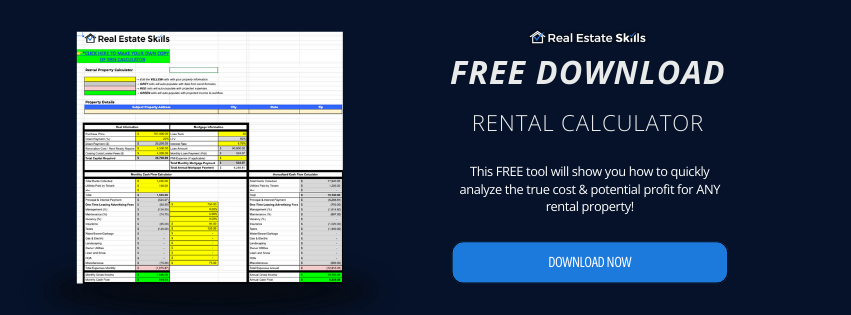
Everything above depends on one input no article can give you: what a specific property actually cash flows at today's rates. A house clearing $400 a month gets you to $1 million in about nine properties. One clearing $200 takes twelve. One clearing nothing never gets there at all. Download the same calculator we use to analyze our own deals — enter the purchase price, the rent, and your real expenses, and see the cash flow, cap rate, and cash-on-cash return before you make an offer.
When This Doesn't Work, And Who It's Wrong For
Real estate is the wrong vehicle if you need liquidity, can't hold reserves, or want something passive. Leverage magnifies losses exactly as much as gains, and the investors who get wiped out are almost always the ones who bought without cash flow and got forced to sell at the bottom.
Everything up to here made the case. This section is the other half, and I'd rather you hear it from me than find out on your own property.
You need cash you're not investing. Lenders want six to nine months of taxes and insurance in the bank before they'll fund you, and you want considerably more than that regardless of what they ask. A water heater goes. A tenant leaves and the unit sits for two months. An insurance claim drags. None of these are unlikely — over a decade of ownership, all of them happen.
The thing that ends leveraged investors isn't a market crash. It's being forced to sell a property you would otherwise have held, because you couldn't cover a $4,000 repair on a house you own $80,000 of. Cash flow and reserves are what let you wait out a bad market. Without them, the leverage that built the returns above works in reverse and does it faster.
Leverage is symmetric. Twenty percent down on a $155,000 house means a 20% price drop erases essentially all your equity while the loan sits exactly where it was. Ryan's Tate Drive deal ran the other way. It could have run this way, and in 2008 it did for a great many people who were not fools.
It is not passive. Property management runs around 8% of gross rent, which helps, but you still choose the property, arrange the financing, approve the repairs, and take the call when a manager isn't handling it. The index fund earlier in this guide required none of that. The real estate return is higher partly because you are working for it, and anyone selling you "passive income" from rentals is selling you the brochure.
And the part of the return you control least is the biggest part. Ryan buys properties that cash flow from day one — and says plainly that the majority of the returns he's made in real estate have come from appreciation, not cash flow. Sit with that. Cash flow is what keeps you solvent and lets you hold through a bad stretch. Appreciation is what actually built the number, and appreciation is the market's decision, not yours. Anyone telling you real estate returns are predictable is describing the smaller half.
It's illiquid. The $200,000 of equity in Ryan's property is real and it is not spendable. Turning it into cash means selling — with commissions, closing costs, taxes, and a timeline measured in months — or refinancing, which adds debt back. Money you might need inside five years does not belong in a rental property.
Who Should Skip This
Be honest with yourself about these:
- You're carrying high-interest debt. Paying off a credit card at 22% is a guaranteed 22% return. Nothing in this article beats that, and it isn't close. Clear it first.
- You have no emergency fund. See above. Buying a rental before you can absorb a personal emergency puts the property at risk of a forced sale for reasons that have nothing to do with real estate.
- Your timeline is under five years. Transaction costs alone can eat several years of appreciation. Real estate rewards holding, and short holds are where the math turns against you.
- You want to set it and forget it. That's the 401(k) route from the data section, and it's how most American millionaires actually got there. Choosing it isn't settling.
- You can't tolerate a stretch where nothing happens. Alex's own teaching is that it typically takes somewhere in the range of 10 to 15 offers to close a single wholesale deal. Ryan's version: submit ten offers in a month and expect nine rejections. That's the normal state of this business, not a bad month. The Real Estate Skills student mentioned earlier had two contracts collapse before his first one closed.
The Honest Summary
Real estate compresses the timeline to $1 million more reliably than anything else available to an ordinary earner, and it does that because of borrowed money and a tenant covering the payment. Both of those are also what make it dangerous.
If you have reserves, a long horizon, and the willingness to treat it as work, the math earlier in this guide is real. If any of those three is missing, the index fund will very likely make you wealthier — not because it returns more, but because you'll still be holding it in year twelve.
The people who fail at this rarely fail because they picked a bad property. They fail because they ran out of money before the property had time to do its job.
Educational information, not investment, tax, or legal advice. Real estate carries risk including vacancy, unexpected repairs, tenant issues, market decline, and total loss of invested capital. Consult licensed professionals before investing.
Mistakes That Kill Your Timeline
The mistakes that add years aren't dramatic. Buying a property that doesn't cash flow, underestimating repairs, spending the rent instead of reinvesting it, and having no exit plan. Each one is survivable alone. Together they're why some investors take twenty-five years to do what others do in twelve.
Buying a property that doesn't cash flow. The single most expensive mistake, and the most common one in a high-rate market. A property that loses $150 a month is a bill you pay for the privilege of hoping it appreciates — and it removes your ability to wait out a downturn. Run the numbers before you make an offer, not after. If it's negative at today's rate, it's negative.
Trusting the seller's numbers. Listings and seller-provided financials are marketing documents. Ryan's rule is to verify every figure independently — pull comps for the rent rather than accepting the projection, ask for actual utility bills and receipts, and treat every expense number as a claim until you've checked it. The gap between projected and actual expenses is where thin deals turn negative.
Underestimating repairs. Not the roof you knew about. The two months of vacancy while you fix it, the contractor who found something behind the wall, the appliance that failed the week the tenant moved in. Estimate conservatively and hold reserves — and if the deal only works with optimistic repair numbers, it isn't a deal.
Spending the cash flow. The math earlier assumes you reinvest the rent. Spend it instead and you keep the appreciation and the loan paydown but lose a third of the engine, which pushes you from around 12 properties toward 20. Nothing about this mistake feels like a mistake while you're making it. It just quietly adds years.
Having one exit. Markets shift, rates move, plans change. Before you buy, know what you'd do if you couldn't do the thing you're planning. Could you rent it if you can't sell? Sell if you can't rent? Refinance if neither works? A property with one viable exit is a bet on conditions holding. A property with three is an investment.
Overleveraging. Borrowing more than the property's income can carry is the fastest way to lose everything you've built. This is the mistake that separates investors who survived 2008 from investors who didn't, and the difference usually wasn't judgment about markets — it was whether the rent covered the payment when everything else went wrong.
None of these are exotic. That's the point. Nobody's timeline gets destroyed by an unforeseeable catastrophe; it gets stretched by four ordinary decisions made a little too optimistically.
Read Also: The Ultimate Guide To Real Estate Investing
How To Make 1 Million Dollars: FAQs
Final Thoughts On Making $1 Million
$1 million is arithmetic. Three inputs — what you put in, what it earns, how long you leave it — and once you can see the numbers, the question stops being mystical and starts being a plan you either follow or don't.
For most people the honest answer is 25 to 35 years of investing an ordinary income, and that's not a consolation prize. It's how the large majority of American millionaires actually got there, and it works.
Real estate shortens it. Not because it returns more per dollar, but because it's the one asset an ordinary person can borrow 80% to buy, where someone else covers the payment. Ryan's first deal put $35,000 into a $155,000 house in 2015 and that position is worth over $200,000 today. That's the case, and it's real.
The same mechanism is what makes it dangerous. Leverage magnifies both directions, the returns are illiquid, and the piece that drives most of the gain — appreciation — is the piece you control least. The people who fail at this usually didn't pick a bad property. They ran out of money before the property had time to work.
So pick the version that matches your life. If you want it hands-off, the index fund route is genuinely fine and the data backs it. If you're willing to treat this as work, hold reserves, and wait out the boring decade, the real estate math in this guide is available to you.
Either way, the variable that matters most isn't which one you choose. It's how soon you start, because every year you wait roughly costs you the cheapest year you had.
The Timeline Starts The Day You Start.
Every year you wait is the cheapest year you had — and reading about this is not the same as doing it. Our FREE Training shows you exactly how our students find their first property, run the numbers, and close the deal, including the ones who started around a full-time job with no real estate background and no money set aside. Watch it today, then go find your first deal.
Watch The FREE Training →
About The Author
Founder & CEO, Real Estate Skills
Alex Martinez is the Founder and CEO of Real Estate Skills. He has wholesaled and flipped houses for over 14 years, been part of 1,000+ real estate transactions, and personally acquired 33+ residential investment properties. Through Real Estate Skills, he and his team have trained 6,000+ investors nationwide on how to find deals, analyze the numbers, and build long-term wealth through real estate.
Real Estate Skills is not a law firm, and the information in this article is provided for educational purposes only — it does not constitute legal, tax, or financial advice. All investments involve risk, including the possible loss of principal, and past performance does not guarantee future results. The savings, return, and property figures in this article are illustrations based on stated assumptions and historical averages, not predictions or promises of any particular outcome. Individual results vary based on market conditions, financing, and personal circumstances. Always consult a licensed financial advisor, tax professional, and real estate attorney before making any investment decision. See our earnings and income disclaimers.

👉FREE Training
How To Consistently Wholesale, Flip Houses, & Invest In Rental Properties From The MLS
(Without Spending $1 On Marketing)

Alex Martinez, the founder of Real Estate Skills, is known for his strong, practical expertise in real estate, starting from a beginner with no family connections in the industry to completing over 50 real estate deals, including wholesale and flips, within his first year.
He has dedicated his career to providing cutting-edge education and resources for real estate professionals. He emphasizes the importance of self-taught knowledge through mentors, books, and hands-on experience.
His journey from earning a modest income to becoming a successful real estate entrepreneur and educator showcases his expertise and dedication to the field.

Ryan Zomorodi, co-founder and COO of Real Estate Skills, leverages his experience from a diverse background in real estate investment, construction management, and entrepreneurship to provide comprehensive education in the real estate sector.
His expertise is rooted in hands-on experience, extensive industry knowledge, and a commitment to empowering others through education.
Ryan's journey reflects a blend of practical experience and entrepreneurial success, contributing to his role in developing a platform that educates and supports aspiring real estate professionals.
Read Ryan's Full Bio >>
