
How To Wholesale Real Estate In Canada: Step-By-Step Tax, Lawyer & Province Guide (2026)
Sep 24, 2026

Written by
Alex Martinez, Founder & CEO, Real Estate Skills. Has wholesaled and flipped houses for over 14 years, been part of 1,000+ real estate transactions, and personally acquired 55+ residential investment properties. Has trained 6,000+ investors nationwide.
Reviewed by
Ryan Zomorodi, Co-Founder & COO, Real Estate Skills. Reviewed this guide for accuracy before publication.
Publication history: Originally published September 23, 2024. Updated September 2026 with Canadian tax rules (business income, the 365-day flipping rule and GST/HST on assignments), lawyer-based closings, land transfer tax on double closes, licensing rules and a comparison table for nine provinces, and current market data. Legal and tax facts checked against CRA, provincial legislation and regulator guidance as of September 2026, and reviewed by Ryan Zomorodi.
To wholesale real estate in Canada, you sign a below-market purchase contract, assign it to a cash buyer for a fee, and close through a lawyer instead of an escrow company. It's legal, but your fee is taxed as business income, and marketing a deal can require a real estate licence.
If you learned wholesaling from American YouTube, you've probably hit the wall most Canadian investors hit. The videos talk about title companies, county records and the IRS, and none of that exists here. The strategy itself works in Canada. The plumbing around it is different, and those differences cost real money when you don't see them coming.
Start with the money. Canada taxes a wholesaler's fee as business income, not as a capital gain. A double close triggers land transfer tax on both transfers, so the exit US wholesalers treat as a backup plan often wipes out the margin here. Then there's the legal side. Several provinces define trading in real estate broadly enough that marketing a contract can put you in licensing territory. This guide works through each of those differences, then gives you a province-by-province table so you know which rules apply where you're buying.
If you're brand new and want the fundamentals first, grab our free Ultimate Guide to Getting Started in Real Estate, then come back here for the Canadian layer.
What Is Wholesaling Real Estate (And How Does It Work In Canada)?
Wholesaling real estate means signing a contract to buy a property below market value, then selling your right to buy it to another investor for a fee. You never take ownership. The investor steps into your contract and closes with the seller, and you're paid through the closing.
Here's a simple example. You sign a purchase and sale agreement to buy a run-down house for $300,000. A renovation investor agrees to take over that contract for $310,000. At closing, the seller gets their $300,000 and you get the $10,000 difference, which is your assignment fee. You never own the house, never get a mortgage, and never renovate anything. What you're selling is the deal.
There are two ways to get paid:
- Assignment: You transfer your contract to the buyer, and there's one closing. This is the default in Canada.
- Double close: You buy the property yourself, then resell it to your buyer, often the same day. In most provinces this means paying land transfer tax twice (see the land transfer tax section).
US courses describe your position as holding an "equitable interest" in the property. In Canada it's simpler and more accurate to think of it as a contract right that you can assign if the contract allows it. How assignment works depends on your province's standard contract, and in Quebec on the Civil Code, which allows claims to be assigned. That's why step 6 goes through the contract wording province by province.
New to all of this? Start with our wholesaling for beginners guide. For the contract mechanics, read our guide to assignment of contract.
How To Wholesale Real Estate In Canada (8 Steps)
Wholesaling in Canada follows eight steps: check your province's rules, hire a lawyer and line up cash buyers, find distressed listings, call the listing agent, price the deal using recent local sales, write an assignable offer, assign the contract, then close through your lawyer and set aside tax.
The order matters more than people expect. American wholesaling courses, ours included, teach you to find buyers first and deals second, and that part carries over to Canada. What doesn't carry over is everything around the contract: who's allowed to market it, how fast the deposit is due, whether the seller can claim your profit, and who pays you at the end. Each step below keeps the method short and spends most of its words on what changes here. Where a general topic already has its own full guide, I link to it.
This is educational, not legal or tax advice. Rules differ by province and change over time. Confirm your deal structure with a real estate lawyer licensed in your province.
Step 1: Check Your Province's Rules Before You Market Anything
Before you advertise a deal, find out how your province defines trading in real estate. British Columbia's Real Estate Services Act lists assigning a purchase contract as a trade. Most other provinces count advertising a property as trading. Trading normally requires a licence.
This is the step US content skips, and it's the one that carries fines. The risk usually isn't signing a contract to buy a house. It's what comes after: posting the deal, emailing it to a list, lining up a buyer for a fee. Depending on where you are, that activity can count as trading, and the regulator decides whether it does, not you.
Book an hour with a real estate lawyer before your first offer and ask one direct question: "If I put a property under contract and market it to investors, am I trading without a licence here?" The licensing section below has the short version.
Step 2: Hire A Real Estate Lawyer And Find 3–5 Cash Buyers
You need two relationships before you make an offer. One is a real estate lawyer, who will close every deal. The other is three to five cash buyers: investors who buy with their own money and can close without waiting on a bank.
Buyers come first because a contract with no buyer behind it is just your deposit at risk. In Canada that risk comes sooner than in the US (see step 6), which makes the order matter even more. Good places to find buyers include local investor meetups, contractors who renovate for flippers, property managers, and the buyer names on land title records for recently renovated homes that sold. The full playbook is in our guide on how to find cash buyers.
There's a rule here with no US equivalent. Under Canada's Anti-Spam Legislation (CASL), you need a person's consent before you send them commercial emails or texts, and the deal emails you send buyers count. Maximum penalties are $1 million for individuals and $10 million for businesses. Get consent when you add someone to your list, and keep a record of it.
For the lawyer, look for someone who regularly handles investor purchases and assignments, not only first-home closings. The lawyer section below covers what to ask.
Step 3: Find Distressed Listings On Realtor.ca
Start with Realtor.ca, CREA's free public listing site, and look for homes that need work. Check new listings from the last 24 hours, homes that have sat for 60+ days, and price drops. Watch for listing descriptions with phrases like "as is," "handyman special" or "cash only."
This is the on-market approach I teach. The distressed deals are often already listed, and the agent's phone number is right there on the listing. Jesse, one of our students, found on-market deals easier than calling owners directly, because the agent keeps negotiations grounded in reality.
A few things work differently in Canada:
- MLS® access: MLS® is CREA's trademark, and the board systems behind it are for members. The unlicensed "assistant access" you hear about in US videos isn't the normal route here. Work from Realtor.ca and from brokerage portals that operate in Canada. Redfin, for example, operates as a brokerage in British Columbia and Ontario only. Our guide on how the MLS works covers the US system.
- Data tools: US tools don't come with you. PropStream and Privy both describe their data as US-only.
- Off-market leads: Canadian sources of motivated sellers include estates, owners behind on municipal property taxes, and properties with orders from municipal building or bylaw inspectors.
- Cold calling: If you call owners directly, you're telemarketing under CRTC rules. You have to register with the National Do Not Call List and not call numbers on it. Penalties go up to $1,500 per violation for individuals and $15,000 for corporations.
More sourcing ideas are in our guide on how to find distressed properties.
Step 4: Call The Listing Agent Before You Run Numbers
Call the listing agent before you spend time on analysis. A five-minute call tells you why the seller is selling, what condition the house is in, how many offers are already in, and roughly what price gets it signed. Don't make an offer on that first call.
Most beginners do this backwards. They spend three hours on spreadsheets, then call and find out the house sold yesterday. Calling first is the habit that separates people who get contracts from people who don't.
The US playbook adds one more ask at this point: get the listing agent to represent you too, so they earn both sides of the commission and favour your offer. In Canada, check the rules before you ask:
- British Columbia: Since June 15, 2018, a brokerage can't act for both buyer and seller, apart from a narrow exception for remote areas. See BC's ban on dual agency.
- Quebec: Since June 10, 2022, a broker can't represent both parties on residential property with fewer than five units. A buyer without their own broker gets fair treatment, not representation. See the OACIQ rules on representing both parties.
- Ontario: Under TRESA, one brokerage representing both sides needs written disclosure and every client's written consent before it happens. See RECO's multiple representation rules.
- Alberta: A brokerage working for both sides does so under a written transaction brokerage agreement, and can't advocate for either party. See RECA's transaction brokerage rules.
The workable Canadian version is to ask the listing agent to refer you to another agent who will write your offer. Whoever writes it should know from the first conversation that you plan to assign it.
Know Exactly What To Ask The Listing Agent
Step 4 lives or dies on that first call. Our free Discovery Call Script gives you the questions we use with listing agents to learn why the seller is selling, what shape the house is really in, what offers are already in and what price gets a deal signed. It was written for US MLS deals, so if your province restricts one agent representing both sides, use the questions as they are and skip the section that asks the listing agent to represent you.
Step 5: Price The Deal Using Recent Local Sales
Estimate the after-repair value (ARV), meaning what the house will sell for once it's renovated, from three to five recent sales of similar renovated homes nearby. Subtract the repair costs, your buyer's profit and your fee to get your offer price. Finding those sale prices takes more work in Canada than in the US.
The math is the same everywhere. Our guides to after-repair value (ARV) and how to find real estate comps, plus our ARV calculator and MAO formula guides, walk through it. What changes is where sold prices are kept:
- Realtor.ca: It now shows sold prices in some areas, including Nova Scotia and Greater Vancouver, but it depends on the local real estate board.
- BC Assessment: Its free search shows arm's-length sales from the last three full calendar years. See BC Assessment's sales history.
- Ontario: The professional sales database (GeoWarehouse) isn't open to the public, but anyone can buy a parcel register through OnLand.
- HouseSigma: It shows sold data in some markets.
- Agents, everywhere: The most reliable source is the listing agent you called in step 4 and the agents your buyers work with.
Two costs don't show up in US calculators:
- Repairs: Take repair costs from your buyers' actual contractor quotes, not a US per-square-foot rule of thumb.
- Transfer tax on your fee: Your fee can raise your buyer's costs. In BC, property transfer tax on an assigned contract is charged on the original price plus the assignment amount. A bigger fee means a bigger tax bill for your buyer, and they'll factor that into their offer.
Run Every Deal Through The Numbers Before You Offer
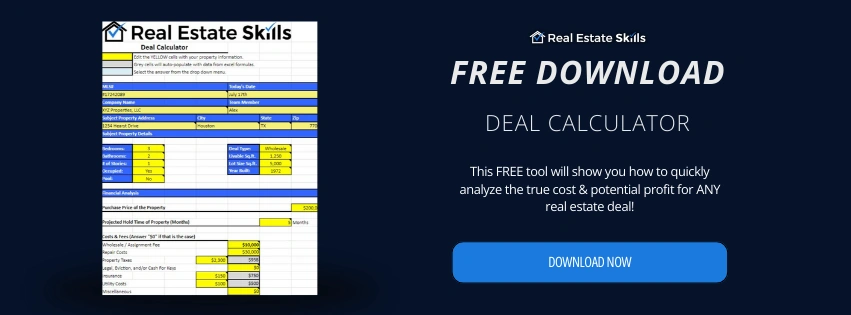
Our free Deal Calculator spreadsheet works backward from the after-repair value and the repair costs to your maximum offer, your buyer's profit and your fee. Before you trust the result on a Canadian deal, add the costs a US calculator won't assume: your lawyer's fees, the land transfer tax your buyer will pay on the price plus your fee, and the tax on your fee itself.
Step 6: Write An Assignable Offer
Your offer needs wording that allows you to assign it, and the default wording is different in each province. Ontario's standard form has no assignment clause. BC's standard terms require the seller's consent and give the seller any assignment profit. Alberta's contract doesn't mention assignment at all.
Ontario: The OREA Agreement of Purchase and Sale (Form 100) only mentions "successors and assigns." Your lawyer adds assignment wording in a schedule. OREA Form 145 is the standard form for assigning the agreement afterward.
British Columbia: Since May 16, 2016, standard contracts say the contract can't be assigned without the seller's written consent, and that the seller is entitled to any profit from an assignment. Removing either term takes a separate Notice to Seller Regarding Assignment Terms. If you sign the standard wording as it is, you've agreed to hand your fee to the seller. See BCFSA's assignment requirements.
Alberta: The January 2026 AREA residential purchase contract has no assignment clause. AREA's own guidance says seller consent generally isn't required, though disclosure is expected. Write it in anyway so the seller isn't surprised later.
Quebec: Assignment is governed by the Civil Code, and in practice the sale is signed before a notary. Bring in a Quebec notary or lawyer before you sign anything. More detail is in wholesaling in Quebec.
The deposit: The US tactic is to sign, use the 72 hours before the deposit is due, and assign the contract before paying anything. Ontario's standard form requires the deposit within 24 hours of acceptance, paid into the deposit holder's trust account. Plan to fund the deposit yourself, or have a buyer committed before the seller signs.
Conditions: Use conditions, such as a home inspection, with deadlines long enough to line up your buyer. Once conditions are waived or expire, your deposit can be at risk if you can't close.
📓 From The Field
Jesse, a Real Estate Skills student who lives in Canada, closed his first wholesale deal in 2025, on a house near Dallas. He agreed to a three-day option period, which is Texas's window to back out. Afterward, buyers told him they would have paid up to $165,000 with a week to inspect. That's about $7,500 more than the price he had to accept, and his fee ended up at $2,500 USD. It was a US deal, but the lesson carries straight over: the deadlines in your offer set your price as much as the number does. One student's first deal; results vary.
Expect to write a lot of offers. Across our students, it has typically taken 10 to 15 written offers to land one deal. Your ratio will vary.
This is educational, not legal advice. Have a lawyer licensed in your province review any offer before you sign it.
Step 7: Assign The Contract (Double Close Only If The Numbers Survive)
Once the seller signs, send the deal to your cash buyers, agree on a price, and sign an assignment agreement that transfers your contract to the buyer for your fee. A double close means you buy the house and resell it the same day. In Canada it usually costs more, because land transfer tax is paid on both purchases.
The paperwork is covered in our guide to assignment of contract. Canada adds two cautions:
- CASL: Your deal email is a commercial electronic message, so send it only to buyers who have given consent (step 2).
- Licensing: Sending a property out to a list is exactly the activity several provinces treat as trading, which is why step 1 comes first.
Double closing: If a seller won't allow an assignment, a double close is the fallback. You can read how a double closing works in our general guide. Run the numbers before you choose it, though. On a $600,000 Toronto home, Ontario and Toronto land transfer taxes add up to $16,950 per purchase. A double close registers two purchases, so you pay that on the first one and your buyer pays it again on the second. With an assignment, only one transfer is registered. The full breakdown is in the land transfer tax section below.
Step 8: Close Through Your Lawyer And Set Aside Tax
In Canada, a real estate lawyer handles the closing (a notary handles it in Quebec). They hold the money in a trust account and register the transfer. Your assignment fee is paid through the process your assignment agreement sets out. Set aside tax right away, because CRA taxes a wholesaler's fee as business income.
There's no escrow company and no US-style title agent in this process. The lawyers on each side coordinate the funds and documents, and your assignment agreement says when and how you get paid.
Two tax points to know before you spend the fee:
- Business income: If you're in the business of wholesaling, CRA treats the profit as business income and taxes all of it. If you held the contract for less than 365 days, the federal residential property flipping rule leads to the same result even for someone who assigns only occasionally.
- GST/HST: If the contract was for a newly built or substantially renovated home, GST/HST generally applies to the assignment.
The tax section below works through both, with an example.
This is educational, not tax advice. Confirm your situation with an accountant who works with real estate investors.
You Know What Changes In Canada. Now Learn The Method Underneath.
The eight steps above cover the Canadian layer: lawyers, deposits, assignment wording and tax. The deal-finding process underneath is the one we teach every student: spot distressed listings, call the agent first, price off real sales and line up cash buyers before you sign. Our FREE Training walks you through that process from start to finish. Watch it, then run every deal through the Canadian checklist on this page.
Watch The FREE Training →How Canadian Tax Changes Your Wholesaling Profit
In Canada, a wholesaler's assignment fee is generally taxed as business income. That means all of it is taxable, not half as with a capital gain. And if the contract is for a newly built or substantially renovated home, GST/HST generally applies to the assignment as well.
Every wholesaling earnings figure you've seen is a gross number, including the ones on our own site. In Canada the gap between gross and what you keep is wider than most US-trained wholesalers expect. Two federal rules explain most of that gap. Neither has a US equivalent, and both explicitly cover assignment sales.
This is educational, not tax advice. Tax rules change, and your situation depends on your income, province and deal structure. Confirm with an accountant who works with real estate investors.
Is An Assignment Fee Business Income Or A Capital Gain?
For nearly every wholesaler, it's business income. CRA looks at why you bought, how long you held the property or contract, and whether you've done similar deals before. Someone who assigns contracts over and over for profit is running a business, and business income is fully taxable.
Here's why that matters. With a capital gain, only half the gain is taxable, because the inclusion rate is generally one-half. With business income, all of it is. On a $10,000 fee, that's the difference between adding $5,000 or $10,000 to your taxable income. The factors CRA weighs are set out in CRA's guidance on buying real estate to sell for profit.
Because you're self-employed, you also pay both the employee and employer portions of CPP contributions on that income. Running it as a business has one upside: reasonable expenses you incur to earn the fee, like marketing and legal costs, are generally deductible.
The 365-Day Flipping Rule Covers Assignment Sales
Since January 1, 2023, profit from selling a home, or a right to buy one, that you held for less than 365 consecutive days is treated as business income. CRA says this includes the right to buy a property through an assignment sale. The principal residence exemption can't be used, and losses are deemed to be zero.
If you already wholesale as a business, you were paying tax on business income anyway, so the residential property flipping rule mostly shuts a door for occasional assignors. Picture someone who buys one presale condo, assigns the contract eight months later and planned to report a capital gain. That profit is now fully taxable. If the flip loses money, the loss can't be deducted.
There are exemptions for certain life events: death, a new household member, a relationship breakdown, a move for work or school, involuntary job loss, serious illness or disability, and a few others. Buying a contract in order to flip it isn't one of them.
Do You Charge GST/HST On An Assignment Sale?
Only on new housing. Since May 7, 2022, assigning a contract for a newly built or substantially renovated home is taxable for GST/HST, even when the person assigning it is an individual. Contracts on resale homes generally fall under the exemption for used housing, and that covers most wholesale deals.
CRA's GST/HST rules for assignment sales are aimed at presale condos and new builds, the part of the Canadian market where assignments are most common. If you work in that space, four details matter:
- The rate depends on the province: It's 5% GST in Alberta, British Columbia, Manitoba and Saskatchewan. HST is 13% in Ontario, 14% in Nova Scotia (cut from 15% on April 1, 2025), and 15% in New Brunswick, Newfoundland and Labrador and Prince Edward Island. Quebec adds its own provincial sales tax, so get Quebec-specific advice. See the current GST/HST rates by province.
- The deposit repayment is excluded only if it's written down: Part of what your buyer pays you simply repays the deposit you put down. That part isn't taxed, but only if the assignment agreement states in writing how much of the price it is. Leave it out, and tax can apply to the whole amount.
- Being a small business doesn't help: The $30,000 small-supplier threshold doesn't cover sales of real property, so being small generally won't get you out of this tax.
- Who collects the tax depends on your situation: If you're not a resident of Canada, your buyer pays the tax directly to CRA.
For resale homes, CRA's general position is that sales of used housing are exempt. Its published assignment guidance focuses on new housing, though, so confirm how a resale assignment is treated with your accountant before you rely on it.
British Columbia Adds A Home Flipping Tax On Assignments
BC's home flipping tax took effect January 1, 2025. It taxes profit on BC residential property held less than 730 days, and that includes rights to acquire a property, such as assignments. The rate is 20% if you sell within 365 days, then phases down to zero at 730 days.
For an assignment, the sale date is generally the day you receive money from the person taking over your contract. The tax is separate from your income tax, and its return is due within 90 days. Exemptions exist, so check BC's guidance on the BC home flipping tax and how it applies to assignments, or ask your accountant before you assign a BC contract. The BC notes in the province table below cover the province's other rules.
Worked Example: A $10,000 Assignment Fee, Gross Vs. After Tax
💡 Deal A: Ontario Resale House, Assigned For A $10,000 Fee
- GST/HST: generally none. It's a resale home.
- Income tax: all $10,000 is business income. At an illustrative combined marginal rate of 30%, that's $3,000.
- CPP: you owe both portions on self-employment earnings, on top of the income tax.
- For comparison: if it counted as a capital gain, only $5,000 would be taxable, which is about $1,500 at the same rate.
- What you keep before CPP and expenses: about $7,000, not $10,000.
💡 Deal B: Ontario Presale Condo, $50,000 Deposit Paid, Buyer Pays You $60,000
- Your profit is $10,000. The other $50,000 repays your deposit.
- If the agreement states that $50,000 is the deposit repayment: HST at 13% applies to the $10,000, which is $1,300.
- If the agreement doesn't separate the deposit: HST can apply to the full $60,000, which is $7,800.
- Income tax on the $10,000 profit then works as in Deal A.
- How the agreement is written decides whether the buyer pays HST on top or it comes out of your price. That's one more reason to have a lawyer draft it.
The rates here are for illustration only. Your marginal rate depends on your income and province, and results vary.
What To Ask Your Accountant Before Your First Deal
Book the accountant before your first contract, not after your first cheque. Bring the property type (resale or new), the province, and how long you'll hold the contract. Those three facts decide which rules apply.
Questions to take with you:
- Will my assignment fees be treated as business income, and should I register a business or incorporate?
- Does GST/HST apply to this particular contract, and do I need to register?
- If the property is in BC, does the home flipping tax apply, and do any exemptions fit my situation?
- What can I deduct, and how much of each fee should I set aside?
Look for an accountant who regularly files for real estate investors, not only for people with regular jobs.
Why You Need A Real Estate Lawyer, Not A Title Company
In Canada, real estate deals close through lawyers, or through a notary in Quebec, not through an escrow or title company. The lawyer checks title, holds money in a trust account, registers the transfer and pays out the funds, including your assignment fee. Hire yours before you make an offer.
If you learned wholesaling from US content, this is the biggest operational change. In the US you'd send the contract to a wholesale-friendly title company and let them run the closing. In Canada each side usually has its own lawyer, the money moves between their trust accounts, and the lawyers handle registration of the transfer. For a standard resale deal, the time from signed agreement to closing is usually 30 to 90 days.
This is educational, not legal advice. Closing practice differs by province. Your lawyer's advice on your specific deal comes first.
What Your Lawyer Actually Does On A Wholesale Deal
Your lawyer reviews the purchase contract and the assignment agreement, confirms who is buying and what they're paying, and makes sure your fee is written into the paperwork that closes the deal. Registering the transfer is also a lawyer's job. In Ontario, only a lawyer can sign the legal statements in electronic registration.
On an assignment, three lawyers are often involved: yours, the seller's and your end buyer's. Your lawyer's job is to protect your side of the deal. That means making sure the assignment agreement is enforceable, that it states when and how you get paid, and, on new housing, that it separates the deposit repayment from your fee for GST/HST purposes (see the tax section above). The Law Society of Ontario's real estate practice guidelines set out which tasks only a lawyer can do in Ontario.
Deposits: In Ontario, the deposit goes to the deposit holder named in the agreement, often the listing brokerage, and sits in a trust account. RECO explains how a deposit held in trust is handled. The funds from the closing itself move through the lawyers' trust accounts.
Quebec And British Columbia Do It A Little Differently
In Quebec, a notary handles real estate closings in practice, and the Civil Code requires a notarial deed for a mortgage on real property. In British Columbia, notaries public can also handle purchase and sale transfers, so you may deal with a notary instead of a lawyer there.
For a wholesaler, the Quebec point matters most. Quebec runs on civil law rather than common law, so assignment works under the Civil Code, not the equitable-interest idea US courses teach. A Quebec notary or lawyer should look at your contract before you sign it. See wholesaling in Quebec for the province-specific process. In BC, a notary is a fine choice for straightforward transfers (see what notaries public in BC handle). For assignment wording and the seller-consent terms covered in step 6, pick someone who handles assignments regularly.
How A Double Close Works Through Trust Accounts
A double close is two separate purchases: seller to you, then you to your end buyer. Each one is its own transaction with its own registration, and in most provinces its own land transfer tax. The money for your purchase has to be in your lawyer's trust account before your purchase can close.
This is where US habits cause the most trouble. In the US, a title company can sometimes use the end buyer's funds to cover the first purchase on the same day. Don't assume a Canadian lawyer will set up a same-day double close that way. Ask directly how they'd structure it, and whether you'd need your own cash or short-term funding for the first purchase. Then run the land transfer tax numbers in the next section before you commit. In most provinces, an assignment avoids both problems.
How To Find An Investor-Friendly Lawyer, And What To Ask
The easiest way to find one is to ask your cash buyers which lawyer closes their investment purchases. Then have a short screening call. You want someone who handles assignments regularly, can explain your province's licensing risk in plain language, and will give you a written fee quote before you start.
Questions for that first call:
- How many assignment closings have you handled in the past year?
- What assignment wording do you add to the standard purchase agreement in this province, and does the seller need to consent?
- Based on how I plan to find buyers, could my marketing count as trading without a licence here?
- How would you structure a double close, and would the end buyer's funds be available for my purchase?
- What do you charge for an assignment compared with a double close, and what costs are extra?
- Do you recommend title insurance on these deals?
The Financial Consumer Agency of Canada recommends considering title insurance as protection against title fraud. It's worth asking whether it makes sense on your deals. Lawyer fees vary by province and by how complicated the deal is, so get the quote in writing before you sign your first contract.
Land Transfer Tax: Why Double Closing Rarely Works In Canada
In most provinces, land transfer tax is charged every time a property changes hands. A double close has two transfers, so the tax gets paid twice. On a $600,000 home in Toronto, the second transfer adds $16,950 in provincial and municipal tax. That's more than a typical assignment fee.
Here's a US habit that costs Canadian wholesalers real money. In most US states, a double close costs you some closing fees and a day of short-term funding, so it's a routine backup when a seller won't allow an assignment. In Canada, the purchase in the middle, where you briefly own the property, is a real purchase for tax purposes, and most provinces tax it. An assignment has only one transfer, from the seller to your end buyer, so the tax is paid once.
This is educational, not tax or legal advice. The figures below are calculated from published rates as of September 2026 for illustration. Rates, rebates and exemptions change, so confirm current amounts with your lawyer before you choose how to close.
Worked Example: Assignment Vs. Double Close On A $600,000 Toronto House
💡 Same House, Same $10,000 Fee, Two Ways To Close
- Tax on one transfer at $600,000: Ontario land transfer tax is $8,475, and Toronto's municipal land transfer tax charges the same brackets at this price, another $8,475. That's $16,950 in total.
- Assignment: one transfer is registered, and your end buyer pays the land transfer tax once. Ontario's Ministry of Finance counts assignment payments in the amount the tax is calculated on, so on $610,000 (price plus your fee) the total is $17,350, split between Ontario and Toronto.
- Double close: two transfers are registered. You pay $16,950 buying at $600,000, and your buyer pays $17,350 buying from you at $610,000. The total is $34,300.
- The difference: the double close adds $16,950 in tax to a deal that only created $10,000 of margin. Somebody has to absorb that, and it will be you or the deal.
How the Ontario figure is calculated: 0.5% on the first $55,000, 1% up to $250,000, 1.5% up to $400,000, and 2% up to $2 million. At $600,000 that works out to $275 + $1,950 + $2,250 + $4,000 = $8,475. The Toronto municipal land transfer tax uses the same brackets at this price.
The Toronto case is the extreme one because there are two taxes, provincial and municipal, on every transfer. The same logic holds anywhere a transfer tax exists. Only the size of the hit changes.
What A Double Close Adds By Province
The extra cost of a double close is roughly one full transfer tax on your purchase price. On a $600,000 home, that ranges from under $1,000 in Alberta, where you pay registration fees rather than a tax, to $16,950 in Toronto. In most provinces the double close costs about as much as a typical assignment fee, or more.
| Province | What it's called | Extra cost of a double close on a $600,000 home |
|---|---|---|
| Ontario (Toronto) | Ontario land transfer tax + Toronto municipal land transfer tax | $16,950 |
| Ontario (outside Toronto) | Ontario land transfer tax | $8,475 |
| British Columbia | BC property transfer tax | $10,000 |
| Manitoba | Manitoba land transfer tax | $9,650 (confirm current rates) |
| Nova Scotia (Halifax) | Municipal deed transfer tax, 1.0–1.5% by municipality (Nova Scotia deed transfer tax rates) | $9,000 at Halifax's 1.5% |
| Quebec (outside Montréal) | Quebec transfer duties ("welcome tax") | $7,110.50 |
| New Brunswick | New Brunswick real property transfer tax | $6,000 (1% of the greater of price or assessed value) |
| Newfoundland and Labrador | Newfoundland and Labrador registry fees (no transfer tax) | About $2,498 (based on a 2007 fee schedule; confirm) |
| Alberta | Alberta Land Titles fees (no transfer tax) | $650 for the transfer, per the fee schedule effective October 1, 2026 |
| Saskatchewan | Land Titles transfer fee (no transfer tax) | Fee changed April 2026; confirm with your lawyer |
These figures cover the transfer tax or fee only. A double close also means a second set of legal fees, possibly short-term funding for the first purchase, and in BC, your own purchase counts toward the home flipping tax. Montréal adds higher brackets above $552,300, so its figure at this price is a little higher than the rest of Quebec.
When A Double Close Can Still Make Sense
A double close is realistic mainly in Alberta, and in the few other places where transfer costs are small, or when the spread on a deal is big enough to absorb a second transfer tax. Everywhere else, treat it as a last resort. Your first move with a seller who won't allow an assignment is to renegotiate the assignment terms, not to double close.
There's an honest case for double closing. It keeps your purchase price private from your end buyer. It also gets around sellers who refuse to allow assignments, and around BC's standard contract terms if the seller won't sign the notice that removes them. In Alberta, where you pay a registration fee instead of a tax, those benefits can be worth the extra legal fees. In Toronto they rarely are.
Before you choose one, run both versions of the deal: every tax, both sets of legal fees, and the cost of funding the first purchase. Our general guide covers how a double closing works. Keep in mind it describes the US version, where the tax math is very different.
Licensing: What To Check Before You Market A Deal
Licensing is provincial. Most provinces count advertising a property as trading in real estate, which needs a licence, and BC's law names contract assignments outright. Assigning your own contract is generally legal, and marketing it is where the risk starts. Confirm your plans with a lawyer in your province before you market a deal.
The short version: your contract is rarely the problem. Public ads for a property you don't own, getting paid to connect a buyer and a seller, and doing deals often enough that the owner exemptions stop covering you are where Canadian wholesalers run into licensing rules. Our legal guide covers each province's act, regulator, exemption wording and penalties: is wholesaling legal in Canada?
This is educational, not legal advice. Before you market any deal, ask a lawyer in your province whether your specific activity needs a licence.
Transfer Tax And Guides By Province: Canada Comparison Table
Transfer costs and local practice change at the provincial border. Use the table below to see what a property transfer costs where you're buying, then open that province's guide for the full process. Licensing rules are covered in the licensing section above.
This page covers the national layer: federal tax, how closings work and how the provinces compare. Each province's guide covers the process on the ground there, with local contracts, local markets and local rules. If you're only going to read one thing after this page, make it the guide for the province you're buying in.
| Province | Transfer tax | Full guide |
|---|---|---|
| Ontario | Ontario land transfer tax, plus Toronto's municipal land transfer tax inside Toronto | wholesaling in Ontario |
| British Columbia | Property transfer tax | wholesaling in British Columbia |
| Alberta | None (Land Titles registration fees) | wholesaling in Alberta |
| Quebec | Transfer duties ("welcome tax"), with higher brackets in Montréal | wholesaling in Quebec |
| Saskatchewan | None (Land Titles transfer fee) | wholesaling in Saskatchewan |
| Manitoba | Land transfer tax, from 0% on the first $30,000 up to 2% above $200,000 | wholesaling in Manitoba |
| Nova Scotia | Municipal deed transfer tax, 1.0–1.5% (plus a 10% provincial tax for non-residents since April 1, 2025) | wholesaling in Nova Scotia |
| New Brunswick | Real property transfer tax, 1% of the greater of price or assessed value | wholesaling in New Brunswick |
| Newfoundland and Labrador | None (Registry of Deeds fees) | wholesaling in Newfoundland and Labrador |
Summarized from provincial legislation, regulator guidance and tax authorities as of September 2026. Prince Edward Island and the territories aren't covered here. Rules change, so confirm current details with a lawyer in the province before you act.
How Wholesaling In Canada Differs From The US
The strategy is the same: contract the property, assign the contract, collect a fee. What changes is everything around it. In Canada, lawyers close deals instead of title companies, licensing is provincial, most provinces charge land transfer tax, and assignments of new homes can carry GST/HST.
| United States | Canada | |
|---|---|---|
| Who closes the deal | Title or escrow company | Real estate lawyer (a notary in Quebec) through trust accounts |
| Who regulates real estate trading | State licensing laws | Provincial regulators (RECO, BCFSA, RECA, OACIQ and others) |
| Where deals are listed | Local MLS, plus portals like Zillow and Redfin | Realtor.ca; board MLS systems are for members, and Redfin operates in BC and Ontario only |
| Property data tools | PropStream, Privy and similar | Those tools describe US-only data, so Canadians rely on sold data by province and on agents |
| Sales tax on the assignment | No federal sales tax | GST/HST on assignments of new or substantially renovated homes |
| Short holding periods | Tax treatment depends on the facts | The federal 365-day flipping rule explicitly covers assignment sales, and BC adds its own flipping tax |
| Transfer tax on a double close | Varies by state | Paid on each transfer in most provinces, up to $16,950 per transfer on a $600,000 Toronto home |
| Deposits | Earnest money timing set by the contract | Within 24 hours of acceptance on Ontario's standard form |
| One agent for both sides | Allowed in many states | Banned in BC and in Quebec residential deals, and needs written consent in Ontario |
| Cold calls and marketing emails | Federal Do Not Call rules | National Do Not Call List, plus CASL consent for commercial emails and texts |
| Property records | County recorder | Provincial land title or registry system |
If you're a US citizen reading this: Canada's Prohibition on the Purchase of Residential Property by Non-Canadians Act generally bars non-Canadians from buying residential property until January 1, 2027. There are exemptions, including for certain temporary residents, and vacant land has been exempt since March 2023. The government has signalled it may replace the ban on non-Canadians buying residential property with a different framework, so check its status before you sign anything. If you aren't a Canadian citizen or permanent resident, ask a Canadian lawyer whether you can sign a purchase contract here at all. Also keep in mind that some of your potential end buyers may be covered by the ban too.
Can You Wholesale US Real Estate From Canada?
Yes. Canadians can wholesale US properties remotely, usually by working with listing agents, local buyers and a US title company. You'll still owe Canadian tax, because residents of Canada are generally taxed on their worldwide income. Foreign tax credits exist so the same income isn't taxed twice.
For some readers this is the more practical route. US title companies close assignments routinely (see our list of wholesale-friendly title companies). Most states don't charge a second transfer tax that wipes out a double close. And the US data tools that don't work in Canada work there. The trade-off is that you're doing business in a market you can't drive to, under another country's rules. Wholesaling laws vary by state, so read the state guide for your target market before you market any deal. Our guide to virtual wholesaling covers the remote process step by step.
The friction is practical more than legal:
- A US phone number: Sellers and agents answer a local-looking number more readily than a Canadian one.
- A bank account that can receive US funds: Your fee will be wired in USD.
- A buyer who can sign in person: Some sellers or closings won't accept remote signing.
- Someone to see the house for you: An agent or contractor you can send to the property.
- Holiday overlaps: Canada Day and the Fourth of July fall three days apart, and deals stall that week.
📓 From The Field
Jesse, a Real Estate Skills student who lives in Canada, joined our program at the end of January 2025 and had his first contract signed in early February. The deal that closed was a three-bedroom, two-bath brick house near Dallas.
- The contract: The seller, a licensed broker selling his own property, had it listed at $190,000. Jesse negotiated directly with him and got it under contract at $155,000.
- The repairs: Jesse sent a local contractor with the lockbox code and got an itemized quote of $45,000–$55,000 the same day.
- The buyer: He found an active local investor by looking up who had recently bought nearby.
- The fee: He assigned the contract for a $2,500 USD fee, paid through a US closing agent.
He's the first to say he left money on the table. A short option period forced his price down (step 6). He also still had to work through Canadian tax on the fee. One student's first deal. Results vary, and this isn't typical earnings.
How He Closed His First VIRTUAL Wholesale Deal (From Canada To Texas)!
A Canadian student walks through his first US wholesale deal, from the first seller call to the closing statement, including the mistake that cut his fee.

This is educational, not tax or legal advice. Cross-border income can create filing obligations in both countries. Talk to a cross-border accountant before your first US deal.
Is Wholesaling Profitable In Canada? What Wholesalers Actually Make
Wholesaling can be profitable in Canada, but no official data tracks what wholesalers earn, and every per-deal figure you'll see is gross. After income tax on business income, CPP, legal fees and marketing, a $10,000 fee can leave you with roughly $7,000 or less. Results vary widely.
Fees vary from deal to deal. One of Alex's own US deals paid a $5,300 fee. Jesse's first deal, covered above, paid $2,500 USD. Online you'll see numbers anywhere from a few thousand dollars to six figures. None of them tells you what someone kept.
What you keep in Canada comes down to this:
What you keep: fee − legal fees − marketing − any lost deposits − income tax and CPP (− GST/HST on new-home assignments)
Each item in that formula is covered earlier on this page. Tax is the biggest one, and the worked example in the tax section shows a $10,000 fee dropping to about $7,000 before CPP and expenses. Transfer tax matters too, even though your buyer pays it. It comes out of the room your buyer has to pay you, so in high-tax cities like Toronto, deals need a wider spread to work.
Any figures here are examples, not a prediction of your income. Results vary with your market, your time and your deal flow, and many people who try wholesaling never close a deal.
What The Canadian Market Looks Like Right Now (September 2026)
In August 2026, national home sales slipped 0.7% from July while new listings rose 3.3%. The MLS® Home Price Index was flat for the month and down 3% from a year earlier. The Bank of Canada held its policy rate at 2.25% on September 2, 2026.
What that means for a wholesaler is a judgment call, and here's mine. More new listings against flat sales gives buyers, including you, more room to negotiate, and sellers of homes that need work feel that first. The same conditions make your cash buyers pickier about their exit price, because prices aren't rising. Deals still work in this market, but only when you buy right, so price every deal off recent sales, not asking prices.
Here are the national figures from CREA's August 2026 national release. The Bank of Canada held its policy rate at 2.25% on September 2.
| Measure (August 2026) | Figure |
|---|---|
| National home sales, month over month | −0.7% |
| New listings, month over month | +3.3% |
| Sales-to-new-listings ratio | 49.1% (51.1% in July) |
| Months of inventory | 4.8 |
| MLS® Home Price Index, year over year | −3% |
| National average sale price | $668,219 (+0.6% year over year) |
Market data verified September 2026 from CREA's national release and the Bank of Canada. National numbers hide big local differences, so check your local board's data too.
Who Wholesaling In Canada Is Wrong For
It's a poor fit if you need steady income soon, can't afford to lose a deposit, or aren't willing to learn your province's licensing rules before marketing a deal. The Canadian version takes more setup than the US version: a lawyer, CASL-compliant buyer lists, and tax planning from the first deal.
Being honest about this helps the people it does fit. Wholesaling rewards people who can make a lot of calls and write a lot of offers, often 10 to 15 per deal, while still working their day job. It punishes people who treat one contract as a sure thing. If deposit risk or licensing risk would keep you up at night, a slower route may suit you better. That could be getting licensed, partnering with a licensee, learning alongside a wholesale mentor, or buying one property yourself. Our guides to flipping houses in Canada and finding a rental property in Canada cover those paths.
Pros And Cons Of Wholesaling In Canada
The main advantages are that you can earn a fee without buying or financing a property, and every deal trains you to price renovation properties. The main drawbacks are specific to Canada: unclear licensing rules in most provinces, full taxation as business income, deposits due quickly, and double closes that transfer tax makes expensive.
Pros:
- No mortgage and no ownership: You earn a fee without qualifying for a loan or holding the property.
- Less upfront cash than buying: You need a deposit, legal fees and marketing money, not a down payment and renovation budget.
- A lawyer on every deal: Canada's lawyer-run closings mean a professional reviews your contract, your assignment and your payout on every deal.
- Skills that carry forward: Pricing a deal off recent sales and repair quotes is the same skill you need to flip or buy rentals later.
- Cheaper double closes in Alberta: With registration fees instead of a transfer tax, double closing stays a realistic option there when a seller won't allow an assignment.
Cons:
- Unclear licensing: Most provinces define trading broadly enough to include marketing a deal, BC's law names assignments outright, and no regulator has published guidance on wholesaling.
- Fully taxable fees: Your fee is business income, the 365-day flipping rule covers assignments, and new-home assignments can carry GST/HST.
- Deposits come due fast: Ontario's standard form requires the deposit within 24 hours, and once your conditions are waived or expire, the deposit can be at risk.
- Expensive double closes: Land transfer tax on both transfers can wipe out a typical fee in most provinces.
- Harder data: US property tools don't cover Canada, and sold prices are harder to get depending on the province.
- Marketing rules from day one: The National Do Not Call List applies to cold calls, and CASL requires consent before you email or text buyers.
How To Wholesale Real Estate In Canada: FAQs
Final Thoughts On Wholesaling In Canada
Wholesaling works in Canada, but it isn't the US version with a different flag. Your lawyer closes the deal, your province decides what counts as trading, your fee is business income, and land transfer tax makes assignment the default exit. Build your process around those four facts and the rest of the method carries over.
Most people who struggle with wholesaling in Canada aren't doing anything wrong on the phone. They're running a process built for another country, and they find out at the lawyer's office or at tax time. Everything on this page exists so you find out beforehand.
Your next step this week:
- Pick your province and read its guide from the table above.
- Book a one-hour consult with a real estate lawyer there, and ask the question from step 1: "If I put a property under contract and market it to investors, am I trading without a licence here?"
- Line up three cash buyers, and get their written consent to receive deal emails.
- Set up a daily check of new Realtor.ca listings in one neighbourhood you know.
Once those four are done, you're ready to make your first discovery call.
Ready To Make Your First Offer? Start With The FREE Training.
You now know the Canadian rules: who closes the deal, how your fee is taxed, and where the licensing lines sit. What's left is the skill of finding and locking up deals. That's what our FREE Training covers, step by step, using the process we've taught to more than 6,000 investors. Watch it today, book your lawyer consult this week, and make your first discovery call with both in hand.
Watch The FREE Training →
About The Author
Founder & CEO, Real Estate Skills
Alex Martinez is the Founder and CEO of Real Estate Skills. He has wholesaled and flipped houses for over 14 years, been part of 1,000+ real estate transactions, and personally acquired 55+ residential investment properties. He has trained 6,000+ investors nationwide.
Real Estate Skills is not a law firm, and the information in this article is provided for educational purposes only. It does not constitute legal, tax, or financial advice. Real estate licensing, tax and contract rules vary by province and change over time. Real estate investing carries risk, earnings examples are not typical, and past results do not guarantee future outcomes. Always consult a real estate lawyer licensed in your province and your own tax and financial advisors before entering into any contract or transaction.

👉FREE Training
How To Consistently Wholesale, Flip Houses, & Invest In Rental Properties From The MLS
(Without Spending $1 On Marketing)

Alex Martinez, the founder of Real Estate Skills, is known for his strong, practical expertise in real estate, starting from a beginner with no family connections in the industry to acquiring over 55 real estate deals, including wholesale and flips, within his first year.
He has dedicated his career to providing cutting-edge education and resources for real estate professionals. He emphasizes the importance of self-taught knowledge through mentors, books, and hands-on experience.
His journey from earning a modest income to becoming a successful real estate entrepreneur and educator showcases his expertise and dedication to the field.

Ryan Zomorodi, co-founder and COO of Real Estate Skills, leverages his experience from a diverse background in real estate investment, construction management, and entrepreneurship to provide comprehensive education in the real estate sector.
His expertise is rooted in hands-on experience, extensive industry knowledge, and a commitment to empowering others through education.
Ryan's journey reflects a blend of practical experience and entrepreneurial success, contributing to his role in developing a platform that educates and supports aspiring real estate professionals.
Read Ryan's Full Bio >>
