
How To Wholesale Real Estate In Connecticut: Attorney Closings, Town Records, And The 90-Day Deal Clock
Sep 15, 2026

Written by
Alex Martinez — Founder & CEO, Real Estate Skills. Has wholesaled and flipped houses for over 14 years, been part of 1,000+ real estate transactions, and personally acquired 33+ residential investment properties. Has trained 6,000+ investors nationwide.
Reviewed by
Ryan Zomorodi — Co-Founder & COO, Real Estate Skills. Reviewed this guide's Connecticut deal process and compliance steps against Department of Consumer Protection and Connecticut General Assembly sources.
Publication history: Originally published January 10, 2023. Updated September 15, 2026 for Connecticut's July 2026 wholesaler rules: DCP registration, the Wholesale Disclosure Report, the three-day cancellation window, and the 90-day limit. Also added guidance on attorney closings, town-level property records, double close conveyance tax, and foundation and lead paint risks. Statute and licensing detail now lives in our Connecticut legal guide. Connecticut process and compliance steps reviewed by Ryan Zomorodi, Co-Founder & COO of Real Estate Skills.
To wholesale real estate in Connecticut, register with the Department of Consumer Protection ($285), give the seller DCP's disclosure report before they sign, and use a contract with a three-business-day cancellation right and a closing within 90 days. Then assign it to a cash buyer and close through a Connecticut attorney.
If you heard Connecticut passed a wholesaling law and figured the door just closed, it didn't. Since July 1, 2026, a Connecticut deal comes with paperwork most states don't ask for: a state registration, a disclosure form the seller signs before anything else, and a contract that expires at 90 days. Skip any of it and you're exposed, because the state treats violations as unfair trade practices.
The deal itself hasn't changed. You sign a contract to buy a house that needs work, then sell your spot in that contract (your right to buy) to a cash investor for a fee. You never own the house. If the model is new to you, start with our guide to how wholesaling real estate works. What Connecticut changes is everything around the deal: an attorney runs the closing, you look up owners in town halls instead of a county office, and you owe the seller and your buyer specific things in writing.
This guide walks through a Connecticut deal in the order it happens, starting with what gets done before you ever make an offer. If you want contract templates to work from, you can download our free wholesale contracts. They're general templates, so have a Connecticut real estate attorney adapt them before you use one here.
Before Your First Deal: Registration And Paperwork
Before you sign a wholesale contract in Connecticut, register with the Department of Consumer Protection, collect the seller's property condition report, and have the seller sign DCP's Wholesale Disclosure Report. Your contract needs a three-business-day cancellation right and a closing within 90 days, and it can't be recorded on town land records.
This section explains how Connecticut's wholesaling requirements generally apply to a deal. It's educational, not legal advice. Confirm your situation with a Connecticut real estate attorney before you sign anything.
In most states, your first deal starts with a phone call to a listing agent. In Connecticut, it starts with a state website and a stack of forms. None of it is hard, but the order matters, because some of these steps have to happen before the seller signs, and you can't go back and fix that after.
Here's the sequence, as of September 2026.
1. Register with DCP before you sign any wholesale contract. A wholesale contract is the purchase agreement you sign with a seller when you intend to sell your right to buy to someone else. Before you enter one, you need an active wholesaler registration from the Department of Consumer Protection (DCP). DCP's wholesaling FAQ says there are no exceptions. You may read elsewhere that doing one deal a year is exempt. That came from an early draft of the bill, and it isn't in the version the legislature analyzed before it became law.
- Cost and renewal: DCP's announcement puts the fee at $285, and registrations expire July 31 of every even-numbered year. DCP says all initial approvals receive an expiration date of July 31, 2028.
- How to apply: the application is online only, through the state eLicense portal linked from DCP's registration page.
- If you use an LLC: the business registers, and at least one registered individual signs contracts for it.
- Sellers can check: DCP invites homeowners to look up whether a wholesaler is registered, so expect a sharp seller to do exactly that.
2. Get the seller's property condition report. Connecticut sellers of one-to-four-unit homes fill out a state form called the Residential Property Condition Report, which covers what they know about the roof, water, foundation, and more. Under the wholesaling law, the seller has to give you that report, plus any required federal disclosures, before the wholesale contract is signed. Since July 1, 2025, some owners must also complete a separate Residential Foundation Condition Report, and DCP's real estate page links both forms. Keep them. You'll hand the condition report to your cash buyer later.
3. Have the seller sign DCP's Wholesale Disclosure Report before they sign your contract. The Wholesale Disclosure Report is a two-page state form. It tells the seller in plain language that:
- you may not be the one buying their house
- you may market it during the contract
- you may earn an assignment fee
- the town's assessed value isn't the same as market value
- they can have an attorney or appraiser review the deal first
The seller and you both sign it, your registration number goes on it, and you can send it electronically.
On a listed property, that means the report goes to the listing agent along with your offer, so the seller has it before they sign anything. One timing note: the legislature's analysis ties this report to contracts on or after October 1, 2026, while DCP's June announcement says wholesalers must provide it now. Use it on every contract and the question never comes up.
Don't treat this form as a hurdle to rush past. It says out loud that you might make money, and a seller who feels surprised by that later is a seller who cancels. Walk the agent, or the seller, through it before you ask for a signature.
4. Use a contract built for Connecticut's terms. Two terms are mandatory, and a national template won't have them:
- A three-business-day cancellation right: the seller can cancel for any reason, or no reason, during that window. Their only obligation is to return any deposit you paid them.
- A closing date within 90 days: the closing date can't be more than 90 days after all parties sign. To go longer, everyone signs a written extension. Without one, the contract ends automatically at day 90.
5. Don't record anything on the town land records. Some wholesalers record a "memorandum of contract" at town hall to lock up a property. That's off the table in Connecticut:
- Nobody can record a wholesale contract, or a notice claiming a lien on the property, on a town's land records.
- A wholesaler can't file a purchaser's lien.
- If something gets recorded anyway, it doesn't serve as notice to a good-faith buyer, the town clerk can refuse to accept it, and the owner can void it by recording an affidavit.
6. Before you assign, give your buyer written notice. Your cash buyer has to receive, in writing, the rights they're taking on under your contract with the seller. They also need a statement that you hold a future interest in the purchase but not title, and a copy of the seller's condition report from item 2. Send it with your assignment paperwork, not after.
That's the whole checklist. Registration is a one-time task with a renewal every other year. The rest takes a few extra minutes per deal once you've done it once.
📍 What Connecticut's Wholesaling Law Actually Says
This guide covers how to run a deal. The law behind it has more detail than a beginner's checklist can hold: how the 2026 rules define a wholesaler, how they treat licensed agents, what happens when something goes wrong under Connecticut's consumer protection law, and why a Connecticut attorney has to conduct your closing. It's all in our guide to whether wholesaling is legal in Connecticut.
How To Wholesale Real Estate In Connecticut, Step By Step
Wholesaling in Connecticut runs in six steps: register with DCP, line up cash buyers and find a distressed property, build an offer package that includes DCP's disclosure report, get the contract signed and wait out the three-day cancellation window, assign it with the required buyer notice, and close through a Connecticut attorney.
The first two steps look like wholesaling anywhere. You need buyers, and you need a house that needs work. Steps three through six are where Connecticut is different, and they're where out-of-state wholesalers make mistakes that cost them the deal.
- Register with DCP and set up your paperwork
- Line up cash buyers and find a distressed property
- Build a Connecticut offer package
- Get the contract signed and wait out the cancellation window
- Assign the contract with the required buyer notice
- Close through a Connecticut attorney
Step 1: Register With DCP And Set Up Your Paperwork
Get your Department of Consumer Protection registration before you make any offer, and have Connecticut-ready documents on hand: DCP's Wholesale Disclosure Report, a contract with the three-day cancellation and 90-day closing terms, and an assignment agreement.
This is the one-time setup covered in Before Your First Deal. Do it before you start calling on properties, not after an agent says yes. If a seller accepts your offer and you aren't registered yet, you can't sign.
Step 2: Line Up Cash Buyers And Find A Distressed Property
Find three to five cash buyers who flip houses in the towns you're targeting, learn exactly what they buy, then look for listed properties that need significant repairs. Check the town's land records to confirm every owner on title before you write an offer.
Buyers come first because Connecticut's clock starts the moment the seller signs. You don't want to be searching for a buyer after that. Our guide to finding cash buyers for wholesale deals covers how to find them and what to ask.
For the property itself, Alex's approach is to work the MLS, the database agents use to list homes for sale, rather than paying for leads. It's walked through step by step in our guide to wholesaling properties listed on the MLS, and our guide to finding distressed properties covers what to look for on a listing. Our guide to wholesaling with a real estate agent covers the call you'll make to the listing agent. Before you call back with a number, run your maximum allowable offer (MAO) formula so your price leaves room for your buyer and your fee.
Two Connecticut adjustments at this stage:
- Ownership lives at town hall: before you offer, search the land records in the town where the property sits and confirm who is on title. Every owner has to sign, including heirs and a spouse who is on the deed. The town records section explains why Connecticut's records work town by town.
- Know who is buying in that town: a buyer who flips in Waterbury may not want a house in Bridgeport. Because Connecticut's markets change so much from town to town, ask buyers which towns they buy in, not just which county.
Make The Listing Agent Call Before You Build Your Connecticut Offer
Every Connecticut offer package starts with a conversation: why the seller is selling, what condition the house is really in, and what price would get it under contract. Our free Discovery Call Script gives you the questions to ask a listing agent on that first call. On a Connecticut listing, add two of your own before you hang up: whether the seller has completed the Residential Property Condition Report, and whether the agent has worked with DCP's Wholesale Disclosure Report yet.
Step 3: Build A Connecticut Offer Package
In Connecticut, your offer package includes DCP's Wholesale Disclosure Report for the seller to sign before the contract, your offer terms with a closing date inside 90 days, proof of funds, and a request for the seller's Residential Property Condition Report.
This is where a Connecticut offer looks different from the ones Alex teaches for other states. After the call with the listing agent and your analysis of the numbers, you'd normally email offer terms and wait for the agent to draft a contract. In Connecticut, send the disclosure report in that same email.
Your offer email should include:
- DCP's Wholesale Disclosure Report: with your name and registration number filled in, ready for the seller to sign before they sign the contract.
- Your offer terms: property address, your name or LLC as purchaser, price, deposit, a closing date no more than 90 days out, your inspection period, and the three-business-day seller cancellation right.
- Proof of funds: showing you can close at your offer price. Our guide to proof of funds letters covers what works.
- A request for the seller's Residential Property Condition Report: the seller must give it to you before the contract is signed.
Explain the disclosure report to the agent when you call, before it lands in their inbox. An agent who has never seen one may worry it will scare their seller. Framed plainly ("this is the state's required form, it protects your seller, and we fill it out on every deal"), it makes you look like the most prepared buyer in the stack.
If the listing agent represents you: when a real estate licensee represents both the seller and the buyer, DCP says both parties must agree to dual agency using the consent form required by CGS §20-325g. Expect the agent to ask you and the seller to sign it. If you hold a Connecticut real estate license yourself, the disclosure report requires you to tell the seller who you represent and what duties, if any, you owe them. How the registration rules apply to licensed agents is covered in our guide to how Connecticut's wholesaler rules treat licensed agents.
This is a general description of Connecticut's requirements, not legal advice. Have a Connecticut real estate attorney review your offer documents before you use them.
Start From Our Contracts, Then Make Them Connecticut-Ready
A Connecticut wholesale deal runs on two documents: the purchase and sale agreement you sign with the seller, and the assignment contract you sign with your cash buyer. Download our attorney-drafted templates as your starting point, then have a Connecticut real estate attorney adapt them to the state's 2026 requirements before you use them on a property here.

These free contracts are general templates, not Connecticut-specific forms. Before you use them on a Connecticut property, have a Connecticut real estate attorney adapt them. As of 2026, a Connecticut wholesale contract must give the seller three business days to cancel, can't set a closing date more than 90 days after everyone signs unless extended in writing, and must be preceded by DCP's signed Wholesale Disclosure Report. You also need an active DCP wholesaler registration first.
Step 4: Get The Contract Signed And Wait Out The Cancellation Window
Once the seller signs, they have three business days to cancel for any reason, and the 90-day closing clock starts. Line up your buyer during the window, but hold off on finalizing the assignment or taking a buyer's nonrefundable deposit until it closes.
A signed contract in Connecticut isn't locked in yet. For three business days, starting when the contract is signed, the seller can cancel without giving a reason. Their only obligation is to return any deposit you paid them.
That changes how you move a deal. In many states, wholesalers send the deal to buyers the same afternoon and collect a nonrefundable deposit from whoever commits first. In Connecticut, doing that inside the cancellation window can leave you holding a buyer's money on a contract that no longer exists.
Our recommendation:
- During the three business days: tell your top buyers a deal is coming, share the numbers, and get their interest.
- After the window closes: sign the assignment and collect any nonrefundable deposit from your buyer.
This is our practical recommendation, not a legal requirement. Confirm the specifics for your contract with your attorney.
Two more things to track from the moment the contract is signed:
- The 90-day clock: the closing date can't be more than 90 days after everyone signed. If you'll need longer, get a written extension signed by the seller before the deadline, not after. Without one, the contract terminates on its own. The deal timeline section below walks through a dated example.
- Nothing gets recorded: don't record the contract or a memorandum of it at town hall. Connecticut bars recording wholesale contracts on town land records.
Step 5: Assign The Contract With The Required Buyer Notice
Assign the contract to your cash buyer with a written assignment agreement, and before the assignment, give them written notice of their rights under your contract, a statement that you hold a future interest but not title, and a copy of the seller's condition report.
An assignment of contract is the short agreement where your buyer takes over your right to buy and pays you a fee for it. The mechanics are the same as anywhere. The Connecticut addition is what you have to hand your buyer first:
- Written notice of their rights under your contract with the seller
- A written statement that you are a wholesaler who holds a future interest in buying the property but does not hold title
- The seller's Residential Property Condition Report you collected in Step 3
Put all three in the same package as the deal details you send your buyer. Our wholesale email template guide covers the numbers, photos, and deadlines a buyer needs to decide. Just make sure your buyer can see the 90-day closing date. A buyer who needs 60 days to line up funds is a problem if your contract closes in 30.
Step 6: Close Through A Connecticut Attorney
A licensed Connecticut attorney must conduct the closing. Send both your purchase contract and your signed assignment to the closing attorney as soon as the assignment is signed, so your fee appears on the closing statement and is paid to you at closing.
In many states, a title or escrow company runs the closing. Connecticut is different. Public Act 19-88 requires a Connecticut-admitted attorney to conduct real estate closings, including any sale where money is paid to change who owns the property.
For you, that means:
- The attorney needs your paperwork early: get the purchase contract and assignment to the closing attorney right away. If the assignment isn't in their file, your assignment fee won't be on the closing statement.
- Line up attorneys before you need one: not every attorney has closed an assignment. The closing attorney section below covers what to ask.
- The seller's costs stay with the seller: Connecticut's real estate conveyance tax is filed by the seller's side and paid when the deed is recorded, according to the Department of Revenue Services. Your buyer pays their own closing costs as the actual purchaser.
If you'd rather buy the property and resell it the same day than assign it, that's a double close, and it works differently in Connecticut. The double close section below breaks down what it costs here.
💡 How The Money Moves On A Connecticut Assignment (Illustrative Numbers)
- You sign a contract with the seller at $240,000 and deliver DCP's disclosure report before they sign.
- The seller's three business days pass with no cancellation.
- You assign the contract to a cash buyer for a $15,000 fee, with written notice and the condition report.
- Your buyer's total cost is $255,000: the $240,000 contract price plus your fee.
- At closing, the Connecticut attorney pays the seller $240,000 (minus the seller's own costs, including conveyance tax) and pays you $15,000.
These numbers are for illustration only, not a real deal. Actual prices, fees, and closing costs vary.
You Know The Connecticut Paperwork. Now Learn To Find The Deals.
Registration, a signed disclosure report, and a 90-day contract only matter once you have a house worth putting under contract. Our FREE Training shows how we find distressed properties on the MLS, what to say when you call the listing agent, and how to run the numbers before you ever make an offer. Watch it, then build your first Connecticut offer package around the steps above.
Watch The FREE Training →How To Find Deals In Connecticut Without County Records
Connecticut has no county government, so property records live with each of its 169 towns. Search the town clerk for deeds and liens, the town assessor for ownership and assessed value, the Judicial Branch for foreclosure cases, and the state's sales listing for recorded sale prices.
Most wholesaling advice tells you to pull the county records. In Connecticut, there are none to pull. The state abolished county government effective October 1, 1960, and its eight counties now exist only as geographic lines on a map. Each of the 169 towns and cities keeps its own records.
That sounds like a headache. It's actually an edge, because plenty of out-of-state wholesalers and list services never adjust to it.
Where Each Record Lives In Connecticut
| Record | Where to find it | What it tells you |
|---|---|---|
| Deeds, mortgages, liens | The town clerk's land records, in the town where the property sits | Who is on title, what's recorded against the property, and anything unusual filed on it |
| Owner and assessed value | The town assessor | The owner's mailing address, building details, and the town's assessment |
| Delinquent property taxes | The town tax collector | Whether the owner is behind on taxes (ask what the town publishes or will provide) |
| Recorded sale prices | OPM's Real Estate Sales listing | Sale prices, sale dates, property types, and assessments, town by town |
| Foreclosure cases | Judicial Branch case look-up and its pending foreclosures by sale, listed by town | Whether a lender has sued, and whether a court-ordered sale is scheduled |
| Estates | Probate Court case lookup, linked from the Judicial Branch public records page | Whether an owner has died and an estate is open |
Once you have an owner's mailing address from the assessor, direct mail marketing to property owners is one way to reach them. If land records use terms you don't recognize, the Judicial Branch's glossary of property law terms explains them in plain language.
Search By Town, Not County
If a list vendor or data tool asks you to pick a county, keep in mind that Connecticut's counties are geography only. A county-wide list here is really a bundle of town lists, pulled from records the county doesn't keep. Filter by town, then check anything important against that town's own records before you rely on it. That's how you find motivated sellers without chasing bad data.
Here's the practical setup:
- Pick a handful of towns: choose ones you can learn well, rather than a whole county.
- Bookmark each town's clerk, assessor, and tax collector pages: some towns let you search land records online and some require a trip to town hall. Find out which before a deal depends on it.
- Check title in the right town: a property's records sit in the town where it's located, not where the owner lives.
Don't Price Off The Assessor's Card
According to the Office of Policy and Management, Connecticut towns assess property at 70 percent of its estimated fair market value as of the town's last revaluation. Towns must revalue at least every five years. DCP's Wholesale Disclosure Report even warns sellers that the assessed value can be significantly less than what the house is worth.
💡 What An Assessment Really Tells You (Illustrative Numbers)
- The assessor's card shows an assessment of $140,000.
- Divide by 0.70: $140,000 ÷ 0.70 = $200,000. That's roughly what the town estimated the house was worth on its last revaluation date.
- If that revaluation was four years ago, today's value could be quite different, and it says nothing about what the house is worth renovated.
Use the assessor's card for ownership, square footage, and year built. Use recorded sales and MLS comps for your after-repair value (ARV), what the house sells for once it's fixed up.
OPM's sales listing works well for checking a street's price history. The state reports it by assessment year (October 1 through September 30), so it runs behind the current market. For comps on a live offer, use recent MLS sales.
Price Connecticut Deals Off Real Comps, Not The Assessor's Card
A Connecticut assessment reflects 70 percent of a value set at the town's last revaluation, so it can't tell you what a renovated house will sell for today. Your after-repair value has to come from recent sales that truly match the property. Download our free Comp Criteria Cheatsheet for the criteria to use when you pull comps, then check your picks against recent MLS sales on the same streets.
Connecticut Foreclosures Run Through The Courts
In Connecticut, a foreclosure is a lawsuit in Superior Court. The Judicial Branch's foreclosure research guide covers the main outcomes:
- Strict foreclosure: there's no auction. The court sets deadlines called "law days" for the owner and others with claims to pay off the debt.
- Foreclosure by sale: the court orders the property sold, and the Judicial Branch lists pending sales by town.
- Foreclosure by market sale: a less common route that requires the lender's motion and the owner's consent.
For a wholesaler, three things follow:
- You can see where a case stands: the Judicial Branch's public look-up tools show it before you contact anyone.
- In a strict foreclosure there's no auction to bid at: the chance to help an owner sell comes before their law day, not after.
- Court deadlines and your contract deadlines have to fit together: the seller's three business days to cancel and your closing date both need room before the court's deadline. A Connecticut closing attorney should confirm the timing and the payoff before you commit.
Our guide to buying foreclosed homes in Connecticut covers the other side of the process.
A homeowner in foreclosure is facing a legal deadline. Don't give them legal advice or pressure them to sign. Encourage them to speak with a Connecticut attorney, and make sure they receive DCP's disclosure report before any contract. This section is educational and is not legal advice.
Read Also: How To Buy Foreclosed Homes In Connecticut
Your Connecticut Deal Timeline: Working Inside 3 Days And 90 Days
A Connecticut wholesale deal runs on two clocks that start when the seller signs: three business days during which the seller can cancel, and a closing date no more than 90 days out. Share the deal with buyers during the window, assign after it closes, and aim to close well before day 90.
Most beginners think about one deadline: closing. In Connecticut, you're managing two, and the first one ends before you'd normally even have a buyer lined up.
Clock one: the three-business-day cancellation window. Once the contract is signed, the seller can cancel for any reason during a three-business-day period, with no penalty. A business day is a normal weekday, so weekends and legal holidays generally don't count. The rule says the period begins when the seller enters into the contract, but the exact counting method should come from your attorney. Plan conservatively: treat the window as open through the end of the third full business day after signing.
Clock two: the 90-day limit. The contract's closing date can't be more than 90 days after everyone has signed. If you need longer, you and the seller both sign a written extension. Without one, the contract ends automatically at the end of the 90 days.
A Sample Connecticut Deal Calendar (Illustrative Dates)
Say the seller signs your contract on Friday, October 16, 2026, after signing DCP's Wholesale Disclosure Report.
| Date | Deal day | What happens |
|---|---|---|
| Fri, Oct 16 | Day 0 | Seller signs the disclosure report, then the contract. Both clocks start. You tell your top cash buyers a deal is coming and share the numbers. |
| Mon, Oct 19 | Business day 1 | The seller can still cancel. Line up buyer interest and schedule a walkthrough. Don't sign an assignment yet. |
| Tue, Oct 20 | Business day 2 | The seller can still cancel. Keep talking to buyers. |
| Wed, Oct 21 | Business day 3 | Under the conservative count, this is the last day the seller can cancel. |
| Thu, Oct 22 | Day 6 | Window closed. Give your buyer the written notice and the seller's condition report, sign the assignment, collect any nonrefundable deposit, and send both contracts to the closing attorney. |
| Fri, Nov 20 | Day 35 | Target closing. The attorney pays the seller and pays your assignment fee at closing. |
| Tue, Dec 15 | Day 60 | If you haven't closed, decide now whether you need an extension. |
| Wed, Dec 30 | Day 75 | Last comfortable point to get a written extension signed. |
| Thu, Jan 14, 2027 | Day 90 | The latest closing date allowed without a written extension. Without one, the contract ends. |
Dates are for illustration only. Your contract terms, holidays, and your attorney's reading of the rules control how deadlines are counted in a real deal.
Why You Wait Out The Window Before You Assign
Here's the scenario the waiting protects you from. You sign on Friday, send the deal out, and a buyer signs your assignment Monday with a $5,000 nonrefundable deposit. Tuesday afternoon, the seller cancels, which they're allowed to do.
Now the contract you assigned doesn't exist, and you're holding a buyer's money for a deal you can't deliver. Even if you refund every dollar, that buyer remembers.
Compare the sequence in the calendar. The buyer knows the deal and has seen the numbers, but nothing binding happens until Thursday. If the seller cancels Tuesday, you make a phone call, not a refund.
This is our practical recommendation for handling the cancellation window, not a legal requirement. Have a Connecticut real estate attorney confirm how it fits your contract.
How To Use The 90 Days
Ninety days sounds like plenty. It goes faster than you'd think once title work, a buyer's financing, and holidays get involved. A few habits keep it from becoming a problem:
- Set a target closing date far inside the limit: the sample calendar targets day 35. That leaves room if the attorney's title search turns up a lien, the buyer's funds take longer, or someone on title needs to sign something.
- Put days 60 and 75 on your calendar the day you sign: those are your checkpoints for deciding whether you need an extension and getting it signed while the seller is still cooperative.
- Get extensions in writing, signed by the seller: a verbal "sure, take another two weeks" from the listing agent doesn't extend anything.
- Match your buyer to the clock: before you assign, ask how long your buyer needs to close. A buyer who needs 60 days is a bad fit for a contract you signed 45 days ago.
If you don't have a buyer as the deadline approaches, you have three choices:
- Ask for a written extension.
- Use any exit your contract gives you, such as an inspection contingency, if it's still open.
- Let the contract end on its own at day 90.
What each option costs depends on your contract's terms. Read them before you sign, not at day 85. Our wholesale real estate contract guide covers how inspection contingencies and deposits work.
How To Close A Wholesale Deal With A Connecticut Attorney
Connecticut closings are run by licensed Connecticut attorneys, not title companies. Before your first contract, find an attorney who has closed assignments, confirm how they handle your fee and a possible double close, and send them your purchase contract and assignment as soon as both are signed.
If you've wholesaled in Texas or Arizona, you're used to calling a title or escrow company and letting them run the deal. That habit will stall you here. Public Act 19-88 requires a Connecticut-admitted attorney to conduct real estate closings, including any sale where money is paid to change who owns the property. Title insurance still exists in Connecticut, but an attorney runs the table.
The mechanics of an assignment don't change. What changes is who you need on your side, when you need them, and what you ask them. The legal basis is covered in our guide explaining why Connecticut requires an attorney at closing.
Line Up An Attorney Before You Need One
The worst time to look for a closing attorney is the week after a seller signs. By then, your cancellation window has closed, your 90 days are running, and you're calling offices hoping someone has handled an assignment before.
Do it during setup, right after you register with DCP. Three good places to start:
- Ask your cash buyers who closes their deals: investors who buy regularly in Connecticut already have attorneys who handle investor transactions, and they know which ones move quickly.
- Ask listing agents: the agents you've built relationships with know which attorneys they see on investor deals.
- Verify every name: the Judicial Branch offers a public attorney look-up tool, linked from its public records page, so you can confirm an attorney is admitted and in good standing before you hand them a deal.
Aim for two attorneys you can call, not one. If your only attorney is on vacation during day 70 of a 90-day contract, you'll wish you had a backup.
Questions To Ask A Connecticut Closing Attorney
Call before you have a deal, when you're a potential repeat client rather than an emergency.
- "Have you closed an assignment of contract recently?" You want someone who has seen one, not someone learning on your deal.
- "Are you familiar with Connecticut's 2026 wholesaler rules?" The attorney will want to see your DCP registration, the signed Wholesale Disclosure Report, the three-business-day cancellation term, and a closing date inside 90 days. An attorney who already knows the checklist will catch problems before closing day.
- "How do you show my assignment fee on the closing statement, and how is it paid to me?" Confirm your fee will appear as a line item and whether you'll be paid by wire or check. Then ask what they need from you ahead of time.
- "Who do you represent in this transaction?" A closing can involve more than one attorney, for example one for the seller and one for your buyer. The attorney conducting the closing may not be your lawyer. Ask directly, and have your own attorney review your contract and assignment if the closing attorney represents someone else.
- "Will you handle a double close if assignment isn't an option, and how does that work?" If you ever need to buy and resell the same day, you'll need an attorney comfortable with two closings back to back and with how the funds move between them. The double close section below covers the costs.
- "What's your fee, and can you put it in writing?" Get a written quote for an assignment closing and for a double close, and ask who typically pays which charges. Fees vary by attorney and deal, so compare two or three quotes rather than relying on a number from a blog.
- "What's your typical timeline from contract to closing?" Compare the answer to your 90-day clock. If an attorney needs six weeks for title work, your target closing date should reflect that.
- "Can you close for a buyer who lives out of state?" Some cash buyers working Connecticut live in other states. Confirm how signing works when your buyer can't be in the room, and whether you need to attend.
What The Attorney Needs From You
Send this package the day your assignment is signed:
- The signed purchase contract with the seller
- DCP's signed Wholesale Disclosure Report
- The signed assignment, with your fee written in words and numbers
- The written notice you gave your buyer, and the seller's Residential Property Condition Report
- Your DCP registration number and, if you're using an LLC, your business documents
- Contact information for the seller or their attorney, your buyer, and any agents involved
Two reasons this package matters at closing:
- Missing assignment, missing fee: if the assignment isn't in the attorney's file, your fee won't make it onto the closing statement.
- The condition report affects the seller's money: under Connecticut law, a seller who doesn't provide the report owes the buyer a $500 credit at closing, according to DCP's report form. Collect it up front and nobody gets surprised.
What Happens At A Connecticut Assignment Closing
- The attorney runs title: liens, unpaid taxes, and anyone else on the deed show up here, which is why you confirmed ownership at town hall before you offered.
- The closing statement is prepared: check that your fee, your name or LLC, and your payment details are correct before closing day.
- The seller's side files the conveyance tax return: the Department of Revenue Services says the seller, their attorney, or an authorized agent files it, and the tax is paid when the deed is recorded.
- Your buyer funds the purchase, the deed is recorded with the town clerk, and the attorney disburses: the seller receives their proceeds, and you receive your assignment fee.
Your job doesn't end at signing. Stay on the email chain, make sure your buyer can access the property if their contractor needs to walk it, and check in with the attorney well before your target date.
This section describes how Connecticut closings generally work for educational purposes and is not legal advice. Your attorney's instructions and your contract terms control your transaction.
What A Double Close Costs In Connecticut
A double close in Connecticut means two recorded transfers, and conveyance tax is due on each one. As of 2026, the combined state and town rate on a typical house is 1 percent of the price, or more in towns charging an extra local tax. You pay the tax on your resale, plus a second attorney closing.
In a double close, you actually buy the house from the seller and resell it to your cash buyer, usually the same day. It's sometimes used when a contract can't be assigned, or when you'd rather not show your buyer what you paid. Our guide to how a double closing works covers the mechanics. In Connecticut, it costs more than an assignment in two specific ways.
Two Transfers, Two Rounds Of Conveyance Tax
Connecticut charges a real estate conveyance tax when a deed transfers property. According to the Office of Legislative Research, the tax has a state part and a town part, and the seller pays it before the deed can be recorded.
In a double close, there are two deeds:
- Transfer 1: the seller deeds the house to you. The seller pays the tax on your purchase price, just as in a normal sale.
- Transfer 2: you deed the house to your cash buyer. Now you're the seller, so you pay the tax on your resale price.
The rates, for a single-family home or condo under $800,000:
- State tax: 0.75 percent of the price. Portions above $800,000 are taxed at higher tiers.
- Town tax: 0.25 percent. Some eligible towns charge up to an extra 0.25 percent, for up to 0.50 percent.
- Total: 1 percent in most towns, and up to 1.25 percent where the extra town tax applies.
Ask the closing attorney or the town clerk which rate applies to your property. Rates are as of 2026, so confirm before you run numbers on a real deal.
A Connecticut Double Close, Worked Out (Illustrative Numbers)
You have a house under contract at $240,000, and your buyer will pay $265,000.
| Town at 1.00% combined | Town at 1.25% combined | |
|---|---|---|
| Your spread ($265,000 − $240,000) | $25,000 | $25,000 |
| State tax on your resale (0.75% × $265,000) | − $1,987.50 | − $1,987.50 |
| Town tax on your resale | − $662.50 (0.25%) | − $1,325.00 (0.50%) |
| Spread after conveyance tax | $22,350.00 | $21,687.50 |
| Still to subtract | Your attorney fees for two closings, any short-term funding costs, and your other closing costs | Same |
The seller also pays conveyance tax on the $240,000 first transfer, as they would in any sale. These numbers are for illustration only. Actual taxes, fees, and costs depend on the property, the town, and your deal.
On the same deal as an assignment, you'd collect a $25,000 fee with one closing, and there'd be no second deed in your name. The double close costs roughly $2,650 to $3,300 in conveyance tax alone before attorney and funding costs. On a thin spread, that can be most of your profit.
Run The Deal Both Ways Before You Pick A Structure
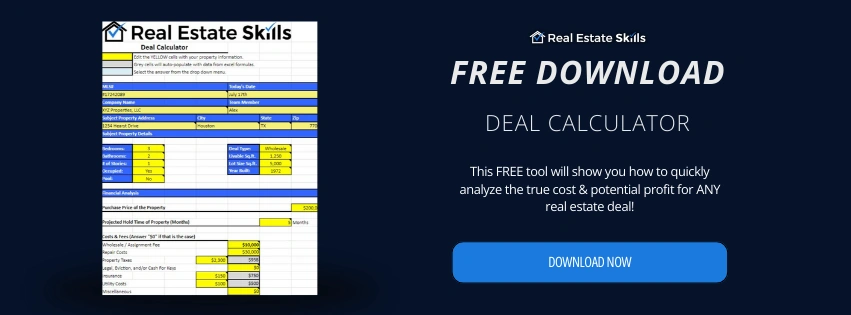
On a Connecticut deal, the better structure comes down to the numbers: an assignment with one closing, or a double close with conveyance tax on your resale and a second attorney closing. Download our free Deal Calculator Spreadsheet to work out your maximum allowable offer, then run the deal both ways using the conveyance tax and closing costs your attorney quotes before you commit.
When A Double Close Can Still Make Sense Here
- The spread is large enough: the extra tax and a second closing don't eat the deal.
- The contract can't be assigned: and the seller won't sign an amendment allowing it.
- Your buyer's lender or funding source requires it: they need to buy from a titled owner.
Ask Before You Double Close In Connecticut
- Does Connecticut's wholesaler law still apply? The law defines a wholesaler as someone who facilitates a sale without taking title. Whether a same-day double close falls inside or outside the rules is a question for a Connecticut attorney. Either way, the three-day cancellation and 90-day terms belong in your contract with the seller. Our guide covers what Connecticut's wholesaler law says about taking title.
- How will the funds move? Ask your closing attorney whether they'll use your buyer's money to fund your purchase or require separate funding, and what each option costs.
- What's the conveyance tax on an assignment? On a straight assignment there's only one deed, from the seller to your buyer. Ask the closing attorney how the consideration for that deed is reported, including whether your fee is counted, before you compare the two structures.
- Thinking about selling an LLC instead? Connecticut has a separate controlling interest transfer tax that can apply when a business owning Connecticut real property changes hands. Get tax advice before you try that route.
This section explains how Connecticut's conveyance tax generally applies, for educational purposes. It's not tax or legal advice. Confirm the taxes and structure of any deal with a Connecticut attorney or tax professional.
How Connecticut Markets Change From Town To Town
In Connecticut, the town sets both your property's assessment and its tax rate, so two houses at the same price can carry very different holding costs. Check each town's median value, mill rate, and recent sales before you pick a market, because your cash buyer's profit depends on all three.
Connecticut's median value for owner-occupied homes was $366,900 in the Census Bureau's 2020 to 2024 American Community Survey. That statewide number won't help you price a deal. In a state with no county government, the market that matters is the town, and Connecticut's towns can differ sharply on price and on property taxes.
Why The Town's Tax Rate Matters To Your Buyer
Your cash buyer pays property taxes while they renovate and resell, so higher taxes mean less room in the deal for them, and for your fee. Connecticut taxes work in two steps:
- The assessment: 70 percent of the property's estimated market value as of the town's last revaluation.
- The mill rate: set by the town. The Office of Policy and Management explains that one mill is $1 of tax for every $1,000 of assessment.
The formula: annual tax = assessment × mill rate ÷ 1,000.
💡 Same House, Two Towns (Illustrative Numbers)
- A house is assessed at $175,000 in both towns. That's 70 percent of a $250,000 market value.
- In a town with a 25 mill rate: $175,000 × 25 ÷ 1,000 = $4,375 a year, or about $365 a month.
- In a town with a 50 mill rate: $175,000 × 50 ÷ 1,000 = $8,750 a year, or about $729 a month.
- Over a six-month renovation and resale, your buyer pays about $2,188 in taxes in the first town and $4,375 in the second.
- That roughly $2,200 difference comes out of the same spread you and your buyer are splitting.
These mill rates are illustrative, not the rates of any specific town. Look up the current rate for the town you're targeting before you run numbers.
This is also why the assessor's card is a poor pricing tool. The assessment reflects the last revaluation, not today's value, and the tax bill depends on a rate the town can change each year.
How To Size Up A Connecticut Town Before You Work It
Check three numbers for each town on your shortlist, all from official sources:
| What to check | Where to find it | Why it matters |
|---|---|---|
| Median home value | Census Bureau QuickFacts (search the town) | Shows whether your buyers' price range fits the town |
| Current mill rate | OPM's mill rates by town | Drives your buyer's holding costs |
| Recent recorded sales | OPM's Real Estate Sales listing, then recent MLS sales | Shows what houses on specific streets actually sell for |
For reference, here are the figures for the towns we're most often asked about:
| Town | County (geographic only) | Median home value (Census ACS 2020–2024) |
|---|---|---|
| Stamford | Fairfield | $624,400 |
| Norwalk | Fairfield | $558,000 |
| Danbury | Fairfield | $411,200 |
| New Haven | New Haven | $287,100 |
| Bridgeport | Fairfield | $274,900 |
| Hartford | Hartford | $228,600 |
| New Britain | Hartford | $223,600 |
| Waterbury | New Haven | $208,500 |
| Connecticut | Statewide | $366,900 |
Figures pulled September 2026 from U.S. Census Bureau QuickFacts. They're survey estimates of what owners think their homes are worth, and they lag the current market. For a town's current mill rate, check the town tax collector's or assessor's page, or OPM's mill rates page.
Why "Fairfield County" Isn't One Market
Look at the four Fairfield County towns in the table. Stamford's median home value is $624,400, while Bridgeport, in the same county, is $274,900, well under half as much. Stamford and Norwalk sit far above the statewide median of $366,900. Bridgeport sits below it, alongside the Hartford-area and central Connecticut cities, where the table's medians run from $208,500 in Waterbury to $287,100 in New Haven.
For a wholesaler, that split changes the deal, not just the price tag:
- Your buyer pool changes: a buyer flipping $600,000 houses in Stamford needs far more capital than one flipping $220,000 houses in New Britain. Many buyers work one kind of market, not both.
- Repairs weigh differently: a $60,000 renovation is about 10 percent of a $600,000 house but more than a quarter of a $220,000 one, so condition problems shrink the spread faster in lower-priced cities.
- A county-wide list hides all of this: that's another reason to build your deal list and buyer list town by town.
Median values describe each town as a whole, not the distressed houses you'll be buying. Price every deal from recent comparable sales on the same streets.
Three habits help once you've picked towns:
- Ask your buyers which towns they buy in: and whether a town's tax rate has ever made them pass on a deal. The answer tells you where your deals will actually sell.
- Don't assume a county is one market: towns in the same county can have very different prices and tax rates, which is why the table lists both.
- Check the town's revaluation timing: towns must revalue at least every five years, and a recent revaluation can change a buyer's future tax bill.
Connecticut Repair Risks That Can Sink A Deal
Before pricing a Connecticut deal, check two things: whether the house sits in a town affected by crumbling concrete foundations, and whether it was built before 1978. A failing foundation can cost more than the spread, and pre-1978 homes carry federal lead paint rules your buyer must follow.
Most repair estimates come down to dollars per square foot for paint, floors, kitchens, and baths, and our guide to estimating rehab costs covers that method. In Connecticut, two problems don't fit that formula, and missing either one can turn a good-looking deal into one no buyer will touch.
Crumbling Concrete Foundations
Some Connecticut homes have concrete foundations made with stone containing pyrrhotite, a mineral that slowly breaks down the concrete when exposed to oxygen and water. The Connecticut Department of Housing says upward of 35,000 homes around Stafford Springs could be at risk of a failed foundation.
The fix is expensive. Citing the Department of Housing, FEMA reports that the only safe and effective repair is lifting the house and replacing all the concrete, at a cost of roughly $100,000 to $250,000. That's often more than an affected house is worth.
Here's what that means for you:
- Know the affected towns: the Capitol Region Council of Governments publishes the list of towns treated as affected for real estate transactions under the state's property condition disclosure law. Check it before you offer in north-central or northeastern Connecticut.
- Check the year built on the assessor's card: FEMA's case study points to homes built between 1983 and 2000, and some towns report foundations poured as late as the mid-2010s. Treat anything from the early 1980s onward in an affected town as a question to ask, not a pass.
- Ask whether the foundation has been tested: the Department of Housing describes two kinds of tests. A visual test is a licensed professional engineer's opinion based on observation. A core test takes a concrete sample and measures whether pyrrhotite is present.
- Read the seller's condition reports closely: you have to collect the Residential Property Condition Report before the contract is signed, and your buyer gets a copy. Since July 1, 2025, some owners must also complete a separate Residential Foundation Condition Report, available on DCP's real estate page. If either raises foundation concerns, price the deal for that risk or walk away.
- Tell your buyer what you know: a buyer who finds the problem after you assigned the contract isn't a buyer you'll work with again.
Lead Paint In Older Homes
For Connecticut homes built before 1978, the year lead-based paint was banned for homes, two federal rules apply, and both touch a wholesale deal.
Rule 1: the seller's lead disclosure. Before a buyer signs a contract on most pre-1978 housing, the EPA's disclosure rule requires the seller to:
- Give the buyer the EPA's "Protect Your Family From Lead In Your Home" pamphlet
- Disclose any known information about lead-based paint or lead hazards in the home
- Include the federal lead warning statement in the sales contract
Connecticut's wholesaling law also requires the seller to meet federal reporting requirements before signing a wholesale contract. So for a pre-1978 house, collect the lead disclosure along with the condition report, before the contract, and pass it to your buyer with your assignment paperwork.
Rule 2: the renovation rule your buyer must follow. The EPA's Renovation, Repair and Painting Rule generally doesn't apply to homeowners working on their own homes. The EPA specifically says it does apply to people who buy, renovate, and sell homes for profit. That's your cash buyer. Connecticut isn't one of the states running its own version, so the EPA administers the rule here.
In practice, work that disturbs paint in a pre-1978 house needs to be done by an EPA-certified renovation firm using lead-safe practices. That can raise your buyer's renovation costs compared with a newer house. When you estimate repairs on an older home, ask your buyer whether their number already accounts for it.
A Quick Pre-Offer Check For Connecticut Houses
- Look up the year built: it's on the town assessor's card.
- If it's in an affected foundation town and built in the early 1980s or later: ask the listing agent about foundation testing and read the condition reports before pricing.
- If it was built before 1978: confirm the seller will provide the lead disclosure before the contract, and flag the renovation rule to your buyer.
- Adjust your offer or pass: do this if either risk isn't priced into your buyer's numbers.
This section is educational and is not engineering, environmental, or legal advice. Rely on qualified inspectors, licensed engineers, and a Connecticut attorney for the property you're buying.
Read Also: How To Flip Houses In Connecticut
Building A Connecticut Cash Buyers List
Find Connecticut cash buyers by spotting properties that sold twice within a year in OPM's statewide sales listing, looking up who bought them in the town's land records, and confirming the buying company through the state's business records. Then ask each buyer which towns they buy in and how they close.
Our guide to finding cash buyers for wholesale deals covers where to look and how to reach out. Connecticut adds a way to find buyers that many states don't offer: a free statewide list of recorded sales.
Use The State's Sales Records To Find Active Flippers
OPM's Real Estate Sales listing records sales of $2,000 or more with the town, address, sale date, property type, sale price, and assessment. It doesn't name the buyer, so you pair it with town records:
- Filter the listing: narrow it to your target towns and to residential sales.
- Look for the same address selling twice within about 12 months: especially where the second price is much higher. That pattern usually means a flip.
- Look up the buyer on the first sale: search that town's land records. The deed names who bought it.
- If the buyer is a company, confirm it: use the Connecticut business registration records, linked from the Judicial Branch public records page. Business filings help you confirm the company is active and learn who is behind it.
- Repeat the process for a few towns: a company name that keeps appearing is a buyer actively working that market.
The state publishes this listing by year, so it runs behind. Use it to find buyers, not to price a live deal.
What To Ask A Connecticut Buyer
Our guide to what to ask cash buyers about their buying criteria covers the usual questions about price range, property type, and repair budget. On top of those, ask about the things that are specific to Connecticut:
- "Which towns do you buy in, and are there any you avoid?" A buyer working Norwalk may not want Waterbury, and the town's tax rate may be the reason.
- "Which Connecticut closing attorney do you use?" Their answer is also a lead for your own attorney list.
- "How long do you need to close?" Your contract can't close more than 90 days after it's signed, so a buyer's timeline has to fit inside that.
- "Have you bought assigned contracts in Connecticut since the 2026 rules started?" A buyer who has already received a wholesaler's written notice and condition report won't be surprised by your paperwork.
Check The Other Wholesalers You Work With
If you co-wholesale with another investor or buy a deal from one, verify their DCP wholesaler registration first using DCP's license lookup. An unregistered partner's paperwork problems can become your problem on a shared deal.
Looking to buy discounted Connecticut property rather than wholesale it? Start with our guide to off-market properties in Connecticut, and ask the wholesalers working your towns to add you to their buyer lists.
Connecticut Wholesaling FAQs
Your First Week Wholesaling In Connecticut
Connecticut didn't make wholesaling impossible in 2026. It made the order of operations matter. Registration comes before offers, the disclosure report comes before the contract, and the three-day window comes before the assignment. Everything has to close inside 90 days, through an attorney. Wholesalers who set that up once will spend their time on deals, not on fixing paperwork. If you're brand new to the model, our guide to wholesaling real estate for beginners covers the basics first.
Here's what to do this week, before you make a single offer:
- Start your DCP registration: apply through DCP's wholesaler registration page. If you're using an LLC, register the business and the person who will sign.
- Read the two state forms your deals run on: print DCP's Wholesale Disclosure Report and the Residential Property Condition Report so you can explain them to an agent without looking anything up.
- Call two closing attorneys: use the questions from the closing attorney section and get written fee quotes before you need them.
- Pick three to five towns: bookmark each town's clerk and assessor pages. Look up the mill rate. Check the affected foundation towns list if you're working north-central or northeastern Connecticut.
- Find your first buyers in the state's sales records: use OPM's Real Estate Sales listing to spot houses that sold twice within a year in your towns, then look up who bought them.
Once those five are done, you're ready to call on your first listing with a Connecticut offer package in hand.
Your Connecticut Checklist Is Ready. Now Go Find Your First Deal.
Once you're registered, have a closing attorney lined up, and know the towns you want to work, the only thing left is the deal itself. Our FREE Training walks through how we find discounted properties on the MLS, talk to listing agents, and analyze an offer from start to finish. Watch it this week, then call on your first listing with your Connecticut paperwork already in hand.
Watch The FREE Training →
About The Author
Founder & CEO, Real Estate Skills
Alex Martinez is the Founder and CEO of Real Estate Skills. He has wholesaled and flipped houses for over 14 years, been part of 1,000+ real estate transactions, and personally acquired 33+ residential investment properties. He has trained 6,000+ investors nationwide.
Real Estate Skills is not a law firm, and this guide is for educational purposes only. It isn't legal, tax, or financial advice. Connecticut's wholesaling registration, contract, disclosure, and closing requirements took effect or changed recently and may change again, and how they apply depends on your transaction. Figures shown are illustrative unless a source is cited. Real estate investing carries risk. Before you sign a contract or close a deal in Connecticut, consult a Connecticut real estate attorney and your own tax and financial advisors.

👉FREE Training
How To Consistently Wholesale, Flip Houses, & Invest In Rental Properties From The MLS
(Without Spending $1 On Marketing)

Alex Martinez, the founder of Real Estate Skills, is known for his strong, practical expertise in real estate, starting from a beginner with no family connections in the industry to acquiring over 55 real estate deals, including wholesale and flips, within his first year.
He has dedicated his career to providing cutting-edge education and resources for real estate professionals. He emphasizes the importance of self-taught knowledge through mentors, books, and hands-on experience.
His journey from earning a modest income to becoming a successful real estate entrepreneur and educator showcases his expertise and dedication to the field.

Ryan Zomorodi, co-founder and COO of Real Estate Skills, leverages his experience from a diverse background in real estate investment, construction management, and entrepreneurship to provide comprehensive education in the real estate sector.
His expertise is rooted in hands-on experience, extensive industry knowledge, and a commitment to empowering others through education.
Ryan's journey reflects a blend of practical experience and entrepreneurial success, contributing to his role in developing a platform that educates and supports aspiring real estate professionals.
Read Ryan's Full Bio >>
