
How To Wholesale Real Estate In Georgia (2026): 7 Steps From FMLS To Closing
Sep 25, 2026

Written by
Alex Martinez, Founder & CEO, Real Estate Skills. Has wholesaled and flipped houses for over 14 years, been part of 1,000+ real estate transactions, and personally acquired 55+ residential investment properties. Has trained 6,000+ investors nationwide.
Reviewed by
Ryan Zomorodi, Co-Founder & COO, Real Estate Skills. Reviewed the Georgia rules and step-by-step process in this guide for accuracy before publication.
Publication history: Originally published November 22, 2022. Updated September 2026 with a 7-step process that matches our Georgia video, the first-Tuesday foreclosure calendar, how to find a closing attorney who handles assignments, the seller-approval rule for assignments in the 2026 Georgia REALTORS contract, double closing and transactional funding costs, virtual wholesaling, a county-level look at metro Atlanta, Savannah, Augusta, Columbus and Macon, startup costs, and current market data. Legal and cost facts checked against the Georgia Code, the Georgia Department of Revenue and the State Bar of Georgia as of September 2026, and reviewed by Ryan Zomorodi.
To wholesale real estate in Georgia, you sign a below-market contract on a distressed house, get the seller's written approval to assign it, and sell your place in that contract to a cash buyer for a fee. A Georgia attorney runs the closing and pays you. I aim for $10,000 or more per deal; one student's first Atlanta fee was $5,000.
Most wholesaling advice was written for states where a title company closes the deal. Georgia isn't one of them. Here an attorney has to run the closing, the standard purchase contract won't let you assign without the seller's OK, and the best distressed leads show up in the county's legal newspaper a month before the courthouse sale. Miss any of those and a deal that looked done falls apart at the closing table.
The method is the one I've taught for years and walk through in our Georgia video: pick your market, line up buyers, find distressed listings, call the agent, run the numbers, write a clean offer and close. This guide keeps that seven-step order and fills in what's different here, with real Atlanta deals from two of our students.
If you're brand new and want the basics first, grab our free Ultimate Guide to Getting Started in Real Estate, then come back here for the Georgia details.
What Is Wholesaling Real Estate?
Wholesaling means signing a contract to buy a property below market value, then selling your right to buy it to another investor for a fee. You never take ownership. In Georgia, the investor steps into your contract, a Georgia attorney closes the purchase, and your fee is paid at that closing.
The fee is called an assignment fee, and handing your contract to the investor is called an assignment. Our guide to wholesale real estate covers the mechanics in full, and I explain it in about a minute at the start of our Georgia video.
How To Wholesale Real Estate In Georgia (7 Steps)
Wholesaling in Georgia takes seven steps: pick a market you know, line up cash buyers and a closing attorney, find distressed listings, call the listing agent, run the numbers, write a clean offer the seller agrees you can assign, and close through a Georgia real estate attorney.
These are the same seven steps as our Georgia video, in the same order, so you can watch any step and read the Georgia detail underneath it. The order matters. Buyers and an attorney come before deals because a signed contract with no buyer and no one lined up to close it is just your earnest money sitting at risk.
How To Wholesale Real Estate In Georgia (STEP-BY-STEP)!
I walk through all seven steps below, including a $350,000 deal worked out on screen. Each step on this page links to its chapter.

This is educational, not legal advice. Georgia rules change over time. Have a Georgia real estate attorney review your contracts and closings.
Step 1: Pick Your Georgia Market (Start Where You Live)
Wholesale where you live. You already know which neighborhoods are rising, which are rough and which streets investors want, and you can meet agents and see houses in person. If you live in metro Atlanta, start there. If you don't, your own city is a better first market than a hot one you've never visited.
People new to wholesaling often chase whatever market a video called hot. After more than a decade in this business, I've found the opposite works. Your local knowledge is an edge you can't buy. You can drive a street and know in five minutes whether a flipper would want it, and you can build the relationships this business runs on, with agents, attorneys and contractors, face to face.
Georgia's markets are priced very differently, and that changes what a fee looks like. The statewide median sale price was $355,580 in August 2026, according to Georgia REALTORS. Metro Atlanta's was $445,000 in July, while typical home values in Macon and Columbus sit under $180,000.
Lower-priced markets mean lower purchase prices and usually smaller fees. Atlanta means bigger numbers and more investors chasing the same houses. Neither is better. The best market is the one where you can see the house, know the comps and get the agent on the phone the day it lists. The Atlanta section breaks the metro down county by county, and the section on Savannah, Augusta, Columbus and Macon covers the rest of the state.
Watch this step in the video (1:44).
Step 2: Line Up 3–5 Cash Buyers And A Closing Attorney
Before you make an offer, find three to five cash buyers, meaning investors who buy several houses a year with their own money, and one Georgia closing attorney who is willing to close assignments. Your buyers tell you what to look for. The attorney is the person who will actually close your deal.
Three to five buyers who answer the phone are worth more than a list of 500 who don't. A list of buyers you can call is called a buyers list, and in Georgia you can build one from public records in an afternoon.
How To Build A Georgia Cash Buyers List
- Search like a seller: Google "sell my house fast Atlanta" (or your city). The investors ranking for that search are spending money to find houses, which makes them active buyers. We call this the Google Ninja trick, and I show it in the video.
- Read the deed records: Georgia's court clerks share a statewide deed index through the Georgia Superior Court Clerks' Cooperative Authority (GSCCCA), which charges $14.95 a month to view documents. Look for names and LLCs buying several houses a year. A purchase with no security deed recorded after it usually means the buyer paid cash. (A security deed is Georgia's version of a mortgage document; step 3 explains it.)
- Check the county tax assessor: Once you have a buyer's name, the county assessor's site shows what else they own and their mailing address. Many Georgia counties use qPublic, while Fulton, DeKalb, Cobb and Gwinnett run their own sites. The Georgia Department of Revenue keeps a list of every county's records site.
- Go where investors meet: The Georgia Real Estate Investors Association (GaREIA) and the Atlanta Real Estate Investors Alliance both hold regular meetings in metro Atlanta. Atlanta also has active Facebook groups where wholesalers and cash buyers trade deals. Watch who actually closes, and message those people directly.
- Ask agents and other wholesalers: Investor-friendly agents know which buyers close. Other real estate wholesalers in Georgia are buyers too, and some will partner with you on a deal you can't sell yourself.
What To Ask Your Georgia Cash Buyers
Once you have a buyer on the phone, get their buying criteria, the specific kind of house they want, so you can go find exactly that:
- Which counties, ZIP codes or neighborhoods do you buy in? Inside or outside the Perimeter?
- What price range, and what size house?
- Do you flip or hold rentals? How much rehab will you take on?
- What share of after-repair value will you pay, and what do you budget per square foot for repairs?
- Do you pay cash or use a lender, and how fast can you close?
- Which closing attorney do you like to use?
Write their answers down. Neelema, one of our students, found her first deal (in Florida, before her Atlanta deal) by asking a buyer exactly what he wanted and then searching only for that. Our guide on how to find cash buyers for wholesaling has the full playbook.
For the attorney, find one who will close assignments before you sign your first contract. Not every Georgia firm will. The closing attorney section covers where to look and what to ask.
Watch this step in the video (3:07).
Step 3: Find Distressed Deals On The MLS And In Foreclosure Notices
Search the MLS, the database agents use to list homes for sale, for distressed houses in the first 24 hours after they list and for houses that have sat 60 to 90 days. Then check each month's foreclosure notices, which run for four weeks before the first-Tuesday courthouse sale in every Georgia county.
Metro Atlanta has two MLSs. FMLS calls itself the largest in Georgia, and Georgia MLS covers all 159 counties. Plenty of Atlanta brokerages pay for both because some listings appear on only one, so find out which your agent uses and check the other when you can. If you're not licensed, our guide to MLS access in Georgia covers your options.
Two searches do most of the work:
- New listings, first 24 hours: Of the 50 or 60 new listings in an area on a given day, maybe five to 12 look distressed: holes in walls, overgrown yards, kitchens from the 1970s. Call on those first. A distressed house often can't get a normal home loan, so the seller needs a cash buyer, and the first professional who calls has the edge.
- Stale listings, 60 to 90 days: A house that's sat for three or four months has a seller who's heard no. On a house listed at $300,000 that hasn't sold, an offer around $240,000 isn't an insult. It may be the first real offer they've seen.
I also run keyword searches in the listing remarks for words like "hoarder," "fire damage," "cash only" and "as is," and I watch price reductions and the coming-soon filter. Each one points to a seller with a problem to solve.
Read The Security Deed Before You Call
Georgia doesn't use a mortgage the way most states do. It uses a security deed, also called a deed to secure debt, which under Georgia law passes title to the lender until the loan is paid off. When you pull a property in the county records, the security deed tells you who the lender is and roughly how much was borrowed. If the owner owes close to what the house is worth, there's no room for a discount, and you can move on.
Other Places To Find Motivated Sellers In Georgia
A motivated seller is an owner who needs to sell more than they need top dollar. Beyond the MLS, these are the Georgia sources I'd work:
- Foreclosure notices: The biggest Georgia-only lead source. Every month, each county publishes the houses set for its first-Tuesday courthouse sale. The foreclosure calendar section shows how to work it.
- Tax sales: Georgia property tax sales follow the same rules as sheriff's sales (O.C.G.A. § 48-4-1), so they also happen on the first Tuesday at the courthouse. Owners on a county's upcoming tax sale list have a deadline, and a sale to you before that date solves their problem.
- Estates: Every Georgia county has a probate court that handles wills and estates. Heirs who inherit a house they don't want, often out of state, are some of the most motivated sellers you'll talk to.
- Code violations: Houses with open code enforcement cases carry fines that grow until the owner fixes or sells. Many Georgia cities and counties post cases online or will release them on request.
- Expired and for-sale-by-owner listings: A listing that expired without selling, or an owner trying to sell alone, often means a house that needs more work than retail buyers want.
If you'd rather not market to owners at all, our guide to finding off-market properties in Georgia covers more sources.
Watch this step in the video (4:19).
Step 4: Call The Listing Agent Before You Run Numbers
Call the listing agent before you spend an hour on analysis. Ask why the seller is selling, what condition the house is really in, how many offers are in, when offers get reviewed and what price would get it done. In Georgia, also ask how long a due diligence period the seller will accept.
We call this the discovery call. The agent listed the house to get calls, so this isn't cold calling. You're a buyer, and that changes the whole conversation. Don't make an offer on this first call. You haven't run the numbers, and a price you walk back later costs you the agent's trust.
Add two Georgia questions. Ask how long a due diligence period the seller will accept, because that's your window to back out (step 6 explains it). And ask which closing attorney the seller uses, since that attorney will be handling your assignment.
Then ask the listing agent to represent you as well. They'd earn both sides of the commission, which gives them a reason to push your offer, and in my experience about 80% of listing agents say yes. Georgia allows one brokerage to represent both sides only with written consent from both clients, or through designated agency, where the brokerage assigns a different agent to each side. If you hold a license yourself, GREC licensing rules add duties of your own.
📓 From The Field
Jeff, one of our students in Atlanta, found his first deal on FMLS about three hours after it listed, before it even had photos. He called the agent, met her at the house that afternoon and was the only buyer who showed up. When the seller called for highest and best offers that evening, he stayed on the phone until he had a firm yes. The house was listed at $125,000, he contracted at $120,000 with his cash buyer already in mind, and his fee was $5,000. He also calls every agent three times: the discovery call, a call as he leaves the property, and a call when the offer lands in their inbox. Jeff's deal was in early 2021. One student's result; results vary.
Know Exactly What To Ask The Listing Agent
Our free Discovery Call Script has the questions I use on every call: why the seller is selling, the real condition of the house, competing offers and the price that gets it signed. Add the two Georgia questions above, the due diligence period and the seller's closing attorney, and you're ready for your first call.

Watch this step in the video (7:10).
Step 5: Run The Numbers Before You Offer
Work backward from the after-repair value, meaning what the house will sell for once it's fixed up. Take 80% of that, subtract repairs, then subtract your fee. On a $350,000 after-repair value with $30,000 of repairs and a $10,000 fee, your maximum offer is $240,000.
💡 The $350,000 Example From Our Georgia Video
- After-repair value: $350,000
- 80% of that: $280,000 (the 20% gap covers your buyer's profit and costs)
- Minus repairs: $280,000 minus $30,000 = $250,000
- Minus your fee: $250,000 minus $10,000 = $240,000
- Your maximum allowable offer: $240,000
The 80% figure is a starting rule, and your buyers are the ones who set it. Ask each one what share of after-repair value they'll pay and what they budget per square foot for repairs. If a buyer renovates at $40 a square foot, a 1,200 square foot house needs about $48,000 of work. Use their number, not your guess.
Three Georgia details change the math:
- Comps: Jeff pulls sales within half a mile and won't let a comparable sale cross a major road or freeway, a ZIP code line or a school zone. He also checks each sale against county tax records, because he's seen listing sites show homes as sold that never sold.
- Inside or outside the Perimeter: Buyers finish houses inside I-285 to a higher standard. Jeff's rough rule is that if finishing a house in the suburbs runs about $15,000, the same work inside the Perimeter can run double. A clean but dated 1,200 square foot house might need $30,000; a vandalized one might need $60,000.
- Closing costs: Budget the attorney's fee and, if you might double close, a second transfer tax and a second closing. The cost comparison below shows both exits side by side.
Our maximum allowable offer guide goes deeper on the formula.
Run Every Georgia Deal Through The Numbers
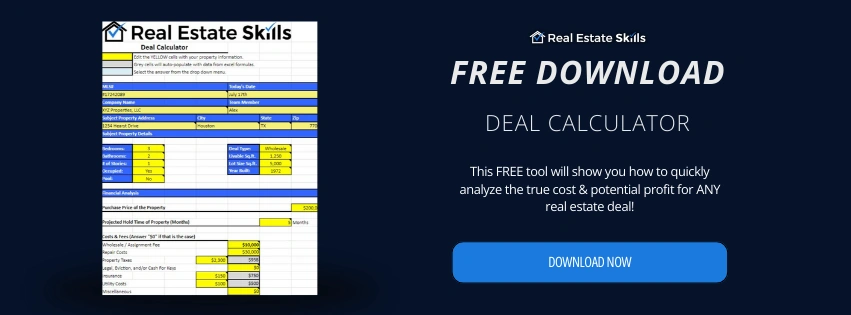
Our free Deal Calculator works backward from the after-repair value and repair costs to your maximum offer, your buyer's profit and your fee. On a Georgia deal, add the costs a generic calculator won't assume: your closing attorney's fee and, on a double close, a second transfer tax and a second closing.
Watch this step in the video (8:58).
Step 6: Write A Clean Offer The Seller Agrees You Can Assign
Match the seller's closing date, keep one short due diligence period, and get the seller's written approval to assign in the offer itself. The standard 2026 Georgia REALTORS contract lets a buyer assign only with the seller's written approval, which the seller can refuse for any reason.
Most listed houses in Georgia sell on the Georgia Association of REALTORS purchase and sale agreement. Three parts of it matter to a wholesaler:
- Assignment: The 2026 form says the buyer may assign only with the seller's written approval, using a special stipulation written for it. Adding "and/or assigns" after your name doesn't get around that. Put the approval in your offer, where the agent sees it before the seller signs. Asking after the fact is how deals die. Our guide to Georgia real estate contracts covers the form, and our assignment of contract guide covers the assignment agreement you'll sign with your buyer.
- Due diligence period: The contract gives the buyer a due diligence period, a window in which you can walk away for any reason, or no reason, and get your earnest money back. In exchange the seller keeps a small nonrefundable payment called option money, $10 on the form plus anything more you agree to. This is your protection. I keep mine to about seven days, and in more than 12 years of wholesaling I've never had to buy a deal I didn't want, because I either assign inside that window or back out.
- Earnest money: Earnest money, the deposit that shows the seller you're serious, goes to the holder named in the contract, usually a brokerage or the closing attorney, and must be deposited in their trust account within five banking days. Have it ready before you sign.
How To Negotiate A Georgia Wholesale Deal
Most of the negotiating happens through the listing agent, and the terms matter as much as the price. What works in Georgia:
- Match the seller's closing date: If the agent told you the seller needs to close in 14 days, write 14 days. Beginners write 30 or 45 out of habit, and agents read that as not listening.
- Use the due diligence period as a lever: A shorter due diligence period, or more option money, tells the seller you're serious. Neelema beat 17 other offers on an Atlanta house by shortening her window and raising her offer $5,000.
- Ask what would make your offer stand out: Then do it, if the numbers still work. Agents will usually tell you.
- Offer under list when the numbers say so: The list price is the agent's opinion. Jeff won his first contract in a highest-and-best round while offering under list.
- Stay on the phone: When a seller calls for highest and best, the buyer who gets a firm answer wins. Jeff held the agent on the line until he had a yes.
- Keep it clean: One short due diligence period, proof of funds from your cash buyer and nothing extra.
📓 From The Field
Neelema, one of our students, wholesales from Long Island, New York, while working as a physician. On an Atlanta house that already had 17 offers at $200,000, she called the listing agent and asked what would make her offer stand out. The agent told her to shorten her inspection period and come up a little. She offered $205,000 with a shorter window and won the contract. The investment company that had also offered $200,000 became her buyer, and all five parties to the deal worked from one email thread with the closing attorney. She went into closing with a $10,000 assignment fee negotiated, and the deal closed. Watch her tell the story. One student's deal, from 2023; results vary.
If your offer loses, stay in touch with the agent. About half of my accepted deals came after the fact, when another buyer's contract fell apart. The Georgia REALTORS forms include a back-up agreement exhibit for exactly this, so ask whether the seller will take a back-up offer, and check in while the house is pending.
This is educational, not legal advice. Have a Georgia real estate attorney review your contract and any assignment wording before you sign.
Watch this step in the video (11:18).
Step 7: Close With A Georgia Real Estate Attorney
Send the signed contract and assignment to your closing attorney. The attorney checks title, holds everyone's money in a trust account, runs the signing and pays out the funds, including your assignment fee, which appears on the settlement statement. In Georgia, a licensed attorney must conduct the closing.
Once the seller signs, send the deal to your buyers with everything they need in one email: photos, your numbers, the comps, the due diligence end date, the closing date and the closing attorney's contact. We call this the platinum platter email. When a buyer commits, you both sign an assignment agreement. I ask the buyer for a deposit when they sign, so they have something at stake too.
From there the attorney runs the closing. The Supreme Court of Georgia held in UPL Advisory Opinion 2003-2 that only a licensed Georgia attorney may close a real estate sale or oversee the signing of a deed, and that a notary acting as a "witness only" isn't enough. The attorney doesn't always have to be in the room: a 2025 State Bar of Georgia opinion says a live video closing counts as long as the attorney controls it from start to finish. That's what makes wholesaling Georgia from another state workable.
If the seller won't allow an assignment, the fallback is a double close: you buy the house and resell it to your buyer, usually the same day, in two back-to-back closings. It works, but it costs more in Georgia. The double close section walks through it step by step.
Watch this step in the video (13:23).
You Have The Georgia Steps. Now Learn The Method Underneath.
The seven steps above cover what changes in Georgia: attorney closings, the seller's approval to assign, due diligence and the foreclosure calendar. Our FREE Training teaches the deal-finding process underneath, the same one Jeff and Neelema used: spot distressed MLS listings, call the agent first, price off real sales and line up buyers before you sign.
Watch The FREE Training →How To Find A Wholesale-Friendly Closing Attorney In Georgia
Ask the agents you work with which attorneys have closed their investor deals, then call two or three and ask directly whether they close assignments and double closes. Not every Georgia firm will. Published flat fees from Georgia law firms run roughly $500 to $1,500 for a standard closing.
In most states you'd call a title company. In Georgia a licensed attorney has to run the closing, so this relationship matters as much as your buyers. And not every firm wants wholesale deals. At least one Georgia title and escrow firm says publicly that it won't close assignments or double closes. Find out before you're under contract, not the week of closing.
Where to look:
- Your agents and buyers: The fastest route. Ask which attorney closed their last investor deal and whether it went smoothly.
- Other investors: Ask at GaREIA or Atlanta REIA meetings who closes wholesale deals.
- The bar associations: The State Bar of Georgia has a public Find a Lawyer search, and the Atlanta Bar Association runs a Lawyer Referral and Information Service, where a first consultation of up to 30 minutes may cost $45.
Questions to ask each attorney:
- Do you close assignments of contract and double closes, and how often?
- What's your fee for an assignment closing, and who usually pays it?
- Will you hold earnest money in your trust account?
- Can you close with an out-of-state buyer or seller by video?
- How will my assignment fee show up on the settlement statement (the itemized sheet of who pays and receives what at closing)?
- How soon do you need the signed contract and assignment to hit the closing date?
Get the fee in writing, because a wholesale deal can mean more work than a standard purchase. The rule behind all this, and what the attorney can and can't do for you, is covered in our legal guide.
Georgia's First-Tuesday Foreclosure Calendar: How To Work It
Most Georgia foreclosures are sold at the county courthouse on the first Tuesday of the month, between 10 a.m. and 4 p.m. Each sale is advertised weekly for four weeks beforehand in the county's legal newspaper. Those four weeks are your window to reach an owner before the house is gone.
Georgia lets a lender foreclose without going to court when the security deed contains a power of sale, and most do. That makes Georgia foreclosures fast compared with states where every case goes before a judge. Here's what the law requires before a sale:
- Notice to the owner: The lender must send the owner written notice no later than 30 days before the sale, by registered or certified mail or statutory overnight delivery (O.C.G.A. § 44-14-162.2).
- Four weeks of ads: The sale must be advertised weekly for four weeks in the county's legal organ, the newspaper officially chosen to carry legal notices (O.C.G.A. § 9-13-140).
- The sale: The first Tuesday of the month, 10 a.m. to 4 p.m., at the courthouse. When the first Tuesday falls on New Year's Day or July 4, the sale moves to the Wednesday right after (O.C.G.A. § 9-13-161).
- Before any of that: Federal rules generally bar a mortgage servicer from starting a foreclosure until the borrower is more than 120 days behind.
A Monthly Routine For Working The Notices
- Early in the month: Pull the new notices for your counties. The Georgia Press Association collects member newspapers' legal notices for free at georgiapublicnotice.com, or you can read the county's legal organ directly.
- Screen fast: Check each address against the county tax assessor and the security deed. Skip houses where the loan is close to the value.
- Reach the owner respectfully: A letter, a knock on the door or a call. You're offering a way out before the sale, not a lecture about it. If you mail offers, Georgia requires specific disclosure wording on unsolicited offers to buy property, so check the rules before your first letter goes out.
- Check the MLS too: Some owners facing foreclosure list with an agent. A stale listing whose address also shows up in the notices is about as motivated as a seller gets.
- Confirm the sale date: Sales get postponed and cancelled, so check again before the first Tuesday.
Work with urgency. Georgia doesn't give owners a statutory right to buy the house back after a non-judicial foreclosure sale, so once it sells, the owner's chance to walk away with any equity is gone. Tax sales work differently: an owner can generally redeem within 12 months of a tax sale, and until the buyer serves formal notice ending that right. If you'd rather buy at the courthouse auction than before it, that's a different strategy, covered in our guide to buying foreclosed homes in Georgia.
The volume is real. ATTOM counted 8,433 foreclosure filings in Georgia in the first half of 2026, up 52% from a year earlier, and the Macon metro had one of the five highest foreclosure rates among U.S. metros of at least 200,000 people. Check the latest figures before you plan around them.
How Long Does It Take To Wholesale A House In Georgia?
Once you have a signed contract, the deal closes on whatever date the contract sets, often two to four weeks out when you match a motivated seller. Finding that first contract takes longer. Jeff had his first Atlanta deal under contract within about three weeks of joining our program; for many people it takes months of steady offers.
Most of the timeline is in your hands, because you write the dates into the offer. Here's how a typical Georgia assignment runs:
| Stage | Typical timing | What sets it |
|---|---|---|
| Finding a deal | Weeks to months | How many offers you write. I plan on about 15 offers per deal. |
| Contract signed | Day 0 | The binding agreement date on the Georgia REALTORS form |
| Earnest money deposited | Within 5 banking days | The contract, in the holder's trust account |
| Assign to your buyer | Inside your due diligence period | The window you negotiated; I keep mine to about 7 days |
| Title work and closing | The closing date in the contract | Often 14 to 30 days, matched to the seller's timeline |
| You get paid | At closing | The attorney pays your fee from the closing funds |
Delays usually come from title problems the attorney finds, like an old lien or an estate that wasn't probated, and from buyers who back out. A double close adds a second closing and a lender to coordinate. Build in slack when a house has a messy history, and keep a second buyer warm.
How Double Closing, Transactional Funding And Wholetailing Work In Georgia
In a Georgia double close, you buy the house from the seller and resell it to your buyer, usually the same day, in two closings run by an attorney. You pay transfer tax on the second deed and usually borrow the purchase money for a few hours from a transactional lender. Wholetailing means keeping the house, fixing it lightly and listing it.
Assignment is the default exit, but it isn't always possible. The seller may refuse to approve an assignment, your fee may be large enough that you'd rather not show it on your buyer's paperwork, or your buyer's lender may require them to buy from the owner of record. That's when a double close comes in. Our guide on how a double closing works covers the general mechanics. Here's how it runs in Georgia:
- Clear it with your attorney first: Confirm they'll handle both closings. Some Georgia firms won't touch double closes, and title insurers look harder at them.
- Sign two contracts: Your purchase contract with the seller and a separate sale contract with your buyer at the higher price.
- Line up the money: You need the full purchase price for the first closing. Most wholesalers use transactional funding, a same-day loan that's repaid from your buyer's money at the second closing.
- Close twice: The attorney closes seller to you, then you to your buyer. Two deeds get recorded, and you pay the transfer tax on the second one as the seller.
- Collect the spread: What's left after the loan, the lender's fee and your closing costs is your profit.
What Transactional Funding Costs
Lenders set their own prices, so get quotes. As two examples from lenders' own pricing pages, DoubleClose lists 1% of the purchase price with a $750 minimum plus a $100 processing fee, and Requity Group says its fee is typically 1% to 2% of the loan. On a $200,000 purchase, 1% is $2,000. Georgia's intangible recording tax applies only when a security deed for a long-term loan, meaning principal due more than 62 months out, is recorded, so a same-day loan usually doesn't trigger it. Confirm with your attorney. Our list of transactional lenders is a place to start.
When Wholetailing Makes Sense In Georgia
Wholetailing means you actually buy the house, do light work like cleaning, paint and landscaping, and list it on the MLS for a retail buyer instead of an investor. It can pay more than a wholesale fee, but now you own a house: you need the purchase money, you carry taxes, insurance and utilities until it sells, and you pay transfer tax when you sell. It makes sense when a house needs little work and sits in a neighborhood where retail buyers are paying up. Listing it with an agent gets it in front of MLS buyers, at the cost of a commission.
Can You Wholesale Georgia Real Estate Virtually?
Yes. Georgia requires an attorney to run the closing, but a 2025 State Bar of Georgia opinion says the attorney can do it by live video, so neither you nor your buyer has to be in the room. Neelema wholesaled an Atlanta deal from Long Island, New York. You still need people on the ground.
Virtual wholesaling means working a market you don't live in, by phone, email and e-signatures. Georgia's closing rules used to make that harder than in title-company states, because the attorney had to be physically present. The State Bar's Formal Advisory Opinion 23-1 changed the practical picture in 2025, as long as the attorney controls the closing from start to finish.
What you can do from anywhere: search FMLS or Georgia MLS listings, call agents, pull GSCCCA deed records and county assessor data, run the numbers, sign contracts electronically and coordinate with the attorney by email. What you can't do from anywhere is see the house. For that you need a local agent who'll walk it on video, a contractor who'll give you a repair number, or a cash buyer you trust enough to send in first. My advice from the start of this guide still stands: if you live in Georgia, wholesale where you live. If you don't, pick one Georgia county and learn it properly.
How To Wholesale Real Estate In Atlanta, Georgia
Atlanta isn't one market. The metro area Atlanta REALTORS reports on covers 11 counties, each with its own courthouse sale, legal newspaper and tax records. The median sale price was $445,000 in July 2026, and investors bought about one in five Atlanta homes in early 2026.
The Atlanta REALTORS monthly market brief, compiled by FMLS, covers Cherokee, Clayton, Cobb, DeKalb, Douglas, Fayette, Forsyth, Fulton, Gwinnett, Paulding and Rockdale counties. Here's what that means for a wholesaler:
- Pick your counties: Each county runs its own first-Tuesday sale, publishes notices in its own legal organ and keeps its own tax assessor records. Learn two or three well rather than skimming all eleven.
- Know the Perimeter: Inside I-285, buyers renovate to a higher finish and pay more for it. Outside, the same house needs less. Jeff's rule of thumb is that rehab budgets inside the Perimeter can run about double.
- Know who's buying: Investors bought 21% of Atlanta homes in the first quarter of 2026, according to Redfin, and a 2024 GAO report found that large institutional investors owned about a quarter of the metro's single-family rentals as of 2022. That's a deep buyer pool, and it's why Atlanta cash buyers are easy to find and hard to impress. Bring numbers that hold up.
- Don't drive to every house: Atlanta traffic turns that into a full-time job. Jeff learned to run most deals from photos, Street View and a call with the agent, and to visit only the houses that are close to a yes or where the agent won't take an offer sight unseen.
Wholesaling In Savannah, Augusta, Columbus And Macon
Outside Atlanta, Georgia's main wholesale markets are lower-priced: typical home values ran about $322,000 in Savannah and under $180,000 in Columbus and Macon in August 2026. Lower prices mean smaller fees per deal, but also fewer investors competing. Each is its own county, with its own records and first-Tuesday sale.
| Market | County | Typical price | Source and period |
|---|---|---|---|
| Savannah | Chatham | $322,239 typical home value, down 2.8% in a year | Zillow, August 2026 |
| Augusta | Augusta-Richmond (consolidated) | $215,000 median sale price, down 2.3% | Redfin, three months to July 2026 |
| Columbus | Columbus-Muscogee (consolidated) | $175,951 typical home value, up 2.9% | Zillow, August 2026 |
| Macon | Macon-Bibb (consolidated) | $174,105 typical home value, up 2.8% | Zillow, August 2026 |
A median sale price and Zillow's typical home value are different measures, so treat these as a guide to price levels, not a ranking. Figures change monthly.
Wholesaling In Savannah
Savannah sits in Chatham County, so its foreclosure sales, deed records and tax assessor records run through Chatham. It's the priciest of Georgia's secondary markets, which usually means larger fees per deal than Macon or Columbus, and values dipped over the past year.
Chatham County's assessor runs its own records site rather than qPublic, so start there when you research owners and buyers. Local investors meet through the Savannah Real Estate Investors Alliance's Meetup group, a good first stop for finding buyers.
Wholesaling In Augusta And Columbia County
Augusta and Richmond County share one consolidated government, so the city's deals run through Richmond County's courthouse and records. Columbia County, right next door, is a separate county with its own sale, records and legal newspaper. Work them as two markets, even though buyers treat the area as one.
That split is the Augusta detail most people miss. A house on one side of the county line is advertised in a different legal organ and sold at a different courthouse than a house a mile away. Pull the notices for both counties each month.
Wholesaling In Columbus
Columbus and Muscogee County have been one consolidated government since 1971, so the city's foreclosure sales and records all run through the Columbus-Muscogee courthouse. Typical values were under $180,000 in August 2026 and rising, which makes it a lower-cost place to learn.
Lower prices cut both ways. A house with a $180,000 after-repair value leaves less room for your fee than an Atlanta house, so the math in step 5 matters even more. Stale listings are worth a hard look here: a house that's sat three or four months in a slower market often has a seller ready to deal.
Wholesaling In Macon
Macon and Bibb County consolidated in 2014, so Macon's deals run through the Macon-Bibb courthouse and tax office. In the first half of 2026, ATTOM ranked the Macon metro among the five highest foreclosure rates of any U.S. metro with 200,000 or more people, which means a steady supply of notices.
A high foreclosure rate is a lead source, not a guarantee of profit. Screen every notice against the security deed and the tax records, because many owners in foreclosure owe close to what the house is worth. Macon-Bibb's tax office runs its own records site.
How To Build Your Georgia Real Estate Network
Your network is the agents, attorneys, cash buyers, contractors and other investors you can call on a deal. In Georgia, start with two or three investor-friendly agents, one closing attorney who handles assignments, and the investor meetings run by GaREIA and Atlanta REIA. Everything else grows from those.
Deals come from people. The agents you treat well will call you before they call anyone else, and that compounds. Here's who to build relationships with, and why:
- Listing agents: Give them what they want, which is a clean offer that closes. Jeff offers to let the listing agent represent him on both sides, and agents who earn double on your deals bring you the next one.
- Closing attorneys: One who knows how you work saves days on every deal.
- Cash buyers: Close what you promise. A buyer who trusts your repair numbers will commit faster.
- Contractors: A contractor who'll walk a house and give you a quick repair number makes your offers sharper, especially if you work virtually.
- Other wholesalers: Partnering with another wholesaler, where one of you has the contract and the other has the buyer, is common. Get the split in writing, and read our legal guide's section on co-wholesaling first.
For investor meetings, the Georgia Real Estate Investors Association and the Atlanta Real Estate Investors Alliance both post upcoming events online. Go to meet people, not to hear a pitch. Ask who's buying, what they're buying and who closes their deals.
What Are The Requirements To Wholesale Real Estate In Georgia?
You need a Georgia closing attorney who will handle assignments, three to five cash buyers, earnest money you can put at risk, a way to see MLS listings, and an offer the seller agrees you can assign. You don't need a license to buy and assign your own contract, but marketing a house you don't control can count as brokerage.
That last point is the one to get right. Selling your contract is one thing. Advertising the house as if it's yours to sell is another, and that's where Georgia's broker license rules apply. Our guide to is wholesaling legal in Georgia? covers the rules, the penalties and how to market a deal the right way.
You don't need an LLC to start, and your first deal can be in your own name. If you form one later, the Georgia Secretary of State charges $110 to file and $60 a year to renew.
What Does A Georgia Wholesale Deal Cost?
On an assignment, your main costs are the earnest money you have at risk and any attorney fees. On a double close you pay for two closings, a second transfer tax of about 0.1% of the resale price and usually a short-term lender. That's why assignment is the default exit in Georgia.
Here's a worked example. A seller signs at $200,000, and your buyer agrees to pay $215,000.
| Cost | Assignment | Double close |
|---|---|---|
| Deeds recorded | One: seller to your buyer | Two: seller to you, then you to your buyer |
| Transfer tax | $200 on the one deed, owed by the seller | $200 on the first deed, plus $215 that you owe as the seller on the second |
| Attorney closings | One | Two, back to back |
| Money to buy the house | None; your buyer funds the purchase | $200,000 for the first closing, usually borrowed from a transactional lender for a fee |
| Intangible recording tax | None if your buyer pays cash | Owed only when a security deed for a long-term loan is recorded, so a same-day loan usually doesn't trigger it; confirm with your attorney |
| Your fee | $15,000, paid at closing | $15,000 spread, minus the extra costs above |
Transfer tax is $1 for the first $1,000 of the price plus 10 cents for each additional $100 (Georgia Department of Revenue). Intangible recording tax is $1.50 per $500 of a long-term loan, capped at $25,000; since July 1, 2025, a loan counts as long-term only if principal is due more than 62 months out. Rates checked September 2026.
The transfer tax is small. The real cost of a double close is the second closing, the lender's fee for short-term funding, and the time it adds. The double close section shows what lenders charge.
Who pays closing costs in Georgia? By law the seller owes the transfer tax unless the contract shifts it, and everything else is split however the purchase contract says. On an assignment your buyer steps into your contract, so your buyer takes on the costs your contract gave to the buyer's side.
What Does It Cost To Start Wholesaling In Georgia?
Starting costs are modest but not zero: earnest money and option money on each contract, an attorney consult, records access and a way to see MLS listings. An LLC is optional at $110. The biggest real cost is the earnest money you can lose if you back out after your due diligence period ends.
| Item | Cost | Notes |
|---|---|---|
| Earnest money | Set in each contract | Deposited within 5 banking days; refundable if you terminate during due diligence |
| Option money | $10 or more per contract | Nonrefundable; the seller keeps it |
| GSCCCA records access | $14.95 a month | Deed and lien images statewide |
| Attorney consult | About $45 for up to 30 minutes | Through the Atlanta Bar referral service; firms set their own fees |
| LLC (optional) | $110, then $60 a year | Georgia Secretary of State |
| MLS access | Varies | Through a licensed agent, or a license of your own |
| Deal calculator and call script | Free | Our downloads above |
| Direct mail or ads (optional) | Your choice | The MLS method in this guide doesn't need paid marketing |
Costs checked September 2026 and subject to change.
How Much Do Real Estate Wholesalers Make In Georgia?
There's no official data on wholesaler income in Georgia, and every fee you'll hear is before costs. I aim for $10,000 or more per deal, and some deals pay less. Jeff's first Atlanta fee was $5,000. Expect to write roughly 12 to 15 offers for every deal you close.
Here's what the two students on this page made. Jeff earned $5,000 on his first Atlanta deal in early 2021. Neelema went into closing on her Atlanta deal in 2023 with a $10,000 fee negotiated. Those are gross numbers. Take out attorney and marketing costs, any earnest money you lose on deals that fall apart, and income tax, and what you keep is smaller.
The number that decides your income is your offer ratio. Jeff was writing about 12 offers for every accepted contract in his first month, and I plan on 15. Write 15 offers a month and hold that ratio, and you're looking at roughly one deal a month. Write five, and you aren't.
Is Wholesaling In Georgia Easy?
The steps are simple, but the work isn't easy. Most offers get a no, the first deal can take months, and Georgia adds steps other states skip: an attorney closing, the seller's approval to assign, and county-by-county records. People who treat it like a daily job with a routine tend to close deals. People who try it now and then usually don't.
Wholesaling in Georgia is probably the wrong fit if:
- You need income this month. Your first deal can take months of steady offers.
- You can't make calls during business hours, when agents pick up.
- You won't walk away from a deal inside your due diligence period when the numbers stop working.
- You'd rather not hear no. Even with a good ratio, most of your offers will be turned down.
It's a good fit if you can put in an hour or two every day, like Neelema did before work, and you treat each no as one step closer to the next yes.
Wholesaling Houses: How Jeff Closed His 1st Deal - Pro Wholesaler VIP Review
Jeff walks through his first Atlanta deal, from a three-hour-old FMLS listing to a $5,000 fee, including his three-call routine with listing agents. Recorded January 2021.

Earnings examples are individual results, not typical outcomes. Your results depend on your market, your effort and your deal flow.
How To Wholesale Real Estate In Georgia: FAQs
Final Thoughts On Wholesaling Real Estate In Georgia
Wholesaling works in Georgia, on Georgia's terms. An attorney closes every deal, the standard contract needs the seller's approval before you can assign it, and the best leads follow a monthly courthouse calendar. Build your process around those facts and the rest of the method carries over.
Most people who struggle here aren't bad on the phone. They're running a process built for a title-company state, and they find out at the closing table. Everything on this page is meant to help you find out beforehand.
Your next steps this week:
- Pick one market you know and set up daily MLS alerts for new listings and listings older than 60 days.
- Call two closing attorneys and ask whether they close assignments and what they charge.
- Find three cash buyers and write down exactly what each one buys.
- Pull this month's foreclosure notices for your county.
Once those are done, you're ready for your first discovery call.
Ready To Make Your First Georgia Offer? Start With The FREE Training.
You now know how Georgia works: who closes the deal, what the contract allows and where the leads come from. What's left is the skill of finding and locking up deals, and that's what our FREE Training covers, step by step, using the process we've taught more than 6,000 investors. Watch it, call a closing attorney this week, and make your first discovery call with both in hand.
Watch The FREE Training →
About The Author
Founder & CEO, Real Estate Skills
Alex Martinez is the Founder and CEO of Real Estate Skills. He has wholesaled and flipped houses for over 14 years, been part of 1,000+ real estate transactions, and personally acquired 55+ residential investment properties. He has trained 6,000+ investors nationwide.
Real Estate Skills is not a law firm, and the information in this article is provided for educational purposes only. It does not constitute legal, tax, or financial advice. Georgia real estate, contract and tax rules change over time, and market figures are dated and will change. Real estate investing carries risk, earnings examples are not typical, and past results do not guarantee future outcomes. Always consult a Georgia-licensed real estate attorney and your own tax and financial advisors before entering into any contract or transaction.

👉FREE Training
How To Consistently Wholesale, Flip Houses, & Invest In Rental Properties From The MLS
(Without Spending $1 On Marketing)

Alex Martinez, the founder of Real Estate Skills, is known for his strong, practical expertise in real estate, starting from a beginner with no family connections in the industry to acquiring over 55 real estate deals, including wholesale and flips, within his first year.
He has dedicated his career to providing cutting-edge education and resources for real estate professionals. He emphasizes the importance of self-taught knowledge through mentors, books, and hands-on experience.
His journey from earning a modest income to becoming a successful real estate entrepreneur and educator showcases his expertise and dedication to the field.

Ryan Zomorodi, co-founder and COO of Real Estate Skills, leverages his experience from a diverse background in real estate investment, construction management, and entrepreneurship to provide comprehensive education in the real estate sector.
His expertise is rooted in hands-on experience, extensive industry knowledge, and a commitment to empowering others through education.
Ryan's journey reflects a blend of practical experience and entrepreneurial success, contributing to his role in developing a platform that educates and supports aspiring real estate professionals.
Read Ryan's Full Bio >>
