
How To Wholesale Real Estate In Rhode Island
Oct 29, 2026

Written by
Alex Martinez, Founder & CEO, Real Estate Skills. Has wholesaled and flipped houses for over 14 years, been part of 1,000+ real estate transactions, and personally acquired 55+ residential investment properties. Has trained 6,000+ investors nationwide.
Reviewed by
Ryan Zomorodi, Co-Founder & COO, Real Estate Skills. Reviewed the deal process, closing steps, and deal math in this guide before publication.
Publication history: Originally published June 16, 2023. Updated October 2026 with Rhode Island's January 1, 2027 wholesaling rules, a closing-cost walkthrough with conveyance tax examples, a 2027 deal timeline, and exit strategies that still work after the law takes effect. Deal process and closing steps reviewed by Ryan Zomorodi, Co-Founder & COO of Real Estate Skills.
Here's how to wholesale real estate in Rhode Island: line up a closing attorney, build a local cash buyers list, find distressed listings on the statewide MLS, contract below market value, then assign or double close. From January 1, 2027, assigning more than once in any 12 months requires a Rhode Island license.
I've been wholesaling and flipping houses for over 14 years, and I can tell you Rhode Island is about to become one of the most interesting states in the country to wholesale in. Not because it's getting easier. Because it's getting stricter, and most people won't bother to learn the new rules.
Wholesaling here works the way it does anywhere else: you put a property under contract below market value and transfer that contract to a cash buyer for a fee. But three things make Rhode Island different, and each one changes how you run a deal.
The licensing rules change on January 1, 2027. From that date, anyone who sells their contract rights in a property more than once in any 12-month period needs a Rhode Island real estate license. The new law also gives both the seller and your buyer a 3-business-day window to cancel. You can still do one deal a year without a license, or use exits where you take title.
There are no counties to work. Rhode Island abolished county government in 1842, so deeds, mortgages, and liens are recorded at each of the state's 39 city and town clerks, not at a county recorder.
An attorney handles the deed. Under a 2020 Rhode Island Supreme Court decision, drafting a deed for a residential sale is the practice of law, so your closing runs through an attorney, or a title agent working within strict limits.
Here's how I'd run wholesaling real estate in Rhode Island today, step by step, with those rules built in, from lining up a closing attorney to choosing an exit strategy that still works after 2027. Grab my free deal calculator before you start, because you'll use it in Step 6.
How To Wholesale Real Estate In Rhode Island (STEP BY STEP)!
I walk through my seven-step MLS system for Rhode Island: picking a market, finding cash buyers, spotting distressed listings, calling agents, running a 70%-of-ARV offer, and closing through a Rhode Island attorney.

Recorded June 2026. Rhode Island's licensing rule changes on January 1, 2027 for anyone who wholesales more than once in a 12-month period; this guide covers what that means for each step.
Rhode Island Wholesaling Markets At A Glance
Most Rhode Island wholesale activity happens in Providence and the older cities around it, where housing stock is oldest and investor demand is deepest. Pawtucket and Woonsocket have the lowest entry prices, Warwick and Cranston have tight single-family inventory, and Newport and South County trade at much higher price points.
Rhode Island is small. You can drive from Woonsocket to Westerly in about an hour, which means you can realistically work the whole state. But the markets inside it behave very differently, and your cash buyers will care which one a deal sits in.
| Market | Q2 2026 Single-Family Median | What To Expect As A Wholesaler |
|---|---|---|
| Providence | $481,000 | The biggest investor pool in the state. Lots of older multifamily (the classic triple-decker), so many deals are 2 to 3 unit buildings, not single-family homes |
| Pawtucket | $420,000 | One of the lowest entry prices in the Providence area. Older housing stock, plenty of multifamily, strong rental demand |
| Woonsocket | $420,500 | Essentially tied with Pawtucket for the lowest median in this table. Older homes, so budget for repairs and lead work |
| Warwick | $462,000 | The most closed single-family sales of any city in this table in Q2. Tight inventory means listings move fast |
| Cranston | $482,500 | Mostly single-family. Good fix-and-flip comps, competitive on the best listings |
| East Providence | $460,000 | Homes sold in about three weeks on average in Q2. Speed matters here |
Sources: Town medians from Spectrum Real Estate Consultants' Q2 2026 residential market report. Statewide, the Rhode Island Association of Realtors reported a record single-family median of $550,000 and a multifamily median of $590,000 in June 2026.
Newport County and South County (Narragansett, South Kingstown, Westerly) are real markets too, but the price points are much higher, a lot of the stock is seasonal, and your pool of fix-and-flip buyers is smaller. If you're new, I'd learn the business in the Providence metro first, then expand.
How To Wholesale Real Estate In Rhode Island: 7 Steps
Wholesaling in Rhode Island takes seven steps: line up a closing attorney, learn the 2027 rules, build a cash buyers list, find deals on the statewide MLS, check records with the town clerk, run the numbers with Rhode Island costs included, and write offers around the 3-day cancellation windows.
Step 1: Line Up A Rhode Island Closing Attorney First
In Rhode Island, an attorney must draft or review the deed on a residential sale, and your closing runs through an attorney or a title agent working under strict rules. Find an investor-friendly closing attorney before your first offer, not after you have a deal under contract.
In most states, I'd tell you step one is building your buyers list. In Rhode Island, it's your closing attorney. Here's why.
In a 2020 Rhode Island Supreme Court decision, the court held that drafting a deed for a residential sale is the practice of law. A non-attorney can't do it. Title agents can still run closings, but within tight limits: they have to tell everyone at the table, in writing and out loud, that they aren't an attorney and can't give legal advice, and the closing pauses if a legal question comes up.
So every deal you do in Rhode Island runs through an attorney at some point. You want that person picked before you ever need them. When you call around, ask these questions:
- Do you close investor deals, including assignments?
- Will you handle a double close, and do you allow the end buyer's funds to fund the first purchase (sometimes called pass-through funding)?
- What do you charge to prepare or review a deed, and what do you charge per closing?
- Starting January 1, 2027, can you add the required wholesaler disclosure and 3-business-day cancellation language to my purchase and assignment contracts?
- How fast can you close if my buyer is paying cash?
That last answer matters more than you'd think. I offer 14-day closes on most deals. If your attorney needs 30 days, your offers lose.
If you don't know where to start, the Rhode Island Bar Association runs a lawyer referral service that can help you find a Rhode Island real estate attorney. Your future cash buyers are another great source. Ask them who closes their deals.
Step 2: Know Where The January 2027 Rules Leave You
Starting January 1, 2027, you need a Rhode Island license to sell your contract rights more than once in any 12-month period. Covered deals also need written disclosures and 3-business-day cancellation windows for the seller and your buyer. One assignment per 12 months, or exits where you take title, stay open.
I'm going to keep this short, because the full breakdown of the law, the penalties, and the open questions lives in our guide: Is Wholesaling Real Estate Legal In Rhode Island. Read it before your first deal.
Here's what you need to know for this guide. Rhode Island's new wholesaling law takes effect January 1, 2027. It defines a wholesaler as someone who sells their equitable interest in a property (their contract rights) more than once in any 12-month period without ever taking ownership. Anyone who meets that definition needs a Rhode Island real estate license. Wholesalers also have to tell the seller in writing that they may assign the contract for a fee, tell the buyer in writing that they hold contract rights and not the title, and give both of them 3 business days to cancel.
Notice what the law does not say. It does not ban wholesaling. It does not touch a deal where you actually take title. And it only kicks in on the second deal in a 12-month window. That leaves you real options, and I'll show you exactly how to use them in the exit strategies section below.
This is educational, not legal advice. Confirm how the 2027 law applies to your deals with a licensed Rhode Island attorney.
Step 3: Build A Cash Buyer List In Rhode Island's Investor Markets
Build your buyers list before you put anything under contract. In Rhode Island, the best sources are recent cash purchases in town clerk records, local investor meetups, hard money lenders, investors advertising "we buy houses" in Providence-area cities, and agents who work with investors.
I always find my buyers before I find my deals. If you lock up a property and then start looking for a buyer, you're racing your inspection period, and in Rhode Island after 2027 you'll also be racing two 3-day cancellation windows. Build the list first.
Here's where I'd look in Rhode Island (and if you want the full playbook, here's how to find cash buyers):
- Recent cash sales: Search recent sales in Providence, Pawtucket, Cranston, and Warwick. Properties bought with no mortgage recorded, then relisted renovated a few months later, are almost always flippers. You'll confirm ownership at the city or town clerk (more on that in Step 5).
- The "sell my house fast" search: Google "sell my house fast Providence" or "we buy houses Cranston." Skip the ads and work the organic results and the review listings. Most of the companies ranking there are local flippers or investors buying for cash. Call them.
- Local investor meetups: Rhode Island has real estate investor groups that meet in and around Providence. Show up, shake hands, and ask what people are buying.
- Hard money lenders: Ask local lenders which borrowers close the most deals. If you send their best borrowers good deals, you're helping both of them.
- Investor-friendly agents: Agents who list renovated homes know exactly who's buying the ugly ones.
When you talk to a buyer, get their buy box before you hang up: property types, price range, which towns, how much repair work they'll take on, how fast they decide, and whether they pay cash or use hard money. In a market this small, you'll keep running into the same serious investors, so treat every conversation as a long-term relationship.
Know Exactly What To Say To Rhode Island Cash Buyers
Rhode Island's investor community is small, so the impression you make on your first call with a Providence or Pawtucket flipper sticks. Download our free Cash Buyer Script to ask the questions that matter: what they buy, their price range, which towns they work, how fast they decide, and how they fund their deals. Know their buy box before you ever put a property under contract.
Step 4: Find Deals On Rhode Island's Statewide MLS
Rhode Island has one statewide MLS, so a single database covers every listing in the state. Search it daily for new distressed listings, homes sitting 60+ days, price reductions, and keywords like "as-is" or "cash only," then call the listing agent before you run the numbers.
This is where Rhode Island gives you an edge. Most states have several regional MLSs. Rhode Island has one: the State-Wide Multiple Listing Service, owned by the Rhode Island Association of Realtors. One login, one search, every listing in the state. Since May 2025, licensees who aren't Realtors can also get access, so if you go the licensed route later, MLS access comes with it. Until then, work with an agent who'll set you up with saved searches, or use public sites like Redfin and Zillow, which pull from the Multiple Listing Service (MLS) but leave out the agent-only remarks. The State-Wide MLS rules and policies explain who can access what.
I focus on listed properties for a simple reason: the seller has already raised their hand, and the agent picks up the phone. You're not cold-calling homeowners who never asked to hear from you, which also keeps you clear of most telemarketing rules (I cover those in the legal guide linked in Step 2).
Here are the searches I run:
- Day Zero: brand-new listings from the last 24 hours that show distress. Be the first call.
- Old listings: 60+ days on market. The seller's expectations drop every week the house sits.
- Price reductions: a reduction is the seller telling you they'll negotiate.
- Keywords: "as-is," "cash only," "estate sale," "needs TLC," "investor special," "fire damage."
- Back on market: a deal that fell out of contract. The seller and agent want a buyer who will actually close.
- Value-add layouts: a 2-bed, 1-bath with enough square footage to become a 3-bed, 2-bath.
When you find one, call the listing agent before you analyze it. Ask why the seller is selling, the real condition of the property, how many offers are in, whether they're homeowner or investor offers, and what price gets it under contract. Then ask if they'd represent you as the buyer. If they say yes, expect to sign Rhode Island's agency disclosure forms and a written buyer agreement. And if you're a licensee, say so up front: "I'm a licensed agent, but I'm buying this as an investor."
Call Rhode Island Listing Agents Like A Serious Buyer
With one MLS covering the whole state, you'll call the same Rhode Island listing agents again and again, so every call builds or burns a relationship. Our free Discovery Call Script gives you the exact questions to ask: why the seller is selling, the real condition of the property, what other offers are on the table, and what price gets it under contract. Use it to qualify distressed listings before you spend time running numbers.
Don't ignore off-market deals entirely. Motivated sellers who never list are out there, and direct mail campaigns still work for reaching them. One Rhode Island timing note: lenders have to offer mediation before foreclosing on most owner-occupied homes, and notice goes out around 120 days into a delinquency. Pre-foreclosure deals here move slower than many investors expect, and if the seller is behind on payments, talk to your attorney before you sign anything, because Rhode Island has specific rules for buying from homeowners in foreclosure.
Step 5: Use 39 Town Clerks For Records, Not Counties
Rhode Island has no county recorders. Deeds, mortgages, liens, and other land records are kept by each of the state's 39 cities and towns, at the city or town clerk's office (Providence calls its office the Recorder of Deeds). Check ownership and liens there before you make an offer.
If you've wholesaled in another state, this one trips people up. Rhode Island doesn't have county government; it was abolished in 1842. There's no county recorder to search. Every one of Rhode Island's 39 city and town clerks keeps its own land evidence records.
That matters in three ways:
- Confirming who owns the property: Before you sign, confirm every owner on title. If three heirs own it, you need three signatures.
- Spotting liens: Look for recorded mortgages, tax liens, and municipal liens before you price your offer.
- Finding cash buyers: Recent deeds with no mortgage recorded are your cash buyer leads from Step 3.
Expect each town to work a little differently. Some have online search going back decades, others need a call or a visit for older records. Your closing attorney will run the full title search before closing, but you want the basics before you make an offer.
Step 6: Run The Numbers With Rhode Island Closing Costs Included
Start with ARV × 70%, minus repairs, minus your fee. Then add Rhode Island costs: the realty conveyance tax ($3.75 per $500, paid by the seller by default), attorney fees on the deed, a smoke and CO certificate, possible cesspool replacement, and nonresident withholding if you're out of state.
Your Maximum Allowable Offer
Every offer I make starts with three numbers: the after repair value (ARV), the repair estimate, and my fee. The simplest version is the 70% rule:
💡 Worked Example: Your Maximum Allowable Offer (Illustration, Not A Real Deal)
- ARV: $600,000
- × 70% = $420,000
- Minus repairs: $40,000
- Minus your wholesale fee: $20,000
- Maximum allowable offer: $360,000
Your buyers may use 65% or 75% depending on the market and the property. Ask them. And if you want the full math, our maximum allowable offer (MAO) formula guide walks through it.
The Rhode Island Costs Your Buyer Will Ask About
The realty conveyance tax. Rhode Island charges $3.75 for every $500 of the sale price (partial amounts round up) on property transfers. On a $400,000 sale, that's $3,000. On residential sales, an additional $3.75 per $500 applies to the part of the price above $824,000 in 2026, a threshold that adjusts each year. The seller pays by default unless the contract says otherwise. On a normal assignment, that's your original seller. On a double close, you're the seller on the second sale, so it's yours.
Attorney fees. Your attorney drafts or reviews the deed. On a double close, there are two deeds. Get quotes in Step 1 so you can plug in real numbers.
Smoke and CO detector certificate. Rhode Island requires a smoke and CO detector inspection by the local fire department when a home is sold. The certificate is good for 120 days and usually costs the seller around $30, but requirements vary by town and by the age of the home. Older multifamily buildings can need more work to pass.
Cesspools. Under Rhode Island's cesspool replacement rule, if a cesspool serves a property being sold, it has to be replaced or connected to sewer within 12 months of closing. Purchase contracts for properties that may have one must give the buyer a 10-day inspection right. A replacement can cost your buyer thousands, so flag it early and price it in.
Nonresident withholding. If the seller isn't a Rhode Island resident, the buyer has to withhold 6% of the seller's net proceeds (7% for corporations) and send it to the state within 3 banking days of closing. If you live in Massachusetts or Connecticut and you double close, that seller is you. Check the rules on nonresident seller withholding before you choose your exit.
💡 Worked Example: What A Double Close Costs You (Illustration)
- You buy at $360,000 and resell to your buyer at $380,000. Spread: $20,000.
- Conveyance tax on your resale ($380,000 ÷ $500 × $3.75): minus $2,850
- Transactional funding at 1% to 2% of $360,000: minus $3,600 to $7,200
- Attorney fees on your deed: get a quote
- What's left: roughly $10,000 to $13,500 before attorney fees
On an assignment of the same deal, your $20,000 fee comes to you at closing without those costs. That's why the exit you choose matters so much in Rhode Island.
Run Your Rhode Island Numbers Before You Offer
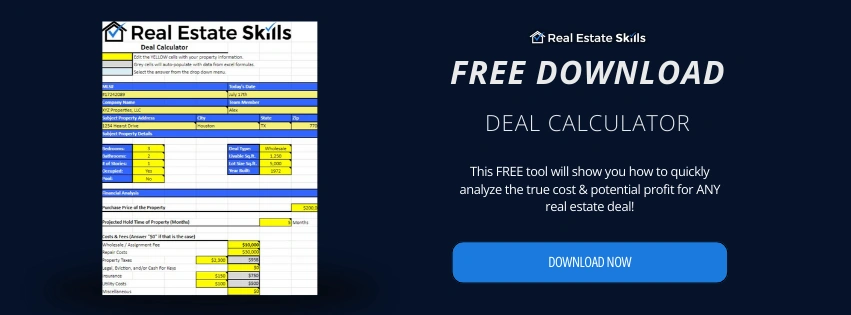
Rhode Island deals carry costs that napkin math misses: attorney fees on the deed, conveyance tax if you double close and become the seller, and lead-safe repair work on pre-1978 homes. Download our free Deal Calculator to work out your Maximum Allowable Offer, add those costs as line items, and see your spread before you ever make an offer.
Step 7: Write The Offer And Plan Around The 3-Day Windows
Offer all cash with a short inspection period, a fast close, and proof of funds attached. On deals covered by the 2027 law, have your attorney add the required disclosure and 3-business-day cancellation language, and make your inspection period long enough to cover both cancellation windows.
My standard offer terms: all cash, a 7-day inspection period, closing in 14 days or less, an earnest money deposit due within a few days of acceptance, and proof of funds attached. Your proof of funds has to show money you can actually access, whether that's your own account, a transactional lender's letter, or a documented funding partner. Never send someone else's bank statement as if it were yours.
Treat the earnest money deposit as real money at risk. It's usually refundable during your due diligence period, but plan for it to be due under the contract, because it will be.
What Changes On January 1, 2027
If the law covers your deal, here's what's different:
- The disclosure goes in before the contract: Before the seller signs, you tell them in writing that you may assign the contract for a fee.
- The contract needs the cancellation notice: The seller gets 3 business days (weekends and holidays don't count) to review and cancel for any reason. Rhode Island's standard purchase forms aren't built for this, so have your attorney prepare the language as an addendum.
- Your buyer gets the same window: When you sign the assignment of contract, you disclose in writing that you hold contract rights, not title, and your buyer gets 3 business days to cancel. The assignment can't take effect until that window closes, and the contract can't stop your buyer from choosing their own closing attorney.
This is educational, not legal advice. Have a licensed Rhode Island attorney draft or review your contract language before you use it.
A Sample 2027 Deal Timeline (Illustration)
| Day | What Happens |
|---|---|
| Monday (Day 1) | Seller signs your contract after receiving your written disclosure. Seller's 3-business-day window starts |
| Thursday (Day 4) | Seller's window ends. You can't transfer the deal before this |
| Friday (Day 5) | Your buyer signs the assignment after receiving your written disclosure. Buyer's 3-business-day window starts |
| Next Wednesday (Day 10) | Buyer's window ends. The assignment can take effect |
| Day 10 to 14 | Inspection period ends, cesspool inspection right (if it applies) runs, smoke/CO certificate ordered, title cleared |
| Day 14 or later | Closing through your attorney |
See the problem? A 7-day inspection period ends before your buyer's cancellation window does. On any deal the law covers, I'd negotiate at least a 10-business-day inspection period so you're never stuck holding a contract your buyer can still walk away from.
You Have The Rhode Island Steps. Now See The Full System.
Lining up a closing attorney, building a buyers list, calling agents, and writing offers around Rhode Island's 3-day windows are the pieces. Our FREE Training shows you how they fit together into one repeatable process for finding discounted properties and getting them under contract. Watch it today, then put it to work on your next Rhode Island deal.
Watch The FREE Training →Why Pre-1978 Housing Changes Your Buyer's Number
Much of Rhode Island's housing predates 1978, when lead paint was common. Most pre-1978 rental units need a Certificate of Lead Conformance, and renovation work that disturbs old paint has to follow lead-safe rules. Buyers who plan to rent or renovate price both into their offer.
This is the Rhode Island detail that kills more deals than people expect. Walk through Providence, Pawtucket, or Woonsocket and you'll see block after block of homes built long before 1978, the year lead paint was banned for homes.
Two rules hit your buyers:
- Rentals need a lead certificate: Most rental units built before 1978 need a Certificate of Lead Conformance, issued after an inspection by a licensed lead inspector, and it has to be renewed at least every two years. Since January 1, 2024, owner-occupied two- and three-unit buildings no longer get an exemption. If your buyer plans to rent out a Pawtucket triple-decker, the cost of getting each unit certified comes off what they'll pay you.
- Renovations cost more: Work that disturbs painted surfaces in older homes generally requires lead-safe practices and certified contractors. That pushes repair budgets up.
What that means for you: when you estimate repairs on a pre-1978 property, go one tier higher than you would on newer construction. Your buyers will thank you, and you won't watch deals fall apart during inspection.
Rhode Island Exit Strategies After 2027
After January 1, 2027, you can still assign one contract in any 12-month period without a license. Use that deal well, then either get licensed or switch to an exit the law doesn't reach: double closing (where you take legal title), an attorney-structured LLC assignment, or the Acquisitions Associate Method.
Here's the part most people will miss.
Your One Deal: Make It Count
You can still legally assign one contract for a profit without a license in any 12-month period. The law only applies when you sell your contract rights more than once in that window. So make that one deal count.
A few things I'd do on that deal:
- Count 12 months from the deal, not the calendar: The law says "any period of twelve months," not "per calendar year." A deal in November 2027 and another in February 2028 are two deals in 12 months.
- Pick your best deal, not your first one: Don't burn your one assignment on a $5,000 fee if a $25,000 deal is a few weeks away.
- Give the disclosures anyway: Even if your one deal falls outside the law, I'd give the seller and buyer the written disclosures and build in the 3-day windows. It costs you nothing and keeps the deal clean.
- Have your attorney confirm it: The one-deal question is new, and you want a Rhode Island attorney signing off on your setup.
Then decide what's next. You've got two paths, and you can take both.
Path 1: Reinvest In Getting Licensed
Use your profits to get your Rhode Island real estate license. Once you're licensed, the 12-month limit stops being your ceiling, you get direct access to the State-Wide MLS, and you can represent yourself on purchases.
Our guide to Rhode Island real estate classes covers where to start.
Path 2: Keep Wholesaling, But Change Your Exit
If you don't get licensed, change how you exit. Double close so you take title, use an LLC assignment your attorney structures, or find deals for an investor through the Acquisitions Associate Method in a setup that fits Rhode Island's licensing law.
Double Closing
Instead of assigning, you buy the property and resell it, usually the same day. Because you take legal title, a double close falls outside the law's definition of wholesaling, which only covers selling contract rights without taking ownership. In Rhode Island, your attorney drafts or reviews both deeds, and you pay the conveyance tax as the seller on the second sale. Run the Step 6 numbers before you choose this route. Here's how a double close works in detail, and you can watch my partner Ryan break down the mechanics in this video, starting at the double close section.
LLC Assignment
You put the property under contract in a brand-new LLC, then sell the LLC itself to your buyer instead of assigning the contract. In many states, that's treated as a business sale rather than a real estate transaction. Rhode Island's law covers selling contract rights "directly or indirectly," though, so whether an LLC sale counts here is an open question. Only use this with a Rhode Island attorney structuring it. The legal guide linked in Step 2 explains why.
The Acquisitions Associate Method
Instead of putting deals under contract yourself, you find deals for an established cash buyer, the buyer's company signs the contract, and you get paid for sourcing it. In Rhode Island, how you're paid decides whether this works:
- With a license: clean. You find deals for your investor as a licensed agent and get paid through your broker.
- Without a license: only as a W-2 employee of the buying company, or as a real equity owner in the entity buying the property. Have an attorney confirm your setup.
- What doesn't work without a license: getting paid a fee per deal as an independent contractor. In Rhode Island, that likely counts as brokerage, and you may not be able to sue to collect a fee if the investor refuses to pay.
This is educational, not legal advice. Each of these exits depends on how your deal is structured, so confirm yours with a licensed Rhode Island attorney before you use it.
Don't Be Most People
Most people will read about this law and throw in the towel. Don't be most people. Every rule change I've seen in this business has done the same thing: it thins out the people who don't read the fine print.
When the beginners who never learned the rules disappear, the ones who did learn them have fewer people bidding against them on the same listings. Rhode Island is heading into that era right now. If you know your one-deal window, have an attorney lined up, and have a plan for deal two, you're already ahead of most of the people you'll be competing with.
Rhode Island Wholesaling FAQs
Final Thoughts On Wholesaling In Rhode Island
Rhode Island isn't the easiest state to wholesale in, and starting January 1, 2027, it gets stricter. But stricter isn't the same as closed. You can still assign one contract in any 12-month period without a license, you can double close because you take title, and you can get licensed and keep going.
The investors who'll win here are the ones who do the boring work first: they line up a closing attorney, they know which of the 39 town clerks to call, they price in the conveyance tax and the lead work, and they know their exit before they sign. That's a short list. Most people won't do it.
If you want help building that system, our Pro Wholesaler VIP program is where I coach investors through it deal by deal. Either way, start with your attorney and your buyers list this week.
Make Every Rhode Island Deal Count.
Under Rhode Island's 2027 rules, every deal matters, whether it's your one unlicensed deal of the year, a double close, or your first deal as a licensee. Our FREE Training shows you the full process for finding discounted properties, running the numbers, and getting them under contract the right way. Watch it today and start building your Rhode Island pipeline.
Watch The FREE Training →
About The Author
Founder & CEO, Real Estate Skills
Alex Martinez is the Founder and CEO of Real Estate Skills. He has wholesaled and flipped houses for over 14 years, been part of 1,000+ real estate transactions, and personally acquired 55+ residential investment properties. He has trained 6,000+ investors nationwide.
Real Estate Skills is not a law firm, and the information in this article is provided for educational purposes only. It does not constitute legal, tax, or financial advice. Rhode Island's wholesaling rules take effect January 1, 2027, and how they apply to a specific deal can depend on facts this article can't cover. Real estate investing carries risk, and past results do not guarantee future outcomes. Always consult a licensed Rhode Island real estate attorney and your own tax and financial advisors before entering into any contract or transaction.

👉FREE Training
How To Consistently Wholesale, Flip Houses, & Invest In Rental Properties From The MLS
(Without Spending $1 On Marketing)

Alex Martinez, the founder of Real Estate Skills, is known for his strong, practical expertise in real estate, starting from a beginner with no family connections in the industry to acquiring over 55 real estate deals, including wholesale and flips, within his first year.
He has dedicated his career to providing cutting-edge education and resources for real estate professionals. He emphasizes the importance of self-taught knowledge through mentors, books, and hands-on experience.
His journey from earning a modest income to becoming a successful real estate entrepreneur and educator showcases his expertise and dedication to the field.

Ryan Zomorodi, co-founder and COO of Real Estate Skills, leverages his experience from a diverse background in real estate investment, construction management, and entrepreneurship to provide comprehensive education in the real estate sector.
His expertise is rooted in hands-on experience, extensive industry knowledge, and a commitment to empowering others through education.
Ryan's journey reflects a blend of practical experience and entrepreneurial success, contributing to his role in developing a platform that educates and supports aspiring real estate professionals.
Read Ryan's Full Bio >>
