
How To Wholesale Real Estate In South Carolina Legally
Oct 16, 2026

Written by
Alex Martinez, Founder & CEO, Real Estate Skills. Has wholesaled and flipped houses for over 14 years, been part of 1,000+ real estate transactions, and personally acquired 55+ residential investment properties. Has trained 6,000+ investors nationwide.
Reviewed by
Ryan Zomorodi, Co-Founder & COO, Real Estate Skills, and host of our 2024 interview with South Carolina real estate attorney Bryan De Bruin.
Publication history: Originally published March 14, 2023. Updated October 2026 to rebuild the process around South Carolina’s 2024 wholesaling law and the Real Estate Commission’s November 2024 guidance, with partner-first and buy-first routes, South Carolina closing costs and foreclosure rules. Reviewed by Ryan Zomorodi.
How to wholesale real estate in South Carolina now comes down to one rule: don't market a house you only have under contract. Two routes still work: partner with a buyer you lined up first, or buy the house, record your deed, then resell, with an attorney closing every deal.
Most wholesaling advice you'll find online was built for states where you can put a house under contract and send it to a list of buyers the same afternoon. South Carolina stopped allowing that in May 2024. If you follow a national playbook here, the first step that feels normal, posting the deal, is the step that gets you in trouble with the Real Estate Commission.
The good news is that the steps around it still work: finding motivated sellers, negotiating a discount, signing a contract and assigning it. What changes is the order. You line up your buyer before you look for houses, or you take ownership before you look for a buyer.
This guide walks you from your first phone call to the closing table using those two routes. I've wholesaled and flipped houses for over 14 years, and I've written this the way I'd set up a new business in South Carolina today. I'm an investor, not an attorney, so treat each legal point here as something to confirm with your own South Carolina lawyer.
What The 2024 Law Changed About South Carolina Deals
Since May 21, 2024, South Carolina treats marketing a home you only have under contract as brokerage. Assigning the contract is still allowed. So you can't post the deal, text it to buyers or describe the house to anyone until you own it, unless your buyer was lined up first.
If you're new to what wholesaling is, the textbook version has four parts: get a house under contract at a discount, market it to investors, assign the contract to one of them, and collect a fee at closing. South Carolina's Act No. 204 took the second part away for homes with one to four units. It defined wholesaling as having a contract to buy a home and then marketing it to a different buyer before you own it, and it said that kind of marketing requires a broker's license.
In practice, that means the moves most wholesaling courses teach are off the table here: sending the deal to a buyers list, posting it in a private Facebook group, putting it on the MLS, or texting a few investors you know with the address and photos. The Real Estate Commission's November 2024 wholesaling guidance treats all of those as marketing, and says a disclaimer like "I'm selling my contract, not the house" doesn't change that. Tying up a house with a land installment contract and marketing it before the deed transfers has the same problem.
What the law didn't touch is just as important. You can still find motivated sellers, negotiate below market, sign a purchase contract, and assign it. You can still buy a house and resell it quickly. Everything in the steps below is built on those pieces.
Why A License Doesn't Get You Around It
No. South Carolina's 2024 law bars brokerage firms and their agents from engaging in wholesaling or helping anyone else do it. A license adds restrictions here without opening new options, and listing agents may be wary of an investor they think plans to market their listing.
In a lot of states, getting a real estate license is the standard fix for wholesaling rules. In South Carolina it works the other way. The same 2024 law prohibits brokerage firms and their agents from engaging in wholesaling or helping anyone else do it, so a license adds restrictions without adding any options.
That also affects how agents will treat you. A listing agent who thinks you plan to market their seller's house before you own it may refuse to work with you, because helping you could put their own license at risk. I'll cover how to handle those conversations in Step 4.
For the statute, the Commission's guidance, and the penalties, read our breakdown of whether you need a South Carolina license and what the law allows.
How To Wholesale Real Estate In South Carolina Without Marketing The House
Hire a closing attorney, choose between partnering with a buyer first or buying first, set your partner's buy box, find sellers, price the offer around South Carolina's closing costs, sign in your entity without advertising the house, then assign it to the venture or close it yourself through the attorney.
These eight steps work for either route. Where the two routes split, I'll say so. Notice that the buyer side happens in Steps 2 and 3, before you talk to a single seller. In most states that's optional. Here it's what keeps the deal legal.
Step 1: Hire Your South Carolina Closing Attorney Before You Make An Offer
South Carolina requires closings to run under attorney supervision, and your attorney will review how your deal is structured before it closes. Hire one before your first offer so your contract, assignment and joint venture terms are set up the way they'll be closed.
In most states you can make offers for weeks before you think about who's going to close the deal. In South Carolina, title examinations, deed preparation and closings all run under an attorney's supervision. That attorney is also the person most likely to stop a deal that's structured wrong, and the Real Estate Commission has said it plans to send its wholesaling guidance to title insurers. You want to find out what your attorney will accept before you sign anything with a seller, not after.
Look for a real estate attorney who closes investor transactions regularly, not only retail sales. If no other investor can refer you, the South Carolina Bar's lawyer referral service is a place to start. When you call, ask:
- Will you close an assignment to a joint venture entity, and what do you need to see in the joint venture agreement?
- Will you prepare or review my purchase contract and assignment?
- What do you charge per closing, and what do you charge for a two-closing resale?
- How do you handle a back-to-back closing, and which transactional lenders have you worked with?
- How long does your title work usually take?
Write the answers down. The fee numbers go straight into your offer math in Step 5.
Step 2: Pick Your Route: Partner First Or Buy First
Partnering first needs little capital but depends on finding a reliable buyer before you look for deals. Buying first needs money for the purchase and carries holding risk, but you own the house and can market it freely. Most beginners start with a partner and add buy-first deals later.
The two routes solve the marketing problem in opposite ways. One removes the marketing entirely. The other waits until you're the owner, when marketing is legal again.
| Partner first (joint venture) | Buy, then sell | |
|---|---|---|
| Money you need | Earnest money, often funded by your partner | The full purchase price, from your own funds or a lender |
| When you find the buyer | Before you look for houses | After your deed is recorded |
| How you get paid | Your share under the joint venture agreement | The spread between your purchase and resale price, minus costs |
| Your biggest risk | Your partner backs out | You can't resell at the price you expected |
| Marketing allowed | None | Any channel, once you own it |
If you're new and don't have capital, start with the partner route. It's one of the more realistic ways of investing with little money of your own. It forces you to learn what a real buyer will pay before you make offers, which is the skill most new wholesalers skip. Add buy-first deals once you have the cash or a lender relationship to fund them.
You may also hear about buying "subject to" the seller's existing mortgage as another way to take ownership. Bryan De Bruin, the Greenville attorney Ryan interviewed about this law, said his firm doesn't close residential subject-to deals, in part because the seller's loan stays in their name after they've handed over the house. That's his firm's position, not a statute, but it tells you how some South Carolina closing attorneys see it. Ask yours before you go down that road.
Step 3: Agree On A Buy Box With Your Partner Before You Look At Houses
Before you search for a single property, write down exactly what your joint venture partner will buy, where, at what price, and how each of you gets paid. Then any house you put under contract already has a buyer, and you never need to market it to anyone.
In the partner route, your buyer comes first. That's a shift from how most people learn wholesaling, where you find the deal and then go looking for someone to take it.
Your partner is usually a local flipper or landlord who already buys in South Carolina. You'll meet them at local real estate investor association meetings, through your closing attorney, or through investors you already know. Look for one who has closed recently, can show proof of funds, and will commit to criteria in writing. One reliable partner whose criteria you know well is worth more than a long list of people who might buy.
Sit down with that partner and agree on:
- Where they buy: specific counties, cities or zip codes.
- What they buy: single-family, duplex, condo; bedroom and bathroom counts; the age range they'll take on.
- Condition: cosmetic updates only, or full renovations.
- How they value it: what they think a renovated house sells for in each area, usually as a price per square foot, and what they budget for rehab.
- Their maximum price for a house that fits.
- Timeline and funding: how fast they close, and whether they'll fund your earnest money.
- Pay: how you're compensated, written into a joint venture agreement.
Ryan and Bryan talk through how this setup works in their August 2024 conversation, starting at the joint venture method. Bryan's framing is useful: you and your partner agree ahead of time that if a property checks these boxes, here's how you'll do the deal. Neither of you is forced to do every deal, but the terms are settled before a seller is ever involved. That's what separates a joint venture from shopping a contract.
How you get paid is the one item you shouldn't settle without your attorney. A share of the profit inside the venture fits the law more cleanly than a flat assignment fee paid when you assign the contract, because a flat fee looks more like payment for transferring the contract.
Find Deals Your Partner Will Actually Buy
In my free training, I walk through how we find discounted properties and analyze them, the same skills that make a joint venture partner want to keep working with you in South Carolina.
Watch The FREE Training →Step 4: Source Sellers Where South Carolina Distress Shows Up
Look for sellers in pre-foreclosure, where South Carolina's court-supervised process gives owners time to sell, and through listing agents with properties that fit your partner's buy box. Tell agents up front which route you're using, because South Carolina bars them from helping anyone wholesale.
With a buy box in hand, you're no longer looking for any cheap house. You're looking for motivated sellers whose houses fit your partner's criteria, or houses you'd be comfortable owning yourself. For a full rundown of lead sources, see our guide to off-market sources in South Carolina. Two sources work differently here than in most states.
Pre-Foreclosure And Master-In-Equity Sales
South Carolina forecloses through the courts, and many sales are handled by a county master-in-equity. That process is slower than in states where lenders can foreclose without going to court, which gives a homeowner more time to sell before the sale date. For you, a foreclosure filing is a lead with a real deadline behind it. Data services such as PropStream let you filter for homes with a recent foreclosure filing.
If the lender asks for a deficiency judgment, bidding at a South Carolina judicial sale doesn't close on the day of the sale. Under S.C. Code §15-39-720, it stays open until the 30th day after the sale, and anyone can raise the bid during that time by making a deposit. If you're buying first at one of these sales, plan for the chance that you get outbid in that 30-day window, and don't spend money on the house until bidding closes. The court's notice of sale will say whether a deficiency judgment was demanded. If the lender ends up owning the house, it may come back to market later as one of the lender's bank-owned (REO) properties.
Listing Agents
Distressed properties on the MLS, such as listings that have sat, need work, or come from estates, can fit an investor's buy box. The difference in South Carolina is how you approach the agent.
South Carolina law prohibits brokerage firms and their agents from assisting anyone in wholesaling. If an agent thinks you're going to put their listing under contract and then market it, they may not take your offer. So when you call, say plainly which route you're using. For example: "I'm buying this with a joint venture partner who's already agreed to the terms," or "I'm buying this myself and will close with my own funds."
Two rules affect how the agent works with you:
- By default, you're a customer, not a client. Under §40-57-370(C), the agent's firm is presumed to treat you as a customer, acting as a transaction broker, until you sign an agency agreement. They represent the seller, not you. The Commission's disclosure of real estate brokerage relationships explains each type of relationship.
- Dual agency needs a written form. If you want the listing agent to represent you as well, §40-57-350(I) requires disclosed dual agency with written consent on the Real Estate Commission's dual agency agreement, signed before you write the offer.
Most investors simply buy as a customer and have their own attorney review the contract.
Step 5: Price The Offer Around What Buying First Really Costs
Start with your partner's after-repair value and the most they'll pay. Then subtract your share and the South Carolina costs: attorney fees on each closing, the $3.70 per $1,000 deed recording fee on a resale, and funding and holding costs if you buy first.
Your offer to the seller has to leave room for every cost between you and the end of the deal. If you're working out your maximum offer for the first time, the formula is the same here as anywhere. What changes is the list of South Carolina costs you plug into it.
- On the partner route, your partner's numbers set the ceiling. Use their after-repair value (ARV) for that area, usually expressed as a price per square foot, their rehab estimate, and the maximum price you agreed in Step 3. Your offer to the seller is that maximum minus your share and any costs you're responsible for under the joint venture agreement. If your partner hasn't seen the house yet, don't guess their rehab number. Walk it with them, or use their past numbers on similar houses. Our guide to scoping the rehab helps you speak the same language as your partner.
- On the buy-first route, you're the buyer twice over, once from the seller and then again as the seller to your end buyer. Build these into your offer:
| Cost | Who usually pays | How to estimate it |
|---|---|---|
| Deed recording fee on your resale | You, as the seller (grantor) | $3.70 per $1,000 of the resale price under S.C. Code §12-24-10 and §12-24-20 |
| Deed recording fee on a master-in-equity purchase | You, as the buyer (grantee) | Same rate, on your purchase price |
| Attorney fees, first closing | You, as the buyer | Quote from your attorney in Step 1 |
| Attorney fees, second closing | You, as the seller | Quote from your attorney in Step 1 |
| Funding the first closing | You | Your own cash, or a quote from a transactional or hard money lender |
| Holding costs | You | Property taxes, insurance, utilities and loan interest for the days you own it |
| Repairs, if you renovate | You | Contractor bids |
South Carolina's deed recording fee is $1.85 for each $500 of value: $1.30 for the state and $0.55 for the county. On a $300,000 resale, $3.70 per $1,000 comes to $1,110. In South Carolina, the seller is responsible for that fee by default, and the buyer is secondarily liable. On a master-in-equity deed, the buyer pays it.
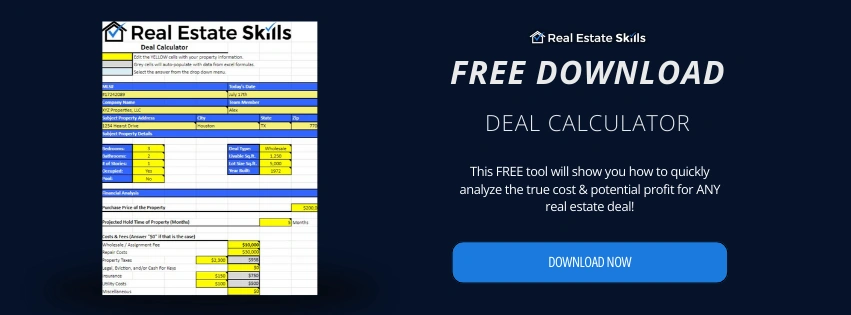
Run Your South Carolina Offer Before You Make It
Our free deal calculator spreadsheet works backward from the after-repair value to your maximum allowable offer, with room for rehab, closing costs and your profit. Enter the South Carolina costs from the table above, including attorney fees on both closings and the deed recording fee, to see the most you can offer.
Step 6: Sign In Your Entity And Keep The Address Off Every Channel
Sign the purchase contract in your company's name, with language that lets you assign it to your joint venture or partner entity. Then share the property's details only with the partner you already agreed terms with. Posting it, texting other investors or shopping it to a second partner is marketing.
Once a seller agrees, the contract goes in the name of your company, not your personal name. If you haven't formed one yet, South Carolina business entities are filed through the Secretary of State's Business Entities Online system. Have your attorney confirm the contract lets you assign it to the joint venture entity or your partner's company, and tell the seller plainly that you may do that. A seller who learns about the assignment for the first time at the closing table is far more likely to balk or delay.
A few practices to follow when you sign:
- Use your partner's proof of funds, with their permission, when the seller or agent asks for it. They're the one buying.
- Let your partner fund the earnest money if your joint venture agreement says they will.
- Only sign deals you or your partner can actually close. The whole route depends on a buyer who's already committed.
- Put your role in plain English. A sentence in your offer saying you're buying with a joint venture partner and may assign to that venture isn't legally required, but it prevents disputes.
Then keep the property to yourself and your partner. That means no posts, no texts with photos, no "coming soon" emails, and no conversations with other investors about the address or condition. The Commission's guidance lists the address, photos, square footage, condition, year built and the neighborhood as details that likely count as marketing.
What if your partner passes on a house you've already put under contract? Don't send it to someone else. That's exactly the shopping the law prohibits. Your options are to buy it yourself under Route 2, or to cancel within your contract's inspection period. That's another reason to write that period into every contract.
Step 7: Assign To The Joint Venture, Or Close It Yourself
On the partner route, assign your contract to the joint venture entity or your partner's company once they've approved the house, using an assignment your attorney prepared or reviewed. On the buy-first route, there's no assignment. You close on the purchase in your own entity and record the deed.
- Partner route. Once your partner has seen the house and confirmed the numbers, you sign an assignment of the purchase contract to the joint venture entity or the company you agreed on. The joint venture agreement spells out who pays what and how the profit is split. Your attorney should prepare or review both documents. If you're new to assigning the contract, the mechanics are the same as anywhere. What's different in South Carolina is who you're allowed to assign it to and how you found them.
- Buy-first route. You don't assign anything. You close the purchase yourself, the deed is recorded in your company's name, and the house is yours. From there you can renovate it, rent it, or sell it as is after a light cleanup, which investors call wholetailing. If you plan to renovate before you resell, our guide to renovating and reselling in SC covers that side.
Step 8: Close Through The Attorney's Office
Your South Carolina attorney runs the title work, prepares or reviews the deed, and supervises the closing. On a joint venture assignment, that's one closing. On a buy-first deal, it's two separate closings, and the resale can't start until your purchase deed is recorded.
On the partner route, the closing looks like a normal sale. The joint venture entity closes with the seller at your attorney's office, and you're paid under the joint venture agreement, at closing or when the venture sells, depending on what you agreed.
Reselling After You Buy
On the buy-first route, you'll have two closings: your purchase, then your sale. You can do them on the same day, but the order is fixed. Your purchase closes and your deed is recorded first. Only then do you market and sell the house as its owner.
Funding is where investors from other states get caught. In his conversation with Ryan, Bryan said a closing attorney can't use your end buyer's money to pay for your purchase unless the end buyer has signed a loan agreement with you. Plan to fund the first closing with your own money, a loan from one of the hard money lenders who work with investors, or a transactional lender who lends for a day. Your attorney can tell you which lenders they've closed with.
On the resale, you're the seller, so the deed recording fee is yours. If you hold a real estate license, South Carolina also requires you to disclose it to your buyer, including on the first page of the contract.
South Carolina Wholesaling FAQs
Final Thoughts: Your First South Carolina Offer
Under South Carolina's 2024 law, the buyer comes first or the deed does. Before your first offer, line up your attorney, choose your route, and if you're partnering, get the buy box in writing. Then keep the property between you and your partner until it closes.
The investors who'll do well in South Carolina under the 2024 law are the ones who stop thinking of wholesaling as "find a house, then find a buyer." Here the buyer comes first, or the deed does.
If you're starting this month, line up your attorney and your route first, and if you're partnering, get the buy box in writing. Make your first offer only after that, and keep the property between you and your partner until it closes.
Start Your South Carolina Business The Right Way
My free training shows how we find discounted properties and structure deals from first call to closing, so you can apply it to a partner-first or buy-first business that fits South Carolina's rules.
Watch The FREE Training →
About The Author
Founder & CEO, Real Estate Skills
Alex Martinez is the Founder & CEO of Real Estate Skills. He has wholesaled and flipped houses for over 14 years, been part of 1,000+ real estate transactions, and personally acquired 55+ residential investment properties. Through Real Estate Skills, he has trained 6,000+ investors nationwide in finding, analyzing and closing deals.
Real Estate Skills is not a law firm. This article is for educational purposes only and isn't legal, tax or financial advice. South Carolina's real estate laws, the Real Estate Commission's guidance and closing practices can change, and how they apply depends on your facts. Consult a licensed South Carolina attorney before structuring or closing any real estate transaction.

👉FREE Training
How To Consistently Wholesale, Flip Houses, & Invest In Rental Properties From The MLS
(Without Spending $1 On Marketing)

Alex Martinez, the founder of Real Estate Skills, is known for his strong, practical expertise in real estate, starting from a beginner with no family connections in the industry to acquiring over 55 real estate deals, including wholesale and flips, within his first year.
He has dedicated his career to providing cutting-edge education and resources for real estate professionals. He emphasizes the importance of self-taught knowledge through mentors, books, and hands-on experience.
His journey from earning a modest income to becoming a successful real estate entrepreneur and educator showcases his expertise and dedication to the field.

Ryan Zomorodi, co-founder and COO of Real Estate Skills, leverages his experience from a diverse background in real estate investment, construction management, and entrepreneurship to provide comprehensive education in the real estate sector.
His expertise is rooted in hands-on experience, extensive industry knowledge, and a commitment to empowering others through education.
Ryan's journey reflects a blend of practical experience and entrepreneurial success, contributing to his role in developing a platform that educates and supports aspiring real estate professionals.
Read Ryan's Full Bio >>
