
Kiavi Reviews 2026: Legit Hard Money Lender or Not?
Oct 02, 2026

Written by
Alex Martinez, Founder & CEO, Real Estate Skills. Has wholesaled and flipped houses for over 14 years, been part of 1,000+ real estate transactions, and personally acquired 55+ residential investment properties. Has trained 6,000+ investors nationwide.
Reviewed by
Ryan Zomorodi, Co-Founder & COO, Real Estate Skills. Has worked with Kiavi on his own deals and walked through a live Kiavi application on camera; verified this review's rates, terms, and requirements against Kiavi's published materials in October 2026.
Publication history: Originally published January 2, 2024. Updated October 2, 2026 with Kiavi's current rates and requirements, a real loan quote from a live Kiavi application, ratings from five review sites, an honest look at the most common complaints, and what Figure's acquisition of Kiavi means for borrowers. Rates, terms, and lending details verified by Ryan Zomorodi, Co-Founder & COO of Real Estate Skills.
Kiavi reviews are mostly positive. It's a legitimate, licensed hard money lender (NMLS #1125207) that has funded $30+ billion and holds a 4.6 on Trustpilot from 783 reviews. Borrowers praise the speed and online platform; complaints center on communication and closing delays. Kiavi is now owned by Figure.
Disclosure: Real Estate Skills is a Kiavi affiliate. If you take a loan through our Kiavi links, we may earn a commission at no extra cost to you. It doesn't change our scores or what we tell you about Kiavi, complaints included. This review is educational, not financial or lending advice.
If you're reading Kiavi reviews, you're probably about to borrow six figures from a company you found online, to buy a house that needs work. That should make you a little nervous. Good. Nervous investors read the fine print, and the fine print is where hard money deals go right or wrong.
Here's my short answer. Kiavi is real, it's big, and on most flips it's fast. Our team has worked with Kiavi on our own deals, and plenty of our students are funding flips with Kiavi money right now. But it isn't perfect. The complaints are real, the rate in the ad isn't the rate most people get, and as of September 1, 2026, Kiavi has a new owner. Figure Technology Solutions bought the company, and Kiavi's rental loans now come from Figure's lending arm. None of the other Kiavi reviews I found mention that yet.
So I'll walk you through what Kiavi actually lends on, what it really costs (including a live quote my co-founder Ryan pulled on a San Diego flip), what borrowers love and hate, and who should borrow somewhere else. One tip before you start: Kiavi will ask for a line-item scope of work before it funds your rehab, so grab our free Scope of Work Template now and you'll be ready when they ask.
What Is Kiavi?
Kiavi is a private lender that helps real estate investors fund fix-and-flip, rental, and bridge deals fast. Formerly called LendingHome, it was founded in 2013, has funded more than $30 billion in loans, lends in 49 states plus DC, and has been owned by Figure since September 2026.
If the name sounds new, it's because LendingHome rebranded as Kiavi in November 2021. It's the same company, team, and license. You'll also see it called Kiavi Funding (the legal name of its lending company, which used to be Kiavi Funding, Inc. and is now Kiavi Funding, LLC). All of those are the same lender.
Kiavi isn't a bank, and it doesn't do mortgages on the home you live in. It's a private lender for investors only, built around one idea: price the loan on the property, not on your paycheck. That's what makes it a hard money lender. What makes it different from the hard money lender down the street is that the whole process runs online, from your first quote to your last draw.
The scale is real. Kiavi says it has funded more than 100,000 projects, originated a record $7.8 billion in 2025 alone, and seen 95% of its loans end in a successful exit, against what it calls an industry average of about 75%. Those are Kiavi's own figures, but the $30 billion total is backed up by independent coverage of the Figure deal.
What Makes Kiavi Stand Out?
- Instant online quotes. You see real rates and terms in the portal after a soft credit pull, before you talk to anyone.
- No appraisal on flips. Kiavi values the property in-house using more than 20 factors, which removes one of the most common closing delays.
- Digital draws. You request rehab money with photos in the app, and Kiavi's own draw team releases it, usually without an in-person inspection.
- In-house servicing on flip loans. The company that makes your bridge loan also services it through payoff, so you're not handed off to a stranger.
- A pre-qualification letter on demand. You can download one to send with offers, any time of day.
Is Kiavi Legit?
Yes. Kiavi is a licensed lender (NMLS #1125207) that has operated since 2013, funded more than $30 billion in investor loans, and was bought by publicly traded Figure in 2026. It holds a 4.6 on Trustpilot from 783 reviews. Complaints focus on service and delays, not fraud.
"Is it legit?" is really two questions. Is this a real lender that will actually fund my loan? And will they treat me fairly? Here's the evidence on the first one:
- It's licensed. You can look up NMLS #1125207 yourself at nmlsconsumeraccess.org. That's the national registry every licensed lender is listed in.
- It's been around. It has operated for 13 years, first as LendingHome, then as Kiavi.
- Institutional money backs it. As part of the Figure deal, a joint venture between Figure and the investment firm Sixth Street bought the loans already on Kiavi's books. That's independently reported, and it means professional investors looked at Kiavi's loans and paid for them.
- A public company just paid $717 million for it. That deal went through due diligence most borrowers will never see.
The second question is where reviews come in, and the answer is mostly yes, with real exceptions. The complaints section below covers them. Nothing in what we found suggests Kiavi is a scam. What we found is a big lender that sometimes moves slower and communicates worse than its marketing promises.
How Kiavi Works (Step-By-Step)
Kiavi's process runs online. You choose a loan type, enter your experience and deal numbers, and get real quotes after a soft credit pull. You can download a pre-qualification letter to send with offers. Then a rep collects your scope of work and LLC documents, underwriting approves, and you close.
The fastest way to understand Kiavi is to watch someone apply. So that's what we did. My co-founder Ryan filled out a real Kiavi application on camera for a flip he was looking at in San Diego, and the steps below follow exactly what he saw.
One tip before you start, straight from Kiavi: once you've found a property, call a Kiavi rep before you submit. Five minutes on the phone can save you a rejected application.
How To Get A Hard Money Loan In 2026!
Ryan Zomorodi walks through a live Kiavi application on a San Diego flip, from picking a loan type to real rate quotes and a pre-qualification letter.

Step 1: Choose Your Loan Type
Kiavi's application opens with one question: what kind of project is this? You'll see four options:
- Bridge, fix-and-flip, or fix-to-rent: buy, renovate, then sell or rent out and refinance.
- New construction: tear down and rebuild, add a second story, or add accessory dwelling units (ADUs, the small backyard homes many cities now allow).
- Rental: a long-term loan on a property that's ready to rent.
- I'm not sure: if you're still deciding.
Step 2: Tell Kiavi Your Experience
Next, Kiavi asks how many properties you've flipped or "exited" in the last 24 months. A refinance counts as an exit. So if you bought a house, fixed it up, rented it, and refinanced, that's one. If the answer is zero, pick none. Kiavi lends to first-time flippers, but your experience affects your rate.
Step 3: Set Up Your Account And Entity
Enter your email, phone number, name, and the state the property is in. Then verify your email and set a password. Kiavi will ask whether you'll hold title in an entity. Answer yes even if your LLC doesn't exist yet, since you can form it before closing. Then enter the property address. Don't have a property yet? Use one you're eyeing to see what terms you'd get. (Watch this part)
Step 4: Enter Your Deal Numbers
This is where you get real numbers. Kiavi asks for:
- Your estimated credit score
- Whether you'll personally guarantee the loan
- Your purchase price
- How much of the purchase you want to borrow
- Your rehab budget
- Your ARV
Ryan's advice is to start with the ARV, because it caps how much Kiavi will lend. As you type, the portal shows your loan-to-cost (how much of your purchase Kiavi is covering) and your loan-to-ARV. If you see error messages, adjust your numbers until the loan fits. (Watch this part)
Step 5: Compare Quotes And Pick Your Terms
Kiavi shows you real rate options right on screen. Ryan saw 12-month and 24-month terms at two leverage levels, from 8.25% to 10.45%. (The full side-by-side is in the rates section below.) Pick the option you want, confirm you're a U.S. citizen or permanent resident and won't live in the property, and choose a signing date. Kiavi can fund the day after you sign.
Step 6: Run The Soft Credit Pull And Get Your Letter
To lock in your quote, you authorize a credit and background check. It's a soft pull, so your score doesn't move. Ryan's came back verified at over 780. Then you see your loan estimate: monthly payment, interest rate, cash needed at closing, and estimated closing costs. You also get a pre-qualification letter you can download and send with offers.
Step 7: Submit And Finish Underwriting With Your Rep
Submit for review, and a Kiavi rep reaches out. A loan processor takes your file, and Kiavi's underwriters check that everything meets its guidelines. Have these ready, because they're what slow most files down:
- A line-item scope of work. Every repair, room by room, with a cost for each.
- Your LLC's operating agreement. The document showing who owns and runs the company.
- Proof of insurance on the property.
Once you're approved, Kiavi sends the loan documents to your title company. You sign, and Kiavi wires the money for closing. (Watch this part)
Step 8: Draw Your Rehab Money As You Go
Your rehab budget doesn't come to you at closing. It sits in a draw account. As you finish each phase of work, you submit a draw request with photos through Kiavi's portal or mobile app. Kiavi's in-house draw team reviews it and releases the money, usually without an in-person inspection. You only pay interest on money once it's drawn.
Kiavi Will Ask For Your Scope Of Work. Have It Ready.
Before Kiavi funds a dollar of your rehab, it wants a line-item scope of work, meaning every repair, room by room, with a cost next to it. A vague budget slows underwriting and can shrink your rehab funding. Our free Scope of Work Template walks you through every item from the roof to the foundation, so you can hand Kiavi, and your contractor, a clear plan on day one.

Can Kiavi Give You A Proof Of Funds Letter?
Yes. After you finish the application, Kiavi's portal gives you a pre-qualification letter you can send with offers, showing you're pre-qualified for a loan up to your purchase price on that property.
It isn't a final approval. It depends on Kiavi's underwriting, and Kiavi doesn't issue pre-approvals. Listing agents and sellers still take it seriously, because it shows real capital behind your offer. (Watch this part)
How Long Does Kiavi Take To Close?
Kiavi advertises fix-and-flip closings in as few as 7 days. It can fund the day after you sign. Rental (DSCR) loans take longer, typically 25 to 35 days from application, because they need an appraisal.
On your first loan, plan for two to three weeks. The fastest closings go to repeat borrowers with clean files. The slowest come from missing documents, which is the most common complaint in Kiavi's reviews.
Kiavi Can Fund The Deal. You Still Have To Find It.
Hard money only works when you buy right. Every number in this review, from the ARV to the rehab budget, starts with finding a property at the right price. Our FREE Training walks you through how we find deals on the MLS and turn them into wholesales, flips, and rentals, without spending a dollar on marketing. Watch it today, then bring your next deal to Kiavi with numbers that work.
Watch The FREE Training →Kiavi Loan Products & Programs
Kiavi offers four kinds of investor loans: fix-and-flip/bridge loans for buying and renovating, DSCR rental loans for long-term holds, new construction loans for ground-up builds, and jumbo loans up to $5 million. Every loan is for non-owner-occupied investment property, and all are quoted online without income verification.
Kiavi doesn't do mortgages for the house you live in. Everything it offers is built for investors, and each loan matches a different way of making money on a property. Here's the lineup as of October 2026.
| Loan | Best for | Key terms | Rates from |
|---|---|---|---|
| Fix-and-flip / bridge | Buying and renovating to sell or refinance | $100,000–$5 million; up to 100% of purchase and 100% of rehab, capped at 80% of ARV; 12, 18, or 24 months | 8.25% |
| DSCR rental | Holding a rental long term, or the refinance step of a BRRRR | $100,000–$2 million; up to 80% of value; 30-year fixed, 5/1 or 7/1 ARM | 6.125% |
| New construction | Ground-up builds, infill lots, build-to-rent | $150,000–$10 million; up to 85% of total cost and 70% of ARV; 12, 18, or 24 months | 9% |
| Jumbo | Larger, higher-value projects | Loans up to $5 million | Not published |
Rates are Kiavi's advertised starting rates. Most borrowers pay more. The new construction figures come from Kiavi's AI reference page, so confirm them with a rep.
Fix-And-Flip And Bridge Loans
This is Kiavi's core product, and what most people mean when they call Kiavi a hard money lender. You'll see it called a fix-and-flip loan, a bridge loan, or a rehab loan. At Kiavi, they're the same short-term loan. "Fix-and-flip" is the version with a rehab budget attached. "Bridge" also covers buying a house that needs little or no work, or moving fast before longer-term financing is in place.
The loan covers up to 100% of the purchase price and up to 100% of your rehab budget, capped at 80% of the ARV. Kiavi doesn't require an appraisal, and your rehab money comes through the draw process covered above.
There are three ways to use it:
- New purchase: buy and renovate a property, closing in as few as 7 days.
- Delayed purchase refinance: if you bought with your own cash, you can pull that cash back out within six months of buying.
- Seasoned finance: if you've owned the property six months or longer, a bridge loan can give you extra runway to finish.
You can check current terms on Kiavi's fix-and-flip loan page and see how Kiavi's bridge loans differ. New to flipping? Start with our guide on how to flip a house before you price a loan.
DSCR Rental Loans
A DSCR loan is a long-term loan on a rental, qualified on the rent the property brings in rather than your personal income. You won't need W-2s or tax returns. As of September 2026, Kiavi's rental loans are made by Figure Lending, Kiavi's new parent company's lender.
You can choose a 30-year fixed rate, a 5/1 or 7/1 adjustable rate (fixed for five or seven years, then it adjusts with the market), or interest-only payments. Kiavi uses the loan for purchases, refinances, and cash-out refinances. A cash-out refinance means borrowing against equity you've built and taking the difference in cash. You can do one after you've owned the property 90 days, or right away if it's free and clear or currently on a Kiavi bridge loan. You'll find current pricing in Kiavi's rental loan terms.
That last part matters if you're doing the BRRRR method: buy, rehab, rent, refinance, repeat. You can buy and renovate with a Kiavi bridge loan, then refinance into a Kiavi rental loan without switching lenders or waiting out a seasoning period.
Does Kiavi do portfolio loans? Not as a single blanket loan, based on Kiavi's current product pages. It finances multiple rentals as separate loans, and you can keep adding properties as your portfolio grows.
New Construction Loans
Kiavi's construction loans fund ground-up building: tearing down and rebuilding, building on an infill lot (an empty lot in an existing neighborhood), or building to rent. Ryan mentioned he builds ADUs himself. Kiavi says loans run from $150,000 to $10 million, cover up to 85% of total project cost, and come with 12, 18, or 24 month terms plus extension options.
Two details stand out. Kiavi doesn't require building permits to be issued before closing, only before your first draw. It also doesn't require a third-party appraisal. Both remove common causes of delay on construction loans.
Jumbo Loans
For bigger projects, Kiavi offers jumbo loans up to $5 million. It doesn't publish separate rates or terms for jumbo deals, so you'll need to talk to a rep. Most of our readers won't need this, but it's there if your deals grow.
Which Kiavi Loan Should You Choose?
- Buying a house to renovate and sell: fix-and-flip.
- Buying a turnkey rental to hold: DSCR rental.
- Renovating, then renting and refinancing: start with fix-and-flip, then refinance into DSCR. That's the BRRRR path.
- Building from the ground up: new construction.
- Buying the home you'll live in: not Kiavi. You'll need a conventional mortgage.
Kiavi Requirements: Credit Score, LLC & Loan Minimums
Kiavi requires a 660 credit score (680 through a broker), an LLC or other business entity, U.S. citizenship or permanent residency, and a loan of at least $100,000 on an investment property. You don't need flipping experience, W-2s, or tax returns. Kiavi lends in 49 states plus DC, not Utah.
Most investors find out they don't qualify for a hard money loan after they've already signed a purchase contract. Don't be that investor. Check these before you make the offer.
| Requirement | Fix-and-Flip / Bridge | DSCR Rental |
|---|---|---|
| Minimum credit score | 660 (680 through a broker) | 660 (680 through a broker) |
| Borrower | LLC or other business entity | LLC or other business entity |
| Citizenship | U.S. citizen or permanent resident | U.S. citizen or permanent resident |
| Experience | None required | None required |
| Loan amount | $100,000–$5 million | $100,000–$2 million |
| Income documents | None | None |
| Cash reserves | Set deal by deal | No minimum liquidity requirement |
| Property | Non-owner-occupied only | Non-owner-occupied only |
| Rent coverage | Not applicable | DSCR as low as 0.8x |
What Credit Score Does Kiavi Require For A Fix And Flip Loan?
Kiavi generally requires a 660 FICO score for direct borrowers in 2026, and 680 if your loan comes through a mortgage broker. Scores of 720 or higher typically get better pricing. Kiavi checks your credit with a soft pull, so getting a quote won't affect your score.
You'll see other numbers online. Some lender directories list 620, and other sites say 640. I'd go by Kiavi's own figure of 660, and Kiavi notes that requirements can change with the product and the market.
The soft pull is a real advantage. A hard pull is the kind that can drop your score a few points, and lenders usually run one when you formally apply. Kiavi's soft pull works like checking your own score on a credit app. When Ryan ran his live application, the portal verified his score at over 780 and showed him real quotes, with no impact on his credit. (Watch this part)
Do You Need An LLC For A Kiavi Loan?
Yes. Kiavi lends only to business entities, such as an LLC or a corporation, in every state it serves. You can't take a Kiavi loan in your personal name.
You don't need the LLC on day one, though. As Ryan points out in the video, you can say yes to the entity question during the application and form the LLC before closing. Just don't leave it to the last week, because Kiavi will ask for your operating agreement (the document showing who owns and runs the LLC) during underwriting.
The LLC doesn't fully take you off the hook. The application asks whether you'll personally guarantee the loan, which means promising to repay it yourself if the LLC can't. Ryan said yes, because a personal guarantee gets better rates.
What Is Kiavi's Minimum Loan Amount?
Kiavi's minimum loan is $100,000 on both fix-and-flip and DSCR rental loans. The maximum is $5 million on fix-and-flip and $2 million on DSCR, and Kiavi caps total loans at $8 million per borrower.
That minimum rules out a lot of cheap markets. Say you find a $70,000 house in the Midwest that needs $25,000 of work. Your total project cost is $95,000, so even if Kiavi funded every dollar, the loan would still fall short of its $100,000 floor. Deals like that need a local lender, a private lender, or your own cash.
Do You Need Experience To Get A Kiavi Loan?
No. Kiavi lends to first-time flippers. Experience still matters, though, because it moves your price.
The application asks how many properties you've flipped, or refinanced into a rental, in the last 24 months, and more completed projects usually means a better rate and more leverage. Your first Kiavi loan will likely cost more than your fifth.
What Kiavi Won't Lend On
Every Kiavi product is an investment property loan, which rules out a lot. Kiavi won't lend on:
- A home you live in. That means no owner-occupied mortgages, no VA loans, and no home equity lines on your own house.
- Mixed-use or commercial property, like a building with a store downstairs and apartments upstairs.
- Mobile homes (manufactured homes on a permanent foundation can qualify for a flip loan).
- Rural property zoned agricultural with 4 or more acres.
- Anything in Utah. It's the only state Kiavi doesn't lend in.
Kiavi also isn't a home buyer. If you're a homeowner looking to sell your house fast, Kiavi lends to the investors who buy houses, not to sellers.
On the eligible side: single-family homes, 2–4 unit properties, condos, townhomes, and planned unit developments (PUDs, which are homes in a community with an HOA). Manufactured homes qualify for fix-and-flip loans only.
One more state detail. Since Figure took over, bridge loans on property in Arizona, Idaho, Nevada, Oregon, and South Dakota are made by Figure Lending rather than Kiavi itself. You still apply through Kiavi. The lender's name on your documents is just different.
Does Your Rental Have To Cash Flow?
Not quite, but close. DSCR stands for debt service coverage ratio, which is the property's rent divided by its full monthly payment (principal, interest, taxes, insurance, and any HOA dues). Kiavi goes as low as 0.8, meaning the rent covers at least 80% of the payment.
For example, a rental with a $2,000 monthly payment needs at least $1,600 a month in qualifying rent. Kiavi counts the lower of your actual lease rent or 110% of the appraiser's market rent. Rental loans also require an appraisal, unlike Kiavi's flip loans.
Kiavi Rates, Fees & Terms (With A Real Quote)
As of October 2026, Kiavi advertises fix-and-flip rates from 8.25% and DSCR rental rates from 6.125%, with no application fee and an origination fee it doesn't publish. Real quotes run higher. Ryan's April 2026 quote on a San Diego flip ranged from 8.25% to 10.45%, depending on leverage.
This section is educational, not financial or lending advice. Rates and terms are Kiavi's published figures as of October 2026 and change often. Your quote depends on your credit, experience, and deal, so confirm current terms with Kiavi before you budget.
Every lender's website shows you the best rate it has ever given anyone. That's the number in the ad. What matters is the rate you get on your deal, and the fees that come with it.
Here's what Kiavi publishes.
| Kiavi's published terms (October 2026) | Fix-and-Flip / Bridge | DSCR Rental |
|---|---|---|
| Starting rate | 8.25% | 6.125% |
| Loan amount | $100,000–$5 million | $100,000–$2 million |
| Leverage | Up to 100% of purchase price, 80% of ARV | Up to 80% of value |
| Rehab funding | Up to 100% of your rehab budget | Not applicable |
| Term | 12, 18, or 24 months, interest-only options | 30-year fixed, 5/1 or 7/1 ARM, interest-only options |
| Appraisal | Not required | Required |
| Prepayment penalty | None | None after year 3 |
| Income verification | None | None (qualifies on the property's rent) |
A few terms in that table, in plain English. ARV, or after-repair value, is what the house should be worth once the renovation is done. Leverage is how much of the deal the lender pays for, and the more leverage, the less cash you bring. A prepayment penalty is a fee for paying a loan off early. Flippers want none, because paying off early is the whole plan.
One honest warning: Kiavi's own pages don't fully agree. The fix-and-flip page lists rates from 8.25%, while Kiavi's AI reference page says 7.75%. The same page that promises up to 100% of cost also says 95% in its FAQ. Treat the advertised numbers as a ceiling on what's possible, not a promise.
The Fees Kiavi Doesn't Advertise
Kiavi charges no application fee, and all fees are collected at closing. The one that matters most is the origination fee, the upfront charge for making the loan, usually quoted as a percentage. Kiavi says it's based on your final loan amount, but it doesn't publish the percentage. You'll see it on your loan estimate in the portal before you commit.
Ask about three more before you sign:
- Rate buydown points. Optional money paid upfront to lower your rate. Make sure you chose to pay them, and that they didn't just appear on your settlement statement.
- Extension fees. What it costs if your project runs past the loan term. On a flip, things run long.
- Higher-leverage pricing. Borrowing more costs more upfront. In Ryan's quote, the top leverage tier added 0.25% to the origination fee.
You Pay Interest Only On Money You've Used
Kiavi charges interest only on funds actually disbursed, which it calls "interest as drawn." Your rehab money sits in a draw account until you complete each phase of work. You don't pay interest on it until it's released. Your payment starts lower and climbs as the renovation moves forward.
Ryan's Real Kiavi Quote, Side By Side
Ryan ran a live Kiavi application on camera in April 2026 for a flip he was looking at in San Diego. It's a two-bed, one-bath house of just over 1,000 square feet, listed at $595,000. His numbers: a $550,000 purchase price, a $65,000 rehab budget, and a $750,000 ARV. Then he priced the same deal two ways. (Watch this part)
💡 Same Flip, Two Kiavi Quotes
| Borrow More | Borrow Less | |
|---|---|---|
| Purchase loan | $500,000 (about 91% of price) | $450,000 (about 82% of price) |
| Rehab funded | $65,000 | $65,000 |
| Your down payment | $50,000 | $100,000 |
| 12-month rate | 10.45% | 8.25% |
| Starting monthly payment | $4,354 | about $3,094 |
| Payment once rehab is fully drawn | about $4,920 | about $3,541 |
| Extra origination | +0.25% (about $1,400) | None |
The $4,354 is Kiavi's own quote, and it's exactly interest-only on $500,000 at 10.45%. The rest is our math, using the same interest-only structure. Kiavi also quoted the smaller loan at 9.25% on a 24-month term. (Watch this part)
Here's what that means. Putting $50,000 more of your own cash into the deal drops the rate by 2.2 points. On a six-month flip, that saves roughly $7,500–$8,300 in interest, plus about $1,400 in origination. Call it $9,000–$9,700 saved, an 18–19% return on that extra $50,000 in six months.
So which is better? It depends on what else that $50,000 could do. If it's sitting in a savings account, borrow less and save the interest. If it's the down payment on your next flip, the higher rate may be worth paying. That's the real decision behind every hard money quote, and most beginners never run it. Results vary, and your rate depends on your own credit, experience, and deal.
Does Kiavi Do 100% Financing?
Close, but it isn't "no money down." Kiavi advertises up to 100% of the purchase price and 100% of the rehab for qualified borrowers, capped at 80% of ARV. You still pay the origination fee and closing costs, and Kiavi may want cash reserves left over after closing.
In practice, the 80% ARV cap usually binds first. On Ryan's deal, 80% of a $750,000 ARV is $600,000, which covers most of the $615,000 total cost but not all of it. The more experience and credit you bring, the closer you get to the top tier.
What Moves Your Kiavi Rate
Kiavi says it prices each loan using more than 20 factors about the property, such as location, square footage, and market data. Then it adjusts for you:
- Credit. 660 gets you in the door. Kiavi says 720 or higher typically qualifies for better pricing.
- Experience. The application asks how many flips you've sold, or refinanced into a rental, in the last 24 months.
- Leverage. Borrow more, pay more, as Ryan's quote shows.
- Term. In Ryan's quote, the 24-month loan cost a point more than the 12-month.
- Personal guarantee. Ryan left it on, which means promising to repay personally if the LLC can't, specifically to get a better rate.
- Repeat business. Kiavi says borrowers who come back may get reduced origination fees and rates.
Run Your Numbers Before Kiavi Runs Them For You
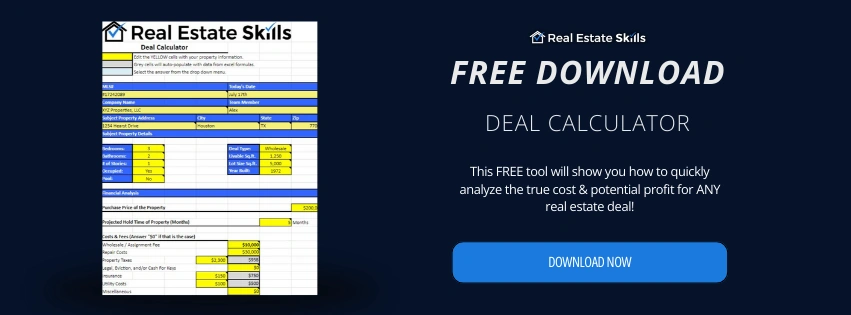
Kiavi will size your loan off your ARV and price it off your deal, so know your numbers first. Our free Deal Calculator spreadsheet works out your Maximum Allowable Offer, which is the most you can pay for a house and still hit your profit, plus your rehab budget and profit spread. Plug in your quote and you'll know in minutes whether the deal still works at 10.45%, or only at 8.25%.
What Real Investors Say: Kiavi Reviews, Ratings & Complaints
Kiavi's reviews are strongest where the volume is highest: 4.6 on Trustpilot from 783 reviews and 4.3 on Google from 715. Borrowers praise responsive loan officers, the online portal, and fast draws. The complaints repeat: slow underwriting, duplicate document requests, surprise fees, and closings that slip past the promised date.
Search for Kiavi reviews and you'll find two lenders. One closes deals in days and has a draw team people name in their reviews. The other loses your documents and pushes your closing back three times. Both are Kiavi. Which one you get depends a lot on your deal, your loan officer, and how ready you are when you apply.
Start with the numbers.
Kiavi ratings by site, as of October 2, 2026
| Site | Rating | Reviews | What to know |
|---|---|---|---|
| Trustpilot | 4.6 / 5 | 783 | Kiavi invites borrowers to review and pays for a Trustpilot subscription. 86% are five stars, 6% are one star. |
| 4.3 / 5 | 715 | As shown on Kiavi's BiggerPockets lender page, which pulls in its Google reviews | |
| Bankrate | 4.5 / 5 | 54 | Lifetime ratings only; 89% would recommend; no reviews in the past 12 months |
| HardMoneyHome | 2.0 / 5 | 22 | Small sample, as shown in Google's results |
| Yelp | 1.7 / 5 | 13 | Small sample, tied to Kiavi's Pittsburgh office listing |
Why The Ratings Disagree
The big sites skew positive, and the small ones skew negative. That isn't a contradiction. It's how review sites work.
Kiavi asks its borrowers for reviews, and the happy ones answer. That's why Trustpilot leans so heavily toward five stars. Asking isn't against Trustpilot's rules, but it does tilt the score. Meanwhile, nobody goes to Yelp to review a hard money lender unless something went wrong. Thirteen Yelp reviews from frustrated borrowers tell you what can go wrong. They don't tell you how often it does.
So here's how I read them. Use the big numbers to answer "is this a real company that closes loans?" The answer is clearly yes. Use the one-star reviews to learn which mistakes to avoid. Kiavi publicly replies to about 44% of its negative Trustpilot reviews, usually within two weeks, so you can see how it responds when a deal goes sideways.
What Borrowers Praise
The same points show up across 2026 Trustpilot and Google reviews:
- Named loan officers who pick up the phone. Happy reviewers almost always mention their rep by name. Several say they've closed 10 or more loans with the same person.
- The draw team. A draw is a payment from your rehab budget, released as each phase of work gets done. Multiple reviewers single out Kiavi's draw team for fast, clear releases, and that's rare praise for any hard money lender.
- The online portal. You can see your rate and terms yourself instead of waiting for someone to email a term sheet.
- Repeat-borrower experience. Investors on their third, fourth, or tenth loan describe the process getting smoother each time.
On Reddit, the top reply in one popular thread came from an investor who said they'd done more than 80 flips with Kiavi and called it the fastest lender they'd used to close and fund.
Kiavi Complaints: What Goes Wrong
The complaints are just as consistent, and they matter more, because they're the ones that can cost you a deal.
- Slow underwriting and closings that slip. Underwriting is the lender's review of you, the property, and your paperwork before it approves the loan. Trustpilot's own summary of recent reviews flags slow underwriting timelines. One September 2026 reviewer said their settlement was pushed back three times, and it strained the relationship with their seller.
- The same documents, requested twice. Reviewers describe uploading paperwork, then being asked for it again a week later, often by a different person on the team.
- Hard to reach when something breaks. The praise names one great rep. The complaints describe being handed between several people, or leaving voicemails that never get returned.
- Fees you didn't expect. One borrower said they first saw a buydown point fee on the settlement statement at the title company. A buydown point is money you pay upfront to lower your interest rate. Another borrower's dispute was over a $2,400 extension fee, which is what a lender charges to give you more time past your loan's maturity date.
- Rejections even with good credit. On Reddit, an investor said Kiavi's online portal rejected them despite good credit. Kiavi sets its own reserve requirements (the cash it wants you to have left after closing) deal by deal, so a strong score alone doesn't guarantee approval.
- Appraisals that move. Kiavi skips the appraisal on flip loans, but its rental loans require one. One BiggerPockets poster said their appraisal changed three times over five weeks, and they walked away.
Some of these are Kiavi's fault. Some come with hard money in general. You can avoid most of them if you know they're coming.
How To Avoid The Most Common Kiavi Complaints
- Call a Kiavi rep before you apply. Kiavi itself recommends this. A rep can tell you upfront whether your deal fits, instead of the portal rejecting it.
- Upload everything at once. Have your LLC's operating agreement, a line-item scope of work, and your insurance ready on day one. Most duplicate requests happen when a file arrives in pieces.
- Ask for every fee in writing before closing. That means origination, points, any rate buydown, and the extension fee if you run long. Nothing should be new when you sit down at the title company.
- Don't promise your seller Kiavi's fastest close. Kiavi advertises closings in as little as 7 days. On your first loan, give yourself two to three weeks of cushion in the contract.
- Ask who will service your loan. Since Figure bought Kiavi, rental loans are made by Figure Lending and serviced by a third party. Know who you'll be paying, and who approves your draws, before you sign.
📓 From The Field
Ryan, my co-founder, has worked with Kiavi a number of times and recommends it to a lot of our students, many of whom are funding flips with Kiavi money right now. When he ran a live application on camera for a San Diego flip, the credit check was a soft pull, his quote came back in minutes, and the portal produced a pre-qualification letter he could send with offers. What we can't vouch for yet is life after the Figure acquisition. It's too new. If your loan is mid-process, ask your rep directly what's changing.
Kiavi Is Now Owned By Figure: What Changes For Borrowers
Figure Technology Solutions completed its $717 million acquisition of Kiavi on September 1, 2026. Kiavi's brand and platform continue, but its DSCR rental loans are now made by Figure Lending LLC, as are bridge loans in five states. Before signing, confirm who funds your loan, who services it, and who approves draws.
This is the biggest change at Kiavi in years, and almost nobody reviewing Kiavi has written about it.
Here's what happened. Figure announced a deal to buy Kiavi on June 10, 2026, valued at $717 million, and closed it on September 1. Figure bought Kiavi's technology and operating business. A separate joint venture between Figure and the investment firm Sixth Street bought the loans already on Kiavi's books. Kiavi's CEO, Arvind Mohan, moved to Figure as Chief Business Officer. Figure is a publicly traded company on the Nasdaq, so Kiavi now sits inside a company that reports its results to shareholders. (Figure's announcement)
For you as a borrower, the front door looks the same. You still go to kiavi.com, see your rate in the same portal, and work with Kiavi's team. What's changed is the company behind some of the loans.
Who actually makes your Kiavi loan, as of October 2026
| Loan | Lender on your documents | NMLS ID |
|---|---|---|
| Fix-and-flip / bridge, most states plus DC | Kiavi Funding, LLC | 1125207 |
| Fix-and-flip / bridge in AZ, ID, NV, OR, SD | Figure Lending LLC | 1717824 |
| DSCR and rental loans, every state | Figure Lending LLC | 1717824 |
NMLS is the national licensing registry for lenders. You can look up either ID at nmlsconsumeraccess.org. Kiavi's own disclosure lists Arizona under both companies, so if you're buying in Arizona, ask which one applies to you. (Kiavi's disclosures)
Is This Good Or Bad For Borrowers?
Honestly, it's too early to say, which is why we left "servicing after the acquisition" unrated in our scorecard.
The case for good news is money. Figure's CEO said the deal adds Kiavi's lending technology to Figure's marketplace while preserving relationships with Kiavi's investor customers. A public parent and an institutional partner buying the loan book suggest Kiavi will keep having capital to lend. For a hard money borrower, a lender that keeps funding is the whole game.
The case for caution is change. Integrations bring new systems, new paperwork, and new people. The most common complaints about Kiavi are already about handoffs between staff and duplicate document requests, and a merger rarely makes those better in the first few months. Kiavi's rental loans already go to an outside company for servicing (collecting your payments and handling your loan after closing), so if you're financing a rental, you'll likely deal with three different names.
None of that is a reason to avoid Kiavi. It is a reason to ask more questions than you would have a year ago.
Five Questions To Ask Before You Sign
- Which company is the lender on my loan documents? Kiavi Funding or Figure Lending.
- Who will service my loan after closing, and where do I send payments?
- Who approves my draws, and has the draw process changed since September?
- Will anything about my terms, fees, or timeline change if my loan was already in process when the deal closed?
- How do I confirm payoff wiring instructions? Kiavi takes payoffs on bridge loans by wire. Always confirm wiring instructions by calling the servicing number listed on kiavi.com, never from an email alone. Wire fraud on real estate closings is common, and a single fake email can cost you the whole payoff.
"Did Kiavi Shut Down?"
No. If you've seen a review site rating Kiavi 1 out of 10 and saying it shut down, read it closely. That site reviews Kiavi as an investment platform for people buying shares of its loans, a program Kiavi stopped offering new notes for back in 2019. It has nothing to do with borrowing. As of October 2026, Kiavi's lending business is open and funding loans in 49 states plus DC.
Kiavi Reviews: Pros And Cons
Kiavi's biggest strengths are high leverage (up to 100% of purchase and rehab, capped at 80% of ARV), no appraisal on flips, and real quotes online without a hard credit pull. Its biggest weaknesses are slow underwriting complaints, unpublished origination fees, a $100,000 minimum, and no lending in Utah.
| Pros | Cons |
|---|---|
| Up to 100% of purchase and 100% of rehab, capped at 80% of ARV | Advertised rates are best case; Ryan's real quote hit 10.45% at high leverage |
| No appraisal on fix-and-flip loans | Origination fee isn't published until you get your quote |
| Real quotes online with a soft credit pull | Recurring complaints about slow underwriting and slipped closings |
| No experience required, 660 credit minimum | $100,000 minimum loan rules out cheap markets |
| No prepayment penalty on flip loans | LLC required; no loans in your personal name |
| Digital draws, and you pay interest only on money drawn | No lending in Utah, and borrowers must be U.S. citizens or permanent residents |
| Loans up to $5 million in 49 states plus DC | Rental loans need an appraisal and take 25–35 days |
| Bridge to rental refinance without waiting out seasoning | New ownership under Figure makes the next few months less predictable |
Here's how I weigh it. The pros are about the loan itself, and on paper Kiavi's loan is as good as any national lender's. The cons are mostly about execution and fit. You can't fix Utah or the $100,000 minimum. You can avoid most of the execution problems by having your documents ready and leaving cushion in your closing date.
Who Is Kiavi Best For?
Kiavi is best for flippers and BRRRR investors with a 660+ credit score, an LLC, and deals over $100,000 who want high leverage and an online process. It's a poor fit for Utah deals, cheap properties, owner-occupied homes, and investors who need lots of hand-holding.
Kiavi is a strong fit if you:
- Flip houses and want to bring as little cash as possible. Up to 100% of purchase and rehab is hard to beat.
- Run the BRRRR method. You can buy and rehab with a bridge loan, then refinance into a Kiavi rental loan without switching lenders.
- Are newer but organized. Kiavi requires no experience, and the online process rewards people who upload everything at once.
- Like seeing numbers before talking to a salesperson. The portal shows real quotes after a soft pull.
- Invest out of state. Kiavi lends in 49 states plus DC, and it skips the appraisal on flips, so you can move on deals you can't visit.
Look elsewhere if you:
- Buy in Utah, or your total project costs less than $100,000.
- Want to borrow in your personal name, or you're not a U.S. citizen or permanent resident.
- Need a guaranteed close in a few days on your first loan. Kiavi can be fast, but first-time files are where the delay complaints come from.
- Want a lender who walks you through every step. Kiavi's strength is its platform, not hand-holding.
- Are buying a home to live in. You need a conventional mortgage.
Kiavi vs. Other Hard Money Lenders
Kiavi's closest fix-and-flip competitors are Lima One Capital, New Silver, and Dominion Financial. As of October 2026, Lima One advertises the lowest starting rate (7.5%), and Dominion the fastest close (48 hours) with up to 100% financing. Kiavi stands out for its 80% ARV cap and no experience requirement.
There's no best hard money lender, only the best one for your deal. A lender with a lower rate that can't lend in your state, or won't touch your property, doesn't help you. So compare these on the things that actually stop deals: leverage, credit, state coverage, and speed.
Kiavi vs. three national fix-and-flip lenders, as of October 2026
| Kiavi | Lima One Capital | New Silver | Dominion Financial | |
|---|---|---|---|---|
| Rates from | 8.25% | 7.5% | 8.5% | Not published |
| Max leverage | 100% of purchase, 100% of rehab, 80% of ARV | 95% of cost, 75% LTV*, 100% of rehab | 90% of cost, 100% of rehab, 75% of ARV | Up to 100% of cost |
| Loan size | $100,000–$5 million | $100,000–$5 million | $100,000–$5 million | Not published |
| Term | 12, 18, or 24 months | 13, 19, or 24 months | Up to 18 months | Not published |
| Minimum credit | 660 (680 via broker) | 660 | 650 | Not published |
| Experience required | No | Yes, one exit in the last 36 months | No | Not published |
| Appraisal on flips | No | Yes (valuations in 5 days or less) | Yes | No |
| Advertised close | As few as 7 days | Within 3 weeks for repeat borrowers | 7 days | As little as 48 hours |
| States | 49 + DC (not Utah) | All but AK, ND, SD, VT | 40 + DC | All but Nevada |
*Lima One's wording. It doesn't say whether the 75% is based on current value or after-repair value. All figures come from each lender's own website (Lima One's fix-and-flip program, New Silver's fix-and-flip loans, and Dominion Financial's fix-and-flip loans) and change often. "Not published" means we couldn't find it on the lender's pages, not that the lender lacks it. "Rates from" is each lender's best-case number. Get real quotes on your actual deal before you choose.
Kiavi vs. Lima One Capital
Lima One advertises a lower starting rate (7.5% vs. Kiavi's 8.25%), offers 24-hour draws, and lets you defer your origination fee until you sell, which leaves more cash in your pocket during the rehab. It also lends to foreign nationals, which Kiavi doesn't.
Kiavi wins on access. Lima One requires at least one completed exit (a flip sold, or an investment property refinanced) in the last 36 months, while Kiavi requires no experience at all. Kiavi skips the appraisal on flips, lends up to 80% of ARV, and lends in Alaska, the Dakotas, and Vermont, where Lima One doesn't. Both lend up to $5 million and both start at a 660 credit score.
For the full breakdown, read our Lima One Capital reviews.
Kiavi vs. New Silver
New Silver looks a lot like Kiavi on paper: online quotes, no hard credit pull, loans up to $5 million, and no experience required. Its credit floor is a little lower (650 vs. 660), and it publishes its origination fee, 1% to 1.75%, which Kiavi doesn't.
Kiavi offers more leverage, though: up to 100% of purchase and 80% of ARV, vs. New Silver's 90% of cost and 75% of ARV. Kiavi also skips the appraisal on flips, while New Silver requires one with interior access. If speed matters, that appraisal is a real difference. It lends in 40 states plus DC for fix-and-flip, so check yours.
Kiavi vs. Dominion Financial
Dominion is the one to look at if speed is everything. It advertises closings in as little as 48 hours, draws funded within 24 hours, no appraisal, and up to 100% of total cost. It's licensed (or exempt from licensing) in every state except Nevada, so it covers Utah, which Kiavi doesn't.
The trade-off is transparency. Dominion's fix-and-flip pages don't publish a starting rate, a credit minimum, or loan limits, so you won't know your real terms until you talk to them. Kiavi shows you real quotes in its portal before you ever speak to anyone.
Which Lender Should You Choose?
- You want the lowest advertised rate: start with Lima One, then price the same deal at Kiavi.
- You need to close in days, not weeks: Dominion, or Kiavi if you're a repeat borrower with a clean file.
- Your deal is in Utah: Kiavi and New Silver are both out. Look at Lima One or Dominion.
- Your deal is in Nevada: Kiavi or Lima One. Dominion and New Silver don't lend there.
- You're a first-time flipper: Kiavi or New Silver. Both state that no experience is required. Lima One requires at least one completed exit.
- Your deal is under $100,000: none of these four. Look for a local or private lender.
Older comparisons often list Fund That Flip. It rebranded as Upright in 2023.
Want more options? Read our reviews of RCN Capital and Easy Street Capital. If you're financing a rental instead of a flip, our guide to DSCR lenders compares 24 of them.
Our Verdict: Is Kiavi Worth It?
Yes, for most flippers and BRRRR investors. Kiavi earns a 4.0 out of 5 from us: excellent leverage and technology, competitive but not cheapest pricing, and real service complaints. Get a quote, compare it against at least one other lender, and leave cushion in your first closing date.
Here's my honest take. Kiavi does the hard part of hard money well. It gives you a lot of money on good terms, quickly, without making you prove your income or wait on an appraiser. For an investor who has found a good deal and needs to close, that's most of what you want from a lender.
What it doesn't do as well is the human part. The complaints are consistent enough that I'd plan around them rather than hope to avoid them. Upload everything on day one, ask for every fee in writing, and don't promise your seller a seven-day close on your first Kiavi loan.
I'd also never take the first quote I get, from Kiavi or anyone. On Ryan's deal, the difference between two leverage choices at the same lender was more than $9,000 over six months. The difference between lenders can be just as big. Price your deal at Kiavi and at one competitor from the comparison above, then decide.
If you want to see what Kiavi would offer on your deal, you can check your Kiavi rate here. It's a soft pull, so it won't affect your credit. (That's our affiliate link, as disclosed at the top.)
Kiavi Reviews FAQs
Quick answers to the questions investors ask most about Kiavi, current as of October 2026.
Final Thoughts On Kiavi Reviews
Most Kiavi reviews say the same thing in different words: fast, easy, sometimes frustrating. That's accurate, but it's not useful on its own. What's useful is knowing which parts you control. You can't change Kiavi's underwriting team, but you can hand them a complete file. You can't lower the advertised rate, but you can decide how much leverage is worth paying for. And you can't predict how the Figure acquisition plays out, but you can ask the five questions that tell you who's actually on the other side of your loan.
Your next step: pick the deal you're working on, run the numbers in our Deal Calculator, then get a Kiavi quote and one competing quote on that same deal. Compare the total cost, not the rate in the ad.
Financing Is The Easy Part. Finding The Deal Is The Skill.
A lender like Kiavi can close a good deal in days, but no loan can save a bad one. The investors who use hard money well are the ones who buy right in the first place. Our FREE Training shows you the exact system we use to find deals on the MLS and turn them into wholesales, flips, and rentals, the same one thousands of our students use. Watch it today, then put this review to work on your next deal.
Watch The FREE Training →
About The Author
Founder & CEO, Real Estate Skills
Alex Martinez is the Founder and CEO of Real Estate Skills. He has wholesaled and flipped houses for over 14 years, been part of more than 1,000 real estate transactions, and personally acquired 55+ residential investment properties. Through Real Estate Skills, he has trained more than 6,000 investors nationwide.
Real Estate Skills is not a lender, mortgage broker, law firm, or financial advisor, and the information in this article is provided for educational purposes only. It does not constitute legal, tax, lending, or financial advice. Loan rates, terms, fees, and eligibility requirements change often and vary by borrower, property, and state. Borrowing to invest in real estate involves risk, including the loss of your investment. Real Estate Skills is a Kiavi affiliate and may earn a commission if you take a loan through our links. Always confirm current terms with the lender and consult a licensed attorney or financial professional before you borrow.

👉FREE Training
How To Consistently Wholesale, Flip Houses, & Invest In Rental Properties From The MLS
(Without Spending $1 On Marketing)

Alex Martinez, the founder of Real Estate Skills, is known for his strong, practical expertise in real estate, starting from a beginner with no family connections in the industry to acquiring over 55 real estate deals, including wholesale and flips, within his first year.
He has dedicated his career to providing cutting-edge education and resources for real estate professionals. He emphasizes the importance of self-taught knowledge through mentors, books, and hands-on experience.
His journey from earning a modest income to becoming a successful real estate entrepreneur and educator showcases his expertise and dedication to the field.

Ryan Zomorodi, co-founder and COO of Real Estate Skills, leverages his experience from a diverse background in real estate investment, construction management, and entrepreneurship to provide comprehensive education in the real estate sector.
His expertise is rooted in hands-on experience, extensive industry knowledge, and a commitment to empowering others through education.
Ryan's journey reflects a blend of practical experience and entrepreneurial success, contributing to his role in developing a platform that educates and supports aspiring real estate professionals.
Read Ryan's Full Bio >>
