
Mashvisor Review 2026: Pricing, Accuracy & Our Honest Verdict
Sep 01, 2026

Written by
Alex Martinez — Founder & CEO, Real Estate Skills. Has wholesaled and flipped houses for over 14 years, been part of 1,000+ real estate transactions, and personally acquired 33+ residential investment properties. Has trained 6,000+ investors nationwide.
Reviewed by
Ryan Zomorodi — Co-Founder & COO, Real Estate Skills. Reviewed this article for accuracy and editorial standards prior to publication.
Publication history: Originally published August 11, 2022. Updated September 2026 with corrected pricing across all four plans, a scored verdict, an independent accuracy assessment, a pros and cons section, new API coverage, and a rebuilt FAQ. All affiliate links removed. Reviewed by Ryan Zomorodi, Co-Founder & COO of Real Estate Skills.
This Mashvisor review covers a real estate analytics platform that estimates rental income, occupancy, and returns for both long-term and Airbnb strategies. As of September 2026 it costs $49.99 to $99.99 per month billed annually. It's a solid screening tool with a real weakness: thin data outside major metros.
Most Mashvisor reviews you'll find were written by companies that sell competing software. Awning, BNBCalc, Airbtics — all of them run analytics platforms of their own, and all of them are reviewing a rival. That's worth knowing before you read any of them, including this one, so here's our position up front: Real Estate Skills doesn't sell software. We teach people how to invest in real estate. We don't earn a commission if you subscribe to Mashvisor, and there's no affiliate link on this page.
What we do have is fourteen years of underwriting deals, and a clear view of what these platforms are actually good for.
Here's the short version. Mashvisor does one job well: it takes a market you're curious about and tells you, in about fifteen minutes, whether properties there are likely to cash flow — as a long-term rental, as an Airbnb, or both side by side. That used to take a weekend and a spreadsheet. If you're deciding where to look, it earns its money.
It does not do the job people assume it does. It will not underwrite a specific deal for you. The revenue projections are estimates built from comparable properties, and how good they are depends almost entirely on how much data exists in the market you're searching. In Phoenix, they're useful. In a county of 40,000 people, they can be built on a handful of listings, and a single outlier can drag the whole number sideways.
The price has also moved. Entry is $49.99 a month billed annually — around $600 a year — and the tier most investors actually need runs about $900. There's no public free trial and no refunds. So this isn't a "sign up and poke around" purchase. You should know what you're buying before the card goes in.
The rest of this review covers what it costs right now, what it's genuinely accurate at, where it falls apart, what real users complain about, and who should skip it.
How Much Does Mashvisor Cost?
Mashvisor costs $49.99/month for Lite, $74.99/month for Standard, and $99.99/month for Professional, all billed annually. Quarterly billing costs more. There's a fourth Enterprise tier priced on request. Annual plans run roughly $600 to $1,200 per year, and Mashvisor does not offer refunds.
Mashvisor sells four tiers on the investor side. Prices below are billed annually, verified against Mashvisor's pricing page in September 2026 — check it directly before you subscribe, because these have moved before and will move again.
| Plan | Annual | Quarterly | Per Year | Who It's For |
|---|---|---|---|---|
| Lite | $49.99/mo | $49.99/mo | ~$600 | Analyzing individual properties — no comps or heatmaps |
| Standard | $74.99/mo | $99.99/mo | ~$900 | Most investors — the real entry point |
| Professional | $99.99/mo | $119.99/mo | ~$1,200 | Agents and full-time investors |
| Enterprise | Contact | Contact | Contact | API access, raw data, bulk downloads |
Lite — $49.99/month
Analyzes individual properties. Long-term and Airbnb rental estimates, occupancy, cap rate, cash-on-cash return, Investment Opportunity Scores, nationwide property search, and short-term rental regulations for over 500 cities. What it doesn't include is the thing most people want: rental comps. No heatmaps, no neighborhood analytics, no ability to customize expense assumptions.
Quarterly billing is the same $49.99, so Lite is the one tier where paying annually saves you nothing.
Standard — $74.99/month
This is the real entry point. Adds rental comps, heatmaps, neighborhood analytics, market comparison, side-by-side property comparison, custom expense inputs, and 10 Excel exports a month. Quarterly billing jumps to $99.99, so annual saves you $300 a year here.
Professional — $99.99/month
Built for agents and full-time investors. Adds multifamily filters for up to three cities on request, foreclosure filters, 30 Excel exports plus PDF property reports, a CRM, and client outreach campaigns. Quarterly runs $119.99.
Enterprise — Priced On Request
Raw data access, API, bulk downloads, up to ten years of history.
There's also a separate product line most reviews skip entirely: Mashvisor sells vacation rental management software starting at $11/month — channel manager, bookable website, reservation system, dynamic pricing. That's a different tool for a different job. If you're an existing host looking to run listings rather than buy them, that's the product to look at, not the analytics plans.
The Part That Actually Matters
Two policies shape this purchase more than the sticker price.
📍 Before You Enter A Card
Two things about Mashvisor's terms that don't appear on the pricing table:
- No refunds. That's their stated policy, and it shows up repeatedly in user complaints. Combined with no public free trial, it means you cannot test this platform risk-free. You're committing to at least one billing cycle sight unseen.
- Cancellation has to happen before renewal. You can cancel anytime with no contract and keep access through the paid period. But if the renewal date passes, you're billed, and their default position is no refund.
Multiple users through 2025 and 2026 reported being charged after believing they'd cancelled — one described the cancellation flow routing through downgrade offers and exit questions rather than a clear cancel button. If you're testing Mashvisor, take the shortest billing term available, and put the renewal date in your calendar the day you subscribe.
What It Costs Compared To What It Saves
Standard at roughly $900 a year is the number to reason about. Whether that's expensive depends entirely on volume.
If you're analyzing two or three markets and buying one property this year, $900 to shortcut research you could do manually with Zillow, Rentometer, and a spreadsheet is a hard sell. If you're screening several markets a month and the platform saves you ten hours, it pays for itself.
The honest framing: this is a tool for people actively hunting, not people casually curious. Casually curious costs $900 a year and produces nothing.
Pricing verified September 2026 and subject to change. Confirm current rates and terms on Mashvisor's own pricing page before subscribing. This is educational information, not financial advice.
Does Mashvisor Have A Free Trial?
No. Mashvisor does not offer a public free trial as of September 2026. Their pricing page lists no trial, and the company has stated directly that no trial period exists. Combined with a no-refunds policy, this means there's no risk-free way to test the platform.
This one causes real confusion, and it's worth being precise about why.
Search "Mashvisor free trial" and you'll find plenty of pages — including older versions of this one — promising a 7-day trial. Mashvisor's own pricing page lists no trial on any plan. And in a public response to a customer in October 2025, the company stated plainly that they do not offer a trial period, while refunding that customer's charge as a courtesy after he signed up expecting one.
That customer's experience is the pattern worth understanding. He believed he was starting a free trial, was charged, emailed support, and initially got no response. Mashvisor eventually refunded him and confirmed there is no trial. He is not the only person this happened to.
So where does the trial idea come from? Two places. Older third-party articles that were accurate years ago and were never updated. And promotional or partner links that may have historically carried trial terms. If you click a link somewhere promising a free trial, read what's actually on the checkout screen before entering a card — not what the article that sent you there said.
What Mashvisor does offer instead: a demo. You can request one and get walked through the platform by their team. It shows you the interface and the analytics without a subscription. Worth noting that user experiences with demo scheduling have been inconsistent — one investor in February 2026 reported booking three separate demo calls where nobody joined, and getting no response through support or the site's chatbot.
There is also a limited amount of free data on Mashvisor's public pages — market-level content and their Airbnb calculator give you a feel for the data before paying. You can't get the analytics that matter without subscribing.
What This Means Practically
You're buying without testing. Given the no-refunds policy, that changes how you should approach it:
Pick the shortest billing term you can, even though it costs more per month. Standard at quarterly is $99.99 versus $74.99 annually — you're paying a $75 premium over three months for the right to walk away. On a $900 annual commitment to a platform you've never used, that's cheap insurance.
Decide what you need it to prove before you subscribe. Pick two markets you're seriously considering, pull the numbers, and check them against what you can verify independently on Zillow, Rentometer, or actual Airbnb listings in the area. If the estimates hold up, keep it. If they're wildly off in your market, you've learned that in week one instead of month eight.
And put the renewal date in your calendar the day you sign up.
Our Verdict: Is Mashvisor Worth It?
Mashvisor scores 3.3 out of 5. It's a strong screening tool for investors actively comparing markets, and a poor purchase for anyone else — no free trial, no refunds, and estimates that get unreliable outside major metros. Use it to decide where to look, not what to pay.
Mashvisor is a better product than it is a purchase.
The platform itself is legitimately strong. The core promise — take a market, get long-term and Airbnb projections side by side, in minutes instead of a weekend — it delivers on. The heatmap is the best thing in it: pick a city, color-code neighborhoods by cash-on-cash return or price, and you can see where the money is before you've looked at a single listing. The regulatory data covering short-term rental rules in over 500 cities is quietly one of its most useful features, because STR rules are where new investors get burned worst and nobody else bundles that in.
What drags the score down isn't the software. It's everything around buying it.
You cannot test it. There's no public trial, there are no refunds, and you're committing about $900 a year for the tier that includes rental comps — the feature most people are actually paying for. That's a lot of trust to extend to a platform you've never opened. And the complaints that recur most in user reviews aren't about the analytics; they're about cancelling. People reporting charges after they thought they'd cancelled, a cancellation flow that routes through downgrade offers, support that sometimes responds within hours and sometimes not at all.
The accuracy question deserves its own honesty. Mashvisor's projections are estimates built from comparable properties, and their quality tracks directly with how much data exists where you're searching. In a top-50 metro, they're solid enough to screen with. In a small or rural market, a single unusual property can skew an entire neighborhood's numbers. This is not a flaw unique to Mashvisor — it's true of every comps-based estimate — but the interface presents a number in a rural county with the same confidence it presents one in Phoenix, and that's a problem for a beginner who doesn't know to discount it.
Who Should Buy Mashvisor
- You're actively hunting and screening multiple markets, not casually browsing
- You're deciding between markets rather than analyzing one specific property
- You're weighing long-term versus Airbnb on the same properties — this is the thing Mashvisor does better than almost anyone
- You're investing out of state and have no local feel for neighborhoods
- You're a developer or PropTech team who needs the data via API, which is consistently the best-reviewed part of the business
Who Should Skip It
- You're not buying in the next 6–12 months. $900 a year to satisfy curiosity is a bad trade
- You invest in one market you already know well. You have better information than the algorithm does
- You're focused on small or rural markets, where the data thins out and the estimates get shaky
- You're an existing host optimizing operations, not acquiring. Wrong tool — look at their $11/month management product, or a dedicated revenue-management platform
- You need underwriting-grade numbers. Nothing built on automated comps is that, and treating it that way is how people overpay
- You can't absorb losing $600–900 if it turns out not to fit your market. No refunds means that risk is real
If you're new to this and not sure which camp you're in, start with the fundamentals before you start with software — our guide on wholesaling real estate for beginners covers the groundwork that makes any analytics tool useful in the first place.
The Bottom Line
Use Mashvisor to decide where to look. Don't use it to decide what to buy. Screen with it, shortlist with it, then verify every number that matters with local comps, an agent who works that market, and actual listings before you make an offer.
If that's the job you need done and you're doing it often enough, $900 a year is defensible. If it isn't, this is an expensive subscription to a very good tool you won't use.
Mashvisor Pros And Cons
Mashvisor's strengths are its dual long-term and Airbnb analysis, heatmap market screening, and STR regulatory data for 500+ cities. Its weaknesses are thin data in rural markets, no free trial, no refunds, and repeated user complaints about cancellation and support responsiveness.
| Pros | Cons |
|---|---|
| Long-term and Airbnb projections side by side | Data thins out fast in small and rural markets |
| Heatmap screening across a whole city | No free trial — you can't test before buying |
| STR regulations for 500+ cities, on every tier | No refunds under any circumstances |
| Nationwide coverage for out-of-state investing | Recurring complaints about cancelling and billing |
| A well-reviewed, well-documented data API | Support quality is inconsistent |
| Responsive to public criticism — replies to ~80% of negative reviews | Expensive for occasional use at ~$900/year |
What Mashvisor Does Well
Long-term and Airbnb analysis side by side. This is the thing it does better than nearly anything else. Most tools pick a lane — AirDNA is short-term, most rental calculators are long-term. Mashvisor shows you both projections on the same property, so you can see that a house cash flows at $180 a month as a rental and $900 as an Airbnb before you decide which business you're in. For anyone still choosing a strategy, that comparison alone is worth something.
The heatmap. Pick a city, color-code neighborhoods by price, rental income, cash-on-cash return, or occupancy, and the map tells you where to look. Green where returns are high, red where they're low. Layer price against return and the undervalued pockets surface visually in about thirty seconds. It's the fastest way to go from "I'm thinking about Tampa" to "these four neighborhoods."
Short-term rental regulations for over 500 cities. Quietly the most underrated feature in the platform, and the one nobody else bundles. STR rules are where new investors get destroyed — you buy a property to Airbnb, then discover non-hosted rentals are banned in that municipality. Having the regulatory highlights and ordinance links inside the same tool you're screening with prevents an expensive category of mistake.
Genuine national coverage. You can research any US market from anywhere. For out-of-state investing, where your alternative is knowing nothing about a city, that's the core value.
The API. If you're building something — a dashboard, an app, an internal underwriting tool — the API is consistently the best-reviewed part of the business. Developers and PropTech teams through 2025 and 2026 describe it as reliable, well-documented, and supported by a responsive team. That's a different product for a different buyer, but it's the strongest thing Mashvisor sells.
Support that shows up on the record. Worth crediting fairly: Mashvisor has publicly replied to about 80% of its negative reviews, usually within a day, and has issued refunds as courtesies in cases where their stated policy didn't require it. That's not nothing.
Where Mashvisor Falls Short
Data thins out fast outside major metros. This is the most important limitation and the least advertised. Mashvisor's projections are built from comparable properties, so their quality depends on how many comparables exist. In a top-50 metro there's enough data for the averages to mean something. In a small or rural market, an estimate can rest on a handful of listings, and one unusual property can pull an entire neighborhood's numbers off. Users have specifically reported thin rural coverage and no visibility into how often the data refreshes. The interface presents a rural number with exactly the same confidence as a Phoenix number, and a beginner has no way to know the difference.
No free trial. You cannot try it before you buy it.
No refunds. Mashvisor's stated policy. Combined with no trial, you're committing at minimum one billing cycle — $150 at quarterly, $900 at annual — to a platform you've never opened.
Cancellation is a recurring complaint. Through 2025 and 2026, multiple users reported being charged after they believed they had cancelled. One described the flow routing through downgrade offers and exit-survey questions rather than a straightforward cancel action. Another reported charges continuing more than a year after unsubscribing. Mashvisor's position is that cancellation must happen before the renewal date and that they don't refund after it. Both things can be true — a policy that's clearly stated and a flow that's easy to get wrong — and the practical result is the same: set a calendar reminder.
Support is inconsistent. The pattern in user reports is bimodal rather than uniformly bad. API and enterprise customers describe excellent, responsive service by name. Some individual subscribers describe the opposite — one investor in February 2026 reported booking three separate demo calls that nobody joined, then getting no reply through email or the site's chatbot. You may get outstanding support. You may get none.
Navigation takes work. Reviewers describe the platform as useful but harder to move around than it should be — getting to specific information takes more clicks than expected. Not disqualifying, but it dents the "analyze a market in fifteen minutes" promise for a first-time user.
It's expensive for what most people need. The tier that includes rental comps — the feature most people are actually paying for — is about $900 a year. If you're buying one property this year, that's a lot of money for research you could assemble manually.
How To Read This
The pros are about the product. The cons are mostly about buying it.
That split is the whole review in one line. The software does what it says. The commercial terms around it — no trial, no refunds, friction on the way out — mean you should decide deliberately rather than signing up to have a look.
How Accurate Is Mashvisor?
Mashvisor's accuracy depends on market size. In major metros with dense listing data, its rental and return estimates are reliable enough for screening. In small or rural markets, estimates rest on few comparables and can be significantly off. Treat it as a shortlisting tool, not an underwriting source.
Start with how these numbers get made, because that explains everything about when to trust them.
Mashvisor doesn't know what a house will rent for. Nobody does. What it does is find comps — comparable properties nearby that are similar in size, bedroom count, and type — look at what those are actually renting for, and project from there. Long-term comps come from listing data and rental sources. Airbnb comps come from short-term rental listings in the area. The platform pulls from the MLS, Zillow, Rentometer, Airbnb, and census data, refreshed regularly.
So the estimate is only ever as good as the comps behind it. That single sentence is the answer to the accuracy question.
In a large metro, the comps are dense. Search a neighborhood in Phoenix or Atlanta and there may be dozens of similar rentals and hundreds of active Airbnbs within a few miles. Average those and you get something meaningful. Estimates in these markets are generally close enough to screen with — good enough to tell a property that cash flows from one that doesn't, which is what you need at this stage.
In a small or rural market, the comps get thin. Search a county of 40,000 people and the platform may be working from a handful of listings. Now a single unusual property — a lakefront cabin renting at four times the local norm, or a run-down unit renting at half — swings the average for the whole area. Users have reported exactly this: rural data that's sparse, missing listings, and numbers that don't match reality. One 2025 reviewer described the portal as difficult to navigate with specific rural data simply unavailable.
The dangerous part is that the interface doesn't tell you which situation you're in. A projection for a rural county appears in the same font, in the same box, with the same authority as one for a major metro. There's no confidence indicator, no comp count, no "this estimate is based on three properties." A beginner has no way to know the second number deserves far less trust than the first.
Where Estimates Drift Most
Beyond market size, a few situations reliably produce worse numbers:
- Unusual properties. If the house doesn't look like its neighbors — much bigger, much smaller, oddly configured, mid-renovation — the comps aren't really comparable, and the estimate inherits that mismatch.
- Airbnb projections generally. Short-term rental income depends on things no algorithm sees: photo quality, review count, how well the place is furnished, whether the host responds in five minutes or five hours. Two identical houses on the same street can differ by 40% in Airbnb revenue based purely on operator skill. Mashvisor projects what an average operator achieves. You may be better than that. You may be worse. Beginners are usually worse for the first year.
- Expense assumptions. The default expense estimates are national approximations. Insurance in coastal Florida, property taxes in Texas, and STR cleaning costs anywhere are wildly local. The Standard plan lets you override these with your own figures, and you should — a cash-on-cash return built on default expenses is close to meaningless.
- Anything regulatory or seasonal. The platform now includes STR rules for 500+ cities, which helps. But a market that permits Airbnb today can restrict it next year, and the revenue projection won't know until the comps change.
What "Accurate Enough" Actually Means Here
There are two jobs in real estate analysis, and they need completely different precision. Screening is deciding which markets and which properties are worth a closer look. You need to be roughly right, fast, across a lot of options. Underwriting is deciding what to offer on a specific property. You need to be precisely right on one thing, because being 15% wrong on rent is the difference between a deal and a mistake.
Mashvisor is built for the first job and marketed in a way that makes people use it for the second.
A projection that's within 10–20% is genuinely useful for screening — it sorts winners from losers. That same 10–20% error applied to an offer price on a specific house is how people overpay. On a property projected at $2,400 a month that actually rents for $2,000, you've lost $4,800 a year and probably your entire margin.
How To Verify Before You Trust It
If you're using Mashvisor, spend twenty minutes checking it against reality in your market before you rely on a single number:
- Check the long-term rent against active listings on Zillow or Apartments.com for genuinely similar properties in the same neighborhood — not the same city, the same neighborhood. If Mashvisor says $2,400 and comparable units are listed at $1,900, you've learned something important.
- Check the Airbnb projection by opening Airbnb, searching that area, and looking at actual nightly rates and calendar availability for similar places. Booked-out calendars mean real demand. Wide-open calendars in peak season mean the occupancy estimate is optimistic.
- Call a property manager in that market. Ten minutes on the phone with someone who leases units there every week will tell you more about achievable rent than any algorithm. They'll do it free because they want your management business.
- Replace the default expenses with real quotes. Get an actual insurance quote. Look up the actual tax bill on the county site. Those two alone often move a projected return by a full percentage point or more.
If the platform's numbers hold up against those checks in your market, you can screen with confidence. If they don't, you've learned that in week one — which is the best possible outcome for $150.
Run The Numbers Yourself — Free
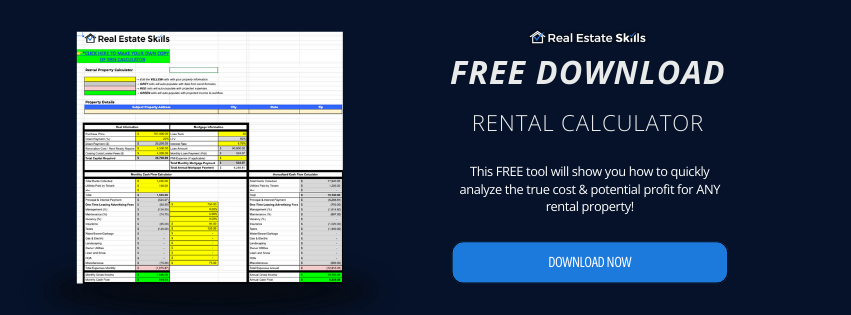
Every projection in this review comes down to the same arithmetic: rental income, minus real expenses, against what you actually put in. Mashvisor runs that math on estimated numbers. You can run it on real ones. Our free Rental Property Calculator handles cash flow, cap rate, and cash-on-cash return — plug in an actual insurance quote, the real tax bill from the county site, and rents you've verified against live listings, and you'll know whether a property works before you pay for software to guess. It's the same spreadsheet we use to underwrite our own deals.
The Honest Answer
Mashvisor is accurate enough to tell you where to look and not accurate enough to tell you what to pay. That's not a knock on Mashvisor specifically — it's true of every automated valuation and rent estimate on the market, including Zillow's. Any tool generating a number from comps without seeing the property, knowing the operator, or reading the lease is producing an educated guess.
The mistake isn't using it. The mistake is treating the output as fact instead of a starting point.
Read Also: How To Find Real Estate Comps
Software Can Tell You Where The Deals Are. It Can't Get You One.
Mashvisor is good at narrowing a map. It won't find you a motivated seller, negotiate your price, or put a contract in your hand — and no analytics platform will. That part is a process, not a subscription. Our FREE Training walks you through the whole thing: how to find discounted properties, lock them up, and get paid, using the same system thousands of our students follow. Watch it before you spend $900 on data you're not ready to act on.
Watch The FREE Training →What Is Mashvisor & How Does It Work?
Mashvisor is a real estate analytics platform founded in 2014 that estimates rental income, occupancy, and returns for US properties. It works by pulling listing and rental data, comparing it against nearby comparable properties, and projecting performance for both long-term and Airbnb rental strategies.
Mashvisor is a research tool for people deciding where to buy investment property. Founded in 2014, it covers the US market and answers one question repeatedly: if I bought this property, what would it likely earn?
The workflow it's built around has four steps. Pick a market. Narrow to neighborhoods worth looking at. Filter to properties that hit your return thresholds. Run the numbers on the ones that survive. Done manually, that's a weekend with a spreadsheet and a dozen browser tabs. That compression is the entire value proposition — and it's genuinely real, with the accuracy limits above attached.
Two terms worth defining before the features, because everything in the platform is built on them.
Cap rate (capitalization rate) is annual net income divided by purchase price — what the property earns as a percentage of what it costs, ignoring any mortgage. A 6% cap rate means $60,000 net income on a $1,000,000 property.
Cash-on-cash return is annual cash flow divided by the cash you actually put in. Put $50,000 down and clear $5,000 a year after every expense including the mortgage, that's a 10% cash-on-cash return. This is the number most investors actually care about, because it measures the return on your money rather than the property's price.
Property Search
The starting point. Enter a city, neighborhood, zip code, or address, and you get listings with the investment metrics already calculated — price, square footage, beds and baths, and then the ones that matter: projected cap rate and cash-on-cash return, shown separately for long-term and Airbnb strategies.
The filtering is what separates this from Zillow. You can screen by property type, year built, listing status, price range, and expected rental income — but critically, by return. Show me properties in this price range with a projected cash-on-cash return above 8% as an Airbnb. That's the query a consumer portal can't answer.
Coverage includes MLS listings plus foreclosures and bank-owned properties on the higher tiers.
Heatmap
The best tool in the platform, and the reason to start here rather than with property search.
Open a city and switch the map into heatmap mode, then color it by whichever metric you care about — listing price, long-term rental income, Airbnb income, cash-on-cash return for either strategy, or Airbnb occupancy rate. Green marks high values, red marks low.
The technique that makes it useful is layering two views. Check price first and note where it's red — those are the cheap neighborhoods. Then switch to cash-on-cash return and look for green in those same areas. Neighborhoods that are red on price and green on return are where the arithmetic works. That's a genuinely fast way to go from a city you're curious about to four neighborhoods worth researching, and it takes a couple of minutes.
Heatmaps require the Standard plan or higher. This is the single biggest reason Lite isn't enough for most people.
Property Finder
Where the heatmap tells you where, Property Finder tells you which. Set your budget, property type, rental strategy, and bedroom and bathroom counts, and it returns matching properties ranked by investment opportunity score — Mashvisor's machine-learning composite that weighs the property's characteristics, neighborhood, comparable sales, and rental comps into a single number.
It can compare multiple markets at once, which matters if you're genuinely undecided between cities rather than committed to one.
Investment Property Calculator
The analysis layer. Once you've got a property, the calculator projects rental income, itemizes expenses, and computes cash flow, cap rate, and cash-on-cash return for both strategies.
Expenses split into one-time costs — closing, inspection, furnishing for an Airbnb — and recurring ones like taxes, insurance, maintenance, and utilities. There's an integrated mortgage calculator, so you can change the loan type, term, down payment, or interest rate and watch the returns move.
The feature to actually use here is the override. On Standard and above you can replace Mashvisor's default expense assumptions with your own figures. Do it. Defaults are national approximations, and insurance in coastal Florida bears no relationship to insurance in Ohio. A return calculated on default expenses is a rough sketch; a return calculated on a real insurance quote and the actual county tax bill is a decision you can act on.
Rental Comps
The underlying data behind every estimate — what comparable properties nearby are actually renting for, long-term and short-term, displayed with supporting charts.
Worth understanding as more than a feature. This is where you audit the platform. If a projection looks too good, open the comps and see what it's built on. Few comps, or comps that don't resemble your property, means the estimate deserves less weight. It's the closest thing Mashvisor gives you to a confidence indicator, and most users never look at it.
Comps require Standard or above. If you're planning to hold long-term, our guide on buying rental properties covers how these numbers fit into a hold strategy.
Short-Term Rental Regulations
Coverage of STR rules for over 500 cities — whether non-hosted rentals are permitted, with links to the actual municipal ordinances.
Underrated and included on every tier. Buying a property to Airbnb in a city that prohibits non-hosted short-term rentals is a category of mistake that ends deals, and having the check inside the same tool you're screening with means you're less likely to skip it. Treat it as a starting point rather than a legal opinion — ordinances change, and enforcement varies — but knowing to look is most of the battle.
Short-term rental regulations vary by municipality and change frequently. Always confirm current rules with the local jurisdiction and a licensed attorney before purchasing a property for short-term rental use.
AI Assistant
Recently added and live in the dashboard. Given that it's new, treat it as a convenience layer over the same underlying data rather than a new source of insight. The data limits described above apply to anything it tells you.
The Mashvisor API
Mashvisor sells direct data access — property records, rental income projections, occupancy, comps, market trends, and up to ten years of historical data — for teams building their own products. This is a genuinely different business from the consumer dashboard, and by user account it's the strongest thing the company sells.
Developers and PropTech teams through 2025 and 2026 consistently describe the API as reliable, well-documented, and backed by responsive support, with several naming specific team members.
If you're building an underwriting tool, an investor-facing dashboard, or a property management product and you need rental data underneath it, the API is worth a conversation regardless of what you think of the consumer plans. It's priced through the Enterprise tier on request.
Read Also: How To Become A Real Estate Investor
Mashvisor Competitors & Alternatives
Mashvisor's main alternatives are AirDNA for short-term rental data, PriceLabs for revenue management, PropStream for off-market and distressed property leads, and Roofstock for turnkey rentals. Mashvisor's advantage is analyzing long-term and Airbnb strategies side by side; each competitor beats it in a narrower lane.
Mashvisor competes in a crowded category, but most of its competitors do a narrower job better. The right question isn't which platform is best — it's which one matches what you're actually doing.
Worth saying plainly before the comparisons: most Mashvisor reviews you'll find online are published by companies that sell competing software. Read them, but read them knowing the author has a stake in the conclusion. We don't sell software in this category — we teach investing — which is the only reason this section can point you away from Mashvisor when that's the right answer.
| Platform | What It Does | Choose It If |
|---|---|---|
| Mashvisor | Long-term and Airbnb analysis side by side | You haven't decided on a rental strategy |
| AirDNA | Short-term rental data, including international | You're committed to short-term rentals |
| PriceLabs | Dynamic pricing and revenue management | You already own short-term rentals |
| PropStream | Off-market leads, distressed property data | Your problem is deal flow, not analysis |
| Roofstock | Marketplace for pre-vetted turnkey rentals | You want minimal work and accept curation |
| Free tools | Zillow, Rentometer, Airbnb, county records | You're analyzing one property in a market you know |
Mashvisor vs. AirDNA
The closest true competitor, and the clearest trade.
AirDNA does short-term rentals only — no long-term analysis at all — and it does them at greater depth, with international coverage and more historical data. Its Rentalizer estimates Airbnb revenue for a specific address, similar in concept to Mashvisor's Airbnb calculator.
AirDNA wins if you're committed to short-term rentals, especially outside the US, and you want the deepest STR market data available.
Mashvisor wins if you haven't decided between long-term and Airbnb. That side-by-side comparison is the thing AirDNA structurally cannot do, and for anyone still choosing a strategy it's the whole reason to pick Mashvisor.
One honest caveat that applies to both: any short-term rental projection built from public listing data carries the same limits described in the accuracy section. Different vendor, same constraint.
Mashvisor vs. PriceLabs
Not really a competitor — a different stage of the same business.
PriceLabs is revenue management for properties you already own: dynamic nightly pricing, minimum-stay rules, occupancy optimization. It assumes you have listings and want them earning more.
PriceLabs wins if you're an operating host. Mashvisor's analytics plans aren't built for you at all.
Mashvisor wins if you're still acquiring. It answers "should I buy this," not "what should I charge tonight."
If you're an existing host, note that Mashvisor's separate management product at $11/month covers channel management and dynamic pricing — a different tool from the analytics plans this review is about, and a much cheaper entry point.
Mashvisor vs. PropStream
Different jobs entirely, and the comparison people most often get wrong.
PropStream is a lead-generation and off-market data tool — distressed properties, pre-foreclosures, absentee owners, skip tracing, owner contact information, plus a rehab estimator for renovation budgets. It's built for finding sellers.
PropStream wins if you're wholesaling or flipping and your problem is deal flow. Mashvisor won't find you a motivated seller.
Mashvisor wins if your problem is analysis rather than sourcing — you can find properties but can't tell which markets support the returns you need.
These two aren't substitutes. Plenty of investors run both, because sourcing and analysis are separate problems.
Read Also: Our Full PropStream Review
Mashvisor vs. Roofstock
Roofstock is a marketplace, not an analytics platform. It sells single-family rentals, many already tenanted, that have passed its listing requirements. You browse properties and buy them.
Roofstock wins if you want turnkey — a cash-flowing rental with minimal work, and you'll accept a narrower selection and marketplace pricing for that convenience.
Mashvisor wins if you want to find deals yourself across the whole market rather than choosing from someone's curated inventory.
The trade is control versus convenience. Roofstock's properties are pre-vetted, which is worth something, and priced accordingly, which costs something.
Read Also: Our Roofstock Review
The Free Alternative Worth Knowing About
Before spending $900 a year, know what you can get for nothing.
Zillow and Redfin give you listings and sold comps. Rentometer gives long-term rent estimates. Airbnb itself — searching your target area and reading actual nightly rates and calendar availability — is the most honest STR data available, because it's not an estimate. County assessor sites give real tax figures. An insurance agent gives a real quote in a phone call.
That stack is free, and for one property in one market you already know, it will beat Mashvisor on accuracy because you're looking at real data instead of projections.
What it won't do is scale. Assembling it manually for one property takes an evening. For forty properties across three markets it's unworkable, and that's precisely where a platform earns its money. If you're analyzing at volume, pay. If you're analyzing one house, don't.
Picking Between Them
- Still choosing between long-term and Airbnb → Mashvisor
- Committed to short-term rentals, want maximum depth → AirDNA
- Already own short-term rentals, want more revenue → PriceLabs
- Need motivated sellers and off-market deals → PropStream
- Want turnkey with minimal work → Roofstock
- Analyzing one property in a market you know → free tools, no subscription
Read Also: Best Real Estate Wholesaling Tools
Is There A Mashvisor Promo Code Or Discount?
Mashvisor does not publish a public promo code. The only standing discount is annual billing, which saves up to 20% versus quarterly — no code required. There's no free trial and no refunds, so the cheapest way to test the platform is the shortest billing term available.
Short answer: there isn't a public code, and you're not missing out by not finding one.
Search "Mashvisor promo code" and you'll hit coupon aggregators listing codes with expiry dates that have already passed, or offers that resolve to the discount everyone already gets. That's how most of those sites work across every software category — they index codes, rarely verify them, and monetize the click regardless.
Here's what's actually available.
- Annual billing is the real discount. Mashvisor advertises savings of up to 20% for paying yearly rather than quarterly, applied automatically at checkout. No code needed. On the Standard plan that's $74.99 a month annually versus $99.99 quarterly — about $300 a year. On Professional it's $99.99 versus $119.99, roughly $240.
- One exception worth knowing: Lite is $49.99 either way. Paying annually for Lite saves you nothing and locks you in for twelve months, so if Lite is genuinely all you need, take the quarterly term.
- Periodic promotions exist. Mashvisor runs seasonal and holiday sales. If your timing is flexible and you're not in a hurry, checking their pricing page around major sale periods is more likely to produce a real discount than any coupon site.
- There's no free trial. Covered in full earlier in this review, but it belongs here too, because "free trial" is what most people searching for a code actually want.
- And there are no refunds. Which means the discount question is less important than the commitment question.
The Cheapest Way To Actually Test It
Here's the trade nobody frames properly.
Annual billing saves you about $300 on Standard. But it commits $900 upfront to a platform you've never used, with no trial and no refunds. Quarterly costs $99.99 a month — $300 for three months — and if it doesn't work in your market, you walk away having spent $300 instead of $900.
So take the quarterly term first. You're paying roughly $75 extra over three months for the option to leave. On a platform you can't test any other way, that's the cheapest insurance available, and it's better value than any discount code would be.
If it proves itself in those three months, switch to annual and take the 20% for year two. That sequence costs slightly more in total and removes essentially all of the downside risk.
Then set a calendar reminder for your renewal date the same day you subscribe. Cancellation has to happen before renewal, and the most common complaint about Mashvisor is people getting charged when they thought they'd cancelled. A reminder costs nothing and is worth more than any discount on this page.
If You Find A Code Somewhere Else
Two things to check before you trust it, since offers change and third-party pages go stale — this one included:
- Read the actual checkout screen, not the page that sent you there. Whatever a code claims, the terms that bind you are the ones displayed when you enter your card.
- Confirm whether a discount is first-term or ongoing. "20% off" and "20% off for life" are different offers, and the second one is rare.
Mashvisor FAQs
Final Thoughts On This Mashvisor Review
Mashvisor is a good tool wrapped in a purchase you should make carefully.
The platform earns its reputation on one thing: it compresses market research that used to take a weekend into about fifteen minutes, and it's the rare tool that shows you long-term and Airbnb returns side by side on the same property. If you're deciding where to buy — especially somewhere you've never been — that's real value, and the heatmap alone will change how you look at a city.
What holds it back isn't the software. It's that you're committing $600 to $1,200 a year to a platform you can't test, with no refunds, and a cancellation process people regularly get wrong. That's a lot of trust to extend sight unseen, and it's why this review lands at 3.3 rather than higher.
The accuracy question deserves the last word, because it's where people actually lose money. Every number Mashvisor shows you is a projection built from comparable properties. In Phoenix, that projection is worth taking seriously. In a rural county working from a handful of comps, it isn't — and the interface won't tell you which situation you're in. Use it to decide where to look. Never use it to decide what to pay.
If you're screening markets at volume and buying in the next year, it's defensible. If you're analyzing one house in a city you already know, save the money — Zillow, Rentometer, Airbnb, and ten minutes with a local property manager will beat it.
What To Do Next
If you're going to try it: subscribe quarterly rather than annually, even though it costs more per month. You're paying roughly $75 over three months for the right to leave, which on an untestable platform is the best money in this whole decision. Put your renewal date in your calendar the day you sign up.
Then spend your first week auditing it. Pick two markets you're seriously considering and pull Mashvisor's numbers. Check the long-term rent against active listings in the same neighborhood — not the same city. Check the Airbnb projection against real nightly rates and calendar availability on Airbnb itself. Replace the default expenses with a real insurance quote and the actual tax bill from the county site. Call one property manager in that market and ask what similar units lease for.
If the platform's numbers survive that, you can screen with confidence for the rest of the year. If they don't, you've learned it for $300 instead of $900.
If you're not buying in the next twelve months, skip it. The free stack will answer your questions, and you can subscribe when you're actually hunting.
You've Got The Analysis. Now Get The Deal.
Knowing a market cash flows is step one. Step two is far harder and nobody sells it as a subscription: finding the property, getting the seller to say yes, and structuring the deal so it actually closes. Our FREE Training shows you that entire process from the first conversation to the closing table — the same system thousands of our students use to do their first deal. Watch it today, then go put what you've learned to work.
Watch The FREE Training →
About The Author
Founder & CEO, Real Estate Skills
Alex Martinez is the Founder and CEO of Real Estate Skills. He has wholesaled and flipped houses for over 14 years, been part of 1,000+ real estate transactions, and personally acquired 33+ residential investment properties. Through Real Estate Skills, Alex and his team have trained 6,000+ investors nationwide on how to find deals, analyze them accurately, and close profitable real estate transactions.
Real Estate Skills is not a law firm or a financial advisory firm, and the information in this article is provided for educational purposes only — it does not constitute legal, tax, or financial advice. Real Estate Skills has no affiliate, referral, or commercial relationship with Mashvisor or any other platform named in this review, and receives no compensation for subscriptions. Software pricing, features, and terms change frequently; all details were verified in September 2026 and should be confirmed directly with the vendor before purchase. Real estate investing carries risk, and past results do not guarantee future outcomes. Always consult licensed professionals before entering into any contract or transaction.

👉FREE Training
How To Consistently Wholesale, Flip Houses, & Invest In Rental Properties From The MLS
(Without Spending $1 On Marketing)

Alex Martinez, the founder of Real Estate Skills, is known for his strong, practical expertise in real estate, starting from a beginner with no family connections in the industry to completing over 50 real estate deals, including wholesale and flips, within his first year.
He has dedicated his career to providing cutting-edge education and resources for real estate professionals. He emphasizes the importance of self-taught knowledge through mentors, books, and hands-on experience.
His journey from earning a modest income to becoming a successful real estate entrepreneur and educator showcases his expertise and dedication to the field.

Ryan Zomorodi, co-founder and COO of Real Estate Skills, leverages his experience from a diverse background in real estate investment, construction management, and entrepreneurship to provide comprehensive education in the real estate sector.
His expertise is rooted in hands-on experience, extensive industry knowledge, and a commitment to empowering others through education.
Ryan's journey reflects a blend of practical experience and entrepreneurial success, contributing to his role in developing a platform that educates and supports aspiring real estate professionals.
Read Ryan's Full Bio >>
