
Real Estate Agent Flipping Houses: Step-by-Step Guide (2026)
Oct 30, 2026

Written by
Alex Martinez, Founder & CEO, Real Estate Skills. Has wholesaled and flipped houses for over 14 years, been part of 1,000+ real estate transactions, and personally acquired 55+ residential investment properties. Has trained 6,000+ investors nationwide.
Reviewed by
Ryan Zomorodi, Co-Founder & COO, Real Estate Skills. Reviewed the legal, tax, and financing points in this guide.
Publication history: Originally published February 19, 2026. Updated October 2026 with a step-by-step process built around a real agent-owned flip, the 70% rule compared against real numbers, an agent income comparison, current NAR disclosure and buyer-agreement rules, and updated partnership structures. Legal, tax and financing points reviewed by Ryan Zomorodi, Co-Founder & COO of Real Estate Skills.
A real estate agent flipping houses buys a property as the principal, renovates it, and resells it, often listing it themselves. The process is the same as any flip, plus three agent-specific steps: get your broker's sign-off, disclose your license in writing before anyone signs, and handle the resale by your MLS's rules.
You already know how to help a client buy a house. Flipping one for yourself uses most of those same skills, plus a few you've never needed: pricing a renovation, lining up hard money, managing a contractor, and selling a house you're personally responsible for. That last part is where agents get nervous, and it's fair to be.
I flipped houses while I held a license. In this guide I'll walk you through the process step by step, using a real cosmetic flip I did in Poway, California, as the example for every step. You'll see what I paid, how I funded it, what the renovation cost, and what it sold for, along with what you'll need to do differently in today's market.
You'll be running numbers in nearly every step, so grab our free Deal Calculator before you start.
How Is Flipping Different When You're a Real Estate Agent?
The flip itself works the same: buy below value, renovate, resell. What changes is your role. You're the principal (the actual buyer and seller), not the agent, so you disclose your license in writing, run the deal past your broker, and can handle the purchase paperwork and the resale listing yourself.
On a normal deal, you're working for a client. On a flip, you are the client. The law calls that being a principal: the person actually buying or selling. Your license doesn't switch off when you become the principal. It means you carry both sets of obligations at once, a buyer's and a licensed professional's.
If you're still deciding whether to flip at all, start with my answer to can real estate agents flip houses and whether you should. It covers the disclosure rules, broker and insurance questions, taxes, and who this is wrong for. This guide assumes you've decided to do it and shows you how.
Here's how the same flip looks with and without a license:
Flipping With a License vs. Without One
| Agent flipping | Investor without a license | |
|---|---|---|
| Finding deals | Sees new MLS listings, price drops and sold data in real time | Relies on public sites like Zillow and Redfin, or an agent's alerts |
| Writing the offer | Drafts it on brokerage forms, often same day (after broker review) | Waits for their buyer's agent to write and send it |
| Buyer-side pay on the purchase | Can represent themselves and collect it (taxable) or waive it to strengthen the offer | Negotiated in a written agreement with their buyer's agent before touring |
| Selling the finished house | Lists it themselves and keeps the listing side; still negotiates buyer-agent pay | Pays a listing agent, and still negotiates buyer-agent pay |
| Disclosure | Must disclose their license and interest in writing to every party before signing | No license to disclose |
| Oversight | Needs broker approval; should confirm E&O covers owned property | None beyond normal contract and disclosure law |
Commissions are negotiable. Specifics vary by brokerage, MLS and state.
How to Flip Your First House as a Licensed Agent
It takes seven steps: clear it with your broker and line up your money, find a deal, run the numbers, disclose and make your offer, fund and close, renovate, then list and sell. The agent-specific parts are the broker sign-off, the written disclosure, and listing the finished house yourself.
I'll use one real deal through every step: a cosmetic fixer in Poway, California, that I bought in June 2015 while I was licensed. It was a 3-bedroom, 2-bath single-family house of about 1,358 square feet. It was dated but solid, and it needed paint, flooring, fixtures and updated bathrooms, not walls moved. It was the first flip where I handled most of the work myself. The market and the commission rules have changed since 2015, so treat the numbers as an example of the process, not a promise of the outcome.
My First House Flip! | Flipping a House From Start to Finish as a Beginner
I walk through my Poway flip from finding it on the MLS to listing it myself as a licensed agent and closing at $535,000.

Step 1: Clear It With Your Broker and Line Up Your Money
Before you search, get your broker's written approval for agent-owned deals, confirm your E&O covers property you own, and know exactly how you'll pay. Talk to a lender now, so you can send real proof of funds or a lender letter with your first offer.
Do this before you fall in love with a house, not after. Ask your broker what they need from you on a personal purchase (which forms, which review, how long), and get the answer in writing. If your E&O (errors and omissions insurance, the liability coverage for your work as an agent) excludes property you own, sort out coverage now.
Then build your money plan. A flip costs more than the purchase price. You'll pay the down payment and closing costs on the purchase, the renovation, loan interest and points, insurance, utilities and property taxes while you hold it, and closing costs again when you sell. Most first-time flippers combine some of their own cash with a hard money loan (a short-term loan from a private company that lends on flips mostly based on the property's value, at higher rates than a bank) and sometimes private money (loans from individuals you know).
Call a hard money lender or two before you make an offer. Ask what they lend as a share of the purchase and renovation, their rate and points, and what they need to issue a letter you can send with your offer.
Step 2: Find a Deal on the MLS
Look for listings that are distressed in condition or circumstance: dated, priced to move, or described as cash-only or as-is. Call the listing agent before you visit to learn the seller's situation and expectations, and treat the list price as a starting point, not the deal price.
Your MLS access is your biggest edge here. Public sites like Zillow and Redfin pull MLS listings, so investors without a license see many of the same houses. But you see them the moment they list, with better sold data for comps and the agent-only remarks the public never sees. Those remarks sometimes spell out the seller's situation: an estate sale, a relocation, a deadline. Set alerts for new listings, price drops and keywords like "as-is," "cash only," "investor special" and "needs TLC." Learn more about using the Multiple Listing Service (MLS) for investing, or about finding off-market fix-and-flip leads once you outgrow on-market deals.
📓 From The Field
Poway, step 2: The house hit the MLS at $500,000, and the photos and description hinted at a seller who needed to move it. We called the listing agent right away. The seller had already accepted another buyer's offer, so we asked to submit a backup offer at $360,000 in case that deal fell apart. It did. We negotiated from there and went under contract at $390,000, $110,000 below the list price. Results vary. That was 2015's market. Watch how I found it.
Before you drive to any property, call the listing agent. Most investors only text, and the ones who actually talk to the agent learn far more. Ask:
- Why is the seller selling, and when do they need to be out?
- What condition is it really in? Ask about major issues like the foundation, roof, electrical or plumbing, and what's been updated.
- Is there anything special about it? A bigger lot or a better view than the photos show can change the resale price.
- How much interest has it had? Ask how many offers there are, and whether they're from homeowners or investors.
- What terms matter most to the seller? A fast close, a later close, or a short lease-back after closing.
- When will the seller review offers?
Don't ask the agent for their seller's bottom line. A listing agent owes their seller confidentiality, and as a licensee yourself, you shouldn't put them in that spot. Ask what range the seller would seriously consider and how flexible it is. As my business partner Ryan likes to say, "the deals are in the data." Then ask one more question before you hang up: does the agent have any other fixers coming up? Agents who list one distressed house usually list more.
Because you're licensed, say so at the start of that call. Something like: "Before we go further, I'm a licensed agent, but on this one I'm buying for my own account as the principal. I'll put that in writing with the offer." It's honest, it's quick, and it sets up the written disclosure you'll make in step 4.
Step 3: Run the Numbers Before You Offer
Work out three numbers before you write an offer: the after-repair value (ARV), your renovation cost, and the highest price you can pay after holding costs, closing costs and your profit target. Use recent renovated sales for ARV and a contractor's walkthrough for repairs, not a guess.
Your after-repair value (ARV) is what the house should sell for once it's fixed. Build it from comps (recently sold, similar homes) that meet all of these:
- Sold and renovated, in the condition yours will be in
- Sold within the last 6 months
- Within about half a mile, in the same zip code and ideally the same neighborhood
- Within about 20% of your property's square footage, above or below
- At least three of them, and more if you can find them
Then use a number you're confident it will sell for in a slow week, not your best-case number. The listing agent will often tell you what they think it's worth fixed up. Listen, but don't build your offer on it.
For repairs, get a general contractor through the house and price every item. Don't estimate from photos.
📓 From The Field
Poway, step 3: My comps came in around $520,000 to $540,000. I used $520,000 as my ARV because I knew it would sell there easily, even though I thought it could go higher. A contractor I was referred to by another flipper walked it with me line by line and quoted about $40,000 for the renovation. I always aim for at least $30,000 of estimated profit. At $360,000 the numbers showed roughly $66,000. When I had to come up to $390,000, they showed about $34,000, and that was with a deliberately long five-month holding period built in. Still above my line, so I bought it. Results vary. Watch how I ran the comps.
What Is the 70% Rule for Flipping Houses?
The 70% rule says to pay no more than 70% of a house's after-repair value, minus repairs. It's a quick screen, not a pricing method. On my Poway flip, it put my maximum at $324,000. I bought at $390,000 and still netted about $61,000.
The 70% rule is meant to leave room for your costs and profit without a detailed calculation. That makes it useful for tossing out obviously bad deals fast. But in many markets, an offer at 70% will lose to buyers who did the real math.
💡 Example: The 70% Rule vs. the Real Numbers on Poway
- ARV: $520,000 × 70% = $364,000
- Minus repairs of $40,000 = a 70% rule maximum of $324,000
- What I actually paid: $390,000, $66,000 over the rule
- What I actually netted after selling for $535,000 and paying everything back: about $61,000
2015 numbers on one deal. Your market and deal will differ. Watch the 70% rule breakdown.
The difference was a real deal analysis: actual repair bids, actual holding and closing costs, and an actual profit target, instead of a flat percentage.
Know Your Maximum Offer Before You Call the Listing Agent
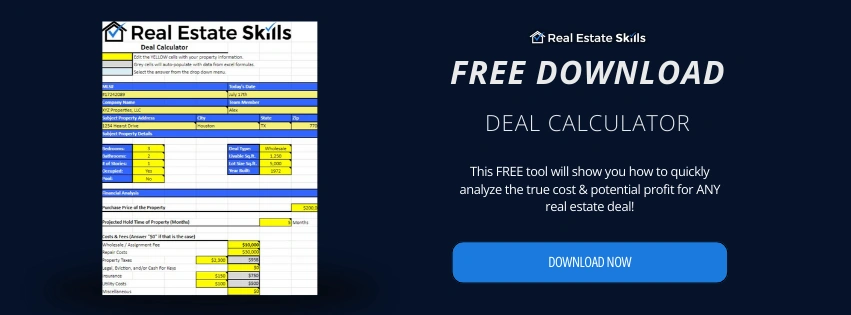
The 70% rule would have capped my offer on the Poway flip at $324,000, and I'd have lost the deal. Real numbers win deals. Download our free Deal Calculator to estimate your rehab, factor in closing costs, and find your maximum allowable offer and profit spread before you make an offer.
Step 4: Disclose Your License and Make Your Offer
Tell the listing agent on your first call that you're a licensed agent buying for yourself, then put it in writing in the offer or a signed addendum before anyone signs. Send a complete package: your offer terms, proof of funds, and documents showing you can sign for your LLC.
This step describes common practice, not legal advice. Disclosure forms and contract terms vary by state. Have a real estate attorney review your forms before your first deal.
The written disclosure is the step agents can't skip. NAR members must disclose in writing to every party before anyone signs, under Article 4 of NAR's Code of Ethics, and your state's license law has its own version. Here's how to handle it on every deal:
- Say it on the first call (the opening line in step 2).
- Put it in writing in the offer itself or a signed addendum, using your state's form if it has one, before the seller signs anything.
- Get your broker's review of the offer and disclosure before it goes out, if your brokerage requires it.
- Keep a signed copy in your file. If anyone ever questions the deal, that page is your proof. NAR publishes how it has applied Article 4 in real cases if you want to see how hearing panels look at it.
Next, decide who represents you on the purchase:
- Represent yourself. If the seller has agreed to pay buyer-side compensation, you can collect it (it's taxable income) or reduce or waive it so the seller nets more and your offer looks stronger.
- Have the listing agent represent both sides, where your state allows dual agency and both sides consent in writing. Some listing agents will push harder for an offer they're on both sides of.
- Use a different buyer's agent if you'd rather keep yourself out of the representation entirely.
Then send the offer terms as one complete package:
- Property address, your buying entity's name, and your price
- Earnest money amount (the good-faith deposit held by escrow or title)
- An inspection period, shortened if you're competing with other offers, but never skipped on your first deals
- A closing date ("14 days or sooner" is strong, but adjust to what the seller needs)
- Seller to deliver clear title
Attach proof of funds and the documents showing you can sign for your company: your LLC's articles of organization or its operating agreement. Only send proof of funds for money that's actually available to you, like your own account statement or a letter from your lender. Sending someone else's funds as if they're yours misrepresents your ability to close.
A few things I've learned about the offer itself. Bend on terms before price: a seller who needs to close in seven days or stay in the house a few weeks after closing may take less for that. Present your number calmly and stop talking. Don't apologize for it or over-explain. And don't plan to renegotiate later as a tactic. Renegotiating is fair when an inspection turns up something new, but offering high and chipping away afterward burns your credibility with every agent in your market. See how to send the offer terms.
It isn't a contract until the seller signs. Read the final version for errors before you sign it yourself. Check whether your inspection contingency lets you cancel for any reason, and when your earnest money stops being refundable, because those terms vary by contract.
One state-specific warning: if you're buying an owner-occupied home that's already in foreclosure in California, California's Home Equity Sales Contract Act adds required contract terms and seller cancellation rights. Other states have similar equity-purchaser laws. If the seller is in foreclosure, talk to a local attorney before you write anything.
Step 5: Fund the Deal and Close
Close using the money you lined up in step 1. Many first-time flippers use a hard money loan for most of the purchase and fill the gap with their own cash or private lenders. Get every loan term in writing, and confirm title, insurance and your renovation budget before closing day.
The time between signing the contract and closing is busy. Most of what goes wrong on a first flip can be fixed here, before it costs you anything. Use escrow to get these done:
- Inspect inside your contingency period. Bring your contractor back with the inspector so the repair bid reflects what the inspection actually finds.
- Lock the loan terms. With hard money, you'll pay points up front (one point is 1% of the loan amount) plus interest every month you hold the house. Many of these loans are interest-only. Ask how renovation money gets released. Many lenders fund repairs in draws after inspecting completed work, not all at closing.
- Paper your private money properly. Anyone who lends you money should get a written promissory note (the signed promise to repay, with the rate and due date) secured by a recorded deed of trust or mortgage on the property. Have an attorney or title company prepare them. If you're pooling money from several people into one deal, talk to an attorney first, because that can trigger securities rules.
- Insure the house as a vacant renovation. A standard homeowner's policy often won't cover a vacant property under construction. Ask your agent about a builder's risk or vacant dwelling policy.
- Review the title report for liens, judgments or anything else that has to be cleared before you can sell clean.
- Schedule your contractor to start the day after closing. Every idle week costs you interest.
📓 From The Field
Poway, step 5: I used two kinds of money. A hard money lender loaned $312,000 at 10% interest plus 2 points. That's $6,240 in points at closing, and roughly $2,600 a month in interest if it's interest-only. The rest, $126,000, came from three private lenders: $76,000, $30,000 and $20,000. I met one at a local REIA meetup (a real estate investors association), knew one from college, and was introduced to the third through a friend. None of them were strangers to how I worked, and that's usually how first private money happens. Results vary. Watch how I funded it.
Step 6: Renovate on Budget and on Schedule
Renovate from a written scope of work with a price for every line, and start the day after you close. Pay your contractor for completed work, not in advance, and check the job in person every week. Fix what buyers in that neighborhood pay for, and skip upgrades your comps don't show.
For your first deal, pick a cosmetic fixer-upper: a house that needs paint, flooring, fixtures, lighting and updated kitchens or bathrooms, not new foundations or moved walls. Cosmetic work is faster, easier to price, and less likely to surprise you behind the drywall.
A few rules I follow on every renovation:
- Write the scope down. Every item, its finish and its price goes in a written scope of work your contractor signs. Vague scopes turn into change orders.
- Renovate to your comps, not your taste. If the renovated sales you used for your ARV have laminate counters, quartz won't get you a higher price. It just costs more.
- Pull permits where your city requires them. Unpermitted work can come back during the buyer's inspection or appraisal, and as a licensed agent you're held to a higher standard on what you knew.
- Pay in draws. Pay against milestones once the work is done and you've seen it. Never pay most of the job up front.
- Build in a cushion. Keep a contingency of 10% to 15% of the renovation budget for the things you couldn't see.
- Track the budget weekly. Compare what's been spent against the bid every week so a small overrun doesn't become a big one.
📓 From The Field
Poway, step 6: The renovation took about four weeks. My contractor's estimate was about $40,000, and I finished at about $42,000, which is close enough that the deal never felt at risk. That only happened because he'd walked the house with me line by line before I made my offer. It was all cosmetic work: paint, flooring, fixtures and the bathrooms. Results vary. Watch the renovation.
Step 7: List and Sell Your Flip Yourself
List the finished house on the MLS yourself, with your broker's approval. Disclose in writing that you're the owner and a licensed agent, price it from your updated comps, and market it hard in the first two weeks. You skip paying a listing agent and control every showing and offer.
This is where your license pays off a second time. Your listing goes into the MLS, which feeds it to Zillow, Redfin, Realtor.com and the other big portals, so your house gets the same exposure as any other listing in your market. You also control the photos, the description, the showings and the timing yourself.
Before you list, handle these:
- Run the listing through your broker like any other listing, using the brokerage's forms and review process.
- Disclose that you own it. Say so in the listing and in writing to every buyer. Fill out your state's property condition disclosures completely, including the work you did and the permits you pulled.
- Get professional photos once the house is staged or at least clean and finished. Online photos are where buyers decide whether to visit.
- Price from fresh comps. The market may have moved while you renovated. Some MLSs allow value range pricing (listing at a range, like $520,000 to $545,000, to draw buyers from both price searches), while others don't. Ask your MLS before you try it.
- Decide on buyer-agent compensation. Since August 2024, offers of compensation can't go on the MLS. As the seller, you can still agree to pay a buyer's agent, and it's negotiable. Decide your policy before the first offer comes in.
- Know the FHA timing rule. A cosmetic flip can easily be back on the market within 90 days of your purchase, and FHA buyers generally can't close on a resale that soon. Plan your timeline or your buyer pool around it.
- Point unrepresented buyers to an agent. If a buyer calls you directly, refer them to another agent rather than negotiating against someone you also owe duties to.
When the offers come in, compare the net, not just the price. Look at financing type, contingencies, closing date and any repair requests. A slightly lower cash or conventional offer with a short inspection period can be worth more than a higher offer that may not close.
📓 From The Field
Poway, step 7: I listed it myself and marketed it in a price range instead of at a single number. It sold for $535,000, $15,000 above the $520,000 ARV I'd conservatively planned around. After paying back the hard money lender and my three private lenders, plus the renovation, holding and closing costs, I netted about $61,000. On the numbers I'd run at the $390,000 contract price, I expected roughly $34,000. Results vary. That was one deal in 2015's market. Watch how I listed and sold it.
Find Your Next Flip Where You Already Work
In our free training, I show how we find discounted houses on the MLS and through other agents, without paying for marketing. You'll learn how to tell whether a deal works best as a flip, a wholesale or a rental, with real case studies from our students along the way.
Watch The FREE Training →How Much More Can a Real Estate Agent Make Flipping Houses?
On a $400,000 sale at a 2.5% buyer-side rate, an agent grosses $10,000 and takes home about $7,000 after a 70/30 broker split. Acting as the principal changes the math. A wholesale fee or flip profit isn't capped by a percentage, but you take on the cost, the risk and extra disclosure duties.
As an agent, your income per deal has a ceiling. It's a percentage of the price, split with your broker, and then reduced by fees and taxes. When you buy as the principal, nobody caps what the deal can make. Nobody covers your losses either. The fair comparison isn't just what you earn. It's what you earn against how much of your own money and time is at risk.
One $400,000 Deal, Three Roles
| Your role | What you could earn (example) | Your money at risk | Typical timeline |
|---|---|---|---|
| Buyer's agent for an investor | About $7,000 take-home (2.5% gross, 70/30 split) | None beyond your business costs | Weeks |
| Wholesaler (you're the principal and assign the contract) | A negotiated assignment fee, often $10,000 to $30,000 in our deals | Your earnest money deposit | Weeks |
| Flipper (you buy, renovate and resell) | My Poway flip netted about $61,000 | The purchase, renovation and holding costs, mostly borrowed | Months |
Illustrative figures. Commissions are negotiable, broker splits vary, and every deal is different. Results vary.
Flipping pays the most per deal, and it also asks the most of you. On Poway, I had about $438,000 of borrowed money riding on the house until it sold. Wholesaling earns less, but your exposure is usually limited to your deposit. That's why many agents learn to wholesale first and flip once they've got cash, lenders and a contractor they trust.
How To Make More Per Deal As A Real Estate Agent!
I break down an agent's take-home on a $400,000 deal and show how the same deal can pay you as an agent, a wholesaler and a listing agent.

How Much Does a Real Estate Agent Make on a $300,000 House?
There's no standard commission rate, so it depends on what's negotiated. At 2.5% for one side, a $300,000 sale grosses $7,500. After a 70/30 broker split, the agent keeps about $5,250, before desk fees, MLS dues, marketing and income taxes. On a $400,000 house, that's about $7,000.
Most new agents start on a less generous split, often 50/50 or 60/40, until they've closed a set number of deals. Here's what that looks like on a single side of a transaction:
Agent Take-Home on One Side of a Sale (2.5% Example)
| Sale price | Gross commission | Take-home on a 70/30 split | Take-home on a 50/50 split |
|---|---|---|---|
| $300,000 | $7,500 | $5,250 | $3,750 |
| $400,000 | $10,000 | $7,000 | $5,000 |
| $500,000 | $12,500 | $8,750 | $6,250 |
Before brokerage fees, MLS and association dues, E&O, marketing and taxes. Rates are negotiable, and this isn't a typical or guaranteed rate. Watch the commission breakdown.
📓 From The Field
A student's next deal: One of our students, a licensed agent, took home about $2,500 after his broker split on his first deal as an agent. On his next deal, he wasn't the agent at all. He bought as the principal and wholesaled the contract. The fee was about $71,500, which he split with his business partner, so he took home over $35,000. Same license, same market, a different role in the deal. Results vary. Most deals won't look like this one. Watch his story.
Can a Real Estate Agent Get Paid a Commission and a Wholesale Fee on the Same Deal?
Sometimes, yes, if every party agrees in writing. You buy as the principal through your company, represent yourself and collect any buyer-side compensation the seller agrees to pay, then assign the contract for a fee. Your broker, your state's wholesaling rules and full written disclosure all decide whether it's allowed.
I call this stacking: more than one paycheck from the same house, without finding another lead. Here's how it can work, with an example:
- Commission on your own purchase. You write the offer in your LLC's name and represent yourself. If the seller agrees to pay buyer-side compensation, you may be able to collect it: about $7,000 after a 70/30 split on a $400,000 purchase at 2.5%.
- An assignment fee. You assign your contract to a flipper for a negotiated fee, say $20,000. Because you're the principal, that fee may fall outside your broker split, depending on your brokerage's policy.
- The listing commission on the resale. Before you assign, negotiate in writing that the flipper will list the finished house with you. If it resells for $600,000 at 2.5%, that's $15,000 gross, about $10,500 after a 70/30 split.
That's roughly $37,500 from one house, against $7,000 as a buyer's agent. Illustrative example. Results vary. Watch how the three checks stack.
📍 Read These Before You Try It
Stacking is where agents get into trouble, so each check comes with conditions:
- The buyer-side check isn't automatic. Since August 2024, compensation offers can't be published on the MLS. Any buyer-side pay has to be negotiated with the seller or listing broker. A commission paid on your own purchase is also taxable income.
- Disclose everything in writing. Your seller and your end buyer must both know you're a licensed agent acting as the principal. Many agents also disclose that they may assign the contract. Some sellers will decline. That's their right.
- Your broker decides. Some brokerages don't allow agents to take a commission on a deal they'll assign, and others take a split of principal income. Get the policy in writing.
- State wholesaling rules vary. Several states now require a license, written disclosures or registration for wholesaling, and some contracts prohibit assignment. Check your state's rules and the contract's assignment clause first.
- The relist needs its own agreement. A promise to list it with you isn't enforceable until it's a signed listing agreement.
Done this way, it's a legitimate way to earn more from a deal you found. Done carelessly, it's the fastest route to a complaint. If you're unsure on any point, ask your broker and a local real estate attorney before you sign.
How Do Investors Find an Investor-Friendly Real Estate Agent?
Look for an agent who closes investor deals regularly, can defend an ARV with renovated comps, knows how hard money works, and can get an offer out the same day. Ask for recent investor deals by address. Then start with a limited or non-exclusive written agreement until they've earned more.
If you're flipping without a license, the right agent is worth more than any software you'll buy. A great retail agent is great at a different job: finding a family the right house in the right school district. An investor-friendly agent thinks in ARV, repair costs and days on market, and knows a distressed listing when they see one.
Before you hire one, ask:
- How many investor purchases or flips have you closed in the last 12 months? Ask for a few addresses and look them up.
- Walk me through the ARV on this house. A good agent picks renovated comps and explains why. A weak one quotes the list price or a portal estimate.
- Which hard money lenders have your clients closed with? They should know how draws, appraisals and fast closings work.
- How fast can you get an offer out once I say go? Same day is the standard on distressed listings. Writing offers subject to inspection, so you don't have to tour every house first, is normal.
- Do you invest yourself? That isn't a deal breaker. Plenty of the best investor agents flip. But ask how they decide which deals they keep and which they bring to you, and get that answer in writing.
Since August 2024, an agent who's part of the MLS needs a written agreement with you before showing you a house. That agreement has to spell out what the agent gets paid. It doesn't have to be exclusive or open-ended. You can ask for one limited to a single property or a short period. Read what triggers payment before you sign. An agreement that says you owe a commission on any house you buy, however you found it, can cost you on deals you found yourself.
Should Investors Use One Buyer's Agent or Call Listing Agents Directly?
Do both. A good buyer's agent is valuable, but relying on one agent puts your whole pipeline on someone who has other clients. Calling listing agents directly gets you more conversations, more information about the seller, and sometimes a listing agent willing to represent you where your state allows.
A buyer's agent who's juggling a dozen clients can't call every new distressed listing in your market the hour it hits the MLS. You can. When you call the listing agent yourself, you hear the seller's story firsthand, you learn what price range would work, and you build a relationship with someone who'll list more fixers.
📓 From The Field
Our representation order: When my team calls a listing agent on a deal we want, we work down this list:
- The listing agent represents us, where dual agency is allowed and both sides consent in writing.
- The listing agent refers us to a buyer's agent they trust and earns a referral fee, often around 25% of that agent's commission, paid broker to broker.
- We use our own buyer's agent, someone we've met at a local investor meetup or worked with before.
- A licensed member of our team represents us and reduces or waives buyer-side pay so the seller nets more.
Not every listing agent will work with you, and some will be short with you on the phone. Don't take it personally. They might be having a bad day, or that might just be how people talk in your market. Stay polite, keep it brief, and call back on the next listing. Before you hang up on any call that goes well, ask whether they have other fixers coming up.
If you keep finding yourself writing deals through someone else's license, it may be time to learn how to become a real estate agent yourself.
How Should Agents and Investors Structure a Partnership on a Flip?
Keep it simple and in writing. Most partnerships pay the agent a commission on the purchase, give them the listing when the flip resells, or both. Any money a licensed agent earns for real estate services generally has to be paid through their broker. Equity splits work, but need an attorney-drafted agreement.
The goal is to give the agent a reason to bring you their best deals, again and again. The fastest way to lose a good agent is to squeeze their pay on both ends of the deal. If an agent finds you a house $100,000 under market, the listing on the resale is a small price to pay for the next one.
Common Agent-Investor Partnership Structures
| Structure | The investor | The agent | How the agent gets paid |
|---|---|---|---|
| Buy-side representation | Funds the deal and makes the final call | Finds the deal, writes the offer, negotiates | Buyer-side compensation negotiated with the seller, or paid by the investor under the written buyer agreement, through the agent's broker |
| Sell-side relist | Renovates and sets the price with the agent | Lists and markets the finished flip on the MLS | A negotiated listing commission. Sometimes it's a reduced rate, like 1% to 1.5%, when the relist is offered as a bonus for bringing the deal |
| Referral | Works with the agent the listing agent recommends | Refers the investor to another agent | A referral fee from the other agent's commission, paid broker to broker |
| Joint venture (equity split) | Puts up most or all of the money and carries the loan risk | Finds the deal and may manage the renovation | An agreed share of net profit after the house sells, under a written agreement and with broker approval |
Every arrangement should be in writing and reviewed by your broker. Rules on compensation and referral fees vary by state.
One rule matters more than the rest. In most states, a licensed agent can't accept pay for real estate services except through their broker, and paying an unlicensed person a fee for bringing you a deal can break the law. A flat "finder's fee" paid straight to an agent can get both of you in trouble. Run it through the agent's brokerage.
Should You Give an Agent Equity in a Flip?
You can, but it's harder than it sounds. An equity split ties the agent's pay to the final profit, which aligns incentives. It also makes taxes, decisions and disputes more complicated. If you do it, use a written joint venture or LLC operating agreement, and get your broker's approval first.
Equity splits make sense when the agent brings more than a deal: managing the renovation, contributing some of the money, or doing it again on the next one. They get messy when the roles are vague. Before anyone signs, your agreement should answer:
- Who decides on the budget, the finishes and the sale price, and who breaks a tie
- What happens if the renovation runs over budget or the house sits longer than planned
- How profit is calculated, after which costs, and when it's paid
- Who's responsible if the deal loses money
If you hold the deal in an LLC with a partner, expect a partnership tax return and K-1s each year. That's more paperwork than a commission. For most first deals, a straightforward commission and a guaranteed relist works better than a share of the profits.
Real Estate Agent Flipping Houses: FAQs
Final Thoughts
A real estate agent flipping houses follows the same process as any investor, plus three steps: broker approval, written disclosure on every deal, and listing the finished house yourself. Start with a cosmetic fixer from the MLS, run real numbers, and treat your first flip as a lesson.
You already have what most new investors spend years building: MLS access, comp skills, contracts experience and relationships with other agents. What's left is learning to think like the buyer instead of the buyer's agent. That means the deal is yours, and so are the money, the timeline and the risk.
If I were starting my first flip as an agent today, here's what I'd do this month:
- Get your broker's written policy on agent-owned deals and talk to two hard money lenders, so you know your numbers before you need them.
- Set MLS alerts for distressed listings in one or two zip codes you know well, and call the listing agent on every one that fits.
- Run the numbers on 10 houses before you offer on any of them, using renovated comps and a contractor's walkthrough.
Want the bigger picture beyond the agent angle? Read our full guide on how to flip a house.
Ready to Find Your First Flip on the MLS?
In our free training, I walk through how we find discounted houses on the MLS and through other agents, without paying for marketing. You'll see how we decide whether to flip, wholesale or keep a house as a rental, with real case studies from our students.
Watch The FREE Training →
About The Author
Founder & CEO, Real Estate Skills
Alex Martinez is the Founder and CEO of Real Estate Skills. He has wholesaled and flipped houses for over 14 years, been part of 1,000+ real estate transactions, and personally acquired 55+ residential investment properties. He has trained 6,000+ investors nationwide.
Real Estate Skills is not a law firm, and the information in this article is provided for educational purposes only. It does not constitute legal, tax, or financial advice. Real estate license laws, NAR and MLS rules, and lending requirements vary by state and change over time. Real estate investing carries risk, and past results do not guarantee future outcomes. Always consult a licensed real estate attorney, a CPA, and your broker before buying or selling property for your own account.

👉FREE Training
How To Consistently Wholesale, Flip Houses, & Invest In Rental Properties From The MLS
(Without Spending $1 On Marketing)

Alex Martinez, the founder of Real Estate Skills, is known for his strong, practical expertise in real estate, starting from a beginner with no family connections in the industry to acquiring over 55 real estate deals, including wholesale and flips, within his first year.
He has dedicated his career to providing cutting-edge education and resources for real estate professionals. He emphasizes the importance of self-taught knowledge through mentors, books, and hands-on experience.
His journey from earning a modest income to becoming a successful real estate entrepreneur and educator showcases his expertise and dedication to the field.

Ryan Zomorodi, co-founder and COO of Real Estate Skills, leverages his experience from a diverse background in real estate investment, construction management, and entrepreneurship to provide comprehensive education in the real estate sector.
His expertise is rooted in hands-on experience, extensive industry knowledge, and a commitment to empowering others through education.
Ryan's journey reflects a blend of practical experience and entrepreneurial success, contributing to his role in developing a platform that educates and supports aspiring real estate professionals.
Read Ryan's Full Bio >>
