
Real Estate Broker Salary (2026): What Brokers Really Make
Oct 23, 2026

Written by
Alex Martinez, Founder & CEO, Real Estate Skills. Has wholesaled and flipped houses for over 14 years, been part of 1,000+ real estate transactions, and personally acquired 55+ residential investment properties. Has trained 6,000+ investors nationwide.
Reviewed by
Ryan Zomorodi, Co-Founder & COO, Real Estate Skills. Reviewed the salary data, commission math, and licensing points in this guide.
Publication history: Originally published November 25, 2025. Updated October 2026 with May 2025 BLS salary data, a state-by-state broker pay table, pay by broker role, post-settlement commission math, and a corrected FAQ. Salary data and commission math reviewed by Ryan Zomorodi, Co-Founder & COO of Real Estate Skills.
The median real estate broker salary is $73,220 a year, according to the Bureau of Labor Statistics (May 2025). The bottom 10% earn under $37,110 and the top 10% earn over $143,300. Most of that pay comes from commissions, not a salary: commissions on their own sales, plus a cut of their agents' deals.
If you're reading this, you're probably a few years into your license, looking at the broker exam, and wondering whether the upgrade actually pays. Fair question. The title sounds like a raise. Sometimes it is. Sometimes it's an office lease, a bigger insurance bill, and a roster of agents whose mistakes are now legally yours.
Here's what actually happens to the money. Most of the extra income brokers earn doesn't come from selling more houses. It comes from keeping more of each commission check. Almost every salary page skips that part, and it's the part that decides whether the license is worth it for you.
So below you'll get the real numbers: by role, by state, per deal, and gross versus what you keep. Then I'll show you how I'd use a broker license if the goal is building wealth, not collecting a title. And if more income from the same deals is what you're after, grab our free Ultimate Guide to Start Real Estate Investing and keep it open while you read.
Real Estate Broker Salary In 2026: The Real Numbers
Real estate brokers earn a median of $73,220 a year, or about $6,100 a month and $35 an hour, according to the latest BLS data (May 2025). That's about $20,000 more than the $52,830 median for sales agents. Pay swings widely: under $37,110 at the bottom, over $143,300 at the top.
I want you to read these numbers the right way, so quickly: the median is the broker in the middle. Half earn more, half earn less. A percentile is where someone ranks, so the 90th percentile is the broker out-earning 90% of everyone else. I always look at the median first. In a commission business, a handful of monster producers drag the average up and make the whole field look richer than it is.
Here's how brokers and agents stack up:
| Bottom 10% | Median | Top 10% | |
|---|---|---|---|
| Real estate brokers | under $37,110 | $73,220 | over $143,300 |
| Real estate sales agents | under $32,970 | $52,830 | over $123,590 |
| Broker median, per month | about $6,100 | ||
| Broker median, per hour (full-time) | about $35 |
Source: Bureau of Labor Statistics data on real estate brokers, May 2025. Monthly and hourly figures are the annual median divided by 12 and by 2,080 hours. BLS publishes the annual number.
Now look at that bottom row for brokers. That's the part nobody puts on the brochure. The license doesn't pay you anything by itself. A broker who isn't closing deals makes less than a busy agent, and I've watched it happen. Even BLS calls the income irregular, especially early, with weeks or months between sales. So when someone tells you the broker license is a raise, my question back is always the same: a raise on what deals?
Why Every Salary Site Shows A Different Number
Salary sites disagree because they measure different people. The BLS only counts brokers on a payroll, and about 55% of brokers are self-employed. Job sites track job postings and self-reported pay, which skew toward salaried roles. NAR surveys its members' gross income, mixing agents and brokers together.
Google "real estate broker salary" and you'll get numbers anywhere from about $60,000 to over $200,000. Agents ask me which one is right all the time. Honestly? They all are. They're just counting different people.
Here's a real example. Search from California in October 2026 and three salary sites put the average broker at about $97,500 (ZipRecruiter), $118,500 (Indeed) and $210,000 (Glassdoor). Same job title, same state, a $112,000 spread.
| Source | Who it counts | What that does to the number |
|---|---|---|
| Bureau of Labor Statistics | Brokers on a company payroll | Leaves out self-employed brokers, who are most of the field. Most reliable for salaried roles. |
| NAR Member Profile | Realtor members, agents and brokers together | Self-reported gross income before expenses. A good read on the industry, but it mixes roles. |
| Job sites (Indeed, ZipRecruiter, Glassdoor) | Job postings and user-submitted pay | Skews toward salaried manager jobs at bigger firms, and changes constantly. Use it as a rough range. |
Here's what this means for you. If you're planning to hang your own license and work on commission, none of these is your salary. Your income is your closed deals times what you keep from each one. That second part, what you keep, is where the broker license earns its money, and I'll show you the math in the next section.
Gross Income Vs. What You Actually Keep
Gross income is what you earn before expenses and taxes; net is what you keep. NAR's 2026 Member Profile puts median gross income for Realtors at $59,200, while median business expenses rose 19% to $9,530. Self-employed brokers also pay their own taxes on top of that.
This is the one that catches people off guard. Gross income is every commission dollar that hits your account. Net income is what's left after you pay to run the business: MLS and association dues, insurance, marketing, your car, software, desk fees. In 14 years of doing deals, I've never once met an agent who budgeted for those properly in year one.
Run NAR's medians and you get this: $59,200 gross, minus $9,530 in expenses, leaves about $49,700. And you still owe income tax, plus self-employment tax if nobody's withholding for you. Expenses jumped 19% last year while gross income grew under 2%. That squeeze is real. It hits brokers who run a firm even harder, because they carry costs an agent never sees. We'll get to those.
The other lever is experience, and it's brutal. NAR members with 16 or more years in the business grossed a median of $88,500 in 2025. Members with two years or less? A median of $8,000. That's why most states won't let you sit for the broker exam until you've put in about two years as an agent. The early years are mostly about learning how to get paid at all.
These are national medians for context, not a prediction of what you'll earn. Results vary widely by market, volume and business model.
Real Estate Broker Salary By Type: Associate, Managing, And Owner
What a broker earns depends on the role. Associate brokers earn commission at better splits than agents. Managing brokers at larger firms often get a base salary plus bonuses tied to office production. Brokerage owners earn the firm's profit plus commissions on their own sales.
Here's something that confuses almost every agent I talk to: "broker" isn't one job. It's a license, and people use it four different ways. A few states make it even messier. In Colorado and Indiana, every licensee is a broker, even someone who passed the exam last week. In Illinois, "broker" is the entry-level license and "managing broker" is the step up. So when you see a salary for "real estate broker," you don't always know who's being counted.
Here's how I'd break it down:
| Role | What they actually do | How they get paid |
|---|---|---|
| Associate broker | Holds a broker license but works under another broker's firm | Commission, usually at a better split than agents get. On a $10,000 commission at 90/10, they keep about $9,000. |
| Managing broker | Runs an office: recruits and trains agents, reviews contracts, handles compliance | At larger firms, often a base salary plus bonuses tied to office production. Many also sell on the side. |
| Designated broker (also called principal, qualifying or broker of record, depending on the state) | The broker legally responsible for the firm and every agent under it | Usually the owner, so they're paid from firm profit plus their own sales |
| Brokerage owner | Owns the business and carries the costs | Firm profit plus commissions on their own deals. No guaranteed salary at all. |
Splits are negotiated firm by firm. The 90/10 example is an illustration, not a standard.
My take: most people who get a broker license end up in the first row, and that's not a bad thing. Keeping $9,000 instead of $7,000 on the same deal is a real raise, and you don't take on anyone else's liability to get it.
Managing Broker Salary
Real estate managing brokers report median total pay of about $191,000 on Glassdoor (October 2026), usually a base salary plus bonuses tied to office production. Other salary sites show far lower figures, so treat that as the top of the range: salaried managers at larger firms.
The managing broker is the one job in this business that often looks like an actual salary. Bigger firms need someone to recruit agents, train them, review every contract, and keep the office out of trouble with the state, and they pay for it. The usual structure is a base salary plus a bonus or override, meaning a cut of what the office produces. Glassdoor's self-reported numbers show that split clearly: base pay of roughly $85,000 to $154,000, plus $58,000 to $109,000 in additional pay.
But don't anchor on $191,000. Comparably puts the average "managing broker" at about $62,000. That's the same problem we saw earlier: different sites, different people. The high numbers come from salaried managers at large firms. The low numbers include managing brokers at small offices, where the "salary" is really whatever the office clears that month.
Here's the trade nobody mentions. The more you manage, the less you sell. Every hour you spend recruiting, coaching or fixing an agent's paperwork is an hour you're not working your own deals. Some people love that job. If you got into real estate to do deals, you probably won't.
How Much Does A Brokerage Owner Make?
Brokerage owners don't earn a salary. They earn the firm's profit plus commissions on their own sales. Margins are thin: in September 2025, brokerages kept about 18% of commission revenue after paying agents, and operating profit was about 3.5% in May 2025, per AccountTECH.
This is the number that kills the "I'll open my own brokerage and collect splits" dream. Let me show you with one $10,000 commission at industry-average margins.
💡 Worked Example: Where A $10,000 Commission Goes At An Average Brokerage
- The agent who closed the deal gets paid first. At an average 18% gross margin, roughly $8,200 goes to the agent.
- The brokerage keeps about $1,800.
- That $1,800 pays for rent, staff, insurance, software, compliance and recruiting.
- At an operating margin around 3.5%, what's left as profit is about $350.
Now do the math on a goal. To clear $100,000 in profit at roughly $350 per $10,000 commission, your agents would need to close about $2.9 million in commissions. That's close to 290 deals at that size, and every one of those agents is legally your responsibility.
Results vary: these figures are national averages, and individual firms run well above or below them.
That's why most small-brokerage owners I've seen don't really make their money from their agents. They make it from their own deals, where there's no split to pay. A one-person brokerage where you're the only agent skips the recruiting machine entirely, and that's the version of the broker license I actually like for investors. More on that later.
What Does A Real Estate Broker Do? (And How Brokers Get Paid)
A real estate broker is licensed to run their own real estate business, and agents must work under one. Brokers get paid three ways: commissions on their own sales, a share of every commission their agents earn, and fees they charge agents for office, technology and support.
Here's the simplest way I can put it. An agent can't legally close a deal alone. Every agent works under a broker, and the broker is responsible for the deals that agent does. That responsibility is why the broker gets a cut.
The money comes in three ways:
- Their own deals. Brokers list and sell homes just like agents do. The difference is there's nobody above them taking a split, so a broker running their own firm keeps the whole commission on their own sales.
- A share of their agents' deals. When one of their agents closes, the commission goes to the brokerage first, and the broker keeps a percentage before paying the agent. That percentage is the split.
- Fees. Many brokerages also charge agents monthly or per-deal fees to cover office space, software, insurance and support.
One thing changed in 2024 that every new broker needs to understand. Under the NAR settlement, which took effect August 17, 2024, offers to pay a buyer's agent can't be posted on the MLS anymore, and agents have to sign a written agreement with a buyer before touring a home. That agreement has to spell out what the agent gets paid. Commissions were always negotiable. Now that negotiation actually happens on every deal, so nobody should assume a fixed 3% is coming.
How The Commission Split Works: A $400,000 Example
On a $400,000 sale at a 2.5% commission, the buyer side earns $10,000. On a 70/30 split, the agent keeps $7,000 and the broker keeps $3,000. A broker with no split above them keeps the whole $10,000, before their own business costs.
I walk through this exact deal in my video on making more per deal, and I want you to see it from both sides of the desk. Watch this part.
Say you're the buyer's agent on a $400,000 house at 2.5%. That's $10,000 in commission. But it doesn't go to you. It goes to your brokerage, and on a pretty standard 70/30 split you take home $7,000 and your broker keeps $3,000. A lot of new agents start worse than that, at 50/50 or 60/40 for their first few deals.
Now run the same $10,000 through each license level:
| Who closed it | Typical split | Keeps |
|---|---|---|
| Newer agent | 50/50 to 60/40 | $5,000 to $6,000 |
| Experienced agent | 70/30 | $7,000 |
| Associate broker | 90/10 | about $9,000 |
| Broker with their own firm | No split | $10,000, before firm costs |
Splits are negotiated firm by firm. These are examples, not standards.
Look at what changes as you move down that table. Same house, same work, same commission. The only thing that moved is how much of it you keep. That's the real "broker salary" raise, and it's why I tell agents the license is mostly a split negotiation tool, not a promotion.
How Much Does A Broker Make Per Sale?
A broker's pay per sale is the sale price times the commission rate, minus any split. On a $300,000 home at a 2.5% buyer-side commission, that's $7,500 gross. An agent on 70/30 keeps $5,250, and the broker keeps $2,250. A broker with their own firm keeps all $7,500, before costs.
Here's the formula I use, and it works for any deal: sale price × commission rate = gross commission. Then subtract whatever split you pay.
And here's the $300,000 house, since it's one of the most common questions I get:
💡 Worked Example: One $300,000 Sale, Buyer Side
- Sale price: $300,000
- Buyer-side commission at 2.5%: $7,500
- Agent on a 70/30 split keeps $5,250; their broker keeps $2,250
- Associate broker on 90/10 keeps $6,750
- Broker running their own firm keeps the full $7,500, then pays their own business costs out of it
That 2.5% isn't a guarantee. It's negotiated on every deal now, and recent data puts the average buyer-side commission somewhere around 2.4% to 2.8%, depending on the source and the market. Plug in your own numbers.
Now stretch it over a year. In the video I run 10 deals at $7,000 take-home each, which comes to $70,000. That's not crazy: NAR's 2026 Member Profile says the typical Realtor closed nine transaction sides in 2025. So if you're closing around the national median, the difference between keeping 70% and keeping 100% of each commission is often worth more than adding a few extra deals. Watch this part.
These examples are for illustration only. Commissions and splits are negotiable and vary by market, firm and deal. Your results will vary.
Real Estate Broker Vs. Agent Salary: What The Upgrade Is Really Worth
Real estate brokers earn a median of $73,220 a year, versus $52,830 for sales agents, a gap of about $20,000 (BLS, May 2025). Most of that gap comes from keeping more of each commission, not from closing more deals. Brokers also take on more legal responsibility.
Agents ask me some version of this every week: "If I get my broker license, how much more will I make?" The honest answer is that the license doesn't make you money. It changes how much of your money you keep, and it changes what you're responsible for.
Here's the side-by-side:
| Real estate agent | Real estate broker | |
|---|---|---|
| Median pay (BLS, May 2025) | $52,830 | $73,220 |
| Top 10% earn more than | $123,590 | $143,300 |
| Can work independently? | No, must work under a broker | Yes, can run their own firm |
| How they're paid | Commission, minus the broker's split | Commission with a better split or none, plus a share of agents' deals if they run a firm |
| Licensing | Prelicensing course and state exam | Usually about 2 years as an agent, extra coursework and a harder state exam |
| Legal responsibility | Their own deals | Their own deals, plus every agent they supervise if they run a firm |
Licensing requirements vary by state. Check your state's real estate commission for the exact rules.
That last row is the one most people skip. When you run the firm, your agents' mistakes are your problem. A missed disclosure or a sloppy contract from your newest agent can land on you. That's a real cost, even in a month when it costs you nothing.
Is A Broker Better Than A Real Estate Agent?
A broker license is better if you already close steady deals and want to keep more of each commission, or if you want to run your own firm. It's usually not worth it if you're still building volume, because a better split on very few deals doesn't add up to much.
I'll give you my straight opinion: the license is a multiplier, not a starting point. A better split multiplies whatever you're already closing. If that number is small, the multiplier doesn't help much.
Here's how I'd think about it.
It's probably worth it if:
- You're closing deals consistently and paying a split you can negotiate down with a broker license
- You want to run your own firm, even a one-person firm, and keep your full commission
- You invest, or want to, and you'd rather not split commissions on your own purchases and sales (more on that below)
It's probably not worth it yet if:
- You're in your first couple of years and still learning how to get paid at all. Remember, NAR's median gross for members with two years or less was $8,000
- You'd be running a firm mostly to recruit agents and live off their splits. As we saw earlier, the average margins on that model are thin
- You don't want legal responsibility for anyone else's deals
And quick reality check on the bigger picture: according to NAR's 2026 Member Profile, 62% of Realtors hold sales agent licenses, 24% are brokers and 16% are broker associates. Plenty of very successful people never upgrade. The license isn't the finish line. What you do with it is.
Real Estate Broker Salary By State
Real estate broker pay varies widely by state. In BLS data from May 2025, New Jersey had the highest average broker wage at $105,630, followed by Connecticut ($101,590) and Virginia ($97,560). Mississippi was lowest at $54,620. BLS doesn't publish broker wages for 14 states, including New York.
Where you work matters almost as much as how hard you work, and the reason is simple math. Commissions are a percentage of the sale price. Same 2.5%, same amount of work, completely different paycheck:
| Sale price | Commission at 2.5% |
|---|---|
| $250,000 | $6,250 |
| $400,000 | $10,000 |
| $700,000 | $17,500 |
Illustration only. Commission rates are negotiated and vary by market.
So a broker closing 10 deals in a $250,000 market and a broker closing 10 deals in a $700,000 market aren't really doing the same job, even though the paperwork looks identical. That doesn't make the expensive markets automatically better. They come with more competition, higher costs and tougher licensing rules. Ten deals in a $250,000 market you know inside out beats three in a $700,000 market where you're nobody.
Here's what the government data actually says, state by state:
| State | Average (mean) annual wage | Median annual wage |
|---|---|---|
| New Jersey | $105,630 | $111,390 |
| Connecticut | $101,590 | $105,800 |
| Virginia | $97,560 | $77,270 |
| Maryland | $97,390 | $81,550 |
| Utah | $96,480 | $92,830 |
| New Mexico | $96,320 | $80,340 |
| Indiana | $92,470 | $75,000 |
| Colorado | $91,510 | $79,970 |
| Washington | $89,720 | $82,790 |
| California | $89,020 | $80,450 |
| Florida | $88,370 | $66,010 |
| Michigan | $86,600 | $82,510 |
| Maine | $83,420 | $55,280 |
| Vermont | $82,620 | $76,920 |
| West Virginia | $81,270 | $58,960 |
| Ohio | $80,070 | $64,510 |
| Hawaii | $79,180 | $74,310 |
| Alaska | $79,120 | $65,820 |
| Illinois | $78,710 | $62,540 |
| North Dakota | $78,430 | $73,300 |
| Alabama | $76,830 | $82,630 |
| Arizona | $76,350 | $74,260 |
| Delaware | $76,120 | $68,690 |
| Arkansas | $75,700 | $73,800 |
| Idaho | $74,530 | $57,660 |
| New Hampshire | $73,780 | $51,490 |
| Minnesota | $69,350 | $39,850 |
| Oregon | $69,140 | $63,070 |
| Kansas | $68,840 | $69,990 |
| Texas | $68,410 | $63,390 |
| Missouri | $68,080 | $62,280 |
| Montana | $67,900 | $63,240 |
| North Carolina | $67,600 | $52,830 |
| Iowa | $65,160 | $50,140 |
| Tennessee | $62,910 | $60,150 |
| Mississippi | $54,620 | $41,690 |
Source: BLS Occupational Employment and Wage Statistics, May 2025, real estate brokers. No broker wages are published for Georgia, Kentucky, Louisiana, Massachusetts, Nebraska, Nevada, New York, Oklahoma, Pennsylvania, Rhode Island, South Carolina, South Dakota, Wisconsin or Wyoming. Figures cover brokers on a payroll, not self-employed brokers.
Two things jump out at me reading this.
First, look at Florida. The average broker there makes $88,370, but the median is $66,010. That $22,000 gap means a handful of big producers are dragging the average up. Most Florida brokers on a payroll make closer to the median. That pattern shows up all over this table, and it's why I always look at the median first.
Second, notice who's missing. New York and Massachusetts, two states people assume pay brokers the most, aren't in the 2025 broker data at all. If you see a "top-paying states" list with New York at number one, ask where the number came from. It's probably an older release or a job site, not this one.
How to look up your own market: BLS publishes broker pay for metro areas too, through its Occupational Employment and Wage Statistics program, and CareerOneStop's salary tool lets you search by ZIP code. Check your local market before you plan your career around a national number.
These figures describe salaried brokers in each state. They aren't a prediction of what you'll earn, and results vary widely by market, volume and business model.
Commercial Vs. Residential Real Estate Broker Salary
Commercial brokers earn far more per deal than residential brokers, but they close fewer deals and wait longer to get paid. A $2 million commercial sale at 3% pays $60,000 in gross commission. Commercial deals can take three months to over a year, so first-year income is often small.
I live mostly in residential, so let me be straight about this one. BLS doesn't publish separate pay for commercial and residential brokers. Any "commercial broker salary" number you see comes from job sites or surveys. So instead of throwing out a salary, here's the math that actually drives the difference:
| Deal | How the commission works | Gross commission |
|---|---|---|
| Residential sale, $400,000 | About 2.5% to the buyer's side | $10,000 |
| Commercial sale, $2,000,000 | Around 3% of the sale price | $60,000 |
| Commercial lease, 5 years at $50,000 a year | A percentage of total rent over the lease, often 3% to 6% (4% here) | $10,000, often split with the tenant's broker |
Illustration only. Commissions are negotiated, and the brokerage usually keeps a share before the broker gets paid. On commercial sales, firms often keep around a third.
That middle row is why people chase commercial. One deal can equal six residential closings. But here's what actually happens in the first couple of years. Commercial deals take months to put together, sometimes more than a year. You can work hard all year and have very little to show for it until deals start closing, and most commercial brokers don't hit a steady income until year two or three.
Residential is the opposite trade. Smaller checks, but faster ones, and a lot more of them. If you need income this year, that matters more than the size of any one commission.
What Kind Of Real Estate Broker Makes The Most Money?
There's no official ranking. BLS doesn't split broker pay by specialty. The highest earners are usually brokers working the biggest transactions (commercial investment sales, high-end residential) and brokers who keep their full commission on high volume. The top 10% of brokers overall earn more than $143,300 (BLS, May 2025).
I'll tell you what I've seen separate the top earners from everyone else, and it's not the title on the license. It comes down to three things:
- Deal size. The commission is a percentage, so a broker working $2 million buildings or luxury homes earns more per deal than one working $250,000 starter homes. Same effort, bigger check.
- Volume. A broker closing 30 residential deals a year can out-earn a commercial broker closing two. Consistency beats occasional home runs.
- How much they keep. This is the one most people overlook. A broker who pays no split, or who earns on both sides of their own investment deals, keeps more of every dollar. That's where the next section comes in.
The brokers who struggle are usually the ones with none of the three: small deals, low volume, and a big split going to someone else.
Is A Broker License Worth It For Real Estate Investors?
For active investors who buy and sell through the MLS, often yes. A broker running their own firm keeps the full commission on their own deals instead of splitting it. On a $300,000 purchase and a $450,000 resale at 2.5%, that's $18,750 kept, versus $13,125 on a 70/30 split.
This is the part of the broker conversation I care about most, because it's where I see the license actually make people money. Not by recruiting agents. By keeping more of the commission on deals you're already doing for yourself.
Here's the idea. As an investor, you're constantly buying and selling property. If you're licensed, you can represent yourself on those deals and earn the commission. As an agent, you still split that commission with your broker. As a broker running your own one-person firm, there's nobody above you, so you keep all of it.
This is educational, not legal or tax advice. Licensees who buy or sell for themselves have extra disclosure rules and brokerage policies to follow. Confirm your state's requirements and talk to a licensed real estate attorney before you structure a deal this way.
The Math On Your Own Flip
On a flip bought at $300,000 and sold at $450,000, representing yourself at 2.5% on both sides earns $18,750 in commissions. An agent on a 70/30 split keeps $13,125. A broker with their own firm keeps all $18,750, which is $5,625 more on the same deal.
💡 Worked Example: Representing Yourself On One Flip
- You buy a fixer for $300,000. Representing yourself, the buyer-side commission at 2.5% is $7,500.
- After the rehab, you sell it for $450,000. Representing yourself, the listing commission at 2.5% is $11,250.
- Total commissions on the deal: $18,750.
- As an agent on a 70/30 split, you keep $13,125 and your broker keeps $5,625.
- As a broker with your own firm, you keep the full $18,750, before your own business costs.
That's $5,625 on one flip that stays in your pocket instead of going to someone else. Do four flips a year and it's real money. Do one and it probably doesn't cover the cost of running your own brokerage.
Two things that worksheet assumes, so you don't get surprised:
- Someone has to pay the buyer-side commission. Since the 2024 NAR settlement, buyer-side pay is negotiated on every deal. When you're the buyer, the seller isn't automatically paying your commission. You have to negotiate it.
- You have to disclose. NAR's Code of Ethics requires Realtors buying or selling for themselves to disclose their license status in writing before the contract is signed, and many states have their own rules on top. I tell everyone the same thing: disclose every single time, no exceptions.
Results vary. These are illustrations, not projections.
Know Your Numbers Before You Buy For Yourself
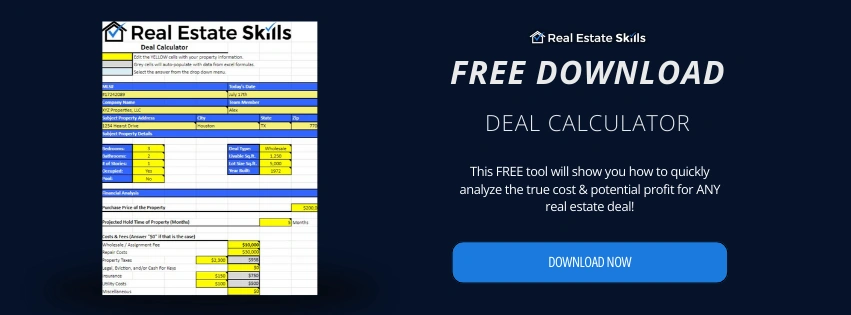
Earning the commission on your own deal is a nice bonus, but overpaying for the property wipes it out fast. Before you write an offer on that next MLS listing, run it through our free Deal Calculator. It works backward to your Maximum Allowable Offer (the most you can pay and still hit your profit), with your rehab estimate, closing costs and profit spread laid out, whether you plan to flip the house or assign the contract.
Three Checks From One Deal
A licensed investor can earn up to three paychecks from one property: a buyer-side commission for representing themselves, a fee for assigning the contract to a cash buyer, and a listing commission when that buyer resells. On a $400,000 deal, that's about $37,500 for an agent on 70/30, or $45,000 with no split.
This is my favorite way to use a license, and I break it down step by step in the video below. Watch this part.
Here's how it works:
- Get it under contract for yourself. You find a distressed listing and buy it in your own company, representing yourself and earning the buyer-side commission.
- Assign it instead of buying it. If you don't want to flip it yourself, you sell your contract to a cash buyer for a fee. That's called wholesaling: you're selling your right to buy the property, not the property itself.
- Negotiate the relist. Fix-and-flip buyers resell after they renovate. Make listing it for them part of the deal, and you earn a third commission on the resale.
| Worked example: three checks, one property | Agent on a 70/30 split | Broker with own firm |
|---|---|---|
| Buyer-side commission (2.5% of $400,000) | $7,000 | $10,000 |
| Wholesale fee | $20,000 | $20,000 |
| Listing commission on resale (2.5% of $600,000) | $10,500 | $15,000 |
| Total from one deal | $37,500 | $45,000 |
Illustration only. Commissions and fees are negotiated, and not every deal produces all three. Results vary.
Compare that to the $7,000 the same agent would have made just representing a client on that purchase. Same house. Same MLS. The difference is acting as the investor instead of only as the agent.
How To Make More Per Deal As A Real Estate Agent!
Alex walks through the split math on a $400,000 deal and how licensed agents can stack a buyer-side commission, a wholesale fee and a relist commission on the same property. It's filmed for agents; the math works the same for brokers, minus the split.

📓 From The Field
One of our students, a licensed agent, took home $2,500 after his brokerage split on his first deal. On his next one, he acted as the investor instead of the agent and made about $71,500, which he split with a partner. He took home over $35,000 from that single deal, with no brokerage split. That's one student's result, not a typical one, and your results will vary.
One quick caution on that example: some brokerages require their agents to run even their own investment deals through the brokerage. Read your agreement before you assume a wholesale fee is yours alone.
When A Broker License Isn't Worth It For Investors
A broker license usually isn't worth it if you only do a deal or two a year, if you don't want the legal responsibility of running a firm, or if your brokerage already gives you a high split. The savings come from volume. With little volume, the costs of running a firm can outweigh them.
I'd be lying if I told you the license is right for every investor. It isn't. Here's when I'd skip it:
- You do one or two deals a year. The split you save on a couple of deals often won't cover what it costs to run your own brokerage: insurance, MLS and association dues, compliance and the time it all takes.
- Your current split is already high. If you're keeping 90% today, upgrading to keep 100% is a much smaller jump than going from 70%.
- You'd rather not carry the responsibility. Even a one-person firm means you're the broker of record, responsible for your own compliance and paperwork.
- You aren't licensed yet. You don't need any license to invest or to wholesale your own contracts in most states. Get the deals first, then decide if a license pays for itself.
Want To Make More Money From Real Estate Than A Commission Check?
A broker license helps you keep more of each commission. Investing is how you stop being capped by one. Our free Ultimate Guide to Start Real Estate Investing walks you through wholesaling, flipping and building rentals step by step.
Read Also: The Ultimate Guide To Real Estate Investing
Your License Gets You Into The MLS. Now Learn To Get Paid Like An Investor.
A broker license helps you keep more of each commission, but you're still capped at a percentage of someone else's sale. The investors who earn the most from the same listings find discounted properties on the MLS and get paid on them through wholesale fees and flips. Our FREE Training walks you through that exact process, with real case studies from our students. Watch it today, then run it on the next listing you see.
Watch The FREE Training →How To Become A Real Estate Broker
To become a real estate broker, most states require about two years of experience as a licensed agent. You also complete extra broker coursework and pass the state broker exam. Requirements vary by state, and some let a bachelor's degree replace part of the experience or training.
The steps are the same in most states. The details aren't, so treat this as the map and your state's real estate commission as the rulebook.
- Check your state's rules first. Look up your state real estate commission's broker requirements: required experience, coursework hours and exam details. Remember that in a few states, like Illinois, "broker" is the entry-level license and "managing broker" is the step up.
- Put in your time as an agent. Most states want at least two years as a licensed agent, and many count closed deals, not just time on the calendar. Some states let a bachelor's degree replace part of this.
- Take the broker coursework. It goes deeper than the agent courses, covering more law, contracts and running a brokerage.
- Pass the state broker exam. Some states also require a background check.
- Decide how you'll use it. You can work as an associate broker under another firm, or open your own firm. Opening your own brings its own registration, insurance and compliance requirements, and those vary by state.
- Keep it active. Licenses typically renew every two to four years, and most states require continuing education to renew.
Licensing rules change and vary by state. Confirm current requirements with your state real estate commission.
What A Broker License Is Worth To You (Run Your Own Numbers)
Use this formula: deals per year × average commission × the share of your split you'd keep. An agent closing 10 deals at $10,000 who moves from a 70/30 split to 90/10 keeps $20,000 more a year. Moving to a firm with no split, it's $30,000, before the firm's costs.
Before you spend a dime on broker courses, do this. It takes five minutes and it'll tell you more than any salary site.
💡 Worked Example: What The License Is Worth On Your Current Volume
- Count your closed deals from the last 12 months. Say it's 10.
- Find your average commission per deal. Say it's $10,000.
- Look at your current split. Say you keep 70%.
- Moving to a 90/10 split as an associate broker means keeping 20% more per deal: 10 × $10,000 × 20% = $20,000 a year.
- Running your own firm with no split means keeping 30% more: 10 × $10,000 × 30% = $30,000 a year. Then subtract what it costs to run the firm.
If that number is small, the license can wait. Spend that energy closing more deals, or learning to invest so you're not capped by a commission check at all. If it's big, that's your answer.
Your next step: Pull up your state real estate commission's website today and check two things: the broker experience requirement, and whether you already meet it. Then run the math above on your own last 12 months. You'll know by tonight whether the broker license is a raise or a distraction for you.
Results vary. This is a planning illustration, not a projection of what you'll earn.
Real Estate Broker Salary FAQs
Final Thoughts: Don't Climb The Wrong Ladder
A real estate broker earns a median of $73,220 a year, but the license itself doesn't pay you. It changes how much of each commission you keep, and what you're responsible for. Whether it's worth it comes down to your deal volume, your current split and what you want to build.
Here's what I want you to walk away with. The broker license is a tool, not a promotion. It's a great tool if you're already closing deals and handing 30% of every check to someone else. It's a heavy one if you're hoping the title brings the deals with it.
And if you're thinking about opening a brokerage so you can collect splits from a roster of agents, look hard at those margins first. That's a real business with real liability, and most of the money still comes from the owner's own deals.
The path I like best is the one in the middle. Get licensed, keep more of every commission on your own deals, and start acting like the investor in the transaction instead of only the agent. That's where one deal stops paying you once and starts paying you two or three times.
Run your own numbers with the formula above before you decide anything. Then build the version of this business you actually want.
Stop Chasing A Bigger Split. Start Building Bigger Deals.
Every broker salary is still a percentage of someone else's deal. Our FREE Training shows how we find discounted properties on the MLS and turn them into wholesale fees, flips and rental income, the same system thousands of our students use. If you're licensed, you already have the access. Watch it today and see what one deal can pay when you're the investor.
Watch The FREE Training →
About The Author
Founder & CEO, Real Estate Skills
Alex Martinez is the Founder and CEO of Real Estate Skills. He has wholesaled and flipped houses for over 14 years, been part of 1,000+ real estate transactions, and personally acquired 55+ residential investment properties. He has trained 6,000+ investors nationwide.
Real Estate Skills is not a law firm, and the information in this article is provided for educational purposes only. It does not constitute legal, tax, or financial advice. Real estate licensing laws, broker requirements, and commission rules vary by state and change over time. Salary figures are shown for context and are not a guarantee of earnings, and real estate investing carries risk. Always consult a licensed attorney and your own tax and financial advisors before entering into any contract, transaction, or licensing decision.

👉FREE Training
How To Consistently Wholesale, Flip Houses, & Invest In Rental Properties From The MLS
(Without Spending $1 On Marketing)

Alex Martinez, the founder of Real Estate Skills, is known for his strong, practical expertise in real estate, starting from a beginner with no family connections in the industry to acquiring over 55 real estate deals, including wholesale and flips, within his first year.
He has dedicated his career to providing cutting-edge education and resources for real estate professionals. He emphasizes the importance of self-taught knowledge through mentors, books, and hands-on experience.
His journey from earning a modest income to becoming a successful real estate entrepreneur and educator showcases his expertise and dedication to the field.

Ryan Zomorodi, co-founder and COO of Real Estate Skills, leverages his experience from a diverse background in real estate investment, construction management, and entrepreneurship to provide comprehensive education in the real estate sector.
His expertise is rooted in hands-on experience, extensive industry knowledge, and a commitment to empowering others through education.
Ryan's journey reflects a blend of practical experience and entrepreneurial success, contributing to his role in developing a platform that educates and supports aspiring real estate professionals.
Read Ryan's Full Bio >>
