
What Is Reverse Flipping In Real Estate? How It Works (2026)
Oct 01, 2026

Written by
Alex Martinez, Founder & CEO, Real Estate Skills. Has wholesaled and flipped houses for over 14 years, been part of 1,000+ real estate transactions, and personally acquired 55+ residential investment properties. Has trained 6,000+ investors nationwide.
Reviewed by
Ryan Zomorodi, Co-Founder & COO, Real Estate Skills. Reviewed the deal math, contract guidance and state law updates in this guide before publication.
Publication history: Originally published February 16, 2026. Updated October 2026 with corrected 2026 state law guidance, both meanings of "reverse flip," real deal breakdowns, worked deal math, and what to do if your buyer backs out. Reviewed by Ryan Zomorodi, Co-Founder & COO of Real Estate Skills.
In real estate, reverse flipping has two meanings. The buyer-first version means lining up a cash buyer first, then finding a property that fits: they'll pay $200,000, you contract it at $190,000, you keep $10,000. The dead-deal version means buying the deed to a legally tangled property and fixing its problems.
If you've looked into wholesaling, you've heard the horror story. Someone puts a house under contract, can't find anyone to take it, and spends two weeks wondering whether they're about to lose their deposit or get stuck buying a house they never wanted.
Reverse flipping is built to avoid that. You start with the person holding the money. You find out what they buy, where, and at what price, and you get it in writing. Only then do you go looking for a house. By the time you sign anything with a seller, you already know who's taking the deal and roughly what they'll pay.
It still isn't risk-free, and anyone who tells you otherwise is selling something. Buyers change their minds. A few states now treat this kind of deal as work that needs a license. Below you'll get how it works, the math, where it breaks, and what the law looks like as of 2026. If you want to run your own numbers as you read, grab our free deal calculator.
What Is Reverse Flipping In Real Estate?
Reverse flipping is a buyer-first way to do a wholesale deal. Instead of locking up a house and hoping someone wants it, you secure a serious cash buyer and their exact criteria first, then find a matching property priced low enough to leave room for your fee.
The name comes from reversing the normal order. Most beginners work supply first: find a house, get it under contract, then scramble for a buyer before the clock runs out. Reverse flipping works demand first. The buyer comes first and the house comes second.
A few terms you'll see throughout this guide:
- Cash buyer
- An investor who buys property without a bank loan, usually a landlord or a house flipper.
- Under contract
- You and the seller have signed a purchase agreement. You don't own the house yet, but you have the right to buy it at the agreed price.
- Assigning the contract
- You hand your spot in that agreement to your cash buyer for a fee. They close with the seller, and you never own the property.
- Buy box
- The buyer's shopping list: where, what kind of house, how much work they'll take on, and the most they'll pay.
Here's how that plays out on a single deal:
💡 Example: One Reverse Flip, Start To Finish
- A local landlord tells you he buys 3-bedroom houses in two zip codes, wants cosmetic work only, and will pay up to $200,000 cash with a 14-day close.
- You get that in writing and see his proof of funds, meaning a bank statement or lender letter showing the money exists.
- You find an owner in one of those zip codes who inherited a house and wants a fast, as-is sale. You agree on $190,000.
- You assign the contract to the landlord at $200,000. The seller receives $190,000 at closing, and you're paid the $10,000 difference.
These numbers are an illustration, not a promise. Real fees depend on how deep a discount you negotiate and how much the buyer can pay.
Most investors use "reverse flipping" and "reverse wholesaling" for this same buyer-first approach. If you want the full step-by-step playbook for building the buyer list and running the process, our guide to reverse wholesaling walks through it. One warning first: the phrase "reverse flip" also gets used for a completely different strategy, which is covered next.
The Other "Reverse Flip": Buying The Deed To Dead Deals
Some investors use "reverse flip" for a different strategy: buying the deed to a legally tangled property (probate, multiple heirs, liens, a stalled foreclosure), clearing the problems, then selling or holding. Investor Will Denis popularized it. It carries far more legal risk than the buyer-first version.
This section is educational, not legal advice. Rules on deed transfers, foreclosure sales and probate vary by state. Talk to a licensed real estate attorney before acquiring a distressed or inherited property.
If you've heard "reverse flip" on a podcast and it didn't sound like anything above, this is why. The same phrase gets used for two different strategies in real estate. It even has a third life outside real estate, where it describes startups moving their parent company back to their home country. If that's what you searched for, you're on the wrong page.
In the dead-deal version, you skip the purchase contract. You go straight for ownership. You find a property other investors walked away from because the paperwork is a mess: heirs who disagree, a probate nobody opened, liens stacked on liens, or a foreclosure that's been stuck for months. You get the owner (or owners) to deed it to you, often for very little up front. Then you do the slow part, clearing the legal problems one by one, before you decide whether to sell, rent or renovate. Denis teaches this model under the Reverse Flip™ name. We don't teach it, and this guide doesn't either. You should still know how it differs:
| Buyer-first reverse flipping | Dead-deal reverse flip | |
|---|---|---|
| What you lock up first | A buyer and their criteria | The deed to a problem property |
| Do you take ownership? | No, you control a contract | Yes, you own it from day one |
| Where the profit comes from | The gap between your contract price and your buyer's price | Value unlocked by fixing title and legal problems |
| How long it takes | Usually tied to your contract's closing date | Often months, because courts and lienholders set the pace |
| What it takes | Negotiation and a reliable buyer | Title, probate and lien knowledge, plus an attorney |
| Biggest risk | Your buyer backs out | Legal problems you can't clear, and the laws below |
The dead-deal model gets pitched on its upside: no bidding wars, little cash up front. What gets less airtime is what you're taking on when you own a legally tangled house. Four things to check before you try it:
- The seller's mortgage can come due: If the house has a loan and the deed moves to you while the loan stays in the seller's name, most residential mortgages include a due-on-sale clause (the lender's right to demand the full balance when the property changes hands). Federal law lets lenders enforce it. The exceptions cover things like transfers to a spouse, or to a relative after the owner dies. A sale to an unrelated investor isn't one of them.
- Foreclosure-rescue laws may apply: Buying from an owner who lives in the home and is behind on payments puts you in some of the most regulated territory in real estate. In California, the Home Equity Sales Contracts Act kicks in when an investor takes title to an owner-occupied 1–4 unit home with a recorded notice of default. It requires a specific written contract, gives the seller a right to cancel, and lets the owner undo a deal that took unfair advantage of them for up to two years after the deed is recorded. Several other states have their own versions.
- The person signing may not have the right to sign: When an owner dies, the heirs usually can't hand you clean ownership on their own. In most states a court-appointed personal representative has to sign for the estate, and some states require court approval of the sale. A deed from the wrong person gets you a lawsuit, not a house.
- You may not be able to insure or resell it until it's cleaned up: A title company generally won't insure over unresolved liens or ownership claims. Fixing them can take a quiet title lawsuit (a court case that confirms who owns the property). That costs time and legal fees before you see a dollar.
Here's where I land. The dead-deal model can work for experienced investors with a real estate attorney on the team. It's a poor first deal for a beginner, because you own the problem from day one and can't walk away the way you can inside an inspection window. The rest of this guide covers the buyer-first version.
How The Reverse Flipping Process Works
A reverse flip runs in five steps: line up a buyer and get their criteria in writing, find a property that fits, work your offer backward from the buyer's price, sign a contract that protects you, then assign it or close. The buyer's number drives every step.
Every step below exists to protect one thing: the buyer's price. Get that number first and everything after it is arithmetic.
- Line up your buyer first. Get their criteria and their maximum price in writing, and confirm they can fund it.
- Find a property that fits. Search only inside what your buyer told you they want.
- Work the math backward. Start from your buyer's price, subtract your fee, and that's your ceiling with the seller.
- Sign a contract that protects you. Assignable, with an inspection window, and compliant with your state's rules.
- Assign it or close it, and get paid. Hand the contract to your buyer, or use a double close or partnership when an assignment won't work.
📓 From The Field
My first wholesale deal went the other way. I put a house under contract before I had a single buyer, couldn't find one in time, and had to cancel a deal I estimate would have paid $10,000 to $20,000. It also cost me some standing with the agent and the seller. Once I started lining up buyers and their criteria first, I never had to cancel another contract for lack of a buyer. The deals I still walked away from were the ones where my own numbers were off, and that's a problem you can actually fix.
It also changes what you put at risk. Because the buyer is already waiting, my goal on a buyer-first deal is to have the contract assigned before my earnest money deposit is even due, which is often within about 72 hours of signing. That doesn't always happen, and deposit deadlines and refund terms depend on your contract, so read yours. But it's a realistic target when the buyer comes first, and close to impossible when they don't.
Step 1: Line Up Your Buyer First
Before you look at a single property, get three to five active local cash buyers to tell you exactly what they buy: where, what type, how much work, their maximum price and how fast they close. Then verify they can actually fund the deal.
A cash buyer is an investor who buys without waiting on a bank's approval, usually a house flipper or a landlord. In a reverse flip, their answers become your shopping list, so a vague answer is useless. "I buy anything in the city" isn't a buy box. You need specifics:
- Where, and where not: The zip codes or neighborhoods they want, and the ones they won't touch (and why).
- What: Bedrooms, bathrooms, rough square footage, and property type (single-family, small multifamily).
- How much work: Cosmetic only, or will they take on foundation, roof or layout changes?
- Their price ceiling: The most they'll pay, and how they get to it. This number drives your whole offer.
- How many: Can they take one deal a month, or five?
- How they fund it: Plenty of "cash buyers" actually use loans from hard money lenders (short-term investor loans) or private lenders. That's fine, but ask for proof of funds or a lender letter before you contract anything for them. A buyer who can't show the money is a hope, not a buyer.
- How fast: My bar: a real buyer answers within a few hours and can decide within 24 to 72 hours. Someone who needs a week to think is going to cost you your inspection window.
💬 Illustrative Example (Not A Real Buyer)
Here's what a complete answer can sound like: "Three-bed, two-bath houses around 1,200 square feet in these two zip codes. Cosmetic to mid-level renovations, nothing structural. Up to $250,000. Two or three a month. Hard money plus cash, and I'll send a lender letter. I can close in 10 days." That's a buyer you can shop for.
Three traps to avoid:
- Out-of-town "buyers": If you're working San Antonio and your buyers all live in New Jersey, they won't move fast on a San Antonio house. Stick to buyers who already buy in your market.
- Wholesalers posing as buyers: Some "buyers" are other wholesalers who quietly resell your deal without telling you (called daisy chaining). An open co-wholesale deal, where you agree up front to split the fee, is fine. A hidden one isn't.
- Only one buyer: One buyer goes on vacation or runs out of capital, and your deal dies. Three to five active buyers gives you a backup.
If you need to find buyers from scratch, start with our guide on how to find cash buyers.
Get Your Buyer's Criteria On The First Call
Reverse flipping starts with one conversation: finding out exactly what a cash buyer buys and what they'll pay. Our free Cash Buyer Script gives you the words to open that call and the questions to pin down their areas, property type, price ceiling and closing speed, so you know what to shop for before you look at a single house.
Step 2: Find A Property That Fits The Buyer
Search only inside your buyer's criteria. Filter listings or off-market lists to their zip codes, property type and price range, then look for signs of distress like "cash only" or "needs work." If a seller won't sell below your buyer's price minus your fee, move on.
This is where reverse flipping saves you the most time. You're not looking for "a deal." You're shopping for one person with a list. That shrinks your search from every house in the county to a few dozen, and it makes your yes-or-no decisions fast.
Start with four filters, all taken straight from Step 1:
- Location: Only your buyer's zip codes or neighborhoods.
- Property: Their bedroom and bathroom count, size range and property type.
- Price: Listings, or off-market owners, where a purchase below your buyer's ceiling minus your fee is at least plausible.
- Condition: Signs a regular homebuyer will pass. On listings, look for phrases like "fixer," "investor special," "cash only," "as-is" or "needs TLC," plus price reductions and homes that have sat on the market a long time.
Your buyer's criteria can also point you at deals other investors miss. If your buyer likes turning two-bedroom, one-bath houses into three-bed, two-baths, then two-bedroom houses with room to expand become your target, even though most people filtering for "3 bed" never see them.
You can do this on-market (the MLS, or sites like Redfin and Zillow if you don't have MLS access) or off-market with lists from tools like PropStream or DealMachine, wholesaling postcards to owners in your buyer's zip codes, or driving for dollars in their neighborhoods. On-market is usually the fastest place to start, because listing agents expect your call and the listing already tells you a lot about the house.
One rule keeps this step efficient: run the quick math before you fall for a house. If your buyer tops out at $200,000 and you need a $10,000 fee, a seller who won't go below $195,000 isn't your deal, however good the house looks. Thank them and keep moving. Step 3 shows how to set that ceiling precisely.
Step 3: Reverse Flipping Math: Work Backward From Your Buyer's Price
Reverse flipping math starts with your buyer's all-in price and works backward: buyer's price minus your fee equals your maximum offer to the seller. If your buyer will pay $200,000 all-in and you want a $10,000 fee, you can't contract the house for more than $190,000.
💡 The Reverse Flipping Formula
[ Buyer's all-in price ] − [ Your fee ] = [ Your maximum offer to the seller ]
Example: $200,000 − $10,000 = $190,000
In a regular flip, you have to guess what a house will be worth after repairs and what the repairs will cost. If you guess wrong, you lose money. In a reverse flip, your buyer has already done that math for their own business. Your job is to fit your fee underneath their number.
Ask one question before you run any numbers: "Is that your all-in price, including my fee?" Most buyers mean all-in: the contract price plus your assignment fee. If you assume their $200,000 is just the contract price and add $10,000 on top, you've priced yourself out of your own deal.
Your buyer works from the after-repair value (ARV), meaning what the house will sell for once it's fixed up. They subtract the repairs, their loan and holding costs, their selling costs, and the profit they need. What's left is the most they'll pay.
The useful part for you is that they'll often share their inputs. Many flippers estimate repairs per square foot. If your buyer tells you they figure $40 a square foot for a cosmetic renovation, a 1,200-square-foot house is a $48,000 rehab in their math. Use their number, not a generic one, because their number is the one that decides whether they buy.
You'll also hear about the 70% rule: offer no more than 70% of the ARV minus repairs. It's a quick gut check, nothing more. Your buyer's actual formula is what counts, and in competitive markets buyers routinely pay well above what the 70% rule would suggest. Our guide to the MAO formula covers the 70% rule and its limits in more detail.
📓 From The Field
Here's a real one of mine. The house was listed at $510,000. My buyer's numbers put the after-repair value at $545,000 and the repairs at $52,000. I got it under contract at $429,700 and assigned it for a $5,300 fee, so my buyer was all-in at $435,000. That left them roughly $58,000 between their all-in price plus repairs and the after-repair value, before their loan, holding and selling costs. A plain 70% rule would have capped the offer around $329,500, far below where the deal actually worked for my buyer. The fee wasn't huge, but it was certain, because I priced it to my buyer's real numbers instead of a rule of thumb. Results vary with every deal and market.
Here's a worked example (an illustration, not a real deal):
| Line item | Amount |
|---|---|
| Buyer's all-in price | $200,000 |
| Your fee target | $10,000 |
| Your maximum offer | $190,000 |
| What you negotiate with the seller | $188,000 |
| Your actual fee ($200,000 − $188,000) | $12,000 |
| Non-refundable deposit from your buyer when they sign the assignment (credited toward your fee, not extra) | $3,000 |
| Paid to you at closing | $9,000 |
Two things change this math:
- If you double close instead of assigning: You actually buy the house and resell it, so you pay closing costs on both transactions. Say those total $7,000 in this example (they vary a lot by state and title company). To still clear $12,000, your purchase price would need to come down to about $181,000. That's why double closes usually only make sense on bigger spreads. Step 5 covers when to use one.
- If your buyer pushes back on your fee: Expect it. Experienced buyers will ask whether your number is flexible, because that's their job. On a deal that genuinely fits their criteria, hold your number. On a deal that's borderline for them, a smaller fee that closes beats a bigger fee that doesn't.
Run Your Buyer's Numbers Before You Call The Seller
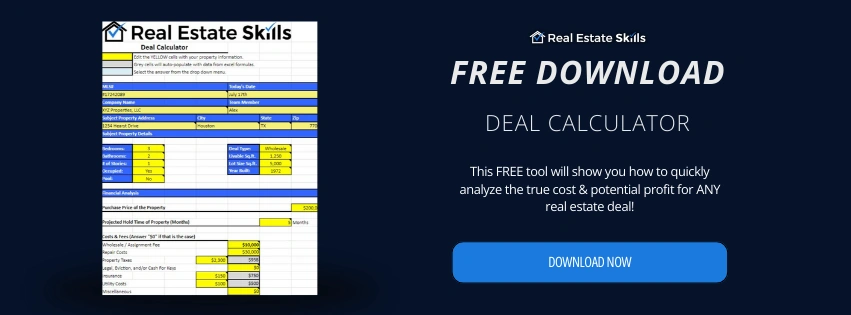
In a reverse flip, your offer is your buyer's price minus your fee, and a mistake in that math comes straight out of your paycheck. Our free Deal Calculator is the spreadsheet we use on our own deals: plug in the after-repair value, the repair estimate, the profit your buyer needs and your fee, and it works backward to the most you can offer the seller.
These figures are examples for learning the math, not a prediction of what you'll earn. Every deal, market and buyer is different.
Step 4: Keep The Deal Legal (Contracts & State Rules)
Yes, with conditions. Buyer-first reverse flipping uses ordinary purchase and assignment contracts, and as of 2026 no state bans it outright. But several states regulate it: Pennsylvania requires a license, Illinois allows one unlicensed deal a year, and Tennessee and Oklahoma require written disclosures.
This section is educational, not legal advice. Wholesaling rules differ by state and change often. Have a licensed real estate attorney in your state review your contracts and your process before you sign anything.
In a reverse flip you aren't selling a house. You're selling your right to buy that house at the price in your contract. That right only holds up if two things are in your purchase and sale agreement:
- Assignment language: The buyer line should read your name or company "and/or assigns." That tells everyone the contract can be handed to someone else. Most purchase contracts are assignable unless they say otherwise. Some aren't: many bank-owned (REO) addenda and some standard forms restrict or prohibit assignment. If yours does, you either get the seller's written consent or close the deal another way, such as a double close.
- An inspection contingency: This is your window, usually 7 to 14 days, to inspect the property and walk away with your deposit if the deal doesn't work. In a reverse flip you should already have your buyer lined up, so this window is for confirming the deal, not scrambling for a buyer.
The Legal Question That's Specific To Buyer-First Deals
Here's the part most guides skip. When you line up a buyer first and then bring them a property for a fee, you're closer to what a real estate agent does than a regular wholesaler is. In most states, bringing a buyer and a seller together for pay is brokerage, and brokerage requires a license.
What keeps you on the right side of that line is being a real principal in the deal:
- You sign the purchase contract as the buyer, with the ability and intent to close if you have to.
- You market your contract to your buyer, not the property as if you owned it.
- If your buyer is effectively your partner from the start, you put that in a written joint venture agreement, so you're both documented principals rather than a buyer and an unlicensed middleman.
Our guide to wholesaling laws in Florida walks through exactly this issue for buyer-first deals. Have an attorney look at your structure, especially if you're being paid a percentage of the purchase price.
📍 State Rules To Check First
As of September 2026, these are the states where the rules most directly affect a reverse flip:
- Pennsylvania: Act 52 of 2024 (effective January 2025) requires a real estate license to wholesale residential property, plus written disclosures and cancellation rights for consumers.
- Illinois: the Real Estate License Act treats wholesaling done twice or more in any 12-month period as a pattern of business that requires a broker's license. One deal a year is the unlicensed limit.
- Oklahoma: you can't publicly market your contract without a license. SB 1075 (effective November 1, 2025) adds a written disclosure that you intend to sell your contract for more than the homeowner is getting, a 2-day cancellation right for homeowners, and a ban on placing liens on the property. Its definitions also reach double closings, so don't treat a double close as a workaround there.
- Tennessee: SB 909 (effective March 25, 2025) requires bold written disclosures: to the seller, that you intend to market or assign your contract, and to your end buyer, that you hold a contract interest, not ownership. You must also tell the seller the effective date of any assignment at least three business days ahead.
- California: AB 1850 would require a license to wholesale and add written disclosure rules, but as of mid-2026 it was held in committee and had not become law. Check its status before you rely on either answer.
For every other state, see our guide to state-by-state wholesaling laws.
One Federal Rule You May Read About
Some older articles, including an earlier version of this one, say a federal report must be filed when an LLC or trust buys a home with cash. That was FinCEN's Residential Real Estate Rule. A federal court in Texas vacated it on March 19, 2026, and FinCEN has appealed. While that order stands, no report is required. If you're closing in late 2026 or later, ask your title company whether anything has changed.
Step 5: Assign It Or Close It, And Get Paid
Most reverse flips end in an assignment: you sign your contract over to your buyer and get paid at closing. Double close when assignment isn't allowed or the spread is large. Or split a deal with another wholesaler, or have your buyer sign from day one.
Your buyer is already lined up, so this step is about choosing the right structure for the deal in front of you. Here's how the four options compare:
| Assignment | Double close | Co-wholesale | Buyer signs from day one | |
|---|---|---|---|---|
| Whose name is on the purchase contract | Yours, then your buyer takes over | Yours (you actually buy the house) | Whoever found the property | Your buyer's company |
| Do you ever own the house? | No | Yes, briefly | No | No |
| How you get paid | Your fee, usually at closing | The difference between your two prices, minus two sets of closing costs | A split of the fee, by agreement | A fee and/or profit share from your buyer, under a written agreement |
| Best when | Most deals | The contract can't be assigned, or the spread is big | You have the buyer, someone else has the contract | You have a close relationship with one active buyer |
| Watch out for | Contracts that restrict assignment | Closing costs on both sides; some states regulate it too | Agreeing on the split in writing first | Licensing rules in your state (see below) |
Assignment (the default): You sign an assignment contract with your buyer that hands them your spot in the purchase agreement. They close with the seller, and your assignment fee is paid at closing or by the buyer directly. Collect a non-refundable deposit from your buyer when they sign, credited toward your fee. Our guide to the assignment of contract walks through the document line by line.
Double close: You buy the house from the seller and immediately resell it to your buyer, usually the same day, using two separate purchase contracts. It keeps your spread private and works when a contract can't be assigned. The cost is two sets of closing costs, which is why Step 3 showed the purchase price dropping by thousands to keep the same profit. Also note that Oklahoma's 2025 wholesaling law reaches double closes, so don't use one there to get around the rules. More in our guide to double closing.
Co-wholesale: Buyer-first fits co-wholesaling naturally. You hold the buyer, another wholesaler holds a contract on a house that fits them, and you split the fee. An even split is common, but put the split, who talks to whom, and who's responsible for what in writing before you introduce anyone. In license states like Illinois and Pennsylvania, check whether your share of a co-wholesale counts as a transaction under your state's rules. See our guide to co-wholesaling.
Your buyer signs from day one: In this version you never sign the purchase contract at all. You and one active buyer sign a written agreement up front: you find deals that fit their criteria, they make the offers in their own company's name with their own proof of funds, and they pay you an agreed amount when a deal closes. There's no assignment and no double close, because your buyer is the buyer from the start.
📓 From The Field
Ryan Zomorodi, our co-founder, has closed dozens of deals this way, more than three dozen of them with one national flipping company. On one, in Bellingham, Washington (a market he's never visited), a house listed at $345,000. He offered the day it hit the market on his buyer's behalf and lost it to a higher offer. That buyer's deal fell apart, then the next one did too. After the second, the listing agent came back and accepted his buyer's $295,000 offer, $50,000 under the list price. Ryan's agreement paid him a 1% acquisition fee at closing ($2,950) plus 6% of the flip's net profit. The house resold after renovation for $535,000, netting just under $79,000, so his profit share came to $4,740. His total: $7,690, without ever signing a contract or owning the house. Results vary; this is one deal, not a typical outcome.
Before you try it, get the structure right: Being paid to find homes for someone else is close to what licensed agents do, especially if your pay is a percentage of the purchase price. The safer setup is a documented partnership (a joint venture agreement) where you and your buyer are both principals in the deal, and a profit share puts you on firmer ground than a flat finder's fee. Have a real estate attorney in your state review the agreement before you send a single offer. How you're paid (at closing, or invoiced to your buyer afterward) is a tax question too, so loop in a CPA.
Our free advanced wholesale contracts bundle includes a joint venture agreement you can adapt for this kind of partnership with your buyer. Review it with your attorney before you use it.
This section is educational, not legal or tax advice. Rules on assignments, double closings and partnership compensation vary by state.
You've Got Your Buyer Lined Up. Now Learn To Find The Deals.
Reverse flipping only pays when you can find houses that fit your buyer's list. Our FREE Training walks you through the system we use to find discounted properties, run the numbers, get them under contract, and hand them to the cash buyers already waiting for them. It's the same process thousands of our students use. Watch it today, then go find the house your buyer already asked for.
Watch The FREE Training →What Happens If Your Cash Buyer Backs Out?
It depends on your purchase agreement. If it releases you when you assign, your buyer is on the hook. If not, you may still be liable, but your loss is often capped at your deposit, and a non-refundable deposit from your buyer can cover it.
Cash Buyer backs out of a real estate contract? DO THIS!
Ryan Zomorodi and Alex Martinez answer the question every new wholesaler asks: if your assigned buyer walks after the inspection period, are you still obligated to buy the house?

This is the fear that keeps people from doing their first deal, so let's take it head on. Buyer-first makes it less likely, because you're contracting houses a vetted buyer already told you they want. It doesn't make it impossible. Buyers lose financing, change plans, or get cold feet.
What happens next depends on when they back out.
If you're still inside your inspection window: You're usually in good shape. The inspection contingency lets you cancel and get your earnest money back. Before you cancel, call your backup buyers. A house that fit one buyer's criteria often fits another's, and this is exactly why you keep three to five active buyers instead of one.
If your buyer backs out after the inspection window closes: Your deposit is no longer refundable and the contract is binding. Whether you are on the hook comes down to two documents:
- Your purchase agreement: Some contracts release the original buyer once the contract is assigned. Others keep you liable even after you assign it.
- Your assignment contract: A well-written one makes your buyer responsible for every obligation in the original contract, so if anyone defaults, it's them.
📓 From The Field
A Real Estate Skills student recently brought us a Florida deal written on the Florida Realtors "AS IS" contract. That form makes the buyer check one of three boxes in its assignability section: you may assign and be released from any further liability; you may assign but stay liable; or you may not assign at all. The same deal can leave you fully protected or fully exposed depending on one checkbox. Read that section before you sign, and if the seller's agent insists on "may assign but not be released," treat your buyer's deposit as your safety net.
If you're still liable, here's what limits the damage:
- Liquidated damages: Many purchase contracts include a clause that caps the seller's remedy at your earnest money deposit: if the deal fails because of the buyer, the seller keeps the deposit and that's the end of it. Check that your contract has one.
- Specific performance: This is a court order forcing the buyer to complete the purchase. Some contracts let the seller choose it instead of keeping the deposit. The attorneys Ryan has spoken with say sellers rarely go this route; they keep the deposit and find another buyer. Rare isn't never, which is one more reason to vet buyers before you need them.
- A non-refundable deposit from your buyer: This is your best protection. Collect it when your buyer signs the assignment, credited toward your fee, and size it larger than your own earnest money. If your buyer walks, their deposit covers yours. Our wholesale real estate contract guide shows how to set this up.
The other way buyers "back out": the retrade. Sometimes a buyer doesn't walk; they come back late and ask you to cut your fee or the price. Expect it from experienced buyers. If the deal still fits their criteria, hold your number. If it's genuinely borderline, trimming your fee to save the deal can be the right call. Either way, decide before your inspection deadline, never after, because that deadline is what protects your deposit.
Watch the parts of the video above on non-refundable deposits, specific performance and working with reputable buyers.
This section is educational, not legal advice. Contract terms and remedies vary by state and by form. Have a licensed real estate attorney review your purchase and assignment contracts.
Reverse Flipping vs. Flipping Houses vs. Wholesaling
Reverse flipping is wholesaling done in buyer-first order. Compared with a traditional fix-and-flip, you need far less money and never own the house, but you earn a fee instead of the renovation profit. Compared with regular wholesaling, it trades speed of finding deals for certainty of selling them.
If you searched for a "reverse house flip," here's the key difference: a flipper buys the house, renovates it and sells it to a homeowner. A reverse flipper never buys it. You find the house for a flipper who's already told you what they want, and you get paid for the contract.
| Reverse flipping (buyer-first) | Traditional fix-and-flip | Regular wholesaling (property-first) | |
|---|---|---|---|
| What you do first | Line up a buyer and their criteria | Find financing, then a house | Find a house, then a buyer |
| Do you own the property? | No | Yes, through renovation and resale | No |
| Money you need | Usually just your earnest money, sometimes less | Down payment, renovation budget, and months of loan payments, taxes and insurance | Your earnest money |
| How you earn | A fee for the contract | Profit when the renovated house sells | A fee for the contract |
| Time on a deal | Usually just until the contract's closing date | Months: buying, renovating and selling | Until closing, if you find a buyer in time |
| Biggest risk | Your buyer backs out or renegotiates | Renovation overruns, a slow sale, or a market dip while you hold | No buyer before your inspection window ends |
| Main skills | Negotiation and buyer relationships | Contractors, budgets, financing and resale | Finding deals and selling them fast |
| Legal watch-outs | State wholesaling and brokerage rules | Mostly lending and contractor rules | State wholesaling and brokerage rules |
What The Trade-Off Looks Like In Real Dollars
On the deal in Step 3, my fee was $5,300. My buyer, the flipper, had roughly $58,000 of room before their loan, holding and selling costs, but they also put up the full purchase price, paid for $52,000 of renovation, and carried the risk for months. I took a smaller, faster, nearly risk-free piece; they took a bigger piece with real exposure. Neither is wrong. They're different jobs.
There's also a middle ground. Ryan's Bellingham deal in Step 5 paid him a small fee at closing plus a share of the flip's profit, without his name on the contract. That's a way to take part in a renovation's upside before you have the money to flip on your own.
Which Should You Choose?
If you have the cash or credit to fund a renovation, can manage contractors, and can survive a deal that takes longer or costs more than planned, flipping pays more per deal. If you don't yet have that capital, or you want to learn how deals are priced before you risk your own money, reverse flipping is the lower-risk way in, and the buyer relationships you build carry over when you're ready to flip. For the broader comparison, see our guide to wholesaling vs. flipping houses, and if you're leaning toward renovating, how to flip a house.
Is Reverse Flipping Right For You?
Reverse flipping fits you if you have little capital, can talk to agents and investors daily, and will send a steady stream of offers. It's wrong for you if you want hands-off income, can't build buyer relationships, or work in a state where wholesaling requires a license you don't have.
Here's the honest version, starting with what it does well.
What It Does Well
- Less money at risk: You usually need only your earnest money, and on a well-run deal you may assign before that deposit is even due. No renovation budget, no loan payments, no property taxes while you wait for a sale.
- Fewer dead contracts: You only sign on houses a buyer has already said they want, at a price that fits their numbers. That's the whole point of the method, and it's why my contract cancellations stopped being about missing buyers.
- You learn real pricing: Your buyers show you how they value houses, estimate repairs and set their price. That's the same skill you'll need if you flip later.
- Faster paydays: You're paid when the contract closes, not after a months-long renovation and resale.
Where It Falls Short
- Smaller paychecks per deal: You earn a fee, not the renovation profit. On my Step 3 deal that was $5,300, against a flipper's much larger (and much riskier) share.
- Your business runs on your buyers' appetite: If your buyers pause, run low on capital or change what they buy, your pipeline stops until you find new ones or adjust. Criteria shift with the market, so check in with your buyers regularly instead of assuming last quarter's buy box still holds.
- It's a volume game: On my own deals, it's averaged about 10 to 15 written offers for every one that gets accepted. A buyer list doesn't change that math. If you won't send offers consistently, the strategy won't work for you.
- Your reputation is on every deal: Bring a buyer a house that doesn't fit what they told you, or numbers that don't hold up, and they stop taking your calls. One active buyer is worth more than a list of names, and you can lose one quickly.
- The legal line is real: Because you line up the buyer first, you're closer to brokerage than a regular wholesaler. In Pennsylvania you need a license, and in Illinois you get one unlicensed deal a year (see Step 4).
- Taxes: Assignment fees are usually taxed as ordinary income, not as an investment gain. Talk to a CPA about how to set up your business.
It's probably not for you if:
- you want passive income or can't make calls during business hours
- you're uncomfortable negotiating with sellers, agents and investors in the same week
- you're in a license-required state and don't plan to get licensed or partner with someone who is
- you'd rather earn more per deal and have the capital to fund renovations (flip instead)
It's a strong fit if:
- you have limited capital and want to learn how deals are priced before risking your own money
- you can commit roughly the same hours every week to finding properties and calling agents
- you'd rather build three to five solid buyer relationships than market to strangers
FAQ: Common Questions About Reverse Flipping
Final Thoughts On Reverse Flipping
Reverse flipping works because it starts with the one thing most beginners skip: knowing who will buy before you sign anything. Get a buyer's criteria and price in writing, contract only what fits, protect yourself with the right clauses, and your downside stays small while you learn.
Most people who quit wholesaling don't quit because they couldn't find a house. They quit because they found one, couldn't sell the contract, and spent two weeks afraid of losing their deposit. Reverse flipping removes most of that fear by changing the order. It won't make every deal close, and it won't replace the work of sending offers, but it means the contracts you sign are ones somebody has already said they want.
Here's what to do this week:
- Talk to three active flippers in your market: Get their criteria, their maximum price and how they fund deals, in writing, and ask for proof of funds.
- Pull this week's listings in their zip codes: Filter them to what they told you.
- Run the math on five of them: Use your buyer's numbers, not a rule of thumb.
- Call the listing agents on the two that fit: Then send your first offer.
You don't need a big buyer list or a perfect market. You need one buyer who's ready, and one house that fits.
Real Estate Skills is not a law firm. This guide is educational and doesn't constitute legal, tax or financial advice. Results vary.
Ready To Close Your First Buyer-First Deal?
Knowing the order is the easy part. Getting paid comes from doing it every week: talking to buyers, finding properties that fit, making offers and closing. Our FREE Training shows you the full process step by step, the same way we teach thousands of our students. Watch it today, then go line up your first buyer.
Watch The FREE Training →
About The Author
Founder & CEO, Real Estate Skills
Alex Martinez founded Real Estate Skills and has wholesaled and flipped houses for over 14 years. He has been part of 1,000+ real estate transactions, personally acquired 55+ residential investment properties, and trained 6,000+ investors nationwide.
Real Estate Skills is not a law firm, and the information in this article is provided for educational purposes only. It does not constitute legal, tax, or financial advice. Wholesaling, assignment and real estate licensing laws vary by state and change over time. Whether you're liable when a buyer backs out depends on the exact terms of your purchase and assignment contracts, and every deal's profit is different. Always consult a licensed attorney in your state before you sign, assign or market a real estate contract.

👉FREE Training
How To Consistently Wholesale, Flip Houses, & Invest In Rental Properties From The MLS
(Without Spending $1 On Marketing)

Alex Martinez, the founder of Real Estate Skills, is known for his strong, practical expertise in real estate, starting from a beginner with no family connections in the industry to acquiring over 55 real estate deals, including wholesale and flips, within his first year.
He has dedicated his career to providing cutting-edge education and resources for real estate professionals. He emphasizes the importance of self-taught knowledge through mentors, books, and hands-on experience.
His journey from earning a modest income to becoming a successful real estate entrepreneur and educator showcases his expertise and dedication to the field.

Ryan Zomorodi, co-founder and COO of Real Estate Skills, leverages his experience from a diverse background in real estate investment, construction management, and entrepreneurship to provide comprehensive education in the real estate sector.
His expertise is rooted in hands-on experience, extensive industry knowledge, and a commitment to empowering others through education.
Ryan's journey reflects a blend of practical experience and entrepreneurial success, contributing to his role in developing a platform that educates and supports aspiring real estate professionals.
Read Ryan's Full Bio >>
