
Rich Dad Poor Dad Review: A Real Estate Investor's Honest Verdict (2026)
Oct 07, 2026
Written by
Alex Martinez, Founder & CEO, Real Estate Skills. Has wholesaled and flipped houses for over 14 years, been part of 1,000+ real estate transactions, and personally acquired 55+ residential investment properties. Has trained 6,000+ investors nationwide.
Reviewed by
Ryan Zomorodi, Co-Founder & COO, Real Estate Skills. Reviewed the book analysis, real estate examples, and figures in this guide before publication.
Publication history: Originally published September 26, 2023. Updated October 2026 with a full rewrite: a clear verdict, an accurate breakdown of all six lessons, worked numbers on whether your house is an asset, the book's main criticisms, and first-hand experience from Alex Martinez's video on applying the book. Book analysis, real estate examples, and figures reviewed by Ryan Zomorodi, Co-Founder & COO of Real Estate Skills.
My Rich Dad Poor Dad review in one line: read it once for the mindset, not the method. Robert Kiyosaki's 1997 bestseller will change how you think about assets and income, but it won't teach you how to find, analyze, or buy a single property. That gap is the real story.
If you're about to read Rich Dad Poor Dad, you've probably heard two things. Half the internet says it changed their life. The other half says it's a fable dressed up as financial advice, built around a "rich dad" nobody has ever been able to identify. Both camps are loud, and both are partly right.
I read it at 19. I was making $10 an hour at a sandwich shop, going to college with student loans, and I'd never thought about money as anything other than hours worked. The book changed that. It also left me with no money, no deal experience, and no idea how to buy a property. Everything I've done in real estate since then came from closing that gap.
So this isn't a book report. It's a working investor's verdict: which ideas in Rich Dad Poor Dad hold up on a real deal, which ones don't, and what to do once you close the book. If you want the part the book skips, our free training walks through how to find and lock up your first deal.
Is Rich Dad Poor Dad Worth Reading?
Yes, read it once, as long as you treat it as a mindset book and not an investing manual. Its core lesson, that an asset puts money in your pocket and a liability takes money out, is worth a weekend. Just know its stories are unverified and it contains no deal math.
Here's my honest take after more than 14 years of wholesaling, flipping, and buying property: the book does one job very well and skips nearly everything else.
The one job is getting you to stop measuring money in hours. Kiyosaki's definitions are blunt. An asset is anything that puts money in your pocket. A liability is anything that takes money out. Run a simple example: a rental that clears $300 a month after the mortgage, taxes, insurance, and repairs is an asset by his test. A car with a $450 monthly payment is a liability, no matter what it's worth on paper. (Both numbers are illustrations, not a promise of what any property will do.) Once that clicks, you start sorting every purchase into one column or the other. That's exactly what happened to me.
What it skips is everything you need to actually do a deal. There's nothing on calculating an offer, estimating repairs, pulling comps (recent sale prices of similar homes nearby), or finding a buyer. You finish the book motivated and empty-handed. I break down exactly what it leaves out, and what filled the gap for me, later in this review.
Who should read it:
- You've only thought about money as a paycheck: This is the book that hands you a different frame.
- You're curious about real estate or owning a business: If you can't see why anyone would take the risk, it makes the case in plain language.
- You want an easy entry point: It's short and built on stories, not spreadsheets, so you can finish it in a weekend.
Who should skip it, or read it with caution:
- You want a step-by-step plan: There isn't one, and plenty of readers finish believing motivation is the plan. It isn't.
- You tend to take advice at face value: The "rich dad" has never been verified, and some of Kiyosaki's ideas on debt and taxes carry real risk for a beginner. Treat the book as a set of ideas to test, not instructions to follow.
How I'd read it today: get through it in a weekend, keep the asset test, and don't quit your job because of it. Kiyosaki himself tells readers to build their asset column while they're still employed. Then put your real energy into learning how deals are found, priced, and closed, because that's where the money is made.
This review is educational and isn't financial advice. Talk to a licensed professional before making investment decisions.
Rich Dad Poor Dad Summary
Rich Dad Poor Dad is Robert Kiyosaki's story of two father figures: his own highly educated but financially strained father, and his best friend's entrepreneur father. Through their contrasting habits, the book argues that wealth comes from owning income-producing assets, not from earning a bigger paycheck.
Kiyosaki wrote the book with Sharon Lechter, and it reads more like a series of parables than a finance textbook. The "poor dad" is Kiyosaki's biological father, a career educator who rose to become Hawaii's state superintendent of education and still struggled with money. The "rich dad" is the father of Kiyosaki's childhood best friend, Mike, a businessman who built his wealth by owning things rather than working for someone else.
Every lesson in the book comes out of a conversation between young Robert and one of these two men. Poor dad says "I can't afford it." Rich dad says "How can I afford it?" Poor dad calls his house his biggest investment. Rich dad calls it a liability. That contrast is the entire engine of the book, and once you see it, you can predict most of what comes next.
The first six chapters are built around six lessons, which I break down below. The back half shifts away from new concepts and toward the mental obstacles that keep people stuck and how to get started anyway. There are no worksheets, no formulas, and no sample deals. It's an argument for a way of thinking, delivered through stories.
Who Is Robert Kiyosaki's Rich Dad?
Nobody outside Kiyosaki's circle has ever confirmed who the rich dad was. Kiyosaki describes him as his best friend's father, a Hawaii businessman, and maintains he was a real person. Critics argue he may be a composite or invented character, and no documentation has settled it.
This is the question that splits readers more than any lesson in the book. Kiyosaki has always said the rich dad was real. His critics, most prominently real estate author John T. Reed, have pointed out that the man has never been publicly identified or documented. As of 2026, the question is still open.
Here's how I'd handle it as a reader: it doesn't change whether the asset test works, but it should change how much weight you give the stories. If a lesson depends on "rich dad said so," test it against real numbers before you act on it. If it holds up on its own math, the source of the story matters less.
When Was Rich Dad Poor Dad Published, and Which Edition Should You Read?
Rich Dad Poor Dad was first self-published in April 1997. A 20th anniversary edition followed in 2017, and a 25th anniversary edition came out in 2022 with updated commentary and study sections. The core lessons are the same in every edition, so any version works.
The publisher reported more than 40 million copies sold with the 2022 edition, and Vanity Fair put the figure at more than 44 million in 2026. Whatever the exact number, it's one of the best-selling personal finance books ever written, which is why it keeps coming up in every conversation about getting started with money.
If you're buying a copy today, the 25th anniversary edition of Rich Dad Poor Dad is the current one (here's the publisher's page for Rich Dad Poor Dad). It includes Kiyosaki's updates on what changed in the 25 years since the original, plus nine study session sections at the end of the chapters. The publisher itself notes that very little in the main text changed, so an older copy from a library or a used bookstore will teach you the same lessons for less money.
What Are The 6 Lessons In Rich Dad Poor Dad?
Rich Dad Poor Dad teaches six lessons, one per chapter in the first half of the book:
- The rich don't work for money.
- Why teach financial literacy?
- Mind your own business.
- The history of taxes and the power of corporations.
- The rich invent money.
- Work to learn, don't work for money.
Below is what each lesson actually says, what it means if you want to invest in real estate, and where I think it holds up or falls short.
Lesson 1: The Rich Don't Work For Money
Kiyosaki's first lesson is that the poor and middle class work for money, while the rich make money work for them. He argues that fear of running short and the desire for more keep most people trading hours for wages, no matter how much they earn.
The book teaches this through a low-paying job young Robert takes in rich dad's business. The frustration of that job is the point: rich dad wants him to feel how little control a wage gives you.
I didn't need the parable. At 19, I was living it at $10 an hour. A raise would have meant $10.30. The path I was on, college followed by a salary and a small raise each year, still tied every dollar to an hour of my time.
Here's what beginners get wrong about this lesson: it doesn't mean income from a job is bad. Your paycheck is what funds your first deposit, your first course, and your first mistakes. The lesson is to stop sending all of it into things that never pay you back.
Lesson 2: Why Teach Financial Literacy?
For Kiyosaki, financial literacy starts with one rule: know the difference between an asset and a liability. An asset puts money in your pocket, and a liability takes money out. He argues that schools never teach this, so most people buy liabilities while believing they're assets.
This is the lesson that rewired how I thought about money. Before it, I understood one model: work an hour, get paid for an hour. After it, I could see a second one, where the things you own produce income whether you show up or not.
Kiyosaki also gives a different definition of wealth: how long you could survive if you stopped working today. Run it on yourself:
- Your monthly expenses are $4,000, and you have $12,000 saved. You're three months wealthy.
- Add rentals that clear $1,500 a month after every expense. Now your assets cover more than a third of your life, and your savings last longer every month.
- When the monthly income from your assets matches your expenses, you could stop working indefinitely. That's the finish line the book is pointing at.
(These are illustrative numbers. Real properties vary, and rents, vacancies, and repairs change cash flow month to month.)
The most controversial application of this lesson, that your own home is a liability, gets its own section below.
Lesson 3: Mind Your Own Business
"Mind your own business" means building your own asset column instead of only working to build someone else's. Kiyosaki's example is McDonald's founder Ray Kroc, who told a 1974 MBA class his real business was real estate, not hamburgers. Keep your job, but build assets on the side.
This is the chapter most summaries get wrong, and it's the most important one for anyone interested in real estate. Kiyosaki separates your profession (what you do for a paycheck) from your business (the assets you own). A banker who doesn't own the bank, he points out, is minding someone else's business.
The Ray Kroc story is the heart of it. McDonald's sold hamburgers, but the company made its fortune by controlling the land under its restaurants. Kiyosaki's point: whatever you do for work, the thing that builds wealth is what you own underneath it.
His list of real assets includes businesses that run without you, stocks, bonds, royalties, and income-producing real estate, which you can also own indirectly through real estate investment trusts (REITs). And he gives a rule I still like: once a dollar goes into your asset column, treat it like an employee and don't pull it back out to spend.
In my own career, my profession was acquisitions: finding deals, negotiating them, and putting them under contract. My business became the real estate itself. Today my partners and I own a couple hundred units across multifamily and commercial property, and every one of them traces back to this distinction.
Lesson 4: The History Of Taxes And The Power Of Corporations
Kiyosaki argues that business owners and investors are taxed more favorably than employees because a business can pay many expenses before taxes, while an employee pays taxes first and spends what's left. The broad idea holds, but tax rules have changed since 1997, so confirm specifics with a CPA.
The core comparison is about order of operations. An employee earns, pays taxes, then spends. A business owner earns, spends on legitimate business expenses, then pays taxes on what remains. That difference is real, and it's why many investors hold property in an entity.
Real estate has its own tax advantages that matter more to a beginner than anything in this chapter. The biggest is depreciation: the IRS lets you deduct the cost of a residential rental building (not the land) over 27.5 years, which can offset some of the rent you collect (see IRS Publication 527 on residential rental property). Mortgage interest, repairs, and other operating expenses on a rental are generally deductible against its income too.
Where beginners get burned is assuming every real estate dollar gets that treatment. Fees from wholesaling and profits from quick flips are usually taxed as ordinary income, much like a paycheck (here's how wholesaling fees are taxed). Forming an LLC can protect your personal assets from a business lawsuit, but it doesn't erase taxes (see whether you need an LLC to wholesale). This is the chapter to read for the idea and then hand to a CPA for the details.
Tax treatment depends on your situation and changes over time. This is educational, not tax advice.
Lesson 5: The Rich Invent Money
"The Rich Invent Money" is about financial intelligence and nerve: spotting opportunities other people miss and putting deals together before you have the cash. It's the most real-estate-heavy lesson in the book, and the riskiest if you copy the stories without the skills behind them.
Kiyosaki's argument is that money follows the person who can see a deal and structure it, not necessarily the person who already has capital. His examples lean on buying real estate in down markets, when other buyers are scared off.
The idea is sound. The way it plays out today usually looks like controlling a deal rather than owning it. Wholesaling real estate is the clearest example: you put a property under contract at a discount, then sell your right to buy it to another investor for a fee. You never take ownership.
📓 From The Field
My first deal came in July 2012, when I was 20, about 45 days after I went all in on real estate. I found a distressed house listed on the MLS for $385,000, called the listing agent the day I saw it, walked the property the next day, and offered $328,000. It was a short sale (a sale where the seller's lender has to approve a price below what's owed on the loan), so after the seller signed, I spent about a month waiting on the bank. I used that month to line up a cash buyer through local investor networking. When the bank approved the price, the deal closed with my buyer, and I collected a $22,000 fee. (That was one deal. Results vary widely, and many beginners take much longer to close their first.)
Even the closing took some invention. The bank wouldn't let my company come off the title for 30 days after closing, so we briefly held the property with the buyer as tenants in common (shared ownership), my company with 1% and the buyer with 99%, and removed ourselves on day 31. That's the creativity this chapter is talking about. It's also the kind of problem you should only solve with a title company and an attorney involved.
Here's the catch the book doesn't spell out: that deal didn't come from nerve. It came from knowing how to read comps, estimate repairs, and run the numbers before I made the offer.
Real estate deals carry risk, and past results don't guarantee future outcomes.
Lesson 6: Work To Learn, Don't Work For Money
Kiyosaki's final lesson is to choose work for the skills it teaches, not just the paycheck. He puts sales and communication above everything else, arguing that many talented people stay broke because they can't sell, negotiate, or handle rejection.
Of the six lessons, this is the one I'd hand to any beginner without a single caveat.
When I got serious about real estate, I cut college back to part-time and took an acquisitions role with an investor who was actively doing deals in San Diego. I called dozens of agents a day through the MLS (multiple listing service, the database of homes listed for sale by agents) and submitted written offers every day the numbers made sense. Most of those offers went nowhere. Every rejection taught me something about pricing or negotiating.
That first year, the acquisitions team I helped build closed more than 50 wholesale and fix-and-flip deals in San Diego County. The money mattered, but the skills mattered more: negotiating, handling objections without getting defensive, and following up until a deal either closed or clearly died.
If you want to invest in real estate, acquisitions is the skill to learn first. Nothing else matters until you can find and lock up a deal at the right price.
Is Your House an Asset? Kiyosaki's Most Debated Idea
By Kiyosaki's definition, your home is a liability, because it takes money out of your pocket every month and puts none back. By standard accounting, it's an asset, and the mortgage is the liability. Both are true. The useful question is whether a property produces cash flow.
"Your house is not an asset" is the most quoted line in the book, and the most misunderstood. Kiyosaki isn't using the accounting definition. He's using his own cash-flow test: does this put money in my pocket or take it out? Run a primary home through that test and it fails almost every time.
Here's what that looks like with real math. These are illustrations, not predictions, and every assumption is listed so you can swap in your own numbers.
💡 Example 1: The Home You Live In
- Purchase price: $400,000, with 20% down ($80,000)
- Loan: $320,000 at an assumed 6.5% for 30 years
- Mortgage payment (principal and interest): about $2,023 a month
- Property taxes (assumed 1.1% a year): about $367 a month
- Insurance: about $150 a month
- Maintenance (assumed 1% of the value a year): about $333 a month
- Total out each month: about $2,873. Total in: $0.
By Kiyosaki's test, that's a liability. Money leaves every month and nothing comes back.
But that's not the whole picture, and this is where his critics have a point. In the first month, about $289 of that payment goes toward paying down the loan, which builds your equity (the share of the home you actually own). If home values rise, your equity grows further. And you'd be paying rent somewhere if you didn't own. By standard accounting, that home is a $400,000 asset with a $320,000 liability against it, leaving you $80,000 in equity on day one.
In Kiyosaki's own case that your house is not an asset, he points to the 2008 housing crash as proof he was right, since millions of owners learned the hard way that a house can drain money and lose value at the same time. Fair enough. But the honest version of his lesson is narrower than the slogan: your home is a cost of living, not an income source, so don't count it as part of your investment plan.
💡 Example 2: A Rental Property, and Why the Purchase Price Decides Everything
Now run a rental through the same test. Same rent, two different purchase prices:
- Rent: $2,100 a month
- Assumed loan terms for an investment property: 25% down, 7% interest, 30 years
- Property taxes (1.1% a year), insurance of $125 a month, plus three costs most beginners forget: 5% of rent set aside for vacancy, 8% for repairs, and 8% for property management
| Bought at $250,000 | Bought at $210,000 | |
|---|---|---|
| Down payment | $62,500 | $52,500 |
| Mortgage payment | about $1,247 | about $1,048 |
| Property taxes | about $229 | about $193 |
| Insurance | $125 | $125 |
| Vacancy, repairs, management | $441 | $441 |
| Monthly cash flow | about $58 | about $293 |
Both rentals pass Kiyosaki's asset test. One barely does. Buying the same property for $40,000 less turns $58 a month into about $293 a month, five times the cash flow from the same rent.
That's the part Rich Dad Poor Dad never teaches. The book tells you to buy assets. It doesn't tell you that whether a rental becomes an asset is mostly decided the day you negotiate the price. That's why I spend so much time on acquisitions: you make your money when you buy, not when you collect rent.
Run Kiyosaki's Asset Test On Any Rental
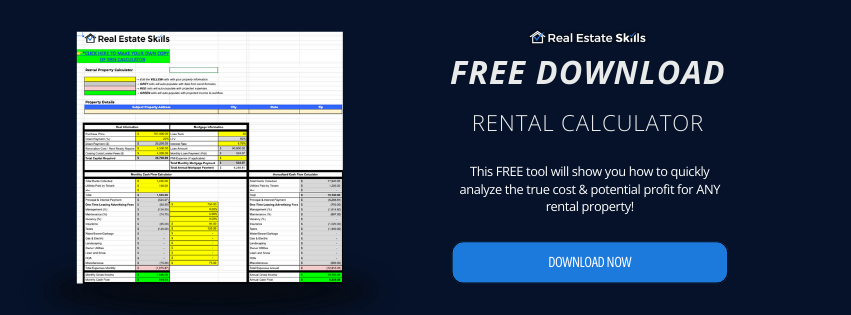
Rich Dad Poor Dad tells you an asset puts money in your pocket. This free spreadsheet shows you whether a specific property actually will. Plug in the purchase price, rent, and expenses to see a rental's monthly cash flow, its cap rate (the property's yearly net income divided by its price), and its ROI before you make an offer. It's the same math behind the two examples above.
My take as an investor: Kiyosaki is right that your home won't pay your bills, and right that most people overspend on it. He's wrong if you read him as saying "never buy a home." Buy the home you need, not the most house a lender will approve, and don't mistake it for your retirement plan. If you want your home to pass his test, look at house hacking: buying a small multi-unit property, living in one unit, and renting out the others so the tenants cover some or all of your payment.
These examples use assumed rates and costs for illustration. Your taxes, insurance, interest rate, and rents will differ, and real results vary. This is educational, not financial advice.
Is Rich Dad Poor Dad a Real Estate Investing Guide?
No. Rich Dad Poor Dad explains why to own real estate, not how. It never covers finding a deal, estimating repairs, calculating an offer, writing a contract, or finding a buyer. Read it for motivation, then learn the mechanics from people who are actively doing deals.
I finished the book completely clear on where I wanted to go: real estate. I also finished it with no money, no deal experience, and no idea how to find or buy a property. That's not a knock on the book. It just isn't the book's job. But a lot of readers don't realize that until they close it and try to do something.
Rich Dad Poor Dad Changed My Life. Here's How I Applied It.
Alex explains how the book changed his thinking about money, then walks through the part it never teaches: finding and acquiring deals with no money and no experience.

Watch this part (3:53): the moment I name exactly what the book leaves out.
Here's what the book leaves out, in the order you'll actually need it:
- How to find a deal: Nothing on where discounted properties come from: motivated sellers, listed properties that have sat too long, or agents who know about deals before they hit the market.
- How to value a property: You need the ARV (after-repair value), meaning what the home should sell for once it's fixed up, which comes from comps: renovated homes nearby that sold recently. I look within about half a mile, sold in the last six months, with similar beds and baths and within 20% of the square footage. You also need a repair estimate. The book covers none of it.
- How to calculate an offer: This is the single most important number in any deal, and the book never mentions it.
- How to write and assign a contract: No purchase agreements, no contingencies, no assignment of contract.
- How to find a buyer or financing: No cash buyers, no lenders, no partners.
- How to keep a deal alive when something goes wrong: In my experience, something always does.
To show how big that gap is, here's the math from my own first deal. Many beginners start with the 70% rule: take 70% of the after-repair value, subtract the repairs, and, if you're wholesaling, subtract your fee. What's left is your maximum offer.
💡 The 70% Rule vs. My Actual First Offer
- ARV my cash buyer and I agreed on: $475,000
- 70% of the ARV: $332,500
- Minus repairs: $50,000
- Minus my wholesale fee: $22,000
- 70% rule maximum offer: $260,500
My actual contract price was $328,000, about $67,500 more than the rule allowed, and I still earned the same $22,000 fee. My buyer's projected profit, if the house sold for $475,000 on a $50,000 rehab, was about $44,700. Following the rule would have had me underbid so badly that the agent and seller would never have taken me seriously.
I wasn't perfect, either. My first ARV estimate was $525,000, about $50,000 too high. The deal survived because I'd checked whether it still worked if I was wrong.
That's why I treat the 70% rule as a quick screen, not an offer price. Real offers come from running a deal's actual numbers: repairs, holding and closing costs, and the profit your buyer needs. Rich Dad Poor Dad doesn't give you a single tool like that.
The Calculator Behind My First $22,000 Deal
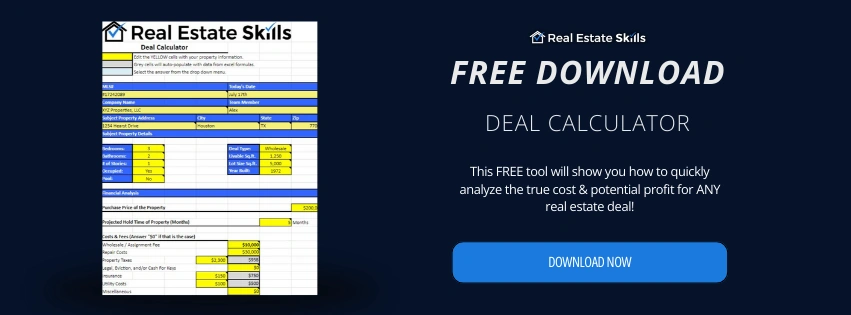
The 70% rule would have capped my first offer at $260,500. Running the real numbers let me offer $328,000 and still earn the same fee. This free spreadsheet is the same deal analyzer I've used and refined on my own deals ever since. Plug in the after-repair value, repair costs, and closing costs to find your maximum allowable offer (the most you can pay and still leave room for your profit and your buyer's) before you ever submit an offer.
So what filled the gap for me? People. The friend who recommended the book connected me with a real estate mentor who was doing deals in San Diego every week. Being close to someone getting the results I wanted taught me more in a few months than any book could, because I could see how he priced a property, what he said to agents, and why he walked away from deals that looked fine on paper.
A word of caution on that: not every mentor, course, or seminar is worth your money. Look for someone actively closing deals right now, who can show you real contracts and settlement statements, and who teaches you to run the numbers yourself rather than just selling you motivation.
I think of it as two steps. The first is acquiring knowledge: reading the book, listening, learning the idea. The second is applying it until it produces a result. Rich Dad Poor Dad handles step one. Almost everyone who reads it stops there.
Every deal and market is different. These examples are educational, not financial or legal advice.
Why Do Critics Call Rich Dad Poor Dad a Bad Book?
Critics point to four problems: the "rich dad" has never been verified, the book offers motivation instead of a plan, its advice on debt and taxes can be risky for beginners, and Kiyosaki's own business record includes a company bankruptcy. Some of that criticism is fair, and some of it overreaches.
I'm a fan of what this book did for me, and I still think you should hear the case against it before you read it. Here's the honest version.
- The stories can't be checked: We covered the rich dad question above. The broader issue is that almost every lesson rests on conversations nobody else witnessed. In John T. Reed's critique of Rich Dad Poor Dad, the real estate author and the book's best-known critic calls it "one of the dumbest financial advice books I have ever read," arguing that it's full of wrong and risky advice. You don't have to agree with him to see the problem: when a lesson can't be verified, you have to test it yourself.
- It's motivation, not instruction: This is the most common complaint, and it's fair. We covered exactly what's missing in the previous section.
- Kiyosaki's own business record is mixed: In 2012, a federal jury ruled that his company Rich Global LLC owed seminar promoter The Learning Annex a share of profits from speaking events, and the court entered a $23.7 million judgment against Rich Global LLC. A few months later, Rich Global filed for Chapter 7 bankruptcy in Wyoming, reporting roughly $1.8 million in assets against nearly $26 million in liabilities. The bankruptcy was corporate, not personal, and a Rich Dad executive said Kiyosaki's personal assets wouldn't be used to pay the judgment.
- His views on debt can mislead beginners: This one deserves the most attention, because it's the criticism most relevant to real estate.
Critics read the bankruptcy as hypocrisy. I read it as a reminder of something Kiyosaki teaches himself: entities like LLCs separate business liabilities from personal ones. Either way, it's a fair thing to know about someone selling financial advice.
Is Robert Kiyosaki Really $1.2 Billion in Debt?
Kiyosaki has said in podcast interviews since 2025 that he's about $1.2 billion in debt. His ex-wife and business partner, Kim Kiyosaki, told Vanity Fair the figure is tied to roughly 1,500 apartment units owned with partners, and Vanity Fair estimated his personal share at roughly $30–60 million.
Kiyosaki uses the number deliberately. He's argued that if you owe a bank a billion dollars and can't pay it back, that's the bank's problem, not yours. He's also said, in the same breath, that people shouldn't copy what he does unless they get educated about debt first. Kim Kiyosaki has said he uses the shocking figure to grab attention before explaining the difference between investment debt and consumer debt.
That difference is the real lesson, and it's worth getting right:
- Bad debt: Pays for things that take money out of your pocket: a car loan, credit card balances, the extra square footage on a home you didn't need.
- Good debt: Buys an asset whose income covers the payment with room to spare: a rental whose rent pays the mortgage, taxes, insurance, and repairs, and still leaves cash flow.
The catch is that "good debt" only stays good if the margin holds. Go back to the $250,000 rental from the house section, the one that cleared about $58 a month. If that property sits empty for one extra month beyond what you budgeted, you lose $2,100 in rent. That single month wipes out about three years of its cash flow. The same leverage that makes a good deal great makes a thin deal dangerous.
Kiyosaki can absorb a bad month across 1,500 units, a team of partners, and decades of experience. A beginner with one rental can't. So take his point about debt being a tool, but borrow only against deals with real cash flow and real reserves behind them.
Where the critics overreach: the asset test is sound. The push to learn how money works is something schools still mostly skip. And the book has started more real estate careers than any critique has ended, including mine. The fair verdict isn't "this book is a scam." It's "this book is a starting point, written by a salesman, that you should verify before you follow."
This section discusses public reporting and is educational, not financial or legal advice. Using debt to invest carries real risk of loss.
Is Rich Dad Poor Dad Still Relevant Today?
Yes, the core principles still hold in 2026: buy assets that produce cash flow, learn how money works, and build skills that let you find opportunities. What's dated is the context. Interest rates, tax rules, and real estate regulations have changed since 1997, so apply the ideas with current numbers.
The book's staying power comes from how simple its ideas are. Simple ideas don't expire. The specifics around them do. Here's how I'd sort it:
| Still holds | Dated or needs adjusting |
|---|---|
| The asset test: does it put money in your pocket? | Assumptions about how easy cash flow is to find. Higher borrowing costs in recent years have made thin deals much thinner. |
| Keep your job while you build your asset column | Tax specifics. Rules have changed repeatedly since 1997, so confirm anything you plan to rely on with a CPA. |
| Learn sales, negotiation, and how to handle rejection | The idea that you can figure out deals alone. Today you can learn from people doing deals in real time, through video, communities, and training. |
| Financial education is your responsibility, not your school's | Wholesaling rules. Several states have added disclosure or licensing requirements in recent years, so check whether wholesaling is legal in your state before you start. |
The biggest shift for real estate investors is the margin for error. When money is cheap, a mediocre rental can still cash flow. When it isn't, the same property can barely break even, as the $250,000 example above showed. That makes the skills Rich Dad Poor Dad skips (pricing, negotiating, buying at a real discount) more important now than when the book came out.
So yes, read it in 2026. Just read it as a set of principles, not a description of today's market.
What Is Robert Kiyosaki's Advice On Real Estate?
Kiyosaki's real estate advice comes down to four ideas: buy property for cash flow, not hoped-for appreciation; use debt to acquire income-producing assets; buy when other investors are afraid; and get educated before you invest. All four are sound in principle, and each one fails without the right numbers.
Here's each piece of his advice, and how it holds up on a real deal.
- Buy for cash flow, not appreciation: This is his strongest real estate idea, and I agree with it completely. Appreciation (a rise in a property's value) is a bonus you can't control. Cash flow is something you can calculate before you buy. If a property only works if prices go up, it's a bet, not an investment.
- Use debt to buy assets: True, with a condition the slogan leaves out: the asset's income has to cover the debt with a real margin, and you need cash reserves for vacancies and repairs. Kiyosaki can carry a large debt load across hundreds of units and partners. A beginner with one property should borrow far more conservatively.
- Buy when others are afraid: Down markets do create discounts. But you can only take advantage of one if you already have cash, credit, and the skill to tell a bargain from a falling knife. Most beginners who wait for a crash aren't ready when it comes.
- Get educated first: Agreed, as long as "educated" means learning to find, price, and close a deal, not just reading more books about mindset. Education that never leads to an offer is just entertainment.
One more thing worth knowing: in recent years, Kiyosaki talks about gold, silver, and Bitcoin at least as often as real estate. That's fine for him. But if you're reading Rich Dad Poor Dad for its real estate message, focus on the cash-flow principle, which hasn't changed, rather than whatever asset he's promoting this year.
This is educational, not financial advice. Investing in real estate involves risk, including loss of capital.
What To Do After You Read Rich Dad Poor Dad
After you finish Rich Dad Poor Dad, turn its main idea into numbers. List your own assets and liabilities, calculate how many months you could live without working, then start analyzing real properties in one market. Your first goal isn't buying a property. It's learning to price one.
Most people finish the book fired up, then do nothing with that energy. Here's what I'd do in the first 30 days instead:
- Sort your life into two columns: Go through everything you pay for and own, and label each item by Kiyosaki's test: does it put money in your pocket or take it out? Most people discover their asset column is nearly empty. That's normal, and it's the starting line.
- Calculate your wealth number: Divide your savings by your monthly expenses. That's how many months you could last without a paycheck. Write it down, because the whole point of the next few years is making it grow.
- Pick one market and learn it: Choose a single area, ideally one you know. Look at recently sold homes and get a feel for what fixed-up properties sell for versus properties that need work.
- Run the numbers on ten listed properties: Pull comps, estimate the ARV and repairs, and use the 70% rule only as a quick screen. Then work out what an investor buyer would actually need to profit. Your early estimates will be wrong. My first ARV was off by $50,000. That's how you learn.
- Talk to five agents: Tell them you're an investor looking for properties that need work. Ask what's sitting on the market and why. You'll learn more from those calls than from another book.
- Make your first written offer: Do it once a property's numbers truly work. Expect most offers to be rejected. Every rejection teaches you something about pricing or negotiating.
None of these steps requires money. Every one of them builds the skill the book can't give you.
What Should You Read After Rich Dad Poor Dad?
If Rich Dad Poor Dad gave you the why, read something next that gives you the how. Good follow-ups include The Millionaire Real Estate Investor by Gary Keller, The Book on Rental Property Investing by Brandon Turner, and Kiyosaki's own sequel, Cashflow Quadrant.
- Cashflow Quadrant by Robert Kiyosaki: The direct sequel, and the one to read if you want more of the same framework. It sorts income into four types (employee, self-employed, business owner, investor) and explains the shift from one side to the other. It's still more mindset than mechanics.
- The Millionaire Real Estate Investor by Gary Keller: Much more practical. It focuses on how investors find deals, evaluate them, and build a portfolio over time, with real models instead of parables.
- The Book on Rental Property Investing by Brandon Turner: The best next step if you want rentals specifically. It covers analysis, financing, and management, which are exactly the topics Rich Dad Poor Dad skips.
- The ABCs of Real Estate Investing by Ken McElroy: Written by one of Kiyosaki's own real estate advisors, so it reads like the practical companion to the Rich Dad series, with a focus on apartment investing.
If wholesaling is your entry point, we've put together a full list of the best books for that strategy.
The Book Gave You The Why. Here's The How.
Rich Dad Poor Dad tells you to buy assets that put money in your pocket. It never shows you how to find a discounted property, run the numbers, or get a deal under contract when you're starting with little money and no experience. Our FREE Training walks you through that process step by step, the skills I had to learn after I closed the book. Watch it today, then start putting Kiyosaki's ideas to work on real deals.
Watch The FREE Training →Rich Dad Poor Dad Review FAQs
Final Thoughts On Our Rich Dad Poor Dad Review
Rich Dad Poor Dad earns its reputation for one reason: it changes the question you ask about money. Not "how much do I make?" but "what do I own, and does it pay me?" That question changed my life at 19, and it's still the first test I run on every deal.
But the book is the beginning, not the plan. It can't verify its own stories, it won't teach you to price a property, and its author's relationship with debt is not a model for someone buying their first rental. Read it with that in mind and you'll keep the best of it without inheriting its blind spots.
The readers who get the most from this book are the ones who close it and do something within a week: run the numbers on a real property, call an agent, make an offer that might get rejected. Rich Dad Poor Dad gives you the reason. The skills come from doing the work.
Ready To Turn Rich Dad Poor Dad Into Your First Deal?
Reading the book is step one. Most readers stop there. The ones who build real wealth learn how to find deals, price them, and lock them up, then do it again. Our FREE Training shows you how to go from finishing the book to closing your first deal. Watch it today and start building your asset column.
Watch The FREE Training →
About The Author
Founder & CEO, Real Estate Skills
Alex Martinez is the Founder and CEO of Real Estate Skills. He has wholesaled and flipped houses for over 14 years, been part of 1,000+ real estate transactions, and personally acquired 55+ residential investment properties. He read Rich Dad Poor Dad at 19, closed his first wholesale deal at 20, and has since trained 6,000+ investors nationwide.
Real Estate Skills is not a law firm, and the information in this article is provided for educational purposes only. It does not constitute legal, tax, or financial advice. Real estate laws and requirements vary by state and change over time. Real estate investing carries risk, including the loss of capital, and past results do not guarantee future outcomes. Always consult a licensed attorney, CPA, or financial advisor before entering into any contract or investment.
👉FREE Training
How To Consistently Wholesale, Flip Houses, & Invest In Rental Properties From The MLS
(Without Spending $1 On Marketing)

Alex Martinez, the founder of Real Estate Skills, is known for his strong, practical expertise in real estate, starting from a beginner with no family connections in the industry to acquiring over 55 real estate deals, including wholesale and flips, within his first year.
He has dedicated his career to providing cutting-edge education and resources for real estate professionals. He emphasizes the importance of self-taught knowledge through mentors, books, and hands-on experience.
His journey from earning a modest income to becoming a successful real estate entrepreneur and educator showcases his expertise and dedication to the field.

Ryan Zomorodi, co-founder and COO of Real Estate Skills, leverages his experience from a diverse background in real estate investment, construction management, and entrepreneurship to provide comprehensive education in the real estate sector.
His expertise is rooted in hands-on experience, extensive industry knowledge, and a commitment to empowering others through education.
Ryan's journey reflects a blend of practical experience and entrepreneurial success, contributing to his role in developing a platform that educates and supports aspiring real estate professionals.
Read Ryan's Full Bio >>
