
70% Rule in House Flipping: What It Is and How to Use It
Oct 08, 2026

Written by
Alex Martinez, Founder & CEO, Real Estate Skills. Has wholesaled and flipped houses for over 14 years, been part of 1,000+ real estate transactions, and personally acquired 55+ residential investment properties. Has trained 6,000+ investors nationwide.
Reviewed by
Ryan Zomorodi, Co-Founder & COO, Real Estate Skills. Licensed agent in California who has done deals in over a dozen states.
Publication history: Originally published January 26, 2021. Previously updated December 5, 2025. Updated October 2026 with a dollar-by-dollar breakdown of where the 30% goes, a six-step process with a worked example, a free 70% rule calculator, guidance for foreclosure auctions, and corrected refinance limits for BRRRR investors. Figures reviewed by Ryan Zomorodi, Co-Founder & COO of Real Estate Skills.
The 70% rule in house flipping says you should pay no more than 70% of a home's after-repair value (ARV), minus repairs. A house worth $300,000 once it's fixed that needs $50,000 of work: $300,000 × 0.70 is $210,000, minus $50,000, so your maximum offer is $160,000.
If you're new to flipping, you've probably heard someone at a meetup say "I only buy at 70%" like it settles the question. Then you look at listings, run the math on your phone, and every house seems to miss by $40,000. So is the rule broken, or are you doing it wrong?
Usually neither. The 70% rule is a quick filter, and it's a good one. I've used it for over 14 years to throw out bad deals in under a minute. But it was never meant to be your final offer, and most of the confusion comes from treating it like one.
In this guide I'll show you exactly what the rule is, where every dollar of that 30% goes on a real deal, how to run it step by step, and where it stops working: auctions, wholesaling and the BRRRR method. You'll also get a free calculator that does the math and shows you the breakdown.
What Is The 70% Rule In House Flipping?
The 70% rule is a quick formula flippers use to find their maximum allowable offer: multiply the after-repair value by 0.70, then subtract repairs. Put another way, your purchase price plus repairs should total no more than 70% of what the finished house will sell for.
🧮 The 70% Rule Formula
(After Repair Value × 0.70) − Estimated Repairs = Maximum Allowable Offer (MAO)
It states that an investor should pay no more than 70% of a property's after-repair value, minus the cost of the repairs it needs. Two terms do all the work here, so let's pin them down:
- After-repair value (ARV): what the house will sell for once the work is done, based on recent sales of similar renovated homes nearby. Not what it's worth today, and not what the seller is asking. If you want to check your number, run it through our ARV calculator.
- Repair costs: everything it takes to get the house to that finished condition. Labor, materials, permits, and a buffer for the problems you can't see yet.
The answer the formula gives you is your maximum allowable offer, or MAO. That's a ceiling, not a target. If the seller wants more, you either renegotiate or walk. (The 70% rule is the most common version of the MAO formula, which you can also run with a dollar profit target instead of a percentage.)
Here's the simplest example I know. A house will be worth $100,000 fixed up and needs $20,000 of work. Multiply $100,000 by 0.70 and you get $70,000. Subtract the $20,000 and your maximum offer is $50,000. Buy at $50,000, spend $20,000, and you're all in at $70,000 on a house worth $100,000. That gap is the whole point of the rule.
My business partner Ryan Zomorodi walks through that exact example in the video below. It's filmed for wholesalers, but the math is identical for flippers. Jump to 4:36 for the 70% rule and 6:22 for how to calculate your maximum allowable offer.
Wholesale Offer Price EXPLAINED: The Formula Every Beginner MUST Know!
Ryan Zomorodi explains the 70% rule, where the 30% margin comes from and how to calculate a maximum allowable offer, using a $100,000 house with $20,000 of repairs.

Where Does The 70% Come From?
The 70% comes from the margin flippers need. Most want to be all in for 70–80% of the sale price, leaving 20–30% to pay the loan, holding and selling costs, and profit. Taking 30% off the ARV builds that cushion in before you make an offer.
There's no official source for the 70% rule. It's a rule of thumb that stuck because it's simple enough to run on your phone while you're standing in the driveway, and because 30% has been a reliable cushion for a typical flip: an average house, in an average neighborhood, held for about six months.
Ryan puts it plainly in that video. Flippers generally look for a 20–30% gross margin (the spread between the sale price and what they paid plus repairs), and that's why so many of them say "ARV times 70% minus repairs" without thinking twice. Buy a $100,000 house for $70,000 all in and you're very unlikely to lose money on it.
The part beginners miss is that 70% is a starting point, not a constant. Ryan mentions buyers who insist on 60%, and others who happily take deals at 80–85% of ARV minus repairs. Both can be right for their market and their costs. I'll show you below why the standard 70% still makes sense as your starting point, and when it doesn't.
One more thing before we go further. A 30% gross margin is not a 30% profit. That's the most expensive misunderstanding in this whole topic, so the next section shows exactly where the money goes.
What Does The 30% Cover In The 70% Rule?
The 30% isn't profit. On a $300,000 flip bought at the 70% rule price, about $12,550 goes to financing, $3,200 to buying and holding costs, and $15,000 to selling. That leaves roughly $59,000 of profit on a six-month hold, and less for every extra month.
The biggest mistake I see new flippers make is looking at the 70% rule and thinking, "Great, I make 30%." You don't. That 30% is the money that has to pay for the whole project between the day you buy and the day you sell. Whatever survives is your profit.
Here's where it goes on the same deal from the top of this article: a $300,000 ARV, $50,000 of repairs and a $160,000 purchase price. That leaves $90,000 (30% of the ARV) to cover everything else.
| Where the $90,000 goes | Amount | Share of ARV | What it pays for |
|---|---|---|---|
| Financing | $12,550 | 4.2% | Hard money interest and one point on 90% of the purchase and rehab, plus interest on private money for the rest |
| Buying and holding costs | $3,200 | 1.1% | Closing costs when you buy, plus property taxes, insurance and utilities while you work |
| Agent commissions | $12,000 | 4.0% | Listing and buyer's agent fees when you sell |
| Closing costs on the sale | $3,000 | 1.0% | Title, escrow and transfer fees on the resale |
| Your profit | $59,250 | 19.8% | What you keep |
Every row uses the assumptions I run in my own deal analysis: hard money at 10% interest plus one point covering 90% of the purchase price and rehab, private money at 10% covering the rest, a six-month hold, buying and holding costs at 2% of the purchase price, selling closing costs at 1% of the ARV, and agent commissions at 4% of the ARV. Your lender, your market and your commission terms will move these numbers, so treat the table as an example, not a promise. This is education, not financial advice.
Three things in that table matter more than the totals.
- Time is the cost that grows: Hold the same house for nine months instead of six and your profit drops to about $53,000. Hold it for a year and it's closer to $47,000. Nothing went wrong with the rehab. You just paid interest, taxes, insurance and utilities for longer. When a deal only works if everything goes on schedule, it doesn't really work.
- Selling costs are negotiable, but don't assume they'll be low: I use 4% for agents in my numbers. Ryan budgets 6–8% of the sale price for selling costs when you're paying both a listing agent and a buyer's agent, with transfer taxes, title and closing fees making up the rest. Since August 17, 2024, offers to pay the buyer's agent can't be posted on the MLS and commissions are fully negotiable, according to NAR's settlement FAQ. Many sellers still end up paying the buyer's agent, so decide what you'll offer before you run your numbers.
- Your profit is your safety net: My rule is to make at least as much profit as I spend on the rehab. On this deal that's $50,000, and the 70% price leaves about $59,000. The extra $9,000 is what absorbs a surprise: a sewer line, a price cut, a slow month. That's why I don't trust any deal that only works at exactly 70%.
So does the 70% rule include closing costs? Yes. Closing costs on both ends, your loan, holding costs and commissions all come out of the 30%. Don't subtract them again from the 70% number.
How To Use The 70% Rule In 6 Steps
To use the 70% rule, set your ARV from recent sold comps, estimate repairs with a contingency, multiply the ARV by 0.70, and subtract the repairs. Then check your timeline and holding costs, and confirm the number in a full deal calculator before you make any offer.
Educational note: these steps teach the method. They aren't financial advice, and your numbers will vary by market, lender and property.
The math takes ten seconds. Getting the two inputs right is the actual skill, and it's where almost every bad flip starts. If your ARV is high or your repair number is low, the rule hands you a confident wrong answer.
- Set the ARV from sold comps. Comps (comparable sales) are recent sales of similar, fully renovated homes near yours. Use homes that sold in the last six months, within about a half-mile, with the same property type, a similar bed and bath count and square footage within about 20% of yours. Use sold prices, never list prices. Ryan calls ARV the most important number in the deal, because every other number is built on top of it. When I'm unsure, I use the price I'm confident the house will sell for, not the best comp on the street.
- Estimate repairs, then add a contingency. Walk the house with a contractor before you commit to a number. Expect three contractors to give you three different bids on the same scope of work, so don't treat any single bid as gospel. Then add a contingency line, a buffer for what you can't see. Size it to the risk: a house that's been vacant for years, has original plumbing or that you couldn't fully inspect needs a bigger buffer than a dated but well-kept house. If you want a starting point for costs, our house flipping spreadsheet lists rehab line items.
- Multiply the ARV by 0.70. This is the most you want to be all in for, purchase plus repairs, on a house that will sell for the ARV.
- Subtract your repairs. What's left is your maximum allowable offer. It's a ceiling. Your opening offer should sit below it so you have room to negotiate.
- Check your timeline and holding costs. The 70% rule assumes a normal hold of around six months. A quick way to estimate the rehab: about one week of construction for every $10,000 of repairs. Add roughly a month on the market and another month for the buyer to close. While you're at it, check two costs that catch beginners:
- Property taxes: the tax bill you see on a listing site is often the seller's, and it can be far below what you'll pay. Many counties reassess the property after a sale. Look up your local property tax rate and multiply it by your purchase price instead.
- Insurance: a vacant or under-construction policy usually costs more than a regular homeowner's policy. Ryan sees about $100–300 a month, and a quote usually takes a day or two.
- Confirm the offer with a full deal calculator. The 70% rule tells you whether a deal deserves a closer look. Before you sign anything, list every cost line by line (loan, taxes, insurance, utilities, closing on both ends, commissions) and check that the profit still clears your minimum. That's exactly what our real estate deal analysis spreadsheet and the calculator further down this page are for.
Set An ARV You Can Trust
Your 70% number is only as good as your ARV. Download our free Comp Criteria Cheatsheet for the exact checklist we use to pick comparable sales and set an after-repair value we trust, before we run the 70% rule on any house.
70% Rule Example: A $300,000 Flip
For a house with a $300,000 ARV that needs $50,000 of repairs, the 70% rule gives a $160,000 maximum offer: $300,000 × 0.70 is $210,000, and $210,000 minus $50,000 is $160,000. If the seller wants $180,000, you renegotiate or walk away.
Let's run it the way you would on a real house.
💡 The Math
- ARV: $300,000, from three renovated three-bedroom, two-bath homes that sold nearby in the last six months.
- Repairs: $50,000, including a contingency.
- The 70% multiplier: $300,000 × 0.70 = $210,000
- Minus repairs: $210,000 − $50,000 = $160,000
- Maximum allowable offer: $160,000
So $160,000 is the most you'll pay. I'd open lower, around $145,000 to $150,000, so there's room to meet the seller partway.
Now the two things that go wrong most often. If the comps were wishful and the house really sells for $280,000, the same formula gives you $146,000, so paying $160,000 means you overpaid by $14,000 before you swung a hammer. If you find another $15,000 of work after closing, your $50,000 rehab becomes $65,000 and your maximum offer should have been $145,000. Either mistake alone eats a big chunk of the cushion from the last section. Both together put you $29,000 over the right offer, and your profit falls from about $59,000 to about $24,000.
That's why steps 1 and 2 matter more than steps 3 and 4.
70% Rule Calculator
Enter the ARV and repair costs, and this 70% rule calculator gives your maximum allowable offer plus where the 30% goes: financing, buying and holding costs, selling costs and estimated profit. Change the hold time to see how every extra month cuts into what you keep.
Most 70% rule calculators stop at the maximum offer. This one also shows you what's left after the 30% pays for the project, using the same assumptions as the table above. Try your own deal, then try it again with a longer hold. That second number is usually the one that changes minds.
🧮 70% Rule Calculator
Financing assumes hard money at 10% plus one point on 90% of the offer plus repairs, and private money at 10% on the rest. Buying and holding costs assume 1% of the offer to buy plus 1% of the offer for every six months held. Estimates for education only, using example financing and cost assumptions. Your lender, market, taxes and commission terms will change the result. This is not financial advice.
At the defaults you'll see the same deal from earlier: a $160,000 maximum offer and about $59,000 of estimated profit. Move the hold to 12 months and the profit drops to about $47,000. Raise the percentage to 75% and the offer goes up $15,000, while the profit drops about $16,000, to roughly $43,000. Paying more also means borrowing more.
Check Your 70% Number Line By Line
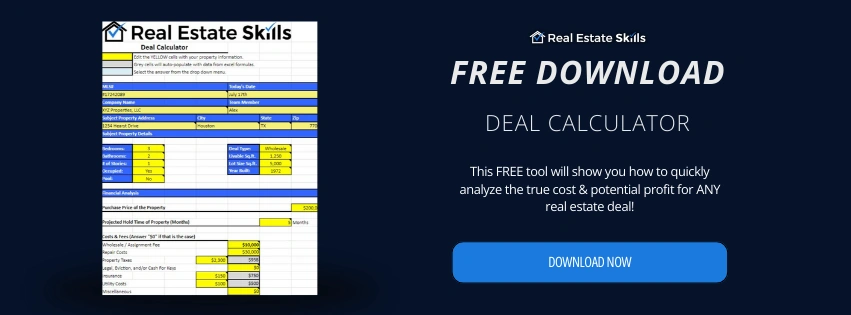
The 70% rule tells you if a deal is worth a look. Our free Deal Calculator tells you if it's worth buying. Enter your purchase price, repairs, loan terms, taxes, insurance and selling costs, and it shows your net profit and ROI before you make an offer. It's the same calculator we use in our own deals.
Is The 70% Rule Outdated In 2026?
No. The 70% rule still works as a screen that tells you in seconds which deals deserve a closer look. What's outdated is treating it as your final offer. A full line-by-line analysis often supports paying more than 70% on a quick, cheap-to-hold flip, and less on a slow one.
You'll find plenty of videos and forum threads saying the 70% rule is dead. I get why. In a lot of markets you'll rarely see a listing priced anywhere near 70% of ARV minus repairs, and investors who refuse to go a dollar higher lose deal after deal.
But the rule was never supposed to be the offer. Ryan says it straight in our wholesaling series: we don't use the 70% rule to decide what to pay. We use a deal calculator, and it lets us offer more than a strict 70% investor on most deals because we know exactly where every dollar goes.
Here's what that looks like on a real analysis from that series.
| Same deal, two methods | Result |
|---|---|
| The deal | $200,000 ARV, $25,000 of repairs, a 3-month hold, an all-cash buyer, about 5% selling costs |
| 70% rule maximum | $200,000 × 0.70 − $25,000 = $115,000 |
| Deal calculator maximum for a flipper who wants $25,000 net profit and a 15% return | About $137,000 |
| Difference | About $22,000 more the buyer could pay and still hit both targets |
On that deal, the investor who stuck to 70% would have lost to anyone who ran the full numbers. The gap exists because the 70% rule assumes a typical flip: a loan, about six months of holding and full commissions. This one had no loan interest, a three-month timeline and lower selling costs, so it needed far less than 30% to cover the project.
It cuts the other way too. Go back to the table earlier in this article: a $300,000 flip held for a year instead of six months loses about $12,000 of profit at the very same 70% price. A slow, financed flip can need a lower percentage than 70%.
The market still supports flipping, just not on autopilot. In the first quarter of 2026, the typical flipped home took 165 days from purchase to resale and earned a $66,000 gross profit, a 25.4% return on the purchase price, according to ATTOM's Q1 2026 home flipping report. That's before repairs, loan costs and commissions, which is exactly the money the 30% is there to cover. Results vary by market.
So keep the 70% rule as your first filter. Then decide the real number deal by deal. Which percentage to use in a hot market or a slow one, and how holding costs push it up or down, is its own question, and I break it down by market and price point in my guide to the fix and flip formula.
Where To Find Deals That Fit The 70% Rule
Deals that fit the 70% rule come from motivated sellers. Look for MLS listings that have sat for months, need heavy work or say "as-is" or "cash only," plus off-market sellers you contact directly, wholesalers and auctions. Pretty, move-in-ready listings almost never fit. Distressed ones on the MLS often can.
A lot of investors will tell you the MLS (the database agents use to list homes for sale) is useless for flippers. I disagree. My first flip came off the MLS. Most retail listings won't come close to 70%, that part is true. But the MLS is also full of houses nobody else wants to deal with, and those are the ones you're looking for.
Here's where I'd look, in order:
- Stale MLS listings: Filter for homes that have been on the market for 60 days or more, have had price cuts, or use words like "as-is," "cash only," "investor special" or "needs TLC." A seller who's been waiting months is usually more flexible than one who listed last week.
- Agents who know what you buy: Tell two or three active agents your exact criteria: area, price range, the kind of rehab you'll take on. Agents see these deals before they hit the portals, and they call the buyers who close.
- Off-market sellers: Owners dealing with an inherited house, a long vacancy, a divorce or a property they can't afford to fix often prefer a fast, simple sale over top dollar. You reach them with direct mail, cold calls and texts before they ever list.
- Wholesalers: They put distressed houses under contract and assign them to buyers like you for a fee. Their price already includes that fee, so run your own 70% math rather than trusting the numbers on their flyer.
- Foreclosure auctions: Deep discounts are possible, but the rules are different. I cover them in the next section.
Whatever the source, the process doesn't change. Run the 70% rule in under a minute to decide if the house is worth your time, then do the full analysis before you make an offer.
Find Deals That Pass The 70% Rule
In our free training, I'll show you how we find discounted properties on the MLS and off-market, and how we run the numbers before we make an offer, so you stop chasing houses that will never pencil out.
Watch The FREE Training →Using The 70% Rule At Foreclosure Auctions
At a foreclosure auction, run the 70% rule, then subtract everything the auction adds: the buyer's premium, a bigger repair contingency for a house you can't walk through, and any liens, back taxes or eviction costs you'll inherit. The result is your maximum bid. Don't go a dollar past it.
Auction rules vary a lot by state and by platform, and the risks here are real. This is education, not legal or financial advice, so read every auction's terms and talk to a local title company or real estate attorney before you bid.
Auctions are where the 70% rule saves the most people from themselves. The bidding moves fast, the house looks cheap, and there's no inspection period to back out of. So set your maximum bid before the auction starts and write it down.
Four things change at an auction compared to a normal purchase:
- You usually can't get inside: Many foreclosure and bank-owned auction properties can't be inspected before you bid. Drive by, look at old listing photos, check how long it's been vacant, and assume the expensive systems (roof, HVAC, plumbing, electrical) need work until you know otherwise. That means a bigger contingency than you'd use on a house you walked.
- There may be a buyer's premium: Many auction platforms add a fee on top of your winning bid, usually a percentage of the price. It varies by platform and property, so read the terms for every listing and treat it as part of your price.
- The title may not be clean: Depending on the type of sale and your state, some liens or back taxes can survive the auction and become your problem. Order a title search before you bid, not after you win.
- The house may be occupied, and you may need to pay cash fast: Some sales require certified funds the same day or within days, so a normal flip loan won't work. If someone still lives there, add the time and cost of getting possession to your holding costs.
Here's how the math changes. Say the ARV is $250,000 and your repair estimate is $45,000, but you can't get inside, so you add another $10,000 of contingency. The 70% rule gives you $175,000 minus $55,000, or $120,000. If the auction charges a 5% buyer's premium (an example, not a standard rate), your bid plus the premium can't exceed $120,000, so your maximum bid is about $114,000. If the title search turns up a $6,000 lien you'd have to pay off, your maximum bid drops to about $108,000.
The 70% Rule For Wholesalers
For wholesalers, the 70% rule sets your cash buyer's maximum price, and your offer to the seller is that price minus your fee. On a $300,000 ARV house needing $50,000 of repairs, a 70% buyer pays up to $160,000, so a $10,000 fee means offering the seller $150,000 or less.
Wholesaling means putting a house under contract and selling that contract to a cash buyer, usually a flipper, for a fee. So as a wholesaler you aren't really using the 70% rule for yourself. You're using it to predict what your buyer will pay, then working backward.
Ryan explains it simply in the video above: whatever you can negotiate below your buyer's price is your fee. If the buyer will pay $160,000 and you get the house under contract for $145,000, you earn $15,000. Get it for $155,000 and you earn $5,000.
Two things trip up new wholesalers here:
- Not every buyer uses 70%: Some want 60%. Many of the buyers we work with take deals at 80–85% of ARV minus repairs. If you offer as if every buyer needs 70%, you'll lose deals to wholesalers who asked. Ask your buyers for their criteria (what Ryan calls their buy box) and offer based on what they'll actually pay.
- A fee that's too big kills the deal: Ryan's advice to beginners is to take a smaller fee, even $1,000, to get the first deal done. A buyer who makes money on your deal answers the phone next time. A buyer who barely breaks even doesn't.
If you're wholesaling rather than flipping, our full breakdown of the wholesale formula walks through reverse-engineering your offer from your buyer's numbers.
The 70% Rule And The BRRRR Method
BRRRR investors use the 70% rule because a conventional cash-out refinance on a one-unit investment property tops out at 75% of appraised value. Buying all in at 70% can return most of your cash, but closing costs, holding costs and timing rules usually leave some money in.
The BRRRR method (buy, rehab, rent, refinance, repeat) runs the same first two steps as a flip. The difference is the exit. Instead of selling, you rent the house and refinance it, using the new loan to pay back the money you used to buy and fix it.
That's why the 70% rule fits so well. Fannie Mae, which sets the rules most conventional lenders follow, caps a cash-out refinance on a one-unit investment property at 75% of the value, and at 70% for two to four units, according to its current eligibility matrix. Buy and fix the house for 70% of its after-repair value and the new loan can cover most of what you put in.
Most, not all. On the $300,000 example from this article, a 75% refinance is a $225,000 loan. You'd be in for $210,000 of purchase and repairs, plus roughly $16,000 of loan interest, points and holding costs on the numbers above, before the new loan's own closing costs. That's close to break-even, but you'd likely leave a few thousand dollars in the deal.
Timing matters too. Under Fannie Mae's cash-out refinance rules, at least one borrower has to be on title for six months before the new loan, and an existing first mortgage being paid off must be at least 12 months old. If you bought with a short-term hard money loan, a conventional cash-out may not be available on a six-month timeline. Many investors refinance with DSCR lenders instead (lenders that qualify the loan on the property's rent), and those lenders set their own limits. Rules change, so confirm the current terms with your lender before you buy. This is education, not financial advice.
70% Rule FAQs
These are the questions new investors ask most about the 70% rule: whether it includes closing costs, whether to use ARV or asking price, what the 75% rule is, whether flipping still pays in 2026, how it relates to the MAO formula, and which mistakes make it fail.
Final Thoughts On The 70% Rule
The 70% rule is a screen, not a verdict. Multiply the ARV by 0.70, subtract repairs, and you'll know in seconds whether a deal deserves your time. Then run every cost line by line, and only make an offer when the profit still clears your minimum.
The 70% rule has lasted this long because it forces discipline at the exact moment most people lose it: when they're standing in a house they already like. It won't tell you the perfect offer. It will stop you from making a terrible one, and that's worth a lot more than it sounds.
Just remember what it is. The 70% is a starting point. The 30% isn't profit. And the rule is only as honest as the ARV and repair numbers you feed it.
Here's what to do next. Pull up one distressed listing in your area today. Find three sold comps to set the ARV, get a rough repair number, and run it through the calculator above. Then change the hold time to 12 months and see what happens to the profit. Do that on ten houses this week and the rule will stop being a formula you read about and start being a habit.
Turn The 70% Rule Into Real Deals
Knowing the formula is step one. In our free training, I'll walk you through how we find houses that fit the numbers, analyze them line by line, and make offers that sellers say yes to.
Watch The FREE Training →
About The Author
Founder & CEO, Real Estate Skills
Alex Martinez is the Founder and CEO of Real Estate Skills. He has wholesaled and flipped houses for over 14 years, been part of 1,000+ real estate transactions, and personally acquired 55+ residential investment properties. Through Real Estate Skills, he and his team have trained 6,000+ investors nationwide to find deals, run their numbers and close.
Disclosure: Real Estate Skills is not a law firm, and the information contained here does not constitute legal advice. You should consult with an attorney before making any legal conclusions. The information presented here is educational in nature. All investments involve risks, and the past performance of an investment, industry, sector, and/or market does not guarantee future returns or results. Investors are responsible for any investment decision they make. Such decisions should be based on an evaluation of their financial situation, investment objectives, risk tolerance, and liquidity needs.

👉FREE Training
How To Consistently Wholesale, Flip Houses, & Invest In Rental Properties From The MLS
(Without Spending $1 On Marketing)

Alex Martinez, the founder of Real Estate Skills, is known for his strong, practical expertise in real estate, starting from a beginner with no family connections in the industry to acquiring over 55 real estate deals, including wholesale and flips, within his first year.
He has dedicated his career to providing cutting-edge education and resources for real estate professionals. He emphasizes the importance of self-taught knowledge through mentors, books, and hands-on experience.
His journey from earning a modest income to becoming a successful real estate entrepreneur and educator showcases his expertise and dedication to the field.

Ryan Zomorodi, co-founder and COO of Real Estate Skills, leverages his experience from a diverse background in real estate investment, construction management, and entrepreneurship to provide comprehensive education in the real estate sector.
His expertise is rooted in hands-on experience, extensive industry knowledge, and a commitment to empowering others through education.
Ryan's journey reflects a blend of practical experience and entrepreneurial success, contributing to his role in developing a platform that educates and supports aspiring real estate professionals.
Read Ryan's Full Bio >>
