
Wholesaling Auction Properties: Rules, Exits & Risks (2026)
Sep 11, 2026

Written by
Alex Martinez — Founder & CEO, Real Estate Skills. Has wholesaled and flipped houses for over 14 years, been part of 1,000+ real estate transactions, and personally acquired 33+ residential investment properties. Has trained 6,000+ investors nationwide.
Reviewed by
Ryan Zomorodi — Co-Founder & COO, Real Estate Skills.
Publication history: Originally published July 21, 2022. Updated September 2026 with corrected assignment and funding guidance, a state-by-state redemption table verified against statute, a rebuilt auction-specific process, and a pre-bid checklist.
Yes, but wholesaling auction properties works differently depending on where the auction happens. At a sheriff's or trustee's sale you're buying outright, usually with certified funds due the same day or within about 24 hours, so there's rarely a contract to assign. At an online bank-owned auction you get a purchase agreement and a short escrow window, but most corporate sellers prohibit assignment. Either way, plan your exit before you bid.
Most people who ask whether you can wholesale an auction property are really asking something narrower: can I flip this contract without having the cash to close? At a courthouse auction, usually not the way you're picturing. The winning bidder is the buyer, the money is due almost immediately, and there's no inspection period to shop the deal during.
That doesn't mean auctions are closed to wholesalers. It means the exit has to be chosen before you raise your hand, not after. Three different things are sold under the word "auction," and each one gives you a different way out: a foreclosure sale at the courthouse, an online bank-owned auction with an actual purchase contract, and a tax deed sale. Which one you're standing in front of decides whether you assign, whether you buy and resell, or whether you should be bidding at all.
This guide covers the part nobody explains: which auction types allow an assignment, what the deposits actually cost and when they're due, how redemption periods can delay your resale by months, and how to set a maximum bid that still leaves you a spread after the buyer's premium.
What Are Auction Properties?
Auction properties are homes sold to the highest bidder at a live or online event with preset rules, deadlines, and closing terms. For a wholesaler, the format matters more than the property: it decides how fast you must pay and whether there's a contract to assign at all.
Properties reach an auction block for a few reasons, and foreclosure is only the most common one. An owner stops paying the mortgage and the lender forces a sale. Property taxes go unpaid for years and the county sells the deed. Sometimes a seller simply wants speed and certainty and chooses an auction on purpose. Not every auction property is distressed.
What matters to you is which of these you're looking at, because the five formats below behave like five different businesses.
- Sheriff's sale (judicial foreclosure). A court orders the sale and the county sheriff conducts it. You're bidding at the courthouse, and there's no purchase contract in the usual sense. The winning bidder is named on the deed the court eventually issues. Payment terms are the tightest of any format. In Florida, the balance plus the clerk's fees are due within 24 hours of the sale, and the clerk can't issue the certificate of title until a 10-day objection window passes. That gap between paying and holding title is the thing that breaks most wholesale exits. Judicial states also tend to be the ones with redemption periods.
- Trustee's sale (non-judicial foreclosure). No court involved. A trustee named in the deed of trust conducts the sale under a power-of-sale clause, which is why these move faster than judicial foreclosures. Certified funds are typically expected at the sale or within a day. Same structural problem: you're the buyer, and there's no contract period to shop the deal during.
- Lender and bank-owned auctions. This is the format that actually behaves like a normal transaction. The property already went through foreclosure, didn't sell, and the lender now owns it. Most of these run online, you sign a real purchase agreement, and you get an escrow window of roughly a week to a month. It's the only auction format where an assignment clause is even relevant, and most corporate sellers write assignment out of the contract. Properties that don't sell here often end up as REO properties after a failed auction.
- Tax deed sales. The county sells the property itself to recover unpaid taxes. The discounts look spectacular and the title risk is the highest of any format here. What survives a tax sale varies by state, and in some places the answer is "more than you'd think." Treat these as a specialist play, not a starting point.
- Owner, builder, and luxury auctions. A seller chose the auction format for speed or exposure. These aren't distressed, the reserve is usually set at market, and the spread a wholesaler needs generally isn't there. Worth knowing they exist; rarely worth your time.
Read that list again and one pattern stands out. In three of the five formats, you are buying the property, not a contract. That single fact is what most guides on this topic get wrong, and it's why the next question, whether you can wholesale one of these at all, has a more interesting answer than yes or no.
Read Also: How Wholesaling Works
Can I Wholesale An Auction House?
Yes, but the auction type decides how. At a sheriff's or trustee's sale you're buying the property, so your exit is a resale after the deed clears, not an assignment. At an online bank-owned auction you sign a real purchase contract, so check whether it permits assignment, because most corporate sellers don't.
This section explains how these mechanics generally work and is educational, not legal advice. Auction terms, foreclosure procedure, and assignment rules vary by state and county. Confirm the specifics with a licensed real estate attorney in your market before you bid.
Here's the honest version, and it's not the one you'll usually get.
When someone says "wholesale an auction property," they're normally picturing the standard move: lock it up, market it, assign the contract to a cash buyer, collect a fee, never own anything. At a courthouse auction that picture mostly falls apart. Not because assigning is illegal, but because there's no contract period to assign during. You win the bid, you're the buyer, and the money is due in hours or days. Nobody's giving you two weeks to find someone else.
So the question isn't whether you can wholesale an auction property. It's which exit the format leaves open.
Exit 1: Assignment (Online Bank-Owned Auctions Only)
This is the only format where the classic assignment is on the table, and even then it usually isn't. You're signing a purchase agreement with a corporate seller, and those contracts are typically written to prohibit assignment outright.
Read the actual purchase agreement before you register, not after you win. Most platforms publish it on the property listing, which means the answer costs you nothing to find. If it prohibits assignment, you've learned that for free. If it's silent, ask the platform in writing rather than assuming, because a real estate contract that says nothing about assignment is generally assignable by default, and a corporate seller who didn't intend that will push back hard at closing.
This matters more than any platform-by-platform summary, including ours. Terms differ by seller and change over time, so the agreement attached to your specific property is the only version that governs your deal. If you're still deciding where to look for inventory, we compare the platforms themselves in our guides to the best real estate auction sites, along with our Hubzu review and Xome review.
Exit 2: Assignment Of Bid (Some Judicial Sales)
Less known and genuinely useful. In some judicial foreclosure states, you can assign the bid itself. It's a filing that tells the clerk whose name belongs on the certificate of title after the sale.
Florida is the clearest example, and the timing rules are local and strict. Broward County requires the assignment to be filed with the clerk before the sale, with the plaintiff identifying the assigned name when the sale is set up. There can also be a tax consequence: Florida's Department of Revenue has taken the position that documentary stamp tax is still owed on the original bid when a bid is assigned, so assigning after the sale can mean the tax is paid twice.
Ask your closing attorney and the clerk's office how your county handles it before the sale date, not after. This is one of those mechanics where the rule in the next county over may not be the rule in yours.
Exit 3: Buy It, Then Resell It
The default at courthouse sales. You pay, you wait for the deed, you sell to your end buyer.
This is where most "just double close it" advice goes sideways. A double close assumes two closings running the same day through one closing agent, and a trustee or sheriff's sale doesn't have a closing agent in that sense. You pay the trustee or the clerk, and the deed arrives on the court's or trustee's timetable. In Florida, that means waiting for the 10-day objection window to pass. That's a gap of days or weeks where you own something you can't yet convey cleanly.
Before you bid, ask your lender and your closing agent directly whether they'll fund and close your specific sale type in your county. Get the answer before the auction, not after you've won. Rules vary by state and county, so confirm yours. If you're new to the mechanics, start with how a double closing works and who the transactional funding lenders are, then bring your specific sale type to them.
Some investors take a fourth route here and keep the property on the open market after minor repairs, which is wholetailing rather than wholesaling.
The Real Constraint Is Money, Not Law
At a courthouse sale you need the funds. Cash, a hard money lender who'll fund an auction purchase, or a partner. All of those want to know your exit before they commit, which is why Exit 1 through Exit 3 come before anything else in this guide.
If you have no capital and no funding relationship, a courthouse auction is the wrong place to start. An online bank-owned auction with a week or two of escrow is closer to a normal wholesale deal, and that's where I'd tell a newer investor to look first. Either way, have your buyer before you have the property: here's building a cash buyer list, and you want it built before the sale date, not during it.
What About Contracting With The Owner Before The Sale?
People ask about this constantly, and it's a different playbook. Contracting with an owner whose foreclosure sale is already scheduled is pre-foreclosure, which we cover in buying before the auction.
Know one thing before you try it. If the foreclosure sale happens before you close, your contract with the owner is likely worthless, because a completed foreclosure generally extinguishes interests recorded after the foreclosing mortgage, and your rights under that purchase contract can be one of them. The specifics depend on your state's foreclosure law. Ask a local real estate attorney what happens to your contract if the sale goes ahead, and how much runway you actually have.
Pick the exit first. Everything else on this page, what you bid, what you deposit, how fast you have to pay, follows from that one decision.
What Do You Actually Have To Pay At An Auction?
Four separate costs, and most guides blur them into one. A bid deposit or registration hold to bid at all, a buyer's premium added on top of your winning bid, a purchase deposit due the day you win, and the balance due within days or weeks. Liens and back taxes can sit on top of all of it.
This is where the numbers you've read stop making sense. One source says auctions need 5% to 10% down, another says $2,500, another says $1,000. They're all describing different things, and if you show up having budgeted the wrong one you either can't bid or you forfeit money.
Four separate costs. Keep them separate.
- The bid deposit (or registration hold): what it costs you to be allowed to bid. Online platforms typically place a hold on a credit or debit card, often per property rather than per account, and release it after the auction if you don't win. It isn't a payment toward the purchase. Live foreclosure sales handle this differently, and many require you to show certified funds or register with a deposit before the auctioneer will take your bid at all.
- The buyer's premium: a percentage added to your winning bid and paid by you, not the seller. This is the one that quietly eats a wholesale spread. Bid $180,000 with a 5% premium and your actual purchase price is $189,000, so if you calculated your maximum bid without it, you just handed away $9,000 of your margin. Premium rates vary by platform and sale, and some have a minimum dollar amount, so read the terms for the specific auction rather than assuming a rate carries over from the last one.
- The purchase deposit: due when you win, usually the same day or within 24 hours, and usually non-refundable. This is the figure most commonly quoted as a percentage of the bid. It's real money toward the purchase, and it's the money you lose if you can't fund the balance. It works differently from the earnest money deposits you'd put up on a normal purchase, where an inspection contingency usually protects you.
- The balance: the rest of the purchase price, due inside the auction's deadline. Courthouse sales are the tightest, and Florida's judicial sales require the balance plus the clerk's fees within 24 hours of the sale. Online bank-owned auctions are more forgiving, often a week to a month. Miss the deadline and you generally forfeit your deposit, and platforms can bar you from bidding again.
And then there's what you inherit. Unpaid property taxes, code violations, HOA assessments, and liens that survive the sale don't show up in any of the four buckets above, but they're part of your purchase price in every way that matters. A foreclosure sale doesn't wipe out everything. What gets extinguished depends on lien priority and on your state's procedure, and liens senior to the foreclosing mortgage typically survive. Property tax liens are usually senior to everything. This is the single most expensive thing to get wrong at an auction, and it's why the title section below isn't optional reading.
💡 What A $180,000 Bid Actually Costs
- Winning bid at an online bank-owned auction: $180,000
- Buyer's premium at 5%: $9,000
- Back taxes assumed: $4,200
- Your real cost basis: $193,200
- That's $13,200 above the number you clicked. If your end buyer is at $205,000, the spread you thought was $25,000 is $11,800 before closing costs.
Illustrative figures only. Confirm the premium rate, deposit, and outstanding liens for your specific auction and property.
Every one of these numbers is published before the sale. The notice of sale, the auction terms, the property listing, and the county tax records will tell you the premium rate, the deposit, the deadline, and the taxes owed. The wholesalers who get burned at auctions aren't the ones who couldn't find the information. They're the ones who didn't look until after they won.
Title, Liens & Redemption Periods: What You're Actually Buying
At most auctions you're buying whatever title the sale conveys, with no warranty and no guarantee of insurance. Some liens survive the sale. In about half of states, a former owner may have a statutory right to redeem the property after a foreclosure sale, which can delay your resale by months.
Redemption rights and lien priority are set by state statute and change over time. The summaries below are educational, not legal advice. Verify current law for your state with a licensed real estate attorney or the clerk before relying on it.
A normal purchase gives you a warranty deed and a title policy. An auction gives you neither, and that's the part that separates a good auction buy from a disaster. Three things to check before you bid, in this order.
1. What Survives The Sale
A foreclosure wipes out interests that are junior to the foreclosing mortgage and leaves senior ones in place. So the question isn't "are there liens." It's where each one sits in priority. Property tax liens are generally senior to everything, including a first mortgage, which is why unpaid taxes tend to follow the property to you. A second mortgage foreclosing doesn't touch the first. Municipal code violations and HOA assessments vary by state and sometimes by city.
Pull a title search before the sale, not after. A title company will usually run a preliminary search for a modest fee, and on a deal where you're about to wire five or six figures with no contingencies, it's the cheapest money you'll spend.
📓 From The Field
Ryan Zomorodi's rule when he hits an auction listing while sourcing foreclosures: treat it as a different buying process entirely. You come to the table with cash, you typically can't count on getting title insurance the way you would on a normal purchase, and the property may carry liens and encumbrances you have no protection against. His take is that auction properties can be a fantastic deal and require a lot more research and care than anything you'd buy off the MLS. (One investor's experience. Terms and title practices vary by state and sale type.)
2. Whether You Can Get Title Insurance, And When
Don't assume. A certificate of title issued by a clerk after a foreclosure sale doesn't come with insurance. You'd have to obtain a policy separately, and title companies are often cautious about insuring a foreclosure purchase, particularly while an objection period or redemption period is open.
This matters beyond your own comfort. Your end buyer's lender will almost certainly require a policy, so if you can't get one, you may not have a sale. Call a local title company before you bid and ask two questions: will you insure a property bought at this type of sale in this county, and how long after the sale before you'll issue?
3. Redemption Periods
Everyone buying at foreclosure auctions should understand this, and most first-timers have never heard of it. In roughly half the states, a former owner has a statutory right of redemption, which is a window after the sale in which they can buy the property back by paying the sale price plus interest and allowable costs. Where it exists, the length varies widely, and specific circumstances can change it. In some states the former owner can keep living in the home during that window.
For a wholesaler, redemption is a timing problem more than a probability problem. Redemptions are uncommon in practice, because people who could afford to redeem usually could have afforded to avoid foreclosure. But the possibility is enough to stall you, because a title company may not insure and an end buyer's lender may not lend while the window is open. A six-month redemption period turns a two-week wholesale into a six-month hold, and your funding costs don't pause while you wait.
| State | Can the former owner take it back after the sale? | What changes the answer | Source |
|---|---|---|---|
| Minnesota | Yes, 6 months | 12 months in defined circumstances under Subd. 2 | Minn. Stat. § 580.23 |
| Michigan | Yes, 6 months for residential of 4 units or fewer | 1 month if abandoned; 30 days, or 15 after the statutory notice, under § 3241a; 1 year if agricultural. The clock runs from the sale date regardless of when the deed is recorded. | MCL 600.3240 |
| Illinois | No, in the usual case | Redemption runs before the sale, ending the later of 7 months from service or 3 months from judgment. A 30-day right applies only when the foreclosing lender buys at under 90% of fair market value. | 735 ILCS 5/15-1603, 5/15-1604 |
| Colorado | No, not for the owner | Only junior lienors may redeem under laws effective 1/1/2008 onward. The owner's protection is a longer pre-sale cure period. | Colo. Rev. Stat. Title 38, Art. 38 |
| Florida | No, but your deed is delayed | Balance and clerk's fees due within 24 hours. The clerk issues the certificate of title only after a 10-day objection window passes. | Fla. Stat. § 45.031 |
Verified September 2026 against the cited statutes and county procedures. This list is not exhaustive. Roughly half of states have some post-sale redemption right, and the rules vary by foreclosure type and circumstance. Confirm your state with the clerk, the trustee, or a local attorney before you bid.
Two questions before you bid in any judicial foreclosure state: does this sale type carry a post-sale redemption period, and how long is it? Get the answer from your closing attorney or the clerk, and confirm it against your state's current statute. If you're working one of the states above, our local guides go deeper on inventory and process in Michigan, Colorado, and Florida.
One last caution, and it applies to this page as much as any other. While building the table above, we found sources confidently stating that Colorado gives owners 75 days to redeem and that Missouri gives none, both contradicted by the statutes and by the county's own trustee page. This is one of the most misreported topics in real estate. Verify the state you're bidding in.
Auction Rules Are State Rules
Redemption periods, what survives a foreclosure sale, whether the sheriff or a trustee runs it: all of it changes at the state line, and so do the rules on how you're allowed to market and assign a contract anywhere. Download our free state-by-state guide to see how your state handles it before you bid in an unfamiliar county.
How To Wholesale Auction Properties: Step By Step
Eight steps, in order: read the notice of sale, confirm your exit, underwrite without entering the property, run title and check redemption, set your maximum bid backwards from your buyer, register and deposit, fund inside the deadline, then assign or resell. The first two decide whether the rest is worth doing.
Before any of this, you need an end buyer and a funding source already in place. Both are ordinary wholesaling groundwork, and both are covered elsewhere: building a cash buyer list and finding a hard money lender. Auctions don't change how you do them. What auctions change is that you can't do them after you win. There's no inspection period to scramble in.
Assume that's handled. Here's the auction-specific sequence.
Step 1: Read The Notice Of Sale And The Auction Terms
Everything you need is published before the sale, and almost nobody reads it. For a courthouse sale, that's the notice of sale, the legal advertisement naming the property, the case, the date, the place, and the terms. For an online auction, it's the property listing plus the platform's terms and the actual purchase agreement, which most platforms publish on the listing itself.
Look for five things: the payment deadline, the deposit required, the buyer's premium rate, whether the contract permits assignment, and what the sale conveys. If you can't find one of them, call the clerk, the trustee's office, or the platform and ask. The answer is free before the sale and expensive after.
Step 2: Confirm Your Exit Before You Bid
From the three exits above, decide which one this specific sale allows: an assignment, an assignment of bid, or buying and reselling. Then confirm it with the people who'd have to execute it. Ask your title company whether they'll insure this sale type in this county and how soon after the sale. Ask your lender whether they'll fund this sale type on this timeline.
If either answer is no, you've saved yourself a deposit. This step is where most auction wholesale deals die, and it costs nothing to do.
📋 The Pre-Bid Checklist
Eight things to confirm before you bid. All of them are answerable before the sale, and all of them are expensive to learn after.
- 1. Sale type
- Sheriff's sale, trustee's sale, online bank-owned, or tax deed? This decides everything below. Where: the notice of sale or the platform listing.
- 2. Your exit
- Assignment, assignment of bid, or buy-and-resell? Confirm the specific one this sale allows. Where: the purchase agreement, or your closing attorney for a courthouse sale.
- 3. Payment deadline
- Deposit due when, balance due when, in what form of funds? Get the exact hours or days, not "quickly." Where: the notice of sale or auction terms.
- 4. Buyer's premium
- What percentage, and is there a minimum? Add it to your maximum bid calculation before you bid, not after. Where: the auction terms.
- 5. Title
- What liens survive, and are there back taxes? Where: a preliminary title search plus county tax records.
- 6. Title insurance
- Will a local title company insure this sale type in this county, and how soon after the sale? Where: call one and ask.
- 7. Redemption period
- Does this sale carry one, and how long? Where: your state's statute, confirmed with a local attorney or the clerk.
- 8. Occupancy
- Is anyone living there, and what does removing them cost in time and money? Where: drive it, and check the listing.
If you can't answer all eight, you're not ready to bid on that property. Screenshot this or print the page and take it with you.
Step 3: Underwrite Without Getting Inside
You usually can't walk an auction property. Occupied homes stay occupied until the sale, and nobody is letting you in for an inspection. So you underwrite from the outside in.
Drive it and photograph the roof line, the foundation, the windows, and the yard. Judge the neighbors, because a well-kept block usually means a better interior than a block with three boarded houses on it. Pull the county permit history, which tells you what's been done legally and hints at what hasn't. Look for any interior photos in the listing, an old MLS listing, or a prior listing on a major portal, since a property that was on the market three years ago often left photos behind.
If the only image you have is an exterior, assume the interior is worse than the exterior, because it usually is. Then price the repairs at the pessimistic end of your range and bid accordingly. The cost of being wrong here is the whole deal.
Step 4: Run Title And Check Redemption
Covered in detail above. In sequence, it belongs here: before you set a number, know what liens survive, whether your title company will insure, and whether a redemption period could hold your resale for months.
Step 5: Set Your Maximum Bid Backwards From Your Buyer
Don't start with what the property is worth. Start with what your end buyer will actually pay, then subtract everything between you and them.
Ryan Zomorodi's approach to any deal is to work the numbers backwards from the return he needs rather than forward from the asking price. If the return at the seller's number is too thin, he solves for the price that produces the return he wants and offers that. At an auction, the same method has more to subtract:
- Start: your buyer's price
- Minus: your fee
- Minus: the buyer's premium, which is a percentage of your bid, so it scales with every increment
- Minus: back taxes and surviving liens
- Minus: funding costs for however long you hold it, including any redemption window
- Minus: closing costs, two sets if you're buying and reselling
- Equals: your maximum bid
Write that number down before the auction starts, and treat it as a wall. Auctions are built to make you exceed it: the pace, the competition, the sense that you'll lose the thing you drove out to see. A wholesaler who bids $6,000 over their maximum hasn't lost $6,000 of profit. They've often lost the entire spread, because the premium scales with the bid too. If you want the arithmetic formalized, our guide to the maximum allowable offer formula covers the underlying math.
Your Maximum Bid Is A Number, Not A Feeling
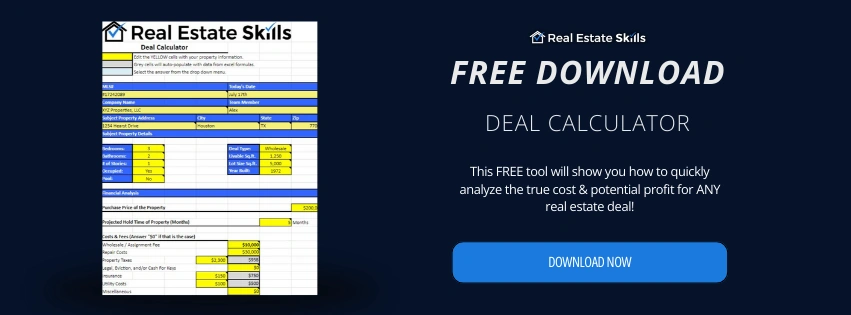
At an auction there's no inspection period to renegotiate in and no contingency to escape through. Whatever you bid is what you pay, plus a premium that scales with it. Work the number backwards before the sale: your buyer's price, minus your fee, the buyer's premium, surviving liens, funding costs, and two sets of closing costs if you're reselling. Download our free Deal Calculator to lock that number down, then take it to the auction and treat it as a wall.
Step 6: Register, Deposit, And Bid
Register ahead of the deadline, not on the day. Most sales require proof of funds or a deposit before they'll let you bid at all, and live foreclosure sales often want certified funds in hand, sometimes a cashier's check made out a specific way, which is worth confirming with the clerk or trustee beforehand. Bring what the terms require, bid to your number, and stop.
Step 7: Fund Inside The Deadline
The clock starts the moment the gavel falls. Courthouse sales can demand the balance within 24 hours; online bank-owned auctions typically give you a week to a month. Whatever the number is, you knew it in Step 1, and your funding was confirmed in Step 2. Miss it and you generally forfeit your deposit and can be barred from bidding again on that platform.
Step 8: Execute The Exit
If you're assigning at an online auction, the assignment happens inside the escrow window on the platform's terms. If you're assigning a bid in a judicial state, the filing has to be made on the county's schedule, which may mean before the sale. If you're reselling after taking title, your timeline starts when the deed actually issues, not when you paid. Line your end buyer up against that date, not against the auction date.
Notice how much of this happens before you bid. Seven of the eight steps are decisions you make with no money at risk. That's the whole discipline of auction wholesaling: the work is front-loaded, and the people who lose money are the ones who reversed the order.
You Know The Auction Rules. Now Learn To Have A Buyer Waiting.
Auction deals die on the exit, not the entry. Winning a bid with nobody lined up to take it is how wholesalers forfeit deposits and eat holding costs on a property they never wanted to own. Our FREE Training walks you through the whole system: finding discounted properties, locking them up, and handing them to cash buyers who actually close, the same process thousands of our students use. Watch it today, then go pull your county's sale calendar.
Watch The FREE Training →How Do You Find Auction Properties To Wholesale?
Auction inventory is published by law, not by listing services. Foreclosure sales must be advertised in advance, in the legal notices of a local newspaper, on the county clerk or sheriff's website, and on trustee sites. Tax deed sales are published by the county treasurer. Online bank-owned auctions run on the major platforms.
Here's the part that makes auctions different from every other lead source in wholesaling. You don't have to find these properties. Somebody is legally required to tell you about them.
Foreclosure sales can't happen in secret. The sale has to be advertised before it occurs, with the property, the date, the place, and the terms. That's what a notice of sale is, and it exists so the sale can't be conducted quietly. Which means the inventory is public, free, and available to anyone who knows where it's published. Most wholesalers don't, so they pay for aggregated lists of the same information.
- The county clerk or sheriff's website: start here. In judicial foreclosure states the clerk of court publishes the sale calendar, often weeks out, with the case number, the property, and the judgment amount. Search your county name plus "foreclosure sales" or "clerk judicial sales." Many counties now run these through an online bidding portal, which means you can see the entire upcoming calendar in one place.
- Legal notices in the local newspaper: the oldest source and still one of the best, because far fewer people read it. Foreclosure sales are advertised in a newspaper of general circulation in the county where the property sits, usually for several consecutive weeks before the sale. Most of those papers now publish their legal notices section online for free. It's tedious reading, which is exactly why the inventory there is less picked over.
- Trustee websites in non-judicial states: in states where foreclosure runs through a trustee rather than a court, the trustee companies post their own sale schedules. A handful of trustee firms handle most of the volume in any given state, so finding those three or four sites covers most of the market.
- The county treasurer or tax collector for tax deed sales: a separate calendar from foreclosure sales, run by a different office, usually on an annual or quarterly cycle. These lists are published well in advance because the county wants bidders to show up. Our guide to finding tax lien properties covers that side in more depth.
- The online platforms: for bank-owned inventory, the major auction sites are where it lives. That's a different search from the courthouse calendar and a different exit, since these come with a contract.
The advantage isn't access. Everyone can see these lists. The advantage is time.
A courthouse sale calendar published three weeks out gives you three weeks to do the work in Steps 1 through 5: read the terms, run title, check redemption, drive the property, and set your maximum bid. Most bidders show up having done none of it, which is why properties sell at auction for prices that make no sense in both directions. Work a calendar that's three weeks out and you're competing against people working from that morning's list.
So build the habit, not the list. Check your county's sale calendar on the same day each week, track the properties that fit your buyer's criteria, and start your title and underwriting work the day a property appears rather than the day before the sale. The inventory refreshes itself constantly and it costs nothing to watch.
Paid aggregators bundle this information into one searchable interface, which is a convenience purchase rather than an access purchase, since they're compiling records you could pull yourself. Worth it if you're working several counties at once; unnecessary if you're working one.
How To Find Houses In Foreclosure To Buy (FAST & FREE)
Ryan Zomorodi covers the full foreclosure timeline in this walkthrough. The part that matters for auction buyers starts around 43 minutes, where he explains what happens when a property doesn't sell at the sale.

Wholesaling Houses From An Online Auction
Online auctions give you something courthouse sales don't: a purchase contract and an escrow window, often a week to a month. That's the closest an auction gets to a normal wholesale deal, which is why it's where most wholesalers should start, despite the assignment restrictions.
The practical difference is that you don't have to produce the full purchase price the moment the auction ends. You'll typically register, place a bid deposit, and then have a defined window to fund if you win. That window is what makes an online auction workable for someone without a vault of cash standing by, and it's why these platforms have grown.
What you give up is access. Many of these homes are still occupied, so you may not get inside. You can still drive the exterior and read the neighborhood, and some listings do allow self-tours, which will be noted on the property page.
What you gain is documentation. Online listings usually provide a property report, a title report, and the purchase agreement itself, which is more than you'll ever get standing at a courthouse. Read all three. The purchase agreement is where the assignment question gets answered, and the title report is where you start the work in Step 4.
Two things to keep in mind. Proof of funds is typically required within about 24 hours of a winning bid, and nearly everything sells on an as-is, cash basis. And a high bid isn't a sale: sellers generally retain the right to accept or reject, so nothing is yours until acceptance is confirmed in writing. If the property is a short sale, the seller's lender has to approve the winning bid too. Wherever your deposit and balance are held, they'll move through escrow rather than directly to the seller.
Can You Inspect A Property Before An Auction?
Usually not the inside. Occupied properties stay occupied until the sale, and no one is granting access for an inspection. Some online listings include interior photos or allow self-tours, and some sales are advertised as open to inspection, but assume you're buying based on an exterior view and public records.
This is the risk that stops most people, and it should give you pause. Without seeing the interior, your after-repair value is a guess, and a guess is a bad foundation for a number you can't renegotiate later.
There are ways to narrow the gap. Some auctions do permit pre-auction inspection, and filtering to those properties is a legitimate strategy, though it shrinks your inventory considerably and you may go months without finding one that fits your buyer. Listings with interior photos or video are the next best thing. If all you have is a single exterior shot, treat that as information in itself: nobody hides a renovated kitchen.
Driving the property also tells you something an inspection wouldn't. You'll see whether anyone's living there, whether there's evidence of squatters, and what the block looks like. If the property is occupied, add the time and cost of removing occupants to your numbers before you bid, not after.
What Happens If You Win An Auction And Can't Close?
You forfeit your deposit, and that's the floor rather than the ceiling. Platforms can bar you from future bidding. At a courthouse sale, the clerk may issue a certificate of non-sale, the property gets re-advertised, and depending on the state and the sale terms you can be liable for the costs of the resale.
The deposit is the obvious loss and usually the smallest one. On an online auction, a forfeited purchase deposit can run into five figures. That money is gone, and unlike a normal purchase there's no contingency to shelter behind.
The second loss is access. Platforms track bidders who fail to perform, and being barred from a marketplace closes off a deal channel entirely. At a courthouse, a bidder who can't pay creates a mess the clerk has to unwind, and the plaintiff has to re-advertise and pay the costs of doing so. Depending on the state and the terms of that particular sale, some of those costs can come back to you.
The honest advice is short: if you're not certain you can fund the balance on the published deadline, don't bid. Not "probably can," not "my lender said it should be fine." Certain. This is why Step 2 exists, and why confirming your funding before the sale costs you nothing and protects everything.
Are Sheriff's Sale Properties Good For Wholesaling?
They offer the deepest discounts and the tightest constraints. You're buying outright with almost no time to pay, often with no interior access, and possibly with a redemption period holding your resale. Good for a funded wholesaler with a title company and lender already lined up; wrong for a first deal.
Here's the part I'd want someone to tell me honestly.
Sheriff's sales are where the real discounts live, because the barrier to entry filters out almost everyone. Fewer bidders means less competition, and less competition means prices that can look absurd next to the MLS. That's the appeal, and it's genuine.
It's also why the advice you'll see about wholesaling with no money down collapses here. There's no assignment window, no inspection contingency, and no financing contingency. You need funds at the sale or within a day, you need a title company willing to work with you afterward, and you need to accept that the deed arrives on someone else's schedule. Every one of those is a relationship you build before the auction, not a problem you solve after winning one.
So this channel is right for a wholesaler who has closed deals, has a funding source that answers the phone, and can absorb a hold if a redemption period runs. It's wrong for a first deal, and I'd say the same thing to someone sitting across from me. An online bank-owned auction gives you a contract and a couple of weeks, and that's a far better place to learn what auction inventory actually looks like.
Can You Wholesale A Tax Deed Property?
Yes, with the heaviest title caveat of any auction format. A tax deed sale conveys the county's interest, and what survives varies by state. Many title companies won't insure a tax deed property until a quiet title action clears it, which can take months.
Tax deed sales are a different animal from foreclosure auctions. The county is selling to recover unpaid taxes, not to satisfy a mortgage, and the discounts can be dramatic.
The exit is where it gets complicated. Your end buyer's lender will want title insurance, and many title companies won't issue a policy on a tax deed purchase until a quiet title action has run through the courts. That's a legal proceeding measured in months, not days, and it sits directly between you and a clean resale. Cash buyers who understand the format may take it anyway at the right price, but your buyer pool narrows considerably.
Treat tax deeds as a specialist strategy with its own learning curve. If you're sourcing that inventory, start with finding tax lien properties, and talk to a local attorney about what a quiet title action costs and takes in your state before you bid on one.
Wholesaling Auction Properties FAQs
Final Thoughts On Wholesaling Auction Properties
Auctions are the only deal channel in wholesaling where the property is handed to you on a schedule, published weeks in advance, with the terms printed in front of you. No marketing spend, no cold calls, no competing with forty other investors for the same absentee-owner list. The inventory is sitting there in the legal notices section of a newspaper almost nobody reads.
What auctions take away is the safety net. There's no inspection contingency, no financing contingency, and often no way to walk once the gavel falls. You can't see inside most of them. The title might carry something you didn't find. And in half the states, a former owner may have months to buy it back out from under your resale.
That trade is the whole thing. Deep discounts in exchange for doing your homework before you bid instead of after. Every protection a normal purchase gives you automatically, you have to build yourself in advance: the title search, the funding confirmation, the exit lined up with a named buyer.
So be honest about which auction you're standing in front of. A courthouse sale wants cash in hours and gives you a deed on the court's timetable, not yours. An online bank-owned auction gives you a contract and a couple of weeks, and usually won't let you assign it. Those aren't the same business, and treating them as one is how people lose deposits.
If you're funded, have a title company that will talk to you, and can name the buyer before you bid, auctions will show you numbers the MLS won't. If you're missing any of those three, work a different channel until you're not. There's no shame in that. The auction calendar refreshes every week and it isn't going anywhere.
Most People Read About Auctions. Far Fewer Ever Bid.
The ones who do are the ones who had the funding, the buyer, and the process in place before a property ever caught their eye. That's the part that takes work, and it's the part we teach. Our FREE Training shows you how to find deals, run the numbers, and get paid, without spending a dollar on marketing or learning it the expensive way. Watch it today, then go put it to work on your next sale calendar.
Watch The FREE Training →
About The Author
Founder & CEO, Real Estate Skills
Alex Martinez is the Founder and CEO of Real Estate Skills. He has wholesaled and flipped houses for over 14 years, been part of 1,000+ real estate transactions, and personally acquired 33+ residential investment properties. Through Real Estate Skills, he has trained 6,000+ investors nationwide to find discounted properties, analyze deals, and close profitable transactions.
Real Estate Skills is not a law firm, and the information in this article is provided for educational purposes only — it does not constitute legal, tax, or financial advice. Foreclosure procedure, auction terms, redemption rights, and lien priority vary by state and county and change over time. Auction purchases carry significant risk, including forfeited deposits, undiscovered liens, and title that cannot be insured; past results do not guarantee future outcomes and any figures shown are illustrative. Always consult a licensed real estate attorney and your own tax and financial advisors before bidding at any auction or entering into any transaction.

👉FREE Training
How To Consistently Wholesale, Flip Houses, & Invest In Rental Properties From The MLS
(Without Spending $1 On Marketing)

Alex Martinez, the founder of Real Estate Skills, is known for his strong, practical expertise in real estate, starting from a beginner with no family connections in the industry to completing over 50 real estate deals, including wholesale and flips, within his first year.
He has dedicated his career to providing cutting-edge education and resources for real estate professionals. He emphasizes the importance of self-taught knowledge through mentors, books, and hands-on experience.
His journey from earning a modest income to becoming a successful real estate entrepreneur and educator showcases his expertise and dedication to the field.

Ryan Zomorodi, co-founder and COO of Real Estate Skills, leverages his experience from a diverse background in real estate investment, construction management, and entrepreneurship to provide comprehensive education in the real estate sector.
His expertise is rooted in hands-on experience, extensive industry knowledge, and a commitment to empowering others through education.
Ryan's journey reflects a blend of practical experience and entrepreneurial success, contributing to his role in developing a platform that educates and supports aspiring real estate professionals.
Read Ryan's Full Bio >>
