
Wholesaling Houses: How To Tell If A House Is Worth It
Aug 26, 2026

Written by
Alex Martinez — Founder & CEO, Real Estate Skills. Has wholesaled and flipped houses for over 14 years, been part of 1,000+ real estate transactions, and personally acquired 33+ residential investment properties. Has trained 6,000+ investors nationwide.
Reviewed by
Ryan Zomorodi — Co-Founder & COO, Real Estate Skills. An active real estate investor who reviewed and verified the deal figures, cost estimates, and legal points in this guide before publication.
Publication history: Originally published June 24, 2019. Previously updated January 4, 2026. Updated August 2026 with a full rewrite focused on evaluating houses — a framework for reading condition, seller situation, repair costs, title, and equity; a real first-deal walkthrough with complete numbers; rehab-cost guidance from a working San Diego contractor; and a rebuilt FAQ. Reviewed and verified by Ryan Zomorodi, Co-Founder & COO of Real Estate Skills.
Wholesaling houses means putting a house under contract, then selling that contract to a cash buyer for a fee — commonly $5,000 to $20,000 — without ever owning the house. It only works on the right house: one distressed enough that most banks won't lend on it.
Most guides on wholesaling houses explain the paperwork. Two contracts, an assignment, a fee. That part is real, and you can understand it in about ten minutes. It also isn't what decides whether you make money.
The house decides. Whether there's enough room between what the seller will take and what an investor will pay. Whether the repairs are cosmetic or structural. Whether the title is clean enough to actually close. Get the house right and the paperwork is a formality. Get the house wrong and no contract in the world saves you.
My first deal was a five-bedroom in El Cajon, California, listed at $385,000 in the summer of 2012. I was 20 years old. It had been on the market one day when I called the agent. The house wasn't wrecked — outdated, needing a full cosmetic refresh, nothing structural. I offered $328,000, had it under contract nine days later, and assigned it — sold my right to buy it — to a cash buyer for a $22,000 fee. I never owned the house.
A strong result for a first deal in a different market and a different year. Fees commonly run $5,000 to $20,000, outcomes vary, and there is no guaranteed income in wholesaling.
Here's the part I don't usually lead with: I thought that house would be worth $525,000 renovated. My buyer said $475,000. He was right and I was off by fifty thousand dollars on my very first deal. It still worked, because there was enough room in the other numbers to absorb my mistake. That's the real lesson — you don't have to be perfect on a house, you have to be close enough that being wrong doesn't kill you.
So that's what this guide is: how to look at a specific house and know whether it's worth putting under contract. What makes one wholesalable and the one next door worthless. What the repairs actually cost. What kills a deal at the title company. You can grab our free deal calculator here and run the numbers alongside me.
What Is Wholesaling Houses?
Wholesaling houses is putting a house under contract with the seller, then transferring that contract to a cash buyer for a fee. You never take ownership. Your profit is the assignment fee — the gap between your price and your buyer's price, commonly $5,000 to $20,000.
You're not selling a house. You're selling your right to buy one.
When you sign a real estate purchase and sale agreement, you get something called an equitable interest — a legal, recognized stake in that property, created the moment the contract is signed. You don't own the house. The seller still holds title. But you hold the exclusive right to buy it at an agreed price, and nobody else can buy it out from under you while that contract is alive.
That right has value. A cash buyer will pay you for it, because you've done the work of finding a house worth buying and locking it up before they could.
Here's the distinction that matters legally, and it's worth getting straight before you do anything else. If you're selling property, you're a real estate agent and you need a license. If you're selling a contract you hold as the buyer, you're a wholesaler. You're a principal in your own deal, not a middleman representing someone else's. That difference is the entire legal basis of the strategy.
Which means you have to mean it. When you sign that contract, the law treats you as the person buying that house — with a real obligation to perform. Go in with genuine intent to buy, and structure the deal so you can walk if it doesn't work. A contract you never intended to honor is a problem waiting to surface.
Where The Money Actually Comes From
Say a house needs work. You get it under contract at $180,000. You bring it to a flipper who agrees the numbers work, and you assign the contract to him for $195,000. He closes with the seller, the seller gets their $180,000, and you collect $15,000 as your assignment fee for putting it together. You never owned it, never fixed anything, never made a mortgage payment.
The obvious question: why doesn't the flipper just find the house himself?
Because finding houses is a full-time job, and he already has one. A flipper doing three to ten deals a month is raising money for those deals, managing contractors, and negotiating resales. Deal-finding is one quarter of his business and the most time-consuming quarter. Serious buyers spend real money on marketing to generate leads — direct mail, online ads, sometimes tens of thousands a month. When you hand him a deal he didn't have to pay to find, your fee is cheaper than his marketing budget.
He's not paying you out of charity. He's paying you because he's going to make more than you on the house — and he's taking on all the risk to do it.
The Part That Actually Decides Whether You Get Paid
Everything above is mechanics. You can learn it in an afternoon.
What you can't learn in an afternoon is which houses work. Most houses don't. A house in good condition with a comfortable owner isn't a wholesale deal at any price — there's no room in it, and no investor wants it. The skill is reading a specific property and knowing whether there's enough distance between what the seller will accept and what an investor will pay to leave something for you in the middle.
That's what the rest of this guide is about.
What Is Wholesaling Real Estate & HOW Does it Work?
Alex Martinez explains how the model works — and why a house has to be distressed enough that a bank won't lend on it before there's a discount to work with.

What Makes A House Worth Wholesaling
A house is worth wholesaling when three things line up: the condition is bad enough that a bank won't lend on it, the seller has a reason to sell now, and there's enough equity to leave room for a discount. Miss any one and there's no deal.
Most beginners drive around looking for ugly houses. That's a third of the answer, and on its own it's a waste of gas.
Three things have to be true at once. The house has to be in bad enough shape to be cheap. The owner has to have a reason to sell. And there has to be enough equity in it to absorb a discount. A house can fail on any one of those and look perfect on the other two.
1. The Condition Has To Lock Out Regular Buyers
This is the mechanic almost nobody explains, and once you see it you'll never look at a house the same way.
A normal buyer needs a mortgage. A bank won't write a mortgage on a house with a caved roof, no working furnace, active water damage, or wiring from the sixties. The appraiser flags it, the loan dies, and that buyer is gone. Same for the next one.
So who's left? Someone paying cash. And cash buyers are investors, and investors buy at a discount because that's the only way the math works for them.
The condition is what creates the discount. Not the seller's mood, not your negotiating. The house has priced itself out of the retail market, and the only remaining buyers are people who expect to buy below market.
This is also why a nice house is worthless to you. A three-bedroom in good shape can be bought by anyone with a pre-approval, so you're bidding against every retail buyer in the neighborhood — people who'll pay full price because they're going to live there. No flipper wants to compete with that, and no flipper will pay you a fee to hand them that house.
What you're looking for is deferred maintenance that's gone far enough to matter: dated kitchens and baths, worn or missing flooring, a roof at the end of its life, dead HVAC, water intrusion, a house that's been sitting. Outdated is good. Broken is better.
2. The Seller Has To Have A Reason To Sell Now
Here's where most beginners get it backwards, and it costs them months.
A distressed house and a distressed seller are two different things. You can find a house with a tarp on the roof, weeds to the window line, and paint peeling off every surface — and the owner is current on the mortgage, comfortable, and going nowhere. My business partner Ryan has looked up plenty of houses like that. The property looks like an opportunity. The owner has no reason to talk to you.
It runs the other way too. A seller in real financial trouble might own a perfectly maintained house.
What creates a genuinely motivated seller is usually a specific event, not a mood:
- A job loss that put them behind on payments
- A health problem
- A house inherited by someone who can't maintain it or doesn't want it
- A loan that adjusted and became unaffordable
- A lawsuit or judgment that has to be paid
- A landlord worn down by a bad tenant
One thing worth knowing before you start knocking on doors: people in this situation usually don't want to sell. They want to keep their house. Most of them are in some degree of denial about how bad it's gotten. That's not a sales obstacle to overcome — it's a reason to be careful about who you're dealing with and how. If someone has options you're not telling them about, you're not helping them.
3. There Has To Be Equity
The quietest deal-killer, and the one beginners find last — usually after they've already spent two weeks on a house.
If the seller owes more than the house is worth, there is nothing to work with. No amount of motivation creates room that isn't there.
Here's how that happens, using numbers Ryan and Henish Pulickal, a San Diego investor and broker we work with, walked through recently. A house is worth $900,000 fixed up. In its current condition it's worth about $700,000. The owner has a $650,000 loan, and after a few missed payments with interest and fees piling on, the balance has pushed past $700,000. Sell it at $700,000, pay commissions and closing costs, and the seller nets around $650,000 — the bank is short $50,000.
That's a short sale: the debt against the house exceeds what the house will bring. These deals aren't impossible, but the bank has to approve the loss, and that approval takes time. My own first deal was a short sale and I waited three weeks on the bank.
Before you get emotionally invested in a house, find out roughly what's owed on it. A house with a $60,000 loan and $200,000 of value has room. A house that's underwater doesn't, no matter how motivated the seller sounds.
Reading All Three At Once
None of these three works alone.
A wrecked house with a comfortable owner is a house you can't buy. A desperate seller with a pristine house is a retail listing. And a distressed house with a desperate seller who owes more than it's worth is a short sale that may take months and may never get approved.
The houses that actually work sit where all three overlap: bad enough condition to be cheap, a real reason to sell, and enough equity to make room for everybody. That combination is rarer than it sounds — which is exactly why cash buyers pay for it.
How To Tell What A House Is Worth Fixed Up
A house's after-repair value is what it will sell for once renovated. You find it with comps: houses sold in the last six months, within half a mile, renovated, same property type, same bed and bath count, within 20% of the square footage.
Every number in a wholesale deal hangs off one figure: what the house will be worth once somebody fixes it. That's the after-repair value, or ARV. Get it right and the rest of the math follows. Get it wrong and you'll either overpay for a house nobody wants, or lowball a good deal and lose it to someone who did their homework.
You find ARV with real estate comps — comparable sales. Houses near yours that already sold, already renovated, that tell you what a buyer paid for the finished version of what you're looking at.
What Counts As A Comp
Not every nearby sale is a comp. Loose criteria are how beginners talk themselves into bad numbers.
| Criterion | What To Look For |
|---|---|
| Property type | Same as yours. Detached single-family compares to detached single-family — not condos, not duplexes |
| Status | Sold, not listed. Asking prices are opinions; sold prices are facts |
| Condition | Renovated, in the best condition available. You're pricing the finished house |
| Sale date | Within 6 months. Two or three months is better |
| Distance | Half-mile radius |
| Location | Same city and zip code |
| Size | Within ±20% of your square footage. A 1,000 sq ft house compares to 800–1,200 |
| Layout | Same bed and bath count, or as close as you can get |
Three comps is the working minimum. More is better — every additional comp that agrees with the others is confidence you're not fooling yourself.
You can do this on Redfin or Zillow without paying for anything. Draw a half-mile circle, filter to sold in the last six months, and start looking at what actually closed.
When The Comps Don't Cooperate
Here's what the clean version of this advice leaves out: sometimes there are no good comps, and you have to make a call anyway.
On my first deal, comping the house was hard. I found two beautifully renovated sales in the same zip code — one at $580,000, one at $565,000. Both were in a nicer pocket with better views, and both had pools. My house had neither. I knew it wasn't selling anywhere near those numbers, but they told me something useful: that was the ceiling. Then I found a third at $422,000, decently renovated but not beautifully.
So I had a ceiling and a floor and a wide gap in between. I landed on $525,000 and moved forward.
I was wrong. The cash buyer said $475,000, and he was right — he'd been buying in that market for years and I'd been doing this for a few months.
The deal still worked, and that's the point worth taking. I made $22,000 on a house where my central assumption was off by fifty thousand dollars, because there was enough room in the other numbers to absorb it. You don't need to be perfect on a house. You need to be close enough that being wrong doesn't kill you.
Comping takes practice. I wasn't good at it on day one and neither is anyone else. The way you get better is by doing it on houses you don't buy — pull comps on ten properties this week, write down your number, then check what similar houses actually sell for. You'll calibrate faster than you expect, and it costs nothing.
Let Your Buyer Check Your Work
Your cash buyer is the best ARV check you have, and it's free.
When you send a house to an experienced buyer, you get one of three answers. Yes, at this number. Close — get it lower and I'll take it. Or that's not a deal at all. Every one of those tells you something about your read on the house.
Buyers who are flipping in your market every month know what finished houses sell for on those streets, because they've sold them. When my buyer told me $475,000 instead of $525,000, that wasn't a negotiating tactic. It was better information than I had.
Use it. Especially early on.
Don't Analyze Every House
One practical note that will save you weeks.
You don't need to run full comps on every property that catches your eye. If you analyze everything, you'll spend your time on houses you'll never get and make almost no offers.
Talk to the listing agent or the seller first. Find out if the house is really in the condition the photos suggest, and whether there's any flexibility on price. If that conversation goes nowhere, move on — you've spent ten minutes instead of two hours. If it goes well, then sit down and do the work properly.
Analysis is what you do to a house that has a real chance, not a filter you apply to the whole market.
- After-Repair Value (ARV)
- What a house will sell for once it has been renovated to current market condition. Every other number in the deal depends on it.
- Comps
- Short for comparables. Recently sold houses similar enough to yours that their sale prices tell you what yours is worth.
- Subject Property
- The house you're actually analyzing. Comps are compared against it.
- Assignment Fee
- Your profit. The difference between your contract price with the seller and what your cash buyer pays you for the contract.
- Equitable Interest
- The legal interest you hold in a house the moment you sign a purchase agreement. It's what you're selling when you assign the contract.
- Short Sale
- A sale where the debt against the house exceeds what it will sell for. The lender has to approve the loss, which takes time.
- Lien
- A legal claim recorded against a property for money owed — unpaid taxes, a contractor, a judgment, a city fine. It has to be cleared before the sale can close.
What The Repairs Will Actually Cost
Wholesalers estimate repairs from listing photos and the agent's description, then confirm the number with a cash buyer. A working method is to assume the house needs everything, then subtract for what's already been replaced — the roof, the furnace, the windows.
You are not paying for the repairs. Your buyer is. But you still have to estimate them, because that number determines what you can offer — and if you're wrong by enough, your buyer walks and your deal dies.
The good news: you don't need a contractor's precision. You need to be close.
Start High And Subtract
Most beginners guess low. They see a tired kitchen, think maybe twenty grand, and build an offer on it. Then a buyer walks the house and finds the roof is shot.
Henish Pulickal, who runs a construction and investment company in San Diego and has flipped houses for close to two decades, works the opposite direction. He assumes the house needs everything until proven otherwise, then deducts.
His baseline in San Diego is about $100 per square foot for a cosmetic renovation. So a 1,500 sq ft house starts at $150,000. Then he takes things off:
- Roof already replaced: subtract about $5,000
- Furnace new: another $8,000 to $10,000
- Windows already done: another $10,000
Now he's at $125,000, and every deduction is based on something he can actually see.
Why start high? Because most houses have old roofs. If you guess low you'll be adding costs back in the whole way through, and you'll be adding them after you've already made an offer.
A necessary warning about that $100 figure: it's San Diego, it's Henish's quality standard, and it is not a national number. He's said himself he was doing rehabs at $70–80 per square foot years ago. In much of the country the number is meaningfully lower. Use the method, find your own number.
Getting Your Number From Your Buyers
Here's the shortcut that works when you're starting out: ask your cash buyers what they use.
A flipper who renovates houses in your market every month knows exactly what a cosmetic rehab costs there. Ask two or three of them, and you'll have a per-square-foot figure you can apply in about thirty seconds.
If your buyers tell you cosmetic work runs $40 a foot in your area and you're looking at a 1,478 sq ft house, round to 1,500 and multiply. That's $60,000, and it took you no time at all.
That works as long as the house is genuinely cosmetic — no new roof needed, no cracked slab, nothing structural. The moment you're outside cosmetic, the shortcut stops applying and you need a real look.
Note that the two numbers in this section — Henish's $100 and a buyer's $40 — aren't in conflict. One is a builder's full-quality rehab in an expensive market; the other is a cosmetic estimate somewhere cheaper. Same method, different inputs. That's the whole lesson: the number is local and scope-specific, and you get it from people doing the work where you are.
What Counts As Cosmetic
Cosmetic is the level most wholesale houses need, and it's a specific list: cabinets, countertops, flooring, interior and exterior paint, light fixtures, doors, windows, and gutting the kitchen and bathrooms. Removing a non-load-bearing interior wall still counts. So does taking down a popcorn ceiling.
When you walk out of a cosmetic rehab, the house looks new. Nothing behind the walls changed.
A full gut is different — opening the house to the studs, replacing plumbing and electrical. Henish puts that closer to $150 a foot in San Diego. And in his worst case, the framing itself was rotted: they kept pulling the house apart and finding more bad wood until nearly all the framing and the entire roof structure had to be replaced. That one started as a $200,000 estimate and finished around $300,000.
Twenty years of experience, fifty percent over budget. Worth sitting with before you trust your own first estimate.
The Numbers That Kill Deals
Some repairs are predictable. These aren't, and they're the ones that turn a profitable house into a loss.
| Problem | Range | Why It's Dangerous |
|---|---|---|
| Foundation | $20,000 to $80,000+ | No reliable rule of thumb — needs a structural engineer and a concrete contractor to price |
| Retaining wall | $2,000 to $30,000+ | Depends entirely on size and height; easy to overlook completely |
| Drainage / grading | Varies | If the ground slopes toward the house, water damage is either happening or coming |
| Water damage behind walls | Unknown until opened | Can escalate into framing and structural work |
Foundation is the one to be most careful with. Henish put it plainly: a major foundation repair is not a $2,000 problem, it's typically $20,000 or more, and it can be $80,000. You can't rule-of-thumb it. Somebody qualified has to look.
If your buyer expects to clear $30,000 to $40,000 on a flip, a $20,000 foundation repair eats most of it. That's not a house that gets sold — it's a house that sits.
On drainage: Henish walks the perimeter before he goes inside, checking which way the ground slopes and whether there are gutters. It's the first thing he looks at and the thing most buyers never check. Water against a foundation for thirty or forty years does real damage. If you're standing at a house, walk around it once and look at the ground.
📓 From The Field
Henish turned down a flip in Spring Valley, a San Diego neighborhood, the same morning we spoke. The pitch came in, it had foundation issues, and he passed on the spot. The reason wasn't general caution. He knew that a developer who built a lot of houses in that area had been setting the forms with rebar, then pulling the rebar out and moving it to the next house before pouring — saving the cost of rebar on every house. Decades later, those houses have foundation cracks offset by eight to ten inches, because there's nothing holding the concrete together. That's not something you can see in listing photos. It's something you learn by working a market long enough to know who built what. The lesson isn't Spring Valley — it's that houses have histories, and some of the worst problems are neighborhood-wide. When you're new in a market, the fastest way to learn this is to ask the investors already working there what they avoid and why.
Build In A Cushion
Whatever number you land on, it's an estimate, and estimates are wrong.
Henish's rule is a minimum 10% contingency on top of the repair budget. Here's why it matters concretely: budget $40,000, add 10%, and you're covered to $44,000. The job comes in at $65,000. You now need to find $21,000 you didn't plan for.
One more, and it's the reason this section exists. An agent on Henish's team budgeted $65,000 to rehab a 1,300 sq ft house. Henish told him to budget $130,000. The agent thought he was being conservative and pushed back. He finished the job at exactly $130,000 — double his own estimate — and still cleared about $75,000 on the deal, because the number he planned for was right.
Had he built his offer on $65,000, that profit would have been gone before he started.
Estimating Rehab Costs For House Flipping (STEP-BY-STEP)!
Ryan Zomorodi and San Diego investor Henish Pulickal walk through how to estimate repair costs on a house — the per-square-foot baseline, what counts as cosmetic, and the repairs that kill deals.

Estimates and figures in this section reflect specific projects in the San Diego market and are educational, not a quote. Renovation costs vary widely by market, scope, and condition — always confirm with local contractors or experienced investors before relying on a number.
What Kills A House Deal
Most house deals die for four reasons: repairs came in higher than estimated, the after-repair value was wrong, a recorded lien has to be cleared before closing, or the seller owes more than the house is worth. Only the last two are invisible from the curb.
You can do everything right on a house and still not close it. Knowing what kills deals is what lets you spot the problem in week one instead of week three.
This section explains how these situations generally work. It isn't legal advice — title and lien issues are state-specific and fact-specific, and a title company or real estate attorney should be the one telling you where a particular house stands.
Liens: The Problem You Can't See
A lien is a legal claim recorded against a property, usually for money owed. Unpaid property taxes, a contractor who wasn't paid, a court judgment, a city fine.
Here's why it matters: liens have to be cleared before the sale can close. Title runs a search, finds a recorded lien, and that amount has to be settled out of the proceeds or paid off some other way. If the seller can't cover it and there isn't enough equity to absorb it, the sale doesn't happen.
Henish has seen this repeatedly with code compliance liens — a city cites a property for being overgrown or uninhabitable, eventually does the cleanup itself, and records the cost against the title. He described one where the city's cleanup bill was $15,000 to $20,000, sitting on the property, waiting.
The serious ones get recorded. That's the useful part: if a code violation is severe enough to matter, it's usually on title where a title company can find it. A title officer can run a preliminary title report and tell you what's on a property. If you're working a market steadily, ask yours whether they can flag recorded code-compliance liens in the zip codes you're targeting.
The practical move: get title involved early. Not the week you're trying to close.
Not Enough Equity
Covered above, and it belongs here too because it's the quiet killer.
If the debt against the house exceeds what the house will sell for, there's no room for a discount and no room for your fee. That's a short sale, the bank has to approve the loss, and the timeline goes from days to months.
Before you spend real time on a house, get a rough sense of what's owed.
The Repair Number Was Wrong
The most common one, and the section above is mostly about avoiding it. A buyer walks the house, finds $30,000 you didn't account for, and either renegotiates or leaves. If you've built your offer on a thin margin, there's nothing to renegotiate with.
The ARV Was Wrong
Same failure, other end of the equation. You thought the finished house was worth $525,000; your buyer says $475,000. If your contract price assumed the higher number, the deal doesn't work for anyone.
I've been on the wrong side of this one. The difference between it costing me the deal and costing me nothing was that I had room to absorb the error.
Physical Constraints That Cap What A House Can Be Worth
Some houses have a ceiling built into them, and it has nothing to do with condition.
Henish looked at a three-unit property where the seller genuinely needed out — one tenant had stopped paying, and when she finally got them out the unit was in a state she didn't want to walk into. Motivated seller, real distress, a property he was interested in.
He couldn't make an offer he felt good about. The property was landlocked — no driveway, no garage, no way to expand. That capped what it could ever be worth renovated, which meant he had to be conservative on ARV, which meant his offer would have been low enough that he wasn't comfortable putting it in front of her.
What he did instead is worth noting: he told her the truth, helped her fix up the unit for $10,000 to $15,000, repaired a broken retaining wall and some dangerous steps, and listed it. It sold for considerably more than she expected.
Not every house you look at should be a house you buy. Sometimes the honest answer is that the deal isn't there — and telling the seller that is worth more long-term than forcing a number.
📓 From The Field
One of Henish's better flips came out of a code-compliance situation in Mount Soledad, an expensive part of San Diego. The property was so overgrown you couldn't see the house. He told his project manager to bring a machete; the PM assumed he was joking, then couldn't get through the backyard. It took six dumpsters just to clear the vegetation off a lot of roughly 10,000 square feet. There were trees growing through the structure — and through the pool, which they didn't know was back there until they cleared it. Water damage had gone on long enough that large structural beams were cracked and broken. The city was moving to foreclose on the recorded code violation liens. The family stepped in, moved the elderly owner out, and sold. He bought it around $1.1 million, put roughly $400,000 into it, and it sold for about $2 million.
Every element of this guide is in that one house: physical distress bad enough to lock out retail buyers, a title problem forcing a timeline, a family circumstance creating the opening, and enough value to make the numbers work. Individual results vary significantly — this was an experienced investor in a high-value market.
The Pattern
Look at the four again. Repairs and ARV are estimation errors — you fix those with practice and by checking your numbers against your buyers. Liens and equity are facts about the house that exist before you show up, and you find them by asking.
The first two get better as you get better. The last two only require that you look.
Where Wholesalable Houses Come From
Wholesalable houses come from specific situations, not random neighborhoods: pre-foreclosures, inherited and probate properties, absentee landlords, hoarder and code-violation homes, and bank-owned houses. Each produces a different kind of seller and a different set of problems to check.
Houses that work don't turn up evenly across a map. They come out of situations — a specific thing happened to a specific owner, and now a house that would otherwise never be for sale at a discount is available at one.
Knowing the situations tells you what to expect before you get there.
Pre-Foreclosure
The owner is behind on the mortgage and the lender has started the legal process, but the house hasn't been sold yet. The owner still controls it.
That last part is the whole reason this category matters. Timelines vary by state, but the shape is consistent: after a period of missed payments the lender records a public notice of default, and if nothing is resolved, a notice of sale follows and an auction date gets set. Once the notice is recorded it's public, which is how investors find these.
The advantage is that you're dealing with a person who can still make a decision about their own house. Compare that to a bank-owned property, where you're negotiating with an asset manager through a listing agent whose job is to generate competing offers.
Two cautions. First, distressed owners in this situation are under real pressure and frequently don't understand their options — sometimes they can cure the default, get a modification, or find a forbearance arrangement and keep the house. Some people who do this work well spend real time helping owners explore that first. Second, the closer to the auction date, the tighter your window to actually close.
Foreclosure timelines and required notices are set by state law and differ substantially. Confirm how the process works where you're operating.
Inherited And Probate Houses
Someone died, the house passed to heirs, and often the heirs don't want it — they live somewhere else, they can't maintain it, or there are several of them and none can agree.
These houses are frequently in the condition you're looking for. A couple renovates at 40, lives there another 45 years, and nothing has been updated since. Dated but structurally sound is a good profile.
But probate is not automatically a discount, and this is where beginners get burned. When a house goes through probate there's usually an attorney involved, often a court-appointed appraiser, and sometimes a court-supervised sale process. In California, a probate sale that requires court confirmation generally can't be approved below 90% of the appraised value under Probate Code § 10309 — so if the appraiser comes in high, there's no room, regardless of how motivated anyone is. That floor doesn't apply when the representative has full authority under the Independent Administration of Estates Act, which is one reason two probate sales can behave completely differently.
Worth knowing as a wholesaler: court-confirmed probate sales typically won't accept offers with financing or inspection contingencies. That removes the protection you'd normally rely on.
Henish has a probate listing right now in a nice San Diego neighborhood: dated condition, odd layout, appraised high, two months on market, nobody touching it. And fifteen beneficiaries, each with an opinion about what the house is worth.
He's honest that he's done probate deals and broken even on a couple. They can work. They're not free money.
Absentee Owners And Tired Landlords
The owner doesn't live at the property — usually a rental, sometimes an inherited house sitting empty in a state they don't live in.
By itself, absentee ownership means very little. Most absentee owners are landlords who are perfectly happy. What it does mean is no emotional attachment, which matters when the other signals show up.
The one to watch for is the worn-down landlord: a bad tenant, a property that hasn't had rent raised in years, deferred maintenance they've stopped paying for. When the income no longer justifies the hassle, selling starts to look good.
Hoarder Houses And Code Violations
The extreme end of physical distress, and often the clearest opportunity.
Henish bought a house from an owner who was facing both a mortgage default and multiple code violations — belongings stacked seven or eight feet high, out to the sidewalk, under tarps. The city had already cleaned the property once and recorded the cost against the title. Neighbors were complaining about rats.
He got the owner cash and got the house sold. The owner spent over $30,000 moving his belongings into storage lockers, and told Henish, "Some people would say that I'm a hoarder, but I'm not, because all of this is valuable stuff."
Two things to take from that. These houses can be genuinely good deals, because the cleanup cost looks worse than it is and most buyers won't go near them. And they usually come with recorded liens — check title first.
Bank-Owned And Foreclosures
Once a house goes through auction and doesn't sell to a bidder, it reverts to the lender and becomes bank-owned. These are typically listed, and they're flagged as such on the Multiple Listing Service (MLS).
A foreclosure is not automatically a deal. The bank wants market value and is generally obligated to pursue it. If the loan balance was low relative to the value, they'll price it accordingly and you'll be bidding against other investors on an open listing.
One real risk: bank sellers are usually exempt from the standard disclosures, because they never lived in the house and don't know its condition. Any appraisal in their file could be years old. Unknown condition is a cost you should price in, not assume away.
What About Condos, Townhomes, And Mobile Homes?
The model works, with caveats.
Condos and townhomes are often easier to estimate because the HOA handles the exterior. Check the HOA rules before you commit — rental caps or restrictions can block your buyer at the finish line.
Mobile homes vary enormously depending on whether the home sits on land the owner holds or in a park with lot rent. The rules and the buyer pool are different. Not a bad place to operate, but not the same deal.
For anything beyond residential — apartment buildings, commercial, land — the mechanics change enough that it's a different discipline.
Read Also: Wholesaling Commercial Real Estate
A Real Wholesale House Deal, Start To Finish
A real example: a 2,692 sq ft house in El Cajon, California listed at $385,000 in 2012. Contracted at $328,000, assigned to a cash buyer for a $22,000 fee, closed 44 days from listing. The wholesaler never owned it.
Every guide gives you a clean hypothetical. Here's a real one, with the dates, the numbers, and the parts that nearly went sideways. It was my first deal.
The House
A five-bedroom, two-and-a-half-bath single-family house, 2,692 square feet, in El Cajon, California — east San Diego County. It hit the market on a Wednesday, May 30, 2012, at $385,000.
Condition: not wrecked. Dated, needing a full cosmetic refresh throughout. Nothing structural.
I was 20 years old and had never done a deal.
Day 1 — The Phone Call
I saw the listing on Thursday, May 31, one day after it went up. The photos and the description suggested something distressed about the situation, so I called the agent the same day.
She confirmed it: the house was in distressed condition and the seller was in a distressed situation. More importantly, she was open to working with me.
I told her the range I'd need to be in — the low $300,000s. She didn't flinch. That told me there was a deal worth pursuing, and it cost me one phone call to find out.
Day 2 — Seeing It, And Making The Offer
Friday, June 1. I went out to the house to verify the condition, look at the neighborhood, and frankly to show the agent I was serious.
Then I went home and ran the numbers.
- Comps: hard, as covered above. Two beautiful renovated sales at $580,000 and $565,000, both in a nicer pocket with views and pools mine didn't have — my ceiling. One at $422,000, decent but not beautiful — closer to my floor. I settled on $525,000 as the after-repair value.
- Repairs: cosmetic throughout, no structural work. I budgeted $50,000.
- Offer: $328,000 — $57,000 below list. Submitted the same day.
Days 5–9 — The Negotiation That Almost Stopped It
The written contract was in my inbox Monday, June 4. I checked that my terms were in it, signed, sent it back.
Then a snag. The seller wanted my earnest money deposit immediately on acceptance.
The problem: this was a short sale. The seller accepting didn't mean the deal was approved — the bank still had to sign off, and that could take a month. I wasn't going to park cash in escrow for a month waiting on a bank.
So I countered. I'd raise the deposit substantially — to 10% of the purchase price, $32,800 — but it wouldn't go in until three days after short sale approval, not seller acceptance.
Bigger commitment, later trigger. The seller signed on Friday, June 8.
Nine days from listing to under contract.
Weeks 2–4 — Waiting, And Finding The Buyer
Now I waited on the bank. I didn't waste it.
I'd been going to real estate investor association meetings every month and had built relationships with the active flippers in the county — I knew what they bought and what returns they needed. I sent the deal to my top three. All three were interested; one was clearly the most serious and ready to move.
He was hesitant about the same thing I was: the ARV. And he landed at $475,000, not my $525,000.
He was right. I re-ran it at his number, and the fee that worked came to $22,000.
What the deal looked like from his side is the part worth understanding. At a $475,000 resale with the $50,000 renovation, his projected profit was about $44,700, roughly an 11% return.
He made more than I did. He also took every bit of the risk: the purchase, the renovation, the carrying costs, and the resale in whatever market showed up six months later. I had none of that.
Week 5 — Approval, And A Closing Problem
Monday, July 2: the bank approved $328,000.
That started every clock at once — three days for the deposit, seven days to inspect, close in 14 or sooner. Manageable, because my buyer had used the three-week wait to do his own inspections and due diligence. He was ready.
Then one more wrinkle. The bank didn't want my company off the title chain until 30 days after closing.
That's an unusual condition, and it's the kind of thing that stops a first deal cold. Instead we closed as tenants in common — I held 1% of the property, my buyer held 99%. On day 31, I came off title and he owned it outright.
The deal closed Friday, July 13, 2012. I had a $22,000 check.
| The Deal | Number |
|---|---|
| List price | $385,000 |
| My contract price | $328,000 |
| Estimated repairs | $50,000 |
| My ARV estimate | $525,000 |
| Actual working ARV | $475,000 |
| My assignment fee | $22,000 |
| Buyer's projected profit | ~$44,700 (11% ROI) |
| Listing to under contract | 9 days |
| Listing to closing | 44 days |
| My capital at risk | Deposit only |
This was a 2012 deal in the San Diego market and a strong outcome for a first deal. Fees commonly run $5,000 to $20,000. Individual results vary significantly, and there is no guaranteed income in wholesaling.
What This Deal Actually Teaches
The house was the decision. Everything downstream — the offer, the fee, the buyer — followed from a house that was dated enough to be cheap, a seller with a real reason to sell, and enough room in the numbers.
I was wrong about the most important number and still got paid. Off by $50,000 on the ARV. It didn't matter, because there was margin to absorb it. Close beats perfect.
The complications weren't in the contract. They were a deposit-timing disagreement and an unusual title condition. Both got solved by proposing something that worked for the other side. Most first deals have a moment like that, and most people quit at it.
How I Got My First Wholesale Real Estate Deal! | $22,000!
The full walkthrough of the El Cajon deal — the comps, the repair budget, the offer, and every complication along the way.

You Just Watched A Real Deal Come Together. Here's The Whole System.
One house, nine days to contract, a $22,000 fee. What that walkthrough doesn't show is everything upstream — how the deal got found in the first place, and why an agent took a 20-year-old's call seriously. Our FREE Training walks you through the entire process, from finding discounted houses to getting paid at closing, the same system thousands of our students use. Watch it today, then go find your first one.
Watch The FREE Training →Wholesaling A House vs. Flipping It
Wholesaling a house means selling your contract for a fee in days, with your deposit as your only risk. Flipping means buying it, funding the renovation, and carrying it for months. Same house, same starting point — very different capital and risk.
Every house you put under contract has more than one exit. The question isn't which strategy is better in the abstract — it's which one this house and your situation actually support.
| Wholesale It | Flip It | |
|---|---|---|
| Do you buy it? | No — you assign the contract | Yes, and you own it through the renovation |
| Money in | Earnest money deposit | Down payment plus the full renovation budget |
| Time to paid | Days to a few weeks | Months |
| Typical result | A fee, commonly $5,000–$20,000 | A larger margin, not guaranteed |
| What can go wrong | Buyer walks, deposit at risk | Repairs overrun, market shifts, carrying costs stack up |
| Who does the work | Your buyer | You |
My El Cajon house is a clean illustration. I made $22,000 assigning it. The flipper who bought it projected about $44,700.
He made twice what I did. He also put up the purchase price, funded a $50,000 renovation, managed contractors for months, and sold into whatever market existed when the work was done. If repairs had run $30,000 over — which happens, as covered above — that gap closes fast. I was out in six weeks with a deposit at risk and nothing else.
That's the trade. You're paid less because you're carrying less.
When The House Tells You To Wholesale It
- When you can't confidently price the repairs. If you don't know what a foundation problem or a roof will cost, you don't have a rehab budget you can bet your own money on.
- When your ARV has a wide range. El Cajon is exactly this — my comps ran from $422,000 to $580,000. That uncertainty is survivable when you're taking a $22,000 fee with room to absorb a $50,000 error. It is not survivable when your capital funds the whole project.
- When you don't have the capital, the credit, or the crew. Flipping needs money and a contractor you trust. Most people starting out have neither.
- When the margin is thin. If the spread only supports a $30,000 profit and there's a $20,000 foundation repair in it, there's no flip there — but there may still be a fee.
When A House Is Worth Flipping Instead
- When the spread is genuinely large and you can fund it.
- When the work is cosmetic and you know your numbers. Predictable scope is what makes a rehab budget trustworthy.
- When you have the money and the crew. Henish's point about his first thirty flips is the honest version: he did them with a partner who had already flipped 200 houses, and that's how his scopes and budgets were right.
The Practical Answer For Most People
Start by wholesaling. Not because flipping a house is bad, but because wholesaling teaches you the same skill flipping requires — reading a house and knowing what it's worth — without your own money funding the lesson.
Every house you send to a cash buyer comes back with feedback. Yes at this number. Not at that one. Not a deal at all. That's a market education you're being paid for instead of paying for. When you've done enough of it that your numbers are consistently close, you'll know — and you'll have cash reserves and a relationship with contractors you met through your buyers.
What To Do Next
Start by evaluating houses you have no intention of buying. Pull comps on ten properties this week, estimate the repairs, and write down your numbers. It costs nothing, it's the only skill that compounds, and you can start today.
Most people finish a guide like this and do nothing. Not because it's hard — because the first step is unclear.
Here's the first step.
This Week: Analyze Ten Houses You Won't Buy
Open Redfin or Zillow. Find ten houses in one zip code near you that look distressed — dated photos, "as-is" language, sitting on the market, obvious deferred maintenance.
For each one, do the whole exercise:
- Pull comps by the criteria above — sold, renovated, six months, half a mile, same type, ±20% square footage, same bed and bath count.
- Write down your ARV.
- Estimate the repairs from the photos.
- Write down what you'd offer.
Then check yourself. Watch what similar houses actually sell for over the next few weeks. You'll be wrong at first. Everyone is. But you'll be less wrong on house ten than on house one, and that gap is the entire skill.
This costs nothing and risks nothing, and it's the only preparation that matters.
Next: Find Out What Repairs Cost Where You Live
Your per-square-foot number is local. Henish's $100 is San Diego and his quality standard. Yours is whatever the flippers in your market actually spend.
Two ways to find it. Ask an investor-friendly agent what rehabs run in your area. Or go to a local real estate investor association meeting — that's how I built the buyer relationships that closed my first deal — and ask two or three active flippers what they budget for a cosmetic renovation per square foot.
That one number makes every future analysis take thirty seconds instead of an hour.
Then: Get One Conversation With A Cash Buyer
Not a list of five hundred names. One real cash buyer who's actually closing deals.
Ask them what they buy: which zip codes, what size, what condition, what they need to make on a deal. Then you're not guessing at whether a house works — you know what one specific person will say yes to.
Once you can evaluate a house and you know what a real buyer wants, you're not learning anymore. You're looking.
Run The Numbers Before You Make An Offer
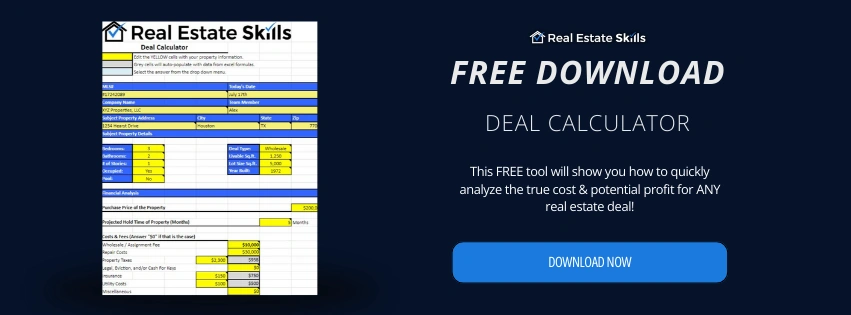
Everything in this guide comes down to three numbers on a specific house: what it's worth fixed up, what the repairs cost, and what's left for you. Get them close and you have a deal. Get them wrong and your buyer walks. This is the same calculator we've used for 13 years to work backward from a house's after-repair value to the number we can actually offer.
Where To Go From Here
This guide covered the house. The parts it deliberately didn't cover, because they have their own guides:
- Wholesaling real estate for beginners — the step-by-step process of finding sellers, making offers, and closing.
- Wholesale real estate contract — the purchase agreement and the assignment, line by line.
- Whether wholesaling is legal in your state — rules vary and several states changed theirs recently.
- How much wholesalers make — realistic income expectations.
- Pros and cons of wholesaling real estate — the honest tradeoffs.
- How to wholesale real estate with no money — structuring deals with minimal capital.
Wholesaling Houses FAQs
Final Thoughts On Wholesaling Houses
The paperwork side of wholesaling houses is not complicated. Two contracts, an assignment, a fee. You could learn it this afternoon and most guides will happily spend three thousand words teaching you exactly that.
It isn't what decides whether you make money.
The house decides. Whether the condition is bad enough to lock out retail buyers. Whether the owner has a real reason to sell. Whether there's enough equity to leave room for everyone. Whether the repairs are what you think they are. Whether the title is clean enough to close. Get those right and the contract is a formality. Get them wrong and no contract protects you from a house nobody wants.
That's a skill, and it's a learnable one. Not a fast one. I was off by $50,000 on the after-repair value of my first house — the single most important number in the deal — and I got paid anyway, because there was enough room in the rest of the numbers to absorb it. Henish Pulickal, who has been flipping houses for close to twenty years, estimated $200,000 on a full gut and finished at $300,000. If someone twenty years in can miss by fifty percent, your first estimates are going to be rough. That's not a reason to wait.
What separates people who do this from people who read about it is unglamorous. They look at a lot of houses. They pull comps on properties they'll never buy. They ask flippers what things actually cost in their market instead of guessing. They get told no, and they use the no.
And plenty of houses won't work. Most won't. A wrecked house with a comfortable owner, a motivated seller who's underwater, a good-looking deal with a foundation problem nobody caught — you'll pass on more houses than you contract. Passing is not failure. It's the job. The wholesalers who get in trouble are the ones who talk themselves into a house because they want a deal to exist.
Start with the houses. Learn to read one properly and the rest of this business opens up — because the same skill that tells you whether to wholesale a house tells you whether to flip it, rent it, or walk away from it. That's the part that compounds.
Reading Houses Is The Skill. Here's Where To Practice It.
You now know what makes a house worth wholesaling, how to price the repairs, and what kills deals at the closing table. What most people never get is a real system for finding those houses week after week. Our FREE Training shows you exactly how we find discounted properties, lock them up, and hand them to cash buyers — without spending a dollar on marketing. Watch it today and put what you just read to work.
Watch The FREE Training →
About The Author
Founder & CEO, Real Estate Skills
Alex Martinez is the Founder and CEO of Real Estate Skills. He closed his first wholesale deal at 20 years old and has spent over 14 years wholesaling and flipping houses, taking part in 1,000+ real estate transactions and personally acquiring 33+ residential investment properties. Through Real Estate Skills, Alex and his team have trained 6,000+ investors nationwide on how to find deals, evaluate properties, and close profitable transactions.
Real Estate Skills is not a law firm, and the information in this article is provided for educational purposes only — it does not constitute legal, tax, or financial advice. Wholesaling laws, contract requirements, foreclosure timelines, and probate rules vary by state and change over time. Renovation costs and property values vary widely by market, and the figures in this guide reflect specific deals rather than typical outcomes. Real estate investing carries risk, and past results do not guarantee future outcomes. Always consult a licensed real estate attorney and your own tax and financial advisors before entering into any contract or transaction.

👉FREE Training
How To Consistently Wholesale, Flip Houses, & Invest In Rental Properties From The MLS
(Without Spending $1 On Marketing)

Alex Martinez, the founder of Real Estate Skills, is known for his strong, practical expertise in real estate, starting from a beginner with no family connections in the industry to completing over 50 real estate deals, including wholesale and flips, within his first year.
He has dedicated his career to providing cutting-edge education and resources for real estate professionals. He emphasizes the importance of self-taught knowledge through mentors, books, and hands-on experience.
His journey from earning a modest income to becoming a successful real estate entrepreneur and educator showcases his expertise and dedication to the field.

Ryan Zomorodi, co-founder and COO of Real Estate Skills, leverages his experience from a diverse background in real estate investment, construction management, and entrepreneurship to provide comprehensive education in the real estate sector.
His expertise is rooted in hands-on experience, extensive industry knowledge, and a commitment to empowering others through education.
Ryan's journey reflects a blend of practical experience and entrepreneurial success, contributing to his role in developing a platform that educates and supports aspiring real estate professionals.
Read Ryan's Full Bio >>
