
Wholesale Real Estate Taxes: What You Owe & How To File (2026)
Aug 27, 2026

Written by
Alex Martinez — Founder & CEO, Real Estate Skills. Has wholesaled and flipped houses for over 14 years, been part of 1,000+ real estate transactions, and personally acquired 33+ residential investment properties. Has trained 6,000+ investors nationwide.
Reviewed by
Ryan Zomorodi — Co-Founder & COO, Real Estate Skills. Reviewed the wholesaling mechanics, deal structure, and holding-cost guidance in this article. Tax figures are sourced directly from the IRS.
Publication history: Originally published February 8, 2022. Updated August 2026 with tax year 2026 figures, corrected self-employment tax calculations, the mid-year IRS mileage rate change, the new $2,000 Form 1099-NEC threshold, updated QBI thresholds, and new sections on property tax, sales tax, and why wholesale profits aren't capital gains. Wholesaling mechanics and deal guidance reviewed by Ryan Zomorodi, Co-Founder & COO of Real Estate Skills.
Wholesale real estate taxes are the federal, state, and sometimes local taxes you owe on your assignment fee. The IRS treats that fee as ordinary business income, not capital gains — so on a $10,000 fee you'd owe roughly $1,413 in self-employment tax plus income tax at your regular rate.
The check clears and it feels like the whole thing is yours. It isn't. Somewhere between a quarter and a third of that number belongs to the IRS, and nobody withheld a dollar of it on your behalf.
That's the part nobody warns you about. You spent months learning to find deals, talk to sellers, and line up cash buyers — and then you get paid like a business owner for the first time in your life, with no employer taking taxes out of the check. Most new wholesalers find this out in April, which is the worst possible time to find it out.
Here's what this guide covers: exactly what you owe on an assignment fee, when it's due, which forms you file, and the deductions that legitimately lower the bill. Every figure is for tax year 2026 — the year you're earning in right now, filing in early 2027 — and every one is sourced to the IRS. Grab the free Ultimate Guide to Start Real Estate Investing to keep your books clean from deal one.
What Are Wholesale Real Estate Taxes?
Wholesale real estate taxes are the federal, state, and sometimes local taxes owed on assignment fees and double-close profits. The IRS treats this as ordinary business income from an active trade or business, which means two separate taxes apply: regular income tax and self-employment tax.
Start with what you actually sold, because everything downstream depends on it.
When you assign a contract, you don't sell a house. You sell your assignment fee — the payment your cash buyer gives you for the right to step into your position as the buyer on that purchase agreement. The property never touches your name. You provided a service: you found the deal, tied it up, and handed it to someone with money.
That distinction is the whole ballgame. Because you sold a service and not real estate, the IRS treats your fee as ordinary business income — the same category as wages or freelance income, taxed at your regular rate. Not capital gains. There's no discounted long-term rate waiting for you and no holding period that improves your situation. If you're new to the model itself, start with wholesale real estate and how an assignment of contract works.
Two separate taxes come out of that income.
Income tax is the one you already know. Your assignment fee gets added to everything else you earned that year, and you pay whatever your bracket says.
Self-employment tax is the one that surprises people. It's Social Security and Medicare — the 7.65% you used to see disappear from a W-2 paycheck, except now you pay both halves because there's no employer covering the other one. The rate is 15.3%, and per IRS Topic No. 554, it applies to 92.35% of your net earnings, not the full amount. You owe it once net earnings from self-employment reach $400.
The Numbers On A $10,000 Fee
Ryan tells students to aim for $10,000 on a deal, so let's use that. Say you collect a $10,000 assignment fee and, to keep it simple, you had no deductible expenses that year.
💡 What You Keep On A $10,000 Assignment Fee
- Self-employment tax: $10,000 × 92.35% = $9,235. Multiply by 15.3% and you owe $1,413.
- The half-back: you deduct half of that — about $706 — from your income before income tax is calculated.
- Income tax: you pay your regular rate on roughly $9,294. In the 22% bracket, that's about $2,045.
- What's left: somewhere near $6,540 of your $10,000.
Round numbers, and your real result will differ — your bracket, your filing status, your other income, and your deductions all move it. The self-employment piece is the reliable part, because 15.3% of 92.35% doesn't care what bracket you're in.
The practical version: set aside 25% to 35% of every assignment fee the day it hits your account. Move it to a separate savings account and pretend it isn't yours, because it isn't. Wholesalers who skip this step aren't bad at math — they just spent money in June that was owed in April.
What Else You Might Owe
Federal is only part of it. Most states charge income tax on the same profit, and a handful of cities and counties add a local business or gross-receipts tax on top. Rates vary enormously, so look up your own state and city rather than assuming.
One thing you generally don't owe: property tax. You never held title, so the tax bill on that house was never yours. That said, property tax still affects your deals in a way that costs wholesalers money — covered later in this guide.
This is educational and not tax advice. Confirm your own situation with a licensed tax professional.
Do You Pay Taxes On Wholesaling Real Estate?
Yes. Every dollar you earn wholesaling is taxable, whether you made $2,000 on one deal or $200,000 across twenty. Assignment fees are income the moment you're paid, and you owe tax on them even if no 1099 arrives and even if you operate without a business entity.
There's no threshold you stay under, no beginner exemption, and no version of this where a first deal doesn't count.
The confusion usually comes from one of three places, so let's take them in order.
"I never owned the property, so what am I being taxed on?" The fee, not the house. You were paid for a service — finding and controlling a deal, then handing it off. The seller pays their own taxes on the sale. The buyer pays theirs at closing. Your slice is the assignment fee, and that's yours to report. This is the same whether you're working with motivated sellers directly or sourcing on-market deals.
"I didn't get a 1099, so it's not reported." It's still income. A 1099 is a reporting form, not the thing that creates the tax. Whether a piece of paper shows up in January has no bearing on whether you owe.
This matters more starting in 2026 than it used to. Under the One Big Beautiful Bill Act, the reporting threshold for Form 1099-NEC rose from $600 to $2,000, and the IRS instructions for Forms 1099-MISC and 1099-NEC now direct businesses to file only when payments to a person reach at least $2,000 in the year. Fewer forms will be issued. Your obligation didn't change at all — you'll just get less mail reminding you of it.
"I don't have an LLC, so I'm not really a business." The IRS doesn't need you to file paperwork to consider you in business. If you're doing deals with the intent to profit, you're operating a trade or business and you report it. Forming an entity changes your liability exposure and can change how you're taxed. It has nothing to do with whether you're taxed.
Assume you owe. Then work on lowering the number legitimately, which the rest of this guide covers.
Educational only — not tax advice. A licensed tax professional can confirm how this applies to you.
How Is A Wholesale Fee Taxed?
Your assignment fee is taxed as ordinary business income on Schedule C. You subtract business expenses from your fees to get net profit, then pay self-employment tax on 92.35% of that profit and regular income tax on what remains after the half-SE-tax deduction.
The order of operations matters here, because taxes come out of your profit, not your fees. That distinction is worth real money.
Step one: add up what you collected. Every assignment fee for the year, plus any double-close profit, plus anything else the business brought in. That's gross income.
Step two: subtract what you spent to earn it. Marketing, mileage, software, contract labor, professional fees. This is your business's expenses, and the deductions section covers what qualifies.
Step three: what's left is net profit. Every tax below is calculated on this number, not on what you collected.
That's why bookkeeping isn't a chore for later. A wholesaler who collected $60,000 in fees and tracked $14,000 in real expenses is taxed on $46,000. One who collected the same $60,000 and tracked nothing is taxed on $60,000 — and pays several thousand dollars extra for the privilege of not keeping records.
Running The Numbers On $60,000 In Fees
Say you closed six deals at $10,000 each, and you tracked $14,000 of legitimate business expenses. Net profit: $46,000.
| Step | Calculation | Result |
|---|---|---|
| Net profit | $60,000 in fees − $14,000 in expenses | $46,000 |
| SE tax base | $46,000 × 92.35% | $42,481 |
| Self-employment tax | $42,481 × 15.3% | $6,500 |
| Half-SE deduction | Half of $6,500, taken above the line | about $3,250 |
| Income tax applies to | Business income after that deduction | roughly $42,750 |
Compare that to the same $60,000 with no expenses tracked: self-employment tax alone jumps to about $8,478. Nearly $2,000 more, for no reason other than lost receipts.
The Ceiling, And The Surcharge
Two boundaries worth knowing, though most wholesalers won't reach them for a while.
The Social Security portion — 12.4% of the 15.3% — only applies up to a yearly cap. For 2026 that cap is $184,500. Above it, only the 2.9% Medicare portion continues, with no ceiling. So a very high-earning year has a lower marginal self-employment rate than you'd expect.
Separately, an additional 0.9% Medicare tax applies once earned income passes $200,000 for a single filer or $250,000 filing jointly.
One thing to watch if you're wholesaling on the side of a W-2 job: your wages fill up that $184,500 cap first. If your day job already paid you $170,000, only about $14,500 of your wholesaling profit gets hit with the Social Security portion. The rest takes Medicare only. That's a genuinely different calculation from someone whose only income is deals, and it's worth raising with a tax professional if it's your situation.
Every figure here is illustrative. Your bracket, filing status, other income, and deductions change the result — confirm your own numbers with a licensed tax professional.
You Can't Optimize Taxes On Deals You Haven't Closed
Every strategy in this guide — deductions, quarterly payments, entity structure — assumes there's a fee to apply it to. That's the part beginners skip. Before you refine your tax planning, get good at the thing that generates the income: finding deeply discounted properties with enough spread that a $6,500 tax bill is a good problem to have. Download our Ultimate Guide to Start Real Estate Investing and learn to source the deals first.

Why Your Wholesale Profits Aren't Capital Gains
Wholesale profits are not capital gains. Capital gains treatment applies to property you owned and held as an investment. You sold contract rights, not real estate, so your fee is ordinary income — which also means no 1031 exchange, no 121 exclusion, and no benefit from waiting.
This section exists because almost everything people know about real estate taxes is true — for someone else.
You've heard that real estate is the best tax shelter going. Depreciation that offsets income. Write-offs from improvements. Investors who owe almost nothing on paper while their net worth climbs. Alex talks about this himself: the reason the wealthiest people in the world hold real estate isn't only appreciation, it's the tax treatment that comes with ownership.
All of it is real. None of it reaches you as a wholesaler, because every one of those advantages is attached to owning the asset. You don't own the asset. You own a contract for about two weeks and then you hand it to someone who does.
Worth being clear about what that costs you, because three specific things people expect to help simply don't.
1. Long-Term Capital Gains Rates Don't Apply
Capital gains are what you owe when you sell a capital asset you held for investment. Hold it more than a year and the profit is taxed at long-term rates — meaningfully lower than ordinary income rates for most people. Hold it less than a year and it's short-term, taxed at your regular rate.
The question people ask is: can I hold longer and get the better rate?
No, and not because your timing is off — because you never held property in the first place. Your assignment fee is payment for a service, and it lands as ordinary income the moment you're paid. There is no holding period to lengthen. A deal you assign in three days and a deal you assign in three months are taxed identically.
2. A 1031 Exchange Won't Defer It
The 1031 exchange lets an investor sell investment real property, roll the entire proceeds into another like-kind property through a qualified intermediary, and defer the tax. It's genuinely powerful, and it's how a lot of portfolios get built.
It doesn't work on an assignment fee. Section 1031 applies to real property held for productive use or investment. What you sold was contract rights — an intangible interest, not real property, and not held for investment. There's nothing to exchange.
The trap here is subtle: a wholesaler hears "real estate investors defer taxes with 1031s," assumes it's available, doesn't set money aside, and finds out in April. If someone has told you to roll an assignment fee into a 1031, get a second opinion before you rely on it.
3. The 121 Home Sale Exclusion Has Nothing To Do With Your Deals
The Section 121 exclusion lets you keep up to $250,000 of profit tax-free when you sell your primary residence — $500,000 if married filing jointly — provided you lived there two of the past five years.
It's a genuinely great rule. It applies to the home you live in. Not to properties you wholesale, not to a house you never occupied, and not to your assignment fee. Occasionally someone tries to connect these because both involve real estate and taxes. They aren't related.
The One Case Where Holding Actually Changes Things: Wholetailing
There's an exception worth understanding, because it's the only route from ordinary income toward capital gains treatment.
Wholetailing means you actually buy the property — take title, do light cleanup, and resell on the open market rather than assigning a contract. Now you own an asset, so the analysis genuinely changes.
Two hard truths before anyone gets excited.
You need real capital. Buying is not assigning. You're funding a purchase, carrying the property, and paying two sets of closing costs. That's a fundamentally different business from wholesaling, not a tax trick layered on top.
Short holds are usually still ordinary income. Long-term rates need more than a year. Nobody wholetails for thirteen months. Beyond the holding period, the IRS looks at intent: property bought to resell quickly is generally inventory of a dealer, and dealer profits are ordinary income regardless of how long you held. Buying with genuine investment intent and buying to flip fast are different things, and calling one the other doesn't change the result.
So wholetailing can shift the tax picture, but only alongside a real change in how you operate — and it's a conversation for a tax professional, not a decision to make from an article.
The Reframe Worth Carrying
Here's the more useful way to think about all this: the tax advantages of real estate are real, and they're waiting on the other side of ownership.
Depreciation, cost segregation, the shelter effect that makes long-term investors' returns look so good — those arrive when you start holding property. Which is exactly why so many wholesalers reinvest fees into rentals. You're not locked out of those benefits permanently. You're on the active-income side of the business right now, and active income gets taxed like active income. When you're ready to move in that direction, start with how to invest in real estate.
Your job at this stage is simpler than optimizing: know what you owe, set it aside, claim every deduction you're entitled to, and don't plan around rules that were written for someone in a different position.
This section explains general tax treatment, not advice for your situation. Entity structure, intent, and holding period all affect outcomes — confirm with a licensed tax professional before acting on any of it.
Self-Employment Tax On Your Assignment Fee
Self-employment tax is 15.3% on 92.35% of your net profit — 12.4% for Social Security up to $184,500 in 2026, plus 2.9% for Medicare with no cap. It covers the Social Security and Medicare an employer would normally split with you. On $46,000 of profit, that's about $6,500.
If you've only ever had a job, this is the line item that doesn't make sense at first.
On a W-2 paycheck, 7.65% disappeared for Social Security and Medicare and you never thought about it. What you didn't see is that your employer paid a matching 7.65% on your behalf. Together, 15.3% of your wages went into those two programs — you just only ever felt half of it.
Wholesaling on your own, there's no employer. So you pay both halves. That's self-employment tax, and it lands on top of income tax, not instead of it.
How It's Actually Calculated
Three steps, and the first one is the one everybody skips.
Step one — take 92.35% of your net profit. You don't pay self-employment tax on your whole profit. IRS Topic No. 554 says the amount subject to the tax is 92.35% of net earnings from self-employment. The reduction exists to mirror the fact that an employer deducts its half of payroll tax as a business expense, so you get the equivalent break.
Step two — multiply by 15.3%. That's 12.4% Social Security plus 2.9% Medicare.
Step three — deduct half of the result from your income. Half of your self-employment tax comes off your income before income tax is calculated. It's above-the-line, so you get it whether or not you itemize. It doesn't reduce the self-employment tax itself — just your income tax.
You owe this once net earnings from self-employment reach $400 for the year. That's the entire threshold. One small deal clears it.
Worked Example: $46,000 Of Net Profit
Carrying forward the running example — six deals at $10,000, $14,000 of tracked expenses:
| Step | Amount |
|---|---|
| Net profit | $46,000 |
| × 92.35% | $42,481 |
| × 15.3% | $6,500 self-employment tax |
| Deduct half from income | about $3,250 |
Then income tax applies separately, at your bracket, on your business income after that deduction.
Watch what the 92.35% step is worth. Skip it and you'd calculate $46,000 × 15.3% = $7,038. That's about $538 more than you actually owe. It's a small enough difference to look like rounding and a big enough one to matter, and it's the single most common error in wholesaling tax content — including, until this update, in an earlier version of this article. If a calculator or a blog post gives you a number, check whether it applied the 92.35% reduction.
The Social Security Cap
The 12.4% Social Security portion stops at a yearly ceiling. For 2026 that's $184,500 of combined wages and self-employment earnings, up from $176,100 in 2025.
Past that point, only the 2.9% Medicare portion continues, and Medicare has no ceiling at all. So your marginal self-employment rate drops sharply in a very strong year — from 15.3% down to 2.9%.
A separate 0.9% Additional Medicare Tax applies to earned income above $200,000 for single filers and $250,000 for married filing jointly.
If You Also Have A W-2 Job
This one's worth its own paragraph, because most people start wholesaling while employed and it changes the math.
Your wages use up the Social Security cap first. If your job paid you $150,000 in 2026, only about $34,500 of your wholesaling profit gets hit with the 12.4% Social Security piece. Everything past that takes Medicare only.
That cuts both ways. Your wholesaling income is taxed less heavily than a full-time wholesaler's at the same profit level. But your job's withholding almost certainly doesn't cover the income tax on your deals, so you can still end up owing at filing. Two options: make estimated payments on the wholesaling income, or increase withholding at your job to cover it. The next section covers the timing.
The Number To Actually Remember
You don't need to run this calculation on every deal. You need a habit.
Set aside 25% to 35% of every assignment fee the day it lands. The bottom of that range fits someone in a low bracket with real deductible expenses. The top fits someone in a higher bracket, in a state with income tax, tracking little.
Why a percentage and not a fixed dollar amount: your fee isn't fixed either. Ryan will tell you a $10,000 target sometimes becomes $5,000 to save a deal — better to make something than lose it to another wholesaler. A percentage scales with whatever actually shows up.
Open a separate savings account, move the money the day you're paid, and treat it as gone. The wholesalers who get into trouble here aren't bad at arithmetic. They spent money in June that was owed the following April.
Figures are illustrative and assume no other income. Your bracket, filing status, state, and deductions all change the result — confirm your numbers with a licensed tax professional.
Now You Know What You Owe. The Next Step Is Earning More To Owe It On.
Understanding self-employment tax is worth exactly nothing if you're not closing deals to pay it on. The wholesalers who build real income don't guess their way through — they follow a proven process for finding discounted properties, locking them up, and getting paid at the closing table. Our FREE Training walks you through the entire system, the same one thousands of our students use. Watch it today, then go find your next deal.
Watch The FREE Training →Property Tax, Sales Tax & Transfer Tax: What Wholesalers Actually Owe
Wholesalers generally owe none of these. You never take title, so property tax, transfer tax, and closing costs belong to the buyer and seller. But property tax still affects your deals — get the number wrong in your offer and the deal falls apart at the buyer's underwriting.
Three taxes people ask about, and the short answer on all three is the same: not yours, because you never own the property. The longer answer on property tax is where the money is.
Property Tax
Property tax is charged to whoever holds title. On an assignment, that's the seller until closing and your cash buyer afterward. Your name never appears on a deed, so no bill ever comes to you and nothing about it touches your return.
That's the tax answer. Now the part that actually costs wholesalers money.
Your buyer's numbers depend on property tax, and property tax is the number most often wrong.
When your cash buyer evaluates a deal, they're modeling holding costs across the whole project — taxes, insurance, utilities, HOA — for however many months they'll own it. Property tax is usually the largest of those. If the figure is understated, their projected profit is inflated, and both of you are working from a number that isn't real.
Here's how it goes wrong. You pull the tax figure from Redfin or the county site. That number reflects what the current owner pays, based on an assessed value that may be decades old. In much of the country, a sale triggers reassessment — the county updates the assessed value to reflect what the property just sold for, and the tax bill moves with it.
📓 From The Field
On a walkthrough with a student, Ryan flagged this directly: a Redfin tax figure is a starting point, not the number. If the seller bought twenty years ago, the taxes shown are artificially low, and a lot of counties reassess after a sale. He's seen that bill jump five to ten times once the assessed value catches up to market — and in a high-property-tax state, that can be tens of thousands of dollars a year. His fix takes about a minute: look up the property tax rate for the county, multiply it by your buyer's purchase price, and use that. Outcomes vary by county, and some jurisdictions cap how fast assessments can move — so confirm the rule where you're actually doing deals.
Do that once and you'll never model a deal off a stale tax line again. It also does something for you beyond accuracy: a wholesaler who hands a buyer correctly modeled holding costs looks like someone worth taking calls from. Most don't.
Sales Tax
You don't charge sales tax on an assignment fee.
Sales tax applies to retail sales of goods and, in some states, specified services. Real estate transactions aren't retail sales of goods, and assigning contract rights isn't on anyone's list of taxable services. No state currently treats a wholesale assignment fee as a sales-taxable transaction.
Two adjacent things do exist and are sometimes confused with it. A few cities and counties impose a local business or gross-receipts tax on businesses operating there, which can reach your fees — that's a business tax, not sales tax, and it's worth checking for your city. And if you ever buy materials for a rehab, you'll pay sales tax on the materials like anyone else. Neither applies to a straight assignment.
Transfer Tax
Transfer tax — sometimes called deed tax, stamp tax, or conveyance tax — is charged when title changes hands. On an assignment there's exactly one transfer, from seller to your cash buyer, and the parties to that closing handle it per local custom and their contract. Not your line item.
Double closes are the exception, and it's a meaningful one. When you take title and resell, there are two transfers, which means two sets of transfer taxes plus two sets of closing costs — title insurance, escrow fees, recording, and the rest. Ryan ballparks closing costs at roughly 1% of purchase price on a cash transaction, higher on lower-priced deals, and 6% to 8% in total sales costs when a property goes back on the market with agents involved.
That's the real argument for assigning when you can. Those costs come straight out of your spread, which is why a double close generally only makes sense on a large enough margin to absorb them. The tax consequences of a double close get their own treatment later in this guide.
What This Means For How You Work
Three things worth carrying:
- You're not exempt from these taxes — you're outside them. Different thing. The moment you take title, in a double close or a wholetail, all of them apply to you.
- Model property tax correctly anyway. Not because you owe it, but because your buyer does, and a deal built on a wrong number dies late — after you've spent your inspection window on it.
- Check your city for a local business tax. It's the one item in this section that can genuinely reach a wholesaler's fees, and it's easy to miss because it varies so much by jurisdiction.
Property tax, transfer tax, and local business tax rules vary widely by state, county, and city, and reassessment practices differ. This is educational, not tax advice — confirm the rules in your market with a local tax professional or title company.
Model Your Buyer's Holding Costs Before You Make The Offer
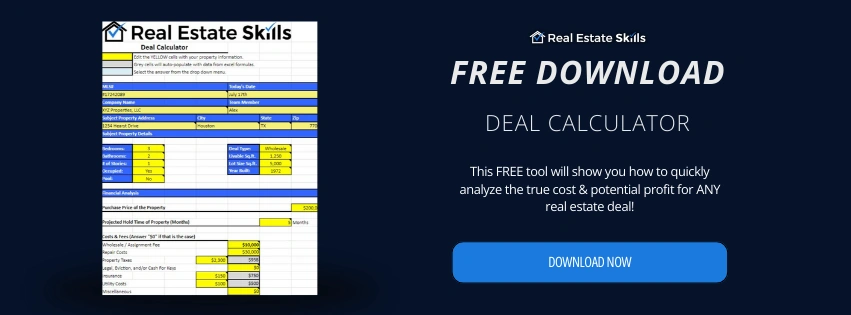
Property taxes, insurance, utilities, and HOA fees all come out of your cash buyer's profit — and a stale tax figure makes a deal look better than it is. Our free Deal Calculator is the spreadsheet we use to run holding costs, closing costs, and Maximum Allowable Offer on every deal. Plug in the reassessed tax number instead of the one on Redfin, and you'll know whether the deal actually works before you tie it up.
When Are Wholesale Real Estate Taxes Due?
Wholesaling income has no withholding, so you pay the IRS four times a year. For tax year 2026 the estimated payment dates are April 15, June 15, September 15, and January 15, 2027. Your annual return is due April 15, 2027.
The U.S. tax system is pay-as-you-go. A W-2 employee satisfies that automatically — money comes out of every paycheck before they see it. Nobody does that for you on an assignment fee. The full amount hits your account, and the IRS still expects to be paid throughout the year.
That's what estimated tax payments are.
The 2026 Dates
| Payment | Covers | Due |
|---|---|---|
| Q1 | Jan 1 – Mar 31 | April 15, 2026 |
| Q2 | Apr 1 – May 31 | June 15, 2026 |
| Q3 | Jun 1 – Aug 31 | September 15, 2026 |
| Q4 | Sep 1 – Dec 31 | January 15, 2027 |
Two things about this table trip people up.
They aren't quarters. Look at the periods — two months, then three, then four. The names say quarterly; the calendar doesn't. Don't assume a payment is three months after the last one.
If you closed a deal this summer, September 15 is your deadline. That's the payment covering June through August. It's close enough that if you've been meaning to sort this out, this is the one to act on.
When a date falls on a weekend or federal holiday, it moves to the next business day.
Who Has To Do This
You generally need to make estimated payments if you expect to owe $1,000 or more after subtracting withholding and refundable credits.
For most wholesalers that's a low bar. One $10,000 assignment fee produces roughly $1,413 in self-employment tax alone, before income tax. If you're doing deals at all, assume you're in.
If you also work a W-2 job, you have a choice: make estimated payments on the wholesaling income, or file a new W-4 to increase withholding at your job enough to cover it. Withholding has a quiet advantage — it's treated as paid evenly across the year regardless of when it actually happened, which can fix an underpayment late in the year that estimated payments can't.
The Safe Harbor — The Rule Worth Knowing
Here's the part almost nobody explains to wholesalers, and it's the one that makes irregular income manageable.
You don't have to predict your year correctly to avoid a penalty. Per IRS Topic No. 306, you generally avoid the underpayment penalty if you owe less than $1,000 at filing, or if you paid at least 90% of this year's tax or 100% of last year's tax — whichever of those two is smaller.
That second option is the useful one. Last year's number is already known. You don't have to forecast a business where a deal can close in March or not at all. Take last year's total tax, divide by four, pay that on schedule, and you're protected even if this year turns out much bigger.
One adjustment for higher earners: if your prior-year adjusted gross income was over $150,000 ($75,000 if married filing separately), the 100% figure becomes 110%. That's set by statute in IRC §6654(d)(1)(C).
A caution worth stating plainly: safe harbor protects you from the penalty. It doesn't mean you've paid enough. If your year runs well ahead of last year's, you'll still owe the difference at filing — you just won't be penalized for the timing. Set money aside regardless.
If Your Income Is Lumpy — The Annualized Method
Wholesaling income doesn't arrive in four equal pieces. A quiet spring and three closings in October is a completely normal year.
The default assumption is that you pay in four equal installments. But the IRS allows the annualized installment method, which lets you vary your payments to match when you actually earned the money. If you made nothing in the first half of the year and everything in the fourth quarter, this can eliminate a penalty that the equal-installment approach would create.
It's more paperwork — you calculate it on Form 2210 — but for a business with a genuinely uneven year, it's the difference between a penalty and none. Worth raising with whoever prepares your return.
What To Actually Do
- Open a separate account and move 25–35% of every fee into it the day you're paid. Covered earlier, and it's the foundation for everything in this section.
- Pick your number using safe harbor. Take last year's total tax, divide by four. If last year was your first year with no wholesaling income, estimate from what you've actually earned so far this year.
- Pay online. IRS Direct Pay from a bank account takes a few minutes, and you get a confirmation. Keep it.
- Put all four dates in your calendar now, not the week they're due.
- Don't skip a payment because you're expecting a refund. The penalty is calculated per period. You can be owed money overall and still be penalized for paying late.
The penalty itself isn't catastrophic — it's computed like interest on the underpayment. But it's entirely avoidable, and it compounds with the much worse problem of not having the money when the bill arrives.
This is educational, not tax advice. Payment requirements depend on your full tax situation, and most states have their own estimated payment schedules and deadlines. Confirm both federal and state obligations with a licensed tax professional.
Tax Forms For Real Estate Wholesalers
Most wholesalers file Form 1040 with Schedule C for business income and Schedule SE for self-employment tax. Partnerships file Form 1065, S-Corps file Form 1120-S, and you'll issue Form 1099-NEC to contractors you paid $2,000 or more in 2026.
Fewer forms than you'd think. Which ones apply depends entirely on how your business is structured, so start there.
The Two That Almost Everyone Files
Schedule C (Form 1040), Profit or Loss From Business. This is where your wholesaling business lives on your personal return. Assignment fees go on the income side, business expenses on the other, and the difference is your net profit. If you're a sole proprietor or a single-member LLC, this is your main form.
Schedule SE (Form 1040), Self-Employment Tax. This takes the net profit from Schedule C and calculates what you owe in Social Security and Medicare — including the 92.35% reduction covered earlier. It's where the 15.3% actually gets computed.
Those two travel together. Profit on Schedule C, self-employment tax on Schedule SE, both attached to your 1040.
If You're Structured Differently
Form 1065, U.S. Return of Partnership Income. For partnerships and multi-member LLCs. The business files this and issues a Schedule K-1 to each partner showing their share of the profit, which each person then reports individually. The partnership itself doesn't pay income tax.
Form 1120-S, U.S. Income Tax Return for an S Corporation. For an S-Corp, or an LLC that's elected S-Corp treatment. Also issues K-1s. Note the deadline difference — 1065 and 1120-S returns are generally due in mid-March, a month before individual returns.
Form W-2 if you've elected S-Corp status and put yourself on payroll. You become an employee of your own company, which means real payroll: withholding, employment tax filings, and a W-2 to yourself in January. Covered in more detail in the structure section.
Form 1099-NEC — And The Change You Need To Know About
Form 1099-NEC, Nonemployee Compensation is the form for reporting what you paid contractors. For wholesalers that's usually VAs, cold callers, acquisition help, designers, or a bird dog.
The threshold changed for 2026. It used to be $600. Under the One Big Beautiful Bill Act, the IRS instructions for Forms 1099-MISC and 1099-NEC now direct you to file Form 1099-NEC for each person you paid at least $2,000 during the year for services performed by someone who is not your employee, including parts and materials. The threshold is indexed for inflation starting in 2027.
If you file them, they're due to both the IRS and the recipient by early in the following year — confirm the exact date for the year you're filing, since it shifts with weekends.
Now the trap, and it cuts both ways.
As the payer: fewer forms doesn't mean fewer records. You still need a W-9 from every contractor before you pay them, and you still deduct what you paid whether or not a 1099 was required. Chasing a tax ID number in January from someone who stopped answering in August is a bad afternoon. Get the W-9 up front.
As the payee: this is the one that costs people money. If a title company or attorney paid you $1,800 in 2026, they may no longer send you a 1099 — but that $1,800 is still fully taxable and still your responsibility to report. Anyone who's been using the arrival of a 1099 as their reminder to report income is about to under-report by accident. The form is a reporting mechanism, not the thing that creates the tax.
Track your own income. Your bank deposits are the record that matters.
One Correction Worth Making
It's common to see wholesalers pointed to Form 1099-MISC for contractor payments. That was right before 2020, when nonemployee compensation moved to its own form. Today, payments for services go on 1099-NEC. Form 1099-MISC still exists for other things — rent, prizes, certain attorney payments — but it isn't the form for paying your VA.
You may also receive a 1099 for your assignment fee. Some title companies and closing attorneys issue one, some don't. Either way, report the income. If you haven't chosen a closing partner yet, here's what to look for in a title company.
Forms At A Glance
| Form | Who Files It | What It Does |
|---|---|---|
| Schedule C (1040) | Sole proprietors, single-member LLCs | Reports business income and expenses |
| Schedule SE (1040) | Anyone with $400+ net self-employment earnings | Calculates self-employment tax |
| Form 1065 | Partnerships, multi-member LLCs | Partnership return; issues K-1s |
| Form 1120-S | S-Corps and LLCs taxed as S-Corps | Corporate return; issues K-1s |
| Form W-2 | S-Corps with an owner on payroll | Reports wages paid |
| Form 1099-NEC | Anyone paying a contractor $2,000+ in 2026 | Reports nonemployee compensation |
| Form 1040-ES | Anyone making estimated payments | Quarterly payment vouchers |
| Form 2210 | Anyone checking for an underpayment penalty | Calculates the penalty; annualized method |
Form requirements depend on your entity structure and your full tax situation. Deadlines shift year to year. Confirm what applies to you with a licensed tax professional.
Wholesaling Tax Deductions: What You Can Actually Write Off
Any expense that's ordinary and necessary for your wholesaling business is deductible — marketing, mileage, software, contract labor, and professional fees are the big ones. Deductions reduce your net profit, which cuts both your income tax and your self-employment tax.
Deductions do more work for a wholesaler than for most people, and the reason is self-employment tax.
A deduction reduces your net profit. Net profit is what both your income tax and your 15.3% self-employment tax are calculated on. So a legitimate $1,000 expense saves you the 15.3% plus whatever your income bracket is — call it 30% or more combined. That's a meaningfully better return than most people assume they're getting from a receipt.
The standard is that an expense must be ordinary and necessary for your business. Ordinary means it's common in your line of work. Necessary means it's helpful and appropriate. Neither means extravagant, and neither covers personal spending you'd have done anyway.
Vehicle Expenses — And The 2026 Split Nobody's Talking About
Driving is the deduction wholesalers underclaim most, and 2026 has a wrinkle that will cost people money if they miss it.
You can deduct business mileage two ways: the standard mileage rate, or actual expenses (gas, insurance, maintenance, depreciation, apportioned to business use). Most wholesalers use the standard rate because the recordkeeping is far simpler.
Here's the 2026 problem: the rate changed mid-year.
The IRS set the 2026 business rate at 72.5 cents per mile starting January 1, up 2.5 cents from 2025. Then, in Announcement 2026-11, it revised the rate to 76 cents per mile for travel on or after July 1, 2026, citing recent increases in fuel prices. The rates from the original notice continue to apply to travel before July 1.
Mid-year changes are rare — this is only the fifth since the late 1990s, after 2005, 2008, 2011, and 2022.
📍 Split Your 2026 Mileage Log At June 30
One log, two rates, two calculations:
- January 1 – June 30, 2026 — 72.5 cents per business mile.
- July 1 – December 31, 2026 — 76 cents per business mile.
If you use a mileage tracking app, check that it updated. An app still applying 72.5 cents to your second-half driving is quietly shorting your deduction.
A worked version: drive 6,000 business miles in the first half and 6,000 in the second, and you'd claim $4,350 plus $4,560 — $8,910 total. Apply the old rate to everything and you'd claim $8,700, leaving $210 on the table. Small on its own; less small once you multiply it by the combined tax rate it would have offset.
Driving for dollars, property walkthroughs, meetings with cash buyers, trips to the title company — all business miles. Commuting to a regular job isn't. The IRS expects a contemporaneous log: date, destination, business purpose, miles.
What Else You Can Deduct
- Marketing and advertising. Direct mail, postcards, skip tracing, online ads, bandit signs, your website, business cards, lead lists. Usually a wholesaler's largest category after vehicle expenses.
- Contract labor. VAs, cold callers, acquisition help, dispositions help, designers, bird dogs. Deductible in full — and remember the 1099-NEC threshold from the last section.
- Software and subscriptions. CRM, skip tracing tools, comping and data services, e-signature, phone systems, accounting software.
- Professional services. Your CPA, bookkeeper, and real estate attorney. Tax prep for your business is a business expense.
- Office expenses. Postage, printing, supplies, and internet apportioned to business use. If you work from a space used regularly and exclusively for business, the home office deduction may apply — worth asking your preparer about, since the rules are specific.
- Phone. The business-use portion of your bill. If your phone is genuinely split between business and personal, deduct the business share, not all of it.
- Education and training. Courses, coaching, books, conferences, and REIA memberships that maintain or improve skills for the business you're already in.
- Business insurance. Liability and E&O premiums.
- Business interest. Interest on a business credit card or loan tied to wholesaling activity. Personal interest doesn't qualify.
- Travel. Airfare, lodging, and ground transport for genuine business travel — scouting a market, attending a conference.
- Business meals — at 50%. A meal with a cash buyer, a partner, or a seller where business is discussed, when you're present and the meal isn't lavish. Half the cost.
One Correction: Entertainment Isn't Deductible
This is on a lot of wholesaling deduction lists, including the earlier version of this article, and it's been wrong since 2018.
The Tax Cuts and Jobs Act eliminated the deduction for expenses related to activities generally considered entertainment, amusement, or recreation. Golf, concert tickets, sporting events, a night out with a buyer — not deductible, even with a real business purpose.
Business meals survived at 50%, which is why the two get conflated. The distinction the IRS draws: food and beverages provided during an entertainment event aren't treated as entertainment if they're purchased separately from the event. So the ticket isn't deductible; a separately purchased meal at the ballpark may be.
If a list tells you entertainment is a write-off, it hasn't been updated in eight years — which is a fair signal about the rest of that list.
Making It Actually Work
Deductions are only worth what you can substantiate.
- Separate your banking. A dedicated business checking account and card is the single highest-leverage habit here. Mixed personal and business spending is how deductions get missed and how an audit gets ugly.
- Keep receipts and log mileage as you go. Reconstructing a year in April guarantees you'll miss things. The IRS generally expects records kept for at least three years.
- Track expenses even when you're not sure they qualify. Your preparer can decide later. They can't deduct something you never recorded.
- Don't invent deductions. Personal spending run through the business is the fastest way to turn a routine return into a problem. A real $1,000 expense saves real money; a fabricated one costs far more than it saves.
Deductibility depends on facts and circumstances. Rules for home office, vehicle, and meals in particular have specific requirements. Confirm what applies to you with a licensed tax professional.
Deductions Only Matter If You Have Fees To Deduct Them From.
Tracking mileage and receipts protects the money you've already made. Closing more deals is what makes the tracking worth doing. The wholesalers who actually get paid follow a proven process from day one — finding discounted properties, negotiating with motivated sellers, and assigning contracts to cash buyers. Our FREE Training shows you the whole system, the same one thousands of our students use. Watch it today, then go put it to work.
Watch The FREE Training →How Your Business Structure Changes Your Tax Bill
Sole proprietors, single-member LLCs, and partnerships all pay self-employment tax on their full net profit. An S-Corp election changes that — you pay yourself a reasonable salary, and only the salary carries payroll tax. The savings are real but smaller than usually advertised, and they come with real costs.
Your structure doesn't change how much you earn. It changes how much of it is exposed to the 15.3%.
Sole Proprietorship
The default. No filing, no formation — you're doing deals in your own name and you're a sole proprietor. Income goes on Schedule C, self-employment tax on Schedule SE, and you owe 15.3% on 92.35% of your net profit.
No liability protection at all. Your personal assets sit behind your business activity.
Single-Member LLC
Forms a legal entity between you and your business, which is real protection worth having. It changes nothing about your taxes by default. A single-member LLC is disregarded for federal tax purposes — same Schedule C, same Schedule SE, same 15.3%.
This surprises people who form an LLC expecting a tax benefit. The benefit is liability, plus looking more established to sellers and title companies. Not tax.
Partnership Or Multi-Member LLC
Two or more owners. The business files Form 1065 and issues each partner a K-1 with their share of profit. Each partner reports it individually and generally pays self-employment tax on their share.
S-Corporation
Not an entity type — a tax election an LLC or corporation makes. This is the one that actually changes the calculation.
As an S-Corp you become both owner and employee. You pay yourself a reasonable salary through payroll, which carries payroll tax. The remaining profit is taken as a distribution, which doesn't. That's the entire mechanism.
The Math, Done Correctly
Here's where most articles — including the earlier version of this one — get it wrong, and the error always runs in the same direction.
Take a wholesaler with $60,000 in net profit.
| Structure | Calculation | Tax On $60,000 Profit |
|---|---|---|
| Sole proprietor / single-member LLC | $60,000 × 92.35% = $55,410, then × 15.3% | $8,478 |
| S-Corp, $30,000 salary | $30,000 × 15.3% — wages get no 92.35% reduction | $4,590 |
| Difference | Before the costs of running payroll | about $3,888 |
Note that the $4,590 is split between the employee and employer sides, both of which you fund. The other $30,000 taken as distribution carries no payroll tax.
You'll frequently see this example presented as saving $4,590, because the writer compared the S-Corp figure against $9,180 — which is $60,000 × 15.3% with the 92.35% reduction skipped. That overstates the benefit by roughly 18%. Run the same comparison at $100,000 of profit and the real saving is about $6,480, not the $7,650 commonly quoted.
The savings are genuine. They're just smaller than the pitch.
What The Pitch Usually Leaves Out
Three costs that eat into that $3,888.
- Payroll isn't free. You need a payroll service, quarterly employment tax filings, and a W-2 issued to yourself. Budget several hundred to a couple thousand dollars a year depending on your provider and your accountant.
- Your return gets more expensive. Form 1120-S is a separate business return on top of your personal one. Most preparers charge meaningfully more for it.
- "Reasonable salary" is not a number you choose freely. The IRS requires your salary to reflect the work you actually do. Pay yourself $10,000 on $100,000 of profit and you've built an audit exposure, not a strategy. There's no published formula — it depends on your role, hours, and what comparable work pays.
Stack those against $3,888 and the picture at that income level is less compelling than it looks. At higher profit, the fixed costs stay roughly flat while the savings grow, which is why the election generally makes more sense as income scales.
Where the line sits depends on your specific situation, and it's genuinely a question for a tax professional. Anyone who gives you a threshold without knowing your numbers is guessing.
The QBI Deduction
One more piece that applies across all of these structures.
The Qualified Business Income deduction under Section 199A lets owners of pass-through businesses deduct up to 20% of qualified business income. Sole proprietors, LLCs, partnerships, and S-Corps can all potentially claim it.
Two things changed for 2026. The One Big Beautiful Bill Act made the deduction permanent — it had been scheduled to expire after 2025 — and added a minimum deduction of $400 for owners with at least $1,000 of qualified business income who materially participate.
Per Revenue Procedure 2025-32, the 2026 taxable-income thresholds where limitations begin are $201,750 for single filers and heads of household, $403,500 for married filing jointly, and $201,775 for married filing separately. Below those, most pass-through owners get the full deduction without further analysis. Above them, wage and property limitations phase in.
The critical detail: QBI reduces your federal income tax only. It does not reduce self-employment tax. A wholesaler with $46,000 of net profit still owes the full $6,500 in self-employment tax regardless of QBI — the deduction works on the income tax side. That distinction gets blurred constantly, and it matters for planning.
Those thresholds reflect inflation adjustments published in October 2025. Confirm current figures for the year you're filing.
How To Think About This
- Start where you are. Almost nobody should form an entity before their first deal. Do a deal, see whether this is your business, then structure it.
- Get the LLC for liability, not taxes. It's worth having. Just don't expect it to change your bill.
- Revisit the S-Corp question when profit is consistent, not when it's high once. A single strong year doesn't justify permanent overhead. Repeatable profit might.
- Have the conversation with a professional before electing. The election has deadlines, payroll obligations, and consequences that are awkward to unwind.
Entity selection affects taxes, liability, and administration in ways specific to your situation. Figures here are illustrative. Consult a licensed tax professional and an attorney before forming an entity or making an election.
How To File Taxes As A Real Estate Wholesaler
Filing as a wholesaler means totaling your assignment fees, subtracting business expenses on Schedule C, calculating self-employment tax on Schedule SE, and filing both with your Form 1040. If you made estimated payments during the year, they're credited against what you owe.
Seven steps. The first three happen during the year — and they're the ones that determine whether filing is straightforward or miserable.
Step 1: Separate Your Business Banking
Open a business checking account and route every assignment fee into it and every business expense out of it.
Do this before your first deal if you can. Mixed personal and business spending is the root cause of most filing pain: missed deductions, hours of reconstruction, and no clean record if anyone ever asks. One account solves it.
Step 2: Track Income And Expenses As You Go
Log every fee you collect and every dollar you spend on the business, with receipts. Accounting software helps, a spreadsheet works, and either beats a shoebox.
Two things to keep current: a mileage log with date, destination, business purpose, and miles for each trip — and a W-9 from every contractor before you pay them, not in January. The IRS generally expects business records kept at least three years.
Step 3: Set Aside And Pay Estimated Taxes
Move 25% to 35% of every assignment fee into a separate savings account the day it lands. Then pay quarterly — for tax year 2026, that's April 15, June 15, September 15, and January 15, 2027.
Use the safe harbor to set your amount: pay 100% of last year's total tax (110% if your prior-year AGI exceeded $150,000) and you're protected from the underpayment penalty even if this year runs bigger.
Step 4: Total Your Income For The Year
Add up every assignment fee, every double-close profit, and any other business income.
Use your own records, not the 1099s you received. With the reporting threshold at $2,000 for 2026, you'll get fewer forms than before — and the income is taxable whether a form arrives or not. Your bank deposits are the record that matters.
Step 5: Complete Schedule C
Report gross business income, then deduct your ordinary and necessary business expenses — marketing, mileage, contract labor, software, professional fees.
Remember the 2026 mileage split: 72.5 cents per mile for travel before July 1, and 76 cents per mile from July 1 onward. Two calculations from one log.
What's left is your net profit, and everything downstream is based on that number.
Step 6: Calculate Self-Employment Tax On Schedule SE
Take the net profit from Schedule C and multiply by 92.35%. Apply 15.3% to that figure — 12.4% for Social Security up to the $184,500 wage base for 2026, plus 2.9% for Medicare with no cap.
Half of the resulting self-employment tax is deductible from your income before income tax is calculated.
Step 7: File Form 1040 And Apply Your Payments
Attach Schedule C and Schedule SE to your Form 1040 and file by April 15, 2027 for tax year 2026.
Your quarterly estimated payments are credited against the total. If you overpaid, you get a refund. If you underpaid, the balance is due at filing.
Different structure, different return: partnerships and multi-member LLCs file Form 1065, and S-Corps file Form 1120-S — both generally due about a month before individual returns.
Should You Hire Someone?
Straight answer: for most wholesalers past their first year or two, yes.
A CPA or enrolled agent who knows real estate typically costs a few hundred to a couple thousand dollars a year, and that fee is itself deductible. What you get is someone who catches deductions you'd miss, handles the entity question with your actual numbers in front of them, and takes the filing off your plate.
The case for doing it yourself is real when you're new — one or two deals, simple expenses, no entity. Tax software handles Schedule C and SE fine at that level.
What doesn't work is outsourcing and disengaging. Your preparer can only work with what you hand them. If your records are a mess, a professional produces a more expensive version of the same problem. The habits in steps 1 through 3 are yours regardless of who files the return.
This is a general outline, not tax advice. Your filing requirements depend on your entity, state, and full tax situation. Confirm with a licensed tax professional.
How To Legally Lower Your Wholesaling Tax Bill
You can't avoid tax on wholesaling income, but you can reduce it. The legitimate levers are claiming every deduction you're entitled to, retirement contributions, entity structure once your profit justifies it, and timing — deciding which year a fee lands in.
Let's be direct about the framing, because the question is usually asked as "how do I avoid taxes" and that's the wrong target.
Avoiding tax you legitimately owe is evasion. Reducing what you owe using rules written into the code is planning. The second one is entirely legal, expected, and how every profitable business operates. What follows is planning.
There's no magic here, and anyone selling you a wholesaling tax loophole is selling something. The levers are ordinary — they're just worth real money when you use them.
1. Claim Every Deduction You're Actually Entitled To
The least exciting item and the biggest one for most wholesalers.
Because deductions reduce net profit, and net profit is what both income tax and the 15.3% self-employment tax are calculated on, a legitimate expense saves you 30% or more combined. Most wholesalers underclaim — not by cheating, but by not tracking.
The mileage log alone is often the largest single miss. Driving for dollars, walkthroughs, buyer meetings, title company runs. At 76 cents per mile in the second half of 2026, 10,000 business miles is a $7,600 deduction that costs you nothing extra to claim — you already drove them.
Go back and read the deductions section. Then fix your tracking.
2. Fund A Retirement Account
The most overlooked lever available to self-employed people.
A SEP IRA or solo 401(k) lets you contribute pre-tax dollars, which reduces your taxable income now while the money stays yours. Contribution limits for self-employed people are far higher than a standard IRA — this is one of the genuine advantages of working for yourself.
Two caveats worth stating. It reduces income tax, not self-employment tax — that 15.3% is calculated before this. And the money is retirement money, with rules and penalties for early access. This is a real strategy, not a way to reach your cash later.
Contribution limits and deadlines change annually and depend on your entity and profit. Worth setting up with a professional rather than guessing.
3. Structure Your Business Once The Numbers Justify It
Covered in detail earlier. The short version: an S-Corp election can reduce what you pay in payroll tax by taking part of your profit as a distribution rather than salary.
The savings are real and smaller than commonly advertised — roughly $3,888 on $60,000 of profit, not the $4,590 you'll often see. Against that, set the cost of running payroll, a separate business return, and the requirement that your salary be genuinely reasonable.
This becomes worth it as profit grows and stays consistent. It's a conversation for a tax professional with your actual numbers in front of them.
4. Time When A Fee Lands
A lever most wholesalers never think about.
Income is taxed in the year you receive it. If a deal is closing in late December and you expect next year to be a lower-income year, there may be a legitimate reason to prefer a January closing — or the reverse, if this year is unusually light.
Two honest limits. Don't let tax timing wreck a deal — a closing date is negotiated with a seller and a buyer who have their own constraints, and losing a fee to save on tax is a bad trade. And this only works prospectively. Once you've been paid, the year is set. Constructive receipt rules mean you can't simply decline to cash a check.
5. Don't Confuse Business Deductions With Itemizing
Worth correcting because it appears on a lot of wholesaling tax pages — including the earlier version of this one.
You'll sometimes read that wholesalers should "itemize instead of taking the standard deduction." These are two unrelated things.
Business expenses are deducted on Schedule C to arrive at net profit. You claim them regardless.
Itemizing vs. the standard deduction is a separate personal-return choice about mortgage interest, state taxes, charitable giving, and similar. It has nothing to do with your business expenses.
You take your business deductions on Schedule C and whichever personal deduction is larger. Not one or the other.
The Double Close: A Different Tax Picture
Assignments and double closes aren't taxed the same way, and the difference is worth understanding before you choose.
When you assign, you never own the property. Your fee is service income, and the closing costs belong to the buyer and seller.
When you double close, you buy and resell — which means you're a party to two transactions. Two sets of closing costs, two sets of transfer taxes, title insurance twice. Ryan ballparks closing costs around 1% of purchase price on a cash transaction, higher on lower-priced deals. Those come straight out of your spread.
The profit is still ordinary business income. Taking title briefly doesn't convert it into a capital gain — as covered earlier, short holds with resale intent are generally still business income.
📍 Ask Before You Double Close Out Of State
Some states withhold a percentage of sale proceeds from out-of-state sellers. In a double close you're a seller on the second transaction, so that withholding can apply to you. The money isn't lost — you claim it back when you file in that state — but it's tied up until then, and on a large deal that's real working capital sitting still. Rules vary by state and change. Ask your title company about out-of-state withholding before you structure the deal, not the week you're closing.
What Doesn't Work
Worth naming, because these come up.
- 1031 exchanges don't apply to assignment fees. You sold contract rights, not investment real property.
- Forming an LLC doesn't by itself reduce your taxes. It's liability protection.
- Not receiving a 1099 doesn't make income untaxable. Especially now that the threshold is $2,000.
- Paying yourself an unreasonably low S-Corp salary isn't a strategy. The IRS requires the salary to reflect the work you actually do.
- Running personal spending through the business isn't aggressive planning. It's the thing that turns a routine return into a real problem.
The Honest Summary
Wholesaling is active income, taxed like active income. You're not going to get it down to nothing, and you shouldn't plan as though you will.
What you can do is claim everything you're owed, fund retirement, structure sensibly once your profit is consistent, and stay ahead of the payments so you're never scrambling. Do those four and you'll keep meaningfully more than the wholesaler who does none of them — and you'll sleep better in April.
Tax planning depends on your specific situation. Retirement limits, entity elections, and state withholding rules all change and all have conditions. Confirm with a licensed tax professional before acting.
Assign It Cleanly And You Skip A Second Set Of Closing Costs
The tax treatment is the same either way, but a double close means two closings, two sets of transfer taxes, and two sets of closing costs coming out of your spread. Assigning avoids all of it — as long as your paperwork supports it. Download our attorney-drafted Wholesale Real Estate Contracts, including the Purchase & Sale Agreement and the Assignment Contract, so every deal you sign is assignable and ready for the closing table.

Wholesale Real Estate Tax FAQs
Final Thoughts On Wholesale Real Estate Taxes
The wholesalers who get hurt by taxes aren't the ones who owe the most. They're the ones who didn't know what was coming.
You close a deal, a five-figure wire lands, and it feels like the whole thing is yours. Some of it isn't. Between self-employment tax and income tax, a meaningful share of every fee belongs to the IRS — and nobody withheld a dollar of it for you. That's the shift from being an employee to running a business, and it catches almost everyone once.
The good news is that it only has to catch you once. The mechanics aren't complicated: your fee is ordinary business income. Deductions come off before tax is calculated. Self-employment tax runs 15.3% on 92.35% of your profit. Four payment dates a year. That's most of it.
The habits matter more than the knowledge. A separate bank account. A mileage log you actually keep. A percentage moved into savings the day you're paid. Four dates in your calendar. None of that is sophisticated, and it's the difference between a wholesaler who files in April with the money sitting ready and one who spends the spring negotiating with the IRS about a bill from last June.
Don't plan around rules written for someone else. No 1031 on your assignment fee. No capital gains rate for holding a contract longer. No LLC that quietly lowers your bill. What actually works is unglamorous: claim every deduction you're entitled to, fund a retirement account, structure sensibly once your profit is consistent, and stay ahead of the payments.
And the tax advantages you've heard about in real estate are real — they're just on the other side of ownership. Depreciation and the rest arrive when you start holding property, which is exactly why so many wholesalers roll fees into rentals. You're on the active-income side right now. Handle it well, and it funds the part that gets the better treatment. If you're still weighing which strategy fits you, here are the ways to make money in real estate.
You Understand The Taxes. Now Go Earn Something To Pay Them On.
Most people read about wholesaling, bookmark the tax guide, and never do a deal. The ones who close follow a proven process instead of guessing — finding discounted properties, locking them up with the right contracts, and collecting assignment fees they actually have to plan around. Our FREE Training walks you through the entire system, the same one thousands of our students use. Watch it today, then go close your first one.
Watch The FREE Training →
About The Author
Founder & CEO, Real Estate Skills
Alex Martinez is the Founder and CEO of Real Estate Skills. He has wholesaled and flipped houses for over 14 years, been part of 1,000+ real estate transactions, and personally acquired 33+ residential investment properties. Through Real Estate Skills, Alex and his team have trained 6,000+ investors nationwide on how to find deals, use the right contracts, and close profitable real estate transactions.
Real Estate Skills is not a law firm or a CPA firm, and the information in this article is provided for educational purposes only — it does not constitute legal, tax, or financial advice. Tax rules, rates, thresholds, and deadlines change from year to year and vary by state and locality. Figures cited here reflect tax year 2026 and are sourced from the IRS as of August 2026. Real estate investing carries risk, and past results do not guarantee future outcomes. Always consult a licensed tax professional and your own legal and financial advisors before making tax or entity decisions.

👉FREE Training
How To Consistently Wholesale, Flip Houses, & Invest In Rental Properties From The MLS
(Without Spending $1 On Marketing)

Alex Martinez, the founder of Real Estate Skills, is known for his strong, practical expertise in real estate, starting from a beginner with no family connections in the industry to completing over 50 real estate deals, including wholesale and flips, within his first year.
He has dedicated his career to providing cutting-edge education and resources for real estate professionals. He emphasizes the importance of self-taught knowledge through mentors, books, and hands-on experience.
His journey from earning a modest income to becoming a successful real estate entrepreneur and educator showcases his expertise and dedication to the field.

Ryan Zomorodi, co-founder and COO of Real Estate Skills, leverages his experience from a diverse background in real estate investment, construction management, and entrepreneurship to provide comprehensive education in the real estate sector.
His expertise is rooted in hands-on experience, extensive industry knowledge, and a commitment to empowering others through education.
Ryan's journey reflects a blend of practical experience and entrepreneurial success, contributing to his role in developing a platform that educates and supports aspiring real estate professionals.
Read Ryan's Full Bio >>
