
Wholesaling With Real Estate Agents: Listing Agent Scripts (2026)
Sep 29, 2026

Written by
Alex Martinez, Founder & CEO, Real Estate Skills. Has wholesaled and flipped houses for over 14 years, been part of 1,000+ real estate transactions, and personally acquired 55+ residential investment properties. Has trained 6,000+ investors nationwide.
Reviewed by
Ryan Zomorodi, Co-Founder & COO, Real Estate Skills. Reviewed and verified the scripts, disclosure guidance and agent compensation points in this guide before publication.
Publication history: Originally published May 28, 2025. Refreshed October 2025. Updated September 2026 with a full rewrite for investors without a real estate license, adding word-for-word scripts for the first call and the offer call, answers to common listing-agent pushback, and corrected guidance on buyer agreements, dual agency and how agents get paid. Scripts, disclosure guidance and agent compensation points verified by Ryan Zomorodi, Co-Founder & COO of Real Estate Skills.
Wholesaling with real estate agents means calling the listing agent on a distressed property, putting it under contract as the buyer, and assigning that contract to a cash investor for a fee. In most states you don't need a license to do it. You do need to know exactly what to say.
You've found the listing. It needs a new roof, the photos are dark, and it's been sitting for two months. You have the agent's number. And you've been staring at your phone for twenty minutes, because you already know the questions coming: Are you an agent? Who's your buyer? What are you offering?
Here's what most beginners don't realize: this isn't a cold call. The listing agent put that house on the market because they want it sold, and they only get paid if it closes. A serious buyer calling about it is the call they're hoping for. The only question is whether you sound like one.
This guide is for investors making that call without a real estate license. It gives you every line, in order: how to open, what to ask, what to say when the agent pushes back, how to present your offer on the second call, and how to follow up so one conversation turns into a steady source of deals. If you're a licensed agent, read this instead. Your conversation with a listing agent works differently, and so do the rules. If you want the full step-by-step process, from building a buyers list to closing, see our guide to running the deal with the agent. This page is about the conversation, and you can download the free Discovery Call Script to keep next to you on your calls.
What Is Wholesaling With Real Estate Agents?
Wholesaling with real estate agents means finding deals on listed properties by working directly with the listing agent instead of marketing to homeowners. You sign the purchase contract as the buyer, then sell your right to buy it to a cash investor. The difference between the two prices is your assignment fee.
A few terms first, because everything else on this page builds on them.
A listing agent is the licensed agent a seller hired to sell their house. Their listing goes on the multiple listing service (MLS), the database agents use to share properties for sale, and from there onto Zillow, Redfin and similar sites. The listing agent works for the seller, not for you. Keep that in mind on every call.
When you wholesale, you're the principal, meaning the actual buyer named on the contract, not anyone's agent. Once the seller signs, you use an assignment of contract to hand your place as buyer to a cash investor, who then closes with the seller. You never own the house. You get paid the difference.
💡 Example: How The Money Works On One Deal
- A listing agent tells you the seller of a dated three-bedroom will take $142,000 for a quick cash close.
- You put it under contract at $142,000.
- A local house flipper agrees to take over your contract at $158,000.
- The seller receives their $142,000 at closing.
- You collect the $16,000 difference as your assignment fee.
Those figures are illustrative. Real spreads depend on the market, the property and what your buyer will pay.
So can you wholesale a house that's already listed with an agent? Yes. You talk to the listing agent instead of the owner, you negotiate the price and terms through them, and you make sure your contract allows you to assign it. Whether a listed property can be wholesaled at all is covered in detail in can you wholesale MLS properties? The rest of this page covers the part that decides whether you get the deal: what you say to the agent.
Calling homeowners directly is a different conversation. For that, see our scripts for calling homeowners.
Will Real Estate Agents Work With Wholesalers?
Yes, many will, if you give them a reason. A listing agent only gets paid when a deal closes, so they want buyers who can close. Agents turn wholesalers away when those wholesalers hide what they're doing, sound unprepared, or send low numbers by text and never call.
Start with why some agents are wary, because it's fair. Plenty of them have dealt with a wholesaler who tied up a listing, went quiet, then backed out a week later and left the seller starting over. When you call, that's the person they're bracing for. Your job in the first few minutes is to show you're not them.
What an agent actually wants is certainty. A cash buyer who closes on time is worth a lot to them, often more than a slightly higher offer from a financed buyer who still has to sell their own home or get a loan approved. If you sound like someone who closes, you're already competitive.
The other thing that decides deals is whether the agent likes working with you. I like to put it like this: picture two buyers offering the same price on the same terms. One is an acquisitions rep from a big company who talks business for two minutes and hangs up. The other asks how the agent's day is going, listens, and treats them like a colleague. When everything else is equal, the agent goes with the buyer they trust, and the buyer who makes their job easier. Some of Alex's best agent relationships started with calls that were more personal conversation than real estate. Watch me explain this part.
There's also a practical reason the call matters. I compare it to poker. If you only look at the listing, it's like playing without seeing your opponent's cards. The photos are a quick flash of them. A good call with the agent turns the cards face up: why the seller is moving, what's actually wrong with the house, how many offers are in, and roughly where the price needs to be. Our co-founder Ryan Zomorodi has a line for this: the deals are in the data.
So how do you know whether a particular agent and listing are worth your time? I use two tests after every first call:
- Is there real distress? Either the property needs serious work, or the seller needs to sell quickly, or both. If a normal buyer could get a mortgage on it, you're competing with the whole market.
- Was it a good call? Was the agent open and willing to talk? Were they open to representing you, or to referring you to someone who could? Are you one of the first buyers to call? Do you have a realistic chance of getting it under contract?
If both answers are yes, that listing goes to the top of your list. If either is no, move on to the next call.
This approach isn't for everyone yet. If you don't have a single cash buyer lined up, build that first (start with our guide to building a cash buyers list), because an agent can tell within minutes whether you can close. If every distressed listing in your market draws a pile of offers in its first weekend, you'll make a lot of calls for very little. And if you're not willing to be upfront that you may assign your contract, don't make these calls at all. That's the line that gets wholesalers into trouble, both with agents and with the law.
What To Say To A Listing Agent In The First 90 Seconds
Open warmly, name the property, and say early that you're a buyer, not an agent. Then ask whether they'd be open to representing you. Answering the agent's biggest question before they ask it builds trust fast and makes everything after it easier.
Treat the call like what it is, a conversation between two people who both want the house sold. Most first calls take 5–10 minutes. Some run 20 or more. The length doesn't matter much. Whether you actually connect does.
💬 What To Say: The Opening
"Hi [agent's name], this is [your first name] with [your company]. How's your day going?"
"I'm calling about your listing on [street name]. Is now an OK time to talk about it?"
Most of the time they'll say yes, because it's their listing and they want it sold. Watch me walk through this opening. If they're busy, don't just hang up and hope. Book a time:
💬 What To Say: If They're Busy
"No problem at all. When's a good time to call you back today?"
The Part That Matters Most
Tell the agent you're a buyer, not an agent, and say honestly that you may close yourself, bring in a funding partner, or assign your contract. Then ask right away whether they'd be open to representing you on the deal.
💬 What To Say: Who You Are
"Great. First, just so you know where I'm coming from, I'm a buyer, not an agent. I buy houses that need work. Depending on the deal, I may close in my company, bring in a funding partner, or assign my contract to another investor. Would you be open to representing me on this one?"
That's a lot for one breath, so here's what each piece does. "I'm a buyer, not an agent" answers the question they were about to ask. It tells them you're not competing for their commission and you're not asking them to do anything outside their license. Saying you may close with a partner or assign your contract is the honest disclosure. You don't need the word "wholesaler" (plenty of agents misread it), but you do need to say what you might do. A listing agent works for their seller and may have to share that with them, and a growing number of states now have disclosure rules for wholesalers. Check yours in our state-by-state wholesaling legality guide.
Asking about representation right away is deliberate. I used to save it for the end of the call, until agents started asking me why I hadn't said so at the start, because they'd have told him more. When an agent may earn on your side of the deal too, they have a reason to help your offer succeed.
Two things to know if they say yes:
- Not every state allows it: Some states don't let a single agent represent both sides, and use other arrangements instead. Where it is allowed, both parties have to agree to it in writing. The agent will know what their state uses. See how dual agency and double commission work for the details.
- There'll be paperwork before a showing: Since August 17, 2024, an MLS participant working with a buyer must have a signed written buyer agreement with that buyer before touring a home, and it has to state what the agent will be paid. Some states add their own rules on top. You can usually keep that agreement limited to one property. How to handle it is covered in the process guide linked at the top of this page.
This is educational, not legal advice. Disclosure rules and agency arrangements vary by state and change over time, so confirm yours with a licensed real estate attorney before you make offers.
If the agent can't or won't represent you, ask for the next best thing:
💬 What To Say: If They Can't Represent You
"No problem. Is there anyone you'd refer me to who could represent me? Maybe someone at your brokerage?"
A referral keeps the listing agent involved in your deal and gets you an agent who already knows the property.
Match The Person On The Other End
Match the agent's style and pace. If they want small talk, have it. If they only want numbers, give them numbers. And always call instead of texting or emailing, because the buyer who actually talks to the agent is the one they remember.
Some agents want to chat about their weekend before they talk about the house. Others, often in faster markets, want the address, the numbers and nothing else. A beginner can hear that bluntness as rudeness. It usually isn't. If they want small talk, have it. If they only want numbers, give them numbers, at their pace.
And make it a phone call. Most investors text or email the listing agent and never speak to them. If four people text and you call, you're the only one having a real conversation, and you're the one the agent remembers.
Questions To Ask A Listing Agent As A Wholesaler
Ask why the seller is selling, what condition the property is really in, what's been updated, what it would sell for fully renovated, how many offers are in, and what price would get it under contract today. Keep the questions open, let the agent talk, and don't name a number on this call.
Here's the full list in the order I ask them. The reasoning for each one follows.
- What's the seller's reason for selling?
- What would you say the overall condition of the property is?
- Are there any major issues, like structural, foundation or electrical problems?
- Has anything been upgraded recently?
- Is there anything special about this property that sets it apart from other homes nearby?
- What do you think it would sell for in its best possible condition, fully renovated?
- How has the activity been so far?
- Are the offers from homeowners or investors, and how many are there?
- Are more offers expected?
- Are you representing any other buyers on this property?
- What price would I need to come in at today to get it under contract?
- How flexible is that price?
- Would the seller consider offers below that?
- Are there any terms the seller would like to see in an offer?
- When does the seller plan to review offers?
- Do you know of any other fixer-type properties, including ones not on the market yet?
How To Wholesale Real Estate With Agents & What To Say (Free Script)
Watch me walk through a full first call with a listing agent, including every question on this list and why I ask it in this order.

Before You Dial
Spend about five minutes on the listing before you call: days on market, price cuts, vacancy and what the photos admit about condition. Save the full analysis for after the call, and know what your cash buyers actually buy.
Spend five minutes on the listing: how long it's been on the market, any price cuts, whether it's vacant, and what the photos and description admit about its condition. Don't go further than that. I used to drive out, photograph a house, and run the full numbers before my first call, only to hear from the agent that his price was nowhere close. Call first. The call tells you whether the property deserves an afternoon of analysis.
Have your cash buyers' criteria in your head too: the areas, the property types and the price range they actually buy. If this listing doesn't fit anyone you know, you'll hear it in the answers. If you're still working out which listings are worth calling, start with how to find wholesale deals.
Questions About The Seller
Ask why the seller is selling. The answer tells you whether the seller is motivated, how fast to move, and what problem you might solve for them, and it rarely appears anywhere on a public listing site.
💬 What To Say
"I'm curious, what's the seller's reason for selling?"
This is the question that tells you whether you have a deal. The answer rarely appears on a public listing site. On the MLS it sometimes shows up in the agent-only remarks (see our guide to getting MLS access without a license), but usually you only get it by asking.
Listen to what comes back. "They're going through a divorce, they haven't touched the place in six months and they just want it done" is a motivated seller. "They want the highest sale in the neighborhood" is not. Both are useful. One tells you to move fast. The other tells you to move on.
The answer also shows you what problem you might be able to solve. I have worked with sellers who had to be out within 30 days, and closed by helping arrange the move and leasing the house back to them for a few weeks after closing. You can't offer something like that if you never ask why they're selling.
Questions About The Property
Ask the agent to describe the condition, any structural, foundation or electrical issues, recent upgrades, and anything that sets the house apart. Their answers shape your repair estimate and set expectations for the offer you'll make later.
💬 What To Say
"Thanks for uploading all those photos, they're really helpful. From your side, what would you say the overall condition of the property is?"
You want the agent describing the problems in their own words. When they tell you about the water stain on the ceiling or the kitchen nobody has touched since the 1980s, they're also setting expectations for the offer you'll make later. A low number is much less of a surprise to an agent who has just walked you through everything that's wrong.
Make sure the photos match reality, too. Sometimes a listing looks rough in pictures and turns out to be mostly cosmetic, and sometimes it's the other way around. You're looking for real distress. If a normal buyer could get a mortgage on it, you'll be competing with the whole market.
If there are no photos at all, call anyway, and ask:
💬 What To Say: No Photos
"Do you have any more photos of the property as it is now? As investors we like to see every room from a few angles, and it would really help my team."
I have found that an agent who usually lists nicer homes is sometimes embarrassed to post photos of a distressed one. They may have dozens on their phone. If they send them to you and nobody else, you're the one buyer who knows what the house really looks like.
💬 What To Say: Major Issues
"Are there any major issues with the property? Anything structural, foundation-related, or electrical?"
This is where your repair estimate comes from. A cracked slab or a failed foundation turns a cosmetic job into a major one, and it changes what you can pay. If the agent isn't sure what you mean, make it concrete: "Things like a cracked slab or bad wiring, or does it look like the work is mostly cosmetic?" Asking this also tells the agent you've done this before.
💬 What To Say: Upgrades
"Has anything been upgraded recently?"
Upgrades cut your repair budget, and that can let you offer more than buyers who never asked.
📓 From The Field
I once found out on a call that a kitchen already had newer cabinets, counters and tile flooring. His actual kitchen cost was about $2,000 for paint, lighting and appliances, while buyers working only from the listing were likely budgeting closer to $20,000 for a full remodel. That gap is room to beat other offers. Outcomes vary, but you only find this out by asking.
💬 What To Say: What Sets It Apart
"Is there anything special about this property that sets it apart from other homes nearby?"
Some things never show in photos: a view, an oversized lot, a school district buyers pay extra for. Agents will sometimes volunteer the downsides as well, like power lines over the backyard or a flight path overhead. Both kinds affect what the house will sell for after it's renovated, and your cash buyer will want to know.
Questions About Value
Ask what the home would sell for fully renovated, in plain English. Treat the answer as a clue to how the agent priced the listing, not a number to rely on, and check the value yourself against recent sales before you offer.
💬 What To Say
"What do you think this home would sell for in its best possible condition, once it's fully renovated?"
Don't use the term after-repair value (ARV), meaning what the house is worth once it's fixed. Most listing agents don't use it. Ask in plain English, then treat the answer as information, not a number to rely on. Watch me ask this question.
The answer tells you how the agent priced the listing. If a house is listed at $400,000 and the agent thinks it would sell for $500,000 renovated, the pricing is reasonable. If it's listed at $400,000, needs $50,000 of work, and the agent thinks it would sell for $400,000 once fixed, the list price makes no sense for an investor, and you've just learned there's room to negotiate. Either way, you'll check the value yourself against recent sales before you make an offer.
Questions About The Competition
Ask how activity has been, whether the offers are from homeowners or investors, whether more are expected, and whether the agent represents other buyers. The answers tell you whether to move fast or sharpen your offer.
💬 What To Say
"How's the activity been on this one so far?"
Start broad and let them talk. If they ask what you mean, narrow it down: how many calls, how many offers, and whether those offers are from homeowners or investors. On a genuinely distressed property you should mostly be up against other investors. If homeowners with mortgages are bidding, the house may not be distressed enough to leave room for you.
Then ask whether more offers are expected. If you're the first caller and nothing's in yet, speed wins. If there are already several offers, you'll need a sharper offer and a stronger relationship with the agent.
💬 What To Say: Other Buyers
"Are you representing any other buyers on this property?"
If the answer is no, and the property is distressed, and the seller needs to sell, that listing moves to the top of your list.
Questions About Price
Ask what price would get it under contract today, how flexible that price is, and whether the seller would consider less. Ask them in that order, and after each one, stop talking and wait for the answer.
This is the most valuable exchange on the call. Ask these in order, and after each one, stop talking and wait.
💬 What To Say
"What price would I need to come in at today to get it under contract?"
"How flexible is that price?"
"Would the seller consider offers below that?"
And if the agent says they can't tell you:
💬 What To Say: If They Won't Say
"Could you give me a ballpark range?"
Here's how that can play out on a house listed at $400,000.
💡 Example: Walking The Price Down On A Listed House
- The house is listed at $400,000.
- You ask what price would get it under contract today. The agent says $380,000 would work.
- You ask how flexible that is, and they say maybe $370,000.
- You ask whether the seller would consider less. They tell you $350,000 is the bottom line.
These figures are illustrative.
You now know the real floor before you've analyzed anything. It won't always go that way, and some agents won't give you a number at all, but plenty will give you a hint, and a hint puts you ahead of buyers who are guessing. Watch me explain how to get price expectations up front.
Notice that none of these can be answered with a simple yes or no. You're not asking whether the seller will come down. You're asking how far.
Questions About Terms And Timing
Ask what terms the seller wants and when they'll review offers. Terms like the closing date or a short stay after closing can win a deal without a higher price, and the review time tells you when to follow up.
💬 What To Say
"Are there any terms the seller would like to see in an offer?"
Terms often win deals without you raising your price. The seller might need a 21-day close instead of 14, or time to find their next place, or a short stay in the house after closing. The agent might tell you that a shorter inspection period than other buyers are offering would stand out. Whatever you offer on terms, make sure it's something you'll actually do. Never offer an earnest money deposit (the good-faith deposit held by the title company) that you don't intend to fund.
💬 What To Say: Timing
"When does the seller plan to review offers?"
If the answer is 3 p.m. today, you know you have a few hours. If it's 11 a.m. tomorrow, you know to call the agent before then and ask where your offer stands. Either way, you're not finding out after the fact that another offer was accepted.
Ask For More Deals Before You Hang Up
Before you hang up, ask whether the agent knows of other fixer-type properties, including ones they're listing or ones not yet on the market. An agent listing one distressed house today will probably list another, so one call can lead to several deals.
💬 What To Say
"One last thing: do you know of any other fixer-type properties we should look at? Anything you're listing, or anything that isn't on the market yet? I'd love to have you represent me on those too."
An agent who is listing a distressed house today will probably list another one. Some sellers of rough houses would rather avoid dozens of showings and take a cash offer quietly. That's often why an agent knows about a property before it's listed. One call can turn into several deals this way. Watch me ask for more deals.
The agent has to follow the seller's instructions and their MLS's rules about when a listing must go public. Your part is simply to ask and to be the buyer they think of. Asking is fine. Pressuring an agent to skip their own rules isn't.
How To End The First Call
Don't make an offer on the first call. Thank the agent, tell them you'll run the numbers properly, and promise to come back as soon as possible rather than naming a time you might not be able to keep.
You haven't run the numbers yet, and a number you have to walk back later costs you the agent's trust. Instead:
💬 What To Say
"Thanks, this has been really helpful. We're in this for long-term relationships, so I'm not going to throw out a random number. I'll run this properly and get back to you as soon as possible with where we can come in. Does that sound good?"
"As soon as possible" is deliberate. I used to promise to call back within the hour, then got caught up in other deals and broke the promise. Say what you can keep.
Take The Discovery Call Script Onto Your Next Call
Keep it next to you while you dial. The free Discovery Call Script walks you through a structured first call with a listing agent: preparing before you pick up the phone, the questions that reveal the property's condition, the seller's motivation and how flexible the price is, and how to build a relationship that brings you future deals.
The Close Call: What To Say When You Make Your Offer
The close call is your second conversation with the listing agent, after you've run the numbers. You remind them who you are, present your price and terms with the reasoning behind them, then ask the agent to write up the contract. The goal is a signed written offer, not a verbal one.
Between the two calls, you do the math. Check the agent's renovated-value estimate against recent sales, estimate the repairs using what you learned on the call, and work out the most you can pay while leaving room for your cash buyer and your fee. Our guide to your maximum allowable offer shows how to calculate that number, and estimating rehab costs covers the repair side. Some people call back within 30 minutes. If you work a day job, calling back on your lunch break is fine too.
Run Your Numbers Before The Close Call
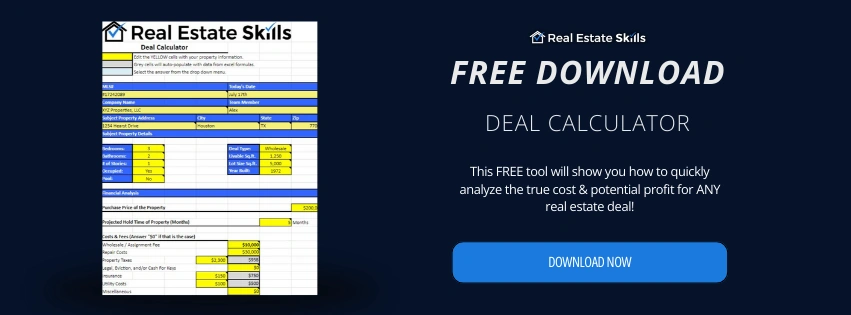
You need a price you'll stick to before you call the agent back. Our free Deal Calculator spreadsheet helps you work back from the renovated value to your maximum allowable offer, with repair and closing costs built in, so you can explain exactly how you got to your number if the agent says it's too low.
Start By Reminding Them Who You Are
Open the close call by putting your name and the property address together, because a busy agent may have talked to ten other buyers since your first call. If they agreed to represent you, remind them of that too.
In the time since your first call, a busy agent may have talked to ten other buyers. Put your name and the address together right away:
💬 What To Say
"Hi [agent's name], it's [your first name], calling back about [street name]. We're looking forward to getting an offer in today."
If they agreed to represent you, say so too ("and having you represent us"). It reminds them that your offer is the one they have a stake in.
Present The Offer, Then Stop Talking
State your price and terms along with the costs behind them, then stop talking and let the agent respond. The explanation matters as much as the number, because it shows your offer comes from real costs, not from testing how low the seller will go.
💬 What To Say
"Let's talk numbers, sound good? I've gone through the property properly: the renovation, the closing costs, the holding costs, everything it takes to bring it up to what's selling nearby. Based on all of that, we can get an all-cash offer in today with a [number]-day inspection period and a [number]-day close, at [price]."
Then say nothing. Let the agent respond. The explanation matters as much as the price. It tells the agent your number comes from actual costs, not from trying to see how low the seller will go.
If they say yes, set up the paperwork. If they say maybe, or no, that isn't the end of the call. The next section covers exactly what to say.
When The Agent Says Yes
Walk the agent through the next steps, then confirm the best email address, whether the contract will be signed electronically, when it will arrive, and whether the seller can review your offer today. Each answer keeps the deal moving.
Walk them through what happens next, step by step, the way someone who has done this before would:
💬 What To Say
"Great. Right after this call I'll email you the offer terms and our proof of funds. Once you send the contract over, I'll sign it and get it straight back to you. Does that work?"
Then ask three short questions that keep the deal moving:
💬 What To Say: Email
"Just to confirm, what's the best email to send that to?"
The email on the listing isn't always the one the agent checks. Confirming it saves a day.
💬 What To Say: Signing
"Will you be sending the contract through e-signature, or will it need signing on paper?"
Most contracts are signed electronically now, but asking shows you know how this works.
💬 What To Say: Timing
"What time do you think you'll be able to send the contract over?"
If they say 2 p.m. and it isn't in your inbox by 2:05, call. Keep it friendly: agents get pulled into other calls, school pickups and other deals, and a polite nudge is usually all it takes. Don't sit and hope.
Before you hang up, one more question:
💬 What To Say: Review
"Will the seller be able to look at our offer today?"
If the seller had planned to review offers tomorrow, sometimes they'll look at yours today, and yours may be the only one they have in front of them.
What To Put In The Offer Email
Your offer email should include the property address, your company name as the buyer, your price, deposit, closing timeline, inspection period and a clear-title requirement, with proof of funds and your company documents attached.
Keep it complete, so the agent doesn't have to come back to you asking for anything:
- Property address: to confirm you're both talking about the same house.
- Buyer's name: your company name exactly as it should appear on the contract.
- Offer price: the number you presented on the call.
- Earnest money deposit: in an amount you will actually fund on time.
- Closing timeline: "14 days or sooner" signals flexibility, but match what the seller needs if they told you.
- Inspection period: the window in which you can inspect the property and cancel if it doesn't check out.
- Clear title: that the seller will deliver title free of liens and other claims.
And attach:
- Proof of funds: a document showing money genuinely available to you for this purchase. That might be a letter from a lender who has agreed to fund the deal, or a statement from a funding partner who has agreed to back it. Don't present someone else's funds as your own.
- Company documents: your articles of organization, or your operating agreement if your name isn't on the articles, so the agent can see you're authorized to sign for the company.
Two buyers can offer the same price. The one whose paperwork arrives complete makes the agent's job easier, and that buyer tends to get the benefit of the doubt.
When the contract comes back, read it before you sign. Check the price, the dates, the deposit and the inspection period, and make sure it allows you to assign it. The wholesale real estate contract guide explains each clause. Remember too that signing isn't the finish line. You don't have a deal until the seller signs as well.
This is educational, not legal advice. Contract forms, deposit rules and inspection terms vary by state, and your contract is what governs. Have a local real estate attorney review your documents, especially on your first deals.
Why A Written Offer Beats A Text, Even When You Lose
A texted number isn't an offer. A signed contract in the agent's inbox is. When an accepted buyer backs out, agents check their inbox for who actually submitted a written offer, so yours can bring you a second chance at the deal.
A lot of beginners think they're making offers when they're really just texting agents a number. A text isn't an offer. An offer is a signed contract sitting in the agent's inbox.
Here's why that matters even when your offer isn't accepted. Say the seller takes a higher offer from another investor who never really ran the numbers. A week into the inspection period, that buyer backs out. The agent now needs the next buyer, and they don't scroll back through their calls trying to remember who was interested. They check their inbox for who actually submitted a written offer. If that's you, you're often the first call. I have seen this happen often enough that he treats every written offer as a second chance at the deal, not just a first one. Watch me explain why written offers get callbacks.
You can also offer to be the backup, meaning your contract steps in if the accepted one falls through. The next section covers how.
How Many Offers It Takes
I challenge new investors to send at least one written offer a day. In his team's experience, landing one deal typically takes somewhere around 10–15 written offers, though your results depend on your market, your numbers and your conversations.
My challenge to new investors is at least one written offer a day, which is roughly 30 a month. In his team's experience, it typically takes somewhere around 10–15 written offers to land one deal that pays a wholesale fee in the region of $10,000. That's his team's observation, not a promise. Your results will depend on your market, your numbers and your conversations. Watch me talk through how many offers to aim for.
Earnings disclaimer: the figures above describe our team's experience and are not typical or guaranteed results. Wholesaling involves risk, you may earn nothing, and your results depend on your market, effort, skills and financial situation.
If you've sent 15 offers without a deal, don't decide the approach doesn't work. Ask a better question: were the offers accurate, and were the conversations good? That's usually where the problem is.
One honest counterweight: your inspection period protects you, but don't treat it as an easy way out. Backing out of contracts again and again is exactly what burns wholesalers with agents. Offer only on deals you've genuinely run and can see a buyer for.
Follow Up Before The Deadline
Call the agent before the seller reviews offers and ask where you stand and whether anything would make your offer stronger. A single check-in can reveal that you're only slightly behind another offer, while there's still time to adjust.
If the seller is reviewing offers at 11 a.m. tomorrow, call the agent before then:
💬 What To Say
"Hi [name], checking in on [street name]. Where do we stand? Is there anything we should adjust to make our offer the strongest one?"
📓 From The Field
Early on, I lost a deal to an offer that was only a thousand or two dollars higher than his. He'd have happily matched it, but he never called to ask. Now he checks in every time before offers are reviewed. The deals are often in the follow-up.
Wholesaling With Realtors & Agents: Secret Strategies That Actually Work
I cover the offer-stage habits from this section: how many offers to aim for, why written offers get you callbacks, and how rapport tips close decisions your way.

You Know What To Say. Now See The Whole System.
The scripts get you through the calls. The deals come from doing it consistently: finding the right distressed listings, calling the agents behind them, and turning written offers into contracts you can assign. Our FREE Training walks you through the entire process, the same one our students use to wholesale from the MLS without spending money on marketing. Watch it today, then go make your first call.
Watch The FREE Training →What To Say When A Listing Agent Pushes Back
Most pushback from a listing agent is a request for reassurance, not a final no. Answer it honestly and explain your reasoning. If they won't share a price, ask for a range. If they say you're low, show your numbers. If they've taken another offer, offer to be the backup.
I treat objections as an invitation to show the agent you're the buyer who closes. Most beginners hear one "no," thank the agent and hang up. The ones who get deals stay on the line, answer the concern and still get their offer in. Here's what to say to the pushback you'll hear most, on the first call and on the close call.
"I Don't Work With Wholesalers."
Don't dodge it or pretend to be something else. Acknowledge the agent's bad experiences, explain how you work (offers after real analysis, proof of funds, upfront disclosure of a possible assignment), and move on graciously if it still isn't a fit.
Don't dodge it, and don't pretend you're something else. Find out what's behind it, because it's usually a bad experience:
💬 What To Say
"That's fair. A lot of agents have been burned by buyers who tie up a house and disappear. Can I tell you how we work? We only make offers after we've run the numbers, we send proof of funds with every offer, and we tell you up front if we might assign the contract. If it's not a fit, no hard feelings."
Some agents will still say no, and some brokerages have their own policies. Thank them and move on. There are plenty of other listings, and the same agent may take your call on the next one once they've seen how you operate.
"Are You Going To Assign This? My Seller Won't Allow That."
Answer honestly that you may assign, then ask what the seller is worried about, which is usually certainty of closing. If the contract doesn't allow assignment, ask for the seller's written consent or close the purchase yourself.
Answer honestly. Then find out what the seller is actually worried about. Usually it's certainty: they don't want their house shopped around, or they don't want to be left without a closing.
💬 What To Say
"I may, yes, and I'd rather be upfront about it. Can I ask what the seller's concern is? If it's certainty of closing, we can put that in writing with our timelines and deposit. If the contract doesn't allow assignment, we'd either ask the seller to consent in writing or close it ourselves."
Many purchase contracts allow assignment unless they say otherwise, but some require the seller's written consent, and forms vary by state. Closing it yourself and immediately reselling it, called a double close, is the other option, but it costs you two sets of closing costs, and some states regulate it too. Never get around a no-assignment clause by being vague about your plans.
Educational, not legal advice. Assignment and disclosure rules vary by state. Confirm yours with a licensed real estate attorney.
"I Can't Discuss Price."
Respect it, because the agent works for the seller and may not be allowed to share what their client will accept. Ask for a ballpark range instead, and if they won't give one, ask which terms matter to the seller.
Respect it. The agent works for the seller and may genuinely not be allowed to share what their client will accept. Ask for less:
💬 What To Say
"Totally understand. Could you give me a ballpark range where an offer would get serious consideration?"
In my experience, a lot of agents will give you a range or a hint, and a hint is enough to know whether the property is worth analyzing. If they won't, don't push. Ask what terms matter to the seller instead, and let your written offer do the talking.
"Send Me Proof Of Funds First."
That's a fair request and a sign the agent takes offers seriously. Have proof of funds ready before you call, and make sure it shows money genuinely available to you, such as a lender's letter or a committed funding partner's statement.
That's a fair request, and a good sign the agent takes offers seriously. Have it ready before you ever call, and make sure it shows money genuinely available to you for this purchase. A lender's letter or a statement from a funding partner who has agreed to the deal both work. Someone else's bank statement does not.
💬 What To Say
"Absolutely. I'll email it over along with our company documents right after this call."
"You'll Need To Sign A Buyer Agreement First."
If the agent will represent you or show you the house, that's correct, since agents working with buyers need a signed written agreement before a tour. Don't refuse it. Ask to limit it to this one property, and read what triggers the agent's pay.
If the agent is going to represent you or show you the house, that's correct. Since August 2024, agents working with buyers need a signed written agreement before touring a home. Don't refuse it. Scope it:
💬 What To Say
"Of course. Could we keep it to this property only? I work with a lot of different listing agents, so I don't sign agreements that cover every property I might buy."
Before you sign anything, check which properties it covers, how long it lasts, and what triggers the agent's pay.
"Just Submit An Offer."
Stay friendly and ask for two minutes to learn about the seller and the condition, so your number doesn't miss. If the agent still won't talk, send a written offer anyway, because it puts you in their inbox.
Some agents will try to skip the conversation. Stay friendly, and ask for two minutes:
💬 What To Say
"Happy to. So I don't send you a number that misses, can I ask a couple of quick questions about the seller and the condition?"
If they still won't talk, send a written offer anyway. It's better than nothing, and it puts you in their inbox.
When An Agent Is Short With You
It's rarely about you. The agent may be having a bad day or may simply be direct, so match their pace and talk numbers. If a call goes badly, move to the next listing and try again later.
It happens, and it's rarely about you. The agent might be having a terrible day, or they might just be direct. Some agents, often in faster-moving markets, only want the address and the numbers, and a beginner can hear that as anger. Match their pace and talk numbers. Watch me answer this question.
If a call goes badly, don't take it personally. Move to the next listing. There are always more listings and more agents, and the same agent may be happy to talk tomorrow. A short follow-up costs you nothing.
Wholesaling Houses Listed With Agents (Top 5 Hacks)
I answer the questions behind this section, including how to get price expectations up front and what to do when an agent is short with you.

"We Already Have Higher Offers."
Don't argue. Ask whether the other offers are from investors or homeowners and roughly where they are, then remind the agent that your price is one you've run and will stick to, and ask to get your offer in anyway.
Don't argue with it. Ask about it:
💬 What To Say
"Got it. Are those investor offers or homeowner offers? And roughly where are they coming in?"
The agent may or may not tell you. Then ask the question the seller cares about most, without saying anything about the other buyer:
💬 What To Say
"How confident are you that they'll close at that number? The reason I ask: our price is one we've actually run the numbers on, and we'll stick to it. Would you be open to putting our offer in today anyway, so the seller has it?"
You're not claiming the other offer will fail. You're reminding the agent that a price only matters if it closes.
"Your Offer Is Too Low."
Don't tell the agent they're wrong. Show them how you got to your number by walking through repairs, buying and selling costs, and holding costs, then offer to send your numbers and ask to get the offer in anyway.
Don't tell the agent they're wrong. Show them how you got there. Most listing agents don't price houses the way investors do, so walk them through it.
💡 Example: Why Buying At List Doesn't Work
A house is listed at $400,000 and would sell for about $495,000 once renovated.
- Purchase: $400,000
- Repairs: $60,000
- Buying and selling costs (closing costs, transfer taxes and agent commissions on the resale): $22,000
- Holding costs for about six months (loan interest, taxes, insurance, utilities): $9,000
- Total in: $491,000, leaving roughly $4,000 of profit for six months of work and risk.
These figures are illustrative. Your actual numbers will differ by market and property.
Nobody takes on a renovation for that. At a lower purchase price the project makes sense, and that's the gap your offer reflects.
Then say it in plain words:
💬 What To Say
"I understand it looks low next to the list price. Once you add the repairs, the closing and selling costs, and six months of holding, buying at list would leave a few thousand dollars for a six-month project. I'd be better off driving for Uber. I'm happy to send you our numbers. How about we get our offer in at [price] and see where we stand? An offer in is better than no offer."
Offering to share your numbers is often what changes the agent's mind. You're not lowballing. You're showing your work.
"The Seller Wants Highest And Best."
Offer certainty instead of just a bigger number. Explain that the highest offer isn't always the one that closes, give a price you'll stick to, and then keep your word by never coming back to ask for a reduction.
The agent is asking for your top number. Give them certainty instead of just a bigger number:
💬 What To Say
"Totally understand. In our experience, the highest offer isn't always the one that closes. Sometimes a buyer comes in high and asks for a reduction later. We'd rather give you a number we'll stick to. We may not be the highest, but we'll be the most reliable offer on the table. Can we get it in today?"
Then keep your word. The whole reason this works is that you really don't come back asking for a discount.
Offer To Be The Backup
If the seller accepts another offer, ask whether they'd consider yours as the backup. A backup offer is a signed contract that becomes active only if the first deal falls through, and it keeps you in front of the agent.
If the seller accepts someone else's offer, you're not necessarily out:
💬 What To Say
"Would the seller consider us as the backup offer? If anything happens with the accepted buyer, we'd be ready to step in."
A backup offer is a signed contract that becomes active only if the first deal falls through. How backups work depends on your state's forms and the agent's process, so ask how they handle them. Either way, it keeps your offer in front of the agent, and deals do fall through.
How The Agent Gets Paid When You're Not Licensed
The listing agent is paid by the seller under their listing agreement. If they also represent you, their buyer-side pay is agreed in writing, and it's often negotiated for the seller to cover. As an unlicensed buyer, you can't take a commission yourself, and anything you pay an agent goes through their brokerage.
This question matters on every call, because an agent who can see how they get paid is far more willing to help. Here are the ways it can work:
- The listing side: The seller already pays the listing agent under their listing agreement. That doesn't change because you're the buyer.
- Representing you as well: Where state law allows it, the listing agent can represent you too and be paid for your side. That requires a written agreement with you that states the amount, and in states that permit dual agency, written consent from both you and the seller. Buyer-side pay is often negotiated as part of your offer, so the seller covers it rather than you. Some states don't allow one agent to represent both sides and use other arrangements instead. See how dual agency and double commission work.
- A referral: If the listing agent refers you to another agent, they may earn a referral fee from that agent's brokerage. That's between the two brokerages.
- A future listing: If your cash buyer plans to renovate and resell, you can suggest they use the listing agent to sell it. That decision belongs to your buyer, so never promise it. Offer to advocate for it.
And here's what you can't do without a license:
- Take a commission, or share in one: In many states, paying someone who isn't licensed for work that requires a license is prohibited.
- Pay the agent personally: If you agree to pay an agent out of your own proceeds, it goes to their brokerage under a written agreement, not to the agent directly. In many states, license law requires an agent's pay to come through their broker.
- Promise something you don't control: Don't promise another person's listing, or a commission rate the seller hasn't agreed to.
The three most common ways to structure the agent's pay, with a worked example of what each costs you, are covered in the process guide linked at the top of this page. Whatever you agree to, it goes in writing and into your numbers before you make an offer, not after.
Educational, not legal advice. Agency and compensation rules vary by state. Confirm the arrangement with the agent's broker and a local real estate attorney.
Common Mistakes New Wholesalers Make With Real Estate Agents
The mistakes that cost wholesalers listing agents are texting instead of calling, being vague about what you'll do with the contract, naming a price you haven't run, texting a number instead of sending a written offer, and never following up. Each one tells the agent you might not close.
Most agents have dealt with a few "wholesalers" who ghost, flake or don't follow through. And when that happens, it makes it harder for serious investors like you to get a shot.
If you want to stand out and build long-term agent relationships, you need to avoid the rookie mistakes that give wholesalers a bad name. Here's a quick table of the most common missteps and what to do instead. Keep it handy. It's your crash course in wholesaling etiquette.
| Mistake | Why It's A Problem | Pro Move |
|---|---|---|
| Texting instead of calling agents | Texts feel impersonal and get ignored, especially if the agent doesn't know you yet | Pick up the phone. Voice builds trust and lets you establish intent clearly |
| Leading with "I'm a wholesaler" | Some agents have had bad experiences and may tune out immediately | Say you're a buyer, not an agent, and be clear that you may assign your contract. Honest beats labels |
| Overpromising or bluffing | If you say you have cash and can close quickly, you'd better deliver, or you'll burn the bridge | Be transparent about your process and buyers. Agents respect honesty |
| Being vague about your criteria | Agents aren't mind-readers. If you're not clear, they can't help | Come prepared. Know your target price, condition, zip codes and timeline |
| Failing to follow up | Even if they don't have a deal now, they might next week, but only if you stay on their radar | Follow up respectfully with a call, text or short email every few weeks |
| Hiding that you may assign | The listing agent works for the seller and may have to share it, and some states require disclosure | Say it on the first call. It's the honest move and the safer one |
| Naming a price on the first call | A number you haven't run is a number you'll have to walk back | Say you'll run it properly and come back with a price you'll stick to |
| Texting your price instead of sending a written offer | A text isn't an offer, and it won't be in the agent's inbox if the accepted buyer backs out | Send a signed written offer with your proof of funds, every time |
| Trusting the agent's price or renovated value | Lock it up at the agent's number and your cash buyers may pass on it | Treat the agent's numbers as information, then check recent sales yourself |
| Backing out of contracts again and again | It's exactly what makes agents wary of wholesalers | Only offer on deals you've run and can see a buyer for |
| Promising what you don't control | A relist, a commission or a closing date you can't deliver damages your reputation fast | Offer what's yours to give, and put it in writing |
Remember: wholesaling with real estate agents is a people-first business. Respect their time, show up professionally, and you'll be light-years ahead of most so-called investors out there.
Frequently Asked Questions About Wholesaling With Real Estate Agents
Final Thoughts On Talking To Listing Agents
You don't need a license to earn a listing agent's trust. Call when others text, say plainly that you're a buyer who may assign, ask better questions than the next buyer, and come back with a written offer you'll stick to. That's what turns one call into repeat deals.
Every deal on the MLS has a person standing between you and the seller, and that person decides whose offer the seller hears about first. You don't need a license to earn that agent's trust. You need to call when everyone else texts, say plainly what you are, ask better questions than the next buyer, and come back with a number you'll actually stick to.
Most of what goes wrong with listing agents comes back to trust: a buyer who hid what they were doing, named a price they couldn't hold, or disappeared after an inspection period. Do the opposite, consistently, and the relationship grows from there. An agent who lists one distressed house will list another, and you want to be the buyer they call first.
Here's your next step, and it's a small one. Pick three distressed listings in your area. Write your opening line and your "I'm a buyer, not an agent" line on a sticky note, and keep the question list from this page in front of you. Then make all three calls before lunch tomorrow, and write down what each agent tells you. You're not making offers yet. You're getting comfortable with the conversation, and that's the part that turns into deals.
Ready To Turn These Calls Into Deals?
Most people read a script and never pick up the phone. The ones who close follow a proven process from their first call to their first assignment fee. Our FREE Training shows you how to find listings worth calling, make offers agents take seriously, and get deals to your cash buyers, the same system our students use to wholesale from the MLS. Watch it today, then put these scripts to work.
Watch The FREE Training →
About The Author
Founder & CEO, Real Estate Skills
Alex Martinez is the Founder & CEO of Real Estate Skills. He has wholesaled and flipped houses for over 14 years, been part of 1,000+ real estate transactions, and personally acquired 55+ residential investment properties. He has trained 6,000+ investors nationwide, and he teaches the listing-agent conversations in this guide on the Real Estate Skills YouTube channel.
Real Estate Skills is not a law firm, and the information in this article is provided for educational purposes only. It does not constitute legal, tax, or financial advice. Real estate licensing, disclosure, agency and wholesaling laws and requirements vary by state and change over time. The scripts and examples in this guide are illustrative, and any figures shared reflect individual experience, not typical or guaranteed results. Always consult a licensed real estate attorney in your state before you make offers, sign buyer agreements or assign contracts.

👉FREE Training
How To Consistently Wholesale, Flip Houses, & Invest In Rental Properties From The MLS
(Without Spending $1 On Marketing)

Alex Martinez, the founder of Real Estate Skills, is known for his strong, practical expertise in real estate, starting from a beginner with no family connections in the industry to acquiring over 55 real estate deals, including wholesale and flips, within his first year.
He has dedicated his career to providing cutting-edge education and resources for real estate professionals. He emphasizes the importance of self-taught knowledge through mentors, books, and hands-on experience.
His journey from earning a modest income to becoming a successful real estate entrepreneur and educator showcases his expertise and dedication to the field.

Ryan Zomorodi, co-founder and COO of Real Estate Skills, leverages his experience from a diverse background in real estate investment, construction management, and entrepreneurship to provide comprehensive education in the real estate sector.
His expertise is rooted in hands-on experience, extensive industry knowledge, and a commitment to empowering others through education.
Ryan's journey reflects a blend of practical experience and entrepreneurial success, contributing to his role in developing a platform that educates and supports aspiring real estate professionals.
Read Ryan's Full Bio >>
